Jessica Morgan as Annelle Dupuy-Desoto styles M’Lynn Eatenton ‘s (Pam Grizzell) hair in the HCT production of “Steel Magnolias.”
By CRISTINA JANNEY Hays Post
The Hays Community Theatre will be staging “Steel Magnolias” Friday and Saturday, but if you don’t already have tickets, you are out of luck. They are sold out.
Many fans may know the popular movie by the same name starring Sally Field and Julia Roberts.
Rebecca Grizzell is directing the HCT production assisted by TMP student Dylan Werth.
“This cast has done an amazing job taking the iconic characters from the movie and making them their own,” Grizzell said. “Each actor has spent so much time and effort getting to know and working on their character development. I am so proud to see these women grow as actors. The movie is so iconic, and the play version actually holds up to the hype of the movie. The play is almost word-for-word the same as the movie. However, it does not have the male characters that the movie has.”
M’Lynn and Truvy Latcherie (Brenda Meder) try to get Shelby Eatenton (Haileigh Jacobs) to drink orange juice during a diabetic emergency in the HCT production of “Steel Magnolias.”
The cast includes Jessica Morgan as Annelle Dupuy-Desoto, Brenda Meder as Truvy Jones, Lynelle Shubert as Clairee Belcher, Haileigh Jacobs as Shelby Eatenton-Latcherie, Pamela Grizzell as M’Lynn Eatenton and Nancy Selbe as Ouiser Boudreaux.
Grizzell talked about working with an all-female cast.
“The benefits of the cast being all female is that the attention is never taken away from the female characters,” Grizzell said. “It allows the audience more time to learn and get to know the women in a way that the movie cannot provide.
“While watching the movie, you can almost completely forget about the character Clairee. In the play version, she is this strong and feisty woman who you cannot stop laughing with. The play does a wonderful job of showing true and genuine female friendships. Having a small, all-female cast was such a fun experience. It allowed us to just have fun with each other and girl talk on the side.”
Grizzell said Annelle is her favorite character in the play.
M’Lynn, Annelle Dupuy-Desoto (Jessica Morgan) and Clariee Belcher (Lynelle Shubert) all in Truvy’s beauty shop in “Steel Magnolias.”
“Annelle starts the production as an emotionally unstable woman who has just lost her man and owns little to nothing,” she said. “She’s very nervous and has no self confidence. Throughout the show, she discovers her love for God. She becomes a stronger woman and learns her self worth. Annelle was the character who always had a nervous laugh, but now she stands tall and has playful banters with the older women. She is the character that everyone should inspire to be.”
Grizzell, who herself struggled with strep throat during rehearsals, said the biggest challenges with this show were illnesses and recasting.
“Since we are a small cast and constantly close, we just passed the sickness around. Some days it was kind of like ‘OK, who is it today?'” she said.
Truvy had to be recast twice.
“Hugs and thank yous go Brenda Meder for stepping in just a few weeks before the show to play Truvy,” Grizzell said. “I am constantly so impressed and in awe of Brenda. She is the true definition of a professional. We are so grateful to her for saving us at the last minute and adding so much character to our production.”
Meder is no stranger to “Steel Magnolias.” She played M’Lynn 19 years ago.
This is Rebecca Grizzell’s first time directing for HCT, but she has acted and served in other roles for many other productions.
“Some of my favorite roles with HCT are Little Red Riding Hood in ‘Into the Woods’ and Fiona in ‘Shrek the Musical,’ ” she said. “I have done choreography for HCT a few times, including ‘The King and I’ and ‘Christmas Story.’ This is my first time directing for HCT, and it has been a whole new experience. I now have so much more respect for the people in our community who constantly volunteer to direct. It’s a ton of hard work, but in the end, so incredibly worth it.”
Rebecca said the best aspect of directing “Steel Magnolias” is the opportunity to work with her mother, Pamela Grizzell, who is playing M’lynn.
“I have worked with my mother on projects with HCT before, but never like this. Working with her has been the most special part of directing. She is a phenomenal woman and actress. We are constantly joking about how the relationship of Shelby and M’Lynn mirror that of our own.
“I don’t think we could have chosen a better M’lynn. She just fits that character so well. Every night she makes the crew tear up with her performance. Haileigh Jacobs plays our Shelby, and those two just have a natural chemistry with their characters. They really sell that they are family, and it’s like watching a snippet of my life with my mother. It’s beautiful.”
Next in HCT’s season line up is its summer musical of “The Little Mermaid,” directed by Cody Kreutzer, who Grizzell said is extremely talented. “Seussical Jr.” will be HCT’s children’s show. The Christmas show is “Fruitcakes.” If people would like to get involved with the community theater, they can visit the HCT website, https://www.hctks.com. You can also purchase tickets for future productions there.
Full cast list
Annelle Dupuy-Desoto——–Jessica Morgan
Truvy Jones———————Brenda Meder
Clairee Belcher—————–Lynelle Shubert
Shelby Eatenton-Latcherie—Haileigh Jacobs
M’Lynn Eatenton————–Pamela Grizzell
Ouiser Boudreaux————–Nancy Selbe
In case you want crew:
Director—————-Rebecca Grizzell
Assistant Director—-Dylan Werth
Stage Manager——–Bill Brown
Costume Design——The Cast
Costume Mistress—–Sharona Fonoble
Set Construction——Jerrett Leiker and Adam Conkey
Set Design————-Rebecca Grizzell, Dylan Werth, and Bill Brown
Lights and Sound——————–Bryan “Buzz” Snyder-Brown, Jayme Brown
Grow Hays invites the public to the 1st annual Ellis County Youth Entrepreneurship Challenge (YEC) today at BriefSpace, 219 W. 10th in Hays.
Ellis County High Schoolers were invited to enter the Network Kansas YEC event earlier this year. There are 24 entries from Hays High and TMP-Marion competing for $2,400 in prize money.
First place receives $900 and will go on to compete at the KansasEntrepreneurship Challenge (KEC) State Championship.
Additionally, Midwest Energy, Nex-Tech and Sunflower Electric are awarding $200 prizes for Best Trade Show, Ready to Launch and People’s Choice. Judging started this morning and winners will be announced at 1:30 p.m. The public is encouraged to attend the event.
During the 2018-2019 academic year, there have been more than 40 YEC events throughout Kansas. The winner of each event is invited to participate in the KEC State Championship, April 30 in Manhattan Kansas. The YEC series gives Kansas students hands-on experience thinking entrepreneurially.
If you have questions, you can reach Grow Hays at 785-628-3102 or at [email protected].
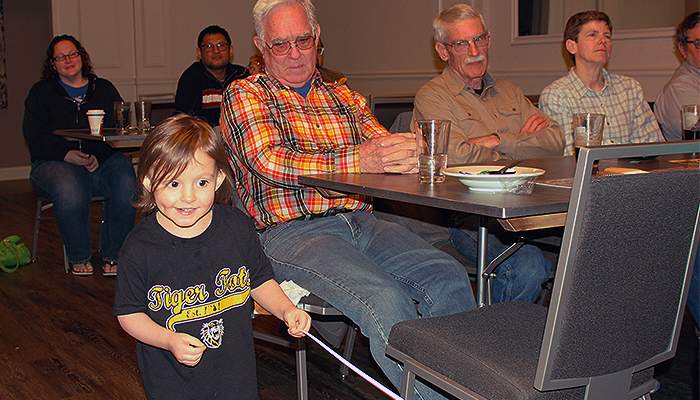
A little girl helps to measure the size of a dinosaur during Monday night’s FHSU Science Cafe lecture on dinosaur growth.
By CRISTINA JANNEY Hays Post
Attendees at the monthly FHSU Science Cafe learned Monday night how an egg that could fit in a easter basket could grow into a gigantic dinosaur.
Cat Sartin, FHSU instructor of biological sciences, presented “The Bare Bones About Dinosaur Growth.”
Sartin’s research has focused on the growth patterns found in fossilized dinosaur bones. Sartin studied hadrosaurs, which were a family of dinosaurs that are commonly known as duck-billed dinosaurs. They were herbivores, which meant they ate plants, and among the most common dinosaurs living during the late Cretaceous Period.
Cat Sartin, FHSU instructor of biological sciences, presented “The Bare Bones About Dinosaur Growth” Monday night at The Venue.
Sartin choose the hadrosaurs in part because they lived in herds with individuals of varying ages.
The eggs of a hadrosaurs were about the size of a potato, but the adults grew to up to 20 feet long.
Even the titanosaurs that grew to be 120 feet long started out from an egg that is only about 18 inches long.
“If dinosaurs were up and running around today, we could go out and measure them. We could look at what they were eating. We could put trackers on them. It would be great, but they’re not around,” she said.
Although researches can look to modern birds and reptiles for clues to how dinosaurs may have lived and grown, these animals don’t grow to near the sizes the dinosaurs did.
“We can’t go out and study them because all we have are the bones, and they are not even really bones. They are fossils, which means the bone material has been largely replaced by rock, so it is just a snapshot in time for each individual animal,” Sartin said. “Fossils don’t grow. They don’t exhibit behavior.”
Sartin analyzed thin sections of hadrosaurs bones under a microscope to evaluate their texture. Young individuals have an open or lacy texture to their bones to allow for more blood vessels to feed the rapid growth of the bones. As an individual ages to equivalent of elementary school child, its bone structure has more order. The collagen fibers in the bone lay down in layers almost like plywood.
Skeletally mature individuals bones are the most organized. These individuals have osteons, which are bone canals. These structures are good at stopping stress fractures in older creatures.
“When you are young, you do a lot of stupid things. We all do. It’s OK. Across the animal kingdom, animals do a lot of stupid things and take a lot of risks. They need really strong bones for all the stupid things they do,” Sartin said.
“As you get older, you get into a routine. You are doing the same things over and over again whether you are a human or a dinosaur. That means you are more likely to have stress fractures from that repetitive motion. That is what this is helping to stop.”
The texture, however, will not tell the age of the animal.
Dinosaurs lay down lines in their bones called lines of arrested growth. These lines can be counted like tree rings to determine age. The amount the animal grew each year can also be estimated by the amount of bone between each line.
Researchers used captive populations of animals, such as alligators and king penguins, to determine what triggered the animals to lay down the rings. They suspected the rings were laid down annually.
They turned to a small primate, commonly called a mouse lemur, that they housed in a lab. They changed the mouse lemur’s light cycles to 18-hour days instead of 24-hour days. After 365 of these 18-hour light cycles, the mammal laid down a bone ring.
Specifically of the hadrosaurs, Sartin choose to focus on a group of eolambia fossil that were found in Utah at the site where a river likely flooded.
The curators who held the eolambia fossils were not all that excited to have Sartin slice up their specimens, so she found isolated bone shafts that weren’t likely to be used for display in museums. She ended up with 20 some specimens to study.
By measuring the lines of arrested growth, Sartin determined these dinosaurs grew quickly for 10 to 12 years, and then their growth slowed.
“It makes good sense, because there are things out there that might want to eat you,” Sartin said, “and it might be helpful to grow a little quicker.”
From analyzing the texture of the bones, she also determined the group of individuals found in the Utah deposit were not skeletally mature. Sartin theorized that some of the teenage dinosaurs might be sexually mature and reproducing.
She also determined the first growth ring in the bones was fairly large, which meant they went from an egg the size of a baked potato to a middle schooler in one year.
Sartin again looked to modern animals to help her with her research. Ostriches go from an egg to a full-grown adult in 18 months.
“It is completely reasonable to think a little eolambia could go from a baked potato to yeah high in a year,” she said.
Eolambia did not have spikes or armor or plates for defenses, so growing quickly and living in herds were their defenses against predators.
Other herding herbivores have also shown similar rapid growth patterns.
Apatosaurus, which we used to know as brontosaurus, grew to adult size in 10 years. They had an average length of about 75 feet and weight of 16 to 22 tons. Most of the plant-eaters’ growth came in three years. Researchers are trying to determine how the animals could consume enough food to support that type of growth.
Theropods (meat-eating dinosaurs) also had quick growth spurts, but they were delaying their spurts to a little later in their youth.
“Theropods hang out as small little guys for the first three to five years of their lives. It is kind of cool and groovy to be little, and then they decide to go gangbusters and get really big, really quickly,” Sartin said.
Researches believe the meat eaters did not have to grow quickly for protection. This allowed them to learn hunting techniques from the adults in their family groups. They also may have been learning social cues from the others in their family groups or packs, Sartin said.
Based on these growth patterns and the family groups in which the meat-eaters’ fossils have been found, researchers believe the meat-eating dinosaurs parented their young, she said.
The American Red Cross is in desperate need of blood donors.
There are two blood drives today in Hays. The Red Cross will be at the TMP Fieldhouse until 2 p.m. today and in the conference rooms near the gift shop at HaysMed until 5 p.m.
Left to right: Hattie, 3, Skyler, 5, and Summer, 8, Simpson of Hays use cereal and marshmallows to construct edible soil layers Thursday at the Water Fun Fest at the Sternberg Museum.
The Hays Water Resources Department hosted hundreds of children and their parents Thursday during the second-annual World Water Day Fun Fest at the Sternberg Museum of Natural History.
Attendees learned about low-flow shower heads, the water table, where to find water in the environment and how to prevent water pollution.
The Water Resources Department gave away shower timers and offered crafts and a coloring contest to remind children to conserve water. Water conservationists urge people to take a five-minute shower or less.
Free jar openers reminded water consumers to avoid sending fats, oils and greases down water drains, because they clog pipes.
Christine Albrecht helps her daughter, Lauren, 7, complete a water droplet craft at the World Water Day Fun Fest Thursday at the Sternberg Museum.
Jeff Crispin, Hays director of water resources, was also giving away toilet dye tabs. You place the tabs in your toilet tank, and if the dye shows up in the toilet water, you have a leak that needs to be fixed. About 1,500 of these packets will soon be going out to local students. You can also pick up packets for free at the city of Hays offices.
“We are trying to bring kids out and parents out to educate them about the importance of saving water and doing everything they can to save water at home, or anywhere for that matter, and how important water resources are,” Crispin said.
The youth and parents were also able to see a tower of 91 gallons of water jugs, which is representative of the per capita water usage of a Hays resident per day.
Crispin said Hays residents use less water than any other city in the state, but we still need to and can do better.
Holly Dickman, water conservation specialist, said the event has been a good opportunity to reach both children and adults with the messages of water quality and conservation.
A volunteer with the watershed district demonstrates how contaminants can make their way into the water table.
“From little on up, it is amazing when I do school programs how much those little kids who live here in Hays already know because they have heard it for awhile,” Dickman said. “Any time we can reiterate that it is best to conserve and it is best to be conscience of water usage and what we are doing with our water is a good thing.”
Stacie Minson, KSU watershed specialist, was also on hand to offer activities and demonstration centers based on water conversation. She said she was trying to educate kids about how dynamic their water system is.
The watershed had a display of different types of pollutants that can get into the watershed, including pet waste, herbicides, soil sediments, chemicals and fertilizers.
The children used cereal and marshmallows to build edible soil layers.
Water$mart Wally and others stand in front of a display of 91 gallon bottles, representing the per capita water usage of Hays residents each day.
“They eventually will become adults who have to pay the utility bills and have to make sure when they turn a faucet on they have a clean, safe water supply. ” Minson said of the children.
A.J. Hill, water plant operator, was available to inform attendees about some of the many rebate programs the city offers.
The city offers rebate programs for high-efficiency wash machines, low-flow toilets , turf conversion and preferred and acceptable trees. Local officials also offered information about xeriscaping, which uses native, drought tolerant plants to conserve water in landscaping.
You can learn more about water conservation, city rebate programs, water-smart landscaping and city water rules on the city of Hays website.
Farmer and rancher Dereck Stockman and his son August.
By CRISTINA JANNEY Hays Post
Derek Stockman’s farming and ranching operation has been brought to a standstill. He sold 41 heifers at the Plainville Livestock Commission on Feb. 5, but his check for almost $37,000 bounced.
Stockman of Kirwin only recently expanded his farming operation into cattle. He is now unable to make his FSA loan payments, nor is he able to get his operating loan for the coming year guaranteed.
“The bills don’t stop coming in,” Stockman said.
Stockman is one of more than 40 livestock producers in the area that have been caught up in legal action and bankruptcy of Plainville Livestock Commission, operated by Tyler Gillum. This is just the latest in a series of financial problems and federal regulation violations faced by the market agency.
“Everybody says you’ll get your money, but I don’t know. When is that going to happen?” Stockman asked. “Are they going to pay my interest or are they going to give my commission back? I doubt it.”
In the meantime, Stockman is working with the FSA to get his loan payments deferred.
Although several producers said they had heard rumors there were problems at Plainville, Stockman said he was blindsided when he received his check back from the bank.
On Feb. 12, Almena Bank froze two of Plainville Livestock Auction’s bank accounts. When the bank froze the accounts, tens of thousands of dollars worth of checks Gillum had written to area ranchers who had recently sold cattle at the Plainville Livestock Commission bounced.
In court filings, the bank noted Plainville Livestock Commission transferred more than $916,000 from its custodial account into its general operating account the bank’s officers believed to cover overdrafts in the general operating account.
Almena Bank has filed an interpleader case, which is legal action that seeks to determine to whom the money that was transferred out of the custodial account belongs.
When a market agency sells livestock, the money collected from the buyers is supposed to be deposited in a custodial account until the sellers are paid. The funds collected during sale have to be deposited into the account by the next business day.
Regulations prohibit market agencies from using the proceeds from the sale of livestock sold on a commission basis for any purpose other than paying consignors the net proceeds from the sale of their livestock, after deducting the market’s lawful charges.
This is not the first time Gillum’s operation had been caught with insufficient funds in his custodial account.
Plainville Livestock Commission was cited by federal court in 2012 and 2014 for not having sufficient funds in its custodial account.
On July 31, 2017, an analysis of Plainville’s custodial account showed Plainville had outstanding checks drawn on its custodial account in the amount of $9,641,594. The custodial account had a balance of $45,928 with proceeds receivable of $46,615, resulting in a custodial account shortage of $9,549,050.
Between March 2018 and May 2018, Gillum issued 33 insufficient funds checks from its custodial account totaling more than $1.25 million. The checks were paid, but were paid up to two weeks late, resulting in $1,500 in overdraft fees and $775 in returned item fees on the custodial account.
The U.S. Attorney filed filed another case another case in July 2018 in which it stated Plainville Livestock Commission failed on numerous occasions to maintain funds in its custodial account. Gillum was fined $117,750.
In addition to the interpleader case, Almena bank also attempted to foreclose on Gillum based on default of three loans totaling more than $3.49 million.
The bank alleged in court documents Gillum was trying to dispose of assets that he had designated as collateral on the loans.
Cattle on Stockman’s ranch.
The stockyard is still operating in Plainville as Heartland Regional Stockyards under a license held by Ll0yd and Judy Schneider. Hays Post tried to contact the Schneiders, but received no answer at the stockyard.
Plainville Livestock Commission filed for Chapter 11 bankruptcy on March 1. Chapter 11 is usually used to restructure debt and pay creditors off over time.
Gillum’s attorney in the bankruptcy case, Thomas Gilman of the Hinkel Law Firm in Wichita, said Gillum hopes to sell the assets of Plainville Livestock Commission as part of the Chapter 11 bankruptcy debt restructure.
Gilman said Almena Bank’s foreclosure case against Plainville will be stayed until the bankruptcy case is heard in U.S. District Court in Wichita. The hearing on that case is set for April 11.
The Hays Post reached out to the attorneys for the Almena Bank, but a phone call was not returned.
Gilman said he was unsure what the procedures will be for repayment of producers who were owed money from Plainville Livestock Commission’s custodial account. He said he is not representing him in that matter nor any matters pertaining to any potential complaints filed by the U.S. Attorney in regards to violations of USDA Packers and Stockyards regulations.
Calls to the USDA Packers and Stockyards Division were not returned.
The Hays Post posed several questions to the U.S. Attorney’s office. Its media representative said he was unable to answer questions about when producers might receive their money back or what process would be used in paying back producers for the bounced checks. The representative also did not know how the bankruptcy filing might affect the claims against the custodial account.
Attorneys for Almena Bank also did not return a phone call.
As a complex legal battle plays out in court, producers like Stockman and others owed money by the operation are trying to hang on.
Larry Dinkel, owner of Jim Mitten Trucking of Oakley, hauled cattle for Plainville Livestock Commission. He has already paid employees, but he can’t go on indefinitely without what he is owed.
In addition to being short of what he was owed from Gillum’s last sale, because of the scandal fewer producers are taking cattle to the stockyard under the new operators, which means lost business for his trucking company.
“We used to haul several loads in and out of there every week, and now I don’t haul anything in and out of there” he said, “because the customers are not going back.”
Dinkel blames, in part, federal regulators, who allowed Gillum to continue to operate despite repeated financial regulation violations.
“Had they done their job, none of us would be in this mess right now,” he said.
Stockman said he also hoped federal regulators would take action.
“I don’t think anyone should have to go through this,” he said. “We farmers go through enough trouble throughout the year to put in a full year’s work and not get paid for a full year’s work. It is nothing anyone should have to go through.
“It shouldn’t ever happen. Whoever is guilty, I feel they should make an example of him, so this doesn’t happen again.”
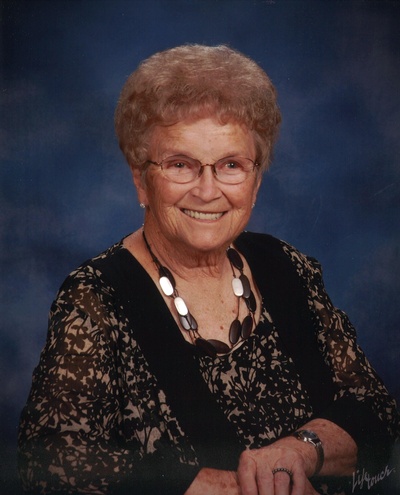
Leona Mae Conaway, 92, passed away Tuesday, March 12, 2019 at her home in Smith Center.
A celebration of Leona’s life will be at 10:30 a.m., Monday, March 18, 2019 at All Faiths Funeral Chapel, Smith Center, with Pastor Lance McDowell officiating.
There will not be a public visitation as cremation was chosen.
Memorials may be given to the Athol Congregational Church or Hospice Services of northwest Kansas or Smith Center Library and can be sent in care of the funeral chapel.
He was born May 20, 1946 in Hays to Edward Kirk and Bethyl Maxine (Fry) Bigge.
Tom graduated from Stockton High School in 1964.
On February 18, 1968 he married the love of his life Ruth Ann Wilhite in Basehor, Kansas.
Tom was a hard-working farmer. He loved the farm but especially his livestock. He wore many hats throughout his life. He was a farmer, stockman, rancher, house mover, hunter and a demolition man.
Known as a man of integrity, Tom’s word was his bond. He was a great believer in the Christian Work Ethic, “there is very little that hard work cannot overcome.” He enjoyed life. He was a good man that enjoyed a good joke and a good laugh.
Tom was very involved in community activities. He served as president of the Unified School District 271; president of Rooks County Farm Bureau Board of Directors; president of Farmers Union Cooperative; trustee of the Congregational Church; and a member of the Board of Directors of Friends of Historic Fort Hays.
He was preceded in death by his parents, an infant brother, an infant daughter, two grandsons and a granddaughter.
Tom is survived by the love of his life Ruth Ann of the home in Stockton; sons: Curt Thomas (Rebecca) Bigge, Douglas Edward (Kori) Bigge, Stephen Louis (Melissa) Bigge all of Stockton; daughters: Beth Ann (Jason) Pfeifer, Russell, Kansas, Holly Marie (Aaron) Beaton, Scott City, Kansas; sisters: Robyn Harris, Kansas City, Missouri, Cynthia J. Kinall, Norton, Kansas; Christine M. (Thomas) Patree was a special person to Tom and Ruth Ann that they think of as a special daughter; and 13 grandchildren.
A good man is gone from out midst but never will never be forgotten.
Visitation will be 2 to 8 p.m. Thursday, March 14 at Plumer-Overlease Funeral Home Plainville, 320 SW Second,
Plainville, KS 67663. Family will be present from 6 to 8 p.m.
The funeral service will be 10:30 a.m. to 12:30 p.m. Friday, March 15, 2019 at the United Methodist Church-Stockton, 204 N. Elm, Stockton, KS 67669.
Burial will be at the Bigge Family Cemetery in Rural Stockton, Kansas.
Memorial contributions can be made to Rooks County Health Center Physical Therapy Department in care of Stinemetz Funeral Home, 522 N. Pomeroy, Hill City, KS 67642, 785-421-2177; Stockton, KS FFA, 522 N. Pomeroy, Stockton, Kansas 67669, 785-421-2177; and Friends of Historical Fort Hays, in care of Stinemetz Funeral Home, 522 N. Pomeroy, Hill City, Kansas 67642, 785-421-2177.
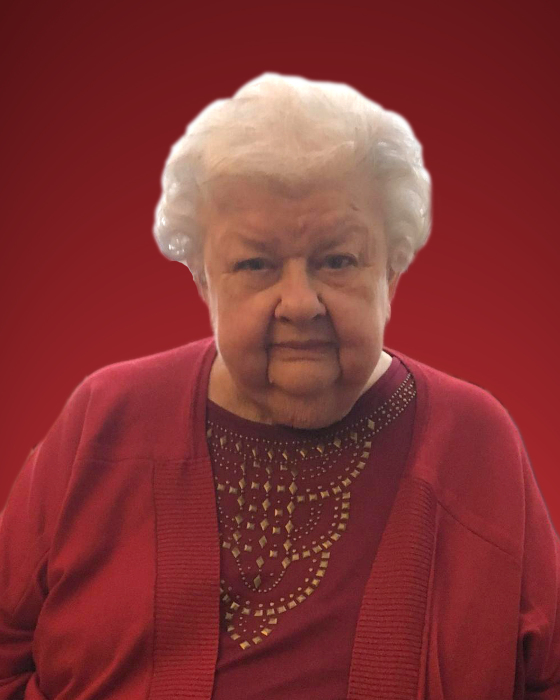
Elizabeth “Betty” Legleiter, age 86, of Hays, Kansas, passed away Wednesday, March 13, 2019 at Via Christi Village, Hays.
She was born July 1, 1932 in Schoenchen, Kansas, to Martin and Julia (Kronewitter) Dreher. She married Gerald H. Legleiter on Sept. 1, 1952 in Schoenchen. He preceded her in death March 10, 2010.
Betty was a member of St. Joseph’s Church in Hays. She enjoyed cooking, reading, sewing and spending time with her grandchildren. Her faith was also important to her.
She is survived by four sons, Neil Legleiter and wife Patty of Hays, Gerald Legleiter Jr. and Kathy McGinnis of Hays, Mark Legleiter and wife Kelly of Topeka and Patrick Legleiter and wife Tammy of Hays; a daughter, Diantha Doyle and husband Stuart of Kearney, Missouri; five grandchildren, Brett Doyle, Melissa Jensen, Nathan Legleiter, Conner Legleiter and Dylan Legleiter and four great-grandchildren, Brandon Doyle, Breanna Doyle, Cuylar Jensen and Sofie Jensen.
She was preceded in death by her parents; six brothers, Thobald Dreher, Frank Dreher, Sylvester “Fess” Dreher, Seraphine Dreher, Sylvanus “Lefty” Dreher and Wendelin “Lynn” Dreher, as well as two sisters, Mary Rose Legleiter, Mathilda “Tillie” Braun.
Funeral services will be at 10 a.m. Saturday, March 16, 2019 at St. Joseph’s Catholic Church with burial to follow in the church cemetery.
Visitation will be 4 to 8 p.m. Friday 9 to 9:30 a.m. and Saturday at Brock’s-Keithley Funeral Chapel & Crematory, 2509 Vine St., Hays, KS 67601.
A combined parish vigil and Rosary service will be at 7 p.m. Friday at the funeral chapel.
Memorials are suggested to St. Joseph’s Church or Via Christi Village.
The Kansas Department of Transportation has closed U.S. 36 between the Colorado border and St. Francis because of winter weather conditions in Colorado.
For up-to-date information on road closures and road conditions, call 511 in Kansas or 866-511-5368 outside Kansas, or check travel information online at www.kandrive.org.
Marcella Marie “GG” Stos, 85, passed away March 12, 2019, at Hays Medical Center, Hays. She was born Jan. 23, 1934, in rural Bison, the daughter of Edward John and Mary Ann (Kopriva) Oborny.
She married Bernard Vincent Stos Dec. 29, 1953 at Timken. He died Aug. 26, 2005.
Marcella, a lifetime resident of Rush County, was a devoted member of St. Ann Catholic Church, Olmitz, and the Altar Society. She was a school cook and reading grandma for Otis Bison High School, private caregiver and twinner for Essex. Marcella enjoyed embroidery, gardening, polka dancing, reading, crossword puzzles, and above all, spending time with her family. She was known for her gift of gab.
Survivors include four sons, Mike Stos of Hoisington, Patrick Stos and wife Sandy of Broken Arrow, Oklahoma, David Stos and wife Renita of Moundridge and Kelly Stos of Costa Rica; five daughters, Bernadean Herl of Great Bend, Rita Engle and husband Ryan of Great Bend, Maureen Faber and husband Paul of Colwich, Kristina Von Elling and husband Bill of Manhattan, and Colleen Sharkey and husband Mike of Otis; one brother, Edward J. Oborny Jr. of Bison; 25 grandchildren, Danah, Mandy, April, Shawna, Chad, Brandee, Becky, Danny, Cody S., Chris, Pattye, Heather, Cody E., Ashley, Brian, Nikki, Tanner, Brittany, Travis, Todd, Taylor, Dawayne, Devon, Danielle and Rylee; 42 great-grandchildren. She was preceded in passing by a grandchild, Bobijo, and two great-grandchildren, Brogan and Audrey.
The Mass of Christian Burial will be at noon, Saturday, March 16, 2019, at St. Ann Catholic Church, Olmitz, with Father Anselm Eke presiding. Interment will follow at St. Ann Catholic Cemetery, Olmitz.
Visitation will be 9 a.m. to 3 p.m., Friday, March 15, 2019, at Nicholson-Ricke Funeral Home, with a Vigil and Rosary at 7 p.m. at St. Ann Catholic Church, Olmitz.
Memorials may be directed to Otis Fire Department in care of Nicholson-Ricke Funeral Home, PO Box 146, Hoisington, KS, 67544.
La Crosse native Vanessa M. (House) Sabee was recently featured in a story in the Martha’s Vineyard Times on her new role as head chef at the Ritz Cafe in Martha’s Vineyard.
She started working at restaurants in La Crosse as a teenager. She attended college for two years in Pratt before moving to Hays, where she attended Fory Hays State University for a time. She worked at the Golden Q, Sip N Spin, and Professor’s before going on to culinary school in Colorado.
Sabee’s mother, Kelly House, taught her how to cook.
“She was always working in restaurants when I was younger, and I guess it was just destiny that that’s where I am now,” Sabee said.
Her mother started her cooking lessons with gravy.
“She is very proud of it. At the time I didn’t know it, but she gave me the proper technique on how to make a roux correctly,” Sabee said.
Sabee said her family has been in Rush County for a very long time. Although she said she doesn’t make it home as much as she would like, most of her direct family still lives in either Hays or La Crosse.
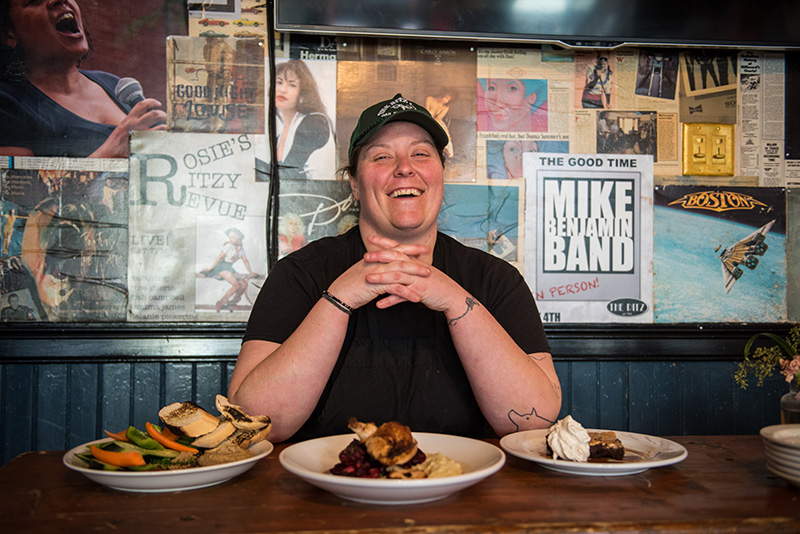
Vanessa Sabee is the new executive chef at the Ritz. Photo by Gabrielle Mannino/ Martha’s Vineyard Times
Since the Ritz Cafe in Oak Bluffs changed hands in 2014, the bar has undergone a number of transformations, and there’s another one on deck: When the Ritz reopens its doors on March 14, after a three-week winter break, they will introduce a new executive chef, Vanessa M. Sabee, and a new menu. You may recognize Vanessa as the first of six chefs who lent their expertise and creativity to the Ritz’s recent six-week Kitchen Takeover series of Wednesday night pop-up dinners, which featured a different chef and menu each week.
Sabee, 34, hails from “middle of nowhere Western Kansas,” and spent five or six years in Boulder, Colo., before she and her then-boyfriend (now husband), Ross Sabee, also a trained chef, came to Martha’s Vineyard in the spring of 2017 to work as line cooks at the Sweet Life Cafe, owned by chef Hal Ryerson and his wife Erin.
“It was awesome,” Vanessa says. “Hal and I have a very similar style of food theory, and so it was really easy to transition into that kitchen.” Vanessa returned to the Sweet Life as the sous-chef for the 2018 season, and prior to being offered the head chef position at the Ritz, she had planned to return for a third season. “We cooked really, really great food that we were very proud of,” she says of her time at Sweet Life.
The couple met Ritz manager Kelly Feirtag while hanging out at the bar their first summer here, and Ross now works at the Ritz doing security. Feirtag, general manager at the Ritz since July 2017, has seen at least three kitchen changes since that time. She said she’s excited to bring Vanessa onboard. “I feel like I’ve been searching for her for a long time,” Kelly says, “and I feel very lucky that she was willing and interested, and up for the challenge.”
Vanessa Sabee, the new Ritz head chef, plates an entree in the kitchen. Photo by Gabrielle Mannino/ Martha’s Vineyard Times
Feirtag is thrilled to have a woman running the kitchen, which is in keeping with Ritz history. “I had a woman chef when we opened the kitchen in 1987,” says former Ritz owner Janet King. Local chef Christina Napolitan ran the kitchen for about six years, King says. More recently, Sai Mai, a Thai restaurant that leased the Ritz kitchen for about four years before closing in 2013, was also run by women.
Vanessa Sabee’s culinary roots go deep, starting with her childhood in Kansas, where her mother, who “was a cook forever,” got Vanessa her first job at 14, flipping burgers in a small local place that her mom was running. “I’ve always been in restaurants,” Vanessa says. “It was a part of my life.”
Eager for change, Sabee got an associate’s degree in journalism after high school. She then transferred to a four-year school, at which point she had to get a job. “I knew I could get one in a kitchen,” she says. After one semester, she decided not to go back to school, and to continue cooking.
Vanessa worked at a couple of sports bars and a steakhouse in Hays, Kan., and did occasional catering gigs. She spent about a year at the steakhouse, where she replaced another cook who left to attend culinary school. Vanessa was in her mid-20s when she started thinking about going to culinary school herself. That meant relocating. “In order for me to further my culinary technique and skill and knowledge,” she says, “I had to move.”
Sabee attended the Auguste Escoffier School of Culinary Art in Boulder, Colo., a six-month program that she describes as “boot camp for the culinary world.”
After completing school, Sabee stayed in Boulder and worked at Shine Restaurant and Gathering Place, where she moved from prep cook to line cook, and departed as head line cook. After Shine came Bramble and Hare, a gastropub focusing on farm-to-table “modern American” food.
Bramble and Hare, sister restaurant to the well-known Black Cat Bistro, also in Boulder, had a farm that raised pigs, and they grew their own vegetables. “Whatever was in the walk-in was what you had,” she says. At times it was easy, particularly in summer, but “in the winter you had to get really creative,” Vanessa said. The restaurant also focused on pickling, preserving, processing, and freezing ingredients from the summer’s abundance so they were available for winter.
The Ritz kitchen has faced challenges over the years, one of which is its small size. Vanessa is accustomed to working in small spaces, particularly at Bramble, where her setup consisted of “an Easy-Bake oven, a two-plate burner, and a steam well,” out of which she did 40 to 60 covers a night. Of the Ritz, she says, “It’s luxurious!”
Sabee says she likes to construct dishes based on their cook time, “but also I like to put a lot of hot and cold elements together.” For Valentine’s Day, she prepared a pork belly dish, cured and smoked beforehand, and then, she says, “all we had to do was sear it.” The set was cold, and included a black-eyed pea purée, a salad of the same peas, collard green kimchi, and a charred pepper purée. “I don’t find the size of the kitchen challenging,” Vanessa says. “My kitchen surrounding basically builds my menu, based on what I think the kitchen, myself, and the staff are capable of executing.”
When the Ritz reopens on March 14, the menu will be mostly new, but will retain some popular staples — the Frito chili pie, wings with house dry-rub, and burgers made with locally butchered meat from Reliable Market, including the $5 burger special (without sauce or sides), which is available year-round from 12 to 2 pm, for dine-in or takeout. The $10 blue plate special, which changes daily, will also remain.
“I’m going to add a lot of vegetables,” Sabee says. She’s looking forward to incorporating produce from local farms, and catering primarily to locals looking for a good meal that won’t break the bank. “The summer people come, and they’ll do what they want,” she says, “but to cook at a year-round establishment, getting the locals back is more important than the weekender.”
There will be separate lunch and dinner menus, and Vanessa is hoping to have a happy hour menu by June, as well as an eventual Sunday brunch with “solid breakfast food” like biscuits and gravy, a build-your-own breakfast plate, and pork shoulder with grits and seared greens. “But that’s down the road,” she says.
Appetizers will include the wings, of course, as well as a pickle and cheese plate, a marinated olive dish, a black-eyed pea dip that is similar to hummus, and other “bar-friendly” items that you can eat “with your hands, in a crowd,” while catching a live band.
There will be a few new salads, sandwiches including a cod sandwich for lunch, chicken salad with roasted garlic aioli, and a vegan-friendly option made with the black-eyed pea spread. There will be a full dinner menu, with composed entrées at reasonable prices. Sabee looks forward to putting more emphasis on the food at the Ritz, but she’s not looking to reinvent the wheel. “Nothing fancy,” she says, “just really good, properly seasoned, properly executed [food].”
Dinner entrées will include dishes featured at the pop-up and on Valentine’s Day: Milk-braised pork shoulder with roasted Brussels sprouts, creamy grits, mustard cream sauce, and fried shallots; blackened cod; and chicken breast with orange-roasted beets, smoked mashed potatoes, and chicken jus (I tasted it, it’s phenomenal). Entrées will be priced at $16 to $21. There will be several dessert items, including a tahini-swirled brownie with salted caramel and fresh whipped cream.
For customers with allergies or dietary restrictions, Sabee is flexible and accommodating. “I’m not in the business of saying no,” she says. “I’d rather say yes.”
“I think it’s important for the community to have affordable, flavorful food that they might not necessarily expect to get from a place like this,” Vanessa says.
Kelly Feirtag agrees. Feirtag, herself a culinary school graduate in culinary management, has known she wanted to open her own restaurant someday, but never expected to get her start in a dive bar. “I love this place,” she says. “I love my job.”
Feirtag has put a lot of energy into growing the Ritz brand, introducing new bands and DJs to bring in new clientele, changing the decor to more accurately reflect the bar’s musical personality, and working to dispel the unsavory reputation that has followed the Ritz for years.
“It’s a safe place for a woman to come and have a drink by herself,” Kelly says. “Our staff doesn’t really put up with a lot.” Although the negative rumors aren’t accurate, she also insists, “We’re not fancy. That’s not at all what we’re going for; we are still a dive bar. We’re more quirky and funky … we don’t take ourselves seriously at all.”
“I don’t know anything about the past here,” Vanessa says. “I don’t want to focus on that. I want to focus on the future [and] my menu, and I think that it’ll be fun for people, to see what’s capable of coming out of this place.”


















Thomas Edward “Tom” Bigge, 72, passed away March 11, 2018 at the Rooks County Health Center in Plainville, Kansas.