We have a brand new updated website! Click here to check it out!

Phillipsburg, Logan superintendent to interview at Hays USD 489

USD 489

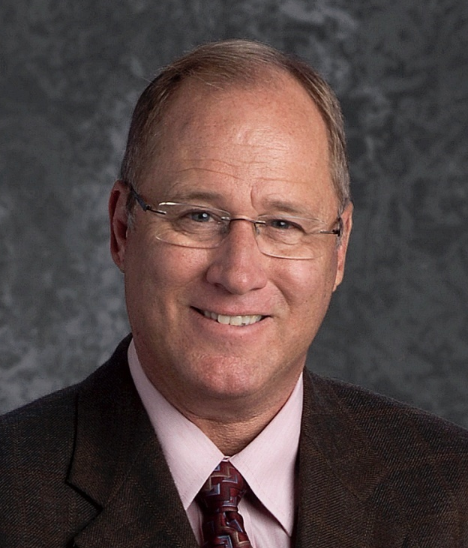
Mike Gower

Michael Gower will be interviewing for the position of superintendent with the USD 489 Board of Education on the evening of Wednesday, Feb. 6.

Gower is the third of four candidates the USD 489 Hays Board of Education will be interviewing. Keith Hall, USD 489 interim director of finance, and Jamie Wetig, Ashland superintendent, interviewed for the job last week. One more candidate will interview with the board on Thursday. The school board is set to vote on its selection at the school board meeting on Monday.

Candidates were selected for interviews based on their fit with desired characteristics that were developed with input from focus groups that were utilized throughout the search process.

Gower is currently serving as the Superintendent of Phillipsburg Schools in USD 325 and Logan Schools in USD 326. Gower is in his ninth year in the position at Phillipsburg and sixth year at Logan. In 2017 Gower became an adjunct professor in the College of Education at Fort Hays State University and continues to serve in that capacity.

The community is invited to meet the candidate from 3:30 to 4:30 p.m. Wednesday in the Toepfer Board Room at the Rockwell Administration Center.

Schedule February 6, 2019

9 a.m. Arrive at Rockwell Administration Center

9:05  – 9:20 a.m. Meet with Superintendent Thissen

Receive schedule and information for the day

9:30 – 10:00 a.m. Roosevelt Elementary School – facility tour and meet and greet

10:15 – 11:00 am Drive to Lincoln, O’Loughlin, and Early Childhood Connections

11 – 11:45 a.m. Hays High School – facility tour and meet and greet

Noon – 1:15 p.m. Lunch with building administrators

1:30 – 2:15 p.m. Hays Middle School (drive by Wilson) – facility tour and meet and greet

2:30 – 3:15 p.m.Rockwell Administration Center – facility tour and meet and greet

3:30 – 4:30 p.m. Community and parent meet and greet – Toepfer Board Room

4:30 – 5:30 p.m. Free time for the candidate (the district will provide transportation to and from the motel for the candidate and/or guest.

5:30 p.m. Dinner with board, candidate and guest, central administrative team

6:15 p.m. Formal Interview

Girl Scouts celebrate Cookie Kickoff; cookie sales start Saturday

By CRISTINA JANNEY
Hays Post

Girl Scout Troop 11268 Hays practices for booth sales. Pictured are Allison Werth, Adalynn Wilkie, Alexis Bickle, Brooklynn Dinkel, Kayden Eaton, Anna Kuhn and Lynsi Kanak-McGrath.

Girls Scouts from the area converged Friday on Celebration Community Church for their annual Cookie Kickoff.

Cookies go on sale Saturday, Feb. 9 and the sale will run through March 17. Cost of cookies are $4 per box.

The event included girls from Service Unit 74, which includes Ellis, Trego, Ness, Russell and Gove counties. More than 90 girls pre-registered for the event.

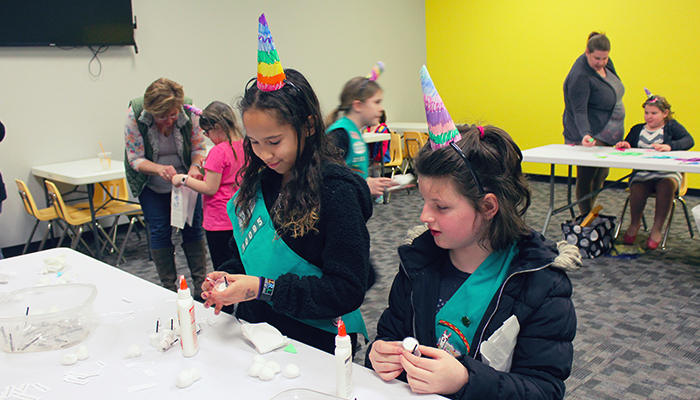
The girls sampled Girl Scout cookies, decorated their own cookies, practiced their selling skills, made crafts, snapped pictures at photo booths and played games.

This year’s mascot for the cookie sale is Sparkles the Narwhal. For those of you who don’t know what a narwhal is, it is an Arctic whale with a large horn. The narwhal and its horn have been cited by many as the creature from which the unicorn legend sprung.

Junior Scouts Delilah Meyeres and Lisa Dible, 10 of Troop 10095, color narwhal horns at the Cookie Kickoff Friday.

In honor of the cookie mascot, girls at the kickoff colored and wore their own narwhal horns.

Junior Scouts Jordan Flavin and Arianna Ayarza, both 10 of Troop 10095, said they hope to use the money they raised from their cookie sales to go to camp this summer.

The girls earn Cookie Credits through cookie sales they can use for Scout activities.

Girl Scout Troop 11268 said they had already been to several camps this year, including the first part of three-part campout in Ellis, a Halloween camp and Cookie Camp in Scott City. The Juniors hope to raise enough money through cookie sales to go on a trip together this summer.


GSUSA

Cookie sale dates

  • The Cookie Sale runs Feb. 9 – March 17
  • Cookie Booth sales will be throughout the entire sale.

How to find cookies

Looking for a local Girl Scout to buy cookies from? Just enter your zip code at kansasgirlscouts.org or call our Cookie Hotline at 888-686-MINT (6468). You can also download the free, official Girl Scout Cookie Finder mobile app for iPhone, Android and other mobile devices. (Yep, there’s an app for that!)

S’mores cookie is returning in the 2019 cookie lineup

This year, Girl Scouts is celebrating a tasty new way to support young female entrepreneurs with a recently debuted Girl Scout Cookie added to the 2019 Cookie Lineup: Caramel Chocolate Chip, which joins classics like the Thin Mints, Caramel deLites and Shortbread varieties. Caramel Chocolate Chip features rich caramel, semisweet chocolate chips, and a hint of sea salt in a chewy gluten-free cookie. The new cookie is offered in select Girl Scout council markets only for as long as supplies last. We still have eight other cookie favorites to choose from: Thin Mints, Caramel deLites, Peanut Butter Patties, Shortbreads, Lemonades, Peanut Butter Sandwiches, and Thanks-A-Lots.

A second century of Girl Scout cookies

In 2019, we celebrate the 102nd anniversary of the first-known instance of Girl Scouts selling cookies and learning the basic skills they needed to be leaders in business, managing their own finances and gaining self-sufficiency and confidence handling money.

So how did it all begin? It started in 1917 in Muskogee, Oklahoma, when the Mistletoe Girl Scout troop there did what Girl Scouts everywhere do: They had a great idea, got together, and took action to make it a reality. They decided to fund their projects by selling homemade cookies, and the idea spread!

The 5 skills

Daisy Scouts Georgia Olson and Harper Leiker, both 5 of Hays, decorate their narwhal horns Friday.

When girls participate in the Girl Scout Cookie Program, the largest girl-led business in the world, they get more than new adventures. They develop important life skills—goal setting, decision making, money management, people skills, and business ethics—that will set them up for success!

For 102 years, Girl Scouts have used cookie earnings to build leaders who make a positive impact on our world. Girl Scout Cookies not only help girls earn money for fun, educational activities and community service projects, they also help transform girls into G.I.R.L.s (Go-getters, Innovators, Risk-takers and Leaders) as they learn essential life skills. There’s no doubt: American society is better because of the girls who have taken part in the Cookie Program.

Price of cookies

Each package of Girl Scout Cookies costs $4. Yes, there are Girl Scout Cookie lookalikes out there, but it’s important to keep in mind that when you buy a box of cookies from a Girl Scout in our council, all of the money stays in Kansas and supports local programs for local girls. Along with earning money for their troop, girls are also earning Cookie Credits they can spend on exciting Girl Scout programs and activities, camps, troop trips, travel, signing up for another year of Girl Scouts, and even on merchandise in our Girl Scout Shops.

How the cookie revenue benefits girls

Brownie Scout Giannna, 8 and Daisy Scout Aria, 6, Haselhorst of Hays are handed cookie samples by volunteer Becca Wilkie as their mother Dacia looks on.

After paying the baker, all of the money earned from cookie sales stays within Girl Scouts of Kansas Heartland and in Kansas. Since the Cookie Sale is the girls’ primary fundraiser, the proceeds are helping girls and their troops pay for things like their first camp experience, a special trip or event, and even community service projects — girls invest their own Cookie Sale proceeds right back into the community. Cookie revenue also supports our council’s programs and services (girl programs, volunteer training, financial assistance for girls, facility operations, and program resources).


Digital cookie

Digital Cookie sales allow Girl Scouts to reach customers with their own personalized webpage on a secure system emphasizing girl safety. Girl Scouts and their families are instructed to share the link to their sale page with a close network of friends and family, rather than the general public, for safety reasons. This is a great option for family and friends who do not live nearby.

Digital Cookie does not replace the traditional Girl Scout Cookie Program – it enhances it. It is another way for Girl Scouts to sell cookies, alongside the traditional sales techniques like door-to-door sales and booth sales. Digital Cookie simply adds another learning component to the Girl Scout Cookie Program that will be relevant in today’s world. They can go to abcsmartcookies.com to access the page and send eCards to family and friends, with a secure link. Customers pay online with a credit card, and cookies are shipped directly to their home or place of business. Online customers can choose any quantity of cookies for direct shipment this year, plus the cost of shipping.

Cookie Share Program: Supporting members of the military and local charities

Sparkles the Narwhal

For customers who’ve already purchased enough cookies for themselves or cannot eat cookies, the Cookie Share Program is a great option. Cookie Sale customers can simply buy a package of cookies and opt to donate it or “share” it with servicemen and women, including those serving overseas; their families; and local charities like the Kansas Food Bank and Catholic Charities. The cost is the same as a package of cookies – just $4. Local businesses can also participate in the Cookie Share matching program, and match the number of Cookie Shares purchased by kind Kansans.

Since the Cookie Share Program started in 2010, Girl Scouts of Kansas Heartland has distributed more than 158,772 packages of cookies, including 19,000 “Cookie Shares” in 2018. To share cookies with a local charity or send a sweet reminder of home to our servicemen and women, just ask your local Girl Scout about the Cookie Share Program or call (888) 686-MINT.

United Way meets campaign goal after Schmidt Foundation donation

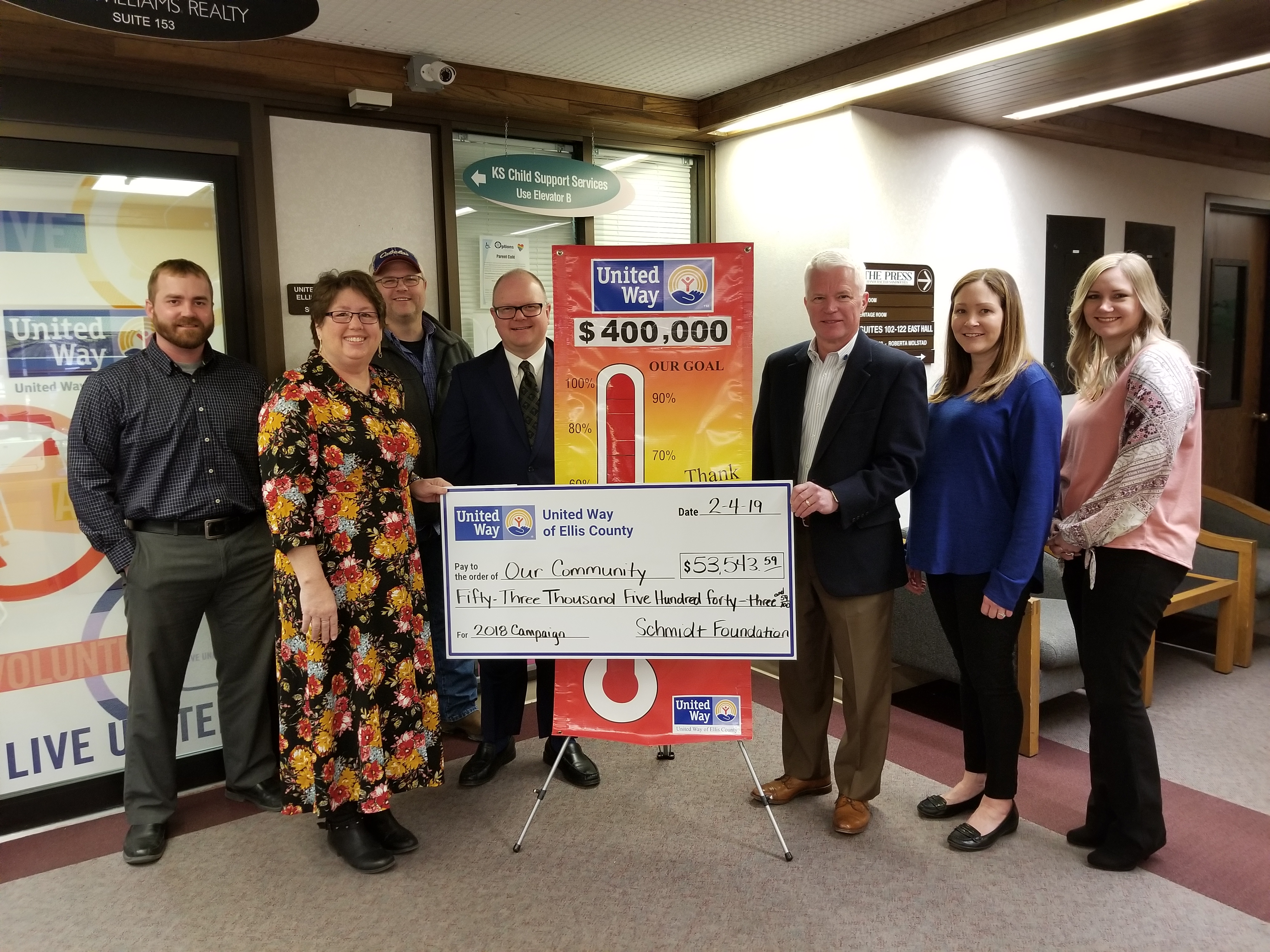
Gary Shorman, president of the Schmidt Foundation, presents a check to the United Way of Ellis County to bring it to its 2018 campaign goal. Pictured are Josh Dreher, former UWEC board member; Sherry Dryden, UWEC executive director; Scott Boomer, UWEC campaign chairman; Phil Smith-Hanes, UWEC board member; Gary Shorman, president of the Schmidt Foundation; Kara Denton, UWEC board president; and Kelly Lewis, UWEC board vice-president.

Submitted

The United Way of Ellis County announced the close of its 2018 campaign with a donation of more than $53,000 from the Bob and Patricia Schmidt Foundation to meet its $400,000 goal.

Sherry Dryden, executive director of the United Way, said she is appreciative of the volunteers, donors and businesses who give every year; however, there has been a continued decline in donations. This donation will help solidify the importance of the United Way and challenge the agency to re-align their vision for the future as they just completed a new strategic plan.

The United Way evolved from the Hays United Fund, which was founded in 1953 by Bob Schmidt.

Gary Shorman, president of the Schmidt Foundation said, “Bob and Pat not only helped start the United Way in Ellis County, but believed fully in the mission of supporting the people and agencies tasked with helping our friends and neighbors in need.”

Through the years, a CARE Council was created in 1992 to review applications and give funding recommendations for potential partner agencies who applied for United Way Funding. The CARE Council is made up of community volunteers who also give recommendations for city and county funding to human service agencies.

United Way funding helps those partner agencies from having to do as much individual fundraising so staff can provide direct services to individuals, youth, and families. One of the many new goals for the United Way is to build on their Endowment Project for a goal of moving administrative expenses completely out of the campaign fund.

Additionally, the United Way applies for grant dollars and sponsorships to fund Community Impact projects ensuring donations for the campaign go directly to the partner agencies. The United Way accepts donations throughout the year at www.liveunited.us, Facebook at “United Way of Ellis County,” or at their offices at 205 E. Seventh St., Suite 111.

FHSU Center for Entrepreneurship to host $10,000 business plan competition

HAYS – The Center for Entrepreneurship at Fort Hays State University will host the Faulkner Challenge on March 30 at the W.R. and Yvonne Robbins College of Business and Entrepreneurship. Fort Hays State students and residents of a 26-county area of northwest Kansas are eligible to compete for $10,000 in prizes.

The event begins at 9 a.m. Saturday, March 30, in McCartney Hall, home of the Robbins College, on the Fort Hays State campus. Admission is free for participants and the public.

The Faulkner Challenge is made possible by the generosity of alumnus, Kevin Faulkner. It is a business plan competition for new, independent proposed ventures in the conceptual, seed or startup stages.

Entries will be accepted until the March 20 deadline. The eight best business plans will be selected as finalists to present on the Fort Hays State campus. Finalists will deliver 10 minute presentations to a panel of judges, and the top three business projects will split the $10,000 in prize money into awards of $6,000, $3,000, and $1,000, to first, second, and third places, respectively.

“It will be an exciting event on our campus to showcase the creativity and entrepreneurial spirit of our students and the Kansans of this region”, said Dr. David Snow, the director of entrepreneurship for FHSU. “This is meant not only to be a fun event for all involved, but a contribution to economic development in northwest Kansas and a boost for those early-stage entrepreneurs.”

The eligibility area comprises the 26 northwest Kansas counties stretching from Cheyenne down to Wallace County, east through the top three tiers of counties and then into the eight-county block from Jewell and Republic down through Ellsworth and Saline.

Plan presentations begin at 9 a.m. and run through 12:15 p.m. A luncheon will go from 12:15 to 12:45 p.m. The judges feedback session will run from 12:45 to 1:15 p.m. Awards presentations begin at 1:15 p.m. and end at 1:30 p.m.

For more information about the Faulkner Challenge, visit https://www.fhsu.edu/cob/faulkner-challenge

For free tickets to watch the event: https://www.eventbrite.com/e/faulkner-challenge-tickets-55640862317?aff=ehomecard

For more information about the FHSU Center for Entrepreneurship, visit https://www.fhsu.edu/cob/entrepreneurship

Hays Community Theatre to present ‘Murder Can Be Habit Forming’

By CRISTINA JANNEY
Hays Post

When a busload of passengers is stranded by a blizzard in upstate New York at the St. Mary’s Convent, all of the Marys must be wary.

While a group of nuns are waiting out a snowstorm in their convent, a radio broadcast alerts them of the murder of a waitress at a nearby diner. The murderer is targeting women named Mary — the name of all the nuns and two passengers on the bus.

Guests at Hays Community Theatre’s latest murder mystery and dinner theater “Murder Can Be Habit Forming” have to guess if the killer is among the convent guests before another Mary gets whacked.

As the story unfolds, two more passengers are added to the potential list of victims. One passenger is a flamboyant actress whose TV character is named Mary and another is a retired school teacher who was formerly a nun named Mary.

Potential suspects include the college professor, the newspaper columnist who doesn’t like to see his name in print, and the bus driver.

Police detective Patrick McDougal was also on the bus and takes charge of solving the case.

“Providing as many laughs as chills, ‘Murder Can Be Habit Forming’ is a lighthearted mystery comedy that reveals the very human side of the nuns as they attempt to stay one step ahead of a killer,” the HCT website said.

Shows are at 7 p.m, Friday, Feb. 15, and Saturday, Feb. 16, at the HCT venue, 121 E. Eighth. Doors open at 6:30 p.m. Tickets are $20 each. The meal is being catered both nights by Hickok’s Steakhouse. A pork tenderloin dinner will be served Friday night, and a spaghetti dinner will be served Saturday night.

The meal includes water, tea and coffee. Other drinks will be available for purchase. Tickets must be purchased in advance. Click here to purchase tickets online.

Cheryl Glassman, director, directed the play years ago while she was with the theater program at TMP-Marian. She said the play never gets old and still makes her laugh.

“It is a great story line, and I sit out here and laugh,” she said. “It is very funny, and I miss lines sometimes because there are so many funny lines. It is really cool to watch more and more and get more out of it. It is just a really good show.”

Glassman said the play’s cast of 15 is fairly large for a winter production.

“It is always a challenge to get everyone here, because we are all working people and we come from so many different directions in life,” she said. “Everyone here works. Our youngest people are high school aged, and our oldest cast member is 72, so quite an age range.”

She said the cast has brought together people with varying levels of stage experience.

“We have people who have never been in a show before, who are in this show and have evolved into these awesome characters,” she said. “It really gives me goosebumps when I think about it. You see people who are really shy and timid, and once they start getting into their characters and understand what is needed to portray that person, you don’t even realize it is that person on stage anymore. For me, that is the best part — watching them evolve.”

The Hays Community Theatre is trying to offer more shows in its new venue on Eighth Street.

“It is basically because we want to get more people involved and have more for the community to enjoy and do versatile things that are different,” Glassman said.  “Some people might want to go to this type of show but others might like that type of show.”

She said HCT will still utilize other venues for other productions like their big summer show.

“For this type of show it is perfect,” she said of their venue on Eighth Street. “We have people who come from all different directions who help us with the set. When I first walked in here, we were all sitting around a table, then I walk in and there is all this stuff up here.”

HCT will also perform the play a week after they wrap up in Hays at a fundraiser for a group in Great Bend.

Superintendent candidate Weitg: People more important than bricks, mortar in teaching kids

By CRISTINA JANNEY
Hays Post

Wetig

Jamie Wetig, candidate for Hays superintendent, said people matter.

The current Ashland Superintendent, Wetig showed this when his community was hit by a massive wildfire two years ago.

As the fire grew, the school was closed and the town was evacuated. The school district at that time was not part of the emergency management plan, but Wetig felt the district had something to offer in the crisis. He offered to serve lunch to the volunteers and firefighters.

The school district served lunch and then dinner and eventually offered its facilities as an emergency shelter. Over the better part of a week, the district housed 110 people and fed many more.

“All that started with one thought of how can I help,” he said.

Wetig said  the fire was an opportunity to volunteer, build leadership and learn how to accommodate and be flexible.

“I think if asked what you learned form the Starbuck Fire, I think I would say the community is resilient,” he said. “What did we learn about the ag community during the Starbuck Fire, not just in Kansas, but all across the country? It is that everyone in the community comes together to support one another. Maybe that is where we are at with USD 489.

“We are in a situation where we have a great community, great teachers, great students, and we need to come together and look at the needs of our students. Because it is the needs of our students that drives what we need to do.”

Wetig said he thinks the district has great programs, but it needs to expand them to create more opportunities for students. He said in talking to teachers at Hays High School, he learned Pathways and electives are getting filled up and the programs have to turn students away.

“My question to  administrators is, ‘What do you need?'” he said. “Staffing came up in every conversation. We need to have a counselors at every elementary school. We need to have additional electives so we don’t have to fight [for] our traveling teachers consistently and ask where are we going to put them in the schedule. … We need to have school nurses in our buildings. We need to have SROs. We need to address the people issue, because brick and mortar is nice when it is brand new, but it doesn’t teach our kids. People make a difference.”

Weitg, 43, is familiar with Hays. His father attended Fort Hays State University. He attended preschool at FHSU and kindergarten at Wilson Elementary School before his family moved to Ness City. His family later moved to Great Bend, where he graduated high school. He has a bachelor’s degree in education from Kansas State University, a master’s degree from Emporia State University and a administrative endorsement from FHSU.

Previously, Wetig served in Valley Center as intermediate principal from 2011 to 2013 and middle school assistant principal and activities director from 2013 to 2016. Wetig also served as the Atchison County elementary principal from 2008 to 2011.

He said he had not considered other jobs before the Hays superintendent position became available, but he has family in Hays, Russell and the immediate area.

“It would be taking over what I consider one of the marquee school districts in the state,” he said.

As the district comes back to discussions of a third bond issue try in three years, Wetig said the district needs to go back to the community, employees and staff members.

“When you have a bond issue and 1,700 people vote for it and you have 2,400 people who don’t vote for it, there is a disconnect somewhere. If the community is so supportive of our schools — its teachers and its programs, there is a disconnect somewhere. I think it means we need to start over and have conversations with our community, with our business leaders, with our parents and with our own staff.”

Ashland’s elementary and intermediate school are Gemni I schools under the state school redesign plan. The district focused on social, emotional and character development. Children were grouped for  twice-a-month student-led character lessons. The district also increased its Career Pathways from three to 11. Students are doing internships and student-led conferences. The district is also considering flex scheduling and a genius hour during which students would pick the topic they wish to study.

He said he liked the Guided Personal Study program already in place at Hays High School.

“I think that we have hit on a lot of things in our school that are best practices, and we have made them better,” he said of the Gemini program.

Kathy Rome, KNEA UniServ director, was at the meet-and-greet with Wetig Thursday afternoon. The Hays school board came to impasse during negotiations for this school year over pay. A federal meditator had to be brought in to settle the dispute.

Wetig was a KNEA student president at K-State, and he said KNEA serves a positive purpose in advocating for education.

He said if a district receives new money, it should consider raises.

“I don’t know what the magic number is, but certainly you want to try to match the average percent increase in the state,” he said. …

“I think you take care of your people first and then your operations second.”

Wetig also said he would work to strengthen board unity.

“Disagreements need to happen behind closed doors, and you must always present a unified front,” he said.

Wetig is the second of four candidates the USD 489 Hays Board of Education will be interviewing. Keith Hall, USD 489 interim director of finance and support services, interviewed for the job on Wednesday. Two more candidates will interview Wednesday, Feb. 6 and Thursday, Feb. 7.

Each day the candidates will meet with parents and other members of the public from 3:30 to 4:30 p.m. in the Toepfer Room of Rockwell Administration Center. The names of those candidates have yet to be announced.

Electricity costs remain low in Hays area despite concerns about rates statewide

By CRISTINA JANNEY
Hays Post

Kansans are paying more for electricity than other states, according to a recent report from the Kansas Corporation Commission.

However, Hays-area customers who receive power from Midwest Energy pay more favorable rates than customers served by the state’s largest power provider, Evergy. Evergy was formed by the merger of Westar and Kansas City Power and Light last year.

“Midwest Energy’s electric rates are competitive statewide, with investor-owned utilities and against the average for co-ops in Kansas. Against electric co-ops in Kansas, our rates on average were 19 percent below those of the average Kansas cooperative,” said Mike Morley, director of corporate communications for Midwest Energy.

A 2018 study compared the electric rates of three electric providers in the state — Empire, Westar and Kansas City Power and Light.

Between June 2016 and June 2017, monthly bills based on average residential consumption of 916 kWh were $121.40, while the national average was $120.56. An equivalent Midwest Energy bill would have been $105.52These numbers were calculated without taxes.

Special interest groups, especially business and industry, are calling for a legislative review of electric rates in the state, saying the high rates are making it difficult for them to stay competitive.

Chuck Caisley, KCP&L and Westar Energy senior vice president of marketing and public affairs, spoke before the Kansas Senate Utilities Committee on Wednesday. He also defended the power company in a press release issued last week.

“We are ahead of our peers in providing renewable energy, meeting federal and state environmental regulations and ensure our transmission system is modernized and reliable,” Caisley said in the press release. “Our prices are competitive with the national average. As utilities in neighboring states continue to invest in their infrastructure, they are asking to increase prices to recover those investments.”

Several of the factors that have resulted in an increase in power rates for Evergy customers are not affecting Midwest Energy.

In its report, the KCC noted installation of emissions-reducing equipment at coal-fueled power plants was one factor that led to utility rate increases.

Midwest Energy was not directly affected by the changes at the coal-fired plants, Morley said. Although Midwest Energy purchases power from Evergy, which has coal-fired power plants, Midwest Energy does so via long-term energy supply contracts, and the costs of any environmental upgrades are contained in those contract prices.

Both Evergy and Midwest Energy have seen the cost effects of improving infrastructure to accommodate the use of wind energy.  In 2008 Midwest Energy signed a purchased power agreement to purchase 49 MW of wind energy from the Smoky Hill Wind Farm. In 2017 Midwest Energy signed a purchased power agreement for an additional 57 Megawatts from the Kingman Wind Farm As a result, roughly one-third of its electricity comes from Kansas wind. 

Transmission charges for Midwest Energy have outpaced inflation, increasing from .0033 cents per kWh in 2009 to .0088 cents per kWh in 2018.

Morley said transmission charges are hard to compare between utilities because of differences in how they are applied to customers’ bills.

Regulation

Morley said he thought the Kansas regulators can take action to keep Kansas electric rates low.

Morley said he would like to see the Legislature address utility property taxes.

Utilities have real property assessed at a rate of 33 percent in Kansas, which is higher than agriculture (30 percent), commercial/industrial (25 percent) and residential (11.5 percent). In 2018, Midwest Energy paid $8.2 million in property taxes to 43 counties, and those costs flow back to the customer. 

Morley also said he would like to see out-of-state power customers pay a greater share of infrastructure costs when power is exported out of state. Midwest Energy has spent tens of millions of dollars over the last decade upgrading and improving its transmission system to allow wind interconnections, even though most of that electricity is sold to far-away markets, Morley said.

Historically, one-third of those costs have been spread regionally through the Southwest Power Pool, with Midwest Energy customers picking up two-thirds of those costs. Discussion is taking place at the Southwest Power Pool to revise that cost-sharing formula and make these transmission projects less costly to local customers.

“One other idea worth considering might be some type of excise tax or fee on wind energy that’s exported out of the state,” he said. “Having that fee offset utility property taxes would directly benefit electric customers, who have had to pay the majority of the cost of building these transmission ‘highways’ for that wind energy to leave the state.”

Smaller utilities have challenges

Despite lower rates, Midwest Energy does have its own challenges. A high ratio of residential customers puts Midwest Energy at a disadvantage when it comes to rates.

“Generally speaking, the more large commercial customers a utility serves, the more positive effect on rates,” Morley said. “This is because large commercial loads (factories, manufacturing) are the most economical to serve, as they have a high “load factor” – they consume a lot of electricity at a consistently steady rate over time.”

Midwest Energy’s customer breakdown is below.

Residential: 59.8 percent of meters; 21 percent of kWh sales
Small commercial and oil:  34.9 percent of meters; 47 percent of kWh sales
Large commercial: .1 percent of meters; 27 percent of kWh sales
Irrigation: 5.2 percent of meters; 5 percent of kWh sales

Customer density is another factor. Utilities in more urban areas often have customers-per-mile ratios of 25 or more, Morley said. Midwest Energy has 4.4 customers per mile of line. All other factors equal, lower customer densities mean higher rates.

Although Hays benefits from lower electric rates, it needs other resources to bring new businesses into the region.

“Our commercial and industrial rates are competitive with those throughout the region,” Morley said. “While there are many challenges in recruiting industrial customers to the region (labor force availability and housing are often cited, as are proximity to markets), we work hard to minimize costs, keeping our rates as low as possible and competitive within the region.”

Change in rate structure

In 2018, Midwest Energy requested a change in rate structure, but it should result in a $0 increase in revenue for the utility.

Midwest Energy bought its W system from Westar in 2003. M system customers were often paying more for electricity than W system customers. The rate structure changes bring rates between the two systems closer together over three years.

The changes also simplify rate designs. For years, Midwest Energy had “inclining block rates” during the summer months. As usage moved up through the blocks, your per-kWh rates would also increase. The new rates bring a lower, year-round per kWh rate for all customers. 

If you are interesting in better understanding your residential bill, click here. You can also see a Q & A about the change in the rate structure by clicking here.

“I can only speak for Midwest Energy, but generally speaking, we predict rates to be fairly stable in the intermediate term (next three years), with modest rate increases approximating inflation over the next 10 years.  We will examine all opportunities to control costs and keep rates affordable,” Morley said.

Corrected to reflect accurate per-kWh charges.
Superintendent candidate Weitg: People more important than bricks, mortar in teaching kids

By CRISTINA JANNEY

Hays Post

Wetig

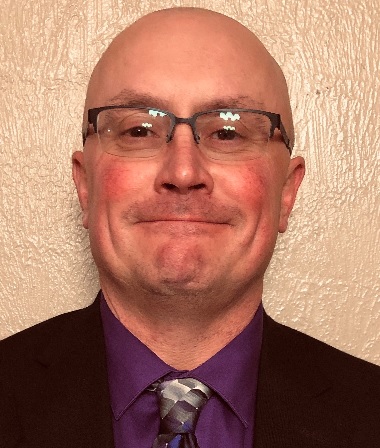
Jamie Wetig, candidate for Hays superintendent, said people matter.

The current Ashland Superintendent, Wetig showed this when his community was hit by a massive wildfire two years ago.

As the fire grew, the school was closed and the town was evacuated. The school district at that time was not part of the emergency management plan, but Wetig felt the district had something to offer in the crisis. He offered to serve lunch to the volunteers and firefighters.

The school district served lunch and then dinner and eventually offered its facilities as an emergency shelter. Over the better part of a week, the district housed 110 people and fed many more.

“All that started with one thought of how can I help,” he said.

Wetig said  the fire was an opportunity to volunteer, build leadership and learn how to accommodate and be flexible.

“I think if asked what you learned form the Starbuck Fire, I think I would say the community is resilient,” he said. “What did we learn about the ag community during the Starbuck Fire, not just in Kansas, but all across the country? It is that everyone in the community comes together to support one another. Maybe that is where we are at with USD 489.

“We are in a situation where we have a great community, great teachers, great students, and we need to come together and look at the needs of our students. Because it is the needs of our students that drives what we need to do.”

Wetig said he thinks the district has great programs, but it needs to expand them to create more opportunities for students. He said in talking to teachers at Hays High School, he learned Pathways and electives are getting filled up and the programs have to turn students away.

“My question to  administrators is, ‘What do you need?'” he said. “Staffing came up in every conversation. We need to have a counselors at every elementary school. We need to have additional electives so we don’t have to fight [for] our traveling teachers consistently and ask where are we going to put them in the schedule. … We need to have school nurses in our buildings. We need to have SROs. We need to address the people issue, because brick and mortar is nice when it is brand new, but it doesn’t teach our kids. People make a difference.”

Weitg, 43, is familiar with Hays. His father attended Fort Hays State University. He attended preschool at FHSU and kindergarten at Wilson Elementary School before his family moved to Ness City. His family later moved to Great Bend, where he graduated high school. He has a bachelor’s degree in education from Kansas State University, a master’s degree from Emporia State University and a administrative endorsement from FHSU.

Previously, Wetig served in Valley Center as intermediate principal from 2011 to 2013 and middle school assistant principal and activities director from 2013 to 2016. Wetig also served as the Atchison County elementary principal from 2008 to 2011.

He said he had not considered other jobs before the Hays superintendent position became available, but he has family in Hays, Russell and the immediate area.

“It would be taking over what I consider one of the marquee school districts in the state,” he said.

As the district comes back to discussions of a third bond issue try in three years, Wetig said the district needs to go back to the community, employees and staff members.

“When you have a bond issue and 1,700 people vote for it and you have 2,400 people who don’t vote for it, there is a disconnect somewhere. If the community is so supportive of our schools — its teachers and its programs, there is a disconnect somewhere. I think it means we need to start over and have conversations with our community, with our business leaders, with our parents and with our own staff.”

Ashland’s elementary and intermediate school are Gemni I schools under the state school redesign plan. The district focused on social, emotional and character development. Children were grouped for  twice-a-month student-led character lessons. The district also increased its Career Pathways from three to 11. Students are doing internships and student-led conferences. The district is also considering flex scheduling and a genius hour during which students would pick the topic they wish to study.

He said he liked the Guided Personal Study program already in place at Hays High School.

“I think that we have hit on a lot of things in our school that are best practices, and we have made them better,” he said of the Gemini program.

Kathy Rome, KNEA UniServ director, was at the meet-and-greet with Wetig Thursday afternoon. The Hays school board came to impasse during negotiations for this school year over pay. A federal meditator had to be brought in to settle the dispute.

Wetig was a KNEA student president at K-State, and he said KNEA serves a positive purpose in advocating for education.

He said if a district receives new money, it should consider raises.

“I don’t know what the magic number is, but certainly you want to try to match the average percent increase in the state,” he said. …

“I think you take care of your people first and then you’re operations second.”

Wetig also said he would work to strengthen board unity.

“Disagreements need to happen behind closed doors, and you must always present a unified front,” he said.

Wetig is the second of four candidates the USD 489 Hays Board of Education will be interviewing. Keith Hall, USD 489 interim director of finance and support services, interviewed for the job on Wednesday. Two more candidates will interview Wednesday, Feb. 6 and Thursday, Feb. 7.

Each day the candidates will meet with parents and other members of the public from 3:30 to 4:30 p.m. in the Toepfer Room of Rockwell Administration Center. The names of those candidates have yet to be announced.

Correction 5:05 p.m. Friday, Feb. 1: Kathy Rome’s title was corrected to KNEA UniServ director.

Commodities to be distributed in Hays on Friday

Government surplus commodities will be distributed in Hays at Unite Common Grounds Coffee House and Free Store (Inside the Gamers Guild), 200 E. Eighth St., in Hays from 11 a.m. to 1 p.m. and 3:30 to 5 p.m. while supplies last.

Doors will not open until 11 a.m. and 3:30 p.m. respectively.

To be eligible for commodities, your household’s total monthly income must be below:

$1,287 for a house of one

$1,736 for a household of two

$2,184 for a household of three

$2,633 for a household of four

$3,081 for a household of five

$3,530 for a household of six

$3,980 for a household of seven

$4,430 for a household of eight

Contact Brandon Nimz, Unite Ministry leader, with any questions at 785-259-2539. This institution is an equal opportunity provider.

Commodities this distribution will be: Applesauce, fresh apples, fresh oranges, frozen blueberries, frozen strawberries, beef stew, split peas, dried plums, shredded cheese, red kidney beans, frozen strawberry cups and fresh grapes.

Student who offered kind notes; teacher assistant with a smile win Best of the Best

Rebecca Whitmer, Wilson fourth-grade teacher, nominated her student Brandon Dague for the January Best of the Best Award.

By CRISTINA JANNEY
Hays Post

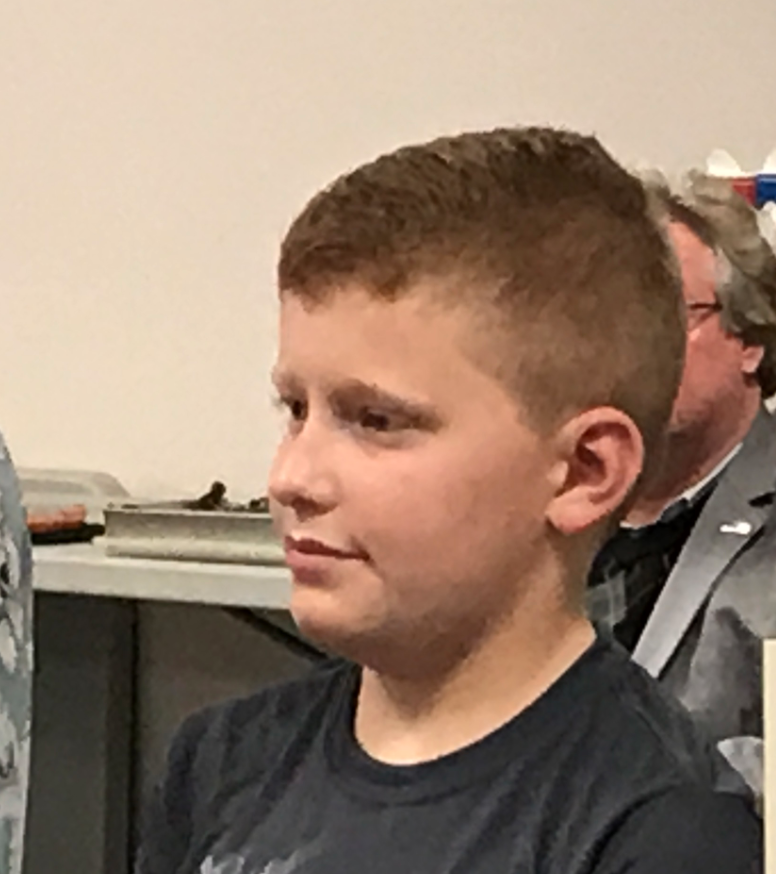
Rebecca Whitmer, Wilson fourth-grade teacher, nominated her student Brandon Dague for the January Best of the Best Award because of his kindness to his fellow students.

Whitmer focuses on one positive character trait each month. On Mondays Whitmer presents the students a quote about that trait. On Tuesdays, the students set goals around the trait. On Wednesdays, they read aloud pieces that have that trait as the theme. On Thursdays, they have class discussion, and, on Fridays, the students do shout-outs to students and staff who exhibit that trait.

During the month of December, the class’s trait was kindness.

Dague‘s goal for the week was to write students in his class positive notes. On his own time, he wrote personalized, uplifting notes to his classmates. He came in early the next morning and delivered the notes.

He revised his goal and decided to write everyone in the class positive notes. He wrote another round of notes that night.

“As he was dispersing the notes on the desks, he brought one to me as well,” Whitmer said. “It put such a smile on my face and started my day on such a bright note.

“As I watched his classmates come in and go through their arrival procedures and they started reading theses notes, the smiles that I saw just meant so much and warmed my heart. Just being able to start the day off on that positive note because of Brandon was incredible.

“I think the best part was that he perpetuated that cycle of kindness we had been talking about, and some of the other students who had received the notes decided they were going to start to write kind notes to their classmates as well.”

Whitmer said she was happy to have Dague in her class this year. She emphasized the importance of a positive classroom.

“He is so friendly. He is very polite,” Whitmer said. “He will go above and beyond for anyone. He is someone who lifts people up. If we share success, he is the first person to congratulate them. If he sees someone sitting by themselves, he will go up and try to include them as well.”

Dague also works hard in school, she said.

“He comes to school ready to learn and do his best, gives his best effort and keeps pushing himself every day,”she said.

Mackenzie Flinn

Krysten Linenberger, Munjor Early Childhood Connections lead teacher, nominated Mackenzie Flinn, assistant teacher, for the staff Best of the Best Award.

Krysten Linenberger, Munjor Early Childhood Connections lead teacher, nominated Mackenzie Flinn, assistant teacher for the staff Best of the Best Award.

Linenberger said of Flinn, “She is always smiling when she comes in. She always stays calm when working with all kids, which is really hard with toddlers. She jumps in and does what is needed from helping kids one on one to taking over a group setting if I am needing to leave.

“She always asks if anything else is needed to be done. If I ask her to do anything, she does it quickly and with a smile on her face. She gets along with everyone in the classroom and makes the classroom run very smoothly.”

Ashland superintendent to interview for Hays USD 489 top job

USD 489

Wetig

Jamie Wetig will be interviewing for the position of Superintendent with the USD 489 Board of Education on the evening of Thursday, Jan. 30.

Wetig is the second of four candidates that the USD 489 Hays Board of Education will be interviewing.  Candidates were selected for interviews based on their fit with desired characteristics that were developed with input from focus groups that were utilized throughout the search process. Keith Hall, USD 489 interim director of finance and support services, interviewed for the job on Wednesday.

Wetig is currently serving as the superintendent for USD 220 Ashland. Wetig is in his third year in the position.

Previously, Wetig served as an administrator for Valley Center as intermediate principal from 2011 to 2013 and middle school assistant principal and activities director from 2013 to 2016.

Wetig also served as the Atchison County elementary principal from 2008 to 2011.

The community is invited to meet the candidate from 3:30 to 4:30 p.m. Thursday in Toepfer Board Room of the Rockwell Administrative Center.

Schedule January 30, 2019

9 a.m. Arrive at Rockwell Administration Center

9:05 a.m. – 9:20 a.m. Meet with Superintendent Thissen via phone

Receive schedule and information for the day

9:30 a.m. – 10 a.m. Roosevelt Elementary School – facility tour and meet and greet

10:15 am – 11 a.m. Drive to Lincoln, O’Loughlin, and Early Childhood Connections

11 a.m. – 11:45 a.m. Hays High School – facility tour and meet and greet

noon – 1:15 p.m. Lunch with building administrators

1:30 p.m.  – 2:15 p.m. Hays Middle School (Drive by Wilson) – facility tour and meet and greet

2:30 p.m. – 3:15 p.m. Rockwell Administration Center – meet and greet in Board Room

3:30 p.m. – 4:30 p.m. Community and parent meet and greet – Toepfer Board Room

4:30 p.m. – 5:30 p.m. Free time for the candidate (the district will provide transportation to and from the motel for the candidate and/or guest.

5:30 p.m. Dinner with board, candidate and guest, and admin team

6:15 p.m. Formal interview

USD 489 superintendent candidate Hall hopes to facilitate building improvements

By CRISTINA JANNEY
Hays Post 

Hall

Hays USD 489 candidate Keith Hall said he hopes to facilitate the board’s work on a bond and help bring unity to the school board.

Hall is one of four candidates that will interview for the Hays USD 489 superintendent position in the next two weeks. Hall interviewed with the board Wednesday night. The second candidate will be announced Thursday morning and will interview Thursday night. Two more candidates will interview Wednesday, Feb. 6 and Thursday, Feb. 7.

Each day the candidates will meet with parents and other members of the public from 3:30 to 4:30 p.m. in the Toepfer Room of Rockwell Administration Center.

Hall, 61, came to Hays USD 489 in December to serve as the interim director of finance and support services. He previously worked as the superintendent in Osborne. He graduated from high school in Connecticut. His farther is from Gorham and went to junior high in the Rockwell basement. He followed his family to Kansas after his father retired from the Navy. Hall graduated from Fort Hays State University.

He worked as a shop teacher in Sabetha and Stockton and later was named the principal at Stockton High School. He was honored with the Milken National Educator Award in 1997.

“I have always had great loyalty to the folks that I worked for, because I worked for kids and you love them,” Hall said. “I felt it immediately when I walked in the door here.”

Hall toured several schools Wednesday as well as met with staff. Teachers shared with Hall what they do for students and what some of their building needs are.

“[The district] has fulfilled its reputation that I anticipated when I got here,” he said. “It’s a great district. It has a great community supporting it, and it has teachers who really care about kids.

“I am really pleased with the experience since I have been here. I think people are striving for excellence. I am excited and delighted.”

Despite the larger enrollment, Hall said the processes here in Hays are very similar to what he experienced in Osborne.

“I just thought that maybe I could help this district move forward,” he said. “It really wasn’t on my radar when I came over here, but as I watched it and in my new position, I think I can help them, and I am excited to talk to them about that.”

The district is looking at a third bond attempt after bond issues failed in 2016 and 2017. Hall said he thought becuase he is serving in the finance position, he could provide I seamless transition for any bond work.

The district has worked on developing another bond question, but on a split vote tabled those plans in June. The board heard a $29.4 milli0n bond proposal from its architect and construction manager on Monday night.

“In my mind, we are restarting the conversation,” Hall said, “so what I would defer to is the board processing that again and deciding how they are going to move forward.”

He said he facilitate whatever the board maps out.

Getting building projects completed, Hall said would be among his goals if he was chosen as superintendent. Trying to build board unity is another.

Several major votes in recent months, most notably the purchase of the Oak Park Medical Complex, which will be renovated for Early Childhood Connections, have been split. Current Superintendent John Thissen said upon his resignation that he wished he could have better united the board during his tenure.

Hall said developing trust is not a simple nor a linear process.

“I think I have enough experience to understand what needs to be put in place to move that along,” Hall said of the board. “You don’t control all of that. Some of that has to do with personalities. Some of that has to do with what is on the table as far as what you are talking about, but I think I know what the components are. The first component is board unity.”

The board of education reached an impasse with teachers during negotiations last year.

Because resources are tighter, conversations with teachers are more difficult, Hall said. He said he would work through the processes that are in place to reach the best outcome for teachers and the community.

Supporting teachers in their accreditation and education redesign work would be yet another of Hall’s goals, he said.

Hall said he thought the move to the Hays district from Osborne was a positive one for his family.

“I love the Hays community,” he said. … “College towns are always the best. I knew whether it was my work life or my retired life, I would be in Hays for sure. There has never been any doubt in my mind.”

Hall said if he is not chosen as superintendent, he said he would like to continue working in the finance position.

First Responders Breakfast set for Friday, Feb. 8

The fourth-annual First Responders Recognition Breakfast will be 6 to 8 a.m. Friday, Feb. 8 at the Paisley Pear, 1100 Main St., in Hays.

First responders are asked to join the Hays Downtown Development Corp., Hay Convention and Visitor’s Bureau, the Hays Area Chamber of Commerce and Grow Hays to be recognized for all they do for the community.

The responders can enjoy a free breakfast of ham and cheese quiche, sausage, fresh pastries, coffee and orange juice.

The general public is invited to also stop in and say thank you to the first responders for their service.


Copyright Eagle Radio | FCC Public Files | EEO Public File