Lakes affected in Osage, Shawnee and Rooks counties
TOPEKA–The Kansas Department of Health and Environment in conjunction with the Kansas Department of Wildlife, Parks and Tourism has issued public health warnings for Carbondale West Lake, Clarion Woods Park Lake and Webster Lake for the upcoming weekend and week.
If a lake is under a public health warning for blue-green algae, activities such as boating and fishing may be safe. However, direct contact with water (i.e., wading, skiing and swimming) is strongly discouraged for people, pets and livestock. The lakes currently under a public health advisory:
Warning: Carbondale West Lake, Osage County
Warning: Clarion Woods Park Lake, Shawnee County
Warning and Beach Closed: Webster Lake, Rooks County
Lakes under a warning are not closed. Marinas, lakeside businesses and park camping facilities are open for business. If swim beaches are closed, it will be specifically noted. Drinking water and showers at parks are safe and not affected by algae blooms. Boating and fishing are safe on lakes under a warning, but contact with the water should be avoided. Hands should also be washed with clean water after handling fish taken from an affected lake. Zoned lakes may have portions fully open for all recreation even if other portions are under a warning.
Kansans should be aware that blooms are unpredictable. They can develop rapidly and may float around the lake, requiring visitors to exercise their best judgment. If there is scum, a paint-like surface or the water is bright green, avoid contact and keep pets away. These are indications that a harmful bloom may be present. Pet owners should be aware that animals that swim in or drink water affected by a harmful algal bloom or eat dried algae along the shore may become seriously ill or die.
When a warning is issued, KDHE recommends the following precautions be taken:
Lake water is not safe to drink for pets or livestock.
Lake water, regardless of blue-green algae status, should never be consumed by humans.
Water contact should be avoided.
Fish may be eaten if they are rinsed with clean water and only the fillet portion is consumed, while all other parts are discarded.
Do not allow pets to eat dried algae.
If lake water contacts skin, wash with clean water as soon as possible.
Avoid areas of visible algae accumulation.
KDHE samples publicly-accessible bodies of water for blue-green algae when the agency receives reports of potential algae blooms in Kansas lakes. Based on sampling results, KDHE reports on potentially harmful conditions.
A Kansas Leadership Center representative made a stop in Hays Wednesday on a 25-city tour to talk to local leaders about cultural change.
Thomas Stanley of the KLC talked about the four ingredients to change a culture of leadership.
Those ingredient are:
• Complete focus on a small set of ideas • Communicate in a way or develop teaching strategies that make ideas stick with people • Work on a small scale
• Assemble a small group of people who can help keep the change alive
Stanley expounded on these ingredients and led a discussion of a group of people who filled the basement of Breathe Coffee House.
“You can think about these ingredients in any type of culture, whether that is a culture of entrepreneurship or a culture of service. Whatever that culture is for you, we think these four ingredients are essential. We hope you can learn a little bit from our mistakes and our lessons as we try to engage and partner with communities, organizations, churches and businesses around Kansas,” Stanley said.
A small set of ideas that everyone in an organization can learn and relate to is sometimes called a common language.
“Those ideas can be different depending on the context and the issue,” he said.
Many of the attendees at the meeting said their organizations had mission statements displayed on their walls. However, Stanley said that is not enough.
“If you went to the employees and asked them what are your values and what does that look like in your organization, you would probably get a different answer or you would get a very vague answer,” Stanley said. “What you really need if you have that common language and that core set of ideas, you need ways to communicate and teach those ideas in ways that they stick. This is essential. They have to be embedded into behaviors, into the minds and into the hearts of people of actual agencies.”
Stanley asked the group to describe times when other people showed leadership and communicated ideas that stuck with them.
Rhonda Meyerhoff of Eagle Communications said her mother’s dedication to teaching catechism helped those ideas stick with her.
“She believed in it, and she loved doing it and she loved children,” Meyerhoff said of her mother.
Another participant said as he went through school he learned much more from the teachers who cared regardless of how much they knew.
“That always stuck with me,” he said. “If you are willing to put in the time and show you care about people, you can motivate, move and engage. … They took time they didn’t need to take to talk to you about something or patience when I was failing. When you are aware they are making a sacrifice for you that they didn’t have to do, you know they cared.”
Hays City Commissioner Shaun Musil talked of coaches who taught him to be respectful, a good sportsman and to go beyond what he thought he could achieve.
Stanley said the KLC is often accused of pushing people, but he said that can be good.
“(The KLC) holds you to a higher standard or pushes you further than you think you can do. It sounds like what a good coach would do,” he said. “I think (it is) that type of behavior — being with the people, making sure and walking alongside them to help them learn something and consistency over time, about pushing them further than they think they can go. I think those are the types of behaviors you would need to learn ideas. I think those types of things exist in organizations.”
Once you have the first two steps, you have to scale up.
“You have to have enough people learning these ideas in ways that stick that reach a tipping point or a shift in how things get done,” Stanley said.
The KLC has trained about 9,000 people during its 11 years, but Kansas has a population of 2.9 million people. He said the KLC has a ways to go.
“You have to have enough people around the new core set of ideas that the new way becomes the way—becomes the default,” Stanley said.
Generally, the KLC trains one person from an organization and then they go back and try to spread ideas. The analogy he used to describe this was taking a goldfish out of a dirty fish tank, cleaning the fish and then putting it back in the dirty fish tank.
“You have to engage enough people in the system or the church or the business so that the fish tank can get clean,” he said.
Finally, your organization needs a small group or backbone to keep the container of learning together, Stanley said.
He asked what might a changed organization look like.
Olga Detrixhe of Leadership Hays said ultimately in a changed organization you would see people willing to ask questions and people having honest conversations and people being comfortable raising the heat when it needs to be.
Doug Williams, Grow Hays interim director, said he has had the opportunity to work with multiple companies that were going through change. He said alleviating fear is a big component to leading change.
“Leadership needs to allow them to be afraid and allow them to bridge that gap to where you are as a leader,” he said. “It is trust, and I would tell you too, it is love. Leadership is love whether it is caring or whether it is just love. When you inspire people, it is not about the numbers. It is not about the results. It is truly about people and organizations and what your legacy is going to be. If you really establish that, you are going to get a lot of people to follow you.”
Sarah Wasinger of USD 489 said the community could do more if more voices were heard and not drowned out by naysayers. She said the community also needs to develop a common language and better communication so groups are not duplicating efforts.
Stanley said he works with many non-profits who put a lot of effort into creating programs and campaigns to achieve goals that are already being met by other groups.
Stanley said KLC offers a variety of ways to learn more about leadership.
You can register for Leadership Hays, which offers a series of leadership training classes from January through May.
KLC has a grant program that allows organizations to take advantage of up to $25,000 in leadership training. Click here for more information.
Finally, the KLC works directly with businesses to develop leadership strategies.
Kansas Secretary of State Kris Kobach has been on vivid display in federal courtrooms over the past year, and his performance there tells Kansas Republicans all they need to know about his capacity to be the next governor of Kansas. He clearly lacks the competence and character to be elected to higher office.
Last week Kobach’s signature “proof-of-citizenship” law was set aside. Federal Judge Julie Robinson, an appointee of Republican President George W. Bush, ruled that the law infringed on the National Voter Registration Act and the 14th Amendment to the U.S. Constitution. According to the Court, that law blocked tens of thousands of eligible citizens from registering to vote and constituted an undue burden on their right to vote. The Judge also gave Kobach detailed instructions for informing eligible voters of their right to vote and complying with her orders.
H. Edward Flentje is professor emeritus at Wichita State University.
The case had been Kobach’s opportunity to showcase his 2010 campaign claims that “the illegal registration of alien voters has become pervasive.” Instead, courtroom proceedings stripped bare Kobach’s public bloviating on illegal voting and revealed his lack of preparation, inadequacies in assembling evidence, ignorance of judicial procedure, and willful violation of elementary courtroom rules.
In an extraordinary action the Judge also ordered Kobach to undergo remedial education as a result of his courtroom ineptitude.
Kobach represented himself in the case and appeared to be heading a band of Keystone Cops that included “expert” witnesses lacking credentials, presenters of flawed research, and ill-prepared election officials. Their testimony was shredded by well-prepared and highly-competent plaintiffs’ attorneys.
The case revealed that over nearly twenty years not one non-citizen had been charged with trying to register to vote in Kansas. Only one had been convicted of illegally voting in that time period. That compares to over 30,000 eligible voters placed in suspension by Kobach and his prized legislation.
Last April, before the current case was decided, Judge Robinson found Kobach in contempt of court and fined him over $50,000 in court costs for violating her earlier court order. In that instance Kobach had failed to inform suspended voters that they were eligible to vote. The Kansas House passed a bill requiring Kobach to pay that bill personally but later backed off.
Last year in federal court Kobach was reprimanded and fined $1,000 for “patently misleading representations” in defending his convoluted two-tier voting scheme. He appealed only to have another federal judge uphold the fine based on Kobach’s pattern of deception in statements to the court.
Lawsuits cling to Kobach like flypaper. President Trump established a voter integrity commission as an opportunity for Kobach to document claims of illegal voting but within months disbanded the commission as legal challenges piled up. Last week Kobach was sued again over his negligent disclosure of private information on a thousand Kansas voters.
Some Republicans may admire zealotry in prosecuting voting fraud by non-citizens. But after seven years in office Kobach appeared in court ill-prepared and lacking in evidence. In his reckless quest he has been cited in contempt of court for repeated misleading representations, defiance of court orders, and violations of judicial procedure.
Kansas Republicans should expect their nominee for governor to demonstrate competence in office and integrity with respect to the rule of law. Kobach’s courtroom antics show him to be utterly deficient on both counts.
Flentje is professor emeritus and Wichita State University and served with Kansas Governors Bennett and Hayden.
Habitat for Humanity of Ellis County received a $30,000 grant from the Dane G. Hansen Foundation in Logan, Kansas, to cover repair costs for a home recycle project in Ellis.
A home recycle is a home rehabilitation on a residence that a former Habitat partner family resided in and a new Habitat partner family will move into after work is completed.
HFHEC works with qualified, low-income families to help them realize the dream of owning a home.
The grant was written by Leslie Wyatt, executive director, and edited by Roberta Martine, board president.
To find more details on how to qualify for the home, visit hfhec.org, click on Own a Home.
The Hays school district hopes to use additional state money to improve salaries and hire more personnel, Superintendent John Thissen said Tuesday.
The Kansas Legislature approved more than $500 million more for school funding to be phased in over five years. The state has been dealing with the Gannon v. Kansas lawsuit filed in 2010 that argued the amount of money going to Kansas schools was not equitable or adequate.
The Kansas Supreme Court ruled Monday the state’s funding formula was equitable to poor districts, but the Legislature still had not dedicated enough money to the school funding formula. The Supreme Court gave the state until June 2019 to increase school funding further.
School districts across the state, including Hays, have been in a holding pattern, waiting for the court’s decision before finalizing their budgets for the 2018-19 school year.
District officials statewide will gather for budget meetings during the second week of July, which is much later than normal. A final budget has to be to county clerks by Aug. 24, which means the school boards will have first review of the budget at their Aug. 6 meetings and final approval of their budgets on Aug. 20.
Tracy Kaiser, Hays director of finance, said the district has been working on the budget for months based on the assumption schools would at least receive the amount the Legislature approved in the spring.
The increase will mean $404,816 more in the general fund for Hays for the next school year, and $242,553 more for USD 489 in special education funds. However, Kaiser noted the district is losing $241,650 from the sate in declining enrollment funding.
In an interview on the KAYS Radio Morning Show, Thissen said the additional funds the district will receive will be used to increase salaries and add certified and classified staff.
Kaiser said the district has faced so many cuts since 2008, it is trying to increase staffing levels to where they were before the recession.
Some of the hires will be for more teachers aides at the elementary level and a least one teacher who will work as a career specialist in the new JAG-K program. JAG-K works with students, who might be at risk of not graduating high school, to achieve academic and career goals.
The district is in the midst of teacher negotiations right now. The board met in executive session to discuss negotiations Monday night, and district officials are set to meet with the Hays NEA negotiations team again on Thursday. Kaiser said she hoped the negotiations would be resolved soon and would not have to go well into the school year as it has in years past.
Kaiser reported at the school board meeting Monday the district was 8 percent under budget as of May. The district’s budget year concludes June 30.
The board approved a transfer of $300,000 to its contingency fund at the meeting Monday. Thissen noted this was budgeted. With the addition of the $300,000, the district will have $961,828 in its contingency account. However, the Kansas Department of Education recommended districts have two months of salary in contingency. For Hays that would be $4.8 million. Thissen said the district’s contingency fund is still short of where it needs to be.
The Hays school board Monday also briefly touched on the capital outlay fund. Board member Greg Schwartz asked the administration to re-evaluate its busing system and look for ways to decrease costs. Several years ago, the district restricted bus routes to those students living 2.5 miles or more from school. This is the requirement for reimbursement from the state for transportation.
Thissen also reported repairs to a water main that failed this spring will cost less than expected. The bid for the repairs came in at $19,000. Thissen told the board preciously he thought the repairs would cost more than $20,000.
The Hays school board voted Monday to delay action on a third bond attempt until January.
The board has been discussing for months what a third bond attempt should look like after bonds failed in 2016 and November.
The board was supposed to decide Monday night about the composition of a committee, which would develop several bond plans to present to the board. The board was also set to define parameters for what those plans might look like.
However, the board was unable to come to a consensus. Ultimately, on a 4-3 vote, with board members Paul Adams, Mike Walker and Luke Oborny in opposition, the board voted to table any further decisions on a bond until January.
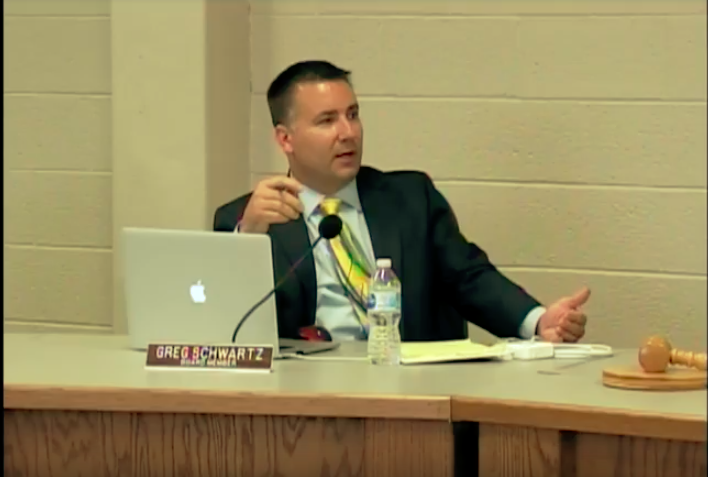
Board member Greg Schwartz discusses delaying any action on a bond during the Hays school board meeting Monday.
Board member Greg Schwartz proposed the move to delay. His first motion was to delay action for a year, saying he did not think the community supported a bond at this time.
Fox said she agreed with Schwartz and added if the board is not unified on a large decision such as a bond, the perception in the community would not be positive.
“I am a person who likes to keep moving forward and not necessarily stand still and keep checking the boxes. In this particular case and the feedback I have received and us not being in a strong consensus, I feel some waiting time … I am not sure a year is where I want to go, but I do feel we need to take our foot off the gas for a little a bit,” she said.
Board member Sophia Rose Young said she supported delaying action on a bond, but wanted to continue to discuss consolidation of schools, especially elementary schools. The board, in its debate leading up to the vote last night, had discussed moving to two or three elementary schools instead of four. However, all of those plans included a new elementary school or an expansion of one of the existing schools, which would have to be financed with a bond.
Adams spoke in opposition of the motion and presented an alternative motion to form a committee and set parameters that had been proposed by administration at a meeting in May. He said if the board charged a committee with creating bond plans it would likely be six months to a year before the school board made any decisions on a bond.
He said was concerned a delay would likely result in increased construction costs due to inflation. He said the new tariff’s levied on steel by the Trump administration also might drive up the cost of construction materials.
“Are we shrugging our ultimate responsibility?” Adams said. “Are we doing the right thing for the students? At the end of the day, the students are there and the board of education does its part. At the end of the day, it is what are we doing to improve the students. … I know we have fiscal responsibilities, but ultimately are we doing the right thing for the education of students?”
Walker said he agreed with Adams. He said the board has already been talking in circles for six months, and it is time to put a committee together and get things moving.
Oborny said the board did not need to rush into another bond, but said he supported the creation of a committee to continue to work on bond plans.
“At some point, safety becomes a factor,” he said. “I am not talking about secure entrances like everybody thinks. I am talking about the buildings falling in around them—46 years on an AC. At some point, that has to start affecting education value. Just the facilities are falling apart.”
In other business:
• The board discussed a pilot study on the use of Chromebooks at the Learning Center and elementary and middle school levels. The board is set to vote on the pilot program at its next meeting.
• The board approved property insurance and workers compensation insurance contracts
TOPEKA—The Kansas Supreme Court appointed Christopher Sook, an attorney from Hays, and David Trevino, an attorney from Lawrence, to three-year terms on the Client Protection Fund Commission.
Their terms begin July 1 and end June 30, 2021. The two succeed Charles “Ed” Watson, an attorney from Wichita, and Aaron Kite, an attorney from Dodge City, who completed their terms on the commission.
The Lawyers Fund for Client Protection, which the board oversees, compensates people who suffer economic loss as a result of dishonest actions by Kansas lawyers. The fund is financed by annual registration fees paid by attorneys to practice law in the state.
Out of nearly 11,000 lawyers actively licensed to practice in the state, typically fewer than 15 lawyers each year have been subject to claims made to the client protection fund.
The commission is composed of one judge, four actively practicing attorneys, and two nonattorneys.
Other members of the commission are Carrie Allton, attorney, Lawrence; Douglas Anstaett, nonattorney, Topeka; Thomas Hammond II, attorney, Overland Park; Beth Love, nonattorney, Dodge City; and District Judge Michael Ward, who serves in Butler County of the 13th Judicial District.
Douglas Shima, clerk of the appellate courts, serves as secretary of the commission.
An Eagle Communications employee last week reported a scam by an individual reporting to be with Publishers Clearing House.
The alleged scammer left a message on her home landline and told the woman she had won $1.2 million and a Mercedes-Benz.
The woman was told she needed to purchase a money card at Walmart for $499.99 any send the money to a specific account number in the United States.
After the money was sent, the alleged scammer told her she would be sent tax forms and other information to claim her prize. The woman did not send the money.
Assistant Hays Police Chief Brian Dawson said he had not encountered this particular scam before, but the department has encountered other scams that require victims to send money, money cards or provide personal information such as bank account or social security numbers to claim prizes.
He strongly urged residents to not to send money or release any personal information until they have been able to independently verify the person calling is who they say they are and the offer is legitimate. Dawson also recommended requesting any verification of a prize award in writing.
A similar scam involves a supposed call from the IRS, demanding back taxes, Dawson said. However, the IRS will not contact you by phone. It will contact you by mail. It will also not ask you to send money cards for payment.
It can be very difficult for local law enforcement to prosecute scammers or retrieve lost money, especially when the scammer has provided false contact information or if the scammer is located overseas, he said.
However, Dawson encouraged local residents to report scam calls, because it makes law enforcement aware of active scams and allows them to alert others in the community.
The Hays school board is set to further discuss plans for a third bond issue at its meeting tonight.
The district will look at organizing a group or groups to bring back plans to the school board for further consideration.
The board and district officials have discussed ways to provide updated facilities for elementary students while vacating older buildings with higher maintenance costs. Administrators has also noted fewer elementary schools would likely result in more efficiency and reduced costs.
The administration is presenting three possible plans in its board packet for tonight.
The first plan suggests the construction of a new elementary school that would house students from O’Loughlin and Lincoln Elementary schools. Under this scenario, the Learning Center, Munjor and the Early Childhood Center could be moved into O’Loughlin.
Under the second plan, ECC students from both Washington and Munjor as well as Lincoln students would be housed in a new elementary school.
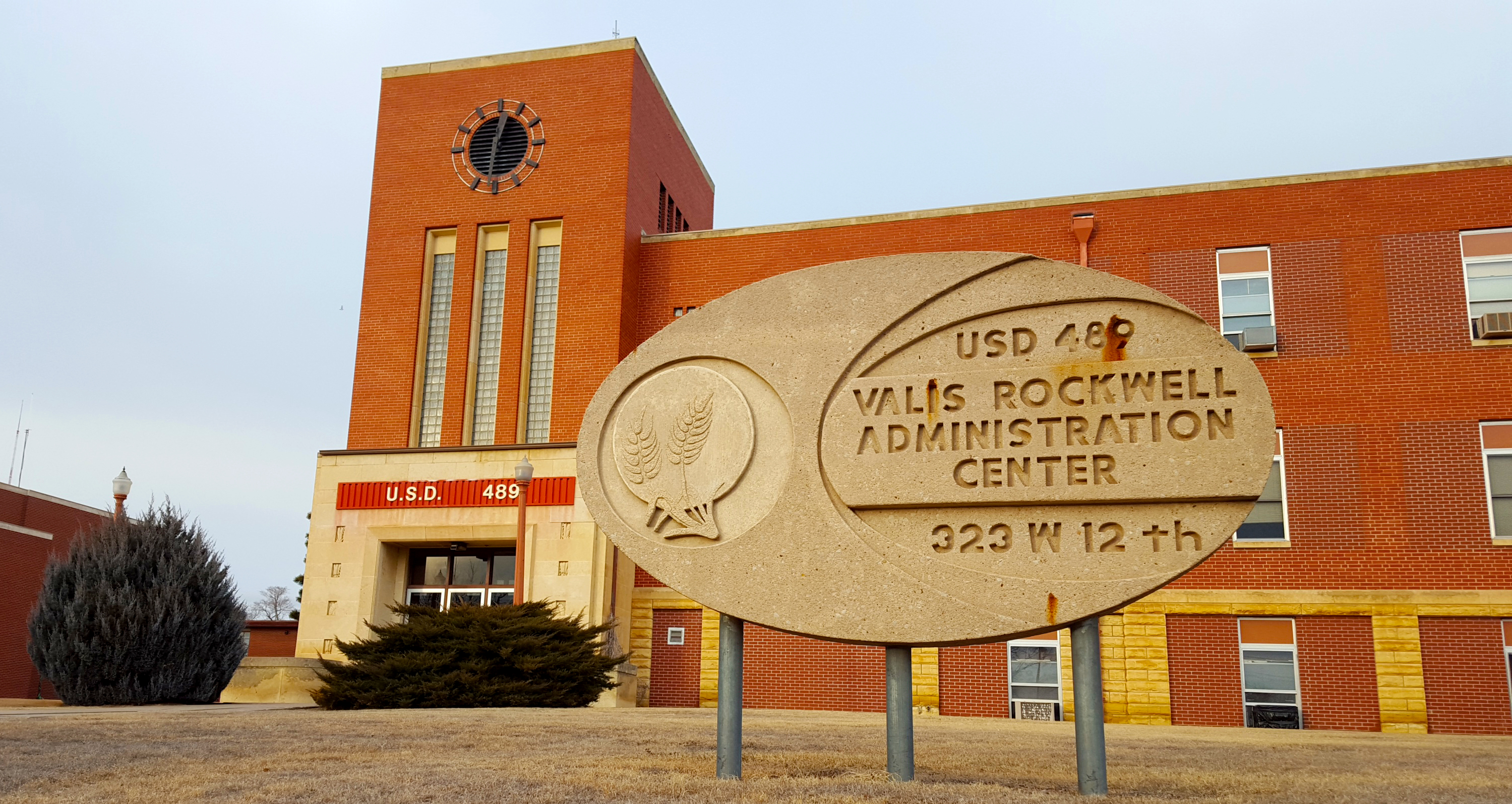
In the third plan, O’Loughlin and Lincoln students would be housed in a new elementary school. The Learning Center, Westside program, administration and maintenance would go to O’Loughlin. This would allow for the closure of the current Westside building and Rockwell.
The board will also review its capital improvement schedule at the meeting tonight.
The board will also discuss a pilot program on the use of Chromebooks in the district.
A recommendation from the administration would create pilot programs at the elementary school and middle school levels and at the Learning Center. Fifteen Chromebooks would be purchased for the Learning Center, 25 for an elementary classroom and 30 for a middle school classroom. With training and licensing, the program is estimated to cost $22,543.
The board just approved the purchase of Dell computers for the high school. However, several board members said they would have preferred a proposal that would have included Chromebooks because they felt it would have been a cost savings.
Other items on the agenda include
• Transfer of $300,000 from the general fund to the contingency fund. The new balance in the contingency fund would be $961,828, which is still less than the two month of payroll or $4.8 million recommended by the Kansas Department of Education.
• Discussion of student handbook revisions
• Approval of property and workers compensation insurance
On the map: Salina, Kansas Distance from Hays: 97 miles Drive time: 1 hour and 28 minutes
SALINA — For many in northwest Kansas, Salina is the “big city.”
It’s not. It is a small town, in many ways similar to Hays.
I lived for a few years in Salina right out of college. There are places here I have been frequenting for years, and yet I often find new places to explore.
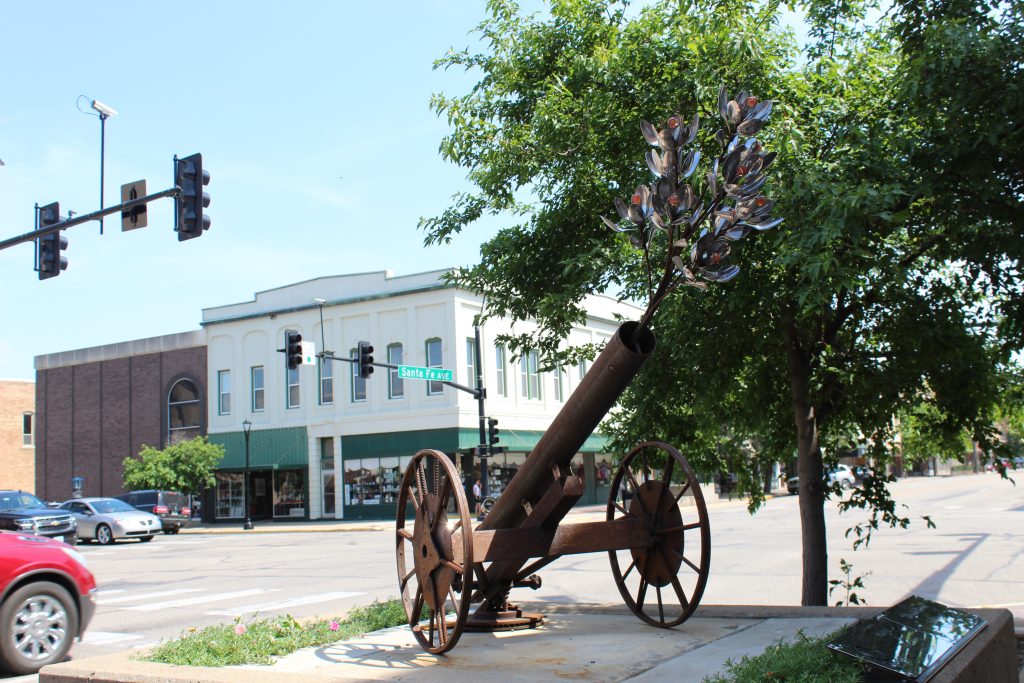
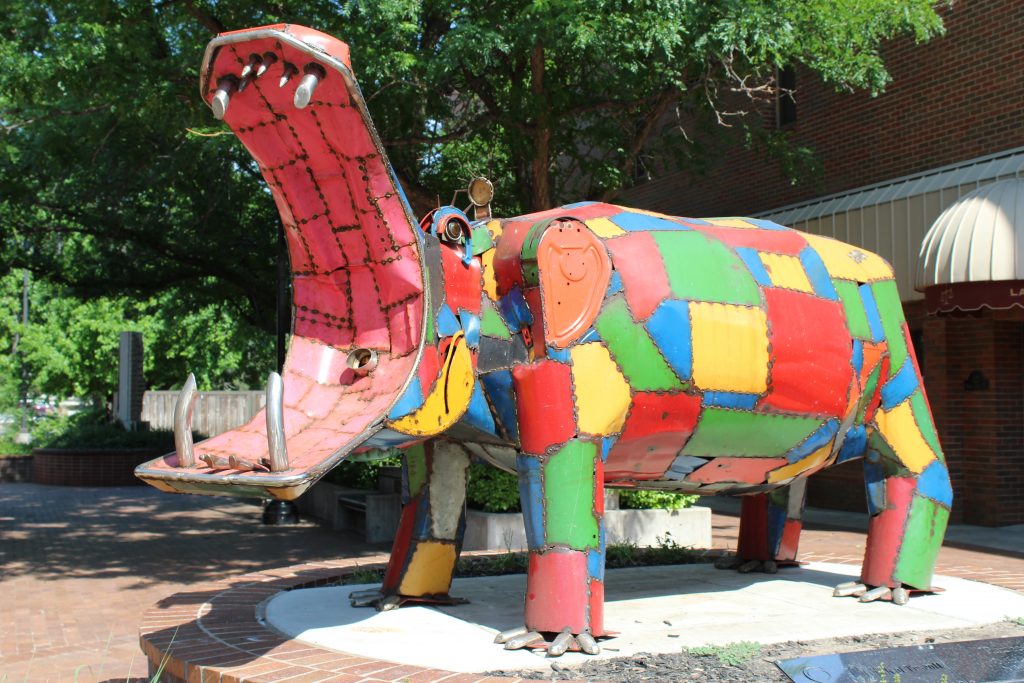
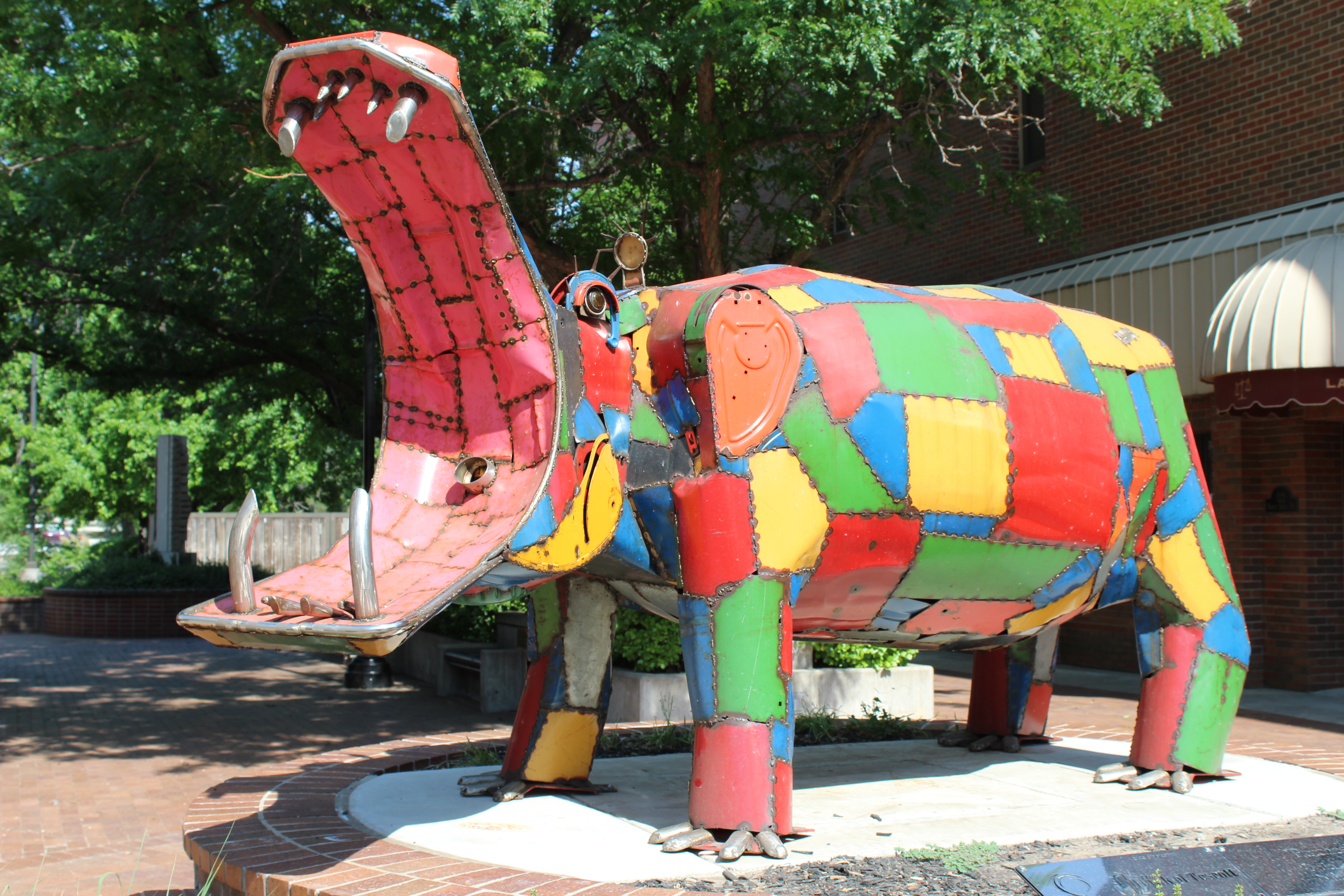
“Patches” is part of the 2018 ScultpureTour Salina and is found on Santa Fe Avenue in Salina.
The south Ninth Street corridor has grown significantly since I lived in Salina in the mid-1990s. I try to resist its big-box store allure when I visit. Instead, I go to where I feel more at home — downtown.
My most frequent stop in Salina even if is for just an hour on my way to see family is Martinelli’s Little Italy, 158 S. Santa Fe. My sister has driven 115 miles to just eat at this restaurant. My family likes the simple spaghetti and meatball. I say meatball, because one of their meatballs is a little smaller than tennis ball. I am not exaggerating.
Across the street from Martinelli’s is the Stiefel Theater, a beautiful art deco movie theater that was opened in 1931. The theater was designed by the Boller Brothers. If the name sounds familiar, it should. They were the same architects on The Dream Theater in Russell. The Stiefel is also on the National Register of Historic Places. Today, the Steifel is primarily a live-performance venue.
The Stiefel Theater, 151 S. Santa Fe, a beautiful art deco theater, was opened in 1931 and is on the National Register of Historic Places.
Tony’s Pizza Events Center is the other major venue in Salina. It hosts concerts and trade shows, among other events. It will host the Salina Comic Con July 7-8.
If you want to do dinner and a show at the Stiefel, there are other downtown dining options. I recently tried Blue Sky Brewery and Eats. These guys will put about anything on their wood-fired pizza. I had the Big Lebowski, which has pasta as a topping. I didn’t think this would work, but it did. Some other recent pizzas of the week, included Crab Rangza and Uncle Morty reuben pizza. Check out their Facebook page for weekly special.
I am not a beer person, which I know is heresy in Hays, but the night I was there, some of their craft beer selections were Crankcase IPA, Watermelon Crawl, Jalapeno Cream Ale, Fire Engine Red and Dirty Ol’ Stout.
I prefer ice cream over beer, so here are a couple of great places in Salina.
A Dagney’s employee is ready to serve up the shop’s homemade ice cream.
Dagney’s Ice Cream, 105 E. Iron, is a newer establishment downtown. Salinans Ken and Dagney Stromberg make their ice cream in store. I had the Speculoos, which tastes like a snickerdoodle, but for the young or young-at-heart, they also have fun flavors, such as Fruity Pebbles and Captain Crunch Berry.
I have been going to Bogey’s for more than 20 years. The small ice cream shop and burger joint was founded in Salina 32 years ago. Carole Sperling, owner with her husband and son, was a big fan of old movies and named the restaurant after Humphrey Bogart.
If Blue Sky will put anything on a pizza, Bogey’s will put anything in a shake. Their slogan is, “Shaking over 101 ways,” but the manager insists they have well more than 100 shake combinations. If you are buzzing through on I-70, they have a drive-through.
The Salina’s culinary history goes even further back. The Cozy Inn, 108 N. Seventh, has been operating in Salina since 1922 and is one of the 8 Wonders of Kansas Cuisine. You can buy chips and a drink at the Cozy, but that is all. It is all about the burgers. Its greasy onion-laden burgers are nationally known. The burgers are slider-sized and most people buy them by the bag takeout because the Cozy is one of the few remaining last six-stool diners in the U.S.
The Cozy Inn has been serving up their burgers by the bag from the same grill for 96 years.
The legend goes the secret to the Cozy burger is the grill, which is the same grill that has been used at the burger joint for 96 years. One of the owners of the Cozy decided they would upgrade, so they sold their old grill and purchased a new one. Cozy regulars complained the burgers didn’t taste the same. The owners had to track down the original grill and repurchase it.
If you are at the Cozy, turn around, because down the street is a beautiful relief sculpture on Sacred Heart Cathedral. The church was built between 1951 and 1953 and combines Greek styles with something that is reminiscent of a Kansas grain silo. The limestone sculpture depicts Christ on the Cross with a turned head looking down upon a processional lead by a Kansas farmer and his family.
Sacred Heart Cathedral, 118 N. Ninth St.
If your belly’s full, downtown has plenty of boutiques, gift shops, antique shops, a you-paint ceramic studio (On the Pot), quilt shop, free-trade store and an organic and local produce market, Prairieland Market.
One of my newer favorites is Ad Astra Books and Coffee House. It is a frequent hangout for local artists and entertainers. It carries a wide selection of used books and a section of new books by Kansas writers.
I have always seen Salina as a culture and arts haven on the prairie. Like Hays, Salina has a strong arts commission. The Salina Arts and Humanities Commission was created in 1966 and is a department of the City of Salina, which means it has been influential in public works projects and public art installations.
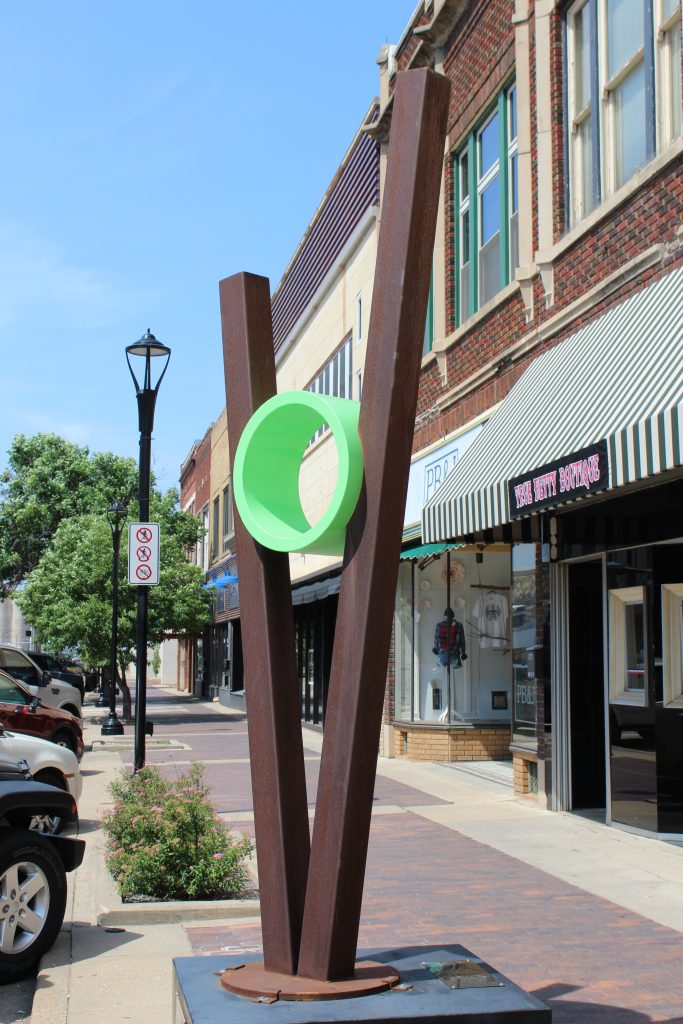
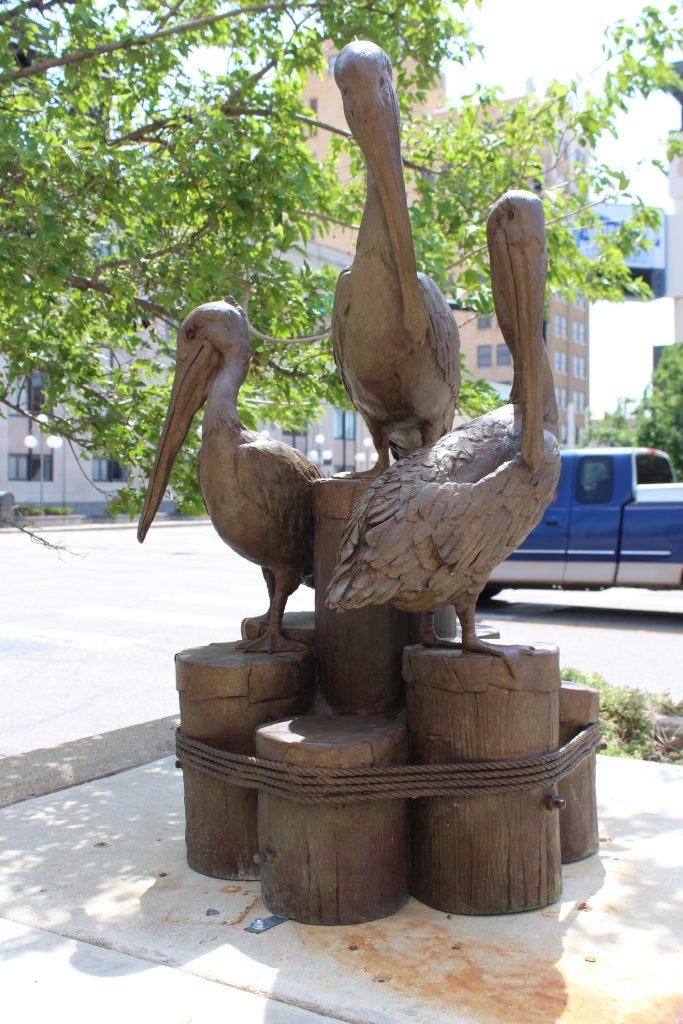
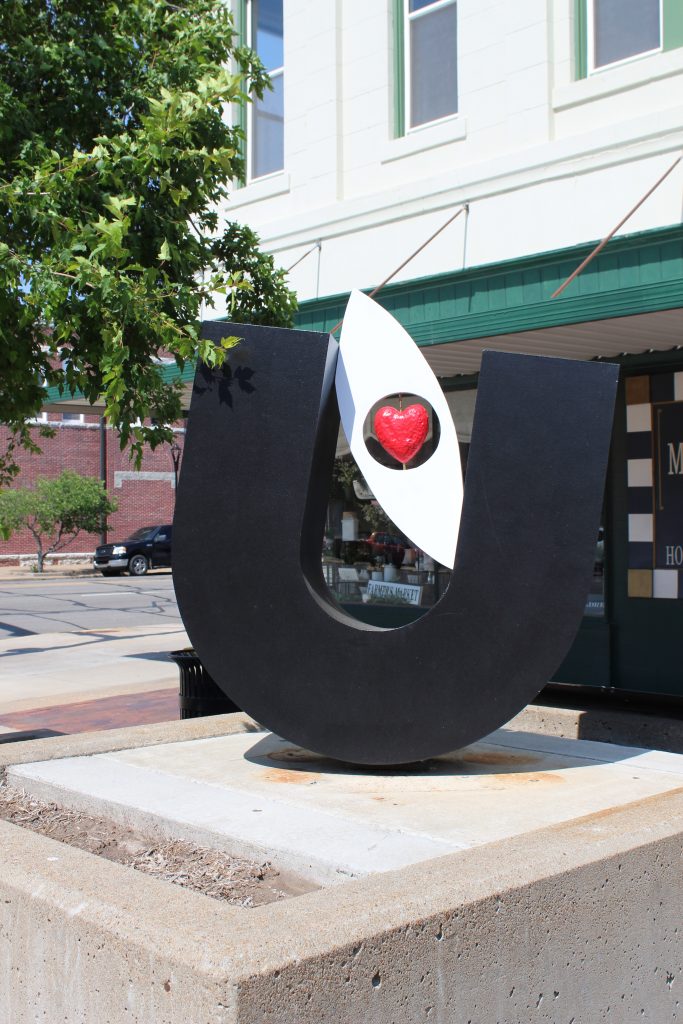
Santa Fe, the main drag downtown, is lined with ScultpureTour Salina. The Arts Commission rotates in new art every spring.
Permanent installations and murals dot the city in public places and parks. The colorful “Waiting in the Wings” by David Lowenstein graces an outdoor stage off Santa Fe downtown. Oakdale Park, the home of the Smoky Hill River Festival in June, boasts “Kansas Blues,” an almost patchwork quilt on the former Carver Pool floor. Also in Oakdale Park “Under Cottonwood,” columns of recycled newspaper, are a commentary on decay and formation of land.
The Salina Arts and Humanities website has photos, locations and a list of artist names to guide you on your sculpture tour around they city.
At the heart of the arts commission is the Salina Art Center. This a space similar to the Hays Arts Center that hosts rotating exhibits. “Anthony Hawley: Fault Design” and “Birdless” will be featured in the gallery through Aug. 26. Admission is free.
Fault Diagnosis by Anthony Hawley is the current exhibit at the Salina Art Center. Photo Courtesy of the Salina Art Center
“Fault Diagnosis“ is a multimedia performance event and exhibition that explores what happens when things we think we know so well break down and fail us, according the art center website. “Birdless“ explores themes of hoarding, collecting and the spam of our lives.
Just down the street from the art center on Santa Fe is the Salina Art Center Cinema. The theater shows foreign films, documentaries and other films that the big movie houses in rural America are probably not going to dedicate space to. Most shows run for only a week and showtimes are limited.
You can sign up for the Salina Art Center email list at the art center to receive weekly updates about exhibitions, lectures and classes at the art center and movies showing at the cinema.
Salina offers plenty of family fun. The Smoky Hill Museum has a new area for kids called the Curiosity Shop. You can make designs on a giant peg light board. An area is dedicated to tornado education in which you can create your own vortex as well as experience a tornado in a wind tunnel.
I was lured into a few free games on their mechanical pinball machine. I am a little bit rusty.
A quiet nook in the rear of the Curiosity Shop offers a place to play board games; games are provided. The museum offers plenty of education opportunities, including several exhibits on Salina’s agrarian history. Children are free to touch and play with items in a dugout model.
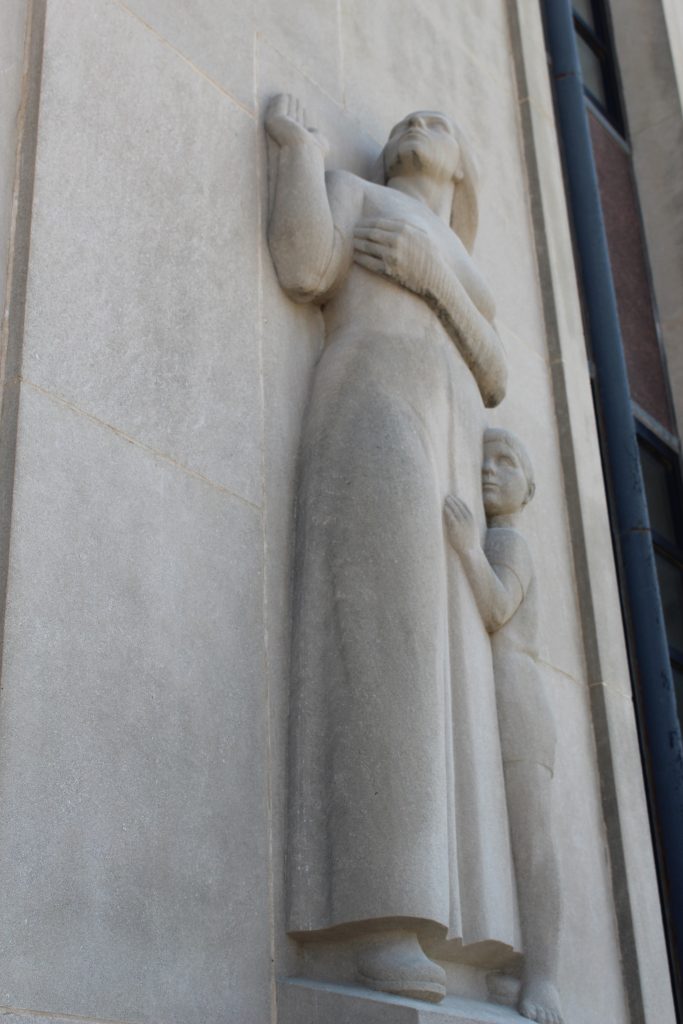
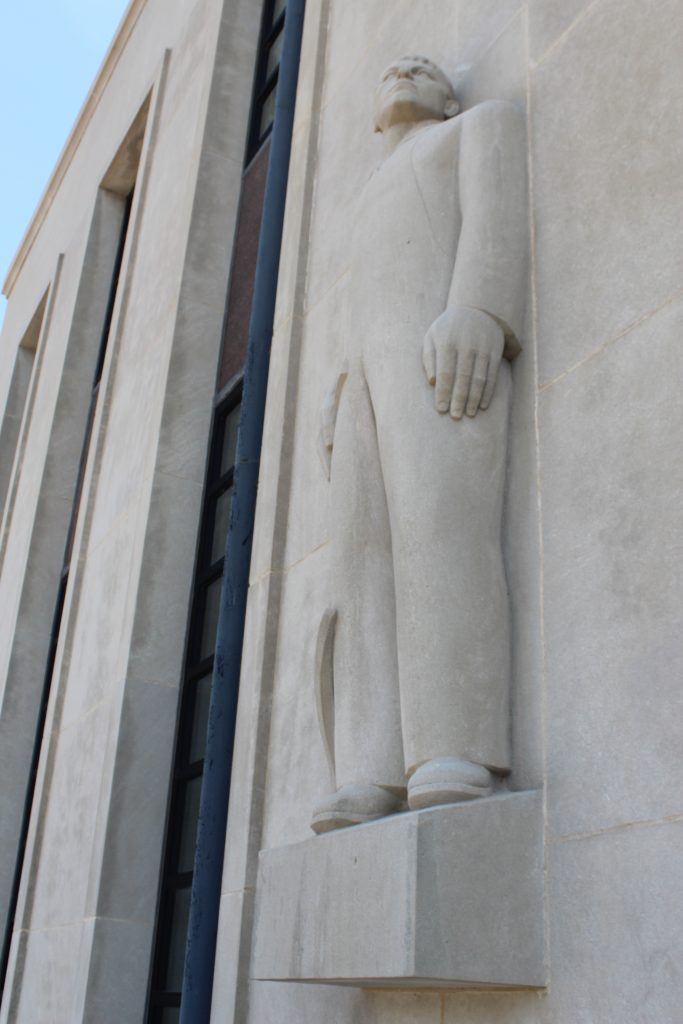
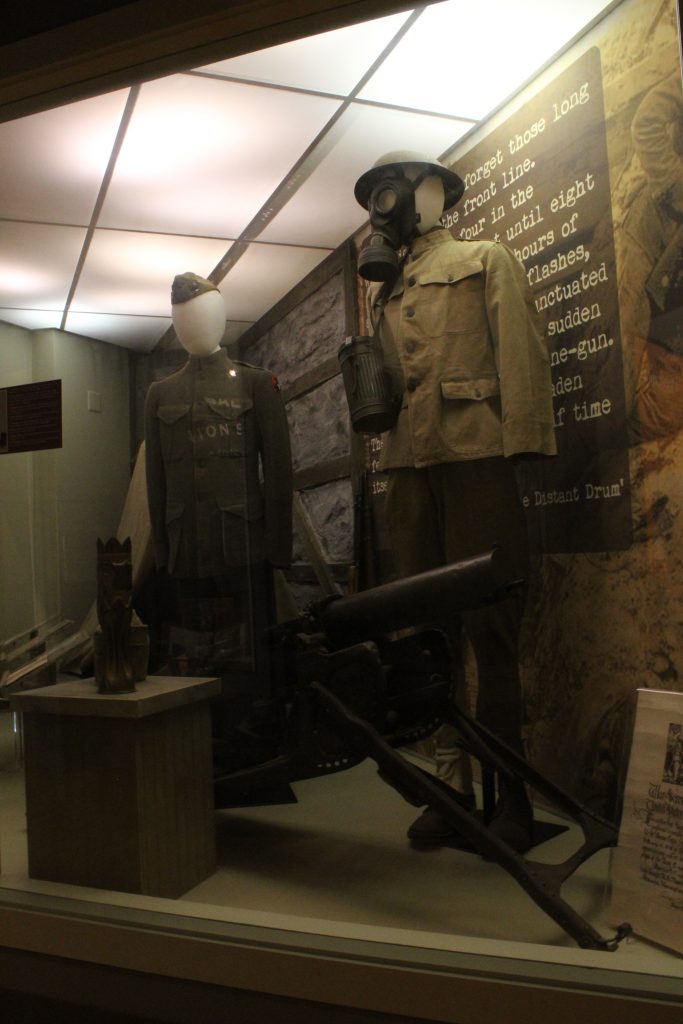
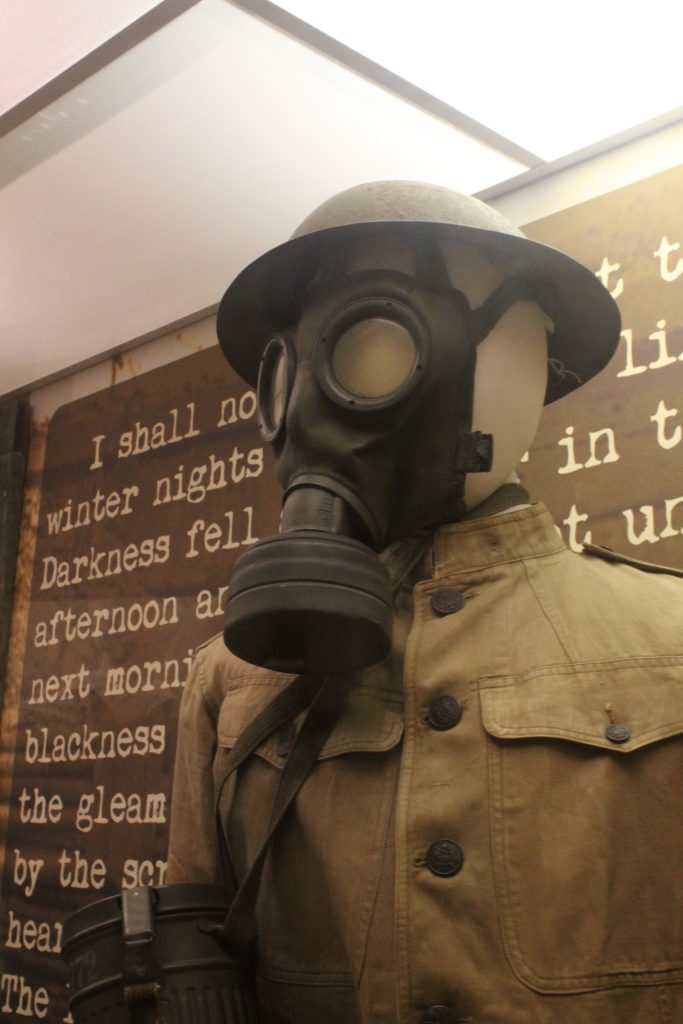
The museum currently has a temporary exhibit, “In the Trenches with Company M,” which depicts the journey of Salina’s Company M during World War I. Those interested in military history can also view artifacts from Salina’s closed Schilling Air Force Base. The museum itself is a former art deco post office and is on the National Register of Historic Places. It too has relief sculptures on its exterior. They were carved by Carl Mose and Jon Johnson. Admission is a free-will donation.
Kenwood Cove Aquatic Park Photo Courtesy of the City of Salina
My nephew had fun last summer at Kenwood Cove Aquatic Park. Philip particularly liked the park’s 1,400 feet of slides. Kenwood also has a lazy river, wave pool and children’s area. Kenwood offers affordable passes: $4 for children through age 17 and $6 for adults.
Salina has many beautiful parks, but one of my favorite recreation areas in the city is Lakewood Park. Nature trails wind around a small lake with plenty of trees and shade. It’s a nice walk on a summer evening. The park also has a discovery center that is open during the week with a lot of displays on native wildlife for kids to explore. Lakewood also has a disc golf course.
Salina Masonic Center, 335 S. Santa Fe Avenue
There are 24 miles of walking trails in Salina. See walksalina.com. One of these tours is “When Houses Became Homes Tour,” which takes you from about Ninth and Iron streets to Ninth and Prescott streets.
H.D. Lee of Lee Jeans founded a garment factory in Salina in 1911. The home in which he lived, at 200 S. Seventh, is on the historic homes tour and is on the National Register of Historic Places. Although not on the NRHP, the Salina Masonic Center on Santa Fe is necessary stop for those interested in local architecture. It was completed in 1927 and is framed by columns and carved gargoyles.
When Philip was younger, he liked to visit Rolling Hills Zoo, which is 6 miles west of Salina off of Interstate 70. The zoo is particularly known for its white rhinos, but you can ride a tram or walk to see more than 100 species.
In the heat of the day, Rolling Hills offers an air-conditioned museum with mounted animals specimens from around the world. At the rear of the museum is a children’s area with lots of hands-on play. The museum hosts traveling exhibits and is currently featuring “The Art & Science of Arachnids” through Sept. 3. See the Rolling Hills website for hours and admission.
One attraction I have yet to get to in the Salina area is Prairie Lavender Farm, which is about 9 miles north of Salina near Bennington.
Prairie Lavender Farm, north of Salina. Photo Courtesy of Prairie Lavender Farm
The Bennington farm was established in 2002 and has 4,600 plants representing 15 varieties.
The lavender is blooming and being harvested now. The farm operates a small shop that sells lavender products. Lavender, which is a member of the mint family, has long been revered for its healing and relaxing properties. In addition, to the lavender, the farm has fairy, flower and herb gardens and plenty of room for children to run and play. Now through September, the farm is open 9 a.m. to noon. Admission is free, but a 45-minute tour will cost you $5 per person for anyone 6 and older. To set up a tour, call 785-488-3371.
I know that is a lot, and probably way more than you could do in a day. Pick and choose what fits your tastes and family.
I’m out to far western Kansas this week, so see you on the road!
Other links to check out while you are planning your trip:
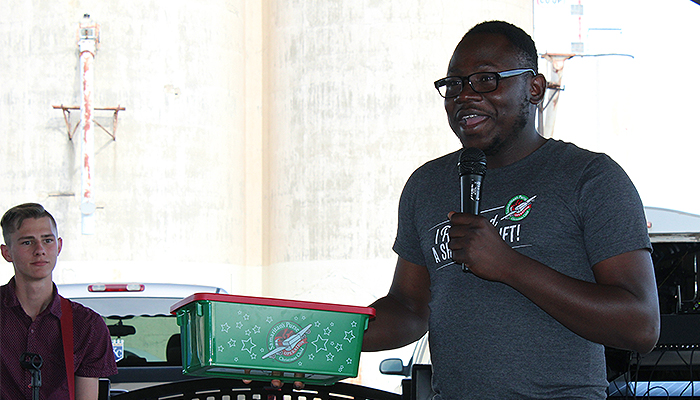
Désiré Nana, who was born in West Africa, holds an Operation Christmas Child box. Nana received a box of toys and school supplies when he was 8. He told his story Saturday to a group in Hays.
Désiré Nana had never received a present in his life and neither had any of his friends.
He lived in the impoverished community of Burkina Faso, West Africa.
Nana’s village did not have electricity and he walked 3 miles one way to school. His parents couldn’t pack him a lunch, so he picked mangoes along the way.
“Our parents were doing the best to feed us, so we did not have toys,” he said.
When Operation Christmas Child came to his school when he was 8 with boxes of toys and school supplies for him and his fellow classmates, it was calamity. Nana, now 25, spoke to a group of Hays residents Saturday at the Hays Downtown Pavilion about his experience with the program.
“I want you to think about it. There are these boxes,” he said. “Children have never received a box. ‘What is going on?’ There is commotion everywhere. There was a team from the United States there. ‘Why are we having people from the United State here? Are we in trouble? I think we are getting gifts.’ ”
Before the children were given their boxes, they were given a booklet in their native French called “The Greatest Gift.”
A minister gave a lesson from the book.
However, the children were rife with anticipation.
“‘Everybody was ‘Oh, my goodness when are we going to open the box!’ The preachers is preaching about Jesus dying on the cross, but I was not listening. I was all about the box. ‘Wrap it up so I can open the box!’ He kept talking and talking. I was thinking, ‘When are you going to wrap it up so we can open the box?’ ”
Finally the children were allowed to open the boxes. It was chaos. Children were ripping into the wrapping paper with their teeth. The children peered into their boxes. Some began to cry. Others screamed with excitement.
That initial sermon may not have completely sunk in with Nana, but he took home and read the booklet, which told of Christian creation, the Gospels and the crucifixion of Christ. He would not fully understand how that shoebox of trinkets would affect his life until he was 12.
Nana received a toy truck, school supplies and a toy he was not sure what to do with. He also received girl’s hair accessories, which he initially didn’t understand. Nana was the only child of his seven-person family to receive a box. Some people who pack boxes account for this and pack items for both boys and girls so the child who receives the box can share items with brothers or sisters.
He did not open the mystery toy for two weeks until one day he dropped it and it lit. His mother “freaked out.” She insisted he open it right away. “Don’t burn the house,” she said. “What is that?” She was scared. Désiré was scared.
It was a light-up yo-yo.
No one else in the village had one. He became famous in his neighborhood.
Désiré Nana talks about the booklet, “The Greatest Journey,” a Christian study guide that accompanies the Christmas boxes.
“People would ask me if they could play with it. I would say, ‘Take it easy, man. That is my toy from the United States.’ ”
There were no lights in his neighborhood, so the children would come and watch him play with his yo-yo. Eventually, he let other children borrow the toy.
Nana said the box and the truck and the yo-yo showed him someone who he did not even know loved him. They did not just say it. They made it tangible with the Christmas box.
Nana came from a Christian home, but his parents did not attend church before the Christmas boxes arrived. The nearest brick-and-mortar church was hours away. After Operation Christmas Child came to his village, his family started attending church together.
When Nana was 12, he organized a children’s ministry in his neighborhood. Two hundred children came. His ministry eventually grew to largest children’s ministry in his country.
“I remembered something about my yo-yo,” he said. “Just like the yo-yo lighted up your dark neighborhood, so are you the light of your neighborhood. According to Jesus, you are to spread out the unconditional love that has been given to you.”
He worked with Operation Christmas Child to train mission workers to accompany boxes.
“The box is just the beginning of the journey,” he said. “In two months, they won’t have the box. They will forget the box, but it is to keep Jesus in their heart. That is the whole point. We do discipleship and multiplication. … We are giving people the opportunity to hear the Gospel.”
After the boxes arrive, children can take a 12-week class guided with another booklet, “The Greatest Journey,” which is also in their language. At the end of the course, the children are given a Bible in their language, and they have a graduation ceremony.
Children don’t have graduation ceremonies in West Africa. Their parents may not know what they are studying in school and likely never attended school themselves.
“That is another opportunity for us to share the Gospel — to tell them somebody loves you and cares about you,” he said.
Churches that were planted in Burkina Faso because of the Operation Christmas Child program when Nana was a child are still operating today.
“I want to say thank you for packing boxes and making a difference,” he said. “You don’t just touch those children’s lives. You transform their lives. If you touch, it would be just for three months. But if you transform them, they know Jesus as their Lord and Savior.
“When people ask me what is the most important thing to put in my box. That is my answer — prayer. The most important thing you put in a box is not the toy that you buy. A flashlight is going to break down. They are not going to use it for eternity. They are going to forget about the box. Your prayer is going to make a difference. I believe the woman who packed my box (She did not put her name or picture in the box, so I do not know who she was.), but I know one thing — she prayed over the box. … That lady prayed I would be a disciple.
“You are actually doing something that has an impact and turning people around. You pray for people to become a disciple or a disciple-maker like me.”
Nana has been studying in the United States for two years. He recently received a scholarship to Oral Roberts University in Tulsa. He hopes to earn a degree in business and ministry. He also has a goal working to establish a hospital in Africa. He has already received a donation of medical equipment toward that goal. He hopes to fight malaria, which kills many children on the continent.
Operation Christmas Child is a branch of the nonprofit Christian mission organization Samaritan’s Purse International Relief. The organization has been led by Franklin Graham since 1979.
Operation Christmas Child encourages volunteers to pack shoeboxes with simple gifts of toys, hygiene items and school supplies. The boxes are sent to children like Nana in countries with extreme poverty or that have been stricken by war.
2.7 million children graduated “The Greatest Journey” course in 2017. 1.9 million of those children made decisions for Christ.
This year’s collection week will be Nov. 12-19. There will be two collection locations in Hays: Messiah Lutheran Church and CrossPoint Church. In 2018 Hays volunteers hope to collect 3,200 shoeboxes to contribute toward the global goal of reaching 11 million children.
If you wish to volunteer or for more information on Operation Christmas Child in northwest Kansas, contact Rachel Albin at [email protected].
Reece Leiker, 13, Hays, with a bottle of her Pure Roots laundry detergent.
By CRISTINA JANNEY Hays Post
Thirteen-year-old Reece Leiker has a pretty nice life — what you might expect of a typical American teenager. She eats well. Her parents live in a nice home in Hays. She has nice clothes.
But when Reece was 11, she learned there were people in this world who did not share that life. Something in her heart compelled her to help.
Leiker, now, 13, is selling Pure Roots homemade laundry detergent to raise money to build homes for the poor in Nicaragua.
Leiker has joined forces with her parents. Leiker alone has raised almost $49,000 to build eight homes in the impoverished country. Together, she and her family have built 14 homes in Nicaragua.
Her parents first took up the cause after they attended a seminar in February 2016 by advocate Dani Johnson of King’s Ransom Foundation. According to the nonprofit’s webpage, it helps build homes, assists orphans, provides clean water and rescues children from sex trafficking around the world.
Reece Leiker looks out a window at dump in Nicaragua. She said seeing children eat from the dump changed her perspective on what it is to be poor.
Taryn Leiker, Reece’s mother, said the family had contributed to many causes in the past, but as they researched these charities, they found very little of the money was going directly toward assisting the people they wished to help.
Taryn Leiker said she and her husband, James, were drawn to the Nicaraguan project because 100 percent of their investment is spent helping the needy. They learned there is great need. Nicaragua is the second poorest country in the western hemisphere only behind Haiti.
Taryn and James initially donated enough money to build six homes in Nicaragua. Each home costs about $5,200. The King’s Ransom Foundation leverages matching Nicaraguan funds to stretch donors’ dollars.
Reece visited Nicaragua with her parents in January 2017.
“It completely changed how I saw things,” she said, “because I saw kids living out of the dump, eating the food that was in there. When I came home, I felt so bad, because I was here eating gourmet food and eating food from the store and not from the dump, so it really changed how I saw that.”
Reece Leiker with Nicaraguan children.
King’s Ransom builds homes that are above the standard required by the Nicaraguan government. They include plumbing, a bathroom and a kitchen. Each home can house five to seven people.
The foundation also tries to establish families with a sustainable income. They might provide chickens, which the family can sell, eat or use to produce eggs.
Taryn said providing chickens can be life-changing for a family. Most poor families in Nicaragua earn $2 per week.
“When one of them would get really sick, they would say this person needs protein,” she said. “An egg can be 75 cents, but it is a full day’s walk to where they can actually purchase an egg. They lose an entire day of an income. (They) walk two ways that takes them an entire day to spend almost 50 percent of what they can earn in an entire week, hoping that is going to bring back the health of someone who has basically gotten to the point they are so malnourished they can’t function.
“It might sound like, ‘So that’s a chicken,’ but the impact that can have is huge for some of these families”
Reece knew she wanted to help, but she had to find a business model that would maximize her return. She wanted to make loom bracelets, but found her return on investment would be low.
Reece and her mother, Taryn Leiker, with a man who makes lamps out of sea shells to sell to support himself.
A family friend suggested homemade laundry detergent. She had been using a store brand, and was not satisfied with the results. The friend tried the homemade soap and found it worked better and was cheaper.
The ingredients are simple: Borax, Arm & Hammer washing soda and Fels Naptha, a recipe that has been used for more than 120 years.
Reece’s dad had a motor oil stain in a shirt. The homemade laundry soap pulled the stain out in five washes.
The return on investment was also higher. She could make 25 bottles in an hour.
Her homemade detergent is also more eco-friendly because instead of plastic packaging, Reece packages in glass bottles, which she recycles.
“It wasn’t about me,” she said. “It was about how we could best help the poor.”
Reece set her sights high — five homes at a cost of $27,000 within the first year. She reached that goal in seven months, more than her mother used to make in a year.
“It just goes to show that we limit ourselves and anything is truly possible if we are just willing to follow the simple steps that it takes to get somewhere,” Taryn said. “This was not something that we have done and encouraged her to do. We just put things on the table to see what she would do with it.
“We would make a comment and see if she would run with it. This is really who she is coming out. We are just creating an environment in which she just knows there are no limits — that she is capable of anything. We are just coming alongside her in any way we can.”
The poor of Nicaragua salvage everything they can to make a living. This swan was made by a young man who dug the paper out of the dump to create items to sell to tourists.
Reece said she can see God working through Pure Roots. The first week she sold her soap at the Downtown Hays Market, she ran out of bottles. The family prayed about it. Someone donated 100 bottles that were just sitting in a basement.
Reece still sells her detergent Saturday mornings at the market. She also accepts monetary donations for her project. Reece’s project is sponsored by one of her parents’ businesses, so 100 percent of the proceeds from the sale of the detergent goes to assisting the poor.
One bottle of Pure Roots detergent costs $6, three bottles $15 or five bottles $20. The number of loads one bottle will make depends on the type of wash machine you own. One ounce is required for high-efficiency wash machines and two half ounces for top-load washers with agitators. One bottle should last about 20-25 loads for the high-efficiency or 10 to 15 loads for a top loader.
People interested in buying detergent or donating to Reece’s cause can also reach her on Facebook.
Reece said helping the families in Nicaragua has brought her peace, and she hopes to be a missionary when she is older.
“It really hit me hard that there were people in the world who were not as lucky as me—who didn’t get to eat, who didn’t have Nike tennis shoes, who didn’t have clean water, who didn’t have homes, who didn’t have air conditioning,” she said. “It was really sad, and I knew I needed not to be somebody who just sat around and said, ‘Too bad, somebody will help them eventually.’ I just needed to step up to the plate and do what I knew I needed to do.”
Reece continues to set lofty goals. Combined with her parent’s initial investment, Reece homes to raise a total of $104,000 to build 20 homes in Nicaragua.
Unfortunately, Nicaragua is experiencing political strife right now, and King’s Ransom has had to divert some funds that it would normally invest in housing to feed people. At least $20,000 a week is needed to fund the food relief effort at this time.
The unrest started as protests over tax increases to fund the country’s pension system, but international journalists are reporting escalating violence in recent days.








 By CRISTINA JANNEY