Come enjoy a science story and activity at the Sternberg Museum. They will explore topics such as shadows, engineering, fossils and flowers. Each week will cover something new and you will have a fun project you can take home.
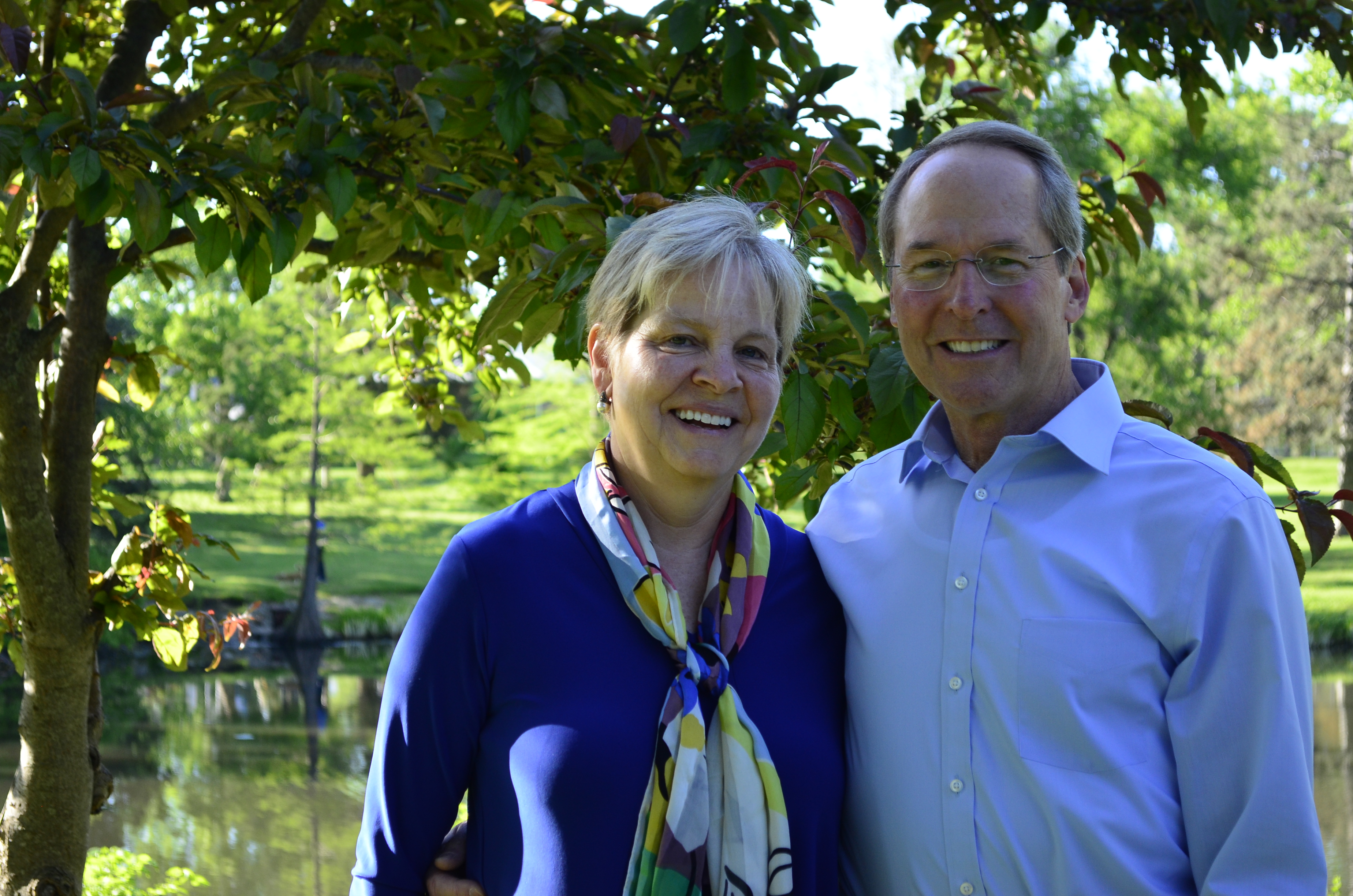
Republican candidate for governor Dr. Jim Barnett is crisscrossing the state to introduce his running mate — his wife, Rosie Hansen.
He made a stop in Hays on Thursday.
If elected, the duo would be the first couple to serve together as governor and lieutenant governor. Barnett said he wanted someone who was correct on the issues and could step in at a minute’s notice to fulfill the role as governor. Hansen said she works well with her husband and sees the partnership as an advantage.
Hansen grew up on a small farm near Americus, Kansas. She earned a bachelor’s degree from the University of Kansas, a law degree from the University of Minnesota, master’s in public administration from Harvard University and was a National Security Affairs Fellow at Stanford University.
She spent the majority of her career working for the U.S. State Department in the Foreign Service Office. She traveled to Kuwait just after Gulf War ended to help set up U.S. Embassy, worked in Sarajevo, Bosnia, as the war coming to an end and in Kabul, Afghanistan, among other posts. Bombs were still flying and snipers still present when she started work in Bosnia.
Hansen worked closely with many government agencies and foreign governments on the management of the embassy operations so others within the embassy could get their jobs done.
“In places like that, a new problem comes up everyday, and if you are not good at problem-solving and managing those types of situations, you are not going to be very effective at your job. That is what I enjoyed, building things and solving problems, and that is what I realized I could bring to state government.”
Hansen said Kansas has suffered in the last seven years from not having a functioning state government. An opportunity to rebuild Kansas’ government was why she said she agreed to step up and run with her husband, which she was initially reluctant to do.
Under Barnett’s and Hansen’s One Kansas platform, they would like to see money go back into Kansas Department of Transportation for infrastructure improvements, the medical and mental health systems, and education. Barnett and Hansen support Medicaid expansion in Kansas for humanitarian and economic reasons.
“What has happened with Gov. Brownback and now Gov. Colyer is that they have raided KDOT and every other fund they could, taken the money out of every cookie jar they could find and now we are harmed as a state,” Barnett said. “We don’t have money in the state for roads. Our mental health system has been systematically dismantled, and we have a privatized Medicaid system called KanCare that sends money out of state to for-profit institutions.”
Colyer championed KanCare. Barnett noted United Health Care’s CEO’s last salary was $66 million. United Health Care is a contractor under KanCare.
“They take 8 percent off the top plus administration costs while our hospitals are struggling to stay open,” Barnett said. “One has closed, and 30 are on the critical list. Our hospitals are not being paid, and Kansans do not have access to health care when we are sending that kind of money out of state.”
There is no accountability for the money, according to the Post Legislative Audit, Barnett said. No data is available to see what value Kansans are getting from these companies, he added.
Rebuilding a functional Department of Commerce is also key, Barnett said.
“We need a Department of Commerce that has a governor leading it and a secretary leading it who understands that our state is different regionally,” he said. “This part of the state is different than the southeast, which is different than Johnson County for instance. The last time we approached economic development on a regional basis was when Bill Graves was governor, and that is very short-sighted.”
Hansen’s extensive global background should prove helpful as the Kansas tries to market ag and other products internationally. Barnett expressed concern about what is happening in Washington with trade and tariffs and how this will affect ag trade.
Barnett and Hansen’s vision for Kansas schools follows some of the goals already set by the Kansas Department of Education. These include kindergarten readiness, social and emotional support and growth for children, and career readiness.
Barnett supports technical programs to train Kansans for the tens of thousands of jobs in Kansas that require advanced training but do not require a college education. He said this will help to attract and retain young people in the state.
Barnett wants to get Kansas out of court. The Kansas Supreme Court is set to rule later this month if the Kansas Legislature’s plan to add about half a million dollars in funding to Kansas K-12 education over the next five years is adequate. The state of Kansas has been in and out of court for years on the funding issue.
Barnett suggested in his One Kansas plan, $600 million in education funding be added to the budget over three years. However, a study commissioned by the Legislature this spring suggested the state needed to increase funding by $2.1 billion.
“It would be my prediction that the court will not accept this,” he said of the Legislature’s plan, “and it is going to take a governor who is going to lead through appropriate investment in education and long-term appropriate investment in economic development for the state to we have enough money to do this.”
The state may see a budget surplus next year as a result of changes in the federal tax code. The Legislature made a failed attempt to float a tax cut in the spring as a result. Other candidates in the race are supporting a tax cut. However, Barnett said Kansas needs to pay its bills.
“We need to shore up KPERS, refund KDOT and invest in education and invest in a functional mental health care system across the state. That is where Kansas has a chance to put money back in the bank and invest,” he said.
Barnett said he recognizes economic development is the most important factor in Kansas if the state wants to raise money for schools, roads and health care. Barnett would like to grow tourism as an economic driver.
“Tourism is the economic engine still parked in the garage in Kansas,” he said, “but it is also for our state’s image. We are looked at as a fly-over state with black eyes. We have black eyes around the nation as a state that can’t stay out of court for schools or put money back for roads. We need to market Kansas in a way that changes our image.”
The last major issue in their campaign platform is young professionals.
“We educate and raise all these great young people, and then they leave. What can we do?” he said. “Jobs are part of that.”
He said Kansas needs to have job opportunities that can support families.
“What do young people look for? They look for communities that bring a sense of community and a sense of something bigger in life that they are working on. Communities [need to] have good schools and access to health care and have quality of life issues,” Barnett said.
Barnett commented briefly on a controversy surrounding his Republican opponent Kris Kobach. Some people objected to Kobach riding in a vehicle with a replica machine gun during a recent parade.
Barnett said although he supports Second Amendment rights, he said “the stunt was insensitive and inappropriate.”
On the Map: Russell, Kansas Distance: 30 miles east of Hays on Interstate 70 Drive time: 34 minutes
I have lived in Kansas all my life and traveled many of its back roads and to its forgotten burgs.
However, a year ago I pulled up stakes from my hometown of El Dorado, Kansas, and moved to Hays to begin a new job working for Hays Post and Eagle Communications.
Now that I live in northwest Kansas, I feel I have a whole new geography and palette of Midwestern cultures to explore. I have set a goal to travel to all 105 counties in the state, so I am using this move as an opportunity to mark off as many of the locales in this corner of Kansas I can.
My first day trip was last weekend to Russell. Although I have sped by this city many times on I-70, I had never really stopped to explore the community.
Russell is by no means a large community, but it has a lot of history to boast about.
I will start in reverse with my last stop on the trip, which was the Oil Patch Museum.
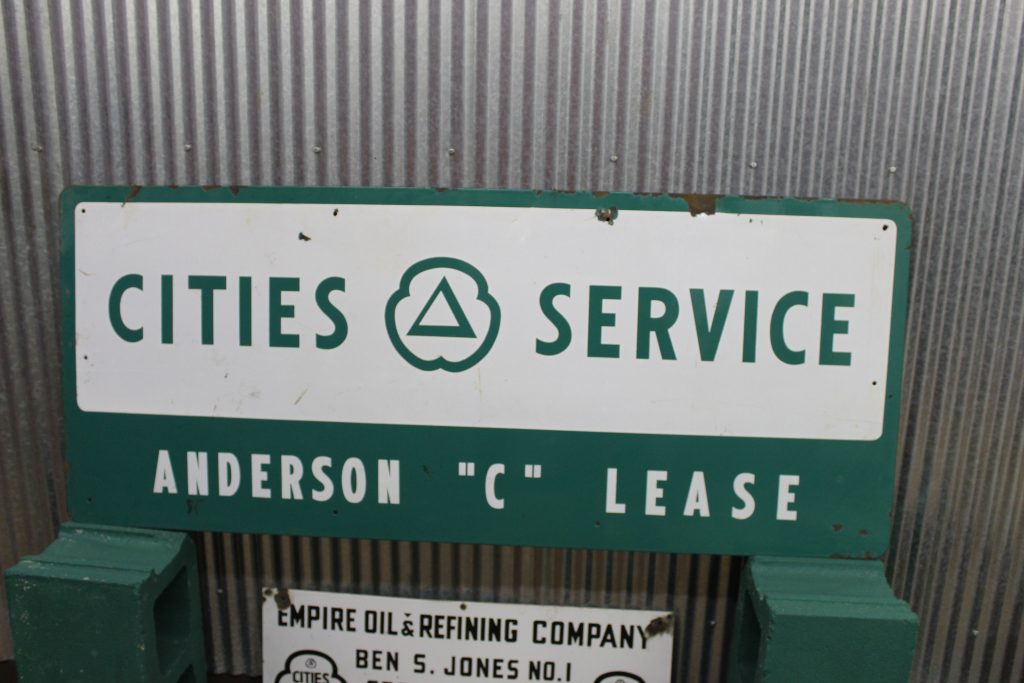
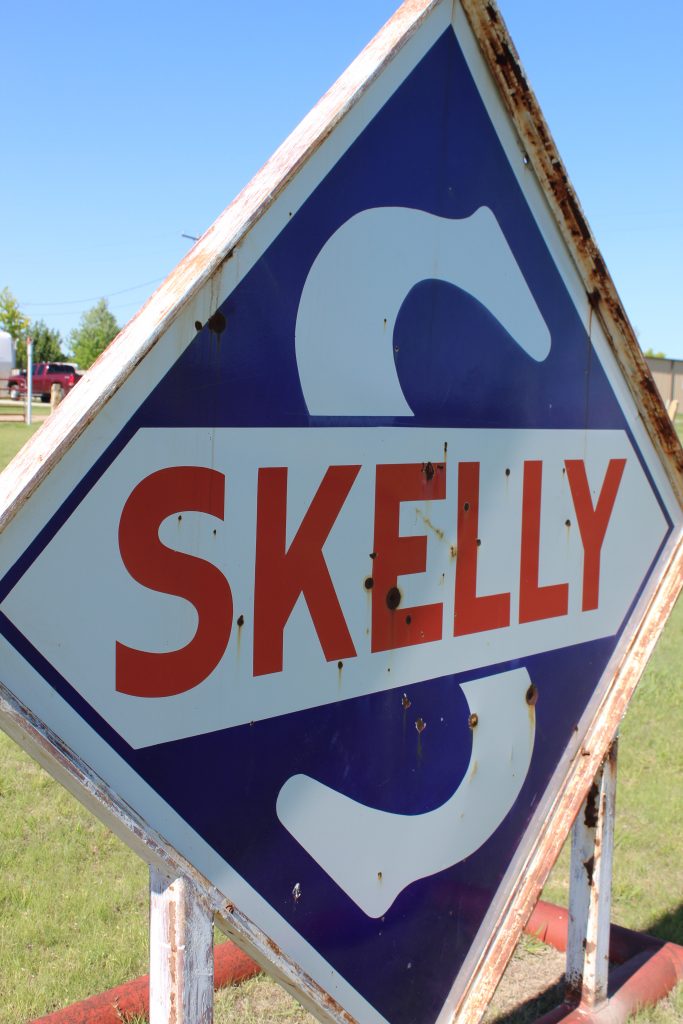
I have a special affinity for oil history because it is inexorably entwined with my own family tree. My grandfather Roy Janney came from southeast Kansas to work in the oil fields of Butler County, Kansas, and eventually was the head electrician for Cities Service. I was tickled when I saw an old Cities Service sign hanging in the Russell museum.
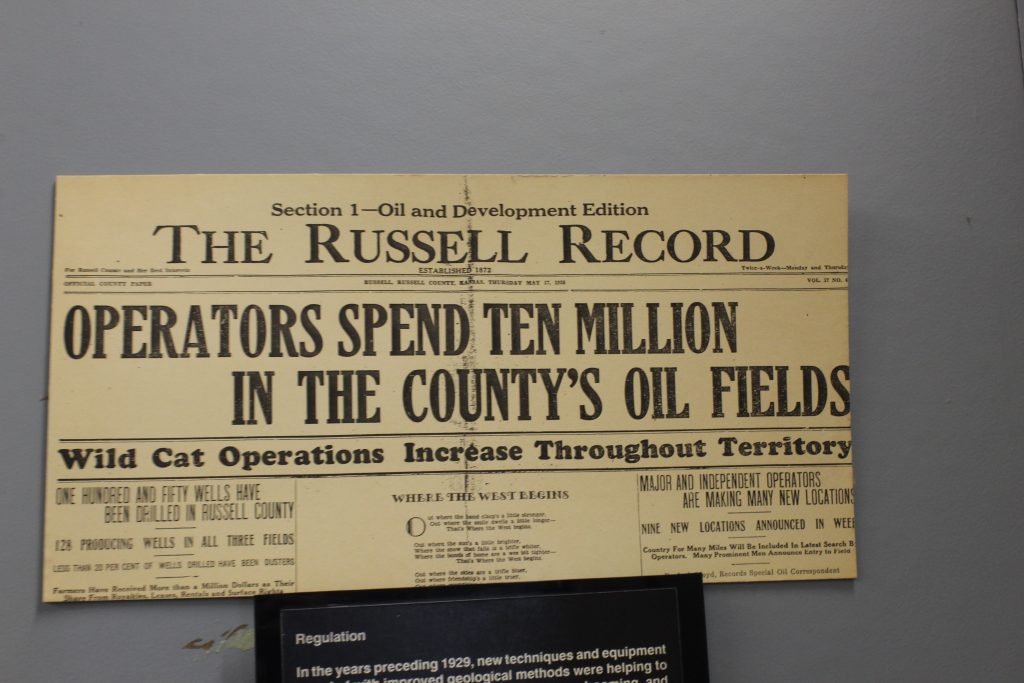
Ag and oil continue to be king in both the Russell and Ellis county economies. There are two things I think are really vital to a Kansas child’s education. That is knowing their food does not come from a grocery store, and the fuel for their car doesn’t come from a gas pump. The Oil Patch Museum tells the story of the latter.
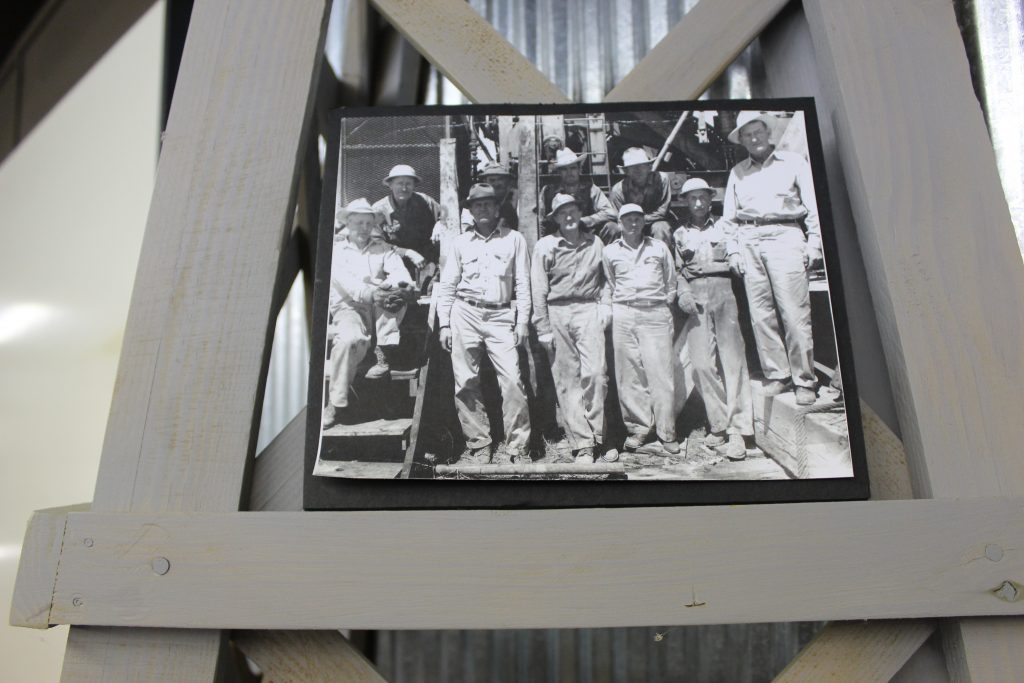
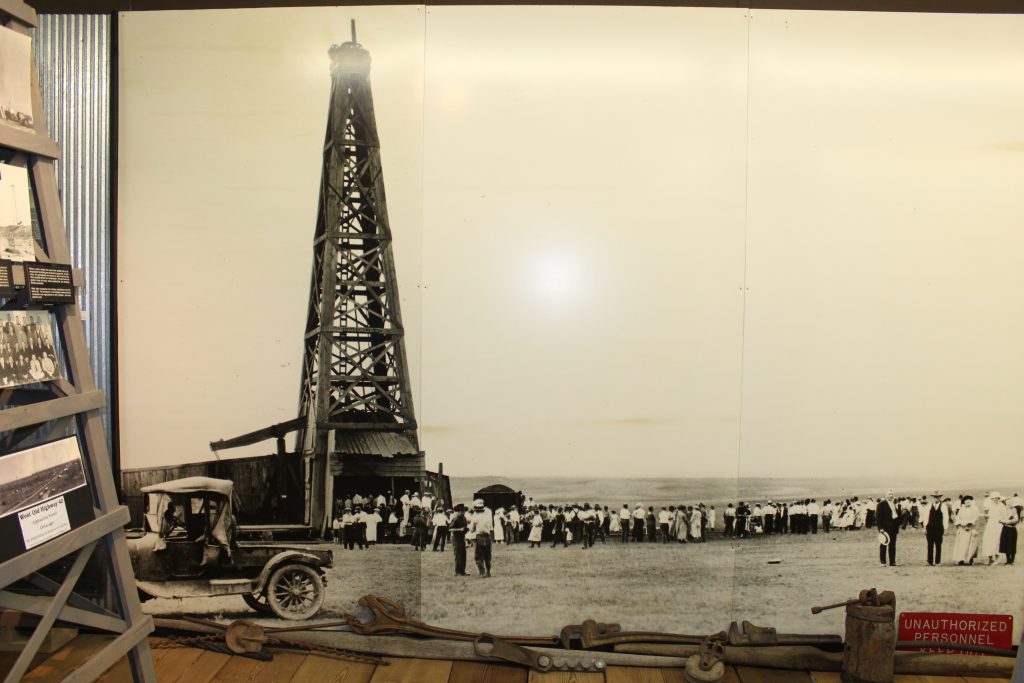
The Carrie Oswald No. 1. Oil derricks were made out of wood when oil was first stuck in Russell County in 1923.
Oil was first struck in Russell County in November 1923 at The Carrie Oswald No. 1 near what is now the unincorporated town of Fairport. The well was named for the land owner’s wife. Ed Oswald was about to go bankrupt and the strike saved his farm and house from foreclosure.
Even though I was in a different part of the state, many of the exhibits and pieces of machinery clicked with stories my grandpa and dad had told me about the oil fields.
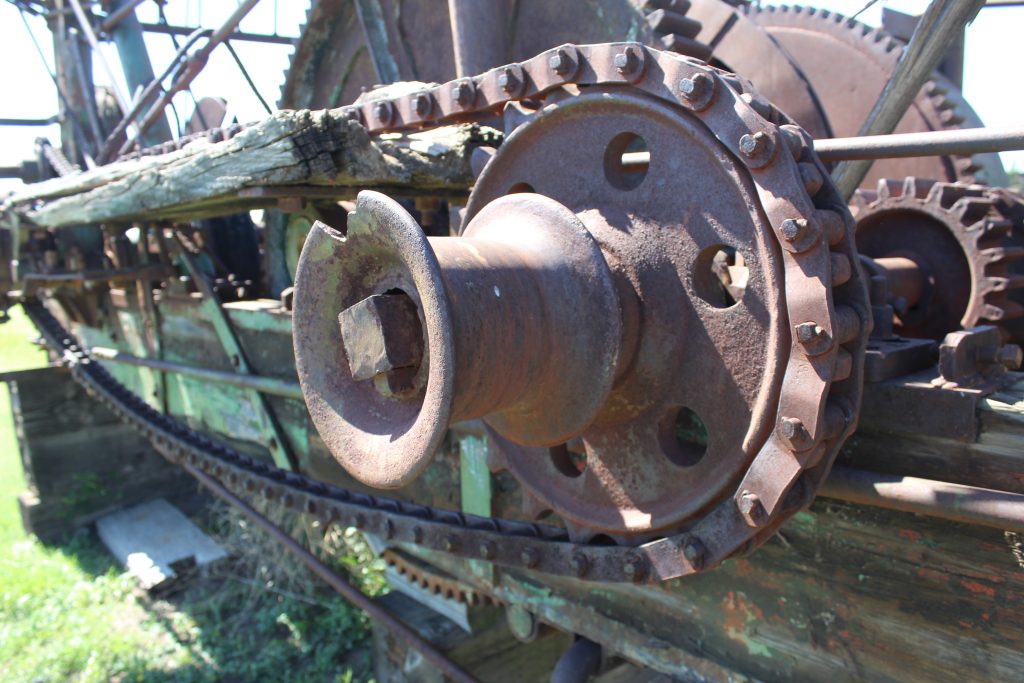
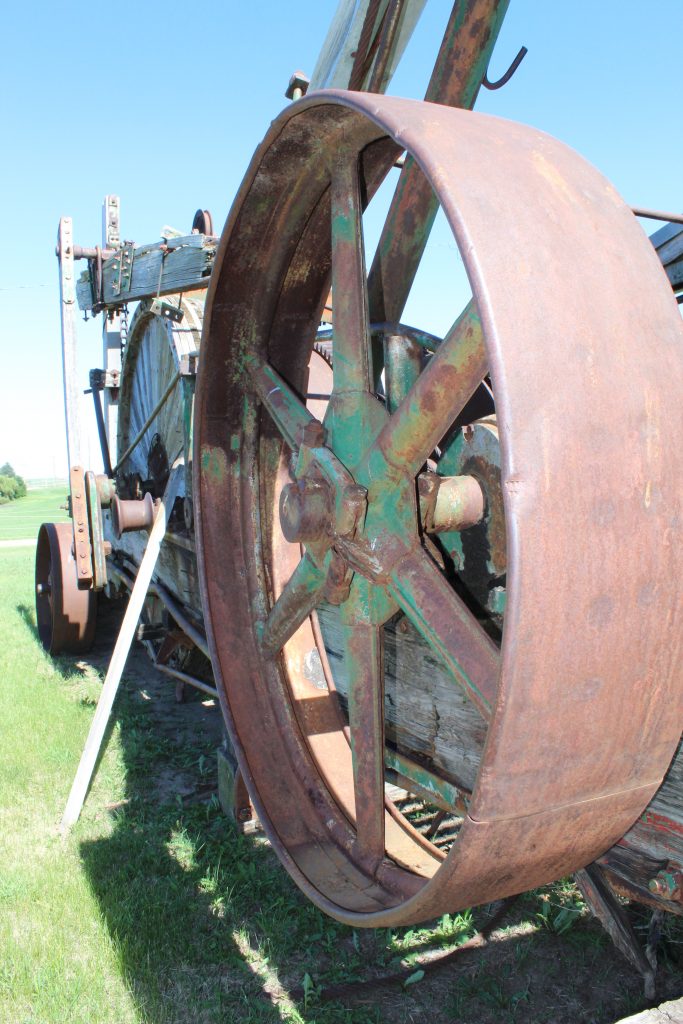
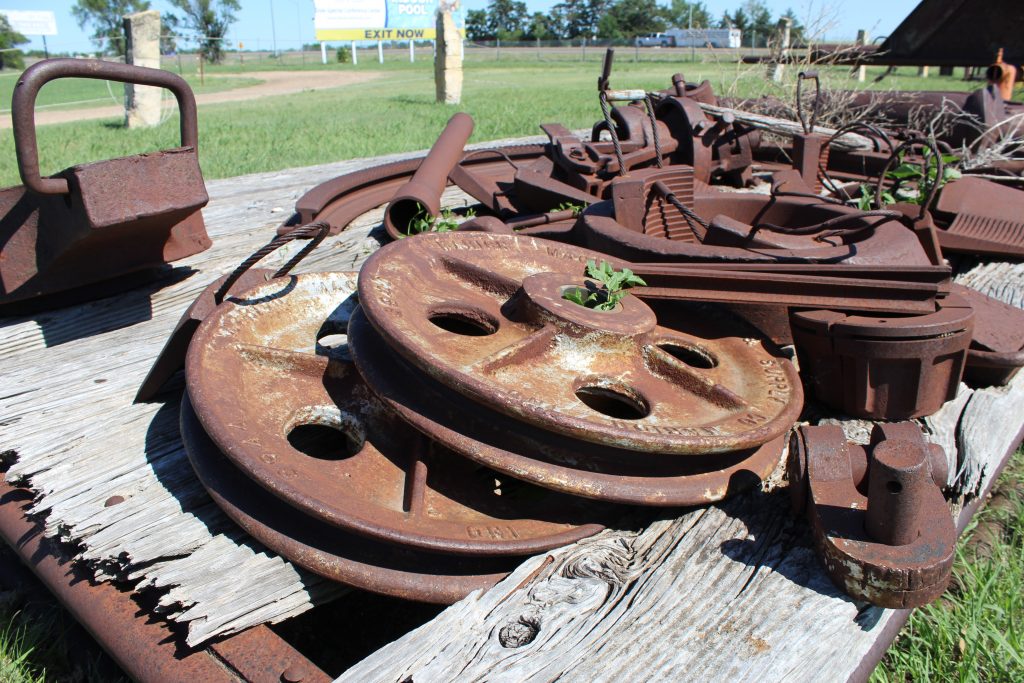
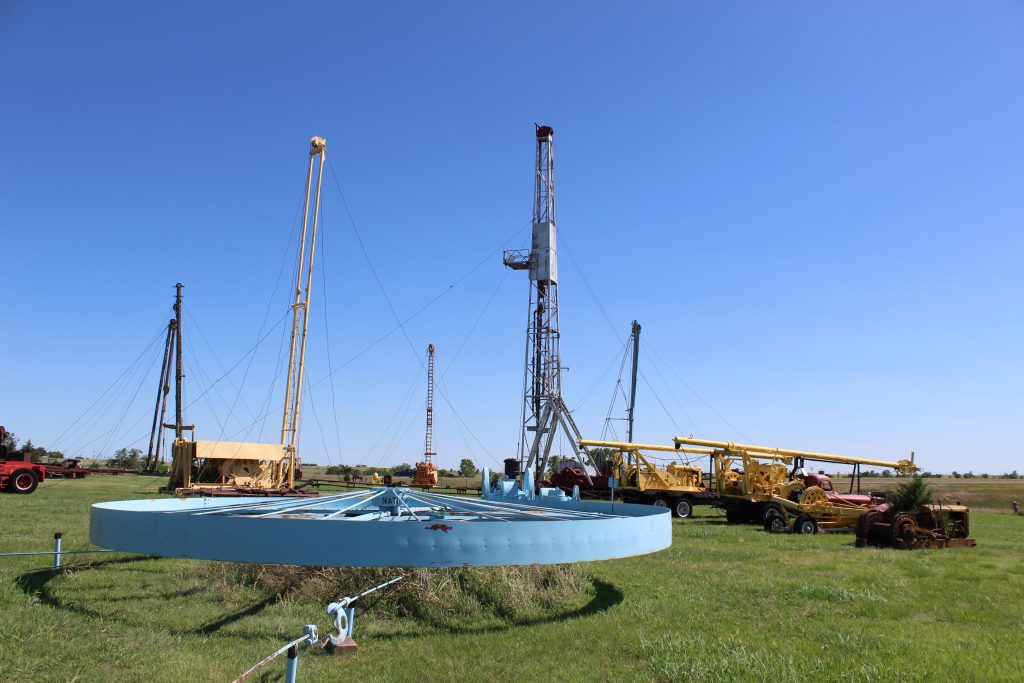
A large horizontally mounted wheel called a bull wheel is on display at the Oil Patch. Coming out from the wheel are pipes or rod lines that attached to pump jacks. These wheels were connected to engines by huge belts, and they ran multiple pump jacks. Pump jacks remind me of metal horses that bob up and down and pump the oil to the surface.
My dad said my grandma warned him to not get tripped up in the pipes as he played in the oil fields near his home in Oil Hill. Apparently the little boys used to try to ride the pipes for fun.
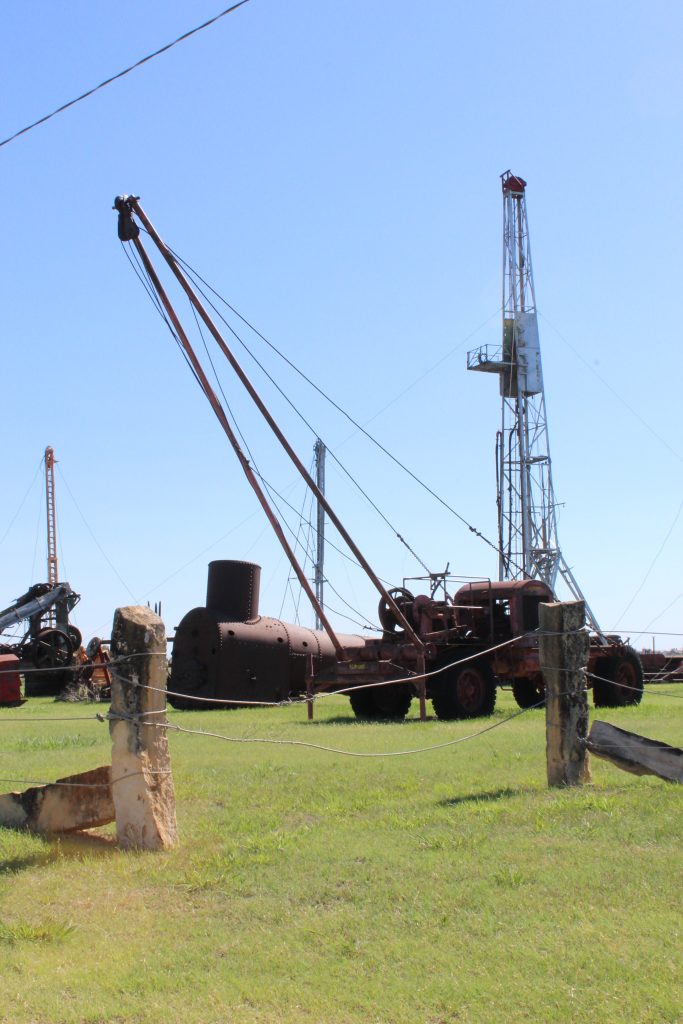
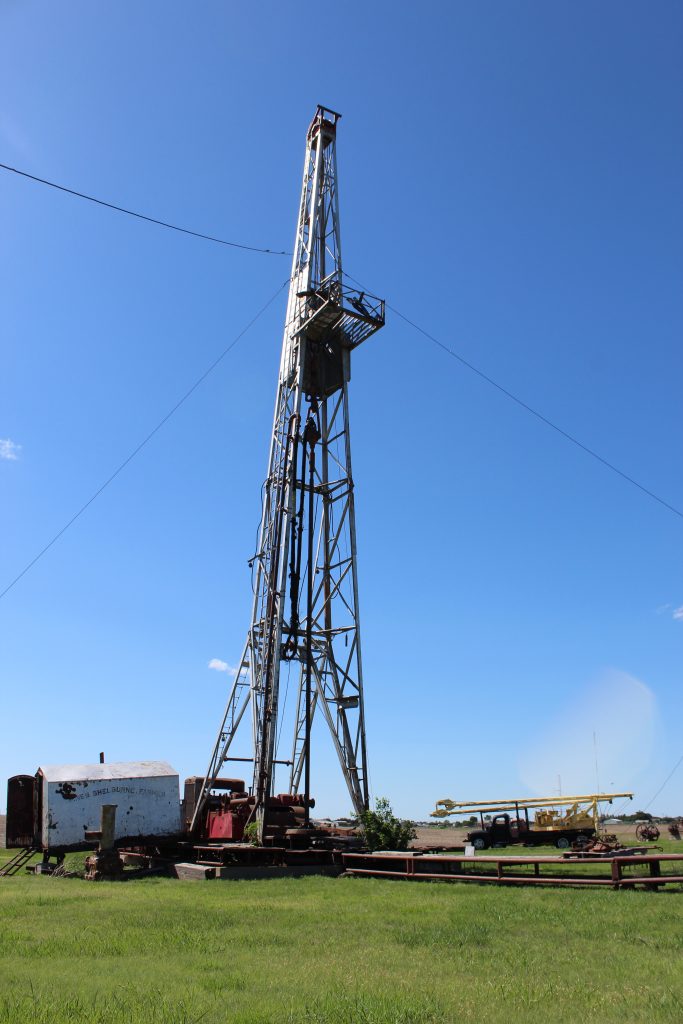
The platform near the top on this rotary rig is an example where my dad worked as a roughneck when he was a young man.
Rotary rigs, giant rusting towers cast criss-cross shadows on the grassy meadow. My dad worked as a roughneck (name for an oil rig worker) from the time he was 18. He was a derrick hand who worked on the stabbing board, a narrow platform just shy of 30 feet off the ground.
It was his job to catch the pipe used in the drilling as it came flying up the side of the rig. I am afraid of heights, and I shuddered at the thought of him balancing on the tiny platform, slippery with mud. He volunteered for the job because he was paid a few extra cents a day. It is a miracle he survived to bring me into this world.
Descendants of these aging rigs and pump jacks can still be seen dotting the area landscape today. In fact, I saw a rotary rig drilling in a field off I-70 on my way home.
From watching old movies like “Giant” and “Hellfighters” with John Wayne, I thought oil rigs always gushed when they hit oil. I spent one very hot, summer day when I was about 11 waiting for this to happen as I watched a well being drilled on my grandparents’ farm in Greenwood County.
To my disappointment, this is not the case. All I had to show for my patience was a bad sunburn.
Only one gusher was recorded in the Russell oil fields. As I learned at the Oil Patch, 90 percent of the wells in Kansas are strippers. Get your mind out of the gutter, not those kind of strippers. In oil field talk, this is a nearly depleted well whose income barely exceeds the cost of production.
My dad said about 90 percent of the slang he used in the oilfield is not fit to print, but here is some of the cleaner terms, according to the museum.
A wildcat is not an animal or a K-State fan. It is a drilling operation seeking unproved oil possibilities.
To spud is to commence drilling operations.
A Christmas tree is an assemblage of valves and gauges used to control the flow of oil and gas.
A tool pusher is a drilling supervisor.
The runs are the purchases from a producing lease.
Admission to the Oil Patch is through freewill donation.
As with any small town, if you really want to get to its heart, you have to sample its downtown.
My first stop downtown was to grab some lunch at Wauby’s Sports Bar and Grill. The Wauby’s building was built in 1885 and is on the Nation Register of Historic Places. The burgers are run-down-your-face juicy, which mine did.
The Wauby’s building was built in 1885 and is on the Nation Register of Historic Places.
There wasn’t much traffic downtown on a warm Saturday afternoon, so, with my belly full of burger, I strolled leisurely hitting up a couple local stores and antique shops.
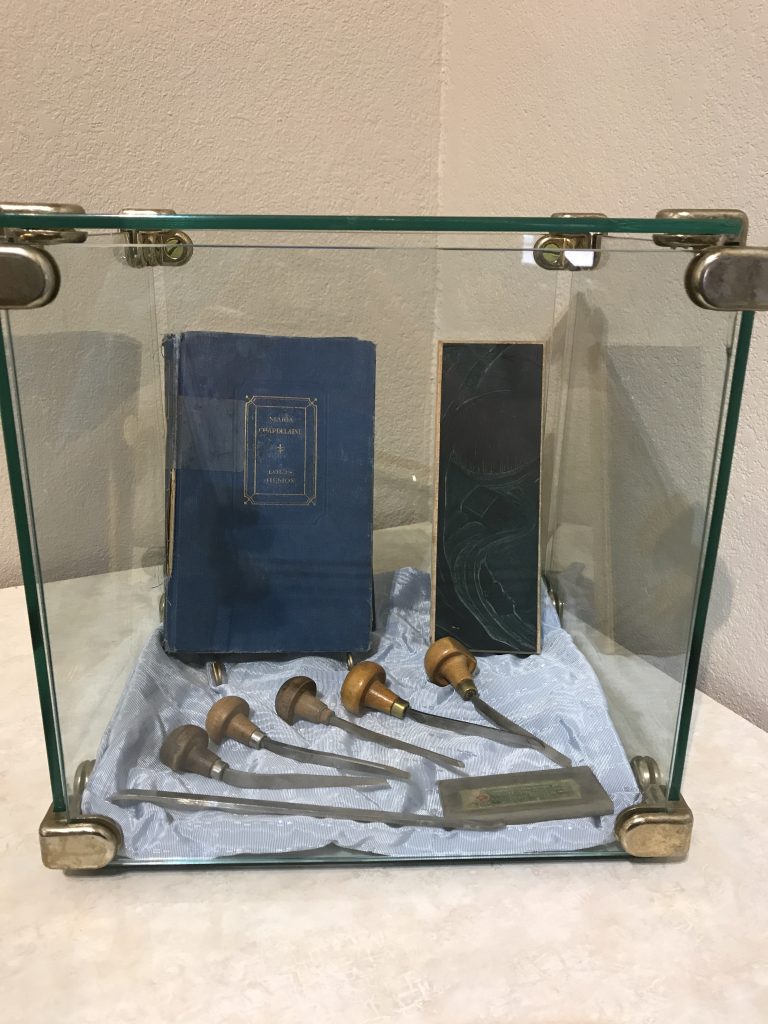
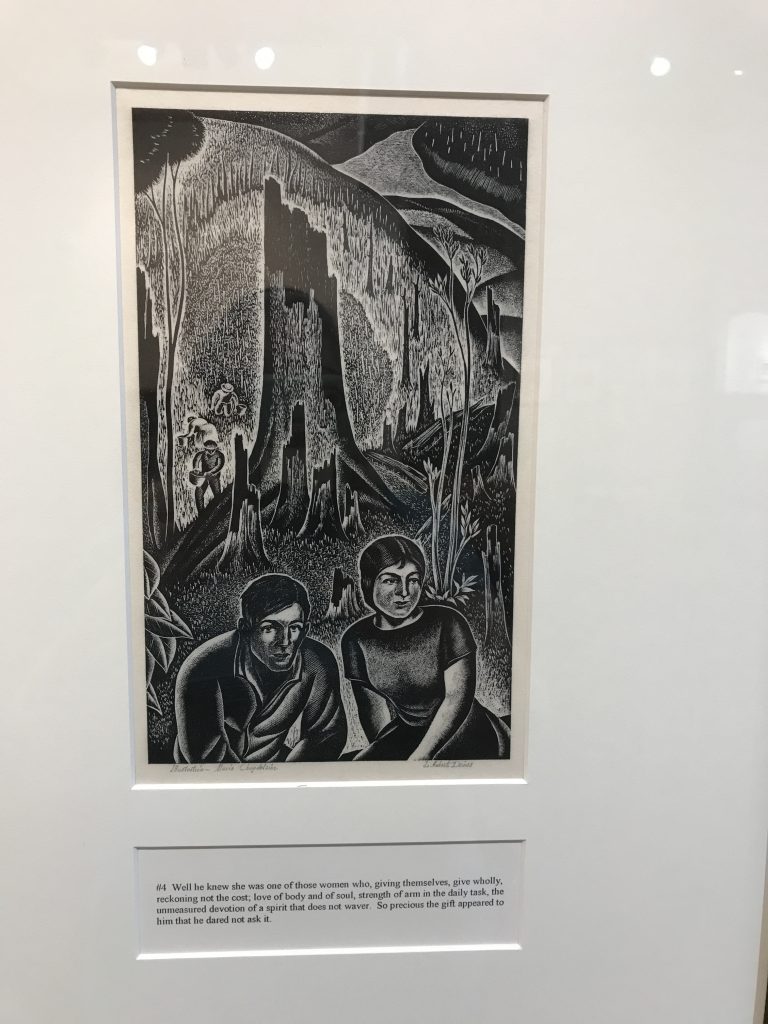
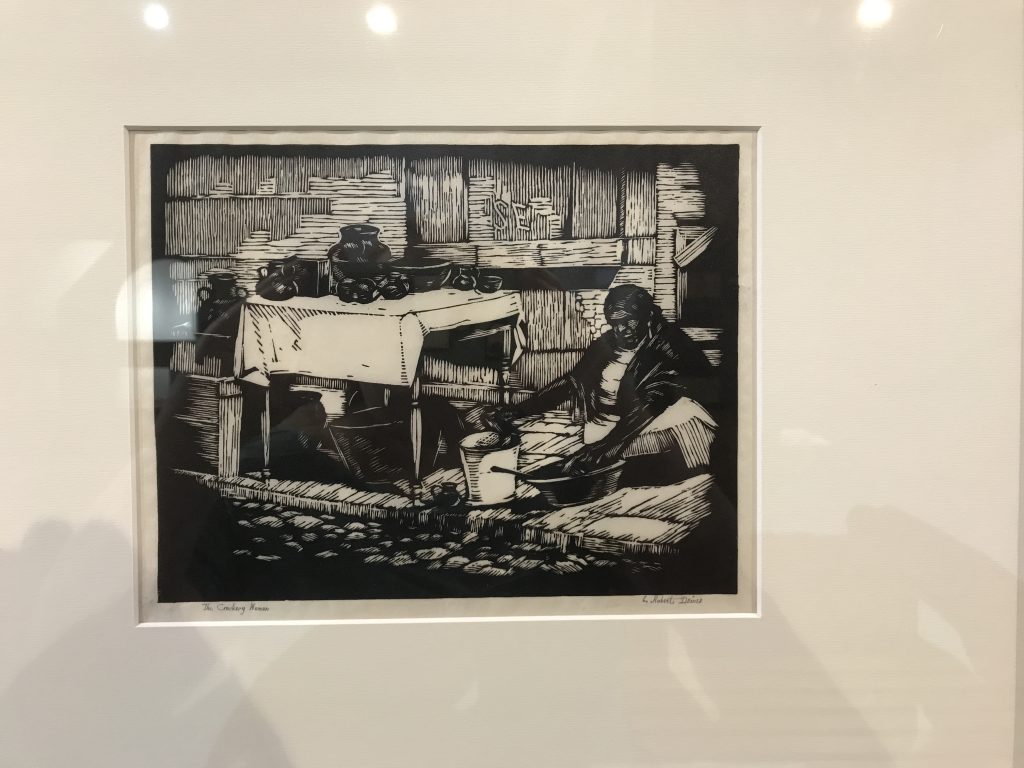
For art lovers, the Deines Cultural Center, which is also downtown, houses wood-engraved prints created by Russell native E. Hubert Deines. Deines worked in the ’30s and ’40s in commercial arts, creating artwork for the Kansas City Star and later national magazines. Admission to the center is free.
In addition to Deines’ work, the Center has on loan from the school district several Birger Sandzén paintings. Sandzén lived in Lindsborg, Kansas, and the Birger Sandzén Memorial Gallery in Lindsborg is dedicated to his work. The Sandzén paintings at the Deines were saved from obscurity, having been pelted by students with butter and one left in a broom closet.
Coming June 22 to the Deines is the “Reflections on Water and My Places,” paintings by Steve Read and “Post Rock Country” photographs by Greg Rud.
Just off of Main Street at 331 N. Kansas is the Fossil Station Museum, which is also on the National Register of Historic Places. The castle-like limestone building was constructed in 1907 to serve as the sheriff’s home and jail. Admission is free.
An outfit worn by a Dole supporter during one of his campaigns on display at the Fossil Station Museum.
The museum includes a tribute to Russell native son, Bob Dole, who served in Congress from 1968 to 1996. He won the Republican nomination for president in 1996 and lost to incumbent Bill Clinton. I have met Bob Dole a number of times throughout my journalism career. I didn’t always agree with his politics, but I have always respected the man. He did much for the state of Kansas and his country, and I would say he is a different breed of politician than we see in office today.
A note to the weird and wacky, the museum has a gallon jar of human teeth as part of its “The Tooth Story” exhibit on an early Russell dentist. The man saved every tooth he pulled. I am sorry I don’t have a picture. I was a bit grossed out by the sight, even though I was warned by a volunteer they were there, and scurried out of the room.
Being in post rock country, limestone was a common early building material. Just down the street you can view the Heym-Oliver House, which was built in 1879, and the Gernon House, also on the National Register of Historic Places. It was built in 1872 and is the oldest house in Russell.
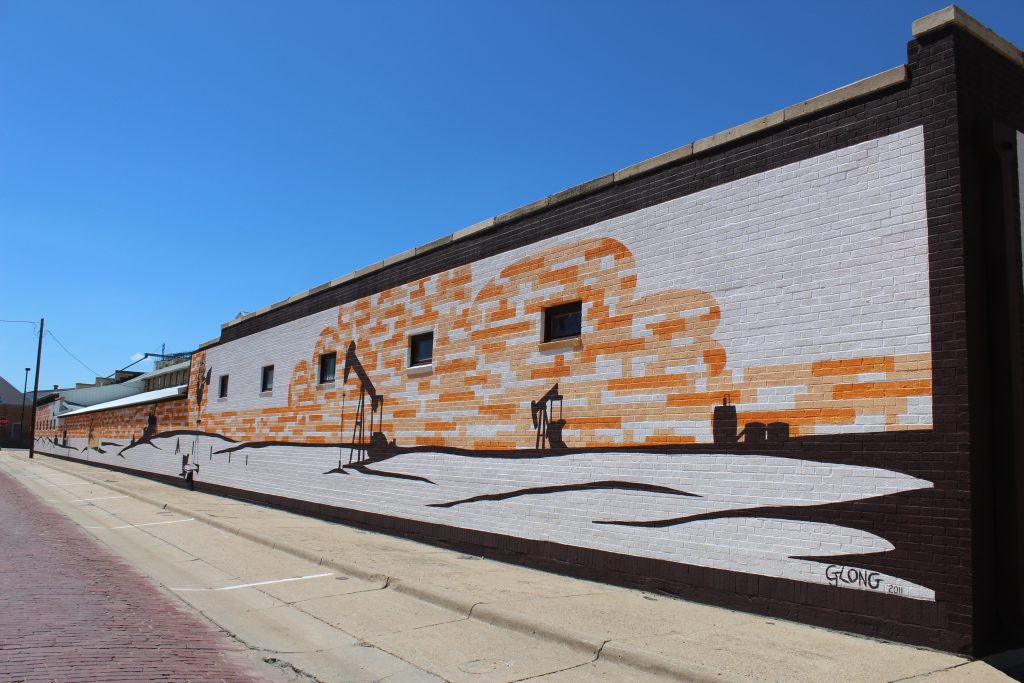
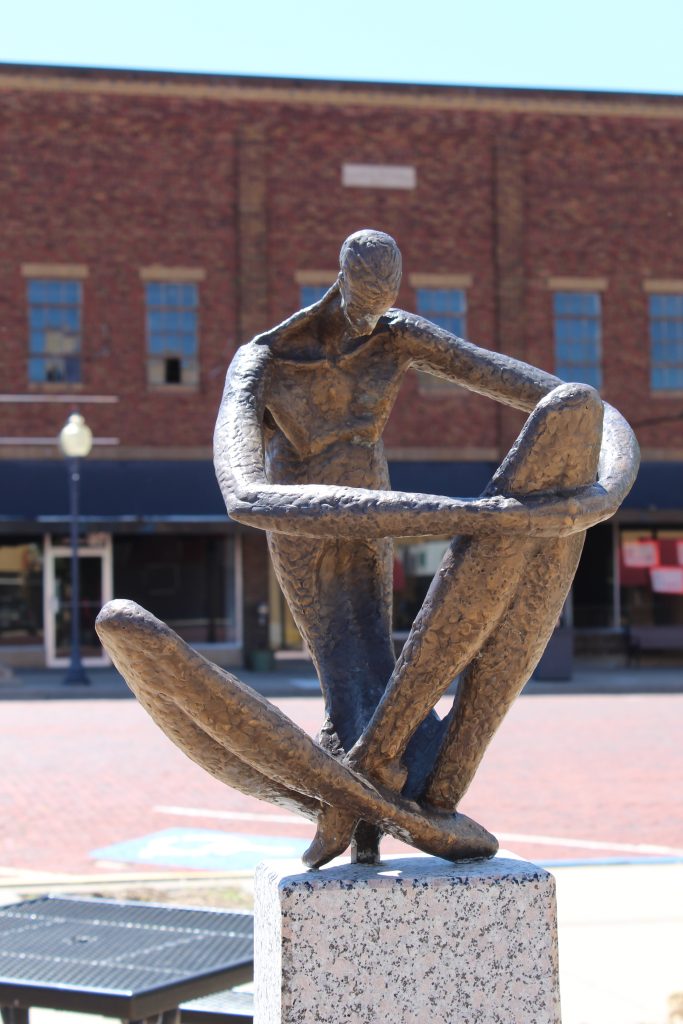
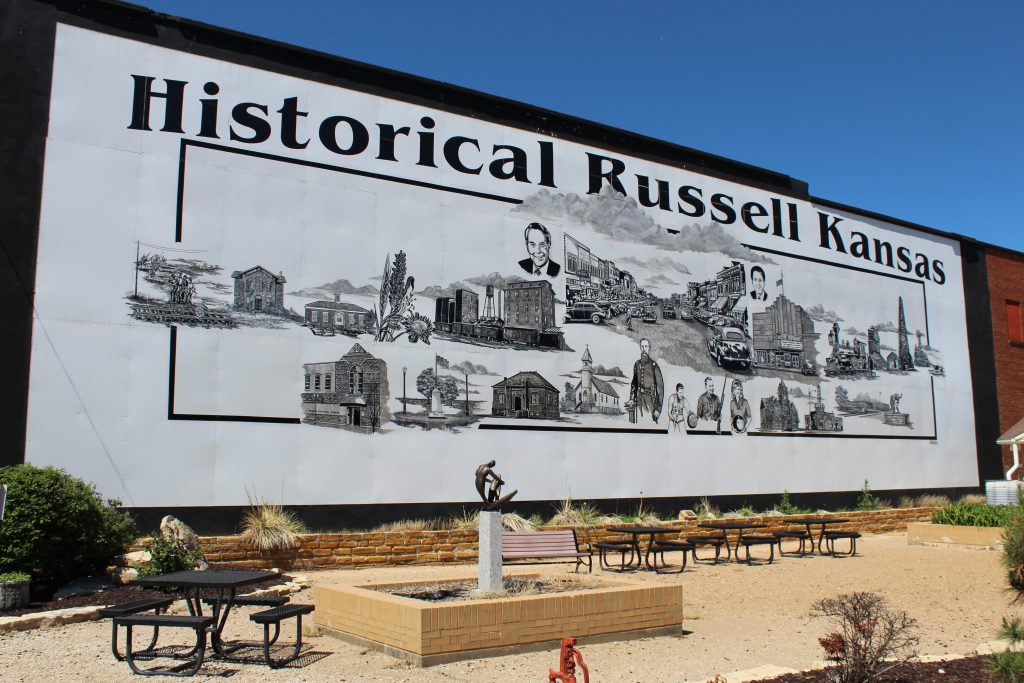
Downtown also offers several examples of public art, including a black and white mural at Eighth and Main streets by Rick Rupp that tells the story of Russell. The Russell Post Office, 135 W. Sixth, also on the National Register of Historic Places features yet another mural “Wheat Workers” by Martyl Schweig.
I didn’t make it over to the Dream Theater to see a show, but I am excited to go back.
The original theater was built in 1923, but was destroyed by fire. It was rebuilt in the Art Deco style in 1949. The theater was built by the Boller brothers of Kansas City, Missouri, and is one nine theaters in Kansas on the National Register of Historic Places. A local committee raised money to reopen the theater after it was closed by B & B Theatres in 2000.
In addition to current-run movies, the theater has summer and classic movie series.
The “Grapes of Wrath” starring Henry Fonda is coming in August and to “To Kill a Mockingbird” with Gregory Peck is showing in September. I have seen both classics on the small screen, but it is not the same as seeing them as they were intended on the big screen with the scent of butter-drenched popcorn in the air and a giant soda in your lap.
If live theater is more your speed, the Russel Community Theater is presenting “The Nerd,” June 26-30.
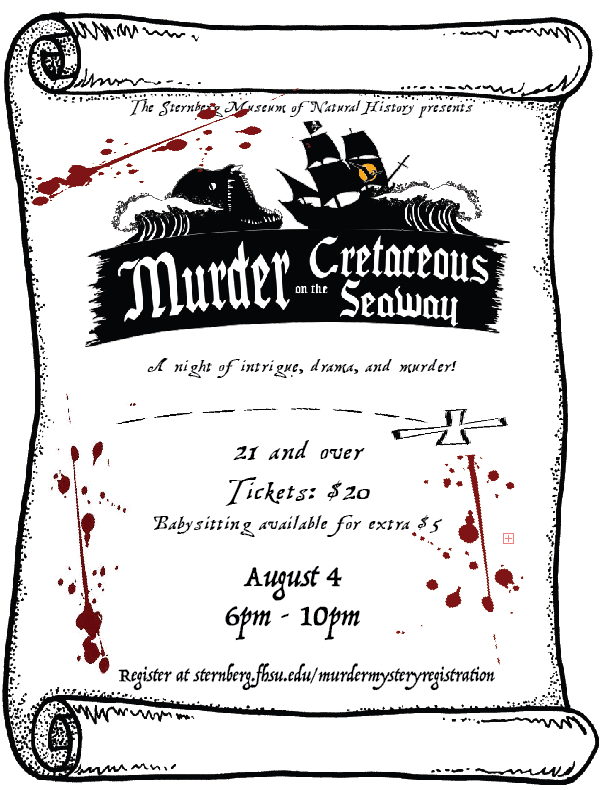
“Murder on the Cretaceous Seaway” will be 6 to 10 p.m. Aug. 4 at the Sternberg Museum of Natural History in Hays.
After a voyage filled with pillaging and plundering, The Jaded Jewel, is docked. As the pirates head to town to celebrate their homecoming and spend their gold and goods, a night of turmoil and trouble is sure to transpire.
A member of the party will be murdered during the evening, and the Sternberg’s cast of characters will be charged with figuring out who done it.
The Sternberg Museum is happy to present “Murder on the Cretaceous Seaway.” This 21-and-older event will bring murder and intrigue to the museum. Guests will search high and low in the museum for additional clues pertaining to the mystery. Hors d’oeuvres and alcohol will be served.
A night of seamen, secrets and scallywags awaits you at the Sternberg Museum.
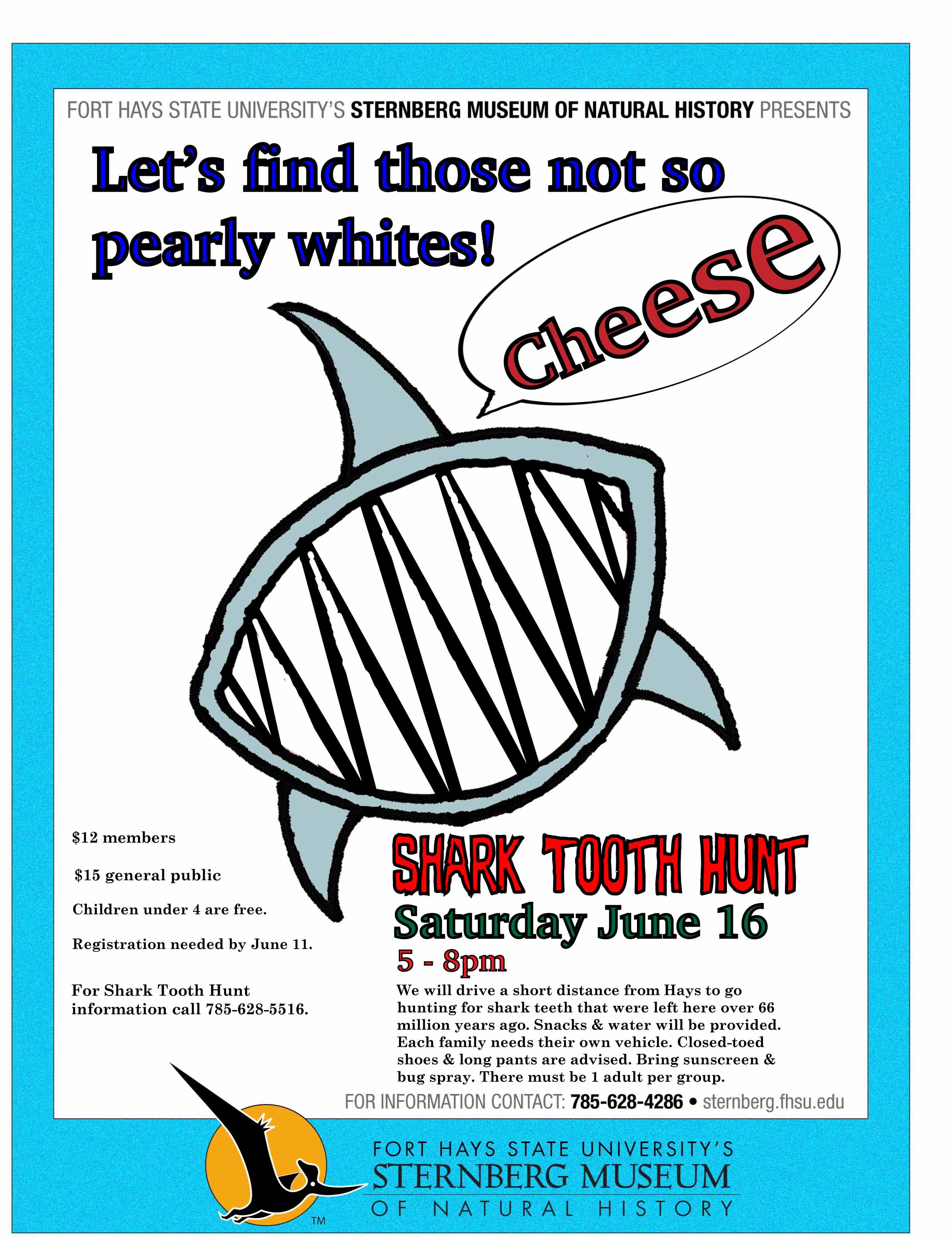
Participants will drive a short distance from Hays to go hunting for shark teeth left over 66 million years ago. Snacks and water will be provided. Each family needs to bring a vehicle, sunscreen and bug spray. Close-toed shoes and long pants are recommended. For more information contact 785-625-5516. Cost is $12 for members and $15 for non-members.
Hays Convention and Visitors Bureau Executive Director Melissa Dixon was appointed to a position on the Travel Industry Association of Kansas Board of Directors in April.
TIAK’s purpose is to speak with one voice for the travel industry in Kansas, promoting and supporting all components of the travel industry and travel development field.
COLBY—Myrtle L. Kropp, 88, died Wednesday, June 6, 2018 at Prairie Senior Living Complex in Colby.
She was born on Sept. 11, 1929 in Sheridan County, Kansas.
She was a retired cook for the Colby schools.
She was preceded in death by her husband, John, on June 2, 2000.
She is survived by her sons, Raymond J. Kropp of Hammond, Oklahoma, and Charles E. Kropp of Colby; daughters Marilyn L. Thummel of Grainfield, Kansas, and Donna B. Colin of Salina; sister Alice Mizer of Jennings; 11 grandchildren; 26 great-grandchildren; and five great-great-grandchildren.
The funeral will be at 10:30 a.m. Monday, June 11 at Trinity Lutheran Church in Colby, officiated by the Rev. Robert Alexander.
Visitation will be from 3 to 6 p.m. Sunday, June 10 at the Kersenbrock Funeral Chapel in Colby. The burial will be in Beulah Cemetery in Colby.
Memorials may be made to the NWKS Foundation for Hope. Donations can be made in care of the funeral home.
The WaKeeney/Trego County Spring Garden Tour will be from 1 to 5 p.m. Sunday.
The tour is sponsored by the Trego County Recreation, Trego County Gardeners and the volunteers who have agreed to let the public tour their gardens.
The gardens on the tour include:
Jim and Teri Briel, 400 Hazel Ave.
Randy and Debbie Balluch, 733 N. Main St.
Hardy and Dawn Howard, 725 N. Eighth St.
John and Betty Schreiner, 316 N. Eighth St.
Tom and Reba Bayuk, 509 N. Ninth St.
Steve and Glenda Hage, 421 N. Seventh St.
Gary and Pam Herl, 914 Easter Ave.
Dave and Mary Hendricks, 430 N. 12th St.
Verlene Wilson, 321 N. 13th St.
Trego Lemke Memorial Hospital, 13 Street on the east and south sides of the building
Owen and Karen Parker, Take Interstate 70 west of WaKeeney to exit 120 (Voda Road). Go south on 180th Avenue to K Road. Go three and a half miles west on K Road The Parkers’ home is the first home you will come to on the south side of the road.
Kirk and Treva Johnson (Shiloh Vineyard and Winery) Take I-70 west of WaKeeney to exit 120 (Voda Road). Go south on 180th Avenue to M. Road. Go two miles west on M. Road. Shiloh is the first place you will come to on the south side of the road.
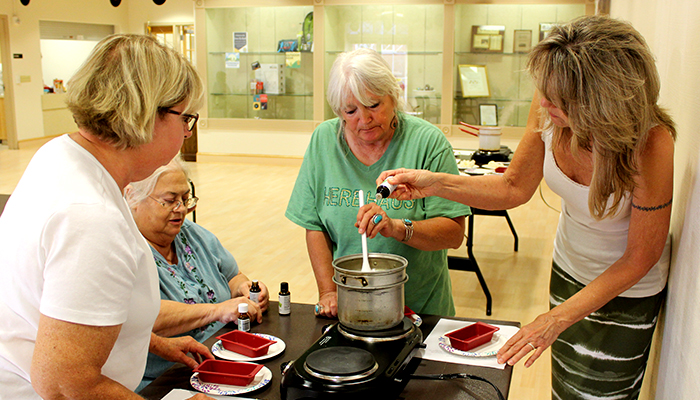
The Hays Herb Study group at the Hays Public Library made natural bug repellent bars at its meeting on Tuesday.By CRISTINA JANNEY Hays Post
The bars use essential oils to repel flies and mosquitoes. The lotion bars can be rubbed on the skin prior to going outside.
Pam Herl, Herb Study member, said other natural pest repellents that you can plant in your garden include lavender, citronella, catnip, lemongrass and basil.
The Herb Study meets at 5 p.m. on the first and third Tuesdays of the month in the Schmidt Gallery at the library. The meetings are open to the public and free to attend.
Other summer upcoming meeting topics include:
June 19, Organic gardening
July 3, Mosaic clay planter
July 17, Energizing herbs
Aug. 7 Herbal medicine kit
Aug. 21 Mullein
Below is the recipe for the bars.
2 oz beeswax
4 oz organic shea butter
2 oz of organic coconut oil
10 drops of citronella essential oil
20 drops lemongrass essential oil
5 drops peppermint essential oil
5 drops of lemon or eucalyptus oil
You will also need a double boiler and silicone bar molds. The library bought its essential oils from Back to Nature, the beeswax from Jensen Farms at Professor’s and the molds on Amazon.
Directions
Melt the beeswax, shea butter and coconut oil over a double boiler. The beeswax will likely take longer to melt, so put it in first.
2. Remove from heat and add essential oils, mix slightly.
3. Carefully pour the mixture into the molds and allow to cure for 24 hours.
4. Remove from the mold and put them in a plastic tub for later use.
Depending on the size of the molds, the recipe will make six bars.
The bars can become soft or melt in heat, so it is best to use the bar before you go out or put it in a sealed container.
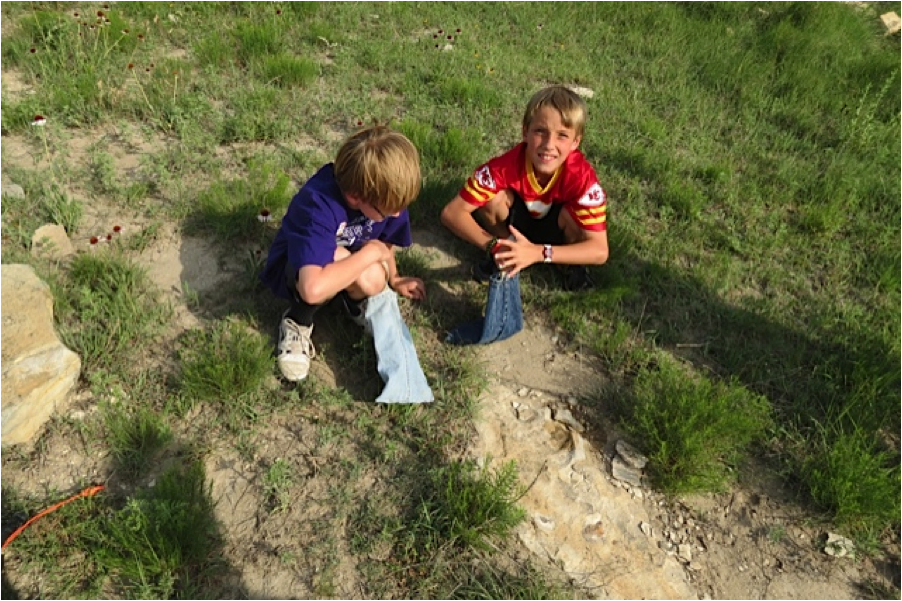
Two young hunters collect fossils at a previous Sternberg fossil hunt. Courtesy photoBy CRISTINA JANNEY Hays Post
The Sternberg Museum of Natural History has set its annual shark tooth and fossil hunt for 5 to 8 p.m. Saturday, June 16.
The cost is $12 for museum members and $15 for non-members. Register is required by June 11.
Participants will caravan to the collection site from the museum. Participants will be surface collecting fossils. Some of their finds could include shark teeth, clam and oyster shells, fossil fish fins, or vertebrae. Fossil hunters on a rare occasion might find a mosasaur vertebrae, Darrah Steffen, public relations assistant, said.
Fossils from the deposit are from the Cretaceous Period when Kansas was covered by a great inland sea and are about 66 million years old.
The event is family friendly and all ages are encouraged to attend, Steffen said.
Wearing long pants and closed-toe shoes is recommended. Participants are also encouraged to wear sunscreen and bug spray. Water and snacks will be provided.
The evening is for those 21 and older. It will be 6 to 10 p.m. Saturday, Aug. 4. Cost is $20 with an additional $5 for babysitting. Tickets are available online through the link above.
Participants, who are encouraged to dress in costume, will be assigned a character in line with the event’s pirate theme.
After a voyage filled with pillaging and plundering, The Jaded Jewel, is docked. As the pirates head to town to celebrate their homecoming and spend their gold and goods, a night of turmoil and trouble is sure to transpire.
Midway through the evening, a member of the group will be “murdered.” It will be up to the remaining characters to solve the crime.
Participants will be posed with riddles and must search the museum high and low, reading museum placards for clues to solve the mystery.
Hors d’oeuvres and alcoholic drinks will be served.
The program is part of a thesis project for FHSU student Kat Rivers as a means of introducing more adult programing at the museum.
“We think it will be a lot of fun,” Steffen said. “We are really excited about it.”
COLBY—Myrtle L. Kropp, 88, died Friday, June 6, 2018 at Prairie Senior Living Complex in Colby, Kansas. Services are pending with Kersenbrock Funeral Chapel in Colby.