OMAHA, Neb. (AP) — A new survey suggests the economy remains strong in nine Midwest and Plains states, but business leaders are concerned about the ongoing trade disputes.
The overall economic index for the region slipped to 57.5 in September from August’s 61.1, but it remained in positive territory.
Creighton University economist Ernie Goss says he expects business will slow down but continue growing in the next few months because of the trade concerns and rising interest rates.
The survey results are compiled into a collection of indexes ranging from zero to 100. Survey organizers say any score above 50 suggests growth. A score below that suggests decline.
The survey covers Arkansas, Iowa, Kansas, Minnesota, Missouri, Nebraska, North Dakota, Oklahoma and South Dakota.
KANSAS CITY – A man was sentenced in federal court Thursday for robbing the U.S. Bank inside Truman Medical Center.
Security camera images from the March bank robbery courtesy KCPD
Jimmy Lee Bozeman II, 57, was sentenced by U.S. District Judge Howard F. Sachs to 12 years and seven months in federal prison without parole, according to the U.S. Attorney’s office.
On June 6, 2018, Bozeman pleaded guilty to one count of bank robbery. Bozeman stole $1,450 from U.S. Bank on March 14, 2018.
According to court documents, Bozeman demanded a bank teller give him all of her $50 and $100 bills. The teller briefly hesitated because she thought he was joking; he told her it was not a joke and he possessed a handgun.
After the teller handed him money from her top drawer, he demanded the money from the second drawer. As she was attempting to open the second drawer, a hospital cafeteria employee approached the bank to make change for the register in the cafeteria.
When Bozeman turned to look at him, the teller activated the hold-up alarm. Bozeman then fled from the hospital, got into a vehicle parked nearby and left the area.
Bank surveillance photos were released to the media. Several social workers at Truman Medical Center recognized Bozeman as a former client. Bozeman’s ex-wife also identified him from the surveillance photos.
Bozeman was previously convicted of bank robbery in the Western District of Missouri in 2009. He also has prior felony convictions for robbery and armed criminal action.
The space allows students, faculty and staff to pick up such items as fresh fruit, cereal, steaks and even gluten-free products.
Shoppers can visit the store twice a week. They receive 15 points each time they visit and they spend the points as they see fit. For example, a package of meat is five points and rice is three pounds.
The food bank is a collaboration of several organizations. Some items were donated by local grocery stores, area farms and from food drives. Just Food, the Douglas County food bank, bought some of the food
SHAWNEE COUNTY – Law enforcement authorities are investigating a suspect on weapons charges after alleged shoplifting.
Burghart -photo Shawnee County
Just after 9p.m. Saturday, police were dispatched to Walmart, 1301 SW 37th Street in Topeka on a report of a shoplifting in progress, according to Lt. Manuel Munoz.
Officers met with Walmart staff and determined four individuals were involved. During the investigation, officers located a firearm on one of the suspects that had been detained and determined that 22-year-old Alex Jacob Burghart was possession of a firearm as a convicted felon.
He was transported to the Shawnee County Department of Corrections. Burghart has previous convictions for theft, robbery and motor vehicle burglary, according to the Kansas Department of Corrections.
LOGAN – The Hansen Museum Continuing Education Program is proud to have certified Bob Ross instructors, T.R. Mathews and Sandy Seamone of Arriba, Colorado, at the Museum on October 20 and October 21 to teach two Joy of Painting classes.
On Saturday, October 20, 2018, the class will paint “Snow Scene,” and on Sunday, October 21, 2018, “Iris with Hummingbird.” Class runs from 9:00 a.m. to 3:00 p.m. with an hour lunch break each day.
Step-by-step, T.R. and Sandy reveal how fun and simple it is to paint using the Bob Ross method. Their tag-team approach to teaching keeps the classroom atmosphere light and entertaining. All painting supplies are provided, and no previous experience is necessary. Young and old alike will enjoy the camaraderie of these classes. Register by October 12 and pay $70.00 per day; after October 12, pay $75.00 per day. Discounts available for Patron and Sustaining Hansen Museum members.
This wonderful learning opportunity is brought to you through the Hansen Museum Continuing Education Program with funds from the Hansen Foundation. For more information, please call 785-689-4846.
The Dane G. Hansen Museum is open Monday through Friday 9-12 and 1-4; Saturday 9 -12 and 1-5; Sunday & Holidays 1-5. We are closed Thanksgiving, Christmas, and New Years. The Museum is handicapped accessible and admission is always free thanks to the generous support of the Dane G. Hansen Foundation. For more information or if you have questions, please contact us at 785-689-4846.
KANSAS CITY (AP) — Federal officials are mailing more than 1 million checks worth a combined $505 million to consumers that former pro racecar driver Scott Tucker swindled through a payday lending scheme.
The Federal Trade Commission and the Justice Department announced the refunds Thursday. The agencies evaluated loan portfolios from seven of Tucker’s brands under his company, AMG Services — 500FastCash, Advantage Cash Services, Ameriloan, OneClickCash, Star Cash Processing, UnitedCashLoans and USFastCash — to find consumers who took the short-term loans.
Tucker, of Leawood, Kansas, is among those convicted of running a payday lending enterprise that used indigenous tribes as fronts to charge predatory interest rates. He began serving a 16-year, eight-month prison sentence earlier this year.
RENO COUNTY — A Kansas man who allegedly threatened and choked the victim in a domestic altercation will come back to court Oct. 26 after the defense indicated Friday it wants plea negotiations with the state.
Thiel -photo Reno Co.
Jason Thiel, 29, Hutchinson, is charged with aggravated battery, aggravated assault with a deadly weapon and one count of interference with law enforcement.
On June 15, police were called to a residence on East 9th Street in Hutchinson for the report of a “trouble with subject” call.
The victim told police she was strangled and threatened with a knife during the altercation.
Thiel also ran from officers as they tried to take him into custody.
Thiel is no stranger to law enforcement officials. He has nine previous convictions for theft, aggravated assault, aggravated battery, obstruction, criminal damage and aiding a felon, according to the Kansas Department of Corrections.
Veteran Service Representative Schedule for October 2018
1st Tuesdays 10/2/18 Stockton Courthouse 9:30 – 11:30 AM
3rd Tuesdays 10/16/18 Osborne Veterans Building 9:30 AM – 11:30 AM
Russell City Hall 1:30 PM – 3:30 PM
4th Tuesdays 10/23/18 Phillipsburg EMS Building 9:30 AM – 11:30 AM
Smith Center Courthouse 1:00 PM – 3:00 PM
The Kansas Commission on Veterans Affairs assists veterans and authorized family members, free of charge, in matters pertaining to their VA claims and benefits.
All itinerants are on a first come, first served basis. No appointment needed.
For more information contact:
Douglas Storie, VSR
Douglas Storie, VSR
Kansas Commission on Veterans’ Affairs
Veteran Service Representative
205 E. 7th Suite 107
Hays, KS 67601
Phone: 785-259-0364
FAX: 785-650-0392
E-mail: [email protected]
LANSING, Kan. (AP) — The adopted daughter of a retired Army officer living in northeastern Kansas may soon be sent back to South Korea.
Patrick Schreiber, wife and daughter-courtesy photo
On Friday, a federal judge in Kansas ruled in favor of U.S. Citizenship and Immigration Services, which seeks to deport Hyebin Schreiber, the legally adopted daughter of retired Lt. Col. Patrick Schreiber of Lansing.
Schreiber sued after immigration authorities rejected visa and citizenship applications for Hyebin. The woman had been Schreiber’s niece when he and his wife legally brought the then-15-year-old girl to the U.S. in 2012.
Schreiber’s deployment the following year to Afghanistan and bad legal advice led the couple to put off her legal adoption until she was 17. But under immigration law, foreign-born children must be adopted before reaching 16 to derive citizenship from their American parents.
Schreiber, who has served six overseas tours in a 27-year U.S. military career, has said he and his wife would go to South Korea with their daughter if she’s deported.
Last week we covered the fall planting of trees and shrubs that come in containers. If, however, you are transplanting a tree or shrub from one location in your yard to another, fall is also a great time to take on this project. The first thing to remember is to wait until the plants in question begin losing their leaves for winter, that is, if they’re deciduous. Below is a list of procedures, or a guide if you will, for transplanting procedures.
Before you begin, determine if the plant you are going to transplant will do well in the new location. Ask yourself if it will get too much sun or shade, will have enough space to grow as it matures, and how much water it is going to require. Also keep in mind whether or not there are local, city or state codes that would determine the location of the transplant.
Be sure to dig the new hole before you dig up the plant that will be relocated. Remember, be ready to get the plant out of the ground, and back in as soon as possible. The longer it is out of the ground, the less of a chance for its survival. Your tree will lose a significant amount of its root system during transplanting. So make sure it’s well-hydrated before the transplanting process begins.
When the digging commences, do not start right at the base of the tree or shrub. Rather, start digging about 3 feet out from the base, all along the perimeter. Get a feel for where the main mass of roots lies. Also think about what the weight of the plant, roots and soil clinging to roots will be. You might need some help to lift it. Tie up any low hanging branches to prevent damage to them while the tree/shrub is being dug. Use a sharp shovel to make clean cuts in the root system to prevent further damage. One standard for the size of the root ball of a tree is to have at least 10 inches radius and depth of the root ball for every 1 inch of trunk diameter. Shrubs should have 10 inches out from the base of the plant for every 18 inches of height.
The width of the new hole should be twice that of the root-ball. The depth should be kept a bit shallower, to avoid puddling and consequent rotting (especially if your soil has a lot of clay in it). When you reach the bottom of the new hole, resist the temptation to break up the soil beneath, as this may cause the plant to sink deeper later on.
Once you have removed enough soil from around the sides of the plant, you will eventually be able to slip your shovel under it and begin to loosen the plant’s grip on the soil below it. After it is loose, spread a tarp on the ground nearby and gently move the tree or shrub onto the tarp.
Drag the plant over to the new hole using the tarp as a transporting medium. Carefully slide the plant into the hole, and then set it straight. Shovel the excavated soil back into the hole all around the root ball. Place the hose into the hole, and water it as you are back filling it. This will help to eliminate air pockets, and allow good contact between the root ball and the surrounding soil.
Mound up the soil in a ring around the newly transplanted tree or shrub, forming a berm that will hold water like a basin. This will help keep the new transplant’s roots well-watered, until it becomes established.
Rip Winkel is the Horticulture Agent in the Cottonwood District (Barton and Ellis Counties) for K-State Research and Extension. You can contact him by e-mail at [email protected] or calling either 785-682-9430, or 620-793-1910.
TOPEKA – The Kansas Department of Health and Environment’s (KDHE) Bureau of Family Health (BFH) and the Kansas Health and Environment Laboratories (KHEL) have been awarded a grant to add at least one new condition to the standard newborn screening panel.
The Centers for Disease Control and Prevention (CDC) funds total $254,486, and will go to the purchase of new instrumentation, staff training and database updates for reporting. The grant will also fund BFH’s Follow-Up Program to develop education materials, train providers and birthing facilities about the new condition(s) and enhance KDHE’s database to provide accurate and timely follow up for abnormal results. With this funding, Kansas can take the necessary steps to expand the panel to include testing for spinal muscular atrophy (SMA) by September 2020.
“The Newborn Screening Program serves every child born in the state, by providing screening, education and referrals for 31 medical conditions. These are conditions that families would not otherwise know their child had, until it was too late,” said KDHE Secretary Jeff Andersen. “We are pleased to focus on expanding and improving these services to families and health care providers in Kansas.”
The Kansas Newborn Screening program is a collaborative effort between public health, hospitals, providers and the parents of the infants screened. Screening is a public health service. Since 1965, it has been available to all Kansas infants and is done shortly after birth. Kansas newborns are screened for 31 conditions recommended by the Secretary of the U.S. Department of Health and Human Services.
Angie Schreiber sees it time and again: dyslexic students failing to learn to read through traditional teaching techniques.
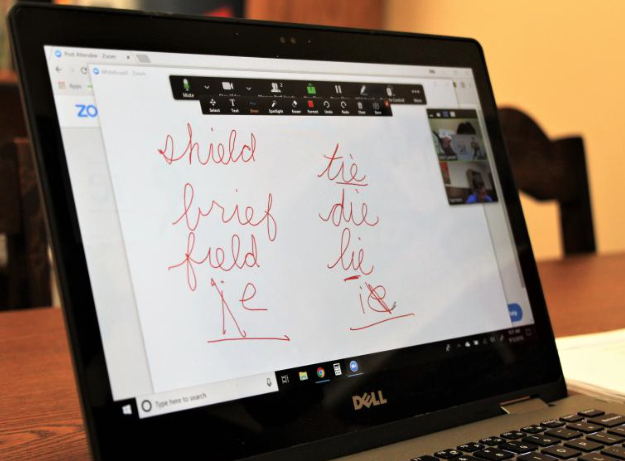
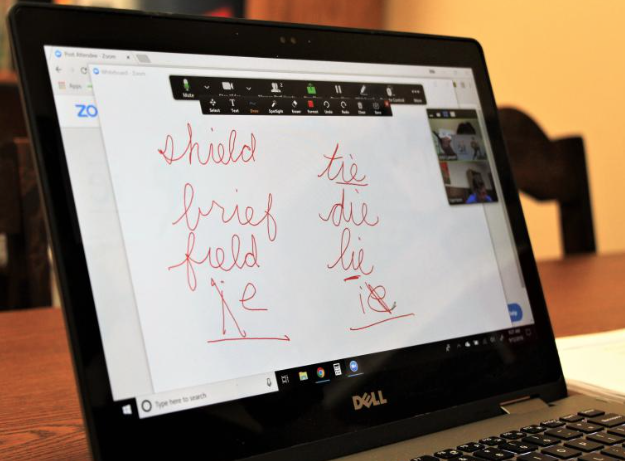
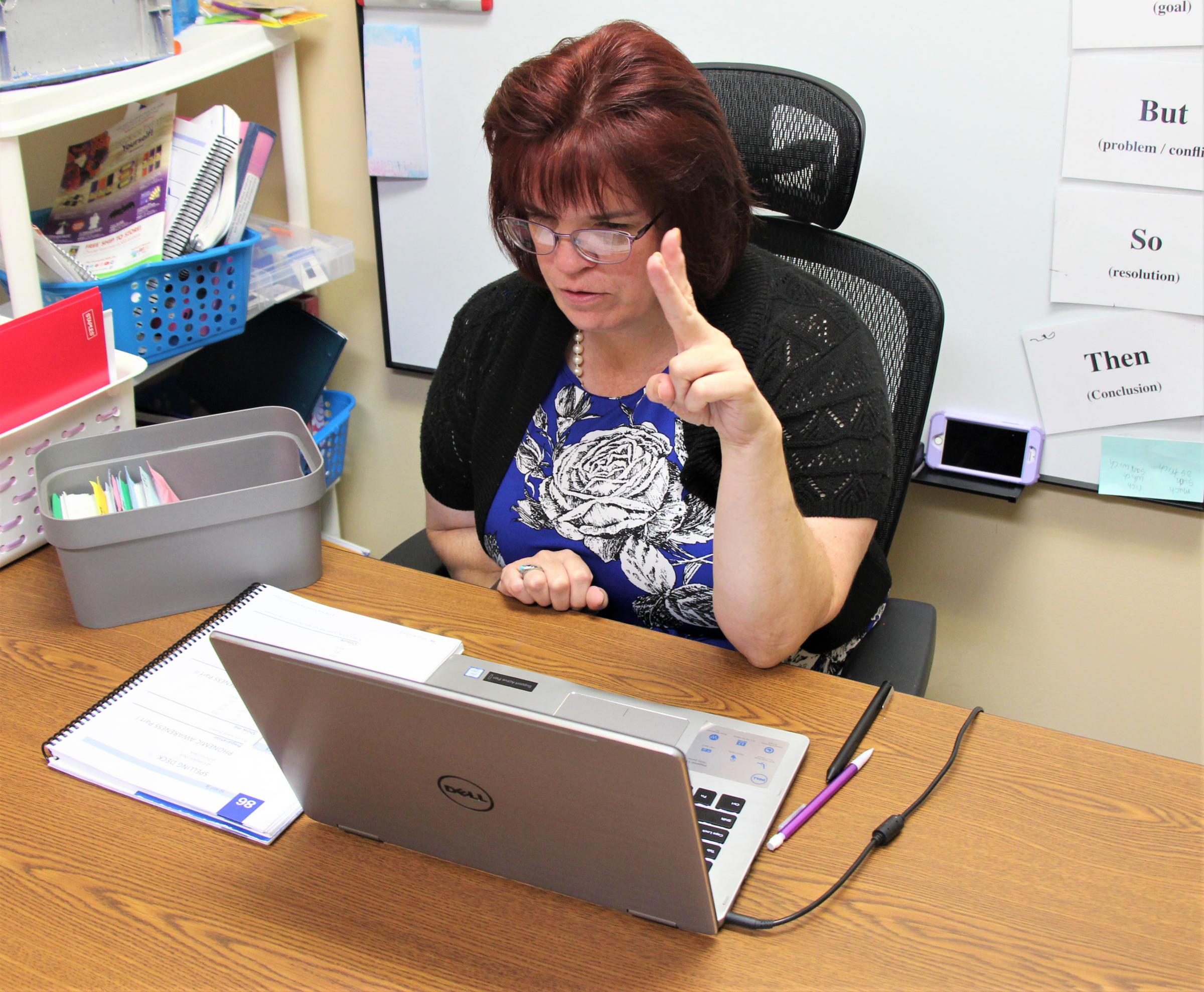
A computer screen shows some of the tricky spelling rules that Ann Lawyer, a teacher at Cradle to Career Literacy Center in Emporia, shared with one of her students during a recent online lesson. CELIA LLOPIS-JEPSEN / KANSAS NEWS SERVICE
But she says she knows how they can flourish.
Schreiber’s private teaching service in Emporia uses an approach known as structured literacy. The method drills students on myriad rules of English sound and spelling that most of us never learned consciously.
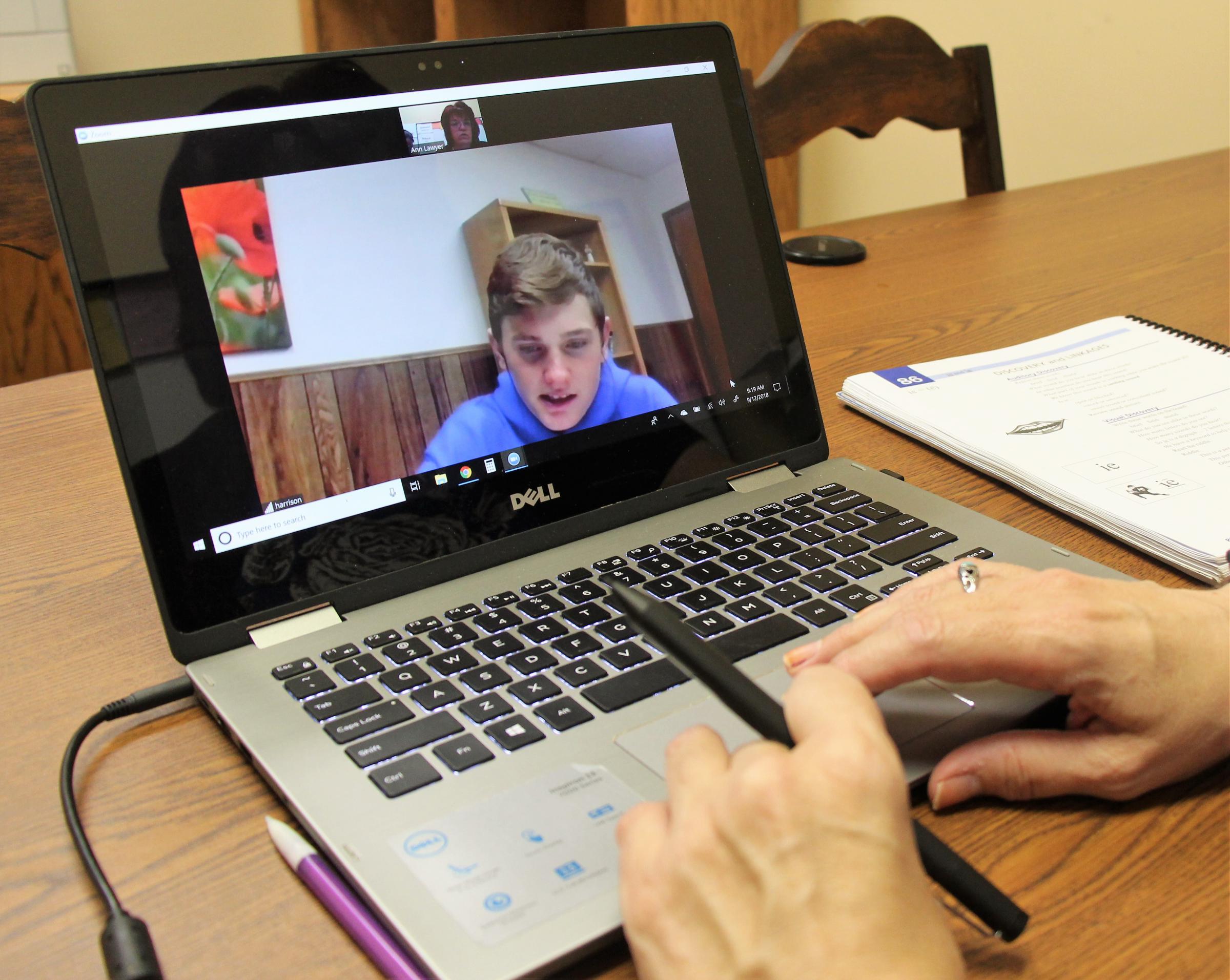
On a recent Wednesday, one of her instructors fired up a laptop for a lesson with Harrison Leniton, an eighth-grader in the southeast Kansas school district of West Elk.
“If I have the ‘kuh‘ sound,” special education teacher Ann Lawyer asked him through their remote video connection, “and I’m using that with an A, O, U — or another consonant — what do I use?”
Harrison: “C.”
Lawyer: “Excellent.”
West Elk eighth-grader Harrison Leniton reviews advanced phonics rules with his teacher, Ann Lawyer.
CREDIT CELIA LLOPIS-JEPSEN KANSAS NEWS SERVICE
For years, dozens of parents of children with dyslexia have gone to the Kansas Legislature with stories of students who don’t get what they need in school — or get it years late, when catching up is many times harder.
Many want the type of lessons Harrison receives.
Now, a state task force could make that happen — with potential, and controversial, effects for how schools teach all children to read.
Skeptics of that structured literacy approach watch uneasily. The state’s colleges of education — where proponents of a different kind of instruction dominate — barely show up on the roster for the task force that could determine the next generation of reading instruction in the state.
Ken Weaver, dean of the Teacher’s College at Emporia State University, says literacy professors were left out by design.
“That is a purposeful mistake,” he said, “to ensure that that voice is not heard.”
Rote rules and reading
The structured literacy classes that Harrison takes can feel like “i before e except after c” for grad students.
Harrison spent the past year catching up multiple grade levels in reading. To do that, he memorized many explicit guides to the maddening world of English orthography. His lessons are peppered with advanced phonics terms. Digraph. Diphthong. Dieresis.
“We take them back to the beginning and say, what we need is to show you a different way to learn to read and spell,” Schreiber said.
Emporia-based teacher Ann Lawyer counts as her student, Harrison Leniton, parses out individual phonemes, or sounds, in a list of words.
CREDIT CELIA LLOPIS-JEPSEN /KANSAS NEWS SERVICE
Many children fret when they fall behind their classmates, even though studies show students with dyslexia are as smart as their peers without it. When schools don’t offer structured literacy, its proponents say, reading drifts farther and farther out of reach. Children with dyslexia pay the price in anxiety, depression and higher dropout rates.
In the past six years alone, American Public Mediasays, more than 30 states have passed laws meant to address concerns that children with dyslexia don’t get help, or even diagnosed.
Some of those laws require teachers colleges to teach structured literacy or the basics of dyslexia. Others make schools screen for the disability and offer intensive phonics. Still others mandate annual dyslexia training for educators.
Kansas doesn’t have any such state law or regulation — yet.
The reading gap
A staggering number of students in the U.S. struggle with reading, whether they’ve been diagnosed with dyslexia or not.
In Kansas, more than half aren’t likely to be able to handle college-level complexity by the time they finish high school. More than a quarter are so far behind they’re not even reading at grade level.
Poor academic outcomes often get attributed to demographic factors, such as poverty. But dyslexia researchers argue the disability — and the way it often goes untreated — likely contributes to a large chunk of the problem.
“The nation has to recognize this is one of the major things holding back millions of children,” said Sally Shaywitz, a professor of pediatrics at Yale University.
The co-founder of the Yale Center for Dyslexia and Creativity, she says one in five people has dyslexia. That translates to a handful of children in any given classroom — a strong argument for training teachers and screening students.
But other sources peg the prevalence of dyslexia at possibly fewer than one in 20. Those figures have some educators concerned that a national movement of vocal parents is pushing schools to overdiagnose children, or focus too much on what is just one of a wide range of student issues that teachers juggle, from childhood trauma to autism.
More phonics?
Then there’s the second big rift that makes conversations between parents and schools difficult: The fight over how children best learn to read.
Literacy specialists at colleges of education today largely push balanced literacy, an approach that relies more on learning through context and deduction, less on detailed lessons in sounds and orthography.
Dyslexia advocates say decades of well-settled research shows that being more explicit benefits all children, not just those with dyslexia. They say it could mitigate the nation’s literacy problems.
The International Literacy Association and International Dyslexia Association have sparred over the matter. (Read their arguments here and here.)
Annie Opat, a literacy expert at Emporia State, said she attended some of the teacher training that structured literacy advocates favor. She wasn’t impressed. Rather, Opat worries that drilling students takes away the enjoyment and context that stimulate learning.
“They’re learning this letter and it’s not related to meaning,” she said. “So that, to me, is not the optimal way for the brain to take on new learning.”
Instead, Opat said, children need to see significance in what they learn.
“If you’re going to learn the letter ‘A’ and my name is ‘Annie,’ that ‘A’ would mean something significant to me knowing it’s part of my name,” she said. “As human beings, if we enjoy something, we’re going to get better at it with more practice.”
That view rankles parents of children with dyslexia, who say context and interest aren’t enough to flip a switch in a brain that’s wired differently. The rules that some teachers dismiss as arcane and tedious can be the difference between whether or not a kid will ever make it through Seuss or Salinger.
Lori McMillan, a Topeka mother whose 8-year-old, Wyatt, has dyslexia, worried when he continued to struggle with basic words in first grade. She recalls writing “the” on a cue card and studying it with him at home.
“By the end of about 20 minutes, you know, he was picking it out of paragraphs,” she said. But 20 minutes later, after practicing the next word, “is,” McMillan showed Wyatt “the” again.
“It was like he’d never seen it before in his life.”
What finally worked for Wyatt, McMillan says, was the explicitness of structured literacy.
The building blocks
On a recent Monday, a few children learned one-on-one with the staff at Pittsburg State University’s Center for Research, Evaluation and Awareness of Dyslexia in southeast Kansas.
The center serves children from multiple states, like 8-year-old Dylan Brooks, of Missouri.
“‘King’ without ‘kuh,’” Courtney Hensler prompted Dylan. “Ing,” he replied. “‘Man’ without ‘mmm’?” she followed up. “An,” came his answer.
Structured literacy drills aim to stimulate sound awareness in children with dyslexia. Doing the mental calculation of deleting a word’s first sound requires an awareness that those individual sounds exist, and can be pulled apart that way.
But the brain pathways that make this connection don’t seem to function the same way in people with dyslexia, researchers say. Helping them hear and manipulate phonemes like “mm” and “kuh” are a first and crucial step to pulling the curtain back on symbols “M” and “K.”
“If you don’t understand that words are made up of sounds,” Pitt State psychology professor David Hurford said, “then when you get to the point where you’re decoding words, that makes no sense to you.”
Hurford leads his college’s dyslexia center and is the sole professor on Kansas’ new dyslexia task force, created by the Legislature last spring.
But academics who teach balanced literacy — the other side of the debate — aren’t convinced their approach is so lacking in the skill sets that Hurford says their colleges should teach.
“Phonemic awareness, sound-symbol associations, decoding,” said Debbie Mercer, dean of the Kansas State University College of Education. “Our program is very strong there. Our students take more coursework in reading methodology than anything else.”
Changes likely
Pitt State’s dyslexia center offers discounts for low-income families, but in other parts of the state, parents say they can’t find such options — if they can find dyslexia specialists at all. Private-practice specialists can cost hundreds of dollars a month.
The state’s dyslexia task force wants to address the lack of access through schools.
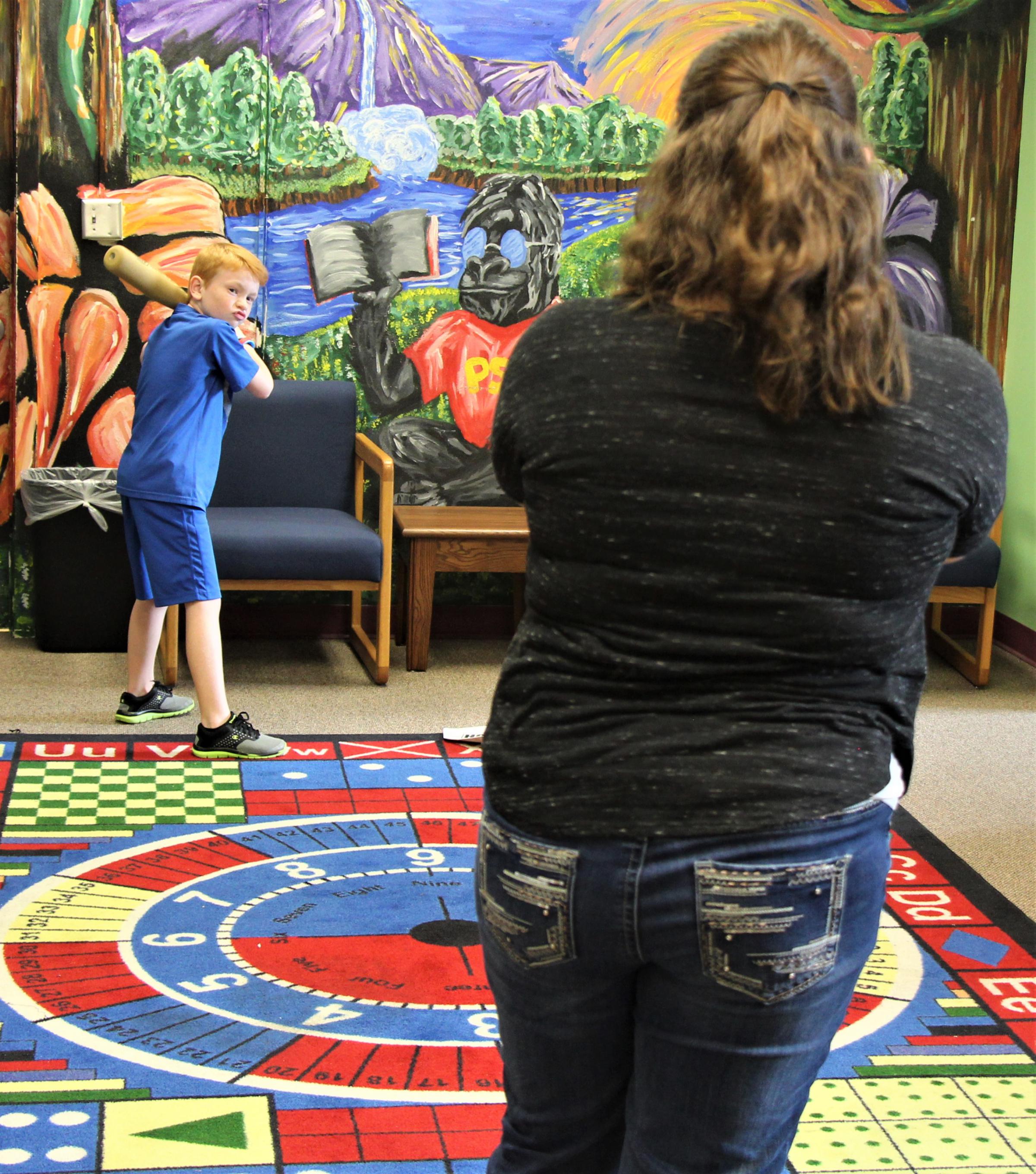
Dylan Brooks and his teacher, Courtney Hensler, take short breaks for fun during his after-school reading lessons. Here Dylan aims to hit a ball with a foam bat.
State board chairman Jim Porter, who also heads the task force, believes his colleagues there will be eager to act.
“There are students,” he said, “whose needs are not being met.”
But education groups wary of overregulation — and a proposal last spring to require dyslexia screening — told lawmakers that Kansas teacher colleges already prepare teachers to help struggling readers. Kansas classrooms, meanwhile, should already be monitoring children for academic deficits and giving stragglers extra help.
The state’s associations for school boards and special education administrators agreed.
But Harrison’s mother, Cynthia Leniton, says structured literacy classes changed her son’s outlook. Now, she says, he sees college as a possibility.
“The education system didn’t know what dyslexia really was,” she said, recalling how she moved him to a different school district in search of better help and signed him up for private lessons in structured literacy.
When it seemed to work, she showed his new superintendent the results and found him willing to offer the remote lessons at school.
The remote lessons cost about $2,500 per student per year. West Elk is now spending about $11,000 for three of its teachers to learn the technique.
The task force exploring whether to roll out dyslexia or structured literacy training on a broader scale hopes to calculate statewide cost estimates for doing so by January.
That could mean training not for three teachers, but for thousands.
Celia Llopis-Jepsen is a reporter for the Kansas News Service. You can reach her on Twitter @Celia_LJ.
PRATT – If you have a fish, turtle, bird or other small pet that you can no longer care for, you may think releasing it at a local lake or park is the most humane thing to do. However, if the release doesn’t end up as a death sentence for your pet, it can lead to new populations of harmful aquatic nuisance species – species not native to Kansas that can threaten native species and habitat.
Through the “Don’t Let it Loose” program, the Kansas Department of Wildlife, Parks and Tourism (KDWPT) is partnering with locally-owned pet stores to provide a safe alternative for families needing to rehome small pets, especially fish. By visiting www.dontletitloose.com, pet owners can view a list of nearly 30 locations across the state willing to help pet owners find the animal a new place to thrive.
In past years, exotic fish species such as pacu, arowana, and the ornate bichir – all non-native species – have turned up in Kansas waters, likely because of aquarium releases. Once a non-native species is introduced into an area, a host of unwanted – and in rare cases, irreversible – effects can occur.
Help protect all animals; don’t release pets into the wild.