We have a brand new updated website! Click here to check it out!

HAWVER: Cross-party endorsements and ‘has-beens’

Martin Hawver
Boys, remember when your father told you to “think twice” before you speak on a first date?

Girls, remember when your mother told you that you can tell a lot about a boy on a first date by quick responses to questions—that those quick retorts are really what the guy thinks?

Who would ever think that those teenager tips from parents would turn out to be important or not when you’re voting for a governor?

We’ll likely see how that advice turns out in the governor’s race, whether an ill-considered slap at “tired has-beens clinging to the part pretending to be Republicans when they so clearly left the party a long time ago…” will split the Republican vote.

That remark came from Republican Secretary of State Kris Kobach’s campaign spokeswoman last week after former U.S. Sen. Nancy Landon Kassebaum, R-Kan., endorsed Democrat Sen. Laura Kelly for governor.

The split: A longtime respected Republican from back in the “old days” when there was more governing and less political sloganeering in campaigns, and today, when there appears to be more catch-phrase and sloganeering in political races.

Now, this may just turn out to be an issue where Democrats can hold the coats of Republicans of all ages while they fight it out under the sheets for just who Republicans want running Kansas, who they want running their political party.

***

There are still some of those Republican “has-been” voters out there who remember back to 1978–yes, 40 years ago–when they elected the first-ever woman U.S. senator to a full Senate term and didn’t just fill out the remainder of the term of her husband.

That was a pretty progressive move for Kansas Republicans who can remember the days when cars had bench seats and an FM radio was an extra-cost option on a new car.

Democrats last week just fired back that the “has been” remark was impolite and inferred that even though it was a fight within the Republican party, it wasn’t respectful.

How would you like to campaign against a candidate who had insulted many members of his own political party, a party that once had elected Kobach to the state party chairmanship? Probably not a bad deal…

***

The whole concept of cross-party endorsements is relatively new to Kansas. It was the 2014 gubernatorial election cycle when a few former GOP leaders endorsed a Democrat for governor. It didn’t work, and Gov. Sam Brownback was elected to a second term in office.

But the effect of that intra-party jab might show up in a gubernatorial election this year. And Kassebaum joined the list of other former Republican leaders who are endorsing Kelly.

Of course, there are a lot of other issues besides endorsements that are in play in the gubernatorial election. And many are relatively party-line issues, ranging from welfare and Medicaid to school and highway finance and tax policy.

There’s the chance that the “has been” voters will just put aside that intra-party jab as an ill-considered remark from youngsters.

Key is that no party has “extra” voters that they can lose through an off-hand remark.

The numbers, remember, are that in Kansas there are about 796,000 registered Republicans, 436,000 registered Democrats, 558,000 unaffiliated voters…oh yes, and 16,800 Libertarians.

Not sure how many Republican votes that Kobach can afford to lose or whether the remark gets him unaffiliated votes. Or whether there are young Democrats out there who aren’t sure why a Republican would support a “real” Democrat.

This is another one to see how it comes out…

Syndicated by Hawver News Company LLC of Topeka; Martin Hawver is publisher of Hawver’s Capitol Report—to learn more about this nonpartisan statewide political news service, visit the website at www.hawvernews.com

Ensemble music group Saint Louis Brass to perform at Beach/Schmidt

FHSU University Relations

Saint Louis Brass quintet, delivering top notch performances all over the country since 1964, will be at Fort Hays State University at 7:30 p.m. Tuesday, Oct. 2, in the Beach/Schmidt Performing Arts Center.

Trumpet players are Allan Dean, Yale University, Miki Sasaki, New York City, and a recent Indiana University graduate, Victoria Knudtson. Daniel Perantoni, Indiana University, is the tubist, and Melvyn Jernigan, formerly with the St. Louis Symphony Orchestra, is on trombone.

They will play many musical selections from their newest CD, “Pops Music of the Americas.” The concert will also include movements from three of their commissions over the years.

New additions for the tour include Anthony Plog’s “Animal Ditties” with music behind the Ogden Nash poem, a new jazz medley, “Tribute to Pops” and “St. Louis Blues” with hits from Louis Armstrong, and the hard driving tango “Libertango” by the Argentinian composer Astor Piazzolla.

The quintet brings with them many ancestors of the brass family of instruments, including the animal’s horn and the conch shell, as well as a short trumpet that was found in King Tut’s tomb. The group also has a straight trombone from the 14th century, a time before man knew how to bend metal.

Saint Louis Brass will also offer free master classes earlier, at 1:30 p.m. in Malloy Hall, open to the public.

Tickets are $5 for the public and free for FHSU students with their student ID. For more information about the concert and the Saint Louis Brass, visit https://bit.ly/2MNnTqP.

SCHLAGECK: Keep kids safe this harvest

John Schlageck writes for the Kansas Farm Bureau.

Keeping children safe while they live, play and work on farms can be challenging. It’s even more difficult during harvest season – a peak time for agricultural injuries.

Long hours, a flurry of activity, less-than-ideal weather conditions and work involving large machines make corn, milo and soybean harvest a potentially dangerous period.

Fall harvest marks the pinnacle of a half year’s effort to produce these crops. During harvest, farmers work long, hard hours. Fifteen-minute meal breaks are about the only real time off in days that often stretch 10 hours. People and machines are pushed to their limits.

While every machine – combine, truck, tractor, grain cart or auger – provides its own unique hazards, operator stress or error account for most harvest accidents. Years of safety features built into these machines are useless without operator safety. Exceed human limitations and accidents are bound to follow.
Carrying an extra passenger is also a safety concern. Children or young adults can fall from cabs. It’s instinct to hold onto something when jarred off balance. Some people have reached for the door handle, accidently hitting the latch and fallen out.

Operator knowledge and attitude remain the key to a smooth, well-oiled fall harvest. A safe operator knows his or her skills, limitations and condition, both physical and emotional.

The safety-conscious operator knows each piece of equipment, its condition, capacities, limitations, hazards and safety equipment. Such an operator is constantly monitoring field and weather conditions.
It’s critical to train young people and go over safety precautions before harvest begins. Beyond the tasks associated with driving harvest equipment, recognizing potential hazards should be discussed.

Consider these safeguards:
Securely fasten seat belts.
Avoid ditches, embankments and holes if possible.
Reduce speed when turning, crossing slopes and on questionable surfaces.
Avoid slopes too steep for operation.
Do not allow passengers – buddy seats may be a safer way.
Be sure everyone is a safe distance before moving.
Operate combines, tractors, trucks and grain carts as smoothly as possible.

Every fall In Kansas, thousands of acres of corn, milo and soybeans add to the pressure of slicing through those crops before foul weather or winter comes to call. With this added pressure comes the desire to take chances, short cuts and extend working hours. Such behavior only adds to fatigue and high levels of stress and tension.

Remember, harvest will take its toll if you don’t take breaks. Eating balanced meals, even if you only take 15 minutes is important.

Stop the machine. Crawl off and relax a few minutes while you’re eating.

Drink plenty of water, tea or other cold liquids during what can be hot, dry days. Jump out of your machine for such breaks at least every hour.

Walk around the machine to limber up. This will also allow you to check for possible trouble spots on your machinery.

Before harvest begins, check your equipment and perform the proper maintenance. Consult your operator’s manual or dealer if you have questions. Well-maintained machinery reduces the chance for breakdowns and related aggravation in the field.

Delays due to breakdown only force harvest crews to work longer and harder to catch up. Such delays also increase the chance of accidents during this catch-up period.

Pulling pre-harvest maintenance is easier and less frustrating than fixing such problems in the cold or heat, dirt and sweat of the harvest field. Reduce your chances of aggravation now – it will be worth it.

John Schlageck is a leading commentator on agriculture and rural Kansas.

Police arrest Kan. man wanted for 15 business burglaries

SHAWNEE COUNTY — Law enforcement authorities are investigating a series of business burglaries and have a suspect in custody.

Swopes -photo Shawnee Co.

On Monday, police arrested a person of interest in at least 15 business burglaries that occurred throughout the Topeka community that spanned several months, according to Lt. Andrew Beightel.

Police booked Eric Darnell Swopes, 44, Topeka, into the Shawnee Co Department of Corrections on requested charges of burglary, theft and criminal damage of property (x15).

Kansas man dies in rear-end semi crash

BROWN COUNTY —One person died in an accident just before 5p.m. Monday in Brown County.

The Kansas Highway Patrol reported a 2004 Chevy Cavalier driven by Ronnie D. Myers, 47, Hiawatha, was eastbound at 783 U.S. 36.  The vehicle rear-ended a semi that was turning into a private drive.

Myers was pronounced dead at the scene and transported to Frontier Forensics.

The semi driver Martin E. Lawrence, 53, Wetmore, was possibly injured, according to the KHP report.  Myers was not wearing a seat belt, according to the KHP.

Windy, cooler Tuesday

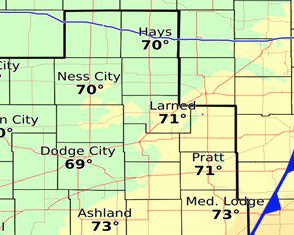
Today A 20 percent chance of showers before noon. Cloudy through mid morning, then gradual clearing, with a high near 69. Windy, with a north wind 9 to 14 mph increasing to 23 to 28 mph in the afternoon. Winds could gust as high as 39 mph.

Tonight Mostly clear, with a low around 43. North wind 5 to 14 mph.

Wednesday Mostly sunny, with a high near 70. North northwest wind 5 to 8 mph becoming south southeast in the afternoon.

Wednesday Night Mostly clear, with a low around 48. South wind 8 to 10 mph.

ThursdaySunny, with a high near 78.

Thursday NightMostly clear, with a low around 52.

FridayA 20 percent chance of showers after 1pm. Mostly sunny, with a high near 65.

Sheriff alerts residents to fake check scam in Kansas

CLARK COUNTY — Law enforcement authorities are alerting citizens in southwest Kansas of a scam involving checks that arrived in the mail.

A citizen in Clark County received two checks in separate envelopes and one required a signature.  They came from the same sender address, had the same check paper but with different company and account information.

Fortunately, they were not cashed at local banks, according to a social media report from the Clark County Sheriff.

The sheriff reminded residents “Pay attention. If you are not expecting a check or refund from a company that you deal with, use extra caution. The citizen who received the checks wanted to share this information to help keep others safe. The sheriff’s office removed their information prior to sharing.

Reward doubled, police investigate Kan. animal cruelty case

SEDGWICK COUNTY —Law enforcement authorities are investigating a case of animal cruelty and have increased a  reward from $500 to $1000 for information leading to those responsible for cutting a month-old puppy’s ear off  with a sharp object, according to Beauties and Beasts Animal Rescue in Wichita.

Photo courtesy Beauties and Beasts Animal Rescue

Doctors at Veterinary Emergency & Specialty Hospital of Wichita performed surgery on the puppy named Brooks after the animal rescue organization rapidly received donations to cover costs of the care. 

Anyone with information on the case should contact the Wichita Police animal cruelty investigator [email protected] or you can send a message to Beauties and Beasts Animal Rescue.


Police K-9 assists with Kansas drug arrest

BARTON COUNTY — Law enforcement authorities are investigating two suspects on drug charges after a traffic stop.

Foster-photo Barton County
Meeks -photo Barton Co.

Just after 3a.m. Monday, a deputy sheriff on patrol conducted a traffic stop on a white Mitsubishi bearing Kansas tags in the 1000 block of Heizer in the City of Great Bend, according to Sheriff Brian Bellendir. 

During the course of the traffic stop, a Great Police Department K-9 unit arrived at the scene. Further investigation uncovered almost 5 grams of methamphetamine, marijuana and drug paraphernalia in the vehicle.  

Deputies arrested the driver, Esteban Foster, 19, of Great Bend. He was booked on charges of possession of a controlled substance, possession of marijuana, possession of drug paraphernalia as well as driving without a license.  Foster is being held in lieu of a $10,000 bond.

The passenger identified as Damaris Meeks, 18, of Great Bend was placed under arrest and booked on charges of possession of marijuana and possession of drug paraphernalia. Meeks is being held in lieu of a $2500 bond. 

State record pumpkin on display in Manhattan

MANHATTAN — The largest pumpkin on record grown in Kansas is on display at the Flint Hills Discovery Center for a short time this fall.

Photo courtesy Jacob Marintzer

The pumpkin officially weighed in on September 8, 2018 in Dewey, OK at 1,176 lbs., a record for any Kansas grown pumpkin, according to grower, owner Jacob Marintzer of Westmoreland, Kansas.

This pumpkin beat Marintzer own official record set in 2016 of 940lbs.

The pumpkin is on display at the Discovery Center Atrium until October 5, so there is no fee to see it.

The seeds, and not the pumpkin are where the real excitement is, according to Marintzer. While the giant pumpkin is a great spectacle to behold, it’s the price that a giant pumpkin seed fetches that really makes all the work worthwhile.

The price for a pumpkin seed that comes from a pumpkin this large can run between $15 to $600 per seed. More info can be found here: www.bigpumpkins.com

The family also has a Youtube channel where they have documented the progress of their pumpkin growing process.

Marintzer described the growing process, “There is a main organization called the GPC Giant Pumpkin Commonwealth. This is the main group which makes all of the rules and regulations. Under them are all of the clubs, some states have 1 club some states have many clubs. These clubs must pay their fees to be part of the GPC and they also must have a certified scale to weigh these pumpkins. I took my pumpkin to a weigh-off in Oklahoma. I took it there and not the State fair because the state fair isn’t part of the GPC and they don’t have a certified scale so any pumpkins weighed there don’t count as an official state record.

The largest ever weighed in Kansas unofficially was 1040 pounds. I had the official state record 2 years ago at 938 pounds that pumpkin was weight in Pawnee City, NE. The pumpkin I grew this year set the record at 1176 pounds. So right now it is the largest pumpkin ever grown in Kansas. Somebody could weigh one here in the upcoming weeks and beat it but I’m not aware of any bigger at the moment.”


Kansas man jailed for criminal use of explosives

SEDGWICK COUNTY — Law enforcement authorities are investigating a suspect in connection with use of explosives at his home.

Redd -photo Sedgwick County

Just after 4:30p.m. Sunday, police responded to a check for explosion call in the 3300 Block of South Glenn in Wichita, according to office Charley Davidson.

Just after the initial call, officers were also sent to report of an injury associated with an explosion at a home in the 3300 Block of South Vine. At the residence, officers contacted 43-year-old Travis Redd of Wichita.  According to investigators, Redd used a large firework in a manner in which it was not designed to explode an item on the ground behind his residence, according to Davidson.

When the firework detonated, fragments hit Redd in the chest.  He was transported to an area hospital for treatment of non-life-threatening injuries and released. Officers then booked him into the Sedgwick County Jail for criminal use explosives, according to Davidson.

There were no other injuries.

The Wichita Police Department Bomb Squad and Alcohol, Tobacco and Firearms agents assisted with the investigation.

As aid checks go out, farmers worry bailout won’t be enough

By JULIET LINDERMAN
Associated Press

WASHINGTON (AP) — Farmers across the United States will soon begin receiving government checks as part of a billion-dollar bailout to buoy growers experiencing financial strain from President Donald Trump’s trade disputes with China.

But even those poised for big payouts worry it won’t be enough. And while support for Trump is near unwavering in the heartland, some growers say that with the November election nearing, such disappointing aid outcomes could potentially affect their vote.

“It’s pretty obvious that the rural agriculture communities helped elect this administration, but the way things are going I believe farmers are going to have to vote with their checkbook when it comes time,” said Kevin Skunes, a corn and soybean grower from Arthur, North Dakota and president of the National Corn Growers Association.

Corn farmers get the smallest slice of the aid pie. Corn groups estimate a loss of 44 cents per bushel, but they’re poised to receive just a single penny per bushel.

“If these issues haven’t been resolved, there could be a change in the way farmers vote,” Skunes said. “A person has to consider all things.”

Farmers are already feeling the impact of Trump’s trade tiffs with China and other countries. China has hit back hard, responding with its own set of tariffs on U.S. agricultural products and other goods.
The Trump administration is providing up to $12 billion in emergency relief funds for American farmers, with roughly $6 billion in an initial round. The three-pronged plan includes $4.7 billion in payments to corn, cotton, soybean, dairy, pork and sorghum farmers. The rest is for developing new foreign markets for American-grown commodities and purchasing more than two dozen select products, including certain fresh fruits and vegetables, nuts, meat and dairy.

Agriculture Secretary Sonny Perdue announced last month that soybean growers will get the largest checks, at $1.65 per bushel for a total of $3.6 billion. China is the world’s leading buyer of American soybeans, purchasing roughly 60 percent of the U.S. crop. But since Beijing imposed a 25 percent tariff on soybean, imports prices have plunged.

The lack of initial detail about how the calculations were made left farmers scratching their heads.
Asked about the confusion, Rob Johansson, the Agriculture Department’s chief economist, responded that the USDA took into account a number of factors “including the share of production that is exported and the value of trade directly affected by the retaliatory tariffs.”

“The level of damage is not the same for each commodity,” he said in a written response to questions submitted by The Associated Press.

He estimated that there would be more than 784,000 applications for relief.

The USDA has since released a detailed analysis of how the department made its calculations.

The breakdown has stunned corn and wheat farmers who say the payments are uneven and won’t do much of anything to help keep struggling farms afloat.

A lobbying group that represents wheat growers is challenging the way the administration determined payments for wheat farmers, who are set to receive 14 cents a bushel. Chandler Goule, CEO of the National Association of Wheat Growers, said the USDA assumed U.S. wheat would be sold to China this year when it made its calculations. But the assumption was flawed, he said.

China typically makes its requests for American wheat between March and June. U.S. wheat farmers have sold, on average, 20 million bushels of wheat to China over the past three years. But none came this year, Goule said, as Trump escalated his threatening rhetoric on trade with Beijing. He hopes the per-bushel rate for wheat goes up if there’s a second round of payments.

“I am very certain that we will not sell any wheat to China this year,” Goule said. “The window we sell in has come and gone.”

The response among farmers has been mixed. While some are grateful for the help, most are eager for the trade disputes to be quickly resolved.

“Nobody wants to have an aid package. I mean, if you’re a farmer you’re in the business of producing a crop. We just want a fair price for it,” said Joel Schreurs, a soybean and corn producer near Tyler in southwestern Minnesota who sits on the board of both the American Soybean Association and the Minnesota Soybean Growers Association.

His personal operation is about 1,000 acres. He farms an additional 500 acres with his son-in-law and other relatives. He estimates that the tariffs would cost him $40,000 to $50,000 in lost income and that he would get $16,000 to $20,000 in emergency aid.

Schreurs worries that it will be hard for farmers to get back the buyers they’ll lose as a result of the trade wars. “And in the short term we have to find another home for those beans, otherwise they’re going to pile up and it will keep prices depressed,” he said.

In the Midwest, growers typically farm both corn and soybeans. Those farmers would get payments for both under the program, which began sign-ups Sept. 4.

Perdue said checks could start going out as soon as the end of September for crops that have already been harvested; payouts are based on yield.

In a recent C-SPAN interview, Perdue said he understands growers’ frustrations.

“Farmers always live in unpredictable times,” he said. “They’re very resilient, but obviously the longer trade issues go on the longer it bears on them regarding what is the future.”

Jack Maloney says corn farmers will be getting so little in bailout aid that for roughly 200,000 bushels of corn a farmer would get only about $2,000 for their losses.

“That’s not even beer money,” said the Brownsburg, Indiana, corn and soybean grower.

Maloney, 62, began farming full time in 1978 and now has two employees. He said some fellow farmers are angry and upset.

“Agriculture has always been the butt of all the trade wars,” he said, adding that this isn’t the first time he’s seen trade disruptions affect the agricultural markets.

Maloney said he had already cut back on expenses during the past three years and hasn’t taken a paycheck from his farm for more than a year because of tough times before the trade war began. He said the recent tumult has dashed hopes for stabilizing agricultural markets anytime soon.

“We were seeing a little light at the end of the tunnel — the markets were improving a little,” he said, “and then this tariff thing happened and this trade war.”

Daniel Weinand worries the market downturn could be the death knell for his farm. Weinand, 30, grows corn, canola and yellow peas on 900 acres of rented land near Hazen, North Dakota. He said he expects to reap about 30,000 bushels of corn, and to receive about $300 in aid.

“A penny a bushel on corn, it’s not that it’s entirely worthless. But it almost is,” he said. “I don’t know how many more years I can weather.”

Copyright Eagle Radio | FCC Public Files | EEO Public File