We have a brand new updated website! Click here to check it out!

New trustees, directors elected for KSU Foundation

Kansas State University Foundation

MANHATTAN — Following an election Sept. 7 at the semiannual meeting of Kansas State University Foundation’s board of trustees in Manhattan, three members were re-elected to three-year terms on the foundation’s board of directors, and 49 members were elected to four-year terms on its board of trustees.

The KSU Foundation now has 348 trustees serving as the university’s premier advocates, ambassadors and investors.

The KSU Foundation’s board of directors oversees management, control and supervision of the KSU Foundation’s business and affairs. Re-elected to the board of directors: Charlene Lake, Dallas, Texas, who earned her bachelor’s degree in journalism and mass communications from the College of Arts and Sciences in 1983; Steve Theede, Houston, Texas, who earned his bachelor’s degree in mechanical engineering from the College of Engineering in 1974; and Mary Vanier,Manhattan, who earned her bachelor’s degree in hotel and restaurant management from the College of Human Ecology in 1989.

The following individuals from Kansas were elected trustees of the KSU Foundation:

Karen and Mike Pestinger, Beloit; Amro and Darla Samy, Garden City; Beth and Trahy Hurst, Junction City; Tom and Vera Hintz, Jane and Wayne Ingmire, Roger Lanksbury, and Christy Linders, all of Manhattan; Garren and Heidi Walrod, Randolph; Lynette and Mick Tranbarger, Wichita; and Diane and Jerry McReynolds, Woodston.

From out-of-state:

Don Gemaehlich, Chandler, Arizona; Doug and Sabrina Kruse, Templeton, California; Andrew and Megan Murphy, Telluride, Colorado; Larry and Linda Nelson,Washington, D.C.; Marta and Tim Belstra, DeMotte, Indiana; Cathy and Tom Ritter; Reistertown, Maryland; Sue and Tim Regan, Waterloo, Nebraska; Karen and Scott Love, Bartlesville, Oklahoma; JP and Teresa Bilbrey, Mechanicsburg, Pennsylvania; Janet Strohmeyer, Austin, Texas; Audrey Mross, Dallas, Texas; Julie and Scott Jimison, Haslet, Texas; Amy and Nick Graham, Highland Park, Texas; Charlie and Debbie Morrison, Keller, Texas; Dan and Kim Wicker, McKinney, Texas; Brian Paulson, Sherman, Texas; Carol Laflamme, Fairfax Station, Virginia; and Jesse and Sabrina Schriner, Sammamish, Washington.

“The KSU Foundation trustees and directors have made an outstanding commitment to boldly advance K-State family,” said Greg Willems, president and CEO of the KSU Foundation. “We thank our trustees — new and returning — for their leadership and dedication to K-State.”

As Kansas State University’s strategic partner for philanthropy, the KSU Foundation inspires and guides philanthropy toward university priorities to boldly advance K-State family. The foundation is leading Innovation and Inspiration: The Campaign for Kansas State University to raise $1.4 billion for student success, faculty development, facility enhancement and programmatic success.

Police capture Kansas home invasion robbery suspect

SHAWNEE COUNTY— Law enforcement authorities are investigating a home invasion robbery and have a suspect in custody.

Just before 2:30a.m. Sunday, offices were dispatched to the 1100 block of SW Hillsdale in Topeka for the report of an aggravated robbery, according to Lt Kelvin Johnson.

The victim reported two individuals came to his door, one of which he knew, and allowed them inside. Once inside the residence, one of the suspects struck the victim and another individual in the head with a weapon causing minor injuries to both of them.

The two suspects then began stealing items from the residence, including the victim’s car.

Officers responding to the scene located the stolen car driven by the suspect near 17th and Gage and attempted to conduct a traffic stop.

The suspect initiated a short vehicle pursuit that ended at 20th and Oakley where the suspect ran on foot and was apprehended quickly without further incident.

Police booked William Blue, 33, into Shawnee County Jail for aggravated robbery, felony theft, battery, felony attempt to flee and elude, driving while suspended, and other traffic charges, according to Johnson.

Blue has previous convictions for theft and flee or attempt to flee and elude police, according to the Kansas Department of Corrections.

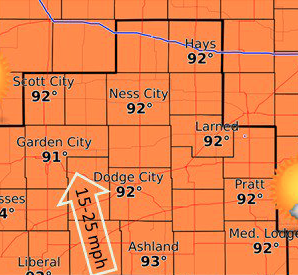
Hot, windy Monday

Today Sunny, with a high near 92. South wind 7 to 15 mph.

Tonight Clear, with a low around 69. South southeast wind 8 to 11 mph.

Tuesday Sunny, with a high near 93. South wind 7 to 14 mph.

Tuesday Night Clear, with a low around 70. South southeast wind 9 to 11 mph.

Wednesday Sunny, with a high near 92. Breezy, with a south wind 9 to 14 mph increasing to 15 to 20 mph in the afternoon.

Wednesday Night Mostly clear, with a low around 71.

Thursday A 50 percent chance of showers and thunderstorms, mainly after 1pm. Mostly sunny, with a high near 86.

KHP identifies woman who died after Gove Co. rollover crash

GOVE COUNTY— One person died in an accident just before 8p.m. Saturday in Gove County.

The Kansas Highway Patrol reported a 1999 Toyota Corolla driven by Rayette Santillan, 44, Oklahoma City, OK, was eastbound on Intestate 70 just east of Campus Road.

The vehicle briefly entered the median, came back onto the roadway and the driver over-corrected and exited the roadway to the right.

The vehicle entered the south ditch, overturned and came to rest on its roof.

Santillan was pronounced dead at the scene and transported to Baalmann Mortuary. She was wearing a seat belt, according to the KHP.

Kansas felon gave police fake name during traffic stop

SHAWNEE COUNTY — Law enforcement authorities are investigating a suspect on theft and weapons violation.

McBurney -photo Shawnee Co.

Just before 10:30 p.m. Saturday, officers conducted a traffic stop in the 1300 block of SW Buchanan in Topeka, according to Lt. Manuel Munoz.

During the investigation, officers determined that the driver was giving them a false identity. Officers were able to positively identify the subject as 39-year-old Robbie McBurney.

During the course of the investigation, McBurney was also found to be in possession of a firearm as a convicted felon and stolen property.

He was transported to the Shawnee County Department of Corrections under suspicion of crimes related to this incident.

McBurney has previous convictions for Aggravated Battery, Forgery and Drugs, according to the Kansas Department of Corrections.

Kansas man dies after run over early Sunday

MORRIS COUNTY — One person died in an accident early Sunday in Morris County.

The Kansas Highway Patrol reported a vehicle was eastbound on U.S. Highway 56 ten miles east of Herrington.

The vehicle ran over Shawn Irons, 56, Herrington,  who was lying in the middle of the road and then departed the scene.

The KHP reported the accident occurred between1:21and 01:44 a.m. Sunday. Irons was pronounced dead at the scene and transported to  Zeiner Funeral Home.

Authorities released no additional details.

Historic Lake Scott State Park to host Youth Day

KDWPT

SCOTT CITY – Live snakes, shotgun and BB gun instruction, and 3-D target archery shooting are all on the agenda for the 2018 Southwest Kansas Youth Day at Historic Lake Scott State Park on Sunday, Sept. 23. All youth ages 16 and younger are invited to enjoy the outdoor skills instruction and demonstrations from 9 a.m. to 2 p.m. Historic Lake Scott State Park is located 11 miles north of Scott City, 101 West Scott Lake Drive, 67817.

Lunch will be provided, and registered participants will get a free event t-shirt.

A variety of prizes will be given away during the day, including mentored hunts, shotguns and pellet guns for youth ages 9-16, and a separate set of prizes for youth ages 9 and younger.

For more information, and to register for this event, contact Manuel Torres at (620) 966-8570 or by e-mail at [email protected].

The event is made possible by Extreme Fowl, Pheasants Forever and the Kansas Department of Wildlife, Parks and Tourism.

Different county policies could impact Kansas voting

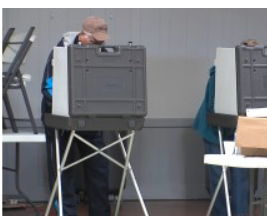
TOPEKA, Kan. (AP) — The chances of a Kansas voter’s ballot being counted might depend on which county he or she lives in — especially if they vote by mail.

The issue of counties having different standards for determining whether a ballot should be counted came up last week (Monday) during a meeting of the State Objections Board, where Davis Hammet of Topeka objected to Republican Kris Kobach’s victory in the Aug. 7 GOP primary for governor. Hammet’s objections involved how the election was administered and whether the varying standards could have influenced the outcome of a race that Kobach won over Gov. Jeff Colyer by less than 350 votes.

Hammet noted Johnson County rejected 153 mail-in ballots because the signature on the envelope used to mail the ballot back to the county did not match the voter’s signature on file in the county election office.

In contrast, Shawnee and Douglas counties’ election officials didn’t reject any ballots because of mismatched signatures.

“This means either Johnson County erroneously rejected these ballots, or there is massive voter fraud in Johnson County,” Hammet told the board. “If the board rules that my objection is wrong and that Johnson County’s rejection is correct, then, given the discrepancy between Johnson County and Shawnee County, it can reasonably be presumed that Shawnee County and other counties improperly allowed fraudulent votes.”

Hammet also noted Kansas doesn’t require county officials to verify signatures when voters mail back their ballots. They are required to do so only when the voter fills out a form requesting an advance ballot by mail.

The Objections Board rejected the argument that county officials should not verify ballot signatures. Deputy Secretary of State Eric Rucker said that while the law does not require verifying signatures on advance ballot envelopes, it does say election officers have a duty to challenge ballots when there is reason to believe the people casting them are not who they say they are, and a mismatched signature can be evidence of that.

Shawnee County Election Commissioner Andrew Howell said his office didn’t reject any ballots in August because of mismatched signatures, but he said he typically sees at least a few mismatched signatures in each election. Deciding whether to count a ballot is often a judgment call that is left to local officials, he said.

“Anytime the law leaves it open for interpretation, everybody does the best they can,” Howell said. “We’re always left with the challenge of trying to make a reasonable determination.”

Howell said Shawnee County also spends a lot of time calling, writing or mailing voters if there is a problem with a ballot before deciding to reject it.

Douglas County Clerk Jamie Shew said the county also didn’t reject any ballots because of mismatched signatures. His office often sends “runners” to voters’ homes to clear up any problems with their ballots.

“There’s nothing in the statute that says we have to reach out to the voter. That’s a decision we make,” Shew said.

Attorney Brant Lauenn said Hammet raised issues that the Legislature should resolve. But Rep. Vic Miller, D-Topeka, an attorney who often frequently handles election contests for Democratic candidates, said he thinks the secretary of state’s office should decide what he called administrative issues.

Howell also said he wasn’t sure whether imposing uniform standards on all counties would be helpful.

“It’s kind of a double-edged sword,” he said. “Too much subscription takes away from judgment calls, and a lot of times you need to make judgment calls. On the other hand, it would be helpful to be super clear what to count and not to count.”

___

Chip seal work to begin in Hays this week

Click to expand
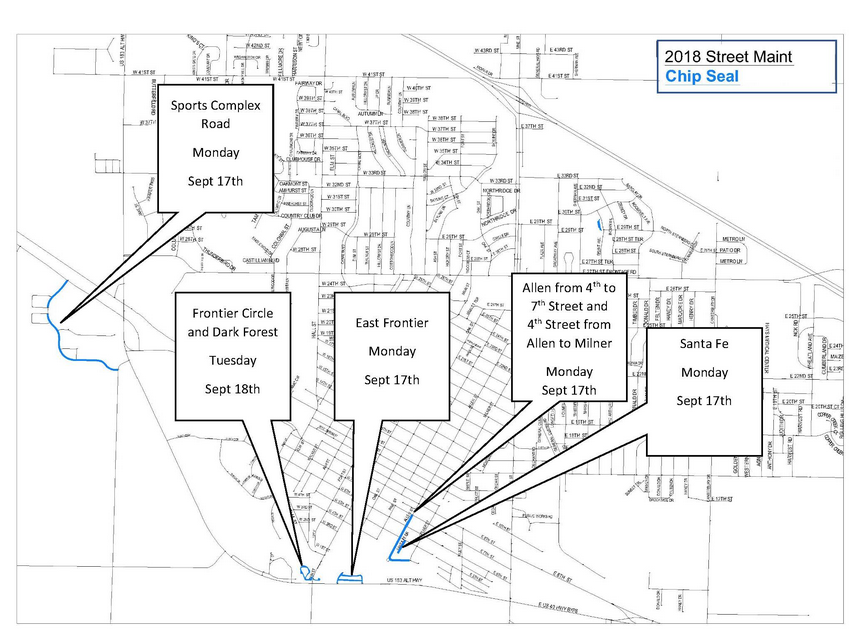
Beginning Monday, the City of Hays, in cooperation with Ellis County Public Works will be doing chip seal at various locations throughout the city.

The chip seal treatment is a spray applied polymerized oil followed immediately by small rock chips. Traffic will be limited during a very short period of time when the streets are being sealed. Vehicles must not be parked on the street prior to chip sealing, and the street should not be wet, so sprinkler systems should not spray on the street prior to chip sealing.

The map above is preliminary and may be subject to weather, mechanical failures, or other production issues; therefore, adjacent property owners will be notified prior to sealing of the streets. The work is estimated to be completed in two days, weather permitting.

Signs will be in place to direct the traveling public. The traveling public should use caution and avoid driving in the wet oil. The construction is in relation to 2018 street maintenance projects.

For more information, call the Public Works Department at (785) 628-7350.

— City of Hays

Hoxie native, NASA astronaut Nick Hague will launch to International Space Station

NASA Astronaut Nick Hague is a Hoxie native.

NASA

NASA astronaut Nick Hague currently is at the Gagarin Cosmonaut Training Center in Star City, Russia, with his crewmate Alexey Ovchinin of the Russian space agency Roscosmos. They will launch from Baikonur, Kazakhstan, on the Russian Soyuz MS-10 spacecraft at 4:39 a.m. (2:39 p.m. Baikonur time) Oct. 11. They are scheduled to return to Earth in April.

The launch to the International Space Station will be the first spaceflight for Hague.
in October.

Hague is a native of Hoxie, Kansas, and a colonel in the U.S. Air Force. He is part of the 2013 NASA astronaut class and will be the first of his class to go to space. Prior to his selection, he was part of the Air Force Fellows program in Washington, where he worked as an adviser to the U.S. Senate on matters of national defense and foreign policy.

Hague earned a bachelor’s degree in astronautical engineering from the U.S. Air Force Academy in Colorado Springs, Colorado, and a master’s degree in aeronautical and astronautical engineering from the Massachusetts Institute of Technology in Boston.

After a six-hour journey to orbit, Hague and Ovchinin will arrive at the station and join fellow NASA astronaut Serena Auñón-Chancellor, Expedition 57 Commander Alexander Gerst of ESA (European Space Agency), and Sergey Prokopyev of Roscosmos, bringing the station’s crew complement to five.

During a planned six-month mission, station crew members will take part in about 250 research investigations and technology demonstrations not possible on Earth to advance scientific knowledge of Earth, space, physical and biological sciences. Science conducted on the space station continues to yield benefits for humanity and will enable future long-duration human and robotic exploration into deep space, including the Moon and Mars.

They’re also expected to be onboard the space station during the first uncrewed test flights of the SpaceX Crew Dragon and Boeing CST-100 Starliner as part of NASA’s Commercial Crew Program, which will return astronaut launches to U.S. soil.

Follow Hague on social media at:

KRUG: Stay Strong Stay Healthy program offered by Extension

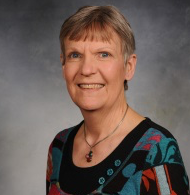
Donna Krug

The natural aging process offers challenges to many people. While we know from listening to the news and our personal experiences, staying active is a key component in maintaining or regaining health. But if you have noticed that your strength, flexibility or balance isn’t what it used to be you may want to consider signing up for a strength training program I will be offering, beginning in October.

“Stay Strong, Stay Healthy” is designed to increase an aging adult’s access to a safe, structured, and effective strength training program. Over 8 weeks, participants learn exercises to improve their strength, flexibility, and balance. During each session, a prescribed set of 8 upper and lower body strengthening exercises are done along with warm-ups and cool-down stretches. Participants are made to feel comfortable regardless of their current fitness level so they can safely participate and gradually build the strength beneficial to health.

The 8-week program is set to begin Tuesday, October 23rd, and ends December 20th.  It meets Tuesdays and Thursdays from 10 – 11 am at the Great Bend Activity Center, 2715 18th Street. The registration fee is $20 and may be paid at the Cottonwood Extension District – Great Bend office, 1800 12th Street, by October 10th. The class size is limited so please enroll soon. When you register we will schedule a time for a pre-assessment to be completed.

K-State Research & Extension has partnered with Missouri Cooperative Extension to bring the Stay Strong, Stay Healthy program to our state. I am excited that the Great Bend Recreation Commission is allowing us to use their facilities and weights for these classes.

Call me if you have any questions about the “Stay Strong, Stay Healthy” workshop.

Donna Krug is the District Director and Family & Consumer Science Agent with K-State Research and Extension – Cottonwood District. You may reach her at: (620)793-1910 or [email protected]

SCHROCK: Asian American students versus affirmative action

John Richard Schrock is a professor at Emporia State University.
While Asian Americans make up 5.2 percent of the U.S. population, they make up over 20 percent of the students in 23 of the most selective U.S. colleges, according to the September 14 issue of the Chronicle of Higher Education. This includes only Asian American students who are citizens and does not include nonresident international Asian students.

The academic accomplishment of Asian American students is impressive. Education idealists such as Lumina are pressing schools to increase college attendance and completion from the low 40 percent of high school graduates to 60 percent. But Asian American students have already surpassed that 60 percent college completion level.

Indeed, on all measurements of K–12 academic achievement across all 50 states, children of Asian descent consistently average higher. Labeled the “model minority,” they are often left off of subgroup comparisons because their performance as a minority is significantly greater than majority white students. Their performance is sometimes labeled the “model minority myth” since there are some Asian American students who do not score high. But distribution in academic performance is a bell curve and their curve is substantially higher than for any other racial or ethnic group. It is no myth. Asian culture values education more highly than do other ethnic groups.

California has a higher percentage of Asian American students (13.9%) than most states. In July of 1995, the University of California Board of Regents voted to eliminate affirmative action in university admissions, as reported in the August 4, 1995 Chronicle of Higher Education, A18. The number of Asian American students immediately increased. Affirmative action had clearly suppressed the Asian minority.
Today, while California’s Asian American population constitutes 13.9 percent, the percentages of Asian American students enrolled at California’s top colleges are as follows:

Cal Tech 40.7%
U.C. Berkeley 42.7%
U.C. Los Angeles 33.3%
Cal. State Long Beach 25.0%
Univ. Southern CA 24.5%
Harvey Mudd College 23.1%…and so on.

Affirmative action admission policies are still used in some states to provide greater diversity among minorities on campus, an educational benefit that was upheld by the U.S. Supreme Court decision issued June 23, 2016 in Fisher v. University of Texas at Austin. That decision found that the race-conscious admissions program in use at the time by UT-Austin was lawful under the Equal Protection Clause.

The Court accepted the rationale for having a diversity of students, that included: “destruction of stereotypes,” promotion of “cross-racial understanding,” preparation of students for “an increasingly diverse workforce and society,” and cultivation of “leaders with legitimacy in the eyes of the citizenry.” Data also showed that race-neutral use of academic criteria could not achieve this mix of students. The court also required ongoing “strict scrutiny” to ensure “…that race plays no greater role than is necessary to meet its compelling interest.”

Two weeks ago, the Department of Justice filed a brief supporting a lawsuit stating: “Harvard has failed to carry its demanding burden to show that its use of race does not inflict unlawful racial discrimination on Asian-Americans.” Harvard University is located in Massachusetts where Asian American students make up 6.1 percent of the state population but comprise 20.3 percent of Harvard’s undergraduates. Nevertheless, it is obvious from the earlier California data that, without affirmative action, Asian American students would make up an even higher portion of Harvard’s student body.

The U.S. Supreme Court recognized the difficulty of balancing the need for campus diversity with the need for fairness in admission to highly selective universities. That Fisher vote was split, with retired Justice Kennedy being the tie-breaking vote. While the country has been focused on the approval of a new Justice based on his views of Roe v. Wade, there is good reason to believe that if this lawsuit against Harvard is appealed to the Supreme Court, we could see the end of affirmative action.

John Richard Schrock is a professor at Emporia State University.

Kan. Nursing Homes Cited For Failings That Can Increase Risk of Deadly Infection

Sepsis hits nearly two million people in the U.S. a year and kills more than a quarter million. It’s a particular problem in nursing homes, where the aging, confused and immobile are especially susceptible.

In Kansas, scores of nursing homes have received federal citations since 2015 for practices that can put residents at a higher risk of sepsis.

A Kaiser Health News compilation of those warnings to nursing home operators shows eight Kansas nursing homes earned the most serious level of citations.

Those health issues matter, says sepsis expert Steven Simpson at the University of Kansas Medical Center, because of where they can lead.

“Sepsis is one of the most common causes of death if you’re in a nursing home,” he said.

Simpson’s school works with nursing homes across Kansas to teach them about early signs of sepsis, warnings that can save a patient’s life.

“People think a lot about heart attacks. People think about strokes,” he said. “But infection is a huge, huge killer.”

Sepsis occurs when your body is fighting off an infection but the chemicals flowing into your bloodstream inadvertently trigger other life-threatening complications, including potential organ failure.

Recognizing the signs of sepsis earlier and more often would cut down on annual deaths from it. Even better would be preventing sepsis from taking hold at all — by keeping elderly residents from developing bed sores or other complications that open the door to infection.

Kaiser Health News on specific citations at Nursing Homes

The Kansas News Service has published the Kansas-specific data from Kaiser Health News. View citations since 2015, if any, at nursing homes in your area above

The citations relate to infection prevention and control, catheters, feeding tubes and bedsores.

Citations are ranked on a scale. Immediate jeopardy to resident health or safety is most serious. Want more info about a given nursing home? You can view additional health indicators and read inspection reports in detail on the Centers for Medicare and Medicaid nursing home website.

Read Kaiser Health News’ in-depth report on sepsis at nursing homes.

Data methodology is available here.

Risk for developing infections leading to sepsis can relate directly to staffing levels at nursing homes.

Residents who can’t move easily without help, for example, require frequent attention to stave off bedsores. Mayo Clinic’s tips for preventing bedsores include shifting one’s weight every 15 minutes if seated in a wheelchair.

That lack of mobility is just one reason nursing home residents are especially vulnerable to sepsis, Simpson said.

Additionally, immune systems weaken with age. Some elderly also may not develop fevers or elevated heart rates that serve as clear warning signs. They may also have trouble describing their discomfort.

“Probably the most important things to look out for in your family member who is in a nursing home are mental status changes,” Simpson said.

For instance, if someone who is normally clear-headed suddenly becomes confused and can’t remember basic facts, sepsis might be the cause.

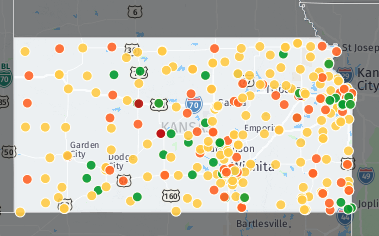
Kaiser Health News also published federal data on staffing levels at nursing homes around the country. The Kansas News Service has reproduced the Kansas data on the map below.

Kansas Nursing Homes and Staffing Levels

Read Kaiser’s in-depth report on staff levels at nursing homes.

Data glossary and methodology are available here.

Celia Llopis-Jepsen is a reporter for the Kansas News Service, a collaboration of KCUR, Kansas Public Radio, KMUW and High Plains Public Radio covering health, education and politics. You can reach her on Twitter @Celia_LJ. 

Copyright Eagle Radio | FCC Public Files | EEO Public File