
 Listen to Mike Cooper interviewing Teresa Heimann and Amanda Harms from the Physical Therapy Department at HaysMed, by clicking the link above and then clicking the play button
Author: Hays Post
Listen to the Holthus Hotline with ‘Voice of the Chiefs’ Mitch Holthus


 Listen as the ‘Voice of the Chiefs’ Mitch Holthus recaps last week’s season opening win over AFC West rival San Diego and previews Sunday’s game at Pittsburgh.
The Holthus Hotline airs Saturday mornings on your home for Chiefs football, KFIX (96.9-FM), at 8 a.m. during the Chiefs season.
Raising vegetables on the High Plains reaps rewards, presents challenges

First in a series of five farmer feature profiles
By JENNIFER KONGS
Kansas Rural Center
KANOPOLIS — Dave Svaty has farming in his family’s roots. He grew up on a farm down the road from where he and his wife, Connie — along with his son, Caleb and his family — are tending cattle, pigs, sheep, and vegetables growing in fields and inside hand-built hoop houses near Kanopolis in Ellsworth County.
Dave and Connie have raised livestock and sold vegetables from a roadside stand for more than 25 years. Dave, who has a degree in Agronomy from Kansas State University, started working 17 years ago at the local co-op to provide a source of steady income. Three years ago, Dave left the co-op job and at about the same time, his son also lost his teaching job. Connie continues to work as a teacher’s aide, largely to keep the family covered with health insurance. The Svatys wanted to try making the combination of meat and increased vegetable production a go, with a focus on high-value crops, like tomatoes, grown in hoop houses. KRC visited Svaty’s Produce on March 30, a muddy, blustery day, to learn more about their operation and get a tour of their production.
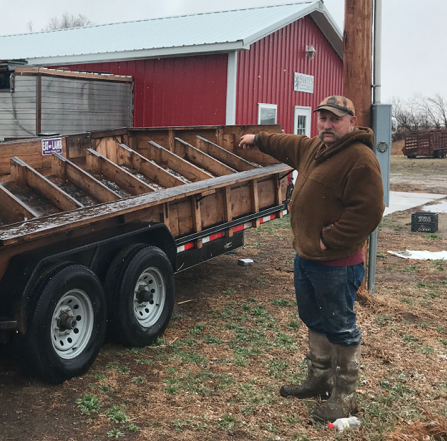
The Svatys have been able to expand their operation and create a unique setup with ingenuity and DIY skills. Dave custom-built his farmers market trailers to pull behind a truck. The wooden frame features a drop-down side that holds flat crates of produce; a walkway where the Svatys stand to sell from; a spot for a freezer to hold the meat; and large bins for melons, potatoes and other larger, heavier crops. The produce is held at eye level for the customer and everything is easily accessible by the person handling sales at market that day. Dave and Caleb liked the first one so much, Dave built a second one, so they could both have one at each Saturday market where they are vendors.
For the folks who want the on-farm experience, the family built a shop on-site, with customer-friendly reach-in coolers, a walk-in cooler for crop storage, and shelves and boxes for produce sales. The investment, Dave says, would be worth it to save the driving time to multiple markets each week, and of course, the family hopes for added income from the set daily operating hours of 3 to 7 p.m. on weekdays. The space also has a back room, which has already provided value in getting the produce-washing and storage out of their house. Before the building, washing, storage and prep on Fridays before the big Saturday markets all happened inside Dave and Connie’s home, where she bakes and packages homemade kolatches by the tens of dozens for market sales.

Dave and Caleb have been smart about how they re-purpose materials and incorporate made-to-fit solutions for season-extension and crop protection. For example, the calving barn is built with bridge planks Dave bought from the county. He moved an unwanted wooden hoop house frame from Ellsworth high school, which came complete with plastic covering. When their second hoop house, which has gone through four seasons, kept losing its plastic covering, Dave boxed in the ends with wooden frames to keep the hoop house together better.
Turns out, wind is often a specialty-crop farmer’s most challenging nemesis. The shape of the hoop house has other shortcomings: “I made a mistake in buying a round hoop house. I should have bought one with sidewalls, because I can’t get in close enough along the sides with equipment,” Dave says in retrospect.
Dave has built a lean-to greenhouse onto his home, heated with the home’s old woodstove. “I came home one night, and told my wife I was going to build a greenhouse. So, I dug this space with a skid loader.”
When I visited, the greenhouse was full of green, growing life. Because of a previous year’s infection, the family now primarily raises tomato varieties resistant to tomato spotted wilt virus, including ‘Mountain Glory’ and ‘Skyway 687.’ They are trying some varieties—especially cherry tomatoes—that are not resistant, such as ‘SunGold,’ because of their popularity with customers. The greenhouse held dozens of flats filled with starts of tomatoes, sweet peppers, hot peppers, cauliflower, cabbage, broccoli, Brussels sprouts, celery and herbs. Once I left, he was planning to plant three colors—red, yellow and orange—of seedless watermelons on electric heating mats to keep the soil warm enough for germination.
There are also fig trees in buckets in the greenhouse that Caleb and Dave are planning to experiment with based on expertise from a fellow farmer in New York. Caleb, his father says, connects to other growers online who are also trying unique setups around the country. I joked with Dave about him being cutting edge, and he smiled, but readily reminded me it was Caleb who was making the new connections.
The farm’s growth and diversification has not come without its struggles. “The first year was great. The second year, we lost all of our tomatoes to tomato spotted wilt virus. We have also lost tomatoes after uncovering them to spray drift,” Dave says. Their history with a nearly complete crop failure caused by TSWV is why the family emphasizes TSWV-resistant varieties for their tomatoes and peppers.
After losing the tomato crop two years ago, Caleb needed to take on off-farm job working on wind turbines. “He has three kids, and we had nothing to fall back on, so he had to get a job for security. He wants to farm and he has a space, and we have markets to go to, but you need health insurance and you need steady income, and you can’t do that as a starting specialty crop farmer,” Dave says.
The family still raises close to 60 acres of conventional wheat and soybeans, accounting for an estimated 20 percent of the family’s farm income. Dave says the farm gets better returns on the vegetables than the meat, especially the lamb and chicken. The pork and beef, largely because they are more popular meats in his area, have higher profit margins. The family has about 200 head of sheep, a dozen cattle and fewer than 10 hogs.
Dave has his concerns for the future of vegetable farming. One is FISMA, the Federal Information Security Modernization Act, and how to update to meet all of the requirements, especially regarding his family’s combination of livestock and vegetables. His lambing barn, which is separated by a barrier wall but connected under one roof with a growing spot for early greens to take advantage of the animals’ heat, would likely be forbidden.
“I’m an exemption, but we try to be up to speed. It is overwhelming, some of the specific rules and the amount of written documentation that would be required. My wooden picking crates wouldn’t be allowed, I couldn’t let my dog go into the field with me when I pick, but we have rattlesnakes and I want my dog with me.”
Dave also wonders whether having multiple weekday markets in different parts of town — rather than a concentrated time in one spot — is best for farmers’ sales. The most economical setup for where and when to hold markets is a commonly discussed direct-sale farmer struggle. “In summer, we saw more foot traffic to the farm store, which is ideal for us, but winter has been harder,” Dave adds.
He worries about new farmers getting started, and existing farmers adding or diversifying their operations, with the heavy financial burden associated, given the current structure for financing and health insurance. Working without a fall-back, as he is now, leaves “no margin for error” with the growing and marketing.
When asked what changes could help his farm be more successful, Dave responds that he feels strongly that the sales tax on food should be eliminated, for the sakes of both farmers and consumers. “It is difficult to track, and compared with neighboring states, we’re putting a tax on poor people trying to buy groceries.”
He also recognizes a need for a better system to protect against drift for sensitive crops. “I have neighbors that do their best to be careful, but even on windless days, we see the damage.” He also suggests that when feedlots or other concentrated operations move in nearby, that the specialty crop farmers who need clean water be protected. As his farm shows, there are multiple ways to grow food and build livelihoods through agriculture in Kansas, and he would like to see them all treated with equal protection.
Despite his concerns, as we walked through the fields, Dave’s love of growing food and raising animals was tangible. He proudly pointed out the field planted days before with 2,200 pounds of potatoes (he named the dozen or so varieties off the top of his head); his sandy soil that grows juicy melons; and the baby lambs he has protected with their mamas in the barn.
Dave shared new ideas he wanted to test this year—clearly skilled at coming up with unique solutions to the various challenges farmers face. He spoke of incorporating oats as a cover crop before planting melons; a new method for stringing and covering tomatoes he’s keen to experiment; harvesting asparagus throughout the year; and more. When he spoke of challenges, he appeared distraught and overwhelmed by handling the bulk of the work solo, as if he were watching the end of an era.
But, while visiting the farm, it’s hard to see anything but hope and potential while watching the lambs bounce, listening to the calves call, and passing through the warming hoop houses filled with new life.
Jennifer Kongs is a freelance writer with Bark Media in Lawrence, Ks. who produced this story as part of KRC’s Specialty Crop Block Grant funded by the Kansas Department of Agriculture through USDA’s SCBG Program.
Senst joins staff of FHSU Foundation
FHSU University Relations

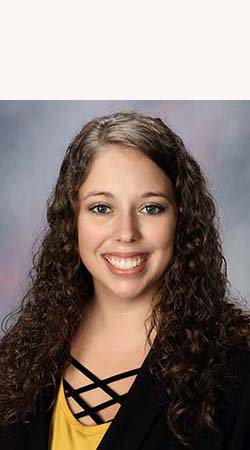
Katlin Senst was recently welcomed to the staff of the Fort Hays State University Foundation as an accountant.
Senst is a 2014 graduate of FHSU. She earned her certified public accounting license in 2016 and previously worked at Adams, Brown, Beran & Ball, Chartered, in Hays.
“I am excited for the opportunity to assist in the advancement of the university I attended and love,” said Senst.
Senst will support the financial well-being of the FHSU Foundation by preparing, maintaining, monitoring and analyzing accounting transactions, entries and reports. She will also serve as an in-house consultant for staff on accounting matters.
Established in 1945, the FHSU Foundation is committed to cultivating lasting relationships with alumni, friends, corporations and other organizations that have a passion for Fort Hays State and who want to continue its legacy of excellence.
As an independent, non-profit organization, the Foundation’s donors have an impact on all facets of university life, and their support continues to translate into success for students at Fort Hays State.
To learn more about the FHSU Foundation, visit https://foundation.fhsu.edu, call 785-628-5620, or email [email protected].
KS SBDC to host Encountering Innovation Sept. 21


Kansas SBDC at Fort Hays State University is hosting the Encountering Innovation: The Hunt for Opportunity Tour.
Encountering Innovation is an annual event in Kansas where the U.S. Department of Defense Tech Scouts identify innovations that may be useful to the Department of Defense. The Department of Defense is one of the largest buyers in the world and looks at a broad range of innovations that include clothing, unmanned aerial systems, cybersecurity solutions, and more.
Ralph Lagergren will be presenting the Encountering Innovation. He is a serial inventor and businessman and is looking to find rural Kansas inventors, patent holders, and business owners who have an idea with potential for commercialization. Topics that will be presented by him include: how to finance a product, how to market a product, how to decide between licensing, selling, or manufacturing a product, the patent process, and other tips.
We have two places in our region that will be hosting this presentation, including:
Hays, KS
September 21st 10am-12pm
Register here: https://ksbdc.ecenterdirect.com/events/24288
For more information, contact [email protected] or 785-628-5615.
Now That’s Rural: Dennis Wright, Bird City’s Wright Farms


By RON WILSON
Huck Boyd National Institute for Rural Development
The Sunflower State. That is a fitting nickname for Kansas, especially when we learn about innovative farm family members in the northwest region of the state who are adding value to their sunflower production.
Dennis Wright and his father Don are the founders of Wright Enterprises and the makers of Wright Farms Sunflower Oil near Bird City. “We are fourth generation farmers here,” Dennis said. “My great-grandfather first homesteaded the place.”
Dennis grew up on the farm with his parents Don and Donna and went to Fort Hays State where he met Dana. They married and lived in Hays for a few years. “When we had our first child, we decided Bird City would be a good place to raise a kid,” Dennis said. They now have three children.

Dennis and Dana moved back to Bird City and joined the family farming operation in 2005. “The only constant in farming is change,” Dennis said. The Wrights looked to expand or diversify their operation, which included sunflowers and other crops. “We were asking, how can we make what we raise more valuable?” he said.
Since they produced sunflowers, they researched the possibility of producing sunflower oil and found that most such oil is sold as a refined product. The Wright’s focus groups identified consumer interest in health-conscious items. The niche which the Wrights pursued was in unrefined sunflower oil.
“Refining uses heat and chemicals to deodorize and treat the oil,” Dennis said. “Instead, we use a cold-pressing process with an expeller press that squeezes the oil while keeping all the nutrients and vitamins in it.”
They then use a plate filtering system with multiple layers of vegetable cloth to clean the oil further before bottling it. They built a plant in a small building on the original homestead. “Dad is an electrician,” Dennis said. “We were able to set up our own automation system where the seeds can feed into the press and stop automatically. It’s farmer ingenuity,” he said with a smile.
They call the product Wright Farms Sunflower Oil. The Wrights also joined the “From the Land of Kansas” program at the Kansas Department of Agriculture. “They’ve been awesome,” Dennis said of the program’s staff.
Today, the Wright’s sunflower oil is available for sale online and at approximately 30 independent grocery, gift shop, and museum stores across Kansas. “Unrefined sunflower oil is high in Vitamin E and has a lot of antioxidant properties,” Dennis said. “It’s a healthy oil in that it has a higher ratio of unsaturated fats to saturated fats. It has a lower smoke point so it is suited for low- and medium-heat cooking, rather than deep fat frying. My cousins say it is perfect for sauteeing. We use it as a marinade too. It’s more like olive oil.”
Sunflower oil also has other uses. “I call it the WD-40 of cooking oils,” Dennis said. Because it has high vitamin E, it is good when applied to skin or hair. I use it to oil chains or moisturize my hands.”
Wright Farms Sunflower Oil has been included in the “From the Land of Kansas” gift baskets which have gone from coast to coast and beyond. Since their plant was built on the original homestead, their production literally goes from field to finished product on the farm, which is located near the rural community of Bird City, population 447 people. Now, that’s rural.
“We do tastings and bread dippings,” Dennis said. “We’ve been told it cooks just like butter with a nutty taste. We also designed a continuous filtration process so it has a nice mild flavor.”
For more information, go to www.wright.farm.
Since Kansas is the Sunflower State, how fitting that a sunflower oil production process would be designed by an innovative Kansas farm family. We commend Don and Donna and Dennis and Dana Wright for making a difference with entrepreneurship and innovation in value-added agriculture. I think this sunflower oil process is in a good state.
Warm, dry Saturday
 Today
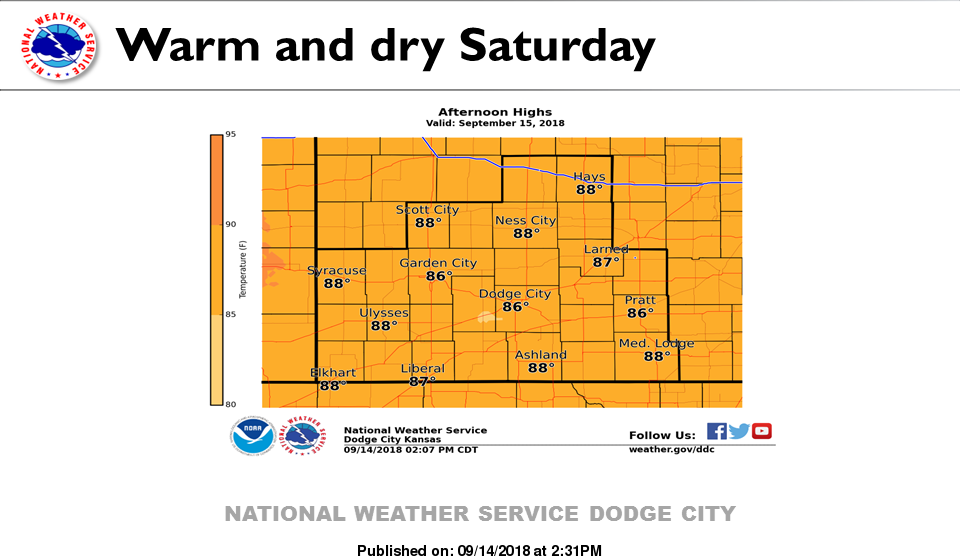
Sunny, with a high near 88. South wind 6 to 16 mph.
Tonight
Mostly clear, with a low around 67. South southeast wind 8 to 11 mph.
Sunday
Mostly sunny, with a high near 87. South wind 8 to 13 mph.
Sunday Night
Mostly clear, with a low around 66. South southeast wind 8 to 10 mph.
Monday
Sunny, with a high near 92. South wind 7 to 13 mph.
Monday Night
Clear, with a low around 67.
Tuesday
Sunny, with a high near 92.
Tuesday Night
Clear, with a low around 69.
Wednesday
Sunny, with a high near 90.
Wednesday Night
Mostly clear, with a low around 68.
Thursday
A 20 percent chance of showers and thunderstorms. Mostly sunny, with a high near 82. Breezy.
Kobach aims to drive out migrants living in Kansas illegally

TOPEKA, Kan. (AP) — Kris Kobach highlights his national reputation as an immigration crusader in running for Kansas governor by promising voters that if he’s elected he’ll work to drive out illegal immigrants to halt what he says is the $377 million in benefits provided to them by the state each year.

The conservative Republican’s plans echo President Donald Trump’s crackdown on immigration — an agenda Kobach has helped to shape. The president has endorsed Kobach , the Kansas secretary of state, who won a narrow primary victory over the state’s GOP governor.
Plenty of immigration policy analysts suggest Kobach’s push could harm the state’s economy, but they start by questioning the dollar figure he is citing repeatedly as the annual cost of illegal immigration to Kansas. Kobach is undeterred.
“My election would send a signal that the public-benefits gravy train is going to end,” Kobach said during a recent interview.
While states such as California and Illinois have offered immigrants sanctuary, Kobach wants Kansas to catch up to others including Missouri, Alabama and Arizona in setting policies designed to prevent immigrants living in the U.S. from getting jobs or obtaining benefits. Kobach has falsely described Kansas as the “sanctuary state of the Midwest.”
His figure for what Kansas could save annually comes from a September 2017 report by the Federation for American Immigration Reform.
The group backs Trump’s call to build a wall on the border with Mexico and opposes “amnesty,” for immigrants living in the U.S. illegally, including a pathway to citizenship for those willing to serve in the military. Its website argues for cutting legal immigration 70 percent and says “immigration levels must fall” for U.S. wages to rise.
The group calculated figures for each state by tabulating a 50-state total for various costs and working from an estimate of how many immigrants living illegally in the U.S. reside in each state. FAIR estimated more than 84,000 immigrants live illegally in Kansas; other sources have lower figures. The total is between 2.2 percent and 2.9 percent of Kansas’ population.
Almost half of the total costs the study cites are for public schooling for immigrant children. But a 1982 decision by the U.S. Supreme Court prohibits states from denying those children an education.
Roughly a third is a combination of policing, court expenses and even general services, such as garbage collection.
In short, much of the spending is for services a state can’t avoid unless immigrants are deported or leave voluntarily.
Kobach acknowledged that he couldn’t cut off much spending immediately and might not be able to completely eliminate his $377 million a year entirely over time but maintains reducing it sharply is worth doing. He’s outlined multiple proposals for combatting illegal immigration.
FAIR research director Matt O’Brien, one of the report’s authors, said the burden to federal and state governments from providing services “offsets any measurable gain” from money “illegal aliens are alleged to inject into the economy.”
“In fact, illegal immigration simply amounts to a massive wealth redistribution scheme,” O’Brien said in an email.
Critics contend the report that Kobach is citing overestimates how many immigrants live in the U.S. illegally and fails to adequately consider immigrant contributions to the economy. A senior policy analyst for the libertarian Cato Institute called it “fatally flawed” — and said it might overestimate net government costs by as much as 97 percent.
“It’s disappointing that a candidate for such an important office is relying on such shoddy research to make his point,” said Alex Nowrasteh, the Cato analyst. He argues for allowing “peaceful” immigrants to stay in the U.S. even if they arrived illegally.
The Democratic nominee for governor, state Sen. Laura Kelly, described the FAIR report as “widely discredited,” adding in an email, “Kris Kobach is deceiving Kansans to further his personal political agenda.”
And independent candidate Greg Orman, a Kansas City-area businessman, said: “We’re not going to grow the Kansas economy by driving workers out of the state.”
Federal law generally prohibits government health coverage and food assistance for illegal immigrants, though Kobach says Kansas is not aggressive enough in policing fraud in those programs.
But FAIR argues that costs for states are bigger and include general services that legal residents also receive, as well as the costs of prosecuting and incarcerating illegal-immigrant criminals and medical care that poor immigrant families can’t afford but are entitled to by law.
In 2016, a study from the National Academies of Sciences, Engineering and Medicine concluded that first-generation immigrants are more costly in the short-term to states and local governments than native U.S. citizens, largely because of education costs. Kim Rueben, a senior fellow at the Urban Institute, which participated in the academies’ study, said immigrant parents have more children on average.
But, she added, “Those kids are also going to be the future labor force.”
Studies by the University of Missouri-Kansas City in 2013and the University of Kansas in 2014 concluded that immigrants benefit the Kansas economy and pay for government services they use. Both also concluded that immigrants expand the Kansas economy.
NW Kansas teen hospitalized after pickup rolls

GOVE COUNTY — One person was injured in an accident just after 11p.m. Friday in Gove County.
The Kansas Highway Patrol reported a 2003 Chevy Silverado driven by Abby Rose Herl, 17, Quinter, was northbound on Castle Rock Road three miles south of Quinter.
The driver lost control of the vehicle. It exited the roadway to the right and rolled multiple times, landing on the wheels in a field.
Herl was transported to Gove County Medical Center. She was not wearing a seat belt, according to the KHP.
SELZER: Know your life insurance basics


September is Life Insurance Awareness Month, and I urge Kansans to consider some important points about life insurance coverage.
Most of us know that life insurance is not about us, but about our families and loved ones. Having a life insurance policy can be of great significance for others over the course of a lifetime. I urge you to think about what a policy can do for your family, and how to protect it for them.
Answers to questions about life insurance are in the Kansas Insurance Department (KID) publication “Life Insurance and Annuity Basics,” which can be printed or ordered from the KID website, www.ksinsurance.org. Some of the more common considerations are listed below.
- Your beneficiary will receive the insurance benefits tax free, and life insurance benefits do not have to go through probate or other legal delays involved in the settlement of an estate. If you die without naming a beneficiary, the benefits will be paid into your estate and then paid out according to your will or through state laws. This delays the payment and could create a financial hardship for your beneficiary.
- Keep your policy in a safe place. However, do not use any place where the policy might not be readily available. Record the basic information — such as company, policy type, policy number, insured’s and beneficiaries’ names — in a separate place. Let your beneficiary know the kind of insurance policy you have, any changes you make, and where you keep the policy.
- A change in beneficiary is possible after the policy is taken out, unless you have named an irrevocable beneficiary. An irrevocable beneficiary arrangement can only be changed with the beneficiary’s consent. Your insurance agent can arrange for a change in beneficiaries, or you can do it by writing directly to your life insurance company and asking for the appropriate form.
- You can specify as many beneficiaries as you want to receive the benefits. You may also specify how the benefits are to be divided. It is a good idea to name a second (contingent) beneficiary to receive the money in case your primary beneficiary dies before you do or at the same time as you.
- Your beneficiary will need to notify the life insurance company of your death. Again, that is why it is important for your beneficiary to be able to locate your policy. Companies require a certified death certificate or other legal proof of death, and they may ask for the policy. The life insurance company will pay the proceeds of the policy to your beneficiary after receiving proper notification of death.
- KID can assist Kansans in locating life insurance and annuity benefits they may be beneficiaries of through the Life Insurance and Annuity Search service. To begin the process, go to https://www.ksinsurance.org/healthlife/life/life-policy-search.php
Knowing your life insurance basics makes for peace of mind for you as well as your loved ones.
For those who have more questions about life insurance, the KID Consumer Assistance Hotline representatives can help. Call 1-800-432-2484 or chat online with a representative at www.ksinsurance.org.
Ken Selzer is the Kansas Insurance Commissioner.
Mistakes cost Monarchs in loss to Plainville

The TMP-Marian Monarchs turned it over four times in the first half, three of them leading to scoring drivers and Plainville’s Jordan Finney three for three touchdowns as the Cardinals earn the 46-6 win Friday night in Plainville.
In what turned out to be an ominous start the Monarchs fumbled on the third play of the game which resulted in a Plainville fumble.
The Monarchs offense followed the fumble with a three-and-out and Plainville marched right down the field and scored on a 37-yard Jordan Finnesy touchdown pass to Kobe Spiess putting the Cardinals up 10-0.
Three plays later the Monarchs quarterback Carson Jacobs threw first interception of the season. The next play Finnesy found Tanner Copeland from 19 yards out to take a 17-0 lead late in the first quarter.
Two plays after the touchdown the Monarchs again put the ball on the ground, this time inside their own two-yard line. Plainville would again take advantage of the turnover as Jared Casey scored his first of three rushing touchdowns in the game giving Plainville a 24-0 lead with just under 10 minutes to play in the first half.
TMP’s lone bright spot came with just under four minutes to play as Ryan Richmeier took the ball from Finnesy and returned it for a touchdown to make it 24-6 Plainville.
Plainville added another scored late in the first half to take a 32-6 lead at halftime.
Jared Casey two more third quarter touchdowns on the ground as the Cardinals more to 2-1. TMP falls to 1-2.
Plainville outgained TMP 338 to 81. Finnesy was 10-of-13 passing for 128 yards with three touchdowns and rushed for 102 more.
The Monarchs begin district play next week at home against Hoisington. While the Cardinals host Smith Center.
High school football scoreboard week 3

Football Score Sheet Week 3 – September 14th
11-Man
Western Athletic Conference
Liberal (1-1) 20 Hays (0-2) 21
Great Bend (2-0) 34 Wichita Northwest (2-0) 56
Wichita Heights (1-1) 27 Dodge City (1-1) 49
Garden City (0-2) 24 Hutchinson (0-2) 28
Mid-Continent League
TMP (1-1) 6 Plainville (1-1) 46
Phillipsburg (2-0) 42 Smith Center (2-0) 14
Norton (0-2) 26 Oakley (2-0) 24
Ellinwood (1-1) 34 Ellis (0-2) 13
Central Plains League
Republic Co. (0-2) 14 LaCrosse (1-1) 44
North Central Activities Association
Southeast of Saline (2-0) 28 Russell (2-0) 14
Ellsworth (1-1) 7 Sacred Heart (0-2) 9
Central Kansas League
Hoisington (1-1) 50 Larned (0-2) 13
Great West Activities Conference
Holcomb (1-1) 34 Colby (2-0) 38
Goodland (0-2) 0 Scott City (2-0) 61
Hugoton (0-2) 6 Ulysses (1-1) 29
8-Man
Central Prairie League
Kinsley (1-1) 0 Central Plains (2-0) 72
St. John (0-2) 0 Ness City (1-1) 54
Macksville (1-1) 24 Victoria (1-1) 70
Stafford (2-0) 0 Otis-Bison (1-1) 50
Mid-Continent League
Triplains-Brewster (1-1) 14 Trego Community (1-1) 46
Northern Plains League
Stockton (1-1) 22 Osborne (1-1) 68
Hill City (1-1) 53 Thunder Ridge (2-0) 6
Clifton-Clyde (2-0) 66 Wilson (1-1) 22
Northwest Kansas League
Dighton (1-1) 12 St. Francis (2-0) 38
Quinter (0-2) 0 Hoxie (2-0) 54
Southern Plains Iroquois
South Central (2-0) 14 Hodgeman Co. (2-0) 28
Western Kansas Liberty League
Logan-Palco (1-1) 6 Wichita Co. (1-1) 54
Northern Valley (2-0) 48 Wheatland-Grinnell (1-1) 0
6-Man
North
Deerfield (0-1) 32 Natoma (1-1) 79
South
Golden Plains (2-0) 67 Rolla (0-2) 18
Other games of note
Maize (2-0) 21 Haysville Campus (2-0) 0
Perry-Lecompton (2-0) 35 Sabetha (2-0) 33
Pratt (2-0) 55 Hesston (2-0) 0
Riley County (2-0) 12 Silver Lake (2-0) 31
Rock Hills (2-0) 0 Hanover (2-0) 68
Andale 62, Rose Hill 0
Anthony-Harper-Chaparral 42, Cheney 14
Axtell 48, Onaga 0
BV Randolph 60, Wetmore 14
BV West 35, St. James Academy 32
Basehor-Linwood 57, Leavenworth 13
Belle Plaine 42, Wichita Independent 14
Beloit 56, Minneapolis 18
Bishop Miege 40, Mill Valley 7
Blue Valley 49, BV Southwest 7
Bucklin 38, Chase 6
Buhler 34, Augusta 6
Burlingame 54, Marais des Cygnes Valley 6
Burlington 34, Wellsville 12
Caldwell 58, Cedar Vale/Dexter 0
Caney Valley 42, Neodesha 7
Central Heights 34, Wabaunsee 22
Centralia 56, St. Mary’s 14
Chanute 49, Iola 14
Chapman 26, Abilene 0
Cherryvale 32, Erie 2
Cimarron 66, Stanton County 8
Clifton-Clyde 66, Wilson 12
Colby 38, Holcomb 34
Conway Springs 38, Kingman 21
DeSoto 56, KC Turner 0
Derby 55, Newton 7
Dodge City 49, Wichita Heights 27
Douglass 50, Marion 38
Elkhart 68, Sublette 28
Ellinwood 34, Ellis 13
Fort Scott 55, Independence 12
Frankfort 54, Doniphan West 6
Fredonia 28, Bluestem 14
Frontenac 26, Commerce, Okla. 0
Galena 50, Prairie View 22
Garden Plain 56, Wichita Trinity 14
Gardner-Edgerton 33, Lawrence 13
Girard 23, Columbus 16
Goddard 17, Andover Central 16
Goessel 30, Wakefield 20
Golden Plains 67, Rolla 18
Greeley County 44, Rawlins County 26
Halstead 64, Lyons 0
Hanover 68, Rock Hills 0
Hays 21, Liberal 20
Hill City 53, Thunder Ridge 6
Hillsboro 32, Haven 24
Hodgeman County 28, South Central 14
Hoisington 50, Larned 13
Holton 37, Nemaha Central 32
Hoxie 54, Quinter 0
Humboldt 56, Eureka 6
Hutchinson 28, Garden City 24
Hutchinson Trinity 8, Ell-Saline 6
Inman 21, Remington 6
Jackson Heights 14, Maur Hill – Mount Academy 0
KC Piper 56, Atchison 28
KC Sumner 36, KC Wyandotte 35
Kapaun Mount Carmel 30, Wichita East 0
La Crosse 44, Republic County 14
Labette County 28, Coffeyville 14
Lakin 28, Syracuse 0
Lawrence Free State 62, SM North 0
Lebo 46, Chetopa 0
Lighthouse Christian, Mo. 48, Riverton 0
Little River 44, Bennington 12
Louisburg 27, Baldwin 7
Madison/Hamilton 76, Hartford 0
Maize 21, Wichita Campus 0
Manhattan 49, Topeka Seaman 7
Marysville 42, Concordia 0
McPherson 56, El Dorado 8
Medicine Lodge 53, South Gray 22
Mission Valley 30, Northern Heights 0
Moscow 58, Weskan 32
Moundridge 48, Solomon 34
Ness City 54, St. John 0
Northern Valley 48, Wheatland-Grinnell 0
Oberlin-Decatur 24, Wallace County 12
Olathe East 37, Olathe West 27
Olathe North 51, SM West 14
Olpe 13, Christ Preparatory Academy 8
Osage City 38, Council Grove 6
Osborne 68, Stockton 22
Oswego 48, Altoona-Midway 16
Otis-Bison 50, Stafford 0
Paola 59, Ottawa 13
Parsons 59, Osawatomie 20
Pawnee Heights def. Cheylin, forfeit
Pembroke Hill, Mo. 44, KC Bishop Ward 8
Phillipsburg 42, Smith Center 14
Pike Valley 50, Glasco/Miltonvale-Southern Cloud 0
Pittsburg 34, BV North 31
Plainville 46, Hays-TMP-Marian 6
Pleasant Ridge 34, McLouth 12
Pleasanton 36, Jayhawk Linn 12
Pratt 55, Hesston 0
Rossville 29, Rock Creek 21
Royal Valley 28, Riverside 27
SM Northwest 27, Olathe South 21
Sabetha 35, Perry-Lecompton 33
Salina Central 27, Salina South 3
Salina Sacred Heart 9, Ellsworth 7
Santa Fe Trail 41, Anderson County 7
Satanta 52, Minneola 6
Scott City 61, Goodland 0
Sedan 66, Marmaton Valley 30
Sedgwick 47, Sterling 8
Shawnee Heights 20, KC Schlagle 14
Silver Lake 31, Riley County 12
Smoky Valley 8, Nickerson 6
South Barber 70, Hutchinson Central Christian 68, 3OT
South Haven 48, Norwich 24
Southeast 39, Yates Center 7
Southeast Saline 28, Russell 14
Spearville 72, Ingalls 44
Spring Hill 24, Bonner Springs 23
St. Paul 54, West Elk 34
Tonganoxie 34, Eudora 6
Topeka 66, Highland Park 0
Trego 46, Triplains-Brewster 14
Troy 41, Horton 8
Ulysses 29, Hugoton 6
Uniontown 52, Northeast-Arma 12
Valley Center 23, Maize South 13
Valley Heights 66, Atchison County 26
Victoria 70, Macksville 24
Wamego 15, Clay Center 6
Washburn Rural 33, Topeka Hayden 17
Wellington 47, Clearwater 26
West Franklin 39, Lyndon 0
Wichita Bishop Carroll 49, Wichita West 20
Wichita Collegiate 42, Mulvane 22
Wichita County 54, Logan/Palco 6
Wichita Northwest 56, Great Bend 34
Wichita South 38, Arkansas City 28
Wichita Southeast 27, Wichita North 12
Winfield 21, Circle 0
Kan. officer charged after high-speed crash injures man

WICHITA, Kan. (AP) — A Wichita police officer is facing charges after a 71-year-old man was thrown through a windshield after his pickup truck was hit by the officer’s car.

An arrest affidavit released Wednesday says officer Samuel Dugo was speeding to a burglary call without his emergency lights and sirens on a Wichita street before his car hit a pickup truck.
Dugo has been charged with felony aggravated battery after the March 16 crash injured Donald Clark of Bel Aire. The arrest affidavit says Dugo’s car was going 79 mph when he hit Clark’s truck.
Prosecutors allege Dugo was driving recklessly that night.
Dugo’s attorney says the officer’s driving was not reckless and consistent with police practices. He also says Dugo tried to take evasive action after Clark’s truck drove into its path.