We have a brand new updated website! Click here to check it out!

Leading Kan. Democrat under scrutiny for backing voter ID

TOPEKA, Kan. (AP) — The leading Democratic candidate for Kansas governor is under attack for her past backing of tough voter identification policies as her party prepares for the possibility that the champion of those measures, conservative Kris Kobach, will win the Republican nomination.

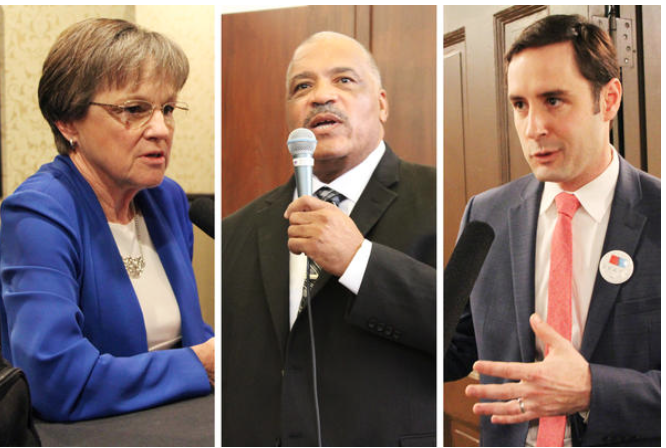
State Sen. Laura Kelly, former Wichita Mayor Carl Brewer, and former Kansas Ag Secretary Josh Svaty are all competing to be the Democratic gubernatorial candidate.
photo Kansas News Service

Democrats have regularly criticized Kobach, the Kansas secretary of state, over policies they believe suppress voter turnout. No state had gone further in requiring prospective voters to provide papers documenting their U.S. citizenship when registering, until a federal judge struck down the law in June as a violation of voting rights.

But the Kansas law had strong bipartisan support when the Legislature approved it in 2011, and one of the yes votes came from state Sen. Laura Kelly, of Topeka. That vote has dogged Kelly in the final weeks before the Aug. 7 primary, with her two main rivals — who were not lawmakers at the time — hoping Democratic voters turn away from her because of it.

“How can we have as the standard-bearer for the party someone who voted with Kris Kobach, really, on his signature issue?” one of them, former Kansas Agriculture Secretary Joshua Svaty, said during an interview after raising the issue in forums.

The measure that Kelly and two-thirds of the Democrats then in the Legislature backed imposed the proof-of-citizenship requirement, starting in 2013. The state is appealing the ruling that struck it down.

Only a few other states have attempted to impose a proof-of-citizenship requirement. Alabama and Georgia have such laws but they are not currently being enforced and Arizona has a more lenient version, according to the American Civil Liberties Union, which opposes them and has fought Kobach in court.

Kelly was a sponsor in 2016 of a bill that would have allowed people born in Kansas to check a box on registration forms, with the state verifying their status, so that citizenship papers would not be necessary to register. It died in committee without a hearing.

“I’ve always been a supporter of voting rights and expanding access to it, but I also saw the need to make sure that our elections were secure,” she said in an interview. “Kobach just went way beyond the authority given to him.”

Kelly’s main Democratic rivals are Svaty and former Wichita Mayor Carl Brewer. Svaty was a House member from 2003 to 2009, leaving to become agriculture secretary. Brewer has never served in the Legislature,

Brewer, seeking to become Democrats’ first black nominee for governor, says he could better stand up to Kobach.

“I just don’t think they did their homework,” Brewer said of legislators who supported the voter ID policies.

Kobach is trying to unseat Gov. Jeff Colyer in a contentious Republican primary race. Many Democrats expect Kobach’s solid base on the right to allow him to win the GOP nomination in a seven-candidate field.

He regularly cites the voter ID policies as one of his biggest accomplishments.

“He spent eight years banging this drum,” said Micah Kubic, executive director of the ACLU of Kansas, a frequent Kobach antagonist. “It is what his entire public record is built on.”

President Donald Trump has cited Kobach as a source for his unsubstantiated claim that millions of immigrants voted illegally in 2016 and Kobach was a vice chairman of Trump’s since-disbanded voter fraud commission.

Kobach argues that tough voter ID policies prevent election fraud, even though he has cited only a few dozen registrations by non-citizens and even fewer attempts by them to vote. U.S. District Judge Julie Robinson ruled in June that the proof-of-citizenship policy disproportionately affects qualified voters.

In the first three years the Kansas proof-of-citizenship requirement was in effect, about one in seven registration applications was blocked — nearly half of them from people under 30, according to court documents. Between 2013 and 2016, more than 35,000 Kansas residents were unable to register. The state has about 1.8 million registered voters.

Kobach’s actions in lawsuits over his policies also have led to him being cited for contempt of court twice, and in an extraordinary rebuke, Robinson ordered him to undergo six extra hours of legal education.

Kelly and other prominent Democrats have argued that lawmakers who voted for his voter ID policies couldn’t guess that Kobach would enforce them as aggressively as he did. They also accuse him of abusing his authority.

But Kobach scoffed at such arguments during a recent interview. He said most Democrats voted for his policies because they were popular and changed their views later when the national Democratic Party — the “mother ship” — attacked them.

“There was absolutely nothing in the implementation of the law that was surprising,” Kobach said. “They’re just trying to scrape the bottom of the barrel for something that sounds like an excuse.”

And longstanding critics of the voter ID policies such as the ACLU and civil rights leaders argue that lawmakers were warned clearly about how they would create obstacles for prospective voters. But some of them aren’t holding the past vote against Kelly or other Democrats who now promise to work to reverse them.

“I’m just glad they’re remorseful now,” Kubic said.
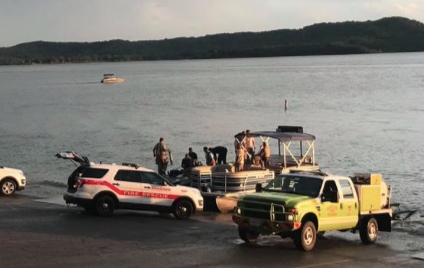
Coast Guard document: Branson duck boat violated inspection terms

ST. LOUIS (AP) – A certificate of inspection for the Missouri tourist boat that sank last month, killing 17 people, shows that it was on the lake at a time when the wind speed far exceeded allowable limits.

First responders on the scene of the lake accident near Branson -photo courtesy KYTV

The Coast Guard on Wednesday announced it has convened a formal Marine Board of Investigation into the accident involving a Ride the Ducks of Branson boat. The vessel sank July 19 at Table Rock Lake.

The lake was calm when the excursion began, but weather turned violent and the boat sank within minutes.

The Coast Guard’s certificate of inspection issued in 2017 prohibited the boat from being on water if winds exceed 35 mph or wave height exceeds 2 feet.

Investigators said the wind speed at the time of the accident was more than 70 mph.

US appeals court: Trump ‘sanctuary cities’ order is illegal

SAN FRANCISCO (AP) — President Donald Trump’s executive order threatening to withhold funding from “sanctuary cities” that limit cooperation with immigration authorities is unconstitutional, but a judge went too far when he blocked its enforcement nationwide, a U.S. appeals court ruled Wednesday.

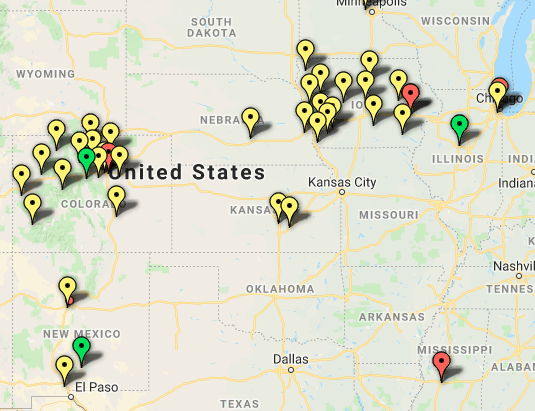
Sanctuary cities, counties and states -2018 map courtesy Center for Immigration Studies

In a 2-1 ruling, the 9th U.S. Circuit Court of Appeals agreed that the order exceeded the president’s authority.

“Absent congressional authorization, the administration may not redistribute or withhold properly appropriated funds in order to effectuate its own policy goals,” Chief Judge Sidney Thomas wrote for the majority.

But he also said there wasn’t enough evidence to support a nationwide ban on the order and sent the case back to the lower court for more hearings on that question.

An email to a spokesman for the U.S. Justice Department was not immediately returned.

U.S. District Judge William Orrick said in November that the order threatened all federal funding and that the president did not have the authority to attach new conditions to spending that was approved by Congress.

The ruling came in lawsuits filed by two California counties — San Francisco and Santa Clara. The executive order potentially jeopardized hundreds of millions of dollars in funding to the two counties, Orrick said, citing comments by Trump and U.S. Attorney General Jeff Sessions as evidence of the order’s scope.

The Trump administration said the order applied to a relatively small pot of money that already required compliance with immigration law.

Government attorney Chad Readler had told Orrick that the order applied to only three Justice Department and Homeland Security grants that would affect less than $1 million for Santa Clara and possibly no money for San Francisco.

During arguments before the 9th Circuit in April, Thomas asked what the court was supposed to make of statements by Trump and his administration about wanting to withhold money from sanctuary cities.

Thomas also questioned whether the order would be constitutional if it applied to all types of funding, as the lower-court judge found.

Readler said the order was much narrower, and the judges should not focus on comments by the president or other administration officials.

The executive order is part of a push by the Trump administration to crack down on cities and states that generally don’t comply with U.S. immigration authorities.

The administration has sued California over three laws aimed at protecting immigrants in the country illegally. It also has moved to block a key public safety grant from going to sanctuary cities and states.

The Trump administration says sanctuary jurisdictions allow dangerous criminals back on the street. San Francisco and other sanctuary cities say turning local police into immigration officers erodes the trust needed to get people to report crime.

Money pouring in and out of Kan. campaigns from candidates, donors, PACs

It helps, the latest Kansas campaign money tallies show, to be rich or have wealthy friends.

Next best thing, run as an incumbent.

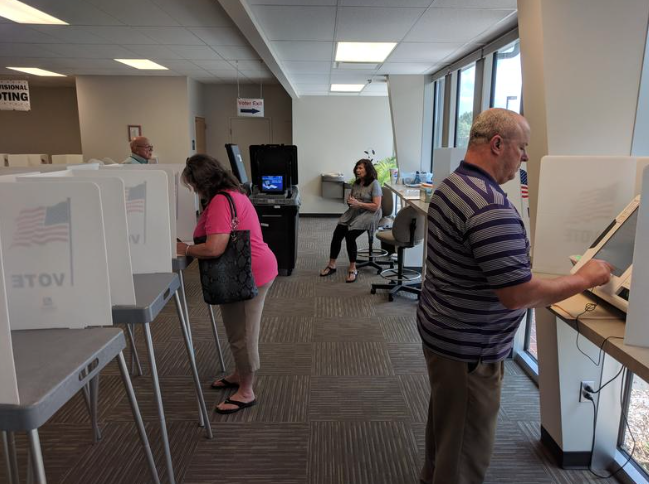
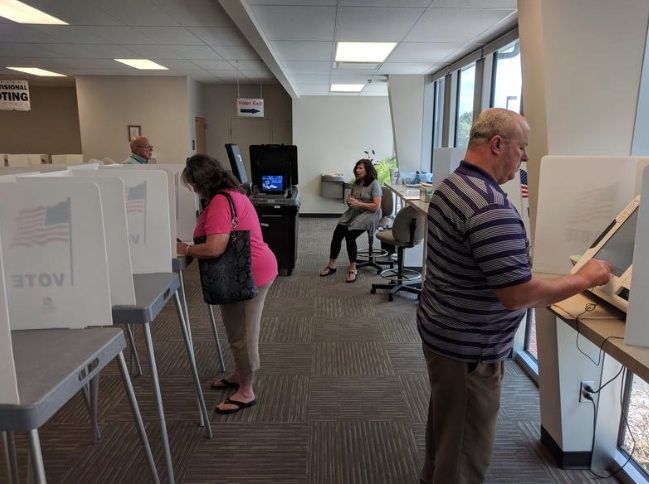
Even as candidates scramble to raise, and spend, campaign dollars, early voting is already underway in the Kansas primary.
SCOTT CANON / KANSAS NEWS SERVICE

Campaign finance reports for the first half of this year show dollars spent nearly as quickly as candidates could corral them — filling airwaves, plastering billboards and stuffing mailboxes with flyers.

Several candidates for governor in the first election since Sam Brownback left the office earlier this year find themselves nearing next Tuesday’s primary on a path to burn through nearly all they’ve raised.

            Fund thyself

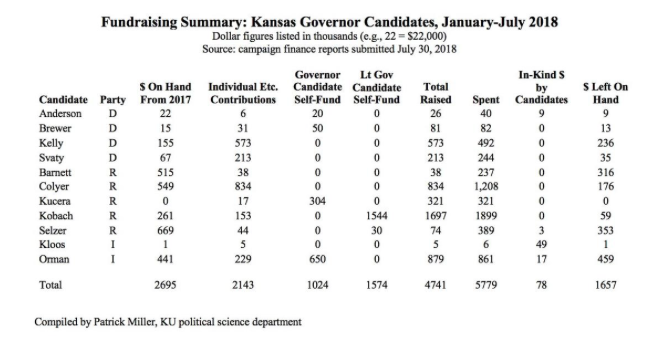
Republican Secretary of State Kris Kobach led the candidates for governor in money raised from Jan. 1 to July 26 with $1.7 million. Nearly all of it, $1.5 million, came from his running mate, Wichita businessman Wink Hartman. Most of that came as loans.

In fact, University of Kansas political scientist Patrick Miller said, about 55 percent of the cash raised by all the contenders in the governor’s race came from the candidates themselves.

“Which is extraordinary and bizarre for a governor’s race,” Miller said.

Although wealthier candidates historically often fund much of their own campaigns, Miller said it is far more rare for the No. 2 candidate on a ticket to pick up the tab.

“I’ve never seen a gubernatorial campaign like that anywhere, ever,” Miller said.

The influx of cash has given Kobach the ability to spend more during the period on campaign costs such as advertising. A single ad buy on July 13 rang in at $533,000.

“As a businessman,” Hartman told the Associated Press in a statement, “I know how important it is to invest in great leadership. And as a conservative, I know how critical investment is to the cause.”

Republican former state Sen. Jim Barnett, a physician, previously loaned his campaign more than $500,000. Self-described “entrepreneurial evangelist” Patrick Kucera’s fundraising was almost entirely made up of more than $300,000 from himself. Republican Insurance Commissioner Ken Selzer and former Democratic Wichita Mayor Carl Brewer have also put their own money into their campaigns for governor.

Independent candidate Greg Orman dropped more than $650,000 on his race.

Incumbent Republican Gov. Jeff Colyer raised the most from donors who aren’t also candidates. His report showed $834,000 during the latest filing period. Colyer made headlines for loans extended at critical points in the 2014 campaign, when he was lieutenant governor and then-Gov. Brownback was running for reelection.

There were no candidate loans in Colyer’s latest fundraising totals.

“I am humbled that our message of strong, optimistic, competent conservative leadership has resonated so well with Kansans,” Colyer said in a statement.

Colyer has also been pouring money into large advertising buys in advance of the primary.

On the Democratic side, state Sen. Laura Kelly led in fundraising with $573,000.

“I’m honored to have the support of such a broad and diverse group of Kansans,” Kelly said in a statement.

Former Kansas Agriculture Secretary Josh Svaty raised $213,000 and Brewer brought in $81,000.

“Nothing about the reports surprise us,” a Svaty campaign spokesman, Mike Swenson, said. “We have known all along that we would not raise as much money as the Kelly-Rogers campaign. They are both sitting state senators in the middle of their term.”

         Easy come, easy go

The reports suggest several campaigns aren’t stockpiling for a general election.

Kobach on the GOP side, along with Brewer and Svaty on the Democratic side, all have used most of their money. Kobach had $59,000 left in his war chest. Svaty maintained $35,000 and Brewer had just $13,000.

That compares to Colyer with $175,000 and Kelly with $236,000.

“I am a little bit surprised by the number of candidates who have basically spent themselves into being broke,” Miller said.

PACs just getting started

Political action committees have started lining up behind some of the candidates for governor.

Colyer has garnered the support of more than two dozen organizations. He received donations of up to $2,000 from groups spanning a wide range of sectors.

The donors range from the Kansas Livestock Association, health care and pharmaceutical PACS to the Kansas Beer Wholesalers advocacy group.

Selzer got money from two insurance PACs and the Livestock Association.

On the Democratic side, Kelly had the support of a dozen PACs, including some that supported Colyer. Kelly also attracted PAC support from unions and transportation workers, as well as the Kansas Livestock Association.

The Kansas Livestock Association also donated to Svaty’s campaign.

Other groups are also starting to show up in the 2018 campaign, some of which  are not constrained by the same spending limits as PACs. One is working on behalf of Orman by criticizing Kelly and Colyer, according to a story by the Wichita Eagle. That could reflect a calculation that the independent’s chances would be better in a three-way race with Kobach and Svaty.

Miller expects fundraising, and PAC activity, to pick up following the primary.

“Most of the money in this campaign,” he said, “is probably ahead of us, not behind.”

   Out-of-state money

Money has poured into the Kansas races from across the country. Orman and a former Google executive running for secretary of state both have seen considerable out-of-state donations.

For Orman, some of that money came from Minnesota, where he was raised.

Democratic secretary of state candidate Brian McClendon pulled in contributions from Silicon Valley.

“Certainly, McClendon having lived in California and worked there, has a lot of connections,” Miller said.

McClendon raised $509,000, although $150,000 came from himself.

McClendon far outraised the best-funded Republican candidate for secretary of state, House Speaker Pro Tem Scott Schwab, who gathered $65,000, including $25,000 of his own money.

Democrats have not performed well in statewide races in recent years and have failed to win elections for offices such as attorney general, insurance commissioner or secretary of state.

“It’s one of the few times recently,” Miller said, “where we’ve seen a Democrat in a down-ballot race actually raise real money.”

Stephen Koranda is Statehouse reporter for KPR, a partner in the Kansas News Service. Follow him on Twitter @kprkoranda.

Kansas Water Congress to meet this week in Hays

The Kansas Water Congress will hold its 2018 Summer Conference Thursday and Friday at the Robbins Center on the campus of Fort Hays State University.

The mission of the Kansas Water Congress is to promote wise management and stewardship of the state’s water resources and to protect, conserve, and develop Kansas water resources for the benefit of the state’s present and future generations.

The KWC is a nonprofit entity funded primarily by annual membership fees. The organization was established in 2002, and seeks to provide a forum where water users strive to:

• reach consensus on water issues;
• advocate positions on water policy;
• promote and advocate interactions between water-related state agencies and water districts;
• provide education and information on water issues affecting Kansas; and
• promote a broad base of membership, to include both sustaining and individual members representing a diversified base of water interests and users.

“The Kansas Water Congress Summer Conference is held each year to shed factual light and discussions on water issues significant to local, state, and national interests,” said KWC President David Brenn. “Our agenda for this year is no exception.”

Topics to be covered at this week’s event include updates on state and federal legislation and policy, watershed district reports, water banking, water transfers, aqueducts, and water quality in Kansas.

Hays City Manager Toby Dougherty will speak on the R9 Ranch project in Edwards County, a large-scale water-transfer project with the goal of securing a long-term municipal water source for the city.

Jeff Crispin, Director of Water Resources for the City of Hays, will lead the group on a bus tour that includes a look at the ongoing construction of the city’s new Waste Water Treatment Plant.

Registration is $80, and the public is welcome to attend. The meeting will adjourn by noon Friday.

More information on the Kansas Water Congress Summer Conference can be found at www.kswatercongress.org. To register, email [email protected] or call 620-287-4541.

— Hays CVB

University of Kansas Health System completes purchase of Great Bend hospital

KANSAS CITY, Kan. – The University of Kansas Health System announced today it has completed the purchase of Great Bend Regional Hospital and its affiliated clinics, including Central Kansas Family Practice and Heartland Regional. Terms of the sale were not disclosed.

Great Bend Regional Hospital will become part of The University of Kansas Health System, which includes The University of Kansas Hospital in Kansas City, HaysMed in Hays, St. Rose Health Center in Great Bend, Pawnee Valley Community Hospital in Larned and The University of Kansas Health System St. Francis Campus in Topeka (in partnership with Ardent Health Services). Great Bend Regional Hospital will be renamed The University of Kansas Health System Great Bend Campus.

HaysMed, St. Rose, Great Bend Regional and Pawnee Valley Community Hospital have historically competed for patients and market share. Now they will be part of one system, with complementary services and providers, not competing but collaborating, focusing together on the needs of the community.

“Our mission is to provide the highest quality care to Kansans. As healthcare across the country evolves, we are taking a new approach in Kansas. Our health system providers in Great Bend, Hays, Larned, Topeka and throughout the Kansas City metro area are keeping care close to home while expanding access to the most advanced treatment options only an academic medical center can provide,” said Bob Page, president and chief executive officer of The University of Kansas Health System. “Together, we can ensure people in Great Bend and across the state of Kansas have access to the right level of care, delivered in the most effective way.”

The University of Kansas Health System Great Bend Campus will remain a strong employer and healthcare provider for the Great Bend community as a result of this purchase. Great Bend physicians, nurses and staff will be important additions to the health system, with substantially all the current workforce remaining in place. Patients will continue to receive care from their current doctors and practices. Moving forward, The University of Kansas Health System Great Bend Campus will be led by local management, and The University of Kansas Health System will establish a local board for the hospital and clinics.

On Aug. 7, 2018, The University of Kansas Health System Great Bend Campus will celebrate the integration of the Great Bend hospital and affiliated clinics with physicians, nurses, staff and local community partners. On the same day, St. Rose Health Care, purchased by HaysMed in 2017, will be renamed “The University of Kansas Health System St. Rose Medical Pavilion.”

To learn more, visit https://www.kansashealthsystem.com/onekansashealth/.

— Submitted

Gag order issued in alleged murder of couple at Barton Co. Fair

BARTON COUNTY —The Kansas Attorney General’s Office has issued a gag order to all investigating agencies associated with an alleged murder that took place at the Barton County Fair on July 13, according to Great Bend Police Chief David Bailey.

Michael Fowler – photo Crawford Co.

Four suspects are in custody in connection with the death of fair vendors Sonny and Pauline Carpenter of Wichita.

Bailey says that any murder trial that would take place would be conducted in Barton County which means the process is underway to get those four suspects back to Kansas.

Carnival workers Michael Fowler, Rusty Frazier and Kimberly Younger, also known as Myrna Khan continue to be jailed in Crawford County, Arkansas while the investigation continues. Last week a fourth suspect, 37-year-old Christine Marie Tenney of Santa Fe, Texas was also taken into custody.

Fowler told investigators that he shot the couple, according to a probable cause affidavit.

Crawford County Sheriff’s Detective Jonathan Wear believes the Carpenters were killed July 13 after meeting the carnival workers as the couple sold crafts, jewelry, purses and other handmade items during the fair.

According to the affidavit Fowler told police that Frazier and  Younger were with him when the couple was killed.

-The Associated Press contributed to this report

Frank William Earl

Frank William Earl passed away on Monday, July 30, 2018 at Rooks County Health Center in Plainville, Kansas at the age of 62. He was born on January 7, 1956 in Hays, Kansas to the late Robert Orville and Laura Louise (Ballard) Earl. After graduating from high school he went on to attend vocational technical school. On May 30, 1981 he was united in marriage to Carolyn Sue Dotson in Olathe, Kansas.

Frank was an avid sportsman. He loved hunting and fishing as well as basketball, baseball, and bowling. He always enjoyed being outside whether he was working cattle or just having fun. He proudly served as a volunteer firefighter with the Woodston Fire Department for over 20 years.

Frank is survived by his wife Carolyn Earl of the home in Stockton; daughter Helen King and boyfriend Thomas Pyle of Stockton; sons Irvin Earl and his fiancé Lexi Ott of Stockton, and David Earl and wife Ashley of Stockton; sister Linda Thompson of Woodston; brothers Charles Earl of Woodston, Donald Earl and wife Jacque of Stockton, and Robert Earl and wife Darlene of Osborne; grandchildren Laura King, Skylar King, Kayden King, Lucas Earl, Cobi Earl, Cameron Earl, and Cayson Earl who is due in October.

He was preceded in death by his parents Robert and Louise Earl, and daughter Sarah Ann Earl.

Not one to be limited by a loss of hearing, Frank was proficient in sign language and had a great sense of humor to boot. Until we see him again, we will miss the joy, laughter and happiness he brought to all of us. Most especially through the one universal sign he took great pleasure in sharing, displaying his batting average, for those he knew and loved the best.

Funeral Services will be held at 11:00am on Friday, August 3, 2018 at Main Street Christian Church in Stockton. A private family inurnment will take place at a later date. Visitation will be from 2:00-8:00pm on Thursday at the funeral home in Stockton with the family receiving friends from 6:00-8:00pm. Memorials are suggested to the Woodston Fire Department and may be sent in care of Plumer-Overlease Funeral Home, 723 N 1st Street, Stockton, KS 67669.

July Kansas tax collections 10 percent above last year

TOPEKA—Tax collections show a continuation of the revenue stability displayed last fiscal year, with total taxes more than 10 percent above last July, according to the latest monthly revenue report released Wednesday, from the Kansas Department of Revenue.

July tax collections total $499.04 million, which is 10.03 percent over last year, and 2.33 percent, or $11.35 million over revised estimates.

“Fiscal year 2019 is starting much like we saw in the 12 months of fiscal year 2018, with collections above estimates, and above the previous year’s intake,” Revenue Secretary Sam Williams said. “We anticipate we will keep seeing this trend in the coming months.”

Because it’s the first month of the fiscal year, July is the only report where the numbers for the month and the fiscal year are the same. Individual income tax collections were $227.69 million, or $39.21 million above last year, exceeding estimates by $7.69 million.

Sales tax collections totaled $205.75 million, which is growth $2.25 million over last year and $753,000 above estimates.

Police: Suspected Kansas car burglar shot by officers

KANSAS CITY, Kan. (AP) — Kansas City, Kansas, police say a man is in stable condition after being shot by officers.

Police on the scene of the officer-involved shooting photo by Kimo Hood courtesy KCTV

Police say the incident began when officers were called Tuesday night to the scene of an attempted car burglary.

KCTV reports when the car’s owner confronted the suspect, he fired several shots into the air and rode away on a bicycle.

Officers found the man about a block away. Police say when he came out of a secluded area, the suspect was armed. Officers fired and hit him in the arm and leg.

The man was hospitalized with non-life-threatening injuries. No officers were hurt.

The police department’s major case unit is investigating the shooting.

Edward James Klein

Edward James Klein, 72, Gorham, died Saturday, July 7, 2018 at HaysMed.

He was born July 9, 1945 in Hays to Sylvanius and Leona (Sander) Klein. He grew up in Pfeifer and graduated from St. Joseph’s Military Academy in Hays. He met and fell in love with Coralee Kuntzsch of Hays, and they were married July 2, 1966.

They settled in Wichita to raise their three children, Brian Klein, Curtis Klein, and Amy (Klein) Brown. His passion for photography led him from photographic sales manager for Lawrence Photo in Wichita to starting his own company, Location One Photo, where he would spend the remaining years until retirement freezing memories and moments in time for others as well as family and friends.

Those close to Ed knew him to be a kind, honorable, and generous man whose handshake and word was backed with integrity to make it his bond. But to us who loved him dearly, he was simply Eddie, loving husband, friend, and dad.

Survivors include his wife Coralee of the home in Gorham, his three children; Brian Klein of Hays, Curtis Klein of Gorham, and Amy (Klein) Brown of Gorham, six grandchildren; Gregory Sean Brown II of Wichita, Gage Brown of Gorham, Cady, Cory, and Bilia of Great Bend, and Bekka of Gorham, and four great grandchildren.

Private inurnment will be held at a later date. Condolences may sent to the family in care of Hays Memorial Chapel Funeral Home, 1906 Pine Street, Hays, Kansas, or left at www.haysmemorial.com

Copyright Eagle Radio | FCC Public Files | EEO Public File