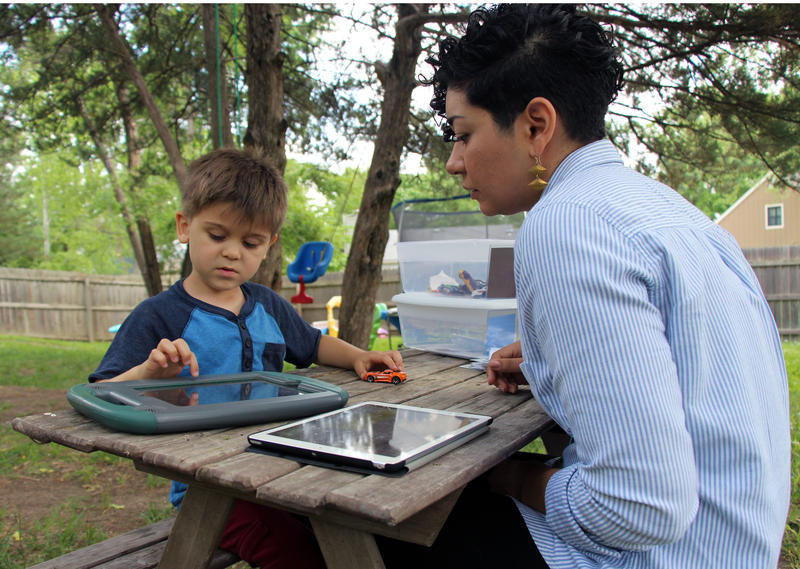
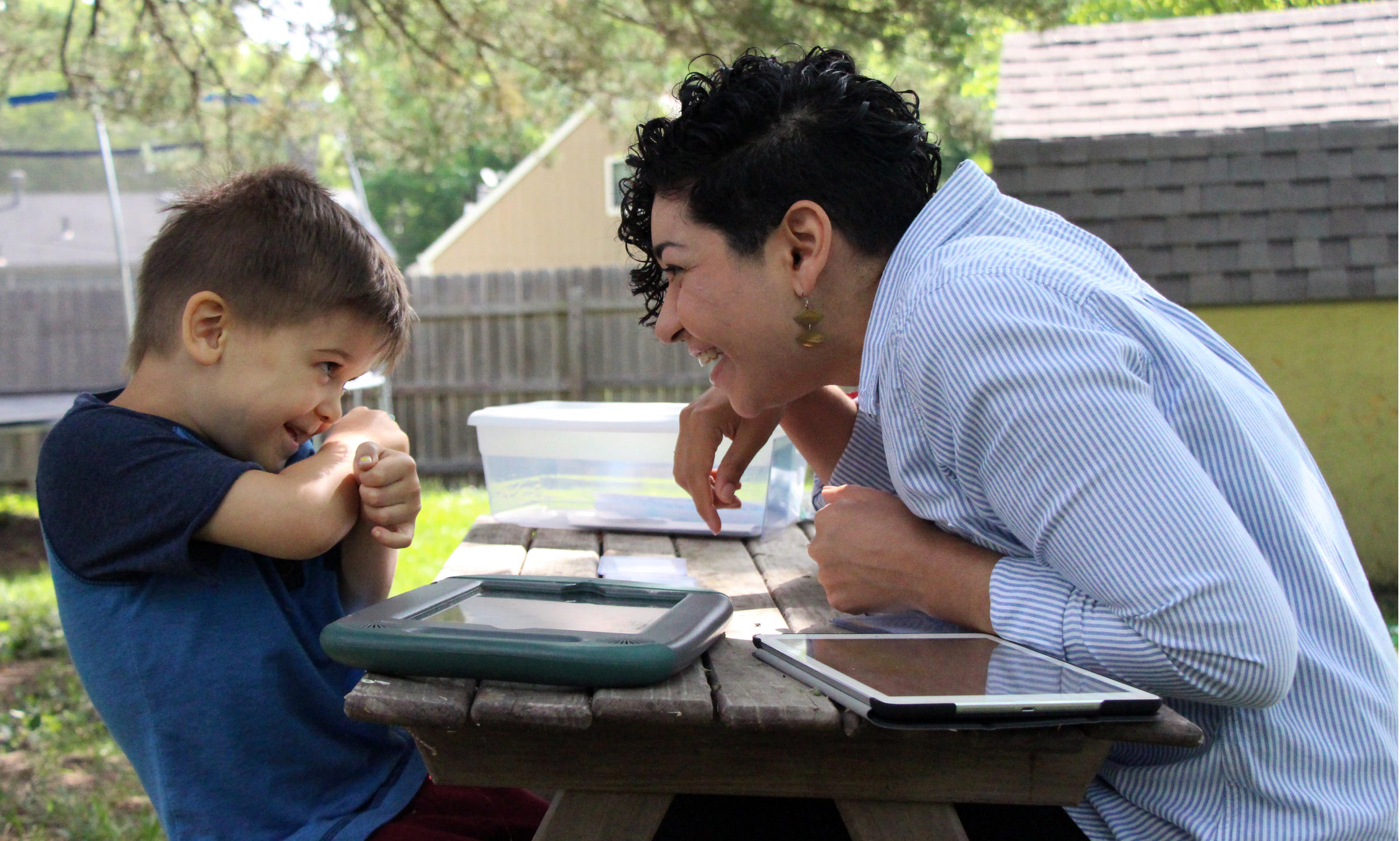
Five-year-old Ridley Fitzmorris works with therapist Ashley Estrada in his backyard. In Kansas, some children with autism end up on long waitlists for therapy. (Photos by Celia Llopis-Jepsen/Kansas News Service)
By CELIA LLOPIS-JEPSEN
Kansas News Service
Five-year-old Ridley Fitzmorris sits at a picnic table in his backyard in Lawrence, one leg dangling and the other tucked beneath him. His eyes are focused on a row of Hot Wheels that his therapist asked him to count.
“One, two, three,” he says in a whisper, his finger hovering over each toy car until he reaches the last one. Turning to an iPad that he uses to communicate, he clicks an icon. “Eight,” the computerized voice announces.
“Good job!” cooes therapist Ashley Estrada, a specialist in treatment for children with autism. “You did it by yourself.”
Then Ridley’s favorite part — the part his therapist recently realized sends him into reliable fits of giggles. With a few clicks on his iPad, he lets her know which car he wants: the green one.
The boy squirms delightedly as she rolls the toy car across the table. Up his right arm. Over his head — prompting more giggles — and plop, she slides it into the left pocket of his blue cotton baseball tee.
The pair then practice saying the word “pocket” a few times.
Therapist Ashley Estrada mixes plenty of play and light moments into her work with five-year-old Ridley Fitzmorris.
Autism looks very different in different people. But for those who struggle to communicate or interact with others, psychologists often point families to the kind of one-on-one treatment that Ridley receives — applied behavior analysis, or ABA.
In Kansas, though, parents face long waitlists and shortages of providers. So a decade into statewide insurance reforms, more Kansans have coverage for this therapy, but that doesn’t mean kids get it.
The situation is worst for children with Medicaid as their primary or secondary insurance, and those in rural areas.
The lack of therapy could be holding kids back, with consequences for their education and career prospects, personal relationships and adult independence.
“I’m just very thankful Ridley was able to get it,” said Jillian Fitzmorris, his mother.
The Fitzmorris family got access to ABA when they had private insurance.
Jillian runs an autism support group and encounters plenty of families navigating the insurance maze and waitlists that can make seeking care complex and time consuming. “I try to share everything we know.”
Often intensive therapy is recommended. Many psychologists and other experts favor applied behavior analysis — though the topic is not without debate — as the most researched and evidence-based method to help autistic children develop life skills that may not come easy. The treatment is often recommended for the early years of childhood and brain development.
Ridley has severe autism and gets upward of 25 hours a week of behavior analysis with specialists like Estrada, who uses an iPad to meticulously note his progress on a wide range of skills.
His mother believes the sheer number of hours has made a difference, so her son can tell her things like what he wants to eat or do. He loves playing puzzles and is learning to type.
“ABA therapy,” Fitzmorris said, “has been huge in helping unlock that.”
But behavior analysts in Kansas can’t keep up with demand. A big reason, they say, is the state’s privatized Medicaid program, KanCare. Reimbursements are too slow — and too low.
One well-established mental health center recently decided to add ABA therapy to its services, but for now, at least, won’t be accepting Medicaid for that program.
“The state of Kansas’ hourly reimbursement rate doesn’t even cover the time and costs,” said a spokeswoman for the Family Service and Guidance Center in Topeka. “The KanCare rate pays about 50 percent.”
Katrina Ostmeyer is the associate executive director of IBT Inc., a provider of therapy for children with autism.
Even the process of getting credentials from KanCare’s three contractors can take months for each therapist. In the meantime, applicants for those jobs sometimes disappear.
“We have about 75 employees in our agency at any one time,” said Katrina Ostmeyer, associate executive director at Integrated Behavioral Technologies. “Ideally, if we’re fully staffed, we should have about 120.”
IBT, which serves large parts of Kansas, currently serves about 60 children. It has about 150 on its waitlist for behavior analysis. Most are enrolled in KanCare, which insures children based on family income and level of need.
It can take a long time for slots to open up because therapy for a single child can take multiple years.
A sense of urgency
Special education professor Tamara Marder at Johns Hopkins University says behavior analysis helps especially with communication and social skills — things like playing alongside other children at preschool.
“Other children will approach them to play,” Marder said. “But if they don’t have the skills to reciprocate, then they won’t approach them eventually. Then the issue becomes, that child becomes more isolated in that school setting.”
Children learn not just from adults but from interacting with one another — just one reason that preventing isolation matters.
Jon Hamdorf, a former researcher at the University of Kansas School of Medicine, became Kansas’ Medicaid director in January amid the gradual transition from the Brownback administration to the Colyer administration.
Hamdorf acknowledges some of the problems raised by IBT and others — including that reimbursement rates are too low and credentialing is, in his words, “onerous.”
“I’ve probably had at least a dozen conversations with IBT directly,” he said.
The three contractors that run KanCare didn’t comment, but Hamdorf said the companies are now engaged in weekly conversations with IBT over unpaid claims.
Some delays can have an explanation, he said, because so many of the children receiving services have a combination of private health insurance and KanCare coverage. That requires sending the bills to both — private plan first. But, he said, that’s not a blanket excuse.
“They’re responsible,” he said of Amerigroup, Sunflower and UnitedHealthcare, “to make sure services are delivered to the individuals and that they’re paying claims in a timely manner. And I will hold them to that.”
Hamdorf is also talking to state lawmakers about the Medicaid reimbursement rates.
The state is trying to streamline credentialing, too, and help providers recoup some costs in the meantime.
“There’s a short-term solution where we’re trying to work with the providers to make sure they’re getting reimbursed something,” Hamdorf said. “But we need to fix the process itself.”
IBT confirmed it’s in regular contact now with the KanCare contractors. Ostmeyer estimates she spends around four hours a week on the phone with them, trying to resolve claims.
Her frustration is that the delays — some payments, she says, can take months — contribute to a vicious cycle. IBT frequently takes loans to make payroll while significant chunks of its revenue lay tangled in paperwork.
At one crisis point last summer, Ostmeyer says the disputed backlog totaled a few hundred thousand dollars. Though things have improved, enough problems remain that the agency hasn’t taken new Medicaid clients for nearly a year and may not be able to start again for fear of going under.
“It’s absolutely devastating,” she said. “Because it’s so hard to tell a family. I know this is a time-limited service.”
Even families with private health insurance face obstacles to behavior analysis, despite statutory reforms to increase access.
Among them, provider shortages outside the state’s two largest metros. Advocates argue higher Medicaid reimbursement rates might help attract more ABA providers to more rural areas, too.
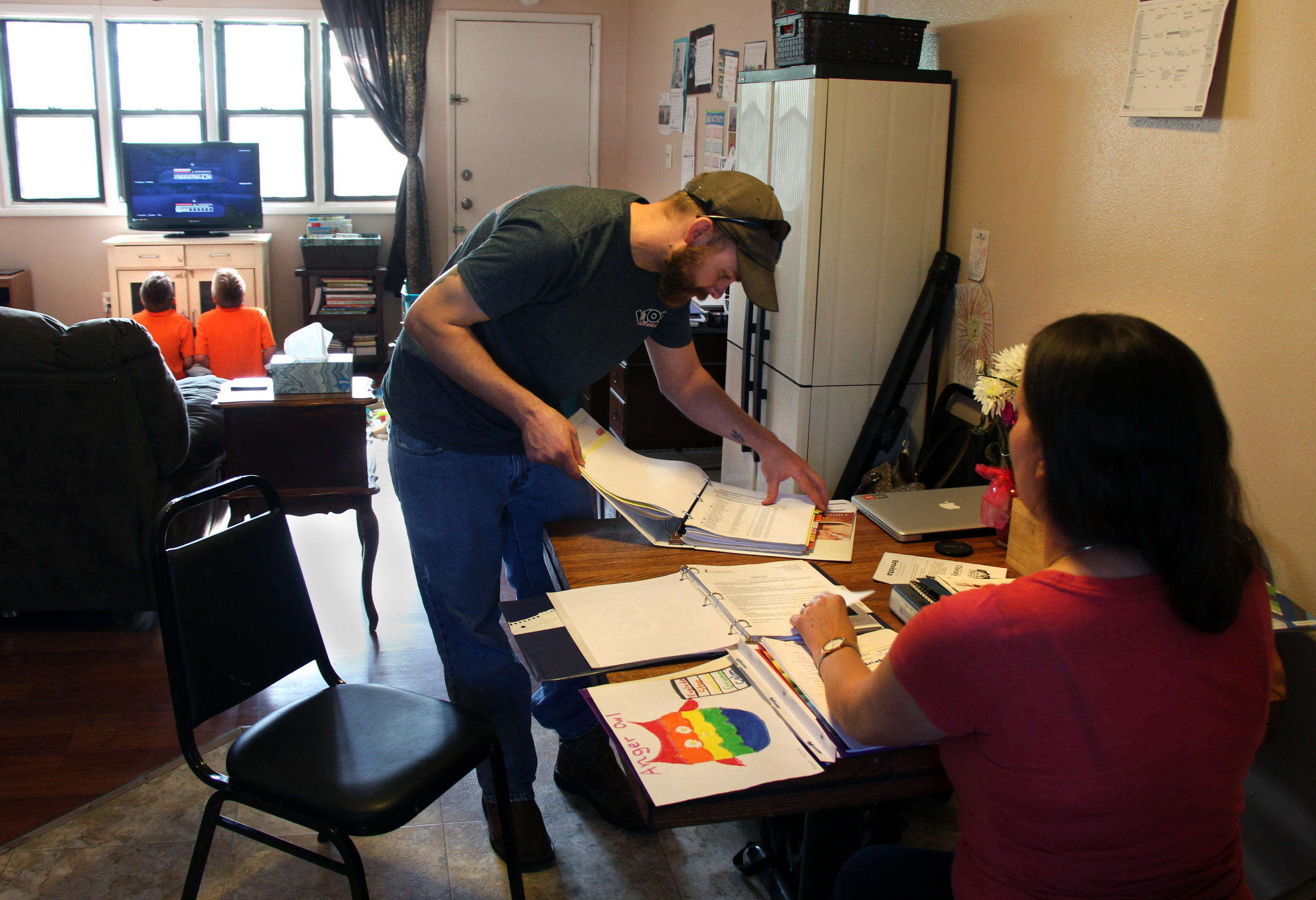
Samantha and Andrew Morrison show some of the binders full of materials that they have amassed over the years while learning about autism. Their sons Richard and James play a video game in the background.
Daily challengesSamantha and Andrew Morrison have loads of reading materials about autism in their Topeka home. Books and pamphlets from psychologists and pediatricians, personal stories written by people with autism and by parents.
They’ve become skilled at scouring for tips to help their nine-year-old son, Richard, because they haven’t had access to ABA therapy for most of his life.
“You’re just trying to make it so that they have an easier way to do things in life without feeling so stressed,” Andrew Morrison said. “Because little things can stress out kids on the spectrum really quickly.”
The Morrisons moved home to Kansas last year from Colorado, where they say behavior analysts helped Richard with his sensitivity to everyday variations in life that could trigger explosive outbursts.
Switching between two activities at home or in school could be difficult for him. Taking a different route to the grocery store or receiving a plate of spaghetti on a different dish than usual — things that any parents might do without much thought — could inadvertently cause intense distress and flailing, and leave the Morrisons struggling with guilt.
One time, they say, he plunged his feet through a van window from his spot in the backseat, shattering the glass.
“He hadn’t cut himself, but it scared him pretty good,” Samantha Morrison recalled. “He had no idea he had even done it. He was just so pent up and angry and upset.”
After the Morrisons arrived in Topeka they sought more behavior analysis. But when they called around, they say, providers told them they would have to wait.
It’s a situation those providers aren’t happy with either. Sandy Crawford, vice president of pediatric services at Easterseals Capper Foundation in the state capital says her team encourages families to get on as many waitlists as they can. The foundation has 90 kids on its own list.
“Some of these kids have been on the waitlist, two, three, four years,” Crawford said. “A four-year-old plus four years on the waitlist — that’s an eight-year-old. You’re losing time.”
Celia Llopis-Jepsen is a reporter for the Kansas News Service, a collaboration of KCUR, Kansas Public Radio, KMUW and High Plains Public Radio covering health, education and politics. You can reach her on Twitter @Celia_LJ.
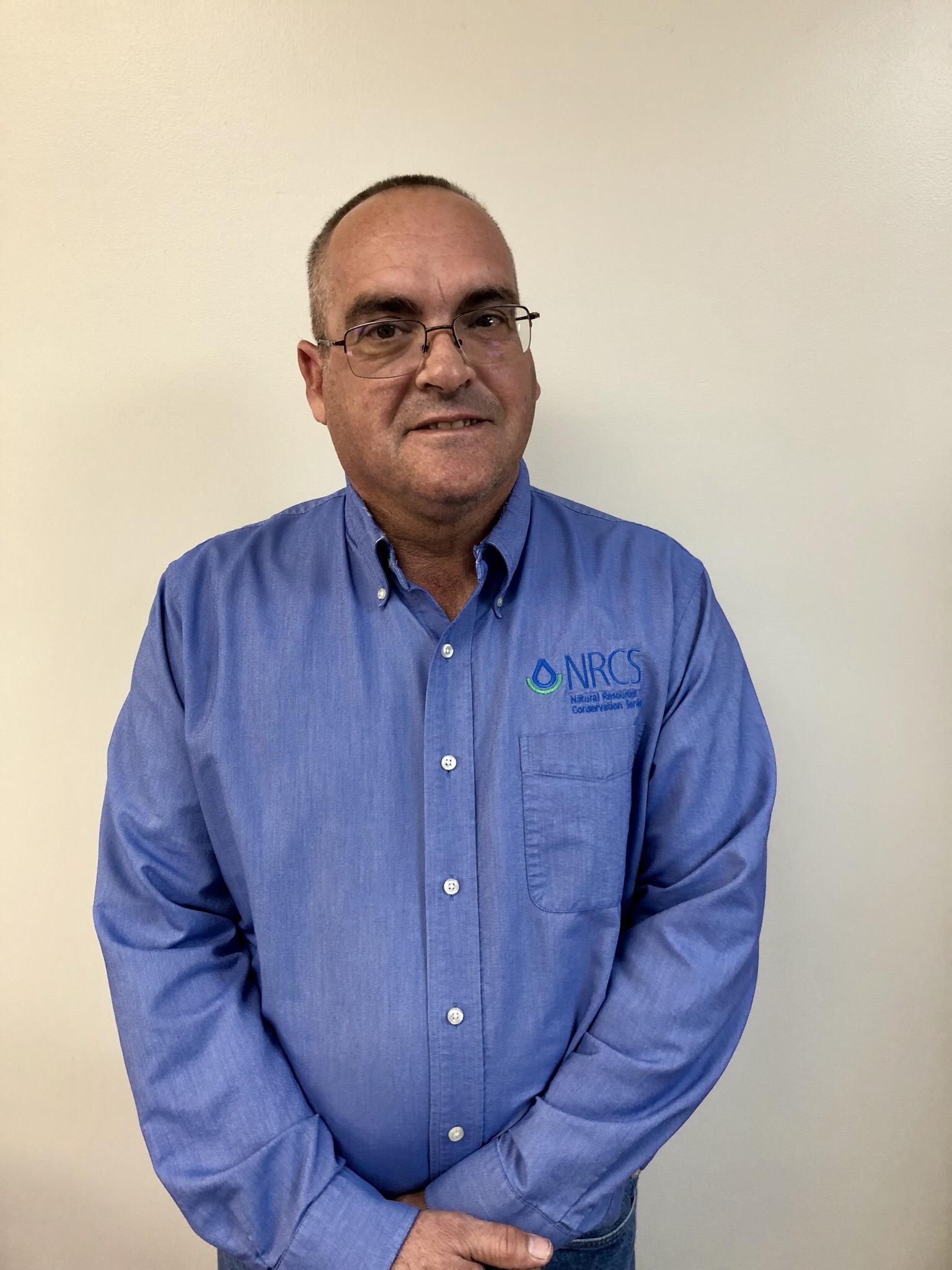
Dale Younker is a Soil Health Specialist with the USDA Natural Resources Conservation Service in Jetmore.
Today I would like to talk about soil aggregate stability. A soil aggregate is a whole bunch of individual soil particles that are bound, or glued, together. How well those aggregates hold up to disruptive forces like tillage and erosion tells us how stable that soil aggregate is. When these disruptive events occur if soil particles stay bound together the more stable the soil aggregate is.
Aggregate stability is critical for water infiltration and in dryland cropping systems it’s all about water. The more we can capture and store in the soil profile the better chance we have a growing a good, productive crop. Stable soil aggregates, that don’t break apart when water enters them provide more pore space for water to enter into. This increases the soil’s water holding capacity. Good aggregate stability also helps in root development, which helps the plant take up more water and nutrients. The soil is also more resistant to erosion.
In low aggregate stability soils soil particles break away from each other when water enters into an aggregate. The individual soil particles fill surface pore spaces and can form a hard crust on the soil surface when the soil dries. Water has difficulty penetrating this crust and it typically runs off, which causes erosion. The crust can also restrict seedling emergence.
Good aggregate stability is highly dependent on soil organic matter and biological activity in the soil. Certain fungal groups help plant roots gather water and nutrients and help bind soil particles together. Other organisms, like earthworms, secrete glue like substances the help hold the particles together. Decomposing soil organic matter also provide organic glues.
Certain soil labs can complete tests to tell you how stable your soil aggregates are. But a simple quick way is to dip an air dried soil clod in a cylinder of water. If that clod breaks up quickly you have low stability because there are no glues holding those aggregates together. If the clod stays together 30 minutes or longer you have high stability.
So how do we improve our soil aggregate stability? The simple answer is to reduce tillage. Excessive tillage physically breaks down soil aggregates and disturbs the fungal groups that secrete glues that hold soil particles together. Over time it also depletes soil organic matter which is also important to aggregate stability.
For more information about this or other soil health practices you can contact me at [email protected] or any local NRCS office.
Dale Younker is a Soil Health Specialist with the Natural Resources Conservation Service in Jetmore.
Today
Sunny and hot, with a high near 101. Breezy, with a south wind 10 to 15 mph increasing to 19 to 24 mph in the afternoon. Winds could gust as high as 37 mph.
Tonight
Partly cloudy, with a low around 72. Breezy, with a south wind 15 to 21 mph, with gusts as high as 31 mph.
Monday
Sunny, with a high near 89. Breezy, with a south southwest wind 15 to 20 mph becoming north in the afternoon.
Monday Night
Mostly clear, with a low around 61. Northeast wind 8 to 14 mph.
Tuesday
A 20 percent chance of showers and thunderstorms. Mostly sunny, with a high near 88. East northeast wind 7 to 9 mph.
Tuesday Night
A 40 percent chance of showers and thunderstorms, mainly after 1am. Partly cloudy, with a low around 64.
Wednesday
A 20 percent chance of showers and thunderstorms before 1pm. Partly sunny, with a high near 90.
Wednesday Night
Partly cloudy, with a low around 69.
TOPEKA – Abuse of adults may take on numerous forms, including physical, emotional or sexual abuse, self-neglect or neglect by a caregiver and financial exploitation.
In FY 2018, the Kansas Department for Children and Families (DCF) has received approximately 16,468 calls regarding abuse and neglect of this vulnerable population, and more than 7,300 investigations have been assigned.
Adult abuse affects individuals 18 and older who are unable to protect themselves. This includes older adults and persons with disabilities.
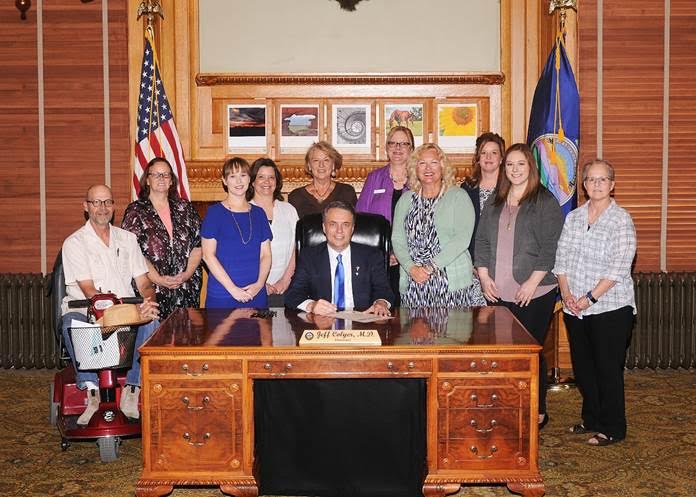
To call attention to this issue, Governor Jeff Colyer signed a proclamation last week declaring June Adult Abuse Awareness Month.
“When someone thinks of DCF, child welfare is often at the forefront of their minds, but these adults are just as vulnerable, and in need of our assistance,” Secretary Gina Meier-Hummel said. “As the population ages, there are more individuals in need of adult protective services, and we have to be ready to offer them a helping hand.”
DCF Adult Protective Services (APS) helps protect older adults from being taken advantage of, as well as to ensure they are taking care of themselves. To promote adult abuse awareness, the public is invited to wear purple on Friday, June 15.
The State of Kansas takes seriously this issue. Since FY 2011, DCF has added Adult Protective Specialist positions to the Adult Protective Services program. It has increased training and outreach efforts and is now better equipped to serve vulnerable adults.
Since 2011, DCF and other State agencies, community providers and advocates have played an active role in positive change by serving on the APS Advisory Committee. They provided direction on a strategic plan to combat adult abuse. The plan includes six goals, including improving services, increasing staff knowledge, improving tracking and monitoring through data sharing and more.
“Every Kansan has the responsibility to report suspected abuse. This vulnerable population deserves our support and protection,” Governor Colyer said. “If you see something, say something.”
Kansans can report abuse by calling the DCF Kansas Protection Report Center, which is available 24 hours per day, seven days a week, at 800-922-5330. Another option would to submit a report online at www.dcf.ks.gov/services/pps/Pages/KIPS/KIPSWebintake.aspx.
TOPEKA – The federal Department of Health and Human Services’ Administration for Community Living has awarded the Kansas Department for Aging and Disability Services (KDADS) a three-year grant to expand and improve the services the state provides to individuals with traumatic brain injury (TBI).
KDADS will use the $150,000-a-year grant to create and strengthen a system of services and supports that maximizes the independence, well-being and health of Kansans with TBI in collaboration with the Brain Injury Association of Kansas and Greater Kansas City, the National Association of State Head Injury Administrators and other key stakeholders.
The objectives of this project are to increase representation of people affected by TBI on Kansas’ TBI Advisory board, develop an annual State TBI Action Plan, develop a TBI Registry, increase enrollment of at least 30 people onto TBI Medicaid waiver, conduct annual seminars and educational events that increase knowledge and build capacity for advocacy, and create a sustainability plan to maintain and expand services in the future.
“We expect this project to result in an increased number of individuals with TBI receiving services under the state’s 1915(c) Medicaid waiver for TBI, which currently serves about 425 individuals,” KDADS Secretary Tim Keck said. “Another aim of this project is to educate people experiencing TBI, and the public, about brain injuries and to make them aware of the community resources available to support them.”
Kansas’ TBI Medicaid waiver provides a range of services and supports to individuals with TBI and their families with the aim of ensuring that individuals can remain in their homes and be as independent as possible in a safe, healthy environment. The HCBS/TBI program serves individuals who would otherwise require institutionalization in a TBI rehabilitation facility. The TBI waiver is designed to be a rehabilitative program for consumers to receive therapies and services that enable them to rely less on supports as their independence increases.
In 2018, the Kansas Legislature enacted a law requiring that the TBI Medicaid waiver cover children and people with acquired brain injuries as well as those with traumatic brain injury. Kansas is in the process of renewing federal approval for its TBI waiver and the proposed new waiver will include children and individuals with acquired brain injuries as required. The waiver is due for renewal in July of 2019. If approved by the Centers for Medicare and Medicaid Services (CMS) Kansas will become the first state in the nation to establish a rehabilitation program for children who have a brain injury.
SEDGWICK COUNTY — Law enforcement authorities are investigating a fatal stabbing and have made an arrest.
Just after 10:30 p.m., Friday, police responded to a cutting call in the 1600 block of south Erie in Wichita, according to officer Charley Davidson. Police located a 68-year-old man in the street who was pronounced dead.
Through the investigation it was learned the victim was driving his 2003 black Chevy Z71 Silverado extended cab pick-up truck north on Erie Street.
The truck stopped and a disturbance ensued in the street between the victim and a suspect. The victim was stabbed multiple times by the suspect who then fled in the victim’s black truck.
At approximately 10:30 a.m., Saturday, at 27th Street south and Magnolia, Wichita Police Department Officers arrested a 53-year-old man. He has been booked into jail for first degree murder, according to Davidson.
Officers recovered the victim’s 2003 black Chevy Z71 Silverado.
Officers recovered the vehicle and made the arrest after a citizen called 911 alerted authorities of the whereabouts of the pickup truck.
Police did not release the name of the victim or the suspect.
——–
SEDGWICK COUNTY — Law enforcement authorities are investigating a fatal stabbing and asking the public for help to locate a suspect.
Just after 10:30 p.m., Friday, police responded to a cutting call in the 1600 block of south Erie in Wichita, according to officer Charley Davidson. Police located a 68-year-old man in the street who was pronounced dead.
Through the investigation it was learned the victim was driving his 2003 black Chevy Z71 Silverado extended cab pick-up truck north on Erie Street.
The truck stopped and a disturbance ensued in the street between the victim and a suspect. The victim was stabbed multiple times by the suspect who then fled in the victim’s black truck. The suspect is described as an unknown black male, 5-foot-8-11, 250 pounds and wearing a light colored hat.
The truck has chrome rims, a chrome handle on the tailgate and the passenger window has been taped up. The truck also had a 60-day tag.
Anyone with information is asked to contact police.
SHAWNEE COUNTY — Law enforcement authorities are investigating a shooting and have a suspect in custody.
Munoz -photo Shawnee Co.
Just before 8a.m. Saturday, police responded to the 400 block of SE Lafayette Street in Topeka on a report of gunshots in the area with two possible victims, according to Lt. Chris Heaven.
Upon arrival, officers located a Hispanic/Male 30’s in the west alley suffering from multiple gunshot wounds. He was transported to Stormont Vail Hospital.
A private vehicle had already taken a second Hispanic-Male unknown age, suffering from multiple gunshot wounds to St. Francis Hospital.
Both gunshot victims suffered injuries that appear to be life threatening, according to Heaven.
Police arrested 28-year-old Daniel R. Munoz Munoz for two counts of Aggravated Battery and one count of Criminal Possession of a Firearm by a Convicted Felon.
————
SHAWNEE COUNTY — Law enforcement authorities are investigating a shooting and have a suspect in custody.
Just before 8a.m. Saturday, police responded to the 400 block of SE Lafayette Street in Topeka on a report of gunshots in the area with two possible victims, according to Lt. Chris Heaven.
Upon arrival, officers located a Hispanic/Male 30’s in the west alley suffering from multiple gunshot wounds. He was transported to Stormont Vail Hospital.
A private vehicle had already taken a second Hispanic-Male unknown age, suffering from multiple gunshot wounds to St. Francis Hospital.
Both gunshot victims suffered injuries that appear to be life threatening, according to Heave.
The fort said in news release it will be conducting a training exercise involving small arm fire, artillery and demolitions.
The exercise is known as Gauntlet and is part of the 1st Infantry Division commander’s Combat Training Center certification program.
Fort Riley says to expect significant noise June 11 through June 13, and on June 17.
More than 18,000 soldiers from the 1st Armored Brigade Combat Team, the 1st Combat Aviation Brigade and numerous National Guard and Army Reserve units will be part of the exercise. The fort says the Gauntlet is designed to test command and control at all levels in field conditions.
WICHITA, Kan. (AP) — The Latest on the death of a woman who led an investigator to the body of her 5-year-old stepson (all times local):
Lucas Hernandez
A prosecuting attorney says law enforcement will continue to work to determine how a 5-year-old Wichita boy died, despite the death of his stepmother, who had been the focus of the investigation.
Sedgwick County District Attorney Marc Bennett said Friday that Emily Glass’ death does not mean authorities plan to wrap up their work in the case of Lucas Hernandez, whose body was found last month after Glass reported him missing in February.
Glass was found dead early Friday after Lucas’ father reported she had committed suicide. Authorities have not determined the cause of death.
Bennett said Glass was the main person of interest in the case and he couldn’t say whether other people might have “levels of culpability” in the boy’s death.
Seven registered nurses at HaysMed were honored recently at a recognition ceremony and luncheon. They completed the yearlong RN Residency Program offered at HaysMed, part of The University of Kansas Health System.
The program began a year ago in July 2017 and the nurses spent the first 3 weeks in a classroom setting. The remainder of training focuses on clinical experience, one on one mentorship with their preceptor, high-fidelity simulations and on the job training. Additionally, nurses receive training from professionals in several departments, such as radiology, pharmacy, cardiac care, periop and others.
The RN Residency class included Danelle Glines, RN, Tabitha Greathouse, RN, Andrew Heimann, RN, Tara Hoekman, RN, Katie Rabe, RN, Shelby Rohr, RN and Amanda Rudman, RN.
The RN Residency Program at HaysMed is one of only two in the state and has been offered since 2008. Shari Hertel, RN heads the program and has oversight of all the training. HaysMed also works closely with critical access hospitals in the region through a rural residency program to provide training to nurses practicing in the rural setting.
“The ever-changing health care landscape presents challenges and opportunities to new nursing graduates.” Said Hertel. “Our evidenced based residency program goes beyond basic orientation and provides a clinical preceptorship focused not just on delivering competent care, but also in how to develop and grow in the nursing profession. The positive clinical outcomes benefit not only the participating nurses, but also our patients.”
Currently there are 10 nurses scheduled in the next program which begins in July and six nurses enrolled in the Rural Residency program. The program is open to newly graduated RNs.
— HaysMed
ALFALFA COUNTY —An earthquake shook many area of Kansas Saturday morning.
Location of Saturday’s quake and where residents felt it -USGS image
The quake just before 9a.m. measured a magnitude 4.5 and was centered approximately 26 miles east of Cherokee, Oklahoma, according to the U.S. Geological Survey. Cherokee is 90-minutes south of Pratt.
Residents from across central Kansas reported feeling the quake. The USGS reported a pair of Kansas quakes on June 4 including a 2.9 temblor in Salina County and a 2.6 in Reno County.
There are no initial reports of damage or injury from Saturday’s quake.

 Jackie Creamer’s The Dance Studio has scheduled the following summer camps and classes for the coming weeks.






 Today