We have a brand new updated website! Click here to check it out!

HPD Activity Log May 16

The Hays Police Department responded to 8 animal calls and conducted 14 traffic stops Wed., May 16, 2018, according to the HPD Activity Log.

Found/Lost Property–4300 block Vine St, Hays; 12:56 AM
Domestic Disturbance–500 block W 17th St, Hays; 4:05 AM; 4:08 AM
Animal At Large–1300 block Lawrence Dr, Hays; 9:03 AM
Animal Cruelty/Neglect–2200 block Drum Ave, Hays; 9:07 AM
Civil Dispute–500 block W 17th St, Hays; 10:26 AM
MV Accident-City Street/Alley–1700 block Marshall Rd, Hays; 11:17 AM
MV Accident-City Street/Alley–27th St and Vine St, Hays; 11:34 AM
Lost Animals ONLY–600 block W 13th St, Hays; 11:37 AM
Lost Animals ONLY–1300 block W 43rd St, Hays; 1:18 PM
Theft (general)–500 block E 8th St, Hays; 1:19 PM
MV Accident-Personal Injury–1100 block E 27th St, Hays; 3:14 PM
MV Accident-City Street/Alley–100 block E 27th St, Hays; 4:45 PM
Counterfeit currency/documents–4700 block Roth Ave, Hays; 5/11 10 PM; 5/16 12 PM
MV Accident-City Street/Alley–200 block E 27th St, Hays; 7 PM


Man hospitalized after SW Kansas collision

HASKELL COUNTY — A Kansas man was injured in an accident just before 6a.m. Thursday in Haskell County.

The Kansas Highway Patrol reported a 2004 Buick LeSabre driven by Justin B. Frey, 47, Satanta, was westbound on Road 50 eighteen miles north of Satanta.

The Buick crossed the center line and struck a 2000 Honda Passport driven by Garcia-Garcia, Hector A. Garcia-Garcia, 35, Ulysses, in the eastbound lane.

The Buick left the roadway, traveled through a fence and into the south ditch.

Frey was transported to the hospital in Garden City.  Garcia-Garcia and a passenger were not injured.   All three were properly restrained at the time of the accident, according to the KHP.


Wheat Scoop: Western Kansas wheat hit hard by hail storm

Kansas Wheat

Storms ripped through western Kansas from Wallace County to Ness County in a swath ten to 15 miles wide on May 14. Wind gusts up to 80 miles per hour and hail from pea-sized to baseball-sized broke out windows, dented cars and tore siding off of houses.
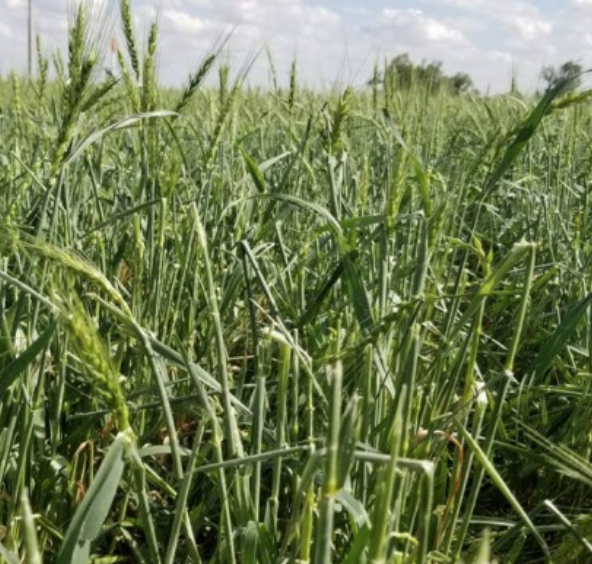
Wheat fields in the area weren’t spared either. Fields that were already suffering from drought stress were completely destroyed by the “great white combine.”

In Scott County, Glenda and Rich Randall estimate that they lost about 300 acres of wheat near their home. Within ten minutes, marble sized hail paired with 70 mile per hour winds tore through their irrigated wheat field. The wheat was just beginning to head out, but after the storm, it appeared as though it had been mowed off by a dull blade. Glenda said, “You looked outside, and it just looked like winter.”

Rich estimated that field, which was planted late after corn, would have made 40 bushels per acre, but now was a total loss. A field to the west also suffered severe damage, but Rich estimated it was only a 50% loss. On the upside, the Randalls did have multi-peril and hail insurance, as hail is common in their area.

35bc7903-5cfb-460b-9d1f-fc1a503f39ea.jpg
Hail damaged field at Rich and Glenda Randall’s near Scott City, Kansas
A few miles to the east, the Ramseys surveyed their fields near Manning, Kan. Marc, who returned to farm with his dad, Craig, in 2011 said this was the worst he’s seen. From the road, the fields still looked somewhat lush, but upon closer inspection, heads were bent over and stalks were broken in half. The smell of freshly cut grass was in the air.

Divots in the ground showed how much force the hail had. The fertilizer tanks on the top of their corn planter had holes in the top. Although they have federal crop insurance, they do not have additional hail insurance. Marc said he couldn’t even hear the wind and rain over the sound of the hail. Estimates from the area included baseball-sized hail up to one report of cantaloupe-sized. Neighbors in the area estimated that up to two-thirds of their crop was destroyed.

cc1c1099-d791-4219-9f20-ee9fbc398bd2.jpg
Craig Ramsey and Marc Ramsey had hail damage in their fields near Manning, Kansas
To the west, David and Lisa Schemm farm near Sharon Springs, Kan., in Wallace County. The storm directly hit their house and fields near the house, which appear to be a total loss. The pre-hail yield estimate for the 325 acre field near their house was 42 bushels per acre.

“The hail storm went from Weskan and went southeast, pretty much in a line,” said Lisa. “It was very wide, so we’re estimating a little over half of our wheat was destroyed. It was 70-plus mile an hour winds. I would say it probably would have been golf ball, up to just shy of a baseball-sized hail, and the winds were vicious.”

The west sides of houses in the area were hit the hardest, with windows busted and siding destroyed. The Schemms only have two west-side windows, so they didn’t have as much personal loss as some of their neighbors, but, on the positive side, Lisa says she’s been wanting new siding on the house for a while.

“It wiped everybody’s west side windows and siding out. Windshields were knocked out of vehicles, and of course, wheat fields,” she said.
7349d33d-94dc-48b7-ac68-0e9ac64b7ae1.jpg
Hail damage near David and Lisa Schemm’s house, south of Sharon Springs, Kansas
This devastation follows a hard year, where Kansas wheat has suffered from drought. Many areas of the state have received less than an inch, up to only a couple inches of moisture since early October. Abandonment of acres has been more common than average, and only 7.8 million acres were planted last fall, which is the third lowest planted acres since 1913, up only slightly since last year.
To view photos and watch a video of damage, visit www.kswheat.com/hail

Report: US births hit a 30-year low

NEW YORK (AP) – U.S. birth rates declined last year for women in their teens, 20s and – surprisingly – their 30s, leading to the fewest babies in 30 years, according to a government report released Thursday.

Experts said several factors may be combining to drive the declines, including shifting attitudes about motherhood and changing immigration patterns.

The provisional report, based on a review of more than 99 percent of the birth certificates filed nationwide, counted 3.853 million births last year. That’s the lowest tally since 1987.

Births have been declining since 2014, but 2017 saw the greatest year-to-year drop – about 92,000 less than the previous year.

That was surprising, because baby booms often parallel economic booms, and last year was a period of low unemployment and a growing economy.

But other factors are likely at play, experts said.

One may be shifting attitudes about motherhood among millennials, who are in their prime child-bearing years right now. They may be more inclined to put off child-bearing or have fewer children, researchers said.

Another may be changes in the immigrant population, who generate nearly a quarter of the babies born in the U.S. each year. For example, Asians are making up a larger proportion of immigrants, and they have typically had fewer children than other immigrant groups.

Also, use of IUDs and other long-acting forms of contraception has been increasing.

The Centers for Disease Control and Prevention report also found:

-The rate of births to women ages 15 to 44, known as the general fertility rate, sank to a record low of about 60 per 1,000.

-Women in their early 40s were the only group with higher birth rates in 2017, up 2 percent from the year. The rate has been rising since the early 1980s.

-The cesarean section rate rose by a tiny amount after having decreased four years. Studies have shown C-sections are more common in first-time births involving older moms.

-Rates of preterm and low birth weight babies rose for the third straight year, possibly for the same reason.

-Birth rates for teens continued to nosedive, as they have since the early 1990s. In 2017, they dropped 7 percent from the year before.

-Rates for women in their 20s continued to fall and hit record lows. They fell 4 percent.

-Perhaps most surprising, birth rates for women in their 30s fell slightly, dipping 2 percent for women ages 30 to 34 and 1 percent for women 35 to 39.

Birth rates for women in their 30s had been rising steadily to the highest levels in at least half a century, and women in their early 30s recently became the age group that has the most babies.

That decline caused some experts’ eyebrows to shoot up, but they also noted the dip was very small.

“It’s difficult to say yet whether it marks a fundamental change or it’s just a blip,” said Hans-Peter Kohler, a University of Pennsylvania demographer who studies birth trends.

Another notable finding: The current generation is getting further away from having enough children to replace itself.

The U.S. once was among a handful of developed countries with a fertility rate that ensured each generation had enough children to replace it.

The rate in the U.S. now stands less than the standard benchmark for replacement. It’s still above countries such as Spain, Greece, Japan and Italy, but the gap appears to be closing.

A decade ago, the estimated rate was 2.1 kids per U.S. woman. In 2017, it fell below 1.8, hitting its lowest level since 1978. “That’s a pretty remarkable decline,” said Dr. John Santelli, a Columbia University professor of population and family health and pediatrics.

Application deadline nearing for day camps at Sternberg Museum of Natural History

Sternberg Summer Camps

By DIANE GASPER-O’BRIEN
FHSU University Relations and Marketing

After a year of teaching at the high school level, Keri Maricle is going to try her hand at working with elementary students this summer.

Maricle, who just finished her first year as a biology instructor at Thomas More Prep-Marian High School in Hays, is the new day camp instructor for elementary school students at Fort Hays State University’s Sternberg Museum of Natural History.

Students ages 6 to 10 are able to choose from nine different camps focusing on earth and life science. They can attend one camp, or two – or all nine if they wish to.

“We have a couple of students enrolled in just one camp, and some are enrolled in six different ones,” said David Levering, education director at Sternberg Museum.

The cost of each camp is $65 for members of Sternberg Museum and $75 for non-members. Financial aid is available and can be applied for along with the online camp application at sternberg.fhsu.edu. Application deadline is Friday, June 1.

Levering started the camps his first summer at Sternberg in 2014, and “our first round of camps was very small, because no one knew they existed,” he said. However, attendance has grown significantly each year.

The first day camp is scheduled for Monday, June 18, and the last one Friday, July 13. The camps run from 9 a.m. to 3 p.m. each day, and will include instruction both indoors and out.

“I’m excited about giving them a taste of science that isn’t all in the classroom,” Maricle said. “It’s fun to show students that this is what excites me.”

Maricle, who earned both her bachelor’s and master’s degrees from Fort Hays State, said she welcomes the challenge of teaching younger students.

“There is a different teaching style that comes with every age group,” she said. “I’m really looking forward to it, especially taking them outdoors and doing things. Hands-on activities are the ones they remember the most.”

Sternberg Museum also offers camps for middle and high school students, which are one week and two weeks, respectively. More information about those opportunities can be found online at sternberg.fhsu.edu.

Levering said the elementary school students will be introduced to subject matter that is in line with the middle and high school camps.

“We’re going to make a point of letting the elementary school students use some of the equipment they use in field camp,” he said. “It’s an introduction for them that is not real demanding of their commitment to the subject but getting to see little bits and pieces.”

Following is the list of camp dates and their subjects:

Monday, June 18 – Reptiles and Amphibians
Wednesday, June 20 – Bird Biologists
Friday, June 22 – Marvelous Mammals
Monday, June 25 – Digging Up Dinosaurs
Wednesday, June 27 – Sea Creatures of Kansas
Friday, June 29 – Minerals Rock!
Monday, July 9 – Gone Fishing
Wednesday, July 11 – Insects and Spiders
Friday, July 13 – Trees, Flowers and Grasses

INSIGHT KANSAS: Helping the Legislature work well, an interim solution

Legislatures are unpopular. Most voters think that legislators do little more than bicker, bicker, bicker. Major problems often go ignored, and back-room deals predominate.

There is some truth to this depressing stereotype, yet most lawmakers try to do what’s best, despite their disagreements over specifics.

Burdett Loomis, Professor, Political Science, College of Liberal Arts and Science, University of Kansas

What we can see, whether in Topeka or Washington, is that partisanship and centralized leadership dominate legislatures, providing little room for deliberation or – save in dire circumstances – compromise. Budget deadlines or the end of a session may force action, but day in, day out, legislative leaders often discourage productive work on serious problems.

This year, the Kansas Legislature barely managed to address the looming school finance issue, and then almost passed a rushed, ill-advised tax cut, just as the state had started to reverse its revenue swoon.

Given the need to bring together large numbers of diverse lawmakers, elected from their distinct constituencies, it is no wonder that legislating is difficult. Regardless, it is not as hard as Kansas representatives and lawmakers have made it.

To render the Legislature a bit more productive and civil, let me suggest one modest change. Legislative leaders should bring back the practice of appointing several meaningful interim committees to address thorny issues between sessions.

We do still have a few such committees, but they rarely lead to serious study of stubborn issues. Indeed, for the Senate president and the House Speaker, these committees are dangerous because they offer the possibility of reaching broad agreement on an important issue outside the majority party caucus.

Thirty or forty years ago, interim committees were plentiful and valuable; they often met for several days between sessions. In 1972 and 1973, years of intense governmental reform, more than thirty interim committees met, addressing subjects from consumer protection to education master planning to the energy crisis.

As recently as 1995, 14 committees met between sessions, and the 1980s averaged more than ten. These numbers contrast sharply with the 2011-2016 Republican era, with just 3.5 interim committees per year. In the wake of the 2016 election, interims increased to eight in 2017, but they did not shape the legislative agenda to the extent that earlier committees did.

Kansas has historically had an amateur (or maybe “semi-pro”) legislature, with its 90-day sessions and meager pay. In the 1970s, 1980s, and 1990s, many legislators studied hard, did their homework, and with the assistance of the Legislative Research Department came to deep understanding of many issues facing the state. Interim committees served as one vehicle to enhance their knowledge, and the discussion of major issues benefited from their experiences.

Without question, there are many current legislators, such as the retiring Rep. Tom Sloan (R-Lawrence), who have gained great understanding during their service, but he stands as a contemporary exception, not the rule.

In fact, much current legislation comes pre-packaged from the right-wing universe of Americans for Prosperity and ALEC (the American Legislative Exchange Council).

One path to a deeper understanding of major issues is to reinvigorate the interim committee system, which could place ideology on a back burner. Perhaps ten or so such committees every year would mean that the Legislature could do a better job of hitting the ground running in an era of difficult, overlapping issues like education, mental health, Medicaid expansion, foster care, prisons, and many more.

Effectively using the June-January period could make for less bickering, less partisanship, and more coherent policy-making. Definitely worth a try.

Burdett Loomis is an emeritus professor of political science at the University of Kansas.

Ignatius J. ‘Ig’ Schumacher

Ignatius J. “Ig” Schumacher, age 84, of Hays, Kansas, died Wednesday, May 16, 2018, at Via Christi Village Care Center in Hays, Kansas.

Services will be at 10:00 A.M. Monday, May 21, 2018, at The Basilica of St. Fidelis, Victoria, Kansas.

Burial will be in St. Joseph Cemetery, Hays, Kansas with military honors by the Hays V.F.W. Post No. 9076.

A Knights of Columbus rosary will be at 6:30 P.M. Sunday, followed by a vigil service at 7:00 P.M. Sunday, both at Cline’s-Keithley Mortuary of Hays, 1919 East 22nd Street, Hays, Kansas 67601.

Visitation will be from 5:00 to 8:00 P.M. Sunday, at Cline’s-Keithley Mortuary of Hays and from 9:00 to 10:00 A.M. Monday, at the Basilica of St. Fidelis, Victoria, Kansas. The family suggests memorials to the Hays Recreation Commission or Via Christi Village Care Center.

Condolences can be left by guestbook at www.keithleyfuneralchapels.com or can be sent via e-mail to [email protected].

SHPTV Writers Contest winners announced

SHPTV

BUNKER HILL – Smoky Hills Public Television has announced the winners of the 2018 SHPTV PBS Kids Writers Contest. SHPTV received 154 entries, submitted from January through March from 18 communities across Kansas. Children in kindergarten through third grade were eligible to enter stories.

“We again received fantastic stories from children around the state and continue to believe in the positive educational impact of this contest,” said Callie Kolacny, SHPTV marketing director. “We thank the parents and teachers who encouraged their kids to submit stories and are thrilled that this program continues to grow.”

Each story was judged twice with three places awarded in each grade level. The children, whose stories placed, receive a prize pack and a trophy. The stories can be read at smokyhillstv.org.

2018 Writers Contest Winners

Kindergarten
1st – Asher Van Patten, Almena – “The Robot Family”
2nd – Austin Rothenberger, Osborne – “The Tornado Man”
3rd – Stormy Guttery, Osborne – “The Storm Came”

1st Grade
1st – Malachi Miller, Gorham – “Calfie in the City”
2nd – Kimber Barfield, Osborne – “Superstar Girl Meets Evil Agent Otter”
3rd – Libbie Carlin, Osborne – “Fairyland”

2nd Grade
1st – Lauren Smith, Hays – “Annie’s First Job”
2nd – Kenadee Schmidt, Sterling – “Imagination Girl and Builder Girl”
3rd – Ethan Schulte, Victoria – “A Scientist’s Discovery”

3rd Grade

1st – Norah Ellenz, Tipton – “Great Grandpa”
2nd – Janessa Miller, Gorham – “The Gymnast Who Never Gave Up”
3rd – Emma Miller, Lakin – “Two Big Wishes”

Nicodemus prepares for second annual Chautauqua

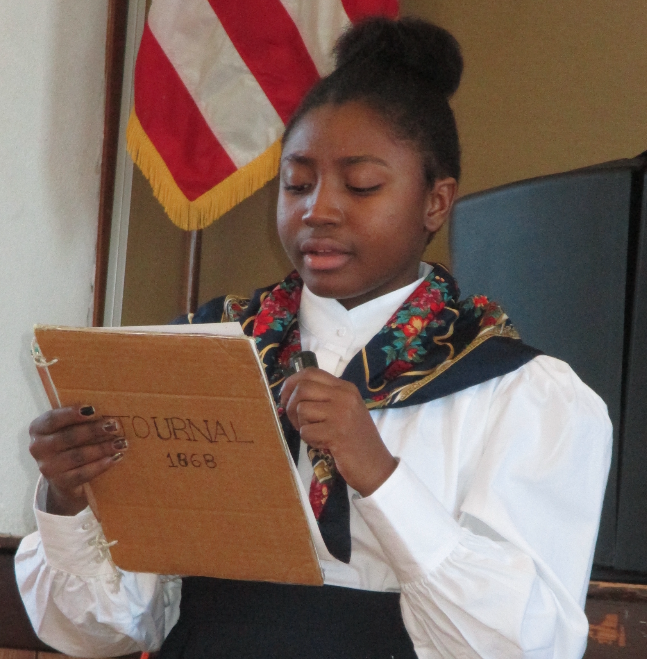
NICODEMUS — The second annual Nicodemus Chautauqua will be Saturday, May 26, starting at noon under the big tent in Nicodemus. There will be free food and refreshments for all.

The big tent will house visitors and performers and keep you cool under what might be a hot day. Todd Tomar has organized the ‘Nicodemus Old New Timers Band.” They will provide period musical entertainment between performances.

Performers will include stories and history of Nicodemus past. Leroy Walz who lives on the Ellis Trail, portrays, Nicodemus newspaper editor, Lightfoot, will quarrel with Phil Martin, also of Ellis, portraying W.R. Hill, editor and town organizer.

Len Shamber of Damar, will keep you spellbound as he describes the 1886 fire. Daniel Moore, portraying postmaster Zach Fletcher, will detail the settler’s response to Indians who arrived in town the winter of 1878.

single post card#2

BOOR: Barton, Ellis county wheat plot tours this month

Alicia Boor

The 2018 wheat crop has had it challenges to say the least. Much of the planting was late because it was too wet to get into the fields last fall. Then, that was the last measurable moisture the crop had until April. A mid-April hard freeze has also impacted some of the fields while the drought and cold spring has left the plants short and behind in development. Wheat is hardy though, and if favorable weather happens, the crop may still be close to average come harvest.

The Cottonwood District has two wheat demonstration plots out this year, one in each county.

Dr. Lucas Haag, KSRE North East Area Agronomist will be on hand to talk about the individual varieties which were planted, and how they are producing in each area. He will also discuss the different situations and stressors for this year. Eric DeWolf, KRSE Plant Pathologist will also be on hand to discuss what disease pressures are present and what to keep a lookout for coming into harvest.

At the Ellis County plot, Dr. J.P. Michaud KSRE NW area Entomologist will also be present to discuss insect populations and answer any questions that you may have.

The first plot tour will be on May 24th in Barton County beginning at 6:00. This year’s plot cooperator is Terry Reif. Directions to the field are: from Hoisington: go N. on blacktop Susank Rd. at Susank go 4 miles E. on the blacktop, turn N. onto NE40 Ave. go 1-mile N. to NE 200 Rd., turn E on 200 and go about 3/8 mile.

After the plot tour, everyone is invited to the Beaver Volunteer Fire Department located at 588 1st Ave in Beaver. Please call 620-793-1910 to RSVP for the meal following so that we have enough food for everyone.

The second plot tour will be on May 31st at 6:00 pm on L & M Farming’s ground. Directions from I-70: take the Victoria exit 168 go 2.5 miles north on Cathedral Ave./HWY. 255. Turn west onto Fairground Rd and go 1.5 miles. From Catharine: go ½ east and turn south onto 310, go 1 mile and turn east onto Fairground Rd and go 1.5 miles.

A meal and refreshments will immediately follow the field day in Victoria at the city park, beside the swimming pool on Iron Street. All interested people are invited to attend. No RSVP necessary.

Alicia Boor is an Agriculture and Natural Resources agent in the Cottonwood District (which includes Barton and Ellis counties) for K-State Research and Extension. You can contact her by e-mail at [email protected] or calling 620-793-1910.

Kan. man accused of making, cashing fake receipts at Dillons

RENO COUNTY — A Kansas man accused of creating fake Coinstar receipts and cashing them at local Dillons stores has been formally charged.

Lawrence-photo KDOC

David Lee Lawrence, 33, Hutchinson, is charged with one count of an unlawful act concerning the use of a computer and seven counts of making false information.

He’s accused of going to Dillons stores in Hutchinson on various dates in November and December of last year and using Coinstar receipts to get cash. He cashed in a total of $879.70 — according to the criminal complaint.

Coinstar kiosks allow customers to turn coins into cash, an eGift Card, or a charity donation.

Lawrence made an initial Court appearance Wednesday. His bond was set at $2,500.

Lawrence has five previous drug convictions in McPherson and Harvey County, according to the Kansas Department of Corrections.

Copyright Eagle Radio | FCC Public Files | EEO Public File