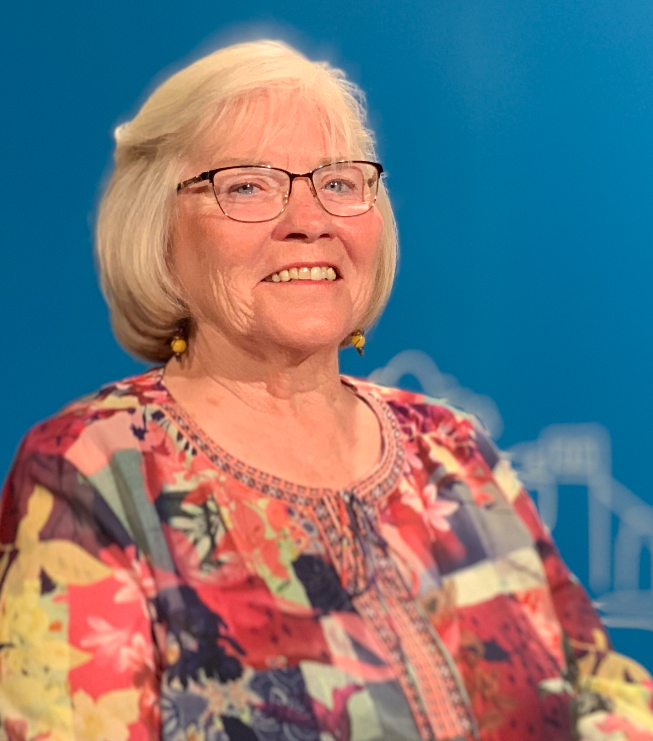
Eagle’s Mike Koerner interviews Janis Lee about the governor’s tax reform plan.
Author: Hays Post
Trial set to begin in Kansas abortion stalking lawsuit
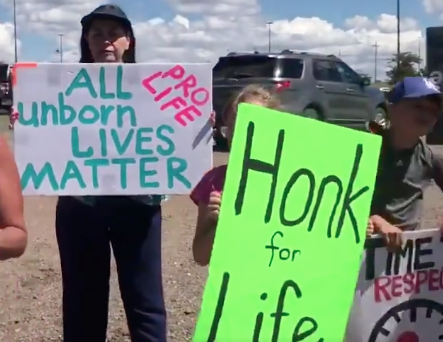
WICHITA, Kan. (AP) — A federal jury will decide whether the operator of a Wichita abortion facility had reasonable grounds to seek a protection-from-stalking order against an abortion protester.

Jury selection begins Monday in the federal lawsuit filed by anti-abortion activist Mark Holick against clinic operator Julie Burkhart.
The lawsuit stems from anti-abortion protests in 2012 and 2013 in front of Burkhart’s home and in her neighborhood. She subsequently got a temporary protection-from-stalking order against him that was dismissed two years later.
U.S. District Judge John Broomes has already thrown out some of the lawsuit’s claims, but left it to a jury to decide whether the facts constituted malicious prosecution.
Kansas man used phone to record victims to produce child porn
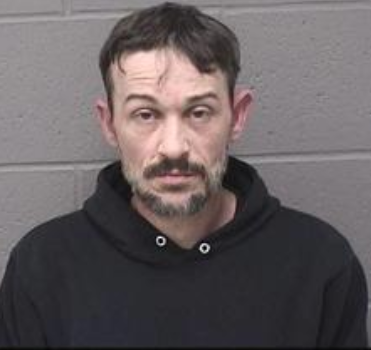

WICHITA, KAN. – A Kansas man was sentenced Thursday to 27 years in Federal prison for using his pone to produce child pornography, according to U.S. Attorney Stephen McAllister.
Michael Paul Murphy, 41, Pittsburg, Kan., pleaded guilty to two counts of producing child pornography.
In his plea, Murphy admitted using an iPhone to surreptitiously record minor victims in various stages of undress. He edited the recordings to focus on the victims’ genitals. He emailed the images to his workplace.
Great Bend woman hospitalized after 2-vehicle crash

PAWNEE COUNTY — Two people were injured in an accident just before 2:30p.m. Sunday in Pawnee County.
The Kansas Highway Patrol reported a 1997 Honda Accord driven by Gerardo M. Lara, 49, Amarillo, was northbound on U.S. 183 five miles east of Rozel.
The driver disobeyed a stop sign at the Kansas 156 Junction and collided with a westbound 2002 Chevy Impala driven by Kaci N. Jordan, 36, Great Bend.
The Chevy rolled multiple times before coming to rest on its roof facing north. EMS transported Jordan and Lara to the hospital in Larned. Both drivers were properly restrained at the time of the accident, according to the KHP.
Police: Kan. man remains hospitalized after weekend stabbing
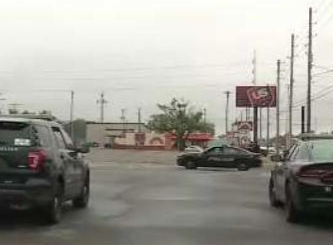
SEDGWICK COUNTY Law enforcement authorities are investigating a stabbing that sent a man to the hospital.

Just after 11 a.m. Saturday, police were dispatched to a stabbing call in the 500 block of N. West Street in Wichita, according to officer Kevin Wheeler.
Upon arrival they located a 38-year-old man with a stab wound to his abdomen. He was taken to a local hospital where he remains hospitalized.
The preliminary investigation shows that the victim was in a verbal and physical disturbance with another man. During the disturbance, he was stabbed once. Police detained two individuals near the scene. One woman was interviewed and then released. A 38-year-old male was booked on outstanding warrants.
There is no threat to the community, according to Wheeler. Police have not reported an arrest in connection with the stabbing.
New ‘inclusive’ plaque approved for Kansas Capitol
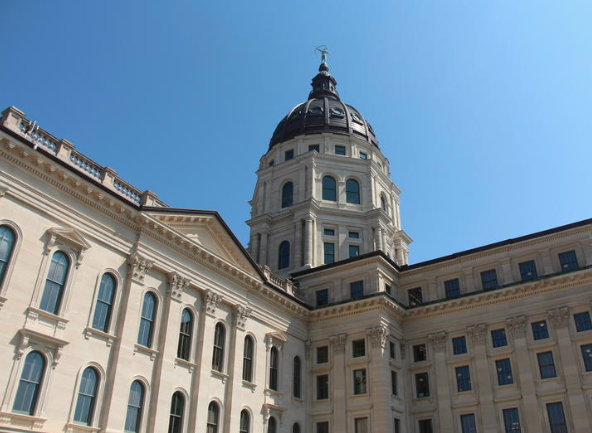
TOPEKA, Kan. (AP) — A state committee has agreed to replace a plaque commemorating the completion of the Kansas Capitol renovation that named only former Gov. Sam Brownback with a plaque bearing the names of four governors involved in the project.
The original plaque was installed during a dedication ceremony in 2014 after the $325 million project was completed.
The renovation project began in 1999 and ended in 2014, when Brownback was governor.
The new privately-financed plaque approved by the Capitol Preservation Committee will include the names of Govs. Bill Graves, Kathleen Sebelius, Mark Parkinson and Brownback. It also names the contractor, architects and the former director of legislative administrative services.
Senate Majority Leader Anthony Hensley, a Topeka Democrat, said he pushed for the new plaque because the original was not inclusive.
Police: Woman shot in the head at Kansas home
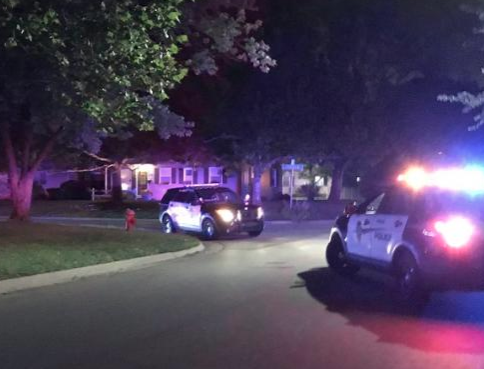
SHAWNEE COUNTY— Law enforcement authorities are investigating a shooting that sent a woman to the hospital.

Late Friday night police were called to the 1200 block of SW Chatham Place in Topeka for a report of a disturbance, according to Lt. Aaron Jones. Officers learned that a disturbance was heard followed by a single gunshot.
At the residence, police located a woman with an apparent gunshot wound to the head. Police also located a man in the vicinity. He attempted to run from officers, but was quickly apprehended, according to Jones.
The woman was treated and released from a local hospital. Police have not reported an arrest or released the victim’s name.
The Post Podcast: Hays economy vital to area
USGS: Series of earthquakes reported in north-central Kansas
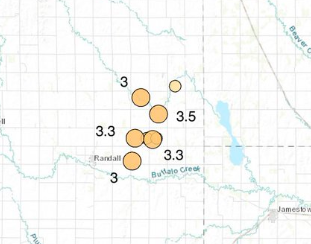
JEWELL COUNTY — A series of earthquakes shook north central Kansas over the past 24-hours.

The ten quakes measured from a magnitude 2.1 to 3.5, according to the U.S. Geological Survey.
The first just after 6:45p.m. measured 3.3 and was centered just east of Randall, Kansas. The strongest of the quakes measured 3.5 and was centered in the same area.
There are no reports of damage or injury, according to the Jewell County Sheriff’s office.
Pro racer killed in Kansas street drags competition

MONTGOMERY COUNTY —One person died in an accident just after 4p.m. Saturday during the street drag races at the Coffeyville Industrial Park.

The Kansas Highway Patrol reported a 2000 Pontiac Firebird 2-door driven by Joseph K. Hunt, 27, Carter Lake, ID., and a 1980 Ford truck driven by Jason L. Maxey, 43, Carthage, Mo., were westbound on B Street.
Hunt lost control of the Pontiac. It struck the driver’s side of the Ford, entered the north ditch and collided with a sewage drain pipe.
The Ford entered the north ditch and came to rest in the grass. Hunt was pronounced dead at the scene. Maxey was not injured.
Kansan receives Association of Fish and Wildlife Agencies national award
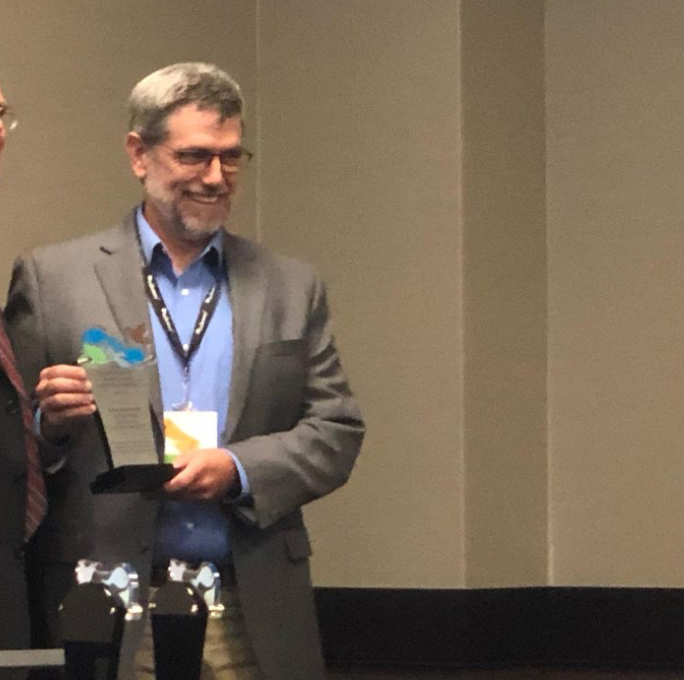

TNC
TOPEKA – The Nature Conservancy (TNC) has been honored as two of its employees receive Climate Adaptation Leadership Awards for Natural Resources from the Association of Fish and Wildlife Agencies. The Climate Adaptation Leadership Award, established in 2016, recognizes exemplary leadership by individuals, agencies, businesses, and other organizations to reduce impacts and advance adaptation of the Nation’s vital natural resources and the many people who depend on them in a changing world.
Brian Obermeyer, director of Protection and Stewardship for the Conservancy’s Kansas program, and Chris Hise, associate director of Conservation for the Conservancy’s Oklahoma program, were jointly recognized in the Nongovernmental Organization category for their work creating Site Wind Right, which identifies areas in 17 Midwest states where wind development is unlikely to encounter significant wildlife-related impacts. Projects in low-impact places are also less likely to be delayed or cancelled, resulting in more reliable and efficient renewable energy deployment.
“The Site Wind Right project was truly a team effort, with contributions from Conservancy scientists and GIS staff across the central U.S.,” Hise said. “We sincerely appreciate this award from AFWA.” Hise is a lifelong resident of the Great Plains, and has managed The Nature Conservancy’s conservation efforts in western Oklahoma since 2000.
“The Site Wind Right team, including myself and Mr. Hise, are honored that AFWA recognized the Conservancy’s science-based approach to steer wind energy away from ecologically important habitats and landscapes,” added Obermeyer.
Obermeyer has led the Conservancy’s Flint Hills Initiative for nearly two decades and was recently named director of protection and stewardship for the state.
The Nature Conservancy is a global conservation organization dedicated to conserving the lands and waters on which all life depends. Guided by science, we create innovative, on-the-ground solutions to our world’s toughest challenges so that nature and people can thrive together. We are tackling climate change, conserving lands, waters and oceans at unprecedented scale, providing food and water sustainably and helping make cities more sustainable. Working in 72 countries, we use a collaborative approach that engages local communities, governments, the private sector, and other partners. To learn more, visit www.nature.org or follow @nature_press on Twitter.
In Kansas, the Conservancy has protected 140,000 acres of the state’s most ecologically important lands and waters. To learn more, visit www.nature.org/kansas.
Census: Inequality grew, including in heartland states
ORLANDO, Fla. (AP) — The gap between the haves and have-nots in the United States grew last year to its highest level in more than 50 years of tracking income inequality, according to Census Bureau figures.

Income inequality in the United States expanded from 2017 to 2018, with several heartland states among the leaders of the increase, even though several wealthy coastal states still had the most inequality overall, according to figures released Thursday by the U.S. Census Bureau.
The nation’s Gini Index, which measures income inequality, has been rising steadily over the past five decades.
The Gini Index grew from 0.482 in 2017 to 0.485 last year, according to the bureau’s 1-year American Community Survey data. The Gini Index is on a scale of 0 to 1; a score of “0” indicates perfect equality, while a score of “1” indicates perfect inequality, where one household has all the income.
The increase in income inequality comes as two Democratic presidential candidates, U.S. Sens. Bernie Sanders and Elizabeth Warren, are pitching a “wealth tax” on the nation’s richest citizens as a way to reduce wealth disparities.
The inequality expansion last year took place at the same time median household income nationwide increased to almost $62,000 last year, the highest ever measured by the American Community Survey. But the 0.8% income increase from 2017 to 2018 was much smaller compared to increases in the previous three years, according to the bureau.
Even though household income increased, it was distributed unevenly, with the wealthiest helped out possibly by a tax cut passed by Congress in 2017, said Hector Sandoval, an economist at the University of Florida.
“In 2018 the unemployment rate was already low, and the labor market was getting tight, resulting in higher wages. This can explain the increase in the median household income,” Sandoval said. “However, the increase in the Gini index shows that the distribution became more unequal. That is, top income earners got even larger increases in their income, and one of the reasons for that might well be the tax cut.”
A big factor in the increase in inequality has to do with two large population groups on either end of the economic spectrum, according to Sean Snaith, an economist at the University of Central Florida.
On one side, at the peak of their earnings, are baby boomers who are nearing retirement, if they haven’t already retired. On the other side are millennials and Gen Z-ers, who are in the early stages of their work life and have lower salaries, Snaith said.
“I would say probably the biggest factor is demographics,” he said. “A wealth tax isn’t going to fix demographics.”
The area’s with the most income inequality last year were coastal places with large amounts of wealth — the District of Columbia, New York and Connecticut, as well as areas with great poverty — Puerto Rico and Louisiana.
Utah, Alaska, Iowa, North Dakota and South Dakota had the most economic equality.
Three of the states with biggest gains in inequality from 2017 to 2018 were places with large pockets of wealth — California, Texas and Virginia. But the other six states were primarily in the heartland — Alabama, Arkansas, Kansas, Nebraska, New Hampshire and New Mexico.
A variety of factors were at play, from a slowdown in agricultural trade and manufacturing to wages that haven’t caught up with other forms of income, economists say.
While some states have raised the minimum wage, other states like Kansas haven’t. At the same time, the sustained economic growth from the recession a decade ago has enriched people who own stocks, property and other assets, and have sources of income other than wages, said Donna Ginther, an economist at the University of Kansas.
“We’ve had a period of sustained economic growth, and there are winners and losers. The winners tend to be at the top,” Ginther said. “Even though we are at full employment, wages really haven’t gone up much in the recovery.”
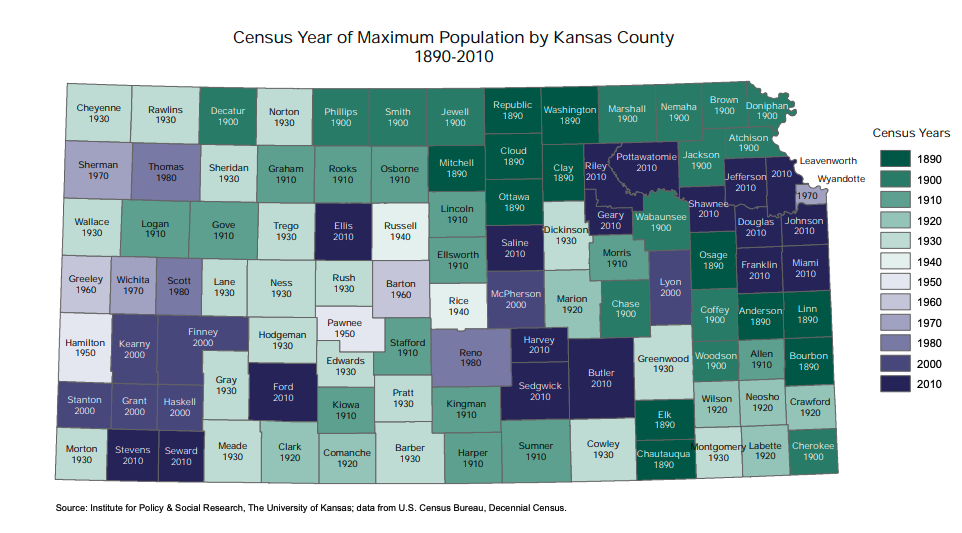
68 Kansas counties’ populations peaked in 1890; Ellis Co. peaked in 2010
 KU News Service
LAWRENCE — Sixty-eight of 105 counties in Kansas peaked in population before the Dust Bowl. The most recent Kansas Statistical Abstract includes this and other interesting facts about Kansas.
The Institute for Policy & Social Research at the University of Kansas recently published the 53rd Edition of the Kansas Statistical Abstract, which contains social and economic data broken down by state, county and city.
“It is important for business and community leaders as well as policymakers to understand the changing demographic, social and economic characteristics of Kansas,” said Genna Hurd, IPSR associate researcher and KSA editor. “The KSA covers data on Kansas from climate to crime, parks to population, and energy to employment. We are honored that IPSR and KU have been able to provide this service to the people of the state for more than 50 years.”
This year’s KSA presents several new data visualizations.
“Our maps and graphs bring the data to life to illustrate patterns across the state,” said Xanthippe Wedel, IPSR senior research data engineer and State Data Center lead.
These visualizations reflect ongoing areas of interest for Kansans, such as a county-by-county look at the average small business loan amount at origination and a map of natural attractions and scenic byways in Kansas. And, with a presidential election coming up in 2020, one new map shows voter participation rates in the United States, by state, for the November 2016 election.
A new graph shows poverty rates by state and compares rates from 2011 to rates from 2017. The Kansas poverty rate increased to 14.7 percent in 2017, putting Kansas in the top 10 among states for the highest poverty rate.
More sobering data includes a map of infant mortality rates in Kansas by county and life expectancy at birth in Kansas by county. According to the data behind the life expectancy map, young children in Johnson County have a life expectancy that is nearly 8 years longer than their peers in Comanche County.
Each year, the KSA is compiled from state and federal data sources ranging from the Kansas Board of Regents to the Census Bureau. It is available at no cost from the IPSR website at https://ipsr.ku.edu/ksdata/ksah/.
“Working on the KSA has been an incredible and unique experience. I am lucky to be involved in research and data collection at IPSR, and I think the KSA showcases how useful this research can be on a local, state and national level,” said Abigail Byrd, IPSR student research assistant and KU 2019 Student Employee of the Year.
Illustration: Map showing Census year of maximum population for each county in Kansas. In Linn, Bourbon, Anderson, Osage, Elk, Chautauqua, Washington, Clay, Republic, Cloud, Ottawa and Mitchell counties, the maximum population census was in 1890. In Leavenworth, Johnson, Miami, Jefferson, Douglas, Franklin, Shawnee, Pottawatomie, Riley, Geary, Butler, Saline, Harvey, Sedgwick, Ellis, Ford, Stevens and Seward counties, the maximum population census was in 2010. Data sources available in Population in Kansas, by County, 1860 – 1970 (https://ipsr.ku.edu/ksdata/ksah/population/2pop16.pdf) and Population and Population Change in Kansas, by County, 1980 – 2010 (https://ipsr.ku.edu/ksdata/ksah/population/2pop12.pdf).