Left to right, Hays CVB Director Melissa Dixon, CVB Tourism and Hospitality Intern Delaney De Silva, CVB Convention and Sales Manager Janet Kuhn, CVB Administrative Assistant Bobbi Pfeifer, and Hays Area Chamber of Commerce Executive Director Tammy Wellbrock/courtesy photo
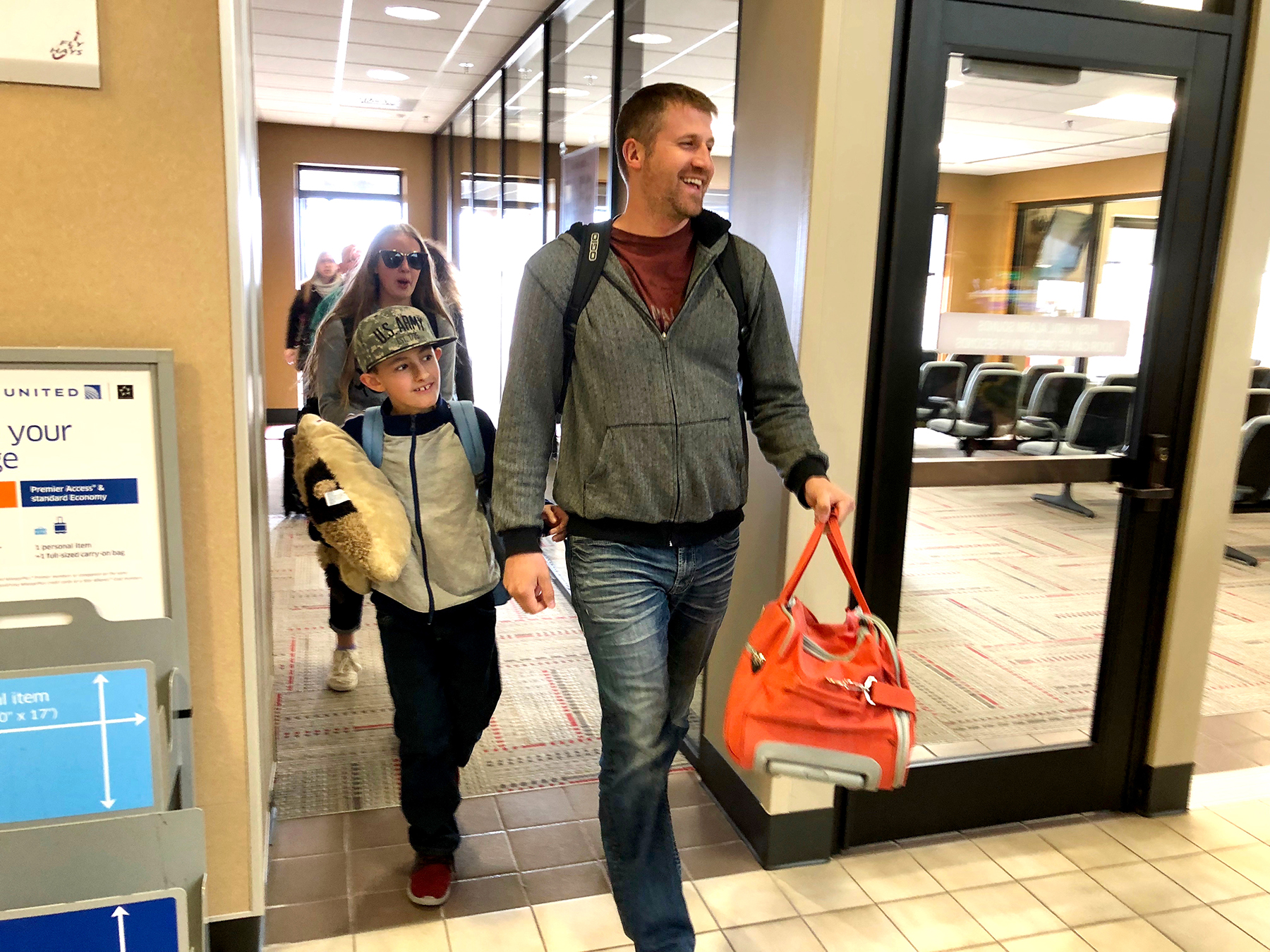
James Leiker and his family were on the inaugural flight from Hays to Chicago/courtesy photo
James and Taryn Leiker and their children pose with Hays Regional Airport’s new flight schedule map/courtesy photo
Hays CVB
On Monday, staff from both the Hays Convention and Visitors Bureau and the Hays Area Chamber of Commerce welcomed the first passengers to arrive at Hays Regional Airport on the inaugural flight from Chicago to Hays. The passengers received sunflowers, carnations, and a hearty “Thank you for flying Hays!”
The city of Hays Fire Department will be inspecting and flow testing fire hydrants on Tue., April 10, 2018 in the area of Walnut St. to Main St. between 27th St. and 33rd St.
This is part of a coordinated effort by the city of Hays to inspect all fire hydrants in the city and flush all water mains annually.
On April 16, a 310 Leadership team will be hosting the Dancing Together for the Developmental Services of Northwest Kansas at Beach/Schmidt Performing Arts Center. The event will kick off with a silent auction starting at 4:30 p.m. and the dance show, which showcases the Styles Dance Centre team, will start at 5:30 p.m.
The event is being put on by a Fort Hays State University 310 Leadership whose goal is to make the event larger and raise more money this year. The show will consist of the Styles Dance Centre team performing their competition dances and the finale of the show will be the Styles dancers alongside 26 individuals from DSNWK.
“This event provides a lot of education to the dancers and the public. If someone doesn’t have a person with disabilities in their direct family or circle, they are not aware of the needs that are to be provided to those individuals,” said Raenee Patterson, member of the 310 Leadership team.
Many of the DSNWK individuals have never had the chance to have the experience of what it is like to dance at a studio or the stage when they were younger, but with this event they finally get their chance to shine on stage.
“I hope that people attending this event get a better understanding of how important DSNWK is in the Hays community as well as other towns in western Kansas. I hope they see that individuals who are disabled are capable of doing anything they put their mind to,” said Chloe Brown, member of the 310 Leadership team.
All proceeds from the event, which include the silent auction and ticket sales, will back to DSNWK.
Tickets can be purchased ahead of time at Styles Dance Centre, DSNWK on Hall Street, the Main Street Cerv’s, or at the door for $7. If you are unable to attend the event but still wish to make a donation you can make checks payable to Styles Dance Centre and mail them to 101 W. 38, Hays, KS 67601.
SEDGWICK COUNTY — Law enforcement authorities have issued a statement on how a man accused in a fatal hoax 911 call got access to social media from a Kansas jail.
Barriss- photo courtesy Glendale, Calif. police
On April 6, the Sedgwick County Sheriff’s Office received information about an inmate possibly posting on a social media website. Based on this information authorities started an investigation to see what had occurred, according to a media release from Lt. Tim Myers.
Tyler Barriss, the suspect charged with involuntary manslaughter in the December hoax call death of Andrew Finch at a Wichita home was the inmate posting on twitter.
How am I on the Internet if I’m in jail? Oh, because I’m an eGod, that’s how
According to Lt. Myers, during the investigation it was discovered a software upgrade to one of the inmate kiosks was done improperly by the vendor.
This improper upgrade on a kiosk at the Sedgwick County Jail, and at kiosks at other jails across the country, allowed inmates a path to get to the internet. At this time it is unknown how many inmates accessed the internet. The kiosk in question was only accessible to 14 inmates for less than a few hours before the vendor became aware of the issue.
As soon as the path was identified it was closed and the affected kiosk was upgraded with the proper digital security features by the vendor. The kiosk in question has been tested and the issue did not reoccur.
Prosecutors allege Barriss made a call December 28 with a fake story about a shooting and kidnapping that led police to a home where 28-year-old Andrew Finch was shot and killed after opening his door.
Martin HawverJust imagine that three months after being sworn in as governor, the Kansas Legislature decided to make Jeff Colyer essentially the king of Kansas — for nine days.
As king, of course, you can sign bills into law, veto bills, scratch out any of the hundreds of line items for spending in the upcoming budget bill.
In the past, lawmakers have always made sure that once they have completed their entire session and sent bills to the governor, they later have a day—called sine die adjournment — in which they can consider gubernatorial vetoes and override them if they believe the governor has made a bad decision.
That’s the Legislature’s final check on the governor if an overwhelming majority—two-thirds of the members of the House and Senate—agree that the governor has made the wrong decision by vetoing bills that a super-majority of legislators believe is good public policy or has cut funding for programs that they believe are important to the state and its people.
But now Colyer—who has 10 days to act on bills after they have passed the Legislature or they become law without his signature—can merely sign bills that he considers a good photo-op or hang onto them until lawmakers leave town.
The measure that creates the brief—April 26 to May 4—period of unbridled gubernatorial power was the adjournment resolution that lawmakers had to pass before midnight Saturday. Without that adjournment resolution passage by midnight Saturday, this year’s Legislature would have ended. No wrapup-session, no more meetings…just ended and the lawmakers go home.
That absolute adjournment, which would have occurred at midnight, was avoided by last-minute, yes, literally last-minute depending on your view of the clock in the House—either 11:58 p.m. or 11:59 p.m.—passage by the House of the Senate-written resolution which allows lawmakers to return April 26 to complete their work.
With the Senate across the hall debating a school finance bill in what was clearly a filibuster to chew up time, the House was literally forced into agreeing to the Senate’s earlier-passed adjournment resolution. It was a deadline like few have seen in the past; the House either OK’d the Senate’s resolution or the Legislature ended at midnight, without a budget and spending authority for the upcoming fiscal year.
Yes, that’s how close it was. Just seconds before the Legislature would have gone out of business for the year with no money appropriated for schools, highways, law enforcement, prisons, health-care programs and welfare. Imagine the entire state with its agencies, employees and state services not funded.
The tradeoff for the session ending at midnight was abandoning that legislative oversight of the governor’s actions on all bills passed during the wrapup session.
Is it just insider stuff? Under-the-dome politicking? Partly. Colyer undoubtedly would have called a special session, forcing lawmakers to return to finish their work. The state wouldn’t have turned out the lights at the end of this fiscal year.
But…this is a year in which the entire House seeks re-election, and in which Colyer is hip deep in the campaign for the Republican nomination for the governorship.
A well-aimed veto pen can be a political tool. Colyer can cut specific appropriations with much political fanfare: He’s saved money, cut what he can label wasteful spending. …and just a little clip here or there can be portrayed to show that he’s not a big-spender like the Legislature, that he is looking out for those potential GOP primary voters…
Any chance the GOP-controlled Legislature might near-anonymously put something in the budget bill that is a good political pick-off for the governor?
Hmmm…
Syndicated by Hawver News Company LLC of Topeka; Martin Hawver is publisher of Hawver’s Capitol Report—to learn more about this nonpartisan statewide political news service, visit the website at www.hawvernews.com
The Ellis County Coalition for Economic Development will host the annual Hays Area Job Fair at Big Creek Crossing on April 11 from 3 to 6 p.m. The job fair has been in place since 2011.
“It is a good time of the year to host this event because there will be college students graduating looking for jobs and even some possible summer employment,” said Ernee Sly, office manager for the Ellis County Coalition of Economic Development.
There will be a wide variety of job opportunities from several business sectors. Employers are hoping for a pool of applicants, while prospects are hoping to find something they are interested in or haven’t even thought of before.
The sponsors of the job fair are Hess Services, Rebel Staffing, Wilken’s Manufacturing, KANSASWORKS, Med Staff, LLC., Bruckner Truck Sales and Big Creek Crossing.
This year’s event will be just off center court in the former Hallmark space.
When it comes to protecting the land and improving the environment, farmers continue to lead the way and do their part. As this nation celebrates Earth Day April 22, farmers and ranchers remain committed to protecting the environment using modern conservation and tillage practices.
Farmers and ranchers will tell you their fondest wish remains to pass their land on to their children. They work years, often a lifetime, to leave a legacy of good land stewardship. Most farmers learned about conservation and respect for the land from their parents.
So, it comes as no surprise Kansas farmers and their counterparts across the country continue to adjust accepted practices to meet their individual cropping conditions. Practices can vary from farm to farm and even field to field.
During the last 30-plus years, most Kansas agricultural producers now use some form of minimum tillage to further conserve the soil. Like compost in a garden, these conservation tillage practices ensure ground cover by leaving stalk residues on the surface, provide stored fertility for future crops while protecting the soil against erosion and loss of nutrients. These cultivation practices sustain and improve the soil’s productive capacity.
Today, approximately 76 million acres of U.S. crop acres utilize some form of conservation tillage. An additional 100 million acres of land throughout the United States incorporates no-till practices for all crops. That means approximately 65 percent of U.S. cropland incorporate either no-till or minimum-tillage conservation practices.
In Kansas thousands of ponds, thousands of miles of terraces and thousands of acres of grassed waterways help control soil erosion. Farmers have also planted thousands of acres of trees.
Farmers across the state have been known to leave patches of milo close to timber and other grassy cover so birds and other creatures can eat something when snow, ice and other bad weather hit.
It’s also not uncommon to see a farmer with a cherry-red face and earflaps pulled snugly over his head, walking along a hedgerow with a five-gallon bucket of milo in each hand. No, he’s not out to feed a lost calf, but rather the quail, pheasant of some other hungry critter.
Farmers and ranchers have a vested interest in protecting endangered species. More than 75 percent of species listed as endangered or threatened live on private lands.
Kansas farmers utilize biotechnology on their farms. This benefits the environment by producing crops that protect themselves against insects and disease, requiring less tillage and less use of chemical weed control.
Ag producers also produce biofuels that benefit the environment and promote energy security.
Farm and ranch families are proud to live and grow in harmony with Mother Earth. They understand how important it is to protect and nurture this valuable resource. They take their stewardship of the land seriously. They’ve devoted their lives to safeguarding their farms and families while providing us with the safest, most abundant and affordable food in the world.
John Schlageck, a Hoxie native, is a leading commentator on agriculture and rural Kansas.
John Richard Schrock is a professor at Emporia State University.Every time I fly over the North Pole from Chicago to Beijing—in a little over 12 hours—I renew my respect for earlier Western scholars of China who had a much more difficult journey. I knew Professor Derk Bodde in his last few years after retirement. He had been the first recipient of a Fulbright award shortly after World War II. Traveling with his young family, it took most of a month to get to China on a ship that broke down halfway across the Pacific.
Even in 1975, when I flew with my family to teach in Hong Kong, it took nearly two days, with refueling layovers in Hawaii and Guam. Times have changed.
With the “opening up” of China under Deng Xiao-ping, China’s growing middle class increased the demand for internal airlines. An airline company was formed in nearly every province. Each would hub out of its provincial capitol, while Air China was the national airline.
There were three decades of intense competition. Today, a few Chinese airline companies have risen to become the major carriers. Those include China Eastern (Shanghai) and China Southern (Guangzhou/Canton). Shenzhen, a special region begun as a sweatshop community just across the border from Hong Kong, evolved into a model modern city and has major airline routes across China. Most unexpectedly, an airline from the island province of Hainan arose to become not only an internal carrier, but also flies international routes, including from China to Seattle, Washington. It occupies the older of the three terminal buildings at Beijing Capitol International Airport. This competition among airline companies is just one example of how good and bad management shakes out in China.
In one aspect, competition went a little too far. In 1998, you still bought plane tickets through travel agents and had to confirm your return flight several days beforehand. In China that year, the different travel agencies had made exclusive marketing arrangements with different airlines, and it was troublesome wandering around Beijing to find the right travel agent to confirm your flight. Public complaints soon ended that hyper-capitalism. A few years later, booking and confirmations were all online.
Today, regardless of the Chinese airline company, I still fly on Boeing or Airbus aircraft. That will soon change. Last November, at the university in China where I was teaching, I was eating my lunch in the Foreign Guest House and watching the noon news. Local networks broadcast the maiden flight of the C-919, China’s first passenger jet designed and built in China.
The C-919 is built by COMAC (the Commercial Aircraft Corporation of China Ltd.) in state-of-the-art factories in the modern Pudong District of Shanghai. The C-919 is a 168-seat narrow-body jet that resembles a mid-size Airbus.
Historically, the United States and Europe were about the only manufacturers of passenger jet planes. Then Canadian Bombardier (now allied with Airbus) and Brazil’s Embraer broke into the market with smaller regional jets. But China’s home-built C-919 will soon compete with both Boeing and Airbus for medium range air travel, having a range of 2,500 miles. This is about equivalent to the Boeing 737 or Airbus 320 but is estimated to cost 30 percent less than those models. According to the COMAC news release, 21 companies in China and abroad have already placed orders for over 500 new C-919s. Commercial production will begin after the completion of additional test flights.
Just as Boeing and Airbus contract parts from outside companies, the C-919 engines are bought from CFM International, a joint venture between the French company Safran and the U.S. General Electric.
The C-919 will not replace the long-range jetliners, such as the Boeing 777 that makes 8-to-13 hour flights between continents. But China will soon be building the C-929, a bigger wide-body plane that will enter the future market for large civilian jetliners. Engines for that model will likely be China-made.
If China’s current growth in customers continues, China will have the most citizens traveling by air by 2025 of any country. China anticipates needing over 32,000 freight and passenger jets by 2035. And they are unlikely to be built by Boeing or Airbus.
John Richard Schrock is a professor at Emporia State University.
RENO COUNTY — Three Great Bend residents were arrested Saturday on drug charges after an employee of Dunham’s Sports in Hutchinson reported a theft.
Ray-photo KDOC
The employee said a white male stole items from the business. Officers found the suspect and eventually made three arrests.
Mark A. Ray, 30, was arrested for theft, distribution of methamphetamine, possession of drug paraphernalia and a tax stamp violation.
Michael S. Moore, 27, was arrested for theft, possession of marijuana, possession of drug paraphernalia and interference with law enforcement.
Both Moore and Ray managed to make bond, while 23-year-old Courtney Clark faces charges of theft, possession of methamphetamine and drug paraphernalia. She made a court appearance Monday where she managed to get her bond lowered from $6,000 to $4,500.
Moore-photo KDOC
Moore and Ray should make a first appearance later this week.
KANSAS CITY, Kan. (AP) — The designer of a waterslide where a 10-year-old Kansas boy was decapitated has pleaded not guilty to second-degree murder in the boy’s death.
Schooley -photo Wyandotte Co.
John Schooley, who designed the Verruckt slide for the Schlitterbahn Water Park in Kansas City, Kansas, made his first court appearance Friday in the 2016 death of Caleb Schwab. Schooley remains jailed in Wyandotte County after being brought to Kansas from Texas Friday.
District Judge Roger Burns declined to lower Schooley’s bond from $500,000 to $250,000 and ordered Schooley to surrender his passport.
Schooley’s attorney, Justin Johnston, declined comment after the brief hearing.
Jeff Henry, co-owner of Texas-based Schlitterbahn Waterparks and Resorts, pleaded not guilty last week to second-degree murder in Caleb’s death.
A trial date for Henry and Schooley has been tentatively set for Sept. 10.
HARVEY COUNTY— A Kansas man died in an accident just before 3p.m. Monday in Harvey County.
The Kansas Highway Patrol reported a 2017 Chevy passenger car driven by Orville A. Schmidt, 67, Newton, was eastbound on U.S. 50 just west of South Meridian.
The Chevy crossed the center line, struck a semi in the west bound lane and rolled.
Schmidt and a passenger Nancy A. Schmidt, 75, Newton, were transported to a Wichita hospital where he died.
The semi driver from El Paso, Texas was not injured. All three were properly restrained at the time of the accident, according to the KHP.























 The Kansas Highway Patrol reported a 2017 Chevy passenger car driven by Orville A. Schmidt, 67, Newton, was eastbound on U.S. 50 just west of South Meridian.