We have a brand new updated website! Click here to check it out!

Exploring Outdoors Kansas: The pelicans at Curley’s Corner

Steve Gilliland

Just north of Inman is an infamous intersection with sinkholes of various sizes on all four corners called “Curley’s Corner.”

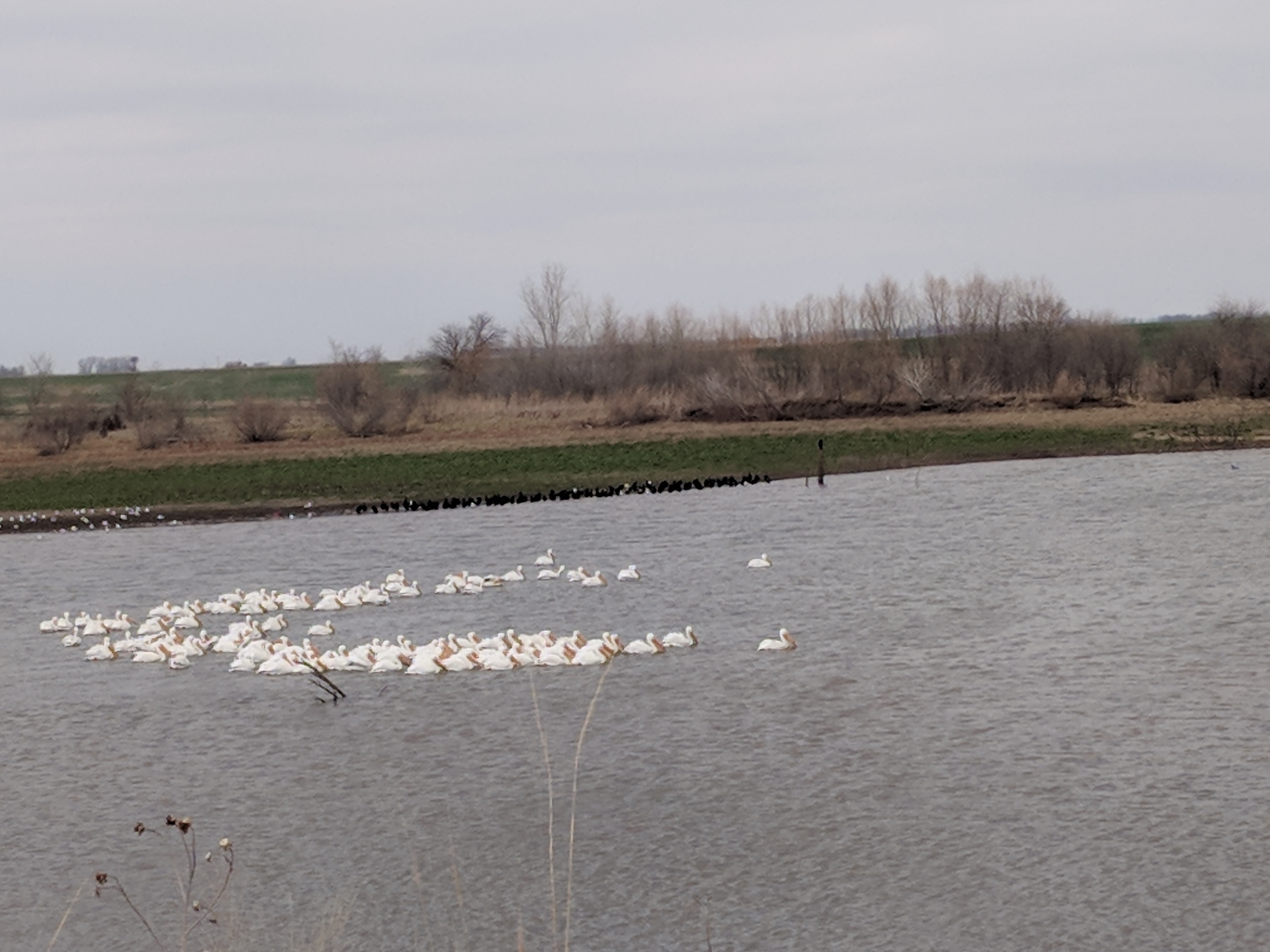
A well-known local guy, “Curley” Neufeldt and his family lived there and actually had to eventually move because the house kept sinking. One of the sinkholes has dead standing timber in it and covers a few acres when full, often making it popular with waterfowl. As we approached Curley’s Corner early Easter Sunday morning on our way out of town, a large “feathery” looking patch covered a portion of the wooded sinkhole. We stopped to look and ponder what we were seeing, and as we sat there, heads began popping up out of the feathery mass. It was a big group of white pelicans, all with their heads down and huddled together to keep warm in the cold, blustery north wind.

The white pelicans at Curley’s Corner / photo courtesy of Sarah Krehbiel from Inman

Mike Rader, Wildlife Education Supervisor for the Kansas Dept of Wildlife, Parks and Tourism (KDWPT) told me white pelicans are migratory and nest north in Minnesota, the Dakotas or southern Canada, so the pelicans we see this time of year are heading from Texas or wherever in the southern US they could find open water in winter, to their nesting grounds up north. I asked him about the white pelicans we see around Kansas lakes all summer, and he says those are probably birds that are either too young or too old to breed, or were sick or injured and couldn’t make the migration trip for whatever reason.

White pelicans are big birds; fully grown adults can weigh nearly twenty pounds, can stand 4 feet tall and can have a wingspan greater than 7 feet. There is no visible distinction between males and females (thankfully they can tell the difference.) Since they are such big heavy birds, they would never successfully migrate if they had to flap their wings most of the time like ducks or geese, so they have to rely on finding thermals to ride during most of their migration journey. During spring and fall we can sometimes see big groups of them high in the sky soaring around in circles. Rader says they are not just out for a cruise, but are in fact finding thermals to help them continue their migration flight.

Once in their summer breeding grounds up north, females nest in colonies sometimes numbering in the thousands. Rader told me females lay only 2 eggs, and other information suggested clutch sizes to be from 1 to 6 eggs. However Rader and all other sources I found agreed that only 1 chick from each nest usually survives to adulthood. During breeding season both male and female white pelicans develop a very prominent hump on the top of their bills that inexplicably disappears after breeding season ends.

The most prominent feature by far of white pelicans is their immense pouch or throat sac, thought to be the longest bill of any bird. Pelicans use those big pouches much like a fisherman uses a dip net to scoop fish from the water. One biologist I spoke with told me he has seen pelicans with carp weighing several pounds in their pouch, which is thought to hold upwards of 3 gallons of water. White pelicans are not diving birds, but use a feeding method known as “synchronized or coordinated feeding” where large groups of them work together to force fish into shallow water or into tight schools where the birds use those big pouches to scoop fish from beneath the surface. Once in the pouch, a backward toss of the head sends the fish whole and still alive into their throat and drains water from the pouch at the same time. Warnings that white pelicans eat hordes of sport fish are unfounded, as research shows the bulk of a white pelican’s diet consists of rough fish like carp, drum and buffalo.

With a diet like that, sounds to me like everyone with a farm pond should have a resident pelican to keep the carp out of there pond! The next time you’re at the lake, look for a group of pelicans, which by the way is called a brief, a pod, a scoop or a squadron, and watch them soar above you on the winds, or watch them fish. They’re a little majestic, a little handsome and a little goofy, but they really are quite interesting and majestic birds; white pelicans are yet another reason to Explore Kansas Outdoors.

Steve Gilliland, Inman, can be contacted by email at [email protected].

Kan. lawmakers pass school finance plan, now must wait for court OK

Lawmakers may not know for months whether a deal to pump half a billion dollars into schools goes far enough to end seven years of court battles over whether the state shortchanges Kansas children.

Members of the state’s largest teachers union came to the Statehouse Saturday evening to lobby for more school spending.
CELIA LLOPIS-JEPSEN / KANSAS NEWS SERVICE

If it falls short, the Kansas Supreme Court could call them back to Topeka this summer with yet another ultimatum to send even more money to local districts.

The deal to increase public education funding squeaked through with the bare minimum of votes amid desperate Statehouse gamesmanship over the weekend.

It will boost state aid to schools over the next five years, eventually adding more than half a billion dollars in annual funding.

In coming weeks, state lawyers will prepare briefs to the Kansas Supreme Court arguing this money is enough. Lawmakers, meanwhile, will wrangle over collecting online sales taxes to help cover the cost.

“We must keep our schools open,” Gov. Jeff Colyer told reporters at 12:30 a.m. Sunday after a 16-hour legislative day. “We must have a good response to the Supreme Court. … I believe that this bill — while it’s had a robust debate — has actually achieved those things.”

The night included a high-stakes game of legislative chicken between the House and conservatives in the Senate — all amid a backdrop of hundreds of teachers clad in red shirts who packed the galleries and hallways in a show of support for education funding.

Teachers made their presence felt through 11th hour negotiations in the Kansas Capitol last weekend.
CREDIT CELIA LLOPIS-JEPSEN / KANSAS NEWS SERVICE

“I look at this as an investment in our future,” said Karen Wilkerson, who teaches in the southwest Kansas town of Ulysses. “You invest in assets all the time for your business.”

Senate leaders wanted to add half as much money to schools as the House did. They fought the House’s plan to the bitter end, filibustering all the way through a midnight deadline that would kill the school finance bill and every single other piece of unfinished business from the 2018 legislative session.

“I could go on and on,” Republican Sen. Rick Wilborn said as he decried government spending with four minutes remaining on the clock. “As a matter of fact, I think I will.”

Just seconds before midnight, frustrated House members on the other side of the building took a procedural vote to keep the clock from running out on the session. But because of how that extraordinary action toyed with legislative rules, it will complicate things in the days ahead. It gives Colyer the ability to veto bills without risk of legislative override.

“We were 90 seconds from melting down the entire session,” House Democratic leader Jim Ward said. “The Senate is a very dysfunctional body right now.”

Earlier in the day, the school finance bill had seemed on an easier path to victory. Colyer had endorsed it and Attorney General Derek Schmidt had admonished lawmakers to finish fast amid a looming court deadline.

“Each day of delay,” he wrote to them, “further damages the State’s ability to prepare a proper defense.”

House Speaker Ron Ryckman and Senate Republican leader Jim Denning held closed-door talks. The House passed a compromise bill making minor concessions to the Senate’s own school funding plan. Proponents crossed their fingers as the bill headed to the Senate.

“I’m holding my breath,” said Rep. Melissa Rooker, who helped craft the legislation, “and hoping they live up to their end of the bargain.”

House Majority Leader Don Hineman talks with House Speaker Ron Ryckman — they’re both Republicans — about options as the clock ticked toward the deadline Saturday night.
CREDIT JIM MCLEAN / KANSAS NEWS SERVICE

But optimism faded when the Senate launched into a tax debate that led to hours upon hours of discussion on amendments and parliamentary procedure.

Even after winning enough votes for that bill — which contained tax breaks that could cost the state treasury nearly $500 million over five years — Senate leaders stalled.

“I’m here standing for all my constituents,” Senate President Susan Wagle said. “My teachers, my administrators, my aircraft workers, my CPAs, my health care workers, my hotel workers, the maids. Everybody. I’m here for my whole district. I’m just not here for all the phone calls that have come in today from the teachers.”

In October, the Kansas Supreme Court found the state wasn’t meeting its obligation to suitably fund education. It pointed, in part, to the quarter of public school students lagging behind grade level in math and reading.

Dozens of school boards have helped foot legal bills for the seven-year lawsuit. Two of the state’s largest, highest-poverty districts are among its formal plaintiffs — Wichita and Kansas City, Kansas.

Their lawyers have argued the state should put at least $600 million into schools. Lawmakers opted to add less. They also phased the money over five years. That means they could face further challenges that inflation over that period will undermine the plan’s effect.

Meanwhile, groups such as the Kansas Chamber that think the courts have long overstepped their authority by meddling in school funding levels, will likely continue lobbying for a constitutional amendment to change that.

A proposal to do so passed the House judiciary committee earlier in the week.

House Democrat Pam Curtis, a member of that committee, said if lawmakers face another court order to increase school funding this summer, they could return to Topeka more eager to alter the constitution.

“I certainly wouldn’t want to see something like that give that momentum,” she said. “Because I don’t think then it’s considered in a very thoughtful manner.”

See how the House and Senate voted on the school finance bill.

Celia Llopis-Jepsen is a reporter for the Kansas News Service. You can reach her on Twitter @Celia_LJ. 

Jim McLean is managing director of the Kansas News Service. You can reach him on Twitter @jmcleanks. 

HaysMed Sports Medicine announces Athletic Testing Combine

HAYSMED

HaysMed Sports Medicine is hosting their 17th Annual Athletic Testing Combine on Saturday, April 28 from 9:00 a.m. – 11:00 a.m. at The Center for Health Improvement, Hays, Kansas.  Registration fee is $20 per person.  This testing is for male or female, grades 6 through 12.  A makeup combine session will be held on Saturday, May 5 at 3:00 pm at The Center for Health Improvement.  During the 17 years the combine has performed over 5,000 tests on area athletes.

Every athlete strives to do his or her best in whatever sport they participate in.  In order to achieve that goal, it is important to know at what level you are performing and how that performance can be improved.  The Athletic Testing Combine is designed to assess athlete’s individual strengths and weaknesses in order to help them reach their highest athletic potential.

Tests performed during this event include: Height, Weight, Seated Shot Put, Pro Agility, Vertical Jump, Standing Long Jump, Bench Press and 10 Yard and 40 yard dashes which are electronically timed.  HaysMed Sports Medicine provides highly qualified staff and professional testing equipment including the use of electronic timing equipment accurate to the 1/100th of a second.  This ensures accurate and reliable results.

Each athlete in attendance will receive an individual athletic profile.  This includes test results, percentile rankings, and an overall athletic rating allowing athletes to identify specific strengths and weaknesses.  In addition coaches from each school will be provided similar reports.  The results are also sent to Midwest colleges for their review of athletes interested in playing college sports.  Participants also receive a T-shirt.

Registration can be mailed to Shawn Landers, PO BOX 8100, Hays, KS 67601, dropped off at The Center for Health Improvement, or participants can bring the registration the day of the event and pay the fee then.  For more information contact Shawn Landers, MS, LAT, ATC, CSCS at 785.623.6369, https://www.haysmed.com/the-center/athletic-testing-combine/  or email at [email protected].

MADORIN: Gardens then and now

Native Kansan Karen Madorin is a local writer and retired teacher who loves sharing stories about places, people, critters, plants, food, and history of the High Plains.

By St. Patrick’s Day, my fingers itch to sift soil and plant seeds or potato eyes. Some March 17ths permit starting new growth while others force me to wait. Recently, I read a garden-themed post from old Fort Hays dated March 26, 1871. it stated, “Ten men have been directed to report for work in the post garden and all the prisoners will report each afternoon until further orders.” Clearly, military leadership was eager to turn over that loam and insert seeds saved from previous harvests.

I thought back to old photos I’ve seen of early settlement days where barren prairie dominates the view. It’s easy to imagine how hungry residents and travelers would’ve been after a winter without fresh greens. Just thinking of eating straight-from-the-plant corn, tomatoes, or melons must’ve wreaked havoc on salivary glands. I know how I long for tender spinach or lettuce freshly plucked. In my imaginings, I taste sunbeams before they reach the roots.

Unlike us, those hardy souls couldn’t grocery shop to buy vegetables recently shipped from California or Mexico. Even canned goods offered less selection than consumers have today. You know soldiers and settlers anticipated fresh produce for long months.

Thinking about this historical document raised numerous questions. How big was this garden to require so much labor? What did they plant? How did they water it? Did prisoners see this as punishment or were they, like me, glad to get dirty hands? Once plants began production, did the commander post guards to prevent unauthorized reaping? What procedures did they use to store harvests and seeds for future use?

During past summers, I’ve seen reproduction kitchen gardens behind officers’ quarters, but with ten assigned men and additional prisoners to help, this endeavor required substantially more acreage than those small plots. After all, mess halls feed hundreds. If I planned this, I think I’d place it between the stables and creek so it would be easy to gather fertilizer and to create an irrigation system.

This thought reminded me of decades ago when an older gentleman in south Hays nurtured a phenomenal truck garden on the site of an old dairy. Every year, his abundant crops dazzled family and friends. Every one with a defective green thumb or too little time looked forward to buying his tomatoes, cucumbers, and other lush produce. When I recall his undertaking, I imagine the fort garden must’ve been similar. Every row would have been just as orderly and precise.

To this day, January and February’s first hints of warmth excite me into planning the moment when I tuck that season’s hopes into recently tilled soil. That said, my anticipation can’t match that of soldiers who hadn’t eaten fresh vegetables for at least six months. This reminds me how spoiled I am to have a vegetable drawer full of carrots, celery, radishes, peppers, and lettuce no matter the season. However, my taste buds remind me there’s nothing better than salad made minutes after picking and washing the ingredients.

Native Kansan Karen Madorin is a local writer and retired teacher who loves sharing stories about places, people, critters, plants, food, and history of the High Plains.

USGS: Monday morning quake shakes Kansas

NOBLE COUNTY, OK— Another earthquake shook portions of Kansas Monday morning.

The quake just before 5:30 a.m. measured a magnitude 4.3 according to the U.S. Geological Survey. It was centered approximately 27 miles west of Perry, Oklahoma.

On Sunday, a 3.3 magnitude quake just before 2:30 a.m. was centered approximately 23 miles northeast of Anthony in Harper County Kansas according to the U.S. Geological Survey.

On Saturday, the USGS reported a 4.6 magnitude quake 90 minutes south of Anthony near Covington, Oklahoma. That quake was in the same area where four others struck Friday, including one of magnitude 3.7.

There are no reports of significant damage or injury from the quakes.

————-

HARPER COUNTY— Another earthquake shook portions of Kansas Sunday morning.

Location of Sunday’s quake-image courtesy Kansas Geological Survey

The quake just before 2:30 a.m. measured a magnitude 3.3 and was centered approximately 23 miles northeast of Anthony, according to the U.S. Geological Survey.

On Saturday, the USGS reported a 4.6 magnitude quake 90 minutes south of Anthony near Covington, Oklahoma. That quake was in the same area where four others struck Friday, including one of magnitude 3.7.

There are no reports of significant damage or injury from the quakes.

———-

COVINNGTON, Okla. (AP) — The U.S. Geological Survey reports that Oklahoma recorded a magnitude 4.6 earthquake that was also felt in Kansas and Missouri.

USGS image reference Saturday morning earthquake felt in 3 states

It was one of four earthquakes in northwest Oklahoma on Saturday morning.

Garfield County Emergency Management Director Mike Honigsberg says there are no reports of injury or serious damage following the quakes.

The largest temblor was at 7:16 a.m. near Covington. Reports on the USGS website show it was felt as far away as Kansas City, Missouri, some 300 miles  northeast of Covington. People in Joplin, Missouri, and Wichita, Kansas, also reported feeling it.

Saturday’s quakes were in the same area where four others struck Friday, including one of magnitude 3.7.

Third man sentenced for shooting Kansas deputy

KANSAS CITY, Kan. (AP) — A third man has been sentenced to life in prison for shooting and wounding a Wyandotte County Sheriff’s deputy in 2015.

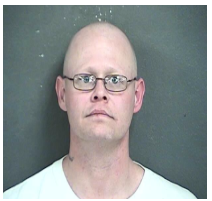
Bowser-photo Wyandotte Co.

Wyandotte County prosecutors say 21-year-old Charles Bowser was sentenced Friday to life plus 37 years for attempted capital murder and other charges.

Deputy Scott Wood, who was off-duty, was shot several times at a 7-Eleven in Kansas City, Kansas, during an attempted robbery. He spent two weeks in the hospital before being released.

In February 2016, Dyron King and Cecil Meggerson were found guilty of attempted capital murder in Wood’s shooting.

2 Kansas men dead, 1 hospitalized after head-on crash

MONTGOMERY COUNTY —  Two people died in an accident just before 4p.m. Sunday in Montgomery County.

The Kansas Highway Patrol reported a 1999 Chevy Silverado driven by Derek Scott Messner, 44, Coffeyville, was east bound on U.S. 166 three miles west of Coffeyvile.  The Silverado went left of center and struck a 2009 Dodge Ram pickup driven by Garry Gene Bush Jr., 57, Caney, head-on.

Messner and Bush were pronounced dead at the scene. A passenger in the Dodge Jana Gay Bush, 55,  Caney, was transported to Mercy Hospital.  The occupants of the Dodge were properly restrained at the time of the accident, according to the KHP. Details on Messner’s seat belt usage are not available.

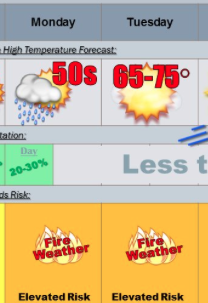
Cloudy, cool Monday with a chance for rain

Today A chance of showers and thunderstorms before 11am, then a slight chance of showers between 11am and 3pm. Mostly cloudy, with a high near 51. North wind 9 to 11 mph. Chance of precipitation is 30%.

Tonight Mostly cloudy, then gradually becoming clear, with a low around 32. North wind 5 to 11 mph becoming south after midnight.

Tuesday Sunny, with a high near 72. Southwest wind 6 to 11 mph increasing to 12 to 17 mph in the afternoon. Winds could gust as high as 28 mph.
Tuesday Night Mostly clear, with a low around 45. South wind 7 to 13 mph.
Wednesday Mostly sunny, with a high near 83. Breezy, with a south wind 10 to 15 mph increasing to 16 to 21 mph in the morning.

Wednesday NightMostly clear, with a low around 46.

Kan. woman confronts daughter’s killer at sentencing

KANSAS CITY, Kan. (AP) — A woman whose two daughters died in separate violent crimes told one of the killers that she hopes he burns in hell.

Lansdowne-Photo Wyandotte Co.

On Friday, Cherri West, of Kansas City, Kansas, spoke in court before Enemencio Lansdown was sentenced to 20 years and seven months in the April 2017 fatal shooting of West’s 34-year-old daughter, Casey Eaton.

Eaton was killed about a block from where her sister, Pamela Butler, was kidnapped in 1999. Pamela was later found dead in Missouri. The man who killed her, Keith Nelson, was sentenced to death.

West told Landsdown before his sentencing that she hoped Eaton haunted his dreams and that “you rot and burn in hell.”

Lansdown did not speak in court before he was sentenced.

Kan. lawmakers approve mental health program for students

TOPEKA, Kan. (AP) — Kansas legislators have approved a pilot program to team up schools and community mental health centers to treat some of the state’s most at-risk children.

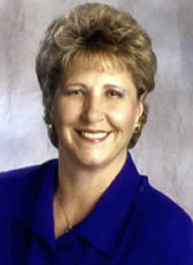
Rep. Brenda Landwehr

The measure would set aside $10 million to treat and track two pre-selected groups of children in six school districts across the state.

The availability of mental health treatment across the county has come under scrutiny in the aftermath of mass school shootings, most recently the February attack in Parkland, Florida. Republican Rep. Barbara Landwehr, of Wichita, who sponsored the proposal, says mental health resources are lacking, and the results of the project will show how to address the problem.

The House approved the plan as part of a larger education funding bill aimed at satisfying a state Supreme Court mandate to boost spending on public schools. Legislators kept the mental health initiative intact in the final version of the education funding bill, which passed early Sunday and went to Gov. Jeff Colyer.

Richard Cagan, executive director for National Alliance on Mental Illness of Kansas, said the $10 million is inadequate.

“For that narrow program it may be a lot of money, but in terms of the broader needs of mental health, no. No,” Cagan said.

Two groups of children would be involved in the project proposed by the House. The first is children in state custody, designated as children in need of care, who often have been shuffled from home to home and school to school. The second is children who haven’t been frequently relocated, but who require above normal behavioral treatment.

All the students would receive the same treatment, therapy and counseling at mental health clinics in their communities. A database would track their progress and provide measurable results, Landwehr said.

State spending on mental health overall dropped dramatically in 2009 and 2010, following the Great Recession and hasn’t fully recovered. Advocates say more money is needed.

State Board of Education Vice Chairwoman Kathy Busch said that when it comes to addressing students’ mental and emotional needs, schools are being asked to do more with less.

“There are kids we couldn’t do enough for, that needed more support than we could give,” Busch said.

The majority of school districts, 200 out of 286, already have relationships with clinics, according to the Association of Community Mental Health Clinics.

But Busch said those relationships are not strong enough. Too few mental health professionals are available in schools, and for some students school is the only place they can get help.

“The schools can’t solve this problem alone,” Busch said. “Some of these kids are going to need some pretty intensive support and that is beyond the realm of what most school counselors are trained to do.”

Four professionals visit FHSU to discuss global business

FHSU University Relations

Aerospace, engineering, oil and construction industry executives will discuss global business in a panel facilitated by Fort Hays State University President Tisa Mason.

The event begins at 6 p.m. on Wednesday, April 11, in the Robbins Center Eagle Communications Hall on the FHSU campus.

The panel is Theo McDonald, rocket test engineering manager of SpaceX, McGregor, Texas; Bruce Jacobs, virtual team’s safety expert for Shell Oil, Denver; David VanDoren, owner of Global 3D Arts and Global Technology Building Systems, Hays; and Kelly Traux, senior vice president of customer support services at Dell, Round Rock, Texas.

The event is free and open to the public.

Kan. tribe regains reservation land from conservancy

RULO, Neb. (AP) — A Native American tribe has regained ownership of river bluffs, hardwood forest and tall grass prairie along the Missouri River through an agreement with the Nature Conservancy of Nebraska.

The conservancy recently transferred 160 acres of Richardson County bluff land to the Iowa Tribe of Kansas and Nebraska. The tribe and the conservancy agreed to a conservation easement, which prevents development incompatible with the land’s ecological value.

The site is a rare habitat where mature hardwood forest coexists with tall grass prairie, said Mace Hack, the conservancy’s state director. The overlapping ecosystems magnify the variety of plants and animals living on the land, he said.

The conservancy bought the land in 1994 in order to expand its Rulo Bluffs Preserve and protect the hardwood forest and prairie habitats.

“This return of a part of our reservation, in a natural condition much as our ancestors would recognize it and which we will continue to restore, is helping us to heal the land and as a tribe,” said Alan Kelley, tribal vice chairman.

The land is also sacred ground to the tribe, said Lance Foster, the tribe’s historic preservation officer.

“To be somewhere where it’s quiet, that’s one of the things I enjoy about being here … and the fact that our ancestors are here,” he said. “The spirits of our ancestors are here. In our private moments we hear them sometimes. We communicate with them.”

The land return is part of a larger attempt by the tribe to purchase back more reservation lands with its casino revenue. About 30 percent of the reservation is currently owned by tribal members.

“It’s a slow process,” Kelley said.

Owner of waterpark where Kan. boy died probed over home dispute

KANSAS CITY, Mo. (AP) — The co-owner of a Kansas waterpark where a 10-year-old boy was decapitated on a raft ride is being investigated in Texas over a confrontation with people in his home.

Jeff Henry, Schlitterbahn co-owner, faces second-degree murder in the death of 10-year-old Caleb Schwab on the Verruckt waterslide. His trial is scheduled for September 10.
CREDIT FRANK MORRIS /Kansas News Service

New Braunfels, Texas, police say a woman reported Thursday that Jeff Henry had threatened her. Henry has not been charged.

Henry co-owns Schlitterbahn Water Parks and Resorts and is charged with murder in the 2016 death of Caleb Schwab, who died on a waterslide when his raft went airborne and hit an overhead loop. Henry made his first court appearance in Kansas and flew back to Texas on Thursday.

Defense attorney Ron Barroso said when Henry arrived at his home he discovered people staying there had burglarized and ransacked it. He says Henry confronted them, which prompted the woman’s call to police.

Barroso says Henry plans to file charges.

Copyright Eagle Radio | FCC Public Files | EEO Public File