Beautiful loft available in Historic Downtown Hays! Great location, immaculate condition and at an affordable price.
Located at 105 W. 10th in downtown Hays.
For more information, call or text: (785) 623-1723 or (785) 656-3081
Beautiful loft available in Historic Downtown Hays! Great location, immaculate condition and at an affordable price.
Located at 105 W. 10th in downtown Hays.
For more information, call or text: (785) 623-1723 or (785) 656-3081
 Today
Sunny, with a high near 61. Northwest wind 7 to 10 mph becoming east in the afternoon.
Tonight
Clear, with a low around 35. East wind around 10 mph.
Sunday
A slight chance of showers between 1pm and 4pm, then a slight chance of showers and thunderstorms after 4pm. Mostly sunny, with a high near 64. Breezy, with a southeast wind 9 to 14 mph increasing to 16 to 21 mph in the afternoon. Chance of precipitation is 20%.
Sunday Night
Showers and possibly a thunderstorm. Low around 39. Breezy, with an east southeast wind 17 to 23 mph becoming north northeast after midnight. Chance of precipitation is 90%. New rainfall amounts between a half and three quarters of an inch possible.
Monday
Showers likely, mainly before 1pm. Cloudy, with a high near 45. Windy, with a north wind 25 to 28 mph. Chance of precipitation is 70%. New precipitation amounts between a tenth and quarter of an inch possible.
Monday Night
Mostly cloudy, with a low around 29. Windy.
Tuesday
Mostly sunny, with a high near 55.
Wednesday
Mostly sunny, with a high near 65.
Each month of the 2018 season, Sunflower Electric Power Corp. and its member-owners will give away a pair of tickets to see a Kansas City Royals home game! Enter below and be sure to come back and enter each month for your chance to win!

KDA
MANHATTAN — The Kansas Department of Agriculture is accepting applications for the 2018 Specialty Crop Block Grant Program (SCBGP). Funds for the program are awarded to the agency by the U.S. Department of Agriculture’s Agricultural Marketing Service (USDA–AMS). The funds are in turn granted to projects and organizations that promote the competitiveness of specialty crops by achieving defined performance measures.
The purpose of the specialty crop program is to enhance the competitiveness of specialty crops. Specialty crops are defined by the USDA as “fruits, vegetables, tree nuts, dried fruits, horticulture, and nursery crops, including floriculture.”
Each state that applies to participate in the SCBGP is reviewed and approved by USDA–AMS and will receive an estimated base amount plus an amount based on the value of specialty crop cash receipts and the acreage of specialty crop production in the state. In 2018 it is expected that Kansas will receive approximately $348,850.
Applications from Kansas organizations and projects will be evaluated by a team of external reviewers. The team will rate proposals on their ability to successfully promote specialty crops in Kansas and make a positive impact on the Kansas economy. Those recommendations will be submitted to the Kansas Secretary of Agriculture, who will make the final awards.
Applications are due to KDA no later than 5:00 p.m. on April 23, 2018. For more information, or to download the 2018 application, go to www.agriculture.ks.gov/specialtycrop.
This grant opportunity supports the development of partnerships and resources that will grow the Kansas specialty crop industry, which is the growth objective for that sector within the Kansas agricultural growth strategy project. For more information about the Kansas Ag Growth project or about specialty crops in Kansas, go to www.agriculture.ks.gov/GrowAg.
 KDWPT
KANSAS CITY, Mo. – The temperature may still be cool outside, but it is a perfect time of year to start getting prepared for the boating season. Boating safety advocates are urging boaters to enroll in a boating education course prior to the main boating season. Spring Aboard – Take a Boating Education Course campaign is a nationally coordinated effort during the week of March 18-24, 2018 to increase the awareness of taking a boating education course.
“We know that an educated boater is safer on the water,” said Tom Guess, president of the National Association of State Boating Law Administrators, and lead organization for Spring Aboard. “If a boater has taken a boating safety education course the likelihood of their time spent on the water being a safe and enjoyable experience is much greater for them as well as their passengers. There’s no reason to head out on the water without knowing what you’re doing, and spring is the perfect time to take a course before the summer boating season begins.”
U.S. Coast Guard statistics indicate that of the accidents where the level of operator education was known, 77% of boating deaths occurred on boats where the boat operator had never received boating education instruction.
With today’s wide variety of courses available, there’s a course for every boater schedule. Boaters have multiple options from classroom courses offered by the Coast Guard Auxiliary and United States Power Squadrons to online offerings available anytime day or night.
Education course providers and offerings will vary between states, so check with your local course provider or state boating agency to find out what courses are accepted in your area. Forty-nine (49) states and U.S. territories require proof of completion of a boating education course for operators of some powered vessels. For a summary of our states’ regulations and available courses, visit:
 Kansas – https://ksoutdoors.com/Boating/
Missouri – https://www.mshp.dps.missouri.
Nebraska – https://outdoornebraska.gov/
Iowa – https://www.iowadnr.gov/Things-
Many providers are offering discounts or other incentives to anyone that takes a boating education course during the week of March 18-24, 2018. BOATsmart! (boatsmartexam.com) is offering discounts on their boating safety courses and BOATERexam.com and Boat-Ed.com are offering 50% off the price of their courses for the entire week.
 The annual Spring Aboard campaign is led by the National Association of State Boating Law Administrators and produced under a grant administered by the U.S. Coast Guard, and it is supported by state, federal, and nonprofit partners. It is open to participation by all states, territories, boating education organizations, instructors, and course providers.
For more information, visit www.springaboard.org .

TOPEKA, Kan. (AP) — The suspect in the shooting of a father and son is now facing a murder charge after one of the victims died.
John Wesley Towner Jr. was charged Thursday with second-degree murder in the death of 34-year-old John Austin Jr. in January.
Towner originally was charged with two counts of attempted murder and other crimes.
Austin and his 57-year-old father, John Austin Sr., were shot on January 22 outside a central Topeka home.
Towner is being held on $100,000 bond. His jury trial is scheduled to begin June 11.
By Molly Hadfield
SHAWNEE COUNTY —Two giraffes at the Topeka zoo are pregnant. Eight-year-old Hope and seven-year-old Abi are both expecting their first calve late spring or early summer.

Many people will remember Hope and the story that surrounded her when she was born. In July 2010, Hope came into this world with a medical complication. Both of her rear legs presented with hyper extended fetlocks. Through a major effort and with the world watching, she beat the odds and overcame the condition. During her treatment, she was the subject matter of local news broadcasts, major networks, and TV specials. Even the TODAY show came to Kansas to share her story.
With life in front of her, Hope represented the future of the giraffe program at the Topeka Zoo. In 2013, Sgt. Peppers, a male reticulated giraffe born at the Oklahoma City Zoo was transferred to the Topeka zoo to be paired with hope. Two years later, Abi, a giraffe from the Albuquerque BioPark Zoo was also transferred to Topeka and together the three giraffe formed the breeding heard that the Topeka Zoo has today. In 2016, the recommendation was made to breed Sgt. Peppers with both Hope and Abi.
Earlier this year, a hormone study showed that both Hope and Abby are pregnant. Gestation in reticulated giraffe is approximately 15 months. The Topeka Zoo is expecting the giraffe calve to be born sometime between May and June.
Both Abby and hope are being closely monitored. A medical team is evaluating their progress and planning for any possible complications.
Over the next month, plans will be announced that will allow the community to watch their progress through WebCams and a rules for a naming contest will be revealed to name one of the calves. The zoo will post regular updates through its social media on the progress of both expecting moms.
WICHITA, Kan. (AP) — Jurors who will decide the fate of three militia members accused of conspiring to bomb an apartment complex housing Somalis in the Kansas will not hear evidence about alleged child pornography found during searches.

U.S. District Eric Melgren excluded the images found on a computer and drives Friday.
Patrick Stein, Gavin Wright, and Curtis Allen have pleaded not guilty to conspiracy to use a weapon of mass destruction and conspiracy against civil rights. Stein also faces a weapons-related charge and Wright faces an additional charge of lying to the FBI.
The trial is set to begin Tuesday.
Stein pleaded not guilty in a separate case that will be tried in July accusing him of possession of child pornography.
TOPEKA, Kan. (AP) — The Latest on the debate in Kansas over increasing funding for public schools (all times local):
4p.m.
A new report from two out-of-state consultants says improving student performance in Kansas public schools could cost the state as much as $2 billion more a year.
The report released Friday stunned some legislators. The Kansas Supreme Court ruled in October that the state’s more than $4 billion in spending a year on aid to public schools isn’t sufficient under the state constitution.
The report outlined multiple spending scenarios, and all assumed that the state would boost its high school graduation rate from 86 percent to 95 percent within four years. That would be the nation’s highest rate.
The consultants’ lowest projected increase in annual spending would be $451 million, or almost 10 percent. The largest figure tops $2 billion. The consultants suggested phasing in any increase over five years.
___
11:45 p.m. Thursday
Kansas legislators are receiving an education funding report that could determine how lawmakers respond to a state Supreme Court mandate to boost spending on public schools.
Legislative attorneys are slated to present the report Friday during a joint meeting of House and Senate committees on school funding. The study comes from two out-of-state consultants hired by Republican leaders.
The GOP-controlled Legislature’s work on a school finance law aimed at satisfying the court has been on hold for several months while lawmakers waited for the study.
The court ruled in October that the state’s aid to its school districts of more than $4 billion a year isn’t sufficient under the Kansas Constitution. The court hinted that funding might have to rise by $650 million a year but allowed for new cost studies.
WICHITA, Kan. (AP) — Kansas’ newly-confirmed secretary for children and families improperly reversed an adoption decision for three children in foster care, a judge said.

DCF Secretary Gina Meier-Hummel recently said the children should go to their grandfather instead of being adopted by their foster family like originally decided.
Meier-Hummel’s decision “potentially placed all three children in serious harm,” according to Sedgwick County Judge Kevin Smith. He said he considered all necessary factors in selecting the foster parents to adopt and that the children should remain with them while continuing visits with their grandfather.
“Our intent was to ask for a 30-day continuance to do our due diligence, given the serious concerns raised by the grandfather about his grandchildren’s future,” Meier-Hummel said. “The court has the authority to make decisions in the children’s best interest, and we respect that authority.”
Smith’s rebuke came during a review hearing about David Rose Sr.’s grandchildren. Rose has sought for two years to adopt the children, and believes he wasn’t chosen because he’s a single black man living in a fourplex while the foster family is a married white couple in the suburbs.
“There’s one person whose bond has never been disrupted, and that’s my client,” said Jennifer Goheen, who stood in for Rose’s attorney who was unavailable.
Smith said the biggest reason for not choosing Rose was the possible involvement of the children’s biological parents, who he said had previously engaged in instances of physical neglect and abandonment.
Smith said he expects Meier-Hummel to attend a hearing about the adoption next month.

By JEREMY McGUIRE
Hays Post
HAYS, Kan.-Thomas More Prep-Marian is once again on the lookout for a head high school football coach after current head coach Jason Cauley submitted his resignation to the school. Cauley has spent the past two seasons as the head of the Monarch football program and went 5-13 over that time. TMP did see offensive improvement during Cauley’s tenure as they averaged over 30 points per game under his direction.
He is leaving TMP to take the same position at a Christian school in the Phoenix/Scottsdale, Arizona area. Cauley will also serve as the school’s head track coach. He will remain at TMP until the end of the current school year.
By JIM MCLEAN
A Kansas House committee on Thursday recommended the legalization of medicinal supplements containing cannabidiol, CBD, a marijuana extract used by some to control seizures and pain.

It also moved to keep an herbal stimulant, kratom, legal in Kansas.
Both decisions came in a regular update of what drugs are legal or illegal in the state. The rules are contained in legislation that still needs approval of the full House, and the Senate, before the governor could sign any changes into law.
The bill cleared the House Health and Human Services Committee that would make CBD legal, but only if the cannabis derivative contained no THC — the compound in marijuana that gets people high.
That substance, often referred to as hemp oil, has been promoted as a way to treat seizures and other medical issues.
“This gives us the ability to help people a lot,” said committee chairman Dan Hawkins, recalling the time a mother was forced to tend to her convulsing child during a legislative hearing on a CBD bill.
Several members disagreed, arguing that CBD is a “gateway drug” that should remain illegal.
“This is a bad idea,” said Republican Rep. John Barker, a retired judge from Abilene. He said legalizing CBD will make it “faddish to be taking hemp oil.”
“I’m here to protect the young people who are naïve in many ways,” he said.
But others, including Republican Rep. John Eplee, a family doctor from Atchison, said CBD should not be considered a dangerous drug.
“There’s nothing about it that could cause you to get high,” Eplee said. “It is simply a supplemental therapy that is, frankly, pervasively available in many other states.”
Law enforcement opposes CBD legalization, Eplee said, because it smells like marijuana.
“It’s really hard to tell when someone’s smoking a doobie,” he said, “or whether they just rubbed CBD oil on themselves.”
Several members of the committee said business owners in their districts had contacted them wanting to know whether they could legally sell THC-free CBD supplements.
It isn’t legal under current law, Hawkins said, citing a recent opinion from Attorney General Derrick Schmidt. That opinion has been contested, creating confusion in the state about the legality of CBD.
The committee also voted to remove kratom, an herbal supplement widely used for pain control by people attempting to wean themselves off opioids, from the state’s updated list of illegal drugs.
In 2016, the federal Drug Enforcement Administration attempted to add kratom to its list of most dangerous and addictive drugs. But an outcry from patients forced the agency to delay a decision pending more research and a public comment period.
That research, said Food and Drug Administration Commissioner Scott Gottlieb, shows that kratom shouldn’t be considered “safe or effective for any medical use.”
Citing those concerns and emails she received from kratom users, Rep. Susan Concannon argued for including it on the list of controlled substances.

“They sounded so desperate and pleading,” she said, “that it smacks of addiction.”
But other lawmakers said that, lacking conclusive evidence of harm, they didn’t want to take something away that could be helping some Kansans. Besides, they said, state officials have the authority to ban the supplement in an emergency.
After reviewing medical literature and the autopsies of several drug overdose victims, Eplee, the Atchison physician, said he saw no compelling reason to ban something that appears to help some people.
“Once you get to a stable dose, you just take that and you’re off of a lot of other meds,” He said. “Life is better for you.”
Among the questions needing answers, Eplee said, is whether large pharmaceutical companies are behind the effort to make kratom illegal.
“Big Pharma is trying to get rid of kratom on the national scene,” he said. “They know it could replicate or replace … a lot of very expensive opioids.”
Jim McLean is managing director of the Kansas News Service. You can reach him on Twitter @jmcleanks.
 OFFICE OF GOV.
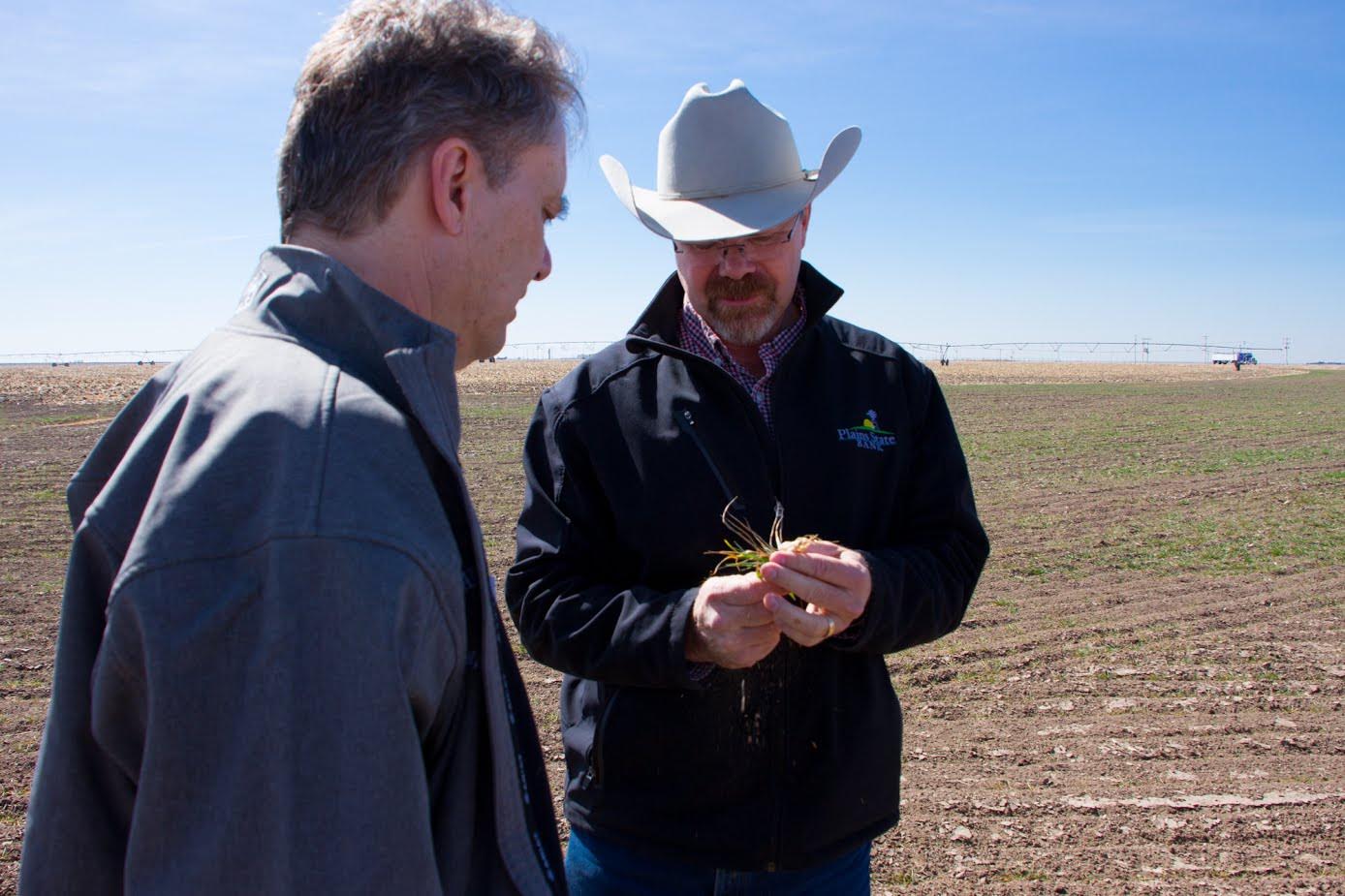
TOPEKA – Governor Jeff Colyer along with Secretary of Agriculture Jackie McClaskey and Kansas Water Office Director Tracy Streeter toured parts of southwest Kansas Thursday, March 15, surveying the drought conditions currently affecting the entire state. The governor made an executive order declaring a state of drought in all the counties in Kansas earlier in the week.
The entire southwest region is currently experiencing extreme drought conditions.
“Farmers and ranchers have a tough job that becomes even more difficult when dealing with a lack of water,” said Governor Colyer, “It was important to me to take the time to visit some of the areas where the drought is affecting our farmers and ranchers, so I can listen to their concerns, understand what challenges they are facing, and offer support however we can.”

The governor started the tour at the Clawson Ranch Partnership just west of Meade, Kansas, where David Clawson showed the governor winter wheat fields that are struggling to come out of dormancy due to the extreme lack of moisture in the soil.
The next stop on the tour allowed the Governor and all tour participants, including leaders from the Kansas Farm Bureau and Kansas Livestock Association, to see firsthand examples of technologies, including soil moisture probes that farmers are implementing to better manage their water resources. Across Kansas, farmers are incorporating new technologies and practices, from participating in voluntary Water Conservation Areas to utilizing more efficient irrigation practices, in their crop management plans. These technologies and management practices have enabled farmers to improve water management and conservation practices, which becomes especially important in tough drought years.
“Kansas farmers are implementing proactive water conservation practices, as we saw today,” said Streeter. “These water-saving strategies are important in our efforts to preserve natural resources for future generations, as well as to persevere through drought years.”
The final tour stop was at the Gardiner Angus Ranch near Ashland, which was the site of devastating wildfires that burned more than 650,000 acres in Kansas last March. Rancher Greg Gardiner showed the governor areas of the ranch that burned last year and efforts that continue to rebuild the operation, including rebuilding fences and other infrastructure. Current drought conditions dramatically increase the risk of wildfire disasters, in addition to the direct challenge the drought poses for the survival of crops and livestock.
Earlier this week, Governor Colyer encouraged county Farm Service Agency (FSA) committees to begin the process of requesting access to Conservation Reserve Program (CRP) acres for haying and grazing. The Governor says he is hopeful FSA will grant this request, as accessing CRP will provide additional forage resources and help reduce wildfire fuel load and aid in fire suppression.
 “We witnessed some incredible examples of the resilience of the farmers and ranchers of Kansas, and the significant efforts they are making to persist through these times of difficulty,” said McClaskey. “Agriculture is the largest industry in Kansas, accounting for 45 percent of the state’s economy. The impacts of this drought will be felt by every Kansan, and we stand ready to support farmers and ranchers however we can during this drought emergency.”
Governor Colyer’s drought declaration signed by executive order on Tuesday will provide assistance to farmers and ranchers as they cope with the impact the drought will continue to have on crops and livestock. The executive order applied to all 105 counties in the state; at that time 57 counties were in D2 (severe) or D3 (extreme) drought levels. Thursday’s U.S. Drought Monitor brought that number up to 66 counties, with no improvement in conditions in the near future.