Today, enjoy at least one song an hour from the Doobie Brothers on 96.9
“Like” KFIX on Facebook.
Today, enjoy at least one song an hour from the Doobie Brothers on 96.9
“Like” KFIX on Facebook.

Former Kansan and now Texas A&M professor Dr. Lori Taylor is apparently conservative on spending and is dissecting school spending based largely on labor costs and costs for students who require extra services such as instruction in proficiency in the English language, disabilities and other health issues.
That report is aimed two ways—first, of course, to determine just what public K-12 education ought to cost and how much the state should spend to provide equal educational opportunities to all its students, the second to determine whether previous cost studies are still responsible standards for the Kansas Supreme Court to use in deciding whether a new school finance plan provides adequate state money to public education.
The court, recall, has held unconstitutional the current school finance formula law, based largely on past studies that another state consultant says are too old and not a good basis for determining state aid to schools.
These consultants were hired by the Legislative Coordinating Council (LCC), which essentially runs the business of the Legislature and is dominated by the Republican leadership of the House and Senate, most of whom aren’t interested in spending much more money on K-12 education or raising taxes this House election year. The two Democrats on the seven-member council voted against hiring the consultants, preferring instead to just adequately fund a previous school finance plan that had been held constitutional by the court.
Nobody has seen that new cost estimate yet—probably won’t until after dark Thursday with a committee explanation in daylight Friday—but betting is that the LCC’s consultant is going to come up with a spending plan far less than the popularly rumored in the Statehouse estimate of at least $600 million or more in new money for schools.
But part of that contracted-out study shoots holes in the two previous K-12 finance studies on which previous constitutional plans were based, and thereby weakens the arguments based on those plans forwarded by supporters of more spending on public schools.
Hmmm…weaken the arguments of the school districts seeking more money and present a new plan based on fresh statistical information that conservatives hope will sway the Supreme Court’s decision on a new finance plan. That’s one strategy if leaders believe that schools are adequately funded by the state, making new taxes unnecessary this election year.
So, what is that Friday report going to do to the Legislature?
Either give lawmakers who don’t want to spend more of your state tax money on K-12 education a new study to indicate to the court that the state is spending enough, or maybe a dab less than enough, but not a budget-busting amount…or, come up with a new plan that changes the formula by which lawmakers tell the State Department of Education to distribute about half of the state’s general fund to schools.
And, of course, there is still that option merely to take a previous formula which the court has held as constitutional and just fund it. Simple, but likely to require either sharp cuts in state spending on everything else or raising your taxes again, with the slim election-year possibility of increasing local school district property taxes.
Meanwhile, everything that costs any money, either little changes for the current fiscal year or for the upcoming fiscal year, are pretty much on hold.
We ought to know by Friday just what happens, and maybe why.
Syndicated by Hawver News Company LLC of Topeka; Martin Hawver is publisher of Hawver’s Capitol Report—to learn more about this nonpartisan statewide political news service, visit the website at www.hawvernews.com

Hays Post and Eagle Communications seeking nominations for the next Teacher of the Month!
From October through April, Hays Post will solicit nominations from through the area from parents, students and colleagues. Fill out the form below to nominate your favorite educator!
This recognition is made possible by the support of Midwest Energy, Diamond R Jewelry, Top Notch Cleaners, Hickok’s Steakhouse and Ultimate Massage.
The winning teacher will receive a gift certificate, courtesy of Hickok’s Steakhouse! Submissions will be accepted through 5 p.m. Monday.
[contact-form to=”[email protected]” subject=”Teacher of the Month”][contact-field label=”Your name” type=”name” required=”1″][contact-field label=”Your email” type=”email” required=”1″][contact-field label=”Teacher’s name” type=”text” required=”1″][contact-field label=”Teacher’s school and grade” type=”text” required=”1″][contact-field label=”Tell us why you are nominating this teacher” type=”text” required=”1″][/contact-form]

Those who play connect the dots find the experience relaxing or agitating, depending on the outcome. Some see relationships between one idea and another despite having too little information to clearly link them. To complicate matters, lack of resources can limit time or money investments even though strong interest in a subject exists. I know this sense of tension well, especially after reading recent articles about Clovis Caches found in America.
I suspect few care much about Clovis culture let alone have a burning interest in stashes of stone tools ancient inhabitants concealed and didn’t retrieve. While made of common, not precious, materials, these relics equal buried treasure for those who love archeology and connecting to ancient humans.
The term Clovis Culture came into existence when a sharp-eyed New Mexican noted artifacts formed using a particular bi-faced fluting between Clovis and Portales. Since that discovery, scientists identifying stonework designed with this pattern characterize them as Clovis points. Scholars attribute the style to bison antiquus and mammoth hunters who lived at the end of the Pleistocene era about 13,000 years ago.
The article that started my exploration mentioned the Busse Cache that contained Clovis bifaces made of Niobrara or Smoky Hill Jasper. Anyone who’s walked country roads or plowed fields in Northwest and North Central Kansas has seen this frequently ochre-hued, silicified stone even if they didn’t know what to call it. Researchers have identified prehistoric quarries containing outcroppings of this desirable knapping material in Trego, Gove, and Graham Counties in Kansas and Fremont County Nebraska. That tidbit has me trying to connect points in history based on limited knowledge.
Interestingly, these western Kansas excavations produced desirable knapping material early hunters used for thousands of years. Oklahoma archeologists have found it in sites from east to west. To entice further, prehistoric mammoth and bison bones found during work on roads, bridges, dams, or other such dirt shifting activities occupy shelves and dark corners in regional museums and personal collections.
This combination makes me wonder how many Pleistocene hunters wandered this way in search of game and resources to make dinner-capturing tools. After all, the Great Plains supported modern bison and native cultures who depended on them for survival. This information increases my curiosity about how often their ancestors roasted a mammoth haunch under prairie skies.
Keep in mind state borders are fairly modern concepts so migratory people would’ve wandered from one watershed to another without worrying about taxes, land ownership, or other recent complications. Nearly a decade ago, Dan Busse in Northeastern Colorado worked a field and noted a fingernail-size bit of Smoky Hill jasper that wasn’t native to his area. Upon further investigation, he dug up a hunter’s pack of fluted Clovis-style stones. Among them are several manufactured from Niobrara or Smoky Hill jasper, commonly found in western Kansas and Nebraska.
Add to this data information about KU professor Rolfe Mandel’s 2014 dig near Tuttle Creek. His team specifically searched for evidence of Clovis and pre-Clovis inhabitants in what is now Kansas. Their efforts are in the hands of lab analysts who work to verify their findings.
Though few Clovis Cache finds are documented in the U.S., such articles offer hope that any day now a Kansan could be turning over soil and make a discovery like a landscaper in Boulder, CO. He recently found a stash of 80 artifacts used to butcher prehistoric camels and horses in his yard.
Though I doubt I’ll find such treasure, the combination of connecting dots leads me to expect I’ll soon read about the person who does.
Native Kansan Karen Madorin is a local writer and retired teacher who loves sharing stories about places, people, critters, plants, food, and history of the High Plains.

Unless something changes in the moisture situation, Barb Downey and husband, Joe Carpenter will not burn their grassland in the Flint Hills this season. The ranch couple report no (moisture) run-off event in more than a year on their native grassland in Riley and Wabaunsee counties.
Every spring across the vast, open Flint Hills grasslands, fires blaze for miles. The flames lick at the blue Kansas sky as the brown, dry grass crinkles, crackles and bursts into orange.
Cattlemen like this east-central Kansas couple understand that controlled burning remains a range management tool that helps maintain the economic viability of the Flint Hills. Fire remains an essential element of the ecosystem.
Long before civilization came to the prairie, fires were ignited by lightning storms and the charred prairie restored the health of the native grasses. Native Americans set the first prairie fires. They used the fire to attract bison for easier hunting.
Controlled burning by those who live on the tall-grass prairie of the Flint Hills is an annual event designed to mimic nature’s match. It’s part of a tradition – part of the culture of the communities and the people who inhabit this region of our state.
This annual pasture burning only occurs for a few days each year. It is not a procedure that is drawn out and lasts for weeks. Weather conditions dictate the length of the burning seasons most years.
Not every cattleman burns his pastures every year. Instead, individual ranchers and landowners survey and decide each spring, which pastures will benefit and produce a healthier, lush grass for livestock after burning. Often neighbors plan and burn together, giving them more hands to ensure a safe, controlled burn.
Because of continued dry conditions, Downey and Carpenter fear they would not be able to control the burn this season.
“It’s so dry and the winds blow nearly every day,” Barb says. “At the ground level, there’s no humidity in the thatch in our native grasses.”
Downey believes her Flint Hills region remains in an extended drought. She’s not counting on moisture any time soon unless this weather pattern turns around drastically – and right away.
For weeks the ranchers have watched forecasts the serve up the possibility of rain in the seven to 10-day forecasts. By the time that period passes, there’s nothing. No moisture for the bone-dry Flint Hills.
“The overriding reason we will not burn our grasslands this spring is because we’re going to need every little bit of forage we can get our hands on,” Barb explains.
“We don’t care if it’s last year’s grass. At this point we need forage of any kind for our livestock.”
Downey is the fourth generation in the ranching business. Her daughter represents the fifth. Decades of experience have provided this cattle family with the know-how and knowledge to plan for their cattle enterprise.
The current drought conditions began on their Riley and Wabaunsee county ranch back in 2005. Except for a couple of years of adequate moisture, drought has been a way of life for more than a decade.
“Twenty twelve marked the peak of this extended drought here in the Flint Hills,” Barb says. “Right now, we’re already worse this year than in 2012.”
Continued dry conditions indicate burning this March or April would ensure little, if any, pasture regrowth. Downey and Carpenter are already operating in “drought-crisis mode.” Irrigated land that would ordinarily soon be planted to corn will be planted to forage this spring.
“We’re beyond the idea of burning,” Barb says. “Conditions today remain too dry. We’re not even receiving what I call ‘band-aid’ rains or brief showers, to help us along.”
Some of the older cows will be culled earlier this year on the Downey and Carpenter ranch. They continue to look at options to lighten the feed load for their herd.
“We’re planning for the worst, and hoping for better times ahead,” Barb says. “Without continued moisture and soon – we’re headed for trouble.”
John Schlageck, a Hoxie native, is a leading commentator on agriculture and rural Kansas.

Last Friday, I had the pleasure of joining Spirit Aerosystems in Wichita to celebrate the 10,000th 737 fuselage delivery. In attendance for the celebration were Senator Jerry Moran, Representative Roger Marshall and Representative Ron Estes. Also, in attendance were eight employees and one employee watching from Oklahoma who helped build the first 737 in 1966 and were a part of building the 10,000th 737 fuselage. Last year Spirit announced their plan to invest $1 billion in Wichita and 1,000 new Wichita jobs. This is all part of the plan to increase production to keep up with demand.
HB2477: Last week we had a hearing in the Ag and Natural Resource committee on a bill that will increase fees for pet animal inspections. Breeders are all in agreement that fees need to be increased so inspections can be completed in a timely basis. However, Humane Society of the United States (HSUS) was able to get an amendment on the House floor mandating policy changes on notification of breeders prior to an inspection. This amendment allows HSUS to get their foot in the door in Kansas and will direct the Department of Ag to carry out inspections without prior notification. The Department of Ag testified that this will increase their cost of doing inspections because showing up unannounced may cause a return visit when the owner/operator is not present to let the inspector into the facility.
In Financial Institutions, Insurance, Pensions and Benefits we had a confirmation hearing for an open board position on the KPERS board. Governor Jeff Colyer has recommended for appointment James Zakoura. Our committee has accepted the appointment and has recommended to the full Senate, James Zakoura.
On Thursday, the Senate voted 22-16 on Concurrent Resolution 1611 which calls for convention of states for the purpose of proposing amendments to the Constitution of the United States that impose limits on the federal government. The purpose of calling the convention would be to implement term limits on members of congress. In addition, it would require the federal government to work with a balanced budget. This vote required two-thirds vote and fell short to pass.
On Wednesday, the Senate Committee of Ethics, Elections and Local Government held a hearing on HB 2539 which deals with qualifications for candidates seeking certain statewide office. The bill would list a minimum age requirement to run for governor, lieutenant governor, attorney general, secretary of state, state treasurer and insurance commissioner. Currently, there is not a minimum age requirement therefore any current resident of Kansas is eligible to run. It was noted that a “qualified elector” should be at least 18 years of age.
It is March and with March comes state basketball. I would like to take this opportunity to congratulate all of the state qualifiers from Senate District 40. Congratulations to the State Champions in class 1A division 2 Quinter Lady Bulldogs (first ever state championship), 1A Division 2 Almena-Northern Valley Huskies men’s basketball team State Champions. In 1A division 2 Wallace County Men’s Wildcats (Sharon Springs) fourth place and congratulations to the lady Wildcats for qualifying for state. Congratulations to 1A Division 1 Atwood-Rawlins County Buffalos men’s team for qualifying for state, class 2A Hill City Ringneck’s girls placed 4th, Class 3A Phillipsburg Panther’s men’s 2nd place winners and TMP-Marian Monarchs men’s qualification for state, and TMP-Marian Monarchs ladies 4th place.
Congratulations to Ty Schultz, Wyatt Mong of Grainfield and Adam Klausmeyer from Hays for your hard work and receiving the Scouts highest honor of an Eagle Scout.
It is an honor and a pleasure to serve the 40th Senate District.
RICE COUNTY – Two people were injured in an accident during a high speed chase just before 1a.m. Tuesday in Rice County.

The Kansas Highway Patrol reported a 1998 Sonoma pickup driven by Zackery J. Best, 34, Lyons, was southbound on 21st four miles northeast of Lyons.
Law enforcement including a 2016 Nissan Rogue SUV driven by Rice County Deputy Marcos K. Guerrero, 48, Hutchinson, and 2014 Ford Taurus driven by Patrol deputy Casey J. Schrag, 48, Nickerson were chasing the Sonoma. The driver did not stop after traffic a violation, according to Schrag.
All three Vehicles went through the tee intersection at Avenue L and struck several trees.
Best and a passenger in the Sonoma Andrea F. McAllaster, 32, Lyons, were transported to Lyons County District Hospital. The deputies were not injured.
After treatment for minor injuries, deputies took them into custody, according to Schrag.
Best has previous convictions for drugs, flee and attempt to flee and elude law enforcement and trafficking contraband into a correctional facility, according to the Kansas Department of Corrections.
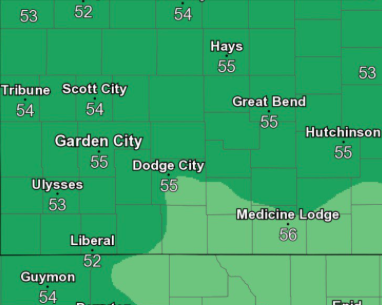
Today Partly sunny, then gradually becoming sunny, with a high near 55. Northeast wind 6 to 8 mph.
Tonight Clear, with a low around 26. East wind around 6 mph becoming south southwest after midnight.
Wednesday Sunny, with a high near 71. South southwest wind 7 to 17 mph.
Wednesday Night Mostly clear, with a low around 41. South wind 10 to 13 mph.
ThursdaySunny, with a high near 79. South southeast wind 9 to 15 mph.
Thursday NightPartly cloudy, with a low around 42.
FridayMostly sunny, with a high near 64.
SHAWNEE COUNTY — Law enforcement authorities are investigating an aggravated battery.
Just before 10p.m. Monday, police responded to a Topeka hospital reference a woman who walked in and reported being shot, according to Lt. Manuel Munoz.
The woman told officers she was walking in the area of 17th and Washburn in Topeka behind a business when she was approached by a white male.
The subject punched her in the face and shot her in the foot. The injuries are considered non-life threating and she is expected to make a full recovery.
Detectives and officers responded to the scene of the attack but were unable to locate a crime scene. There have been no arrests made at this time.
Anyone with information relating to this crime is encouraged to call the Topeka Police Department.
FORT RILEY, Kan. (AP) — A decade after the Pentagon began confronting rape in the ranks, the U.S. military frequently fails to provide justice to the children of service members when they are sexually assaulted by other kids on base.
 An Associated Press investigation finds that sex assault cases occurring where military kids live and learn often die on the desks of prosecutors. Criminal investigators shelved an unknown number of reports.
Instead of punishment or rehabilitation, offenders may be shuffled into the civilian world.
The Pentagon doesn’t know the extent of the problem. On two bases in Kansas, records the Army acknowledges are incomplete document at least 13 sex assault cases among children or teens since 2007. Fort Riley accounted for 12, while Fort Leavenworth recorded one case.
Pentagon officials promised to take “appropriate actions.”

RENO COUNTY — A Kansas man who entered a plea for two counts of aggravated indecent liberties with a child was sentenced Monday to 21 years in prison by District Judge Joe McCarville.
Twenty-two-year-old Adam Miller of Hutchinson entered the plea for inappropriate contact with two children, ages 11 and 14, in 2016.
Technically, one of the charges fell under Jessica’s Law, meaning he could have received a 25-year-to-life sentence. However, District Attorney Keith Schroeder agreed to recommend Miller be sentenced to a lesser level one felony — meaning no life sentence.
Miller was also convicted of a sexual assault in Jackson County (Missouri) and was given 10 years in that case, but it will run concurrent to the Reno County case. He was also suspected in a case in Sedgwick County, but officials there decided not to file charges because of him entering a plea in the Reno County case.
None of the victims had to testify. District Attorney Keith Schroeder says everyone is happy.
RUSSELL COUNTY — A Kansas man died in an accident just before 5p.m. Monday in Russell County.
The Kansas Highway Patrol reported a 2007 Polaris 4-wheeler driven by Timothy A. Burris, 25, Russell, was southbound in the 200 block of Brooks Street in Russell.
As the vehicle approached the intersection of 2nd Street, the driver hit the brakes hard and lost control of the vehicle.
The ATV rolled and the driver was ejected.
Burris was transported to Russell Regional Hospital where he died.
WICHITA, Kan. (AP) — The stepmother of a missing Wichita boy is asking a judge to lower her bond so she can be released from jail.

An attorney for 26-year-old Emily Glass said in a motion filed Friday that Glass’ $50,000 bond is too high. Glass is the stepmother of 5-year-old Lucas Hernandez, who hasn’t been seen since Feb. 17.
She is jailed on a misdemeanor child endangerment charge involving her 1-year-old daughter.
Glass’ attorney argues she is not a threat to the community and wants to be with her husband and other child, who has been placed in state custody.
A court hearing is scheduled for Wednesday.
Also Monday, Wichita police said they have closed an emergency tip line for information on Lucas but urged the public to call in any tips they might have.