KANSAS CITY (AP) — Authorities say five people were shot and wounded at a swingers club near Kansas City.
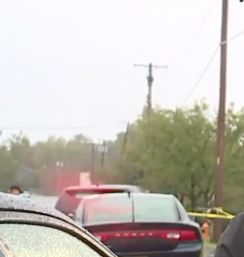
Police on the scene of the weekend shooting photo courtesy Fox4Kansas City
Jackson County Sheriff Darryl Forte said in a tweet that deputies responded around 3:30 a.m. Sunday to the shooting at The SPOTT Lifestyle and Swingers Club. It is located in an unincorporated area less than 10 miles east of downtown Kansas City.
The victims were taken to hospitals in private vehicles. None of the injuries were life-threatening. Forte says three of the victims walked away from a hospital without giving statements to detectives.
Forte says the motive is unknown.
No suspect information was released. The investigation is ongoing.
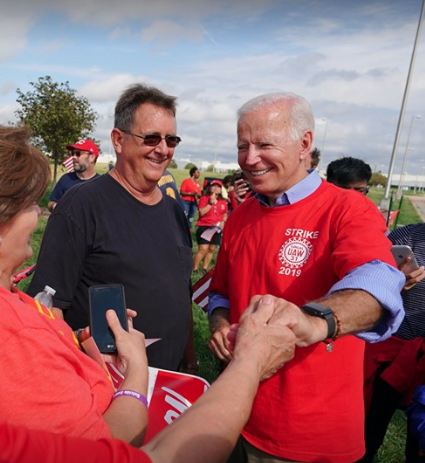
KANSAS CITY — Former Vice President Joe Biden brought his campaign for president to Kansas City Sunday. Biden met with workers in Kansas City who are on strike against General Motors.
Biden speaks to UAW workers Sunday in Kansas City -photo courtesy Joe Biden campaign
“Today, I proudly stood alongside UAW members on strike in Kansas City as they fight for a fair contract. Everything that defines a middle class life is because of unions fighting for worker protections. I stand with you, and America stands with you”
The strike against General Motors by 49,000 auto workers is now in it’s 8th day.
A poll released over the weekend by he Des Moines Register, CNN and Mediacom, found Senator Elizabeth Warren running about even with Biden for the democrat nomination for presidet. Biden led their last poll in June.
SHAWNEE COUNTY— Law enforcement authorities are investigating shooting and have a suspect in custody.
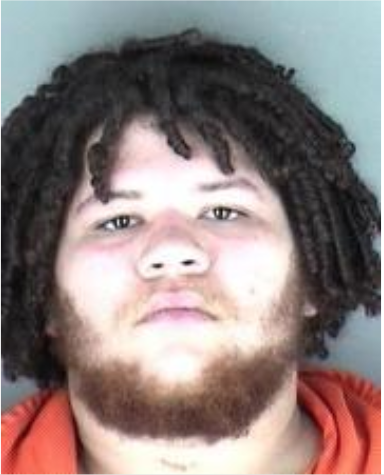
Akins-Bomhoff photo Shawnee Co.
Just after 8:00 p.m.Saturday, police were called to the report of a large group of teens fighting in the area of Huntoon and Tyler in Topeka, according to Lt. Shane Hilton.’
The caller also reported hearing gunshots. Upon arrival, one female was found to have non-life threatening gunshots wounds and transported by ambulance to the hospital. Another female later arrived at the hospital, also with non-life threatening gunshot wounds.
As a result of the investigation, police arrested Anthony Eugene Akins-Bomhoff was on requested charges of Attempted 1st Degree Homicide and Aggravated Battery.
A 17-year-old boy was also arrested for Discharging a firearm in City Limits, Battery on a Law Enforcement Officer, Possession of stolen property, Criminal Use of a Firearm, Disobeying a Lawful Police Order, and Interference with a Law Enforcement Officer.
Beginning at 9 a.m. Monday, the 1100 block of 280th Avenue (just south of Old U.S. 40) will be closed for a culvert repair project, the Ellis County Public Works Road & Bridge Division reported.
That portion of the roadway will remain closed until the project is completed, which is expected to be 4 p.m. Thursday. Motorists traveling in the affected closure area should use alternate routes of travel until the project is completed.
The Annual Western Summit, sponsored by the Hays chapter of AARP, will be from 8 a.m. to 2:30 p.m. Oct. 10 at the Rose Garden Banquet Hall, 2350 E. Eighth.
Registration of $11 can be paid at the door and includes the luncheon. Information will focus on areas of concern for seniors and how to decrease susceptibility to these concerns.
While enjoying coffee and doughnuts from 8 to 9 a.m., there will be a number of tables for participants to peruse information on what’s available for seniors. Some vendors will have free giveaways or door prizes. There will be door prizes to give away at the end of the summit.
To register, call (785) 625-6896 or (785) 623-7412 by Oct. 3.
Gov. Laura Kelly on Thursday announced more than $1.2 million from the Federal Family Violence Prevention and Services Act grant program awarded to communities across Kansas.
“It takes great courage to leave an abuser. Oftentimes, victims need to leave a dangerous situation quickly,” Kelly said. “We must do all we can to encourage women and men to leave abusive relationships. Housing and other resources must be available to keep our survivors and children safe. This grant will help provide these critical resources where they are needed most.”
Hays-based Options: Domestic & Sexual Violence Services was among the organizations receiving grant funding.
The FVPSA grant program assists states in their efforts to support the establishment, maintenance and expansion of programs and projects to:
1) prevent incidents of family violence, domestic violence and dating violence;
2) provide immediate shelter, support services and access to community-based programs for victims of family violence, domestic violence or dating violence and their dependents; and
3) provide specialized services for children exposed to family violence, domestic violence or dating violence including victims who are members of underserved populations.
These programs provide outreach, shelter, support groups, crisis intervention and advocacy in obtaining protection from abuse orders, court accompaniment, transportation and prevention education in schools and communities.
2020 FVPSA Grant Awards
County
Organization Name
Grant Award
Allen
Hope Unlimited
$43,657
Barton
Family Crisis Center
$54,105
Butler
Family Life Center
$49,580
Crawford
Safehouse Crisis Center
$64,100
Douglas
The Willow Domestic Violence Center
$67,735
Ellis
Options: Domestic & Sexual Violence Services
$71,526
Finney
Family Crisis Services
$50,070
Ford
Crisis Center of Dodge City
$47,838
Harvey
Harvey Co. Domestic Violence/Sexual Assault Task Force
$49,558
Johnson
SAFEHOME
$137,328
Leavenworth
Alliance Against Family Violence
$50,103
Lyon
SOS
$52,816
Reno
BrightHouse
$52,527
Riley
Crisis Center
$71,590
Saline
Domestic Violence Association of Central Kansas
$61,875
Sedgwick
Catholic Charities, Harbor House
$78,668
Sedgwick
Wichita Family Crisis Center
$90,505
Seward
Liberal Area Rape Crisis/Domestic Violence Services
When we talk about our right to speak freely, most of us know intuitively that isn’t just limited to the words that come out of our mouths. Because when we say that our “speech” is protected by the First Amendment, we’re also talking about books, movies, TV shows, video games, music, virtual reality simulations, art — every way that human beings express themselves. Last week someone posed the following question: What if the expression isn’t from a human being at all? Does the First Amendment protect speech made by artificial intelligence?
Personally, I love questions like this. Some of the most exciting and unsettled First Amendment issues center on whether or not the amendment covers new forms of technology, like computer code, algorithms or blockchain. It might seem odd to consider these things to be in the same category as a fiery political speech or work of art, but they all share an important commonality in that they’re all vehicles people can use to communicate with one another and express ideas.
The history of technology and the First Amendment essentially involves our legal system slowly and reluctantly expanding the definition of speech to include new forms of communication. My favorite example is the Supreme Court’s initial take on movies. In 1915, the court decided movies weren’t protected by the First Amendment because they were a business rather than a legitimate form of expression and noted that movies were “vivid, useful and entertaining, no doubt, but … capable of evil, having power for it, the greater because of their attractiveness and manner of exhibition.”
This language seems to reflect a fear that the technology behind movies was a little too entertaining and immersive and therefore needed to be controlled. But by 1952, the Supreme Court had changed its mind completely, stating that, “It cannot be doubted that motion pictures are a significant medium for the communication of ideas. … The importance of motion pictures as an organ of public opinion is not lessened by the fact that they are designed to entertain as well as to inform.” By then, the once alarming technology had become engrained in daily life and so the court could recognize its value in facilitating expression. Many believe the same will eventually be true for things like computer code (while some lower courts have recognized code as speech, the Supreme Court has never weighed in on this).
Of course, just deciding that something “counts” as speech doesn’t mean that it’s protected by the First Amendment. Not every type of speech is. For example, if you threaten someone’s life, or hire a hitman, you are certainly engaging in the act of speech, but the First Amendment won’t protect it. There are times when speech becomes conduct — when it’s more than just an expression of an idea, but constitutes an action — and that’s usually when the government can regulate it. For example, using code to create a video game could be considered an act of expression protected by the First Amendment, but using code to launch denial of service attacks probably wouldn’t be. There are very few bright-line rules for determining whether or not something is protected by the First Amendment. Courts have to examine the context surrounding an expression and, sometimes, the intent of the speaker when making these decisions.
Artificial intelligence (AI) adds a whole other dimension to this debate, because it’s not always clear who the speaker is. Right now, most code can be considered to be the expression of the programmers behind it. But as AI grows more sophisticated and more able to think for itself, there will come a point where the things it says and does can’t be attributed to any human being. (Maybe that point has already arrived. In 2016, Microsoft created an AI system named “Tay,” which they had operate a Twitter account to tweet out as a teenage girl and learn from the Twitter accounts that interacted with it. Within 24 hours, Tay became racist and anti-semitic and Microsoft was forced to shut it down.)
When the day comes that Siri and Alexa are able to think for themselves, will the First Amendment protect their right to express those thoughts? As crazy as that might seem, there’s nothing in the text of the First Amendment that requires the speaker to be human. Furthermore, the First Amendment doesn’t just exist so that speakers can express themselves, but to protect listeners and viewers and their right to receive information. As John Frank Weaver wrote in his article, “Why Robots Deserve Free Speech Rights,” “The First Amendment protects the speaker, but more importantly it protects the rest of us, who are guaranteed the right to determine whether the speaker is right, wrong or badly programmed. We are owed that right regardless of who is doing the speaking.”
Of course, there are plenty of reasons why we wouldn’t want the First Amendment to apply to AI. It would make it just as difficult for the government to regulate computer speech as it is for the government to regulate our speech — which might be a problem considering that computers are much, much better at speaking than we are. As the wonderfully named law review article, “Siri-ously? Free Speech Rights and Artificial Intelligence,” points out, ” a number of thoughtful commentators have already extensively documented the harms caused by the speech products of existing technologies due to computers’ phenomenal speed and often global interconnectivity, harms that include deception, manipulation, coercion, inaccuracy and discrimination. We can expect such harms only to mount with the growing communicative capacities of increasingly sophisticated computers.”
But the article goes on to point out that failing to protect AI speech risks the government suppressing a valuable source of information for human beings and that we don’t need to take an all-or-nothing approach here. These are still the early days of the so-called AI revolution, so we have time to think things through before Siri takes over.
Lata Nott is executive director of the First Amendment Center of the Freedom Forum Institute.Contact her via email at [email protected], or follow her on Twitter at @LataNott.
WICHITA – A Kansas woman has been found guilty of an unlawful act relating to the use of an identification card in Sedgwick County, according to Attorney General Derek Schmidt.
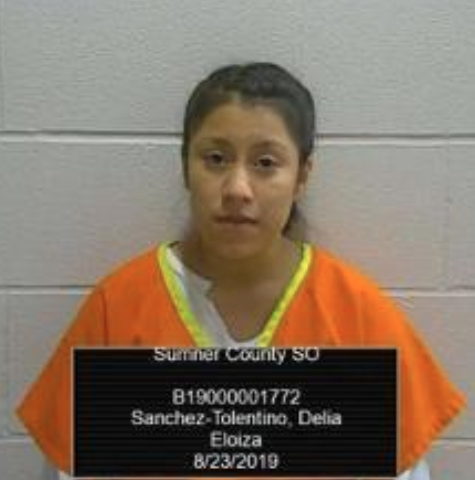
Photo Sumner Co.
Delia Sanchez-Tolentino, 20, pleaded no contest Thursday in Sedgwick County District Court to one felony count of an unlawful act relating to the use of an identification card.
The case stemmed from an investigation by the Office of Special Investigations of the Kansas Department of Revenue, which revealed that on or about October 3, 2018, Sanchez-Tolentino provided a fraudulent permanent resident card as part of her application to renew her Kansas ID card at the Sedgwick County Driver’s License Office in Wichita.
This is the 17th conviction resulting from an agreement announced in March 2018 between the Office of the Attorney General and the Department of Revenue. Under the agreement, the attorney general’s office, in cooperation with local prosecutors, assumed responsibility for the prosecution of cases of tax fraud and related crimes investigated by the Department of Revenue in efforts to strengthen the state’s enforcement efforts for these types of crimes.
District Court Judge James Fleetwood took the plea. Sentencing is scheduled for October 29 at 9 a.m.
FINNEY COUNTY — One person died in an accident just after 11a.m. Sunday in Finney County.
The Kansas Highway Patrol reported a 2005 Dodge Durango driven by Tracy M. Romo, 50, Garden City, was backing out of a parking area at Bosselman’s Travel Plaza,1415 Solar Drive, Unit 7 at U.S. 83 and U.S. 50 North junction.
The SUV struck and ran over 1-year-old Annatile Holguin of Garden City. The child was transported to St. Catherine’s hospital where she died.
Romo and a passenger in the SUV were not injured. Authorities released no additional details.
WICHITA, Kan. (AP) — A 24-year-old man was sentenced to 15.5 years for a fatal shooting in Wichita last year.
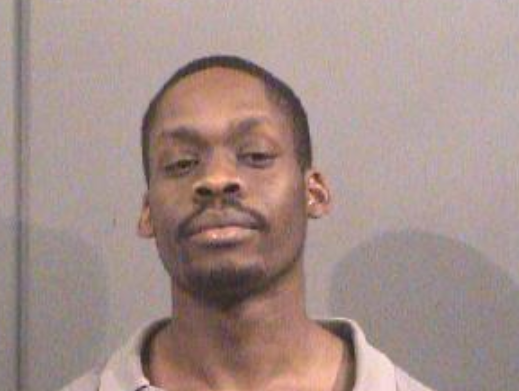
Douglas Pete photo Sedgwick Co.
Douglas Pete, of Wichita, was sentenced Friday in the death of 25-year-old Deonte Mitchell.
Mitchell was found dead in February 2018 outside a Wichita home. He was shot in the back.
District Attorney Marc Bennett said in a news release that Pete pleaded guilty Aug. 9 to second-degree murder, armed criminal action, criminal discharge of a firearm and interference with law enforcement.
Pete initially claimed the shooting was an accident.
Before sentencing, Pete apologized to Mitchell’s family but did not provide a motive for the killing.
WICHITA, Kan. (AP) — A Kansas man is blaming CVS Pharmacy for his stroke, and he says in a lawsuit that the pharmacy filled his prescription for a blood thinning medication with the wrong drug.
Ben Huie said in his lawsuit he suffered a stroke in July 2017 after taking the wrong medicine. Kansas CVS Pharmacy said in a formal response it didn’t provide the incorrect medicine or cause the stroke.
Huie says taking the incorrect medicine lowered the level of warfarin sodium in his system, which contributed to the stroke. That medicine is an anticoagulant used to treat and prevent blood clots.
Huie had filled his warfarin prescription at its store for several years without problems. Kansas CVS says Huie’s existing medical conditions contributed to the stroke.