TOPEKA, Kan. (AP) — Wichita businessman Wink Hartman is ending his campaign for governor and endorsing Kris Kobach.
Hartman said Wednesday he decided during the Kansas GOP convention last weekend. He said his main goal is making the party’s conservative platform into policy to improve Kansas.
Hartman, head of Hartman Oil Co., says he is endorsing Kobach because the secretary of state is a fighter who will not back down from a fight for conservative principles.
Kobach is running against Gov. Jeff Colyer and several others for the GOP nomination in the gubernatorial race.
When asked whether he is interested in being lieutenant governor, Hartman said he would serve in any way Kobach asks him to.
Kobach said Wednesday that he is honored to have Hartman’s support.
One of Kansas’ two foster care contractors learns another child has landed in state custody. It has four hours to pick the kid up.
A kid-friendly room in KVC’s Topeka office is decorated with a space theme. The contractor is used to having kids hanging out in kid-friendly spaces of its offices, but is still adjusting to a growing number of children spending nights there. MADELINE FOX / KANSAS NEWS SERVICE
Workers phone other child placement agencies listing the specific needs for a particular child. Family members are found and called.
If the contractor is picking up a school-aged kid, workers will call the school to get information about teachers, coaches or parents of friends who might take them. Older kids can offer their own suggestions about nearby family members. If those options don’t pan out, contractors look for shelters and group homes.
But almost a year and a half ago, placement workers started coming up empty. That’s how children ended up on couches, futons and cots in contractor offices across the state.
“I’ve been doing this for 17 years. … I had not spent the night in the office with a child — ever,” said Danielle Bartelli, president of eastern Kansas contractor KVC Kansas and a former social worker with the company.
Of all the headlines about foster care in the past year — missing kids, children harmed while in state custody, shredded documents in the state child welfare agency — it’s news about children sleeping in offices that foster care administrators say showed just how overwhelmed the state system had become.
The basic problem is just too few beds, and far too many kids who need them.
Kansas isn’t alone. Foster care systems across the country are seeing a spike in children entering care, which many states attribute to families ripped apart by the opioid crisis.
Drugs may also be a factor in the Kansas bump, though policymakers say Kansas hasn’t seen the worst of the opioid crisis. That could mean the Kansas foster care crisis gets worse before it gets better.
At the same time, some of the services intended to wrap around struggling families or kids within their own communities have taken a hit.
Kansas has 222 fewer psychiatric beds than it did in 2013, and other mental health services have struggled to find funding.
Changes to state welfare policies have dramatically cut the number of people receiving assistance, which some suggest is a factor in increasing foster care numbers. The Department for Children and Families disputes that connection.
Even in a system such as the one in Kansas — where the raw number of beds across foster homes, psychiatric facilities, shelters and group homes is close to the number of kids entering foster care — not all kids can be placed right away.
A 10-year-old boy might need care in a psychiatric residential treatment facility, but perhaps the only open beds are for girls. There might be a foster bed right in a teenage girl’s school district, but a teenage boy is sleeping in the room’s other bed — teenagers of the opposite gender can’t share a room.
With the sheer number of kids coming in, that’s likely to happen more often. So contractors are left with no better option other than an office couch, and kids feeling unwanted.
“It sends a message when kids are sleeping in offices that there isn’t a place for them.”
“Kids who are in the child welfare system are already struggling with not feeling like they belong,” said Christie Appelhanz, president of the nonprofit Children’s Alliance. “It sends a message when kids are sleeping in offices that there isn’t a place for them.”
The trend in overnight stays began for KVC Kansas in September of 2016. St. Francis Community Services, the western contractor, saw its first child sleep overnight in an office in February 2017.
From there, it grew — and it’s still growing. Last fiscal year, 108 kids slept in contractor offices. This fiscal year, with four months left to go, that number is already up to 167.
Most stayed one night, though a handful stayed two or three, or, this month, five. So far, 20 children have stayed in an office overnight in February.
Kansas repeatedly set records for the number of children in foster care over the last five years. More than 7,200 kids landed in out-of-home placements as of December 2017, up 43 percent from the same time in 2012.
Many of Kansas’ foster kids come into the system because of trauma. Some respond by acting out in ways that make it unsafe to put them with other children. They need the more intensive supervision of a residential treatment center or other psychiatric facility.
Many of the kids crashing on couches fall into that high-needs category.
Some had been physically or sexually aggressive. Some had landed in the juvenile justice system.
From January through June last year, KVC Kansas had at least two kids stay in its office who needed psychiatric care, but no residential treatment facility had room. St. Francis saw much the same pattern.
Some were older kids or sibling groups, which contractors can have a tougher time placing.
“We never want a kid to be in the office,” said Lindsey Stephenson, KVC Kansas’ vice president. “That’s always our very last option.”
The fact that it was the only option 230 times in 2017 put the contractors in a tough spot. They want to make kids as comfortable as possible when they stay in offices overnight — but putting in beds or setting up the offices as full shelters would mean surrendering to the idea that it’s become the new normal.
Though the places these kids are staying are standard offices — desks, computers, ringing phones, filing cabinets — they’re also set up with kids in mind. Both KVC Kansas and St. Francis are accustomed to having kids in their offices for supervised family visits, or for meetings with social workers, or even while they’re waiting for placement during the day.
Kids staying overnight at a St. Francis office get a toothbrush, new pajamas, their own blankets and pillows, said St. Francis vice president Diane Carver. The idea is to stick with normal bedtime routines while placement workers elsewhere in the office call around to find actual homes.
At the KVC Kansas Topeka office, volunteers painted Disney-, space- and sports-themed murals around the office. A freezer in their Olathe office’s kitchen is packed with donated meals that social workers can heat up for overnight kids. Crayon marks along an office wall show that kids have been taking some artistic license with the building, and bookshelves in a kid-friendly room are packed with movies for the nearby TV.
But when kids are sleeping there, said DCF secretary Gina Meier-Hummel, contractors and the state must do better.
“It’s not an acceptable practice,” she said. “It’s not a practice that we endorse — nor should we plan for it in the future.”
Her agency and the foster care agencies that find homes are scrambling to increase the beds available for kids — hoping contractors find something better than a couch at midnight. They’re redoubling efforts to place kids with relatives or other trusted adults, recruiting more foster parents, and pushing for more beds in shelters and psychiatric treatment facilities.
A fix won’t come quickly. Training foster parents takes time. So does opening and licensing beds in residential facilities. The number of kids entering foster care, in the meantime, is still trending up.
So KVC Hospitals, which runs the psychiatric residential treatment facilities KVC oversees, has been setting up crisis centers. Those collections of short-term beds offer a more home-like emergency placement than a couch or futon in an office.
The company opened one in Hays in September, and was scheduled to open a second in Kansas City, Kansas, in January, though that’s now been pushed back until spring.
Those crisis centers aren’t funded by KVC Kansas’ contract with the Department for Children and Families. Once they’re up and running, KVC can get the same kind of reimbursement for kids sleeping in them that it would get for other foster placements, but KVC Hospitals is picking up the tab to get them set up.
The state, too, is looking to increase emergency beds. Enhancements to DCF’s budget proposed last month would put nearly $1 million toward emergency foster care placements over the next two years. That money could pay for beds held open for kids who come in unexpectedly and can’t be placed immediately.
DCF and its contractors are also recruiting more foster families to take kids with a variety of needs, Meier-Hummel said. The state launched a $500,000 campaign to recruit more foster parents last year.
Increasing the capacity of an overloaded system, though, won’t fix the problem.
“It’s going to take a government-wide response,” said Christie Appelhanz. “That means the executive branch, the legislative branch, the judicial branch, and, quite frankly, it’s going to take increased funding.”
OLATHE, Kan. (AP) — An Olathe woman has been charged with one count of attempted capital murder after she allegedly gave her three children medication to try and kill them.
Johnson County authorities charged 37-year-old Therese Roever Wednesday. Her bond was set at $1 million.
Roever and her children were found needing medical attention in their home Monday. Police said Roever gave them information that made them believe she had given the children a substance meant to harm them.
Roever was taken to jail Monday night. The children remain hospitalized but their father said Wednesday in a statement that they are recovering and should be returning home soon.
Johnson County court records show Roever and her ex-husband have been involved in long-running litigation involving domestic issues, including child custody.
———–
OLATHE, Kan. (AP) — An Olathe woman involved in a custody dispute with her ex-husband was jailed after she allegedly gave her three children a hazardous substance before taking it herself.
The woman, 37-year-old Therese Roever, was jailed Tuesday but had not been charged in what police labeled in a news release as an attempted murder case.
When officers went to the family’s home Monday night, they found Roever and her three children needing medical attention, police said. Information she gave police indicated her children had taken a substance “meant to harm them.” It was not immediately clear what substance they were given.
The children, girl and boy twins born in 2010 and a son born in 2012, remained hospitalized Tuesday in stable condition. Roever was released from the hospital and booked into the Johnson County jail.
County court records show that Roever and her ex-husband were scheduled for a court hearing Tuesday as part of child custody case. The couple had filed numerous motions, most involving divorce proceedings, child custody and other domestic issues, since the case began in March 2015. They had filed another case beginning in 2011 and that case was dismissed in 2012.
After Tuesday’s hearing was canceled, an attorney for Roever’s ex-husband filed a request Tuesday for an emergency review hearing on the custody case.
“This motion is based on the fact that petitioner (Roever) has been arrested and booked on three counts of attempted capital murder with the children as victims,” Attorney Randy McCalla wrote in the motion.
The ex-husband was given primary custody of the children after the couple divorced in 2016, The Kansas City Star reported .
The office of Roever’s attorney, Sarah Carmody, said she was not accepting calls from reporters on Tuesday.
Record enrollments at Fort Hays State University have continued for a 17th consecutive spring with a 20th-day enrollment of 13,127, which is 474 students higher than last spring’s 12,653.
The overall increase, 3.7 percent, was on the strength of increases in all three components of Fort Hays State enrollment: on-campus enrollment increased by 23 to 4,280; Virtual College enrollment increased by 92 to 6,744; and enrollment at the university’s international partner universities increased by 359 to 2,103.
The number of Kansas students also increased, to 7,334 this spring from 7,205 in spring 2017.
“The ability to meet our strategic growth initiatives for 17 consecutive years is something we do not take for granted,” said Dr. Joey Linn, vice president for student affairs.
“The faculty and staff at FHSU work extremely hard to provide students with a quality education along with a personalized student experience,” he said. “While many universities across the country are experiencing enrollment declines, FHSU is proud to see students across Kansas, the Midwest and the world choose FHSU in record numbers.”
The numbers break down to 10,561 undergraduate and 2,532 graduate students. Enrollment in the university’s Doctor of Nursing Practice program, not included in the Graduate School count, is 34. The Doctor of Nursing Practice is FHSU’s first doctoral degree.
FHSU’s Hispanic student enrollment this spring is up across the board, from 968 last spring to 1,046 in spring 2018. That includes undergraduate and graduate enrollment. On campus is up this spring to 493 from 456 last year, and Virtual College Hispanic enrollment is 553 this year compared to 512 in spring 2017.
The string of record enrollments began in 2002, when both spring and fall enrollments set all-time highs. Each semester since has been higher than the corresponding semester from the previous year.
ABILENE— Plans to erect a 7-foot-tall bronze statue of President Dwight D. Eisenhower on the grounds of the Kansas Statehouse are going to become a reality.
On Wednesday, Governor Jeff Colyer signed SB-262 authorizing the statue. The $140,000 likeness of the Abilene native depicts the Supreme Allied Commander speaking to a group of U.S. soldiers preparing to parachute into Normandy in June 1944.
Gov. Brownback’s office took the lead in raising money for the memorial, and in late January at least $100,000 has been secured.
Colyer conducted the signing at the Eisenhower Presidential Library and Museum in Abilene.
TOPEKA – Sen. Rick Billinger (R-Goodland, 40th Dist.) will participate in several town hall meetings throughout northwest Kansas Friday, Saturday and Monday.
Following Thursday’s turn-around session, the Kansas legislature will be on break until Wed., Feb. 28.
Sen. Billinger’s tour schedule is below.
Friday, February 23, 2018
8:00 a.m. Ellis – Ellis Public Library, Community Room
11:00 a.m. Phillipsburg – Branding Iron II
1:00 p.m. Norton – Town & Country Café
3:00 p.m. Hill City – Graham Co. Court House, Commissioner’s Office
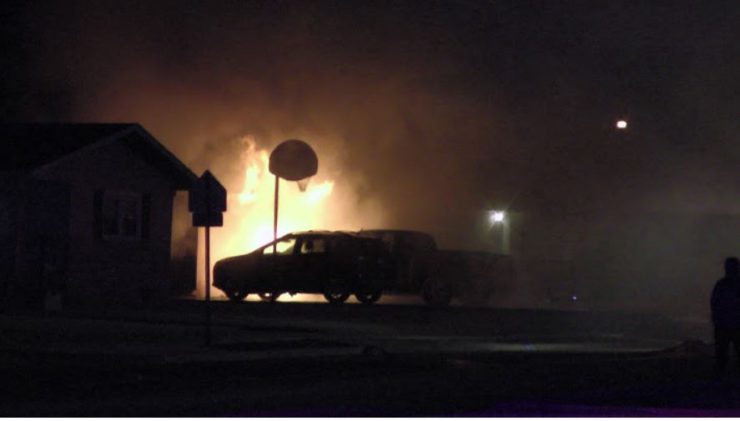
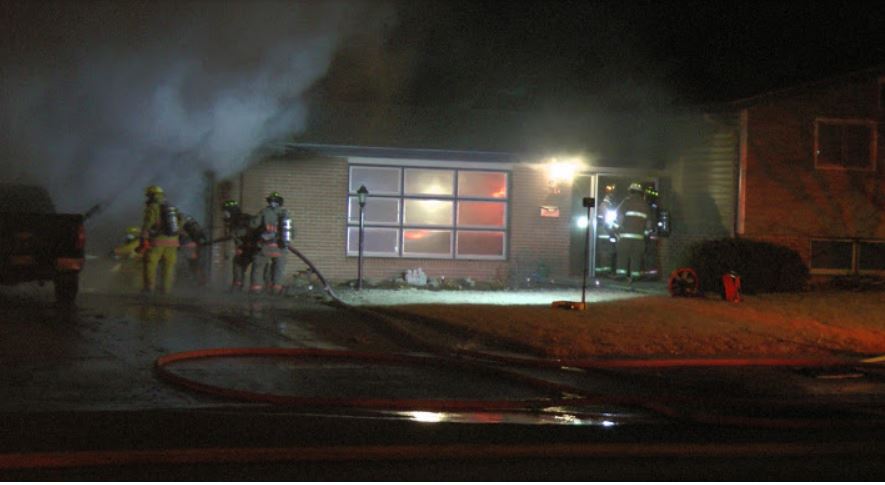
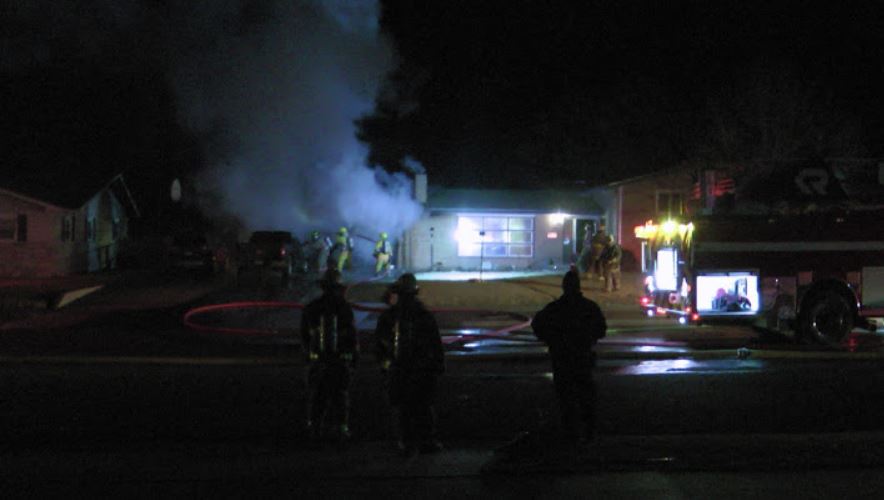
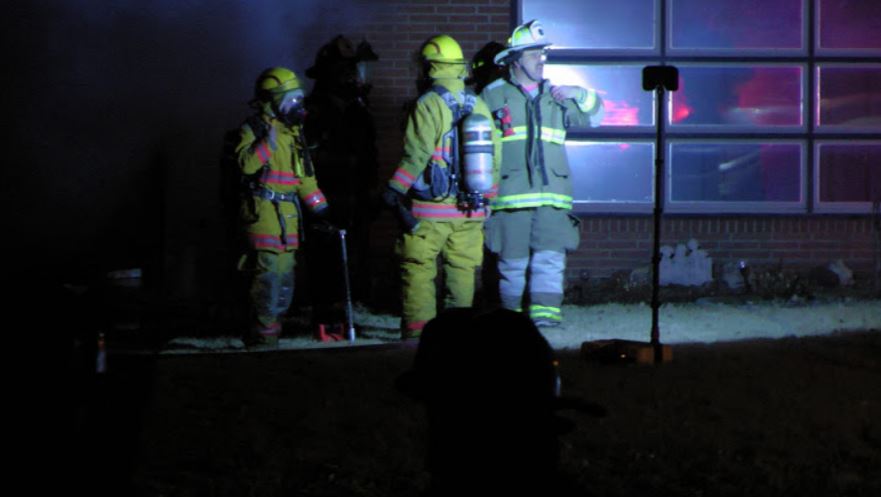
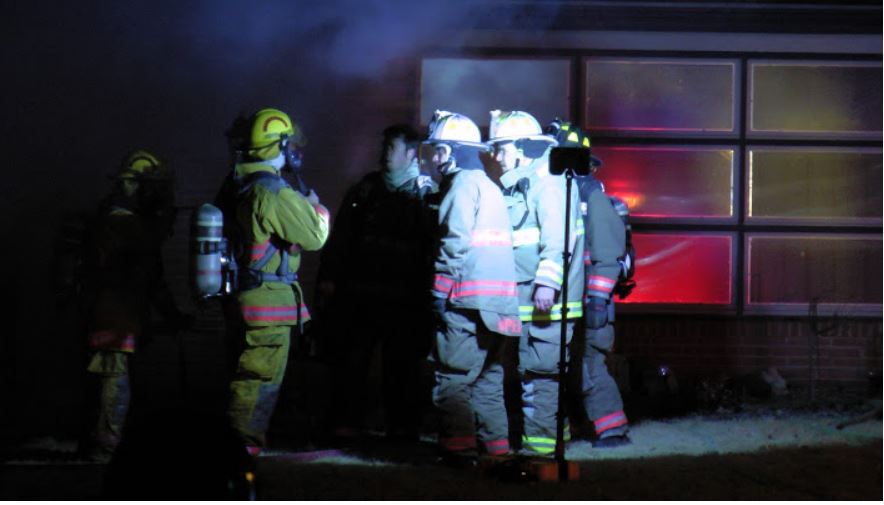
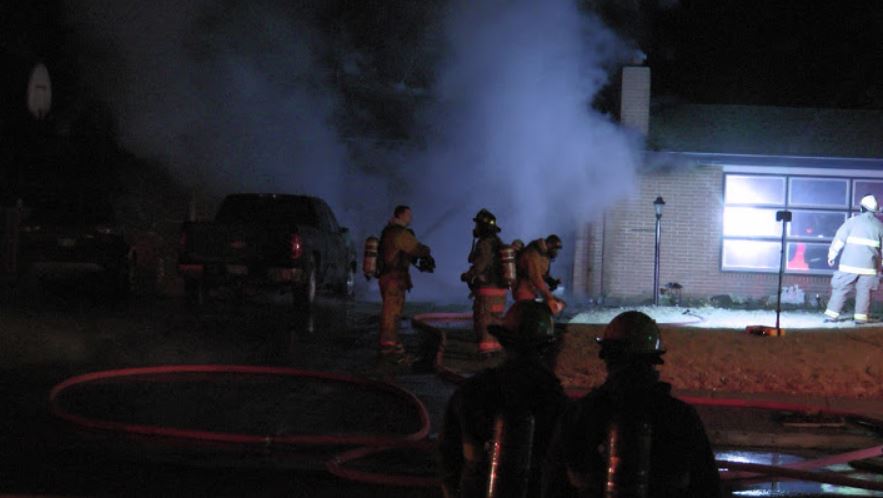
There were no injuries in the Feb. 20 fire at 207 Circle Drive in Hays. (Photos and video courtesy Darrel Goheen)
Hays Fire Department
At 9:33 PM, Tuesday, February 20, 2018, City of Hays emergency dispatchers were alerted to a building fire at 207 Circle Drive. The City of Hays Fire Department, assisted by Ellis County Fire Department Company 5, the Hays Police Department and Ellis County EMS, was immediately dispatched.
Firefighters arrived to find a large fire burning in a two car garage attached to a single family dwelling. The fire had already spread into the attached split level house and to a vehicle in the driveway. The fire department officer-in-command called for additional help from Ellis County Fire Department Company 5, Elis County Fire Department Company 6, the City of Ellis Fire Department and the City of Victoria Fire Department.
As a precaution, officers from the Hays Police Department evacuated the occupants of neighboring homes. Ellis County EMS paramedics checked the occupants of the fire building for injuries.
Four hose lines were used to bring the fire under control. The garage, the attached dwelling and the vehicle in the driveway suffered heavy fire damage. There were no firefighter or citizen injuries.
The cause of the fire is being investigated by the Hays Police Department assisted by the Hays Fire Department.
Nine fire trucks and 42 firefighters responded. Most fire crews left the scene by 12:11 AM. However, one crew of Hays firefighters remained on the scene overnight to watch for rekindle.
There were no injuries in the Feb. 20 fire at 207 Circle Drive in Hays.
A vehicle, garage and house were heavily damaged by Tuesday night’s fire.
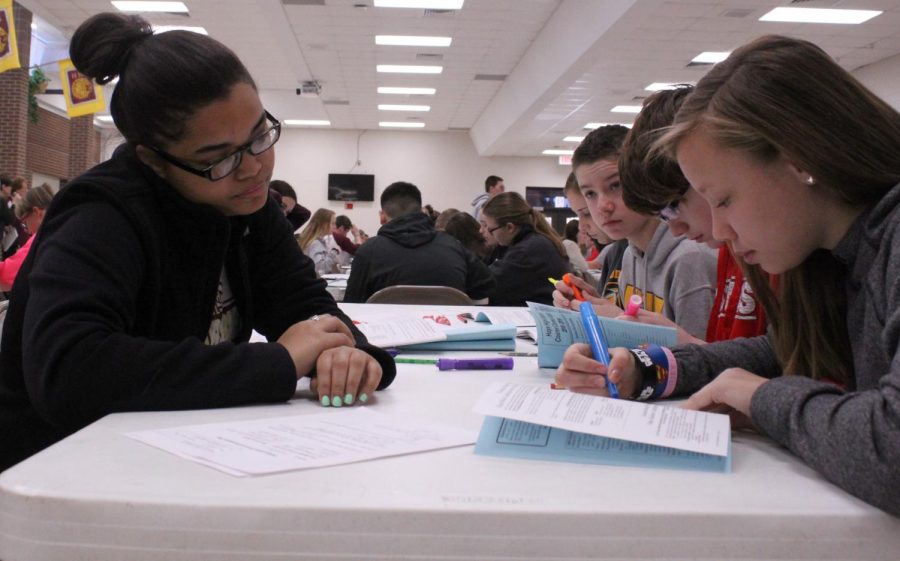
Senior Analyse Claude helps the eighth graders highlight their potential elective classes for their freshman year. The eighth graders ate lunch after filling out their work for the following year. (Photo by Drew Desbien)
In less than a year, a new class of students will be joining the high school. On Feb. 20, those students were given the opportunity to tour the high school and pre-enroll.
During the times of 8:30 a.m. and 11:30 a.m., the eighth graders spent time with Leadership Team as they showed them important parts of the school and answered any questions.
The students were split into multiple small groups and two larger groups which would tell them where to begin.
Instructor Lisa Renz speaks to the eighth graders on their tour. The students got the chance to enter classrooms, such as metals, woods, art and many more. (Photo by Zoe Martin)
“We started out in the cafeteria,” junior Cori Isbell said.
“In the cafeteria we began with using the student handbooks to introduce activities that people can get involved in at Hays High School. Then, the eighth graders highlighted their career clusters in their course guides. After that, we discussed all the courses that Hays High School will offer next year.
“During this time we also talked about what was required to graduate, eligibility and creating a schedule. To end the cafeteria portion, we had a Q&A and discussed a lot of the questions they might have.”
The event was put together by the counselors who wanted to make the transition of schools easier for the incoming freshmen.
“One, they get to really take a look at our building and hopefully get into some of our classrooms where some of our electives are,” counselor Suellyn Stenger said. “The other thing is mainly the enrollment information. They can start looking at what classes they might want for next year and getting pre-enrolled.”
WASHINGTON — The U.S. Department of Defense Tuesday identified a Kansas soldier who died Monday in Iraq as a Reno County resident.
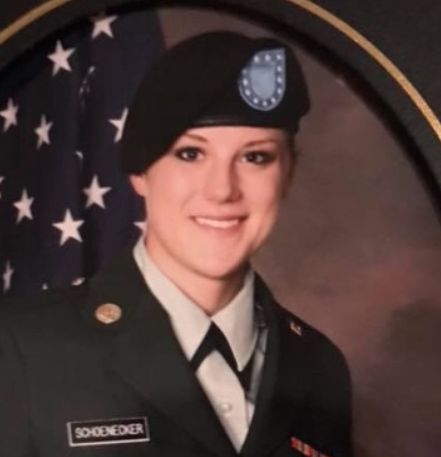
According to a release from the Department of Defense, 26-year-old Sgt. Christina Marie Schoenecker of Arlington, Kansas, died Monday in Baghdad from a non-combat related incident while supporting Operation Inherent Resolve.
According to the command, Schoenecker was a human resources specialist who joined the Army in 2009. She was promoted to sergeant in January 2015 and was completing her first deployment at the time of her death. Her awards include the Army Achievement Medal with one oak leaf cluster and the Army Reserve Achievement Medal with two oak leaf clusters.
Schoenecker grew up in the Arlington area and was a 2010 graduate of Fairfield High School, where her mother currently serves as the district nurse. According to USD 310 Superintendent Nathan Reed, a GoFundMe page has been set up through his wife’s account. The fund will go for travel, funeral and memorial expenses.
The Department of Defense says Schoenecker’s death is under investigation.
Smoky Hill Pheasants Forever Chapter 424 is having its 26th-annual banquet on Saturday, Feb. 24.
The event is open to the public and will feature games, raffles, prizes and auction items, and a chance to socialize with people who have similar interests.
“The purpose of the banquet is to raise funds that will stay here locally,” said member Shayne Wilson. “We want everybody to understand the money stays in the counties we handle, which are Ellis, Trego and Rush. Most of the money goes to our youth events, and we have a habitat program that people can apply for.”
Along with a smothered steak and ham dinner, socialization, and prizes, admission to the banquet includes a Pheasants Forever membership, which includes a one-year subscription to the Pheasants Forever Journal of Upland Conservation (five issues), and the opportunity to make a difference for habitat and conservation education locally.
Some of the auction items available at the banquet include: several firearms, a German short-haired pointer female puppy (4 weeks old), a football helmet and football signed by the Fort Hays State University football team and head coach Chris Brown, and a University of Kansas men’s basketball team autographed basketball.
The banquet will be from 5 p.m. to 8 p.m. Saturday at the Gold Building at the Ellis County Fairgrounds.
Tickets are still available, but they usually go fast as the event gets closer. For more information on tickets, you can contact Shayne Wilson at 785-432-1904.
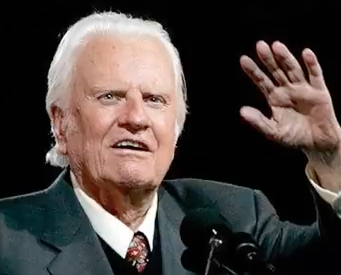
Rev. Billy Graham-photo courtesy Billy Graham Evangelistic Assn.
MONTREAT, N.C. (AP) — The Rev. Billy Graham, who transformed American religious life through his preaching and activism, becoming a counselor to presidents and the most widely heard Christian evangelist in history, died Wednesday. He was 99.
Graham, who long suffered from cancer, pneumonia and other ailments, died at his home in North Carolina, spokesman Mark DeMoss told The Associated Press.
More than anyone else, Graham built evangelicalism into a force that rivaled liberal Protestantism and Roman Catholicism in the United States. His leadership summits and crusades in more than 185 countries and territories forged powerful global links among conservative Christians, and threw a lifeline to believers in the communist-controlled Eastern bloc. Dubbed “America’s pastor,” he was a confidant to U.S. presidents from Gen. Dwight Eisenhower to George W. Bush.
In 1983, President Reagan gave Graham the Presidential Medal of Freedom, America’s highest civilian honor. When the Billy Graham Museum and Library was dedicated in 2007 in Charlotte, former Presidents George H.W. Bush, Jimmy Carter and Bill Clinton attended.
“When he prays with you in the Oval Office or upstairs in the White House, you feel he’s praying for you, not the president,” Clinton said at the ceremony.
Beyond Graham’s public appearances, he reached untold millions through his pioneering use of prime-time telecasts, network radio, daily newspaper columns, evangelistic feature films and globe-girdling satellite TV hookups. Graham’s message was not complex or unique, yet he preached with a conviction that won over audiences worldwide.
“The Bible says,” was his catch phrase. His unquestioning belief in Scripture turned the Gospel into a “rapier” in his hands, he said.
A tall, striking man with thick hair, stark blue eyes and a firm jaw, Graham was a commanding presence at his crusades. He would make the altar call in his powerful baritone, asking the multitudes to stand, come down the aisles and publicly make “decisions for Christ,” as a choir crooned the hymn “Just As I Am.”
By his final crusade in 2005 in New York City, he had preached in person to more than 210 million people worldwide. No evangelist is expected to have his level of influence again.
“William Franklin Graham Jr. can safely be regarded as the best who ever lived at what he did,” said William Martin, author of the Graham biography “A Prophet With Honor.”
Born Nov. 7, 1918, on his family’s dairy farm near Charlotte, North Carolina, Graham came from a fundamentalist background that expected true Bible-believers to stay clear of Christians with even the most minor differences over Scripture. But as his crusades drew support from a widening array of Christian churches, he came to reject that view.
He joined in a then-emerging movement called New Evangelicalism, that abandoned the narrowness of fundamentalism to engage broader society. Fundamentalists at the time excoriated the preacher for his new direction, and broke with him when he agreed to work with more liberal Christians in the 1950s.
Graham stood fast. He would not reject people who were sincere and shared at least some of his beliefs, Martin said. He wanted the widest hearing possible for his salvation message.
“The ecumenical movement has broadened my viewpoint and I recognize now that God has his people in all churches,” he said in the early 1950s.
In 1957, he said, “I intend to go anywhere, sponsored by anybody, to preach the Gospel of Christ.”
His approach helped evangelicals gain the influence they have today. Graham’s path to becoming an evangelist began taking shape at age 16, when the Presbyterian-reared farmboy committed himself to Christ at a local tent revival.
“I did not feel any special emotion,” he wrote in his 1997 autobiography, “Just As I Am.” ”I simply felt at peace,” and thereafter, “the world looked different.”
After high school, he enrolled at the fundamentalist Bob Jones College, but found the school stifling, and transferred to Florida Bible Institute in Tampa. There, he practiced sermonizing in a swamp, preaching to birds and alligators before tryouts with small churches. He still wasn’t convinced he should be a preacher until a soul-searching, late-night ramble on a golf course.
“I finally gave in while pacing at midnight on the 18th hole,” he said. “‘All right, Lord,’ I said, ‘If you want me, you’ve got me.'”
Graham, who became a Southern Baptist, went on to study at Wheaton College, a prominent Christian liberal arts school in Illinois, where he met fellow student Ruth Bell, who had been raised in China where her father had been a Presbyterian medical missionary.
The two married in 1943, and he planned to become an Army chaplain. But he fell seriously ill, and by the time he recovered and could start the chaplain training program, World War II was nearly over.
Instead, he took a job organizing meetings in the U.S. and Europe with Youth for Christ, a group he helped found. He stood out then for his loud ties and suits, and a rapid delivery and swinging arms that won him the nickname “the Preaching Windmill.”
A 1949 Los Angeles revival turned Graham into evangelism’s rising star. Held in a tent dubbed the “Canvas Cathedral,” Graham had been drawing adequate, but not spectacular crowds until one night when reporters and photographers descended. When Graham asked them why, a reporter said that legendary publisher William Randolph Hearst had ordered his papers to hype Graham. Graham said he never found out why.
The publicity gave him a national profile. Over the next decade, his massive crusades in England and New York catapulted him to international celebrity. His 12-week London campaign in 1954 defied expectations, drawing more than 2 million people and the respect of the British, many of whom had derided him before his arrival as little more than a slick salesman. Three years later, he held a crusade in New York’s Madison Square Garden that was so popular it was extended from six to 16 weeks, capped off with a rally in Times Square that packed Broadway with more than 100,000 people.
The strain of so much preaching caused the already trim Graham to lose 30 pounds by the time the event ended. It remains his longest revival meeting ever.
As his public influence grew, the preacher’s stands on the social issues of his day were watched closely by supporters and critics alike. One of the most pressing was the civil rights movement. Graham was no social activist and never joined marches, which led prominent Christians such as theologian Reinhold Niebuhr to publicly condemn Graham as too moderate. Still, Graham ended racially segregated seating at his Southern crusades in 1953, a year before the Supreme Court’s school integration ruling, and long refused to visit South Africa while its white regime insisted on racially segregated meetings.
In a 2005 interview with The Associated Press, before his final crusade which was held in New York, Graham said he regretted that he didn’t battle for civil rights more forcefully.
“I think I made a mistake when I didn’t go to Selma” with many clergy who joined the historic Alabama march led by the Rev. Martin Luther King Jr. “I would like to have done more.” Graham more robustly took on the cause of anti-Communism, making preaching against the atheist regime part of his sermons for years.
As America’s most famous religious leader, he golfed with statesmen and entertainers and dined with royalty. Graham’s relationships with U.S. presidents also boosted his ministry and became a source of pride for conservative Christians who were so often caricatured as backward. But those ties proved problematic when his close friend Richard Nixon resigned in the Watergate scandal, leaving Graham devastated and baffled. He resolved to take a lower profile in the political world, going as far as discouraging the Rev. Jerry Falwell, a founder of the Moral Majority, from mixing religion and politics.
“Evangelicals can’t be closely identified with any particular party or person. We have to stand in the middle, to preach to all the people, right and left,” Graham said in 1981, according to Time magazine. “I haven’t been faithful to my own advice in the past. I will in the future.”
Yet, in the 2012 election, with Graham mostly confined to his North Carolina home, he all but endorsed Republican presidential nominee Mitt Romney. And the evangelist’s ministry took out full-page ads in newspapers support a ballot referendum that would ban same-sex marriage.
His son, the Rev. Franklin Graham, who runs the ministry, said his father viewed the gay marriage question as a moral, not a political, issue. Graham’s integrity was credited with salvaging the reputation of broadcast evangelism in the dark days of the late 1980s, after scandals befell TV preachers Jimmy Swaggart and Jim Bakker.
He resolved early on never to be alone with a woman other than his wife. Instead of taking a share of the “love offerings” at his crusades, as was the custom, he earned a modest salary from the Billy Graham Evangelistic Association.
His ministry was governed by an independent board that included successful Christian businessmen and other professionals — a stark departure from the widespread evangelical practice of packing boards with relatives and yes-men.
“Why, I could make a quarter of a million dollars a year in this field or in Hollywood if I wanted to,” Graham said. “The offers I’ve had from Hollywood studios are amazing. But I just laughed. I told them I was staying with God.”
While he succeeded in preserving his reputation, he could not completely shield his family from the impact of his work. He was on the road for months at a time, leaving Ruth at their mountainside home in Montreat, North Carolina, to raise their five children: Franklin, Virginia (“Gigi”), Anne, Ruth and Nelson (“Ned”).
Anne Graham Lotz has said that her mother was effectively “a single parent.” Ruth sometimes grew so lonely when Billy was traveling that she slept with his tweed jacket for comfort. But she said, “I’d rather have a little of Bill than a lot of any other man.” She died in June 2007 at age 87.
“I will miss her terribly,” Billy Graham said, “and look forward even more to the day I can join her in heaven.”
In his later years, Graham visited communist Eastern Europe and increasingly appealed for world peace. He opened a 1983 convention of evangelists from 140 nations by urging the elimination of nuclear and biological weapons.
He told audiences in Czechoslovakia that “we must do all we can to preserve life and avoid war,” although he opposed unilateral disarmament. In 1982, he went to Moscow to preach and attend a conference on world peace. During that visit, he said he saw no signs of Soviet religious persecution, a misguided attempt at diplomacy that brought scathing criticism from author Alexander Solzhenitsyn, among others.
“It’s worth taking a risk for peace,” Graham contended, although he was clearly stung by the controversy.
Graham’s relationship with Nixon became an issue once again when tapes newly released in 2002 caught the preacher telling the president that Jews “don’t know how I really feel about what they’re doing to this country.”
Graham apologized, saying he didn’t recall ever having such feelings and asking the Jewish community to consider his actions above his words on that tape. Health problems gradually slowed Graham, but he did not cease preaching.
In 1995, his son, Franklin, was named the ministry’s leader. Along with the many honors he received from the evangelical community and the Presidential Medal of Freedom, Graham received the $1 million Templeton Prize for Progress in Religion in 1982 and the Congressional Gold Medal in 1996.
Graham will be buried by his wife, Ruth, at the Billy Graham Museum and Library.
“I have been asked, ‘What is the secret?'” Graham had said of his preaching. “Is it showmanship, organization or what? The secret of my work is God. I would be nothing without him.”
___
The Rev. Billy Graham, who transformed American religious life through his preaching and activism, becoming a counselor to presidents and the most widely heard Christian evangelist in history, has died.
Spokesman Mark DeMoss says Graham, who long suffered from cancer, pneumonia and other ailments, died at his home in North Carolina on Wednesday morning. He was 99.
Graham reached more than 200 million through his appearances and millions more through his pioneering use of television and radio. Unlike many traditional evangelists, he abandoned narrow fundamentalism to engage broader society.