First responders on the scene of the head-on crash Wednesday-photo courtesy WIBW TV
JEFFERSON COUNTY — Three people were injured in an accident just before 2p.m. Wednesday in Jefferson County.
The Kansas Highway Patrol reported a 2006 Pontiac G6 driven by Jessica Lynn Harvey, 41, Topeka, was eastbound on U24 at Kiowa Road. The vehicle crossed the center line crashing head on into a 1991 Jeep Cherokee driven by Caitlyn Marie Midyett, 26, Topeka.
Harvey Midyett were transported to KU Medical Center. A passenger in the Jeep Nathan Bingham, 4, Topeka, was transported to the hospital in Topeka. All there properly restrained at the time of the accident, according to the KHP.
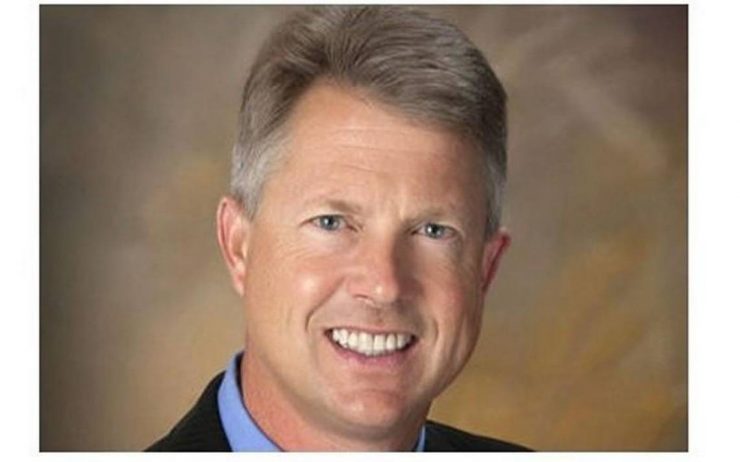
Dr. Roger Marshall, R-Great Bend, is the First District Kansas Congressman.
strong>OFFICE OF REP. MARSHALL
Washington D.C.- Today Congressman Roger Marshall’s bill, H.R. 4675 the Low Dose Radiation Research Act of 2017, passed through the Science, Space, and Technology Committee.
The Low Dose Radiation Research Act of 2017 will provide doctors and government agencies with concrete evidence-based research on the effects that low-dose radiation exposure has on our population.
This legislation is long overdue. Currently, there is ample data that demonstrates the harmful effects that high-dose radiation has on the human body. Yet, as it stands today, there are few measurements or studies seeking to understand low-dose radiation’s effects. This absence of evidence does not give the medical community or government regulators the ability to accurately assess and make the very best decisions for their patients.
“Every day our citizens are exposed to low-dose radiation. Throughout history, radiation has provided vital tools to physicians, from x-rays and CT scans to cutting-edge cancer treatments. Yet we have a limited understanding of the health risks associated with this exposure,” Marshall said. As a doctor, I understand the critical value of verified-research that helps physicians ensure the best medical outcomes for patients.
For example, an adult patient who receives a C.T. (computed tomography) scan of their torso is exposed to approximately three years’ worth of background radiation in one scan. While this type of screening is very valuable to countless Americans and often replaces invasive surgical procedures, we physicians are unable to quantify the specific health risks associated with this type of imaging. Advances in radiation therapy have literally changed survival rates for many cancer patients, and saved thousands of lives. It is important as radiation screening increases that our doctors have a clear understanding of the health risks associated with this exposure.
Physicians must know the risks of this exposure and have access to extensive up-to-date data and research. This bill will provide just that, by directing the Department of Energy to start long-term verified low dose radiation research and studies.
I am proud that my colleagues voted with bipartisan support for H.R. 4675. It is no surprise that my friends on both sides of the aisle are supporting a plan that will help doctors and patients across the country give and receive the best medical care possible. I hope we can take swift action to pass this through the House.”
The Low Dose Radiation Research Act of 2017 has received support from the Health Physics Society, the American Association of Physicists in Medicine, the National Council on Radiation Protection and Measurements, and leading researchers from Northwestern University and Columbia University.
The Low Dose Radiation Research Act of 2017 will:
Direct the Department of Energy (DOE) to carry out a basic research program on low dose radiation within the Office of Science;
Direct DOE to identify ongoing scientific challenges in low dose radiation research and to develop a long-term basic research plan that addresses these challenges while leveraging the existing body of scientific knowledge and engaging with the international research community;
Direct DOE to ensure that in carrying out this program, the Office of Science consults with the National Aeronautics and Space Administration, the National Institutes of Health, the Environmental Protection Agency, the Department of Defense, the Nuclear Regulatory Commission, and the Department of Homeland Security;
Require DOE to provide Congress with a 4-year research plan that identifies and prioritizes basic research needs relating to low-dose radiation within 180 days of enactment;
Authorize funds for low-dose radiation research from within funding provided to the Biological and Environmental Research Program within the DOE Office of Science.
OLATHE, Kan. (AP) — A former Olathe School teacher and coach has admitted to having a sexual relationship with a student.
Michael Jasiczek pleaded guilty Wednesday in federal court to two federal charges involving having sex with a student over the age of 16. A third charge was dropped.
Prosecutors determined the relationship was consensual. But under state law, it is a felony for teachers and authority figures to have sexual relationships with students at the same school.
Jasiczek, a social science teacher and assistant football coach, was placed on administrative leave in May and was later fired.
He was a teacher at Olathe South High School for more than a decade. He coached football, ran a weightlifting club and was called “Coach Jazz” by students and staff.
KANSAS CITY, KAN. – A Kansas woman was indicted Wednesday on charges of producing child pornography, according to U.S. Attorney Tom Beall.
Kayla Michelle Simpson, 22, Junction City, is charged with one count of using a child to produce child pornography and one count of violating the conditions imposed on a registered sex offender. The crime is alleged to have occurred in July 2016 in Junction City.
The indictment alleges that Simpson, who was registered sex offender, enticed a 16-year-old victim to engage in sexual activity for the purpose of producing child pornography.
If convicted, Simpson faces a penalty of not less than 15 years and not more than 30 years in federal prison on the production charge, and up to 10 years and a fine up to $250,000 on the sex offender charge. The FBI investigated. Assistant U.S. Attorney Christine Kenney is prosecuting. Simpson has a previous conviction for indecent solicitation of a child, according to the Kansas Department of Corrections.
Photo of the crash scene courtesy Overland Park Police
PRAIRIE VILLAGE, Kan. (AP) — The family of a pregnant woman who died when the vehicle she was in was hit by a driver fleeing police is suing the city of Prairie Village.
The lawsuit was filed by the husband and two children of Denisse Lopez, who died in January 2016.
The crash occurred in Overland Park when 23-year-old Raphael Sherman, of Shawnee, was trying to escape Prairie Village police. He ran a red light and hit the vehicle Lopez was riding in. The lawsuit alleges the chase was unsafe because of traffic conditions.
Lopez’s baby boy was successfully delivered before she died.
Sherman is serving a prison sentence of nearly 12.5 years after pleading guilty to second-degree murder.
City Administrator Wes Jordan said the city will not comment on the lawsuit.
OVERLAND PARK, Kan. (AP) — An elder of a Kansas City church is jailed without bond in the death of his wife, who was an associate pastor.
Johnson County, Kansas, jail records show that 30-year-old Robert Lee Harris, of Overland Park, Kansas, is being held on suspicion of first-degree murder. No charges have been filed in the death of his wife of 18 months, 38-year-old Tanisha Harris.
The Kansas City Star reports that she was an associate pastor at Repairers Kansas City, a non-denominational church. Pastor Carlton Funderburke described the newlyweds as “loving” and said there were “no signs at all” of trouble.
Police said officers responded Monday to the couple’s apartment about a domestic disturbance and returned when Harris reported that his wife was missing. Her body was found later in Raymore, Missouri.
AAA Kansas offers tips for winter driving, vehicle care and emergency car kit preparedness
TOPEKA– Weather forecasts are calling for a wintry mix of sleet, freezing rain and snow overnight and into Thursday morning across Kansas. This winter blast may create dangerous driving conditions late tonight and for the Monday morning commute. AAA Kansas anticipates a large increase in emergency roadside service calls as the cold front sweeps through and weather conditions deteriorate, with slide-offs and crashes due to slick roads expected, and battery/non-start problems due to the cold also likely.
Hazardous storms and inclement weather are a factor in more than half a million crashes and more than 2,000 road deaths every winter, according to research from the AAA Foundation for Traffic Safety. AAA Kansas is encouraging drivers to be prepared.
Winter precipitation may challenge drivers even before they attempt to leave home tomorrow morning. AAA recommends drivers take action before icing conditions begin:
Protect vehicle: If possible park car inside garage or under a cover like a carport.
Dry and lubricate surfaces: Wipe down and dry weather strips and surfaces around doors and windows. Apply a lubricant (WD40, cooking spray and even Vaseline work well) to the weather stripping to prevent freezing.
Windshield wipers: Pull wipers away from your windshield to prevent them from freezing to the windshield.
Use the right windshield washer solvent: Make sure windshield washer solvent is the correct type for winter. Summer rated solvents will freeze and can cause cracking and serious damage to the washer reservoir.
AAA offers these tips after icing conditions affect vehicles:
Ice coated windshield/windows: NEVER pour hot water on windshield or windows – this can cause the glass to break. Use vehicle defrosters to melt ice for easier removal. Don’t use windshield wipers to remove ice – this will damage the blades.
Frozen windows: Do not continue to push the power window buttons if the window is frozen, it can damage the mechanics inside the door and can also cause the window to break.
Frozen locks: Never use water to thaw frozen locks, instead use commercial deicing products or heat the key and lock with a hair dryer. A lighter can also be used to heat the key.
Frozen windshield wipers: If windshield wipers are frozen to the windshield, use the heater and defroster to melt the ice before turning the windshield wipers on. When you arrive at your destination, remember to pull the windshield wipers away from the windshield to prevent refreezing.
Drivers are urged to use caution if wintry weather occurs because snowy or ice-coated roadways can be treacherous.
“Motorists should heed travel warnings and stay home unless they absolutely must venture out,” AAA Kansas spokeswoman, Jennifer Haugh said. “AAA is reminding anyone who must drive on icy or snow covered roads to adjust their driving behaviors for the conditions and to go nowhere – not even a short distance – without a full tank of gas, a fully charged cell phone (loaded with the AAA Mobile App) and a fully stocked emergency kit.”
AAA offers the following safe driving tips for winter weather:
Slow down: Accelerate, turn and brake gradually. Adjust your speed to the road conditions and leave yourself ample room to stop. Allow at least three times more space than usual between you and the car in front of you.
Do not tailgate: Normal following distances of three to four seconds on dry pavement should be extended to a minimum of eight to ten seconds when driving on slippery surfaces. The extra time will provide additional braking room should a sudden stop become necessary.
Watch the traffic ahead: Slow down immediately at the sight of brake lights, fishtailing cars, sideways skids or emergency flashers ahead.
Never use cruise control on slippery roads: Patches of ice can cause unexpected wheel spin and use of cruise control can slow driver response.
Avoid unnecessarily changing lanes: This increases the chances of hitting a patch of ice between lanes that could cause loss of vehicle control.
Use extreme caution on bridges and overpasses: Black ice typically forms first in shaded areas of the roadway and on bridges and overpasses that freeze first and melt last. Although the road leading up to a bridge may be fine, the bridge itself could be a sheet of ice.
Move Over: Move over one lane for law enforcement and emergency roadside personnel assisting motorists. It is the law. If you are unable to move over, slow down.
Carry a winter weather kit in your car: Contents should include a fully charged cellphone (and car charger), ice scraper, blanket, warm winter clothing, flashlight with extra batteries, jumper cables, a bag of kitty litter or sand for traction, reflective triangles/flares, snow shovel and extra drinking water and snacks.
Tips for Braking on Ice:
Minimize the need to brake on ice: If you’re approaching a stop sign, traffic light or other area where ice often forms, brake early on clear pavement to reduce speed. Maintaining control of your vehicle is much more difficult when braking on ice-covered roadways.
Control the skid: In the event of a skid, ease off the accelerator and steer in the direction you want the front of the car to go.
If your car has an anti-lock braking system (ABS): Do not remove your foot from the brake during a skid. When you apply the brakes hard enough to make the wheels lock momentarily, you will typically feel the brake pedal vibrate and pulsate back against your foot. This is normal and the system is working as designed. Do not release pressure on the pedal or attempt to “pump” the brakes.
If your car does not have an anti-lock braking system: Keep the heel of your foot on the floor and use the ball of your foot to modulate the pressure applied to the brake pedal so the brakes are at the “threshold” of lockup but still rotating.
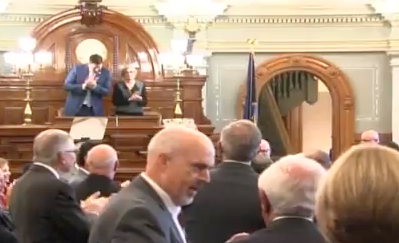
Kansas legislators before Tuesday’s State of the State address in Topeka-photo courtesy office of Governor
TOPEKA, Kan. (AP) — Departing Kansas Gov. Sam Brownback is counting on growing tax revenues from a strong national economy to pay for his proposal to increase spending on public schools, stoking an open revolt Wednesday among fellow Republicans in the Legislature.
The term-limited conservative Republican governor released budget proposals that were supposed to flesh out his plan to phase in a $601 million increase in education funding to meet a court mandate. But his recommendations contained no way to pay for the increase other than relying on growing revenues, and no fiscal projections beyond mid-2019.
Top GOP lawmakers already were upset by the idea even before Brownback outlined his school funding proposal in his eighth and final State of the State address Tuesday evening. They fear they would be forced to consider raising taxes or making deep cuts elsewhere while also shorting public pensions and highway projects next year, when Brownback is out of office.
“I’m not sure what the logic is behind it,” said state Sen. Ty Masterson, a conservative Wichita-area Republican and usual ally of Brownback. “That’s irresponsible, to propose that much new spending without understanding where it’s coming from.”
Brownback’s proposed $16.8 billion budget for the fiscal year beginning in July would leave the state with a small cushion of cash reserves at the end of June 2019, without requiring another tax increase. Lawmakers approved a $600-million-a-year income tax increase last year over Brownback’s veto to help balance the budget.
Lawmakers must come up with more money for schools after the Kansas Supreme Court ruled in October that the state isn’t meeting its funding obligations under the state constitution. Lawmakers have been debating whether the court would accept an increase phased in over multiple years. The $601 million increase touted by Brownback includes $88 million appropriated last year in a previous effort to satisfy the court.
The governor’s proposed budget also includes extra spending to continue pay raises granted in the fall for officers in the state’s stressed prison system, cover gaps in funding for state mental hospitals and raise reimbursements for hospitals and nursing homes providing services to the poor and elderly.
“Thankfully, we have the benefit of a strong national economy that’s on the uptick,” Shawn Sullivan, the governor’s budget director, told reporters during a briefing on the proposals. “The strong revenue growth helps our budget situation.”
Brownback must leave office in January 2019 but President Donald Trump nominated him in July as U.S. ambassador-at-large for international religious freedom. The U.S. Senate’s failure to vote on Brownback’s appointment has created an awkward transition to a new governor.
And top Republican legislators were angry because Brownback strongly criticized last year’s tax increase, which rolled back past income tax cuts he’d championed in 2012 and 2013 following persistent budget woes. He accused them of using the new revenues to finance unnecessary spending.
House Majority Leader Don Hineman, a moderate Republican from western Kansas, described the budget proposal as “a fantasy.”
Senate Majority Leader Jim Denning, a conservative Kansas City-area Republican, initially called Brownback’s proposal “insulting” and said Wednesday after seeing more details, “It doesn’t look any better.”
Brownback’s administration worked on its budget proposals for weeks, allowing hints to leak to lawmakers early.
Republican legislative leaders already had shown their displeasure with Brownback by blocking a plan to build a new prison in the Kansas City area and by criticizing a proposal to have private insurance companies administer the state’s Medicaid health coverage for the poor, disabled and elderly.
Sullivan acknowledged Wednesday that nothing in Brownback’s budget recommendations is likely to quiet the furor.
Legislators already are reviewing projections from their staff showing that even with last year’s tax increase and no extra money for schools, budget problems could arise in 2020 and 2021.
Even Democrats, seeing new funds for schools as desirable, considered Brownback’s proposal unworkable.
“There’s a mean-spiritedness to this because he’s putting the Legislature in a tough position by making these recommendations for all of this spending, which we can’t afford,” said state Sen. Laura Kelly, a Topeka Democrat running for governor. “We’re going to have to be the bad guys.”
Two Ellis County commissioners also ignored one of the basics of our democracy “one is innocent until proven guilty.” Commissioner Marcy McClelland has not been convicted of any illegal activity, as Commissioner Barbara Wasinger implies.
As for impeding development in Ellis County, the county currently has 20+ subdivisions and four incorporated areas that have adequate space for expansion. Further expansion is GREED, not need.
As for potential tax revenue, if one would do their homework, they would know that to provide the infrastructures for suburban development costs more than the tax revenue from that development generates.
I doubt seriously that 29,000 county taxpayers know a great deal about the development in question or even care, unless they knew a portion of their taxes would subsidize the provision of infrastructures for a private development.
The seven homeowners have a right to be concerned over the development. They have invested hundreds of thousands of dollars in their homes, which by the way, they already pay taxes on.
Subdivisions are great when needed but all of the preliminary work must be done before they are approved. If this site would have had an adequate geologic and hydrologic study completed, there would be less need to question the adequacy of a water supply or the capacity of waste water disposal.
I would also note that this property is some of the best farmground in the county, and ask if we need to reduce our food producing capacity in an ever-growing world.
TOPEKA – On February 18-19, the Kansas 4-H program will host Citizenship in Action, a program that seeks to inform 13-18 year-olds on how their state government functions.
Activities include mock legislative sessions in the House and Senate Chambers, meetings with elected officials, and tours of the Capitol.
For any student who wishes to apply, the fee is $170. Rep. Troy Waymaster, R-Bunker Hill, is offering a scholarship to the event for one Kansas 4-H student that resides in the 109th Kansas House District. To apply for the scholarship interested students should email a letter to Rep. Waymaster by January 29th, 2018, stating why they want to attend the event and what they hope to learn from participation in the program. Rep. Waymaster’s email address is [email protected].
Rep. Troy Waymaster, (R-Bunker Hill), 109th Dist.
“I look forward to hearing from students in the 109th District,” Waymaster said. “This is a great learning opportunity, and as a former 4-Her, the value of what is learned during Citizenship in Action is immeasurable.”
The deadline for scholarship submissions is January 29th, Kansas Day.
Brackets for the upcoming Mid-Continent League basketball tournaments were released on Wednesday. The play-in games will begin Saturday, Jan. 13.
Girls bracket
The Smith Center Lady Red are 8-0 and earned the No. 1 seed. They will play the winner of Saturday’s feather bracket game between Plainville (4-4) and Oakley (3-5) on Monday, Jan. 15 in Smith Center.
Click on bracket to view
The winner of that game will play the winner of the four vs. five matchup between Stockton (6-2) and Trego (6-2) in Plainville on Jan. 19. The losers will also play each other in Stockton on Jan. 18.
TMP earned the second seed with an 8-1 record. The will play the winner of Saturday’s feather bracket game between Ellis (5-3) and Phillipsburg (1-7) on Monday in Hays.
Hill City (5-1) is the No. 3 seed and will host Norton (6-2) on Monday with the winner of that game playing the winner of the TMP game on Jan. 19 in Plainville. The losers will also play each other in Stockton on Jan. 18.
Boys bracket
The Phillipsburg Panthers (7-1) are the No. 1 seed on the boy’s side and will host the winner of Saturday’s feather bracket game between Trego (2-6) and Smith Center (2-6) on Tuesday.
Click on bracket to view
Oakley (5-3) is the No. 4 seed and will host Ellis (4-4) on Tuesday. The winner players the winner of the Phillipsburg game on Friday, Jan. 19 in Plainville. The losers will also play each other in Stockton on Jan. 18.
TMP earned the No. 2 seed with a 7-2 record and will play the winner of Saturday’s feather bracket game between Stockton (3-5) and Hill City (1-5).
Plainville (5-3) is the No. 3 seed and will host the six seed Norton (3-5) on Jan. 16. The winner will then play the winner of the TMP game on Jan. 19 in Plainville and the loser will also play each other in Stockton on Jan. 18.
KANSAS CITY (AP) — A Kansas man has been convicted of fighting with and threatening law enforcement officers at the federal courthouse in Kansas City, Missouri.
A federal jury on Tuesday found 31-year-old James Everett, of Kansas City, Kansas, guilty of three charges arising from a confrontation in March 2016.
Prosecutors say when Everett was about 10 yards from the courthouse entrance when he began yelling and demanding to speak to a federal judge. When four federal officers responded, Everett threatened to shoot the officers. Four federal officers and two Kansas City police officers were needed to restrain Everett.
Three federal officers received medical treatment after the encounter.
Investigators later found a handgun in Everett’s car. Because he was a convicted felon, Everett was not allowed to own a weapon.