

There is no question that Americans could use a lesson or two on the Constitution and its amendments. The Freedom Forum Institute’s 2019 State of the First Amendment survey found that only 29 percent of respondents could name freedom of religion as one of the five freedoms safeguarded by the First Amendment. To protect religious freedom, we must educate the public about our inalienable rights.
But what should educators and legal literacy advocates do when people know the law but do not care if authority figures violate it? That is the question raised by a recent survey of teenagers, ages 13 to 17, conducted by the Pew Research Center.
On Oct. 3, Pew published the results of a national survey of American teenagers designed to provide insight into religious activities conducted in American public schools. Their findings are a treasure trove for those who care about religion and education, not least because it is the first large-scale, national survey that asks teens themselves about their experiences with religion in schools.
Some findings might not surprise readers. For example, 53 percent of teens report that they often or sometimes see other students wearing clothing or jewelry with religious symbolism such as the hijab, turban, cross, or Star of David. And 39 percent of respondents say they often or sometimes see other students pray before sporting events.
But another finding should shock Americans committed to religious freedom: 29 percent of students simultaneously know that teacher-led prayer is unconstitutional, but still think it is appropriate.
On the one hand, teachers can be proud of the fact that 82 percent of teens in public schools correctly answer the question, “According to rulings by the U.S. Supreme Court, is a public school teacher permitted to … lead class in prayer?” The answer is, of course, no — though the U.S. Department of Education has affirmed that student-led, student-initiated prayers are allowed when conducted alone or in groups before, during or after the school day, as long as they do not disrupt student activities or teacher instruction.
However, 41 percent of teens say that it is “appropriate” for a teacher to lead a class in prayer. Across multiple religious groups (e.g. evangelical Protestant, mainline Protestant, Catholic and unaffiliated), fewer students say teacher-led prayer is constitutional than appropriate. For example, only 18 percent of evangelical and 13 percent of unaffiliated students say incorrectly that teacher-led prayer is constitutional, but 68 percent of evangelical and 25 percent of unaffiliated students say that teacher-led prayer is appropriate.
Memorizing the five freedoms of the First Amendment will not solve this problem. The data shows that an encouraging percentage of American public school students already know that teachers should not lead students in prayer. Perhaps teachers have covered the U.S. Supreme Court’s 1962 decision in Engel v. Vitale in government or U.S. history courses. Or perhaps students learn about the prohibition against teacher-led prayer from the media, parents or religious communities. In any case, lack of knowledge is not the issue.
The problem is more fundamental: students do not seem to understand why it is important to preserve a religious freedom principle as foundational as the non-establishment of religious practice by public schools.
Students may have different reasons for finding teacher-led prayer appropriate but unconstitutional. Some religious students might think that the U.S. Supreme Court wrongly prohibited teacher-led prayer and they might consider it good to defy the court to protect religion. Other students might be more ambivalent. Perhaps they know the rule about teacher-led prayer, but they do not think enforcement — or lack thereof — affects their lives.
The reality could not be more different. Upholding religious freedom protections is in the interest of every student, whether religious or not, in a country that is rapidly becoming a nation of religious minorities. And the careful balance struck by the Establishment and Free Exercise clauses of the First Amendment — which has compelled the court to strike down teacher-led prayer — actually protects religious communities from harmful government interference or cooptation. Plus, religious communities can never be sure that a government body will not write prayers that contradict their sincerely held beliefs.
So how can educators close the gap between students’ knowledge and commitment to religious freedom?
Students should learn why the current constitutional order matters. To do this, legal literacy education will need to move beyond the memorization of constitutional amendments and court cases. Teachers should help students understand why religious freedom protections — like the prohibition against teacher-led prayer — benefit people of all religions and none. And students should learn about the negative social and political consequences of religious freedom violations. Inquiry-driven coursework should offer students opportunities to explore cases, both historical and contemporary, which demonstrate why students should protect the rights safeguarded by the First Amendment. Without the ability to articulate why religious freedom matters, students will not care whether or not people in authority transgress longstanding rules protecting it.
And, in the spirit of the Williamsburg Charter, published on the 200th anniversary of Virginia’s call for a Bill of Rights, students should learn that their rights are best guarded when they accept the responsibility to protect those rights for others, including those with whom they strongly disagree.
Pew has offered a glimpse of students’ attitudes toward religious freedom in schools, but there is so much more to learn. I suspect that the disconnect between students’ knowledge about the law and their commitment to the law and its underlying principles extends far beyond the realm of religious freedom to other rights. Thankfully we do not need more data to start improving the way we teach about the laws that bind us out of many into one.
Benjamin P. Marcus is religious literacy specialist at the Religious Freedom Center of the Freedom Forum Institute. His email address is: [email protected].

LAWRENCE — A renowned 1992 sketch on “Saturday Night Live” follows newly elected President Bill Clinton as he and Secret Service agents jog into McDonald’s. When a customer asks if he’s in favor of sending U.S. troops to Somalia, Clinton (played by Phil Hartman) provides his own humanitarian aid metaphor by grabbing McNuggets from other customers and claiming “it’s being intercepted by warlords.”
“And you can send all the food you want,” he says filching various items, “a McDLT, hot apple pie … it’s just gonna end up with the warlords!”
But many scholars also agree with this satirical assessment, proclaiming humanitarian food aid increases the risk and longevity of civil conflict in countries that receive it.

Not true says Sébastien Mary, an academic program associate in the University of Kansas Department of Economics. His new article, “Humanitarian Food Aid and Civil Conflict,” appears in the current issue of World Development.
“There is still a misguided belief that it can create more evil than help,” Mary said.
“When I think about what food aid does, you’re gonna have positive effects and negative effects. But I have a hard time understanding why — or haven’t seen a clear explanation for why — the negative effects should dominate the positive ones.”
A 2014 article contending U.S. food aid “increases the incidence and duration of civil conflict,” published in the American Economic Review by Nathan Nunn and Nancy Qian, propelled Mary into challenging this assertion.
“When I first read it, I was like, ‘That’s kind of suspicious,’” he said. “You have a lot of anecdotes. But to extend the anecdotal evidence and case studies and say, ‘It doesn’t work’ — scientists rarely make that step, but policymakers do.”
So he recruited a colleague to help him study the methods used to come up with this assumption.
“I realized there were flaws in the way they ran the analysis. We wanted to address this and see whether we could first replicate their work making the same mistake, then correct the mistake and see what happened,” Mary said.
His research for the article (co-written with Ashok Mishra of Arizona State University) estimates the effect of food aid on civil conflict by sampling 79 recipient countries between 2002-2017. He found a 10 percent increase in this aid per capita decreases the incidence of conflict by a 0.2 percentage. It also decreases the onset and duration of such conflicts.
“Humanitarian food aid saves lives,” Mary said.
A surprisingly few amount of cross-national studies have been performed on this topic – only about four or five, according to Mary.
“Before I did this paper, I wrote another looking at three other cross-national studies that examined humanitarian aid overall. And when I looked at the studies, I replicated three and overturned the results in two. I was like, ‘Wow, we have a problem,’” said Mary, who began working at KU in January.
He believes his own research will be equally scrutinized … and possibly overturned. In the piece, he provides the data and computer code his team used so others can attempt to replicate his results.
“It will probably be criticized for a couple of things that we discussed in the paper that we stated might be a problem,” he said of baseline issues such as migratory flows. “But the one thing I think helped us get confidence is the fact we can replicate the results from the previous study.”
A native of Rennes, France, Mary has written extensively on global food and nutrition security. This includes articles on food trade and extreme hunger and a book titled “The Eurasian Wheat Belt and Food Security.”
Prior to his academic track, he worked for the European Commission in a research center focused on agriculture and rural development in what he terms “evidence-based policymaking.”
“It’s only going to get worse,” Mary said of the strain on humanitarian aid in conflict regions.
“You’re going to have a population of 9 billion people within 25 years. The stress on the food systems is only going to increase, and with that the competition for the planet’s resources will increase. This will be an eternal problem. Hence the need to better understand how and whether aid works.”


SHAWNEE COUNTY — Law enforcement authorities are investigating a Kanas felon and a passenger in his vehicle on charges after a traffic stop.
On Friday, a deputy from the Shawnee County Sheriff’s Office conducted a traffic stop for a registration violation near SW 37th and S.Topeka Boulevard, according to St. Todd Stallbaumer.
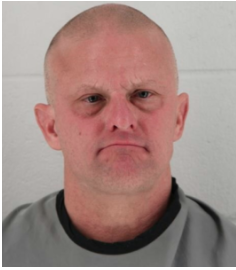
During the investigation, the driver, identified as Edgar B. Branch IV, 47, of Oskaloosa, was arrested booked into the Shawnee County Department of Corrections on requested charges of Criminal possession of a firearm by a convicted felon, Possession of methamphetamine and other misdemeanor traffic violations.
He has previous convictions for theft, burglary, aggravated robbery and flee and elude, according to the Kansas Department of Corrections.
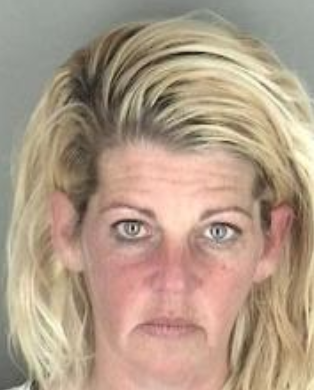
A passenger in the vehicle, identified as Staci A. Stahlheber, 38, of Topeka, was booked into the Shawnee County Department of Corrections for an outstanding Shawnee County warrant as well as requested charges Criminal use of a weapon, Possession of methamphetamine and Possession of drug paraphernalia, according to Stallbaumer.
RENO COUNTY —Law enforcement authorities are investigating a shooting in Hutchinson and have made an arrest.

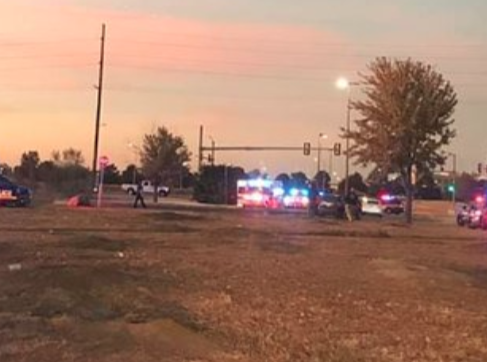
Just before 5:30p.m. Saturday, police were dispatched to 17th and Ring Road in Hutchinson reference to a shooting, according to a media release.
Officers contacted Darin Rodriguez, 54, Hutchinson who had a gunshot wound to his groin. The detectives’ investigation revealed that an argument took place between Rodriguez and the occupants of another car while they were both stopped in traffic on Ring Road just south of 17th Avenue.
Rodriguez exited the passenger side on a vehicle he was riding in. He left his door open as he confronted the occupants of the other vehicle. A rear seat passenger in the other vehicle identified as Deante Jones, 20, Kansas City, discharged a firearm one time striking Rodriguez in the groin.
The bullet went through the open door of the vehicle Rodriguez got out of, ricocheted off the interior and struck the driver Paula Thomas, 74 of Hutchinson on her upper right leg.
Thomas received a graze from the bullet. Rodriguez and Thomas were both transported to the Hutchinson Regional Medical Center where they were treated and released. Police arrested Deante Jones on requested charges of Aggravated Battery and he is being held on a $20,000 bond.
Virginia L. Eklund, 96, of Hutchinson, Kansas, and former Natoma, Kansas, resident, died on Saturday, November 09, 2019, at the Good Samaritan Village in Hutchinson, Kansas.
Services are pending at this time. Please check back later for a full obituary and funeral service date and time.
Pohlman-Varner-Peeler Mortuary of Russell and Natoma, Kansas, is in charge of the funeral service arrangements.

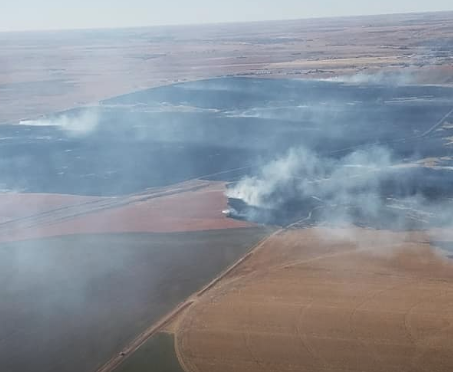
CHEYENNE COUNTY — Crews were busy fighting grass fires Saturday in Cheyenne County that prompted Governor Laura Kelley to issue a verbal disaster declaration.
The first grass fires were reported just after 11:30 a.m., according to Ryan Murry, Cheyenne County Emergency Management Director.
They ultimately had to battle several grass fires across the county. Just after 5 p.m., Murray said the fires were contained. Crews continued to monitor hot spots and the Kansas Forrest Service continued to drop water on those hot spots.
Burn scar from a long-lived fire between St. Francis and Wheeler in Cheyenne county, KS on Saturday November 09, 2019. Burn scar is ~4 miles long and ~2 miles wide. #KSwx #NEwx #COwx pic.twitter.com/5OqRQ2VaDF
— NWS Goodland (@NWSGoodland) November 9, 2019
There is no word on the number of acres burned. The fires may have started by a semi driving by on the highway with a mechanical issue, according to Murry. The cause of the fires is still under investigation.
@GovLauraKelly issued a verbal disaster declaration for Cheyenne County due to grass fires which were sparked along US-36 by the City of Saint Francis. Local officials have evacuated several homes and residents have been alerted for the potential of evacuation if the need arises. pic.twitter.com/TMeKM04L3p
— KDEM (@KansasEmergency) November 10, 2019
LAWRENCE, Kan. (AP) — A former Lawrence police officer convicted of threatening another driver with a gun on a suburban Kansas City highway in a case of road rage has lost his peace officer’s license.

The license for 53-year-old Jeffrey Brian Holtzman was revoked last month.
Holtzman was sentenced in August to 12 months’ probation for the October 2018 incident. He pleaded guilty in June to a reduced charge of criminal threat.
The victim told police that he was driving on Interstate 435 near Interstate 35 when he honked at Holtzman for suddenly slowing down. The victim says Holtzman then pulled alongside him and pointed a handgun at him and his passenger.
Holtzman resigned from the Lawrence Police Department the following month.
SEDGWICK COUNTY — One person died in an accident just before midnight Friday in Sedgwick County.
A Buick LeSabre driven by a 59-year-old man was eastbound on East Mt. Vernon at Bluff, according to office Kevin Wheeler. The vehicle left the road and struck a utility pole.
The driver was trapped in the vehicle and had to be extricated by the Wichita Fire Department. He was pronounced dead at the scene. There were no other occupants in the vehicle, and no other vehicles were involved in the collision, according to Wheeler. The accident remains under investigation. Wheeler did not release the driver’s name.
SEDGWICK COUNTY —Minimum-custody inmate Kyle Ingels who was placed on escape status at Tuesday evening after he walked away from the Wichita Work Release Facility is back in custody, according Randall Bowman with the Kansas Department of Corrections. The KDOC Enforcement, Apprehensions and Investigation unit located him at 11 a.m. Saturday.

On Friday, the Kansas Department of Corrections offered a reward to help locate Ingels.
Ingels is currently serving a 60-month sentence for several convictions in Neosho County including theft, forgery, drug possession, and endangerment of a child. Engels had a prior drug conviction from Neosho County in 2007.
The KDOC has not released further details on his capture.
——-
SEDGWICK COUNTY —Minimum-custody inmate Kyle Ingels was placed on escape status at approximately 6:48 p.m., Tuesday, after he walked away from the Wichita Work Release Facility, according to a media release from the Kansas Department of Corrections.
Ingels, a 32-year-old white male, left for work at 10:30 a.m. and was reported missing when he did not report back to the facility following work Tuesday evening. Ingels was last seen wearing a red hoodie with black writing on the sleeves, blue jeans, black boots, and a black baseball cap.
Ingels is currently serving a 60-month sentence for several convictions in Neosho County including theft, forgery, drug possession, and endangerment of a child. Engels had a prior drug conviction from Neosho County in 2007.
Ingels is 6 feet tall, 198 pounds with hazel eyes and brown hair.
Anyone with information on Ingels can call the Kansas Department of Corrections at 620-221-6660, the Kansas Bureau of Investigation at (800) 572-7463 or local law enforcement at 911.
The walk-away is currently being investigated. New information will be released as it becomes available.
The Wichita Work Release Facility, a satellite unit of the Winfield Correctional Facility, is an all-male, minimum-custody state prison with a population of 250.
 KHF
KHF
TOPEKA — Kansans of all ages who love history are encouraged to express that interest in the two essay contests presented by Native Sons and Daughters of Kansas. The cash prizes have increased in both contests this year. Winners will be announced and recognized as part of the 102nd annual meeting of Native Sons and Daughters of Kansas in Topeka on Friday, January 31, 2020.
The annual Olive Ann Beech Kansas Factual Story Contest, sponsored by Native Sons and Daughters of Kansas, was begun in 1931 to encourage preserving factual, unpublished happenings and anecdotes from today and yesterday. The contest is open to everyone, one entry per person. Stories must be true and unpublished, take place in Kansas, and limited to 750 words. Entries are submitted electronically via email by 5 p.m. Friday, December 20, 2019, to Cindy Stillings, Kansas Historical Foundation (KHF), [email protected]. Submissions should use “Beech Memorial Contest” in the subject line, and include the author’s name, mailing address, and phone number.
This essay contest is named for aviation’s Olive Ann Beech, of Wichita, who provided essay contest winners with cash awards for more than 30 years. The Beech essay contest cash awards are: first place, $300; second place, $250; third place, $150; and $100 each for two honorable mentions. Entries will be judged on quality of writing and interesting anecdotal stories of Kansas.
The Mamie Boyd Kansas! Say It Above a Whisper Contest, sponsored by Native Sons and Daughters of Kansas, began in 1936 as a way for students to celebrate and express pride in the state. The contest is open to Kansas students in eighth through 12th grades, one entry per person, and limited to 250 words. Entries are submitted electronically via email by 5 p.m. Friday, December 20, 2019, to Cindy Stillings, Kansas Historical Foundation, [email protected]. Submissions should use “Boyd Essay Contest” in the subject line, and include the author’s name, school, grade, mailing address, and phone number.
Kansas newspaperwoman Mamie Boyd coined the phrase used for the contest title. The Boyd essay contest cash awards are: first place, $300; second place, $250; third place, $150; and $100 each for two honorable mentions. Past essays have described interesting and strong-hearted Kansans, the state’s vast grain crops and grasslands, diversities in population, and the emotions and pride called to mind by the state’s unique beauty. Entries will be judged on quality of writing, originality, creativity, and sincerity in expressing pride in the state of Kansas.
Colleen K. Taylor, age 69, of Hays, Kansas passed away Saturday, November 9, 2019 at Hays Medical Center.
Arrangements and a complete obituary is pending with Brock’s-Keithley Funeral Chapel and Crematory 2509 Vine Hays, KS 67601