WASHINGTON (AP) — Billionaire industrialist David H. Koch, who with his older brother, Charles, transformed American politics by pouring their riches into conservative causes, has died at age 79.
David Koch in 2015 during his announced $150M gift for a new cancer center image courtesy Memorial Sloan Kettering Cancer Center
Charles Koch announced the death on Friday, saying, “It is with a heavy heart that I now must inform you of David’s death.”
David Koch, who lived in New York City, was the Libertarian Party’s vice presidential candidate in 1980. He was a generous donor to conservative political causes as well as educational, medical and cultural groups.
The Koch brothers were best known for a vast political network they built that became popularly known as the “Kochtopus” for its far-reaching tentacles in support of conservative causes. The brothers founded the anti-tax, small government group Americans for Prosperity.
“I was taught from a young age that involvement in the public discourse is a civic duty,” David Koch wrote in a 2012 op-ed in the New York Post. “Each of us has a right— indeed, a responsibility, at times — to make his or her views known to the larger community in order to better form it as a whole. While we may not always get what we want, the exchange of ideas betters the nation in the process.”
After battling prostate cancer for 20 years, he told a reporter following the 2012 Republican convention that he was thinking about what he will someday leave behind.
“I like to engage where my part makes a difference,” he told The Weekly Standard. “I have a point of view. When I pass on, I want people to say he did a lot of good things, he made a real difference, he saved a lot of lives in cancer research.”
David Koch donated $100 million in 2007 to create the David H. Koch Institute for Integrative Cancer Research at the Massachusetts Institute of Technology. He also gave millions to Johns Hopkins University in Baltimore, the Memorial Sloan-Kettering Cancer Center in New York City, the M.D. Anderson Cancer in Houston, and other institutions.
The Smithsonian’s National Museum of Natural History named in his honor a wing dedicated to the story of human evolution over 6 million years. David Koch donated $15 million to fund the 15,000 square-foot hall.
“The program has the power to influence the way we view our identity as humans, not only today, but for generations to come,” he said in a statement at the time.
David Koch, an engineer trained at MIT, joined Koch Industries in 1970, and served on its board. He also served as chief executive officer of Koch Chemical Technology Group, LLC, a Koch subsidiary. He retired from the company in 2018
Charles and David Koch, each with an estimated net worth of $50.5 billion, tied in fourth place in 2012 on Forbes 500 list of the nation’s richest men.
Two of the Koch brothers, Frederick and Bill Koch, sued the other two, claiming in a 1998 trial that they were cheated out of more than $1 billion when they sold their stake in Koch Industries back in 1983. David and Bill Koch are twins.
The dispute stemmed from a falling out three years earlier when Bill Koch criticized Charles’ management of the company, and with Frederick’s support, tried to gain control of the company’s board of directors. After the takeover move failed, the board fired Bill as an executive. Bill and Frederick Koch and other dissident stockholders sold their interests, and the brothers later sued claiming the company withheld crucial information that would have led to a higher sale price.
Bill and Frederick lost their case, but the lengthy public trial offered a rare behind-the-scenes glimpse at the Koch family.
The Kochs’ father, Fred Koch, guessed early — before two of his boys were out of diapers and before two were even born — that wealth might split his family apart.
“It will be yours to do with what you will,” the father wrote in a 1936 letter to his two oldest sons. “It may be either a blessing or a curse.”
David Koch and his wife, Julia Flesher, have three children.
Sandra Lynn Hartman, age 53, died at her home in Utica, Kansas on August 18, 2019. She was born on June 18, 1966 in Ransom, Kansas the daughter of Norman and Areta (Ummel) Hartman.
Inurnment in the Ransom will be held at a later date.
Merle Nadine “Honey” Cozad, 102, passed away on August 21, 2019.
There will be a visitation Friday, August 23, 2019 from 6-8pm at Langsford Funeral Home in Lee’s Summit, Missouri. Another visitation will take place Sunday, August 25, 2019 at Enfield Funeral Home in Norton, Kansas from 5-7pm. Burial will be in Lyle Cemetery on Monday, August 26, 2019 at 10:30am. Contributions may be made in Merle’s memory to Great Lakes Caring Hospice.
Merle Nadine “Honey” Cozad, daughter of Elmer and Helen Knutson, was born on January 13, 1917, in Wilsonville, Nebraska, where she graduated from high school. Merle married A. Rex Cozad on October 10, 1935, and they had four children, Beverly Jean, John Elwyn, David Charles, and Mary Lynn.
Merle was active in the Lyle community where they raised their family. She participated in community activities and was an active member of the Lyle Methodist Church and the local 4-H club. They left Norcatur, Kansas, to Hutchinson, Kansas, where they spent many years traveling, Friday night dancing, and the social life that came with Rex’s political career.
Merle was a very loving and exceptionally strong woman who had a passion for life and her family. There was never a family event that Merle and Rex missed whether it be marriages, graduations, soccer, baseball or football games. Merle was a true matriarch in every sense of the meaning. She showed her family how to love and to be strong. She was our leader, our strength, and our family glue.
Merle was preceded in death by her parents, Elmer and Helen Knutson; brother, Meredith Knutson; husband of 68 years, Rex Cozad; three of her children, Beverly Morton, John Cozad and David Cozad; and one great-grandson, Shawn Petty.
Survivors include: her daughter, Mary Vanderburg, and husband, Bill; daughter-in-law, Karen Cozad; 15 grandchildren, Tony, Jana, Lynn, Kenny, Sherri, Laura, Tracy, Jon, Jeremy, Kim, Kari, Erin, Nikki, Dusty and Morgan; 28 great-grandchildren; and 15 great-great-grandchildren.
Marjorie L. (Debes) Ludwig, 83, died August 22, 2019, at her home in Hoisington. She was born July 19, 1936, the daughter of Joseph N. and Mary E. (Linsner) Debes. Marjorie graduated from Hoisington High School in 1954.
A longtime Hoisington resident, she was a homemaker, loving wife, mother, and grandmother. Marjorie was a member of St. John the Evangelist Catholic Church and Altar Society.
On August 2, 1954, she married Robert G. Ludwig at St. John the Evangelist Catholic Church, Hoisington.
She is survived by her husband of 65 years, Robert G. Ludwig and their children; Susan Davis and husband Keith of New Cambria, Loretta Riedl and husband Bert of Great Bend, Mary Kaiser and husband Kent of Bushton, Robin Nicholson and husband Brian of Windsor, Colorado, and Dennis Ludwig of Olmitz and special friend Christine Allen; daughters-in-law, Veronica Ludwig of Olmitz and Jeri Ludwig Henderson and husband Bob of Cleveland, Oklahoma; siblings, Pat Radke of Hoisington, Bernice Capps and husband Ron of Newton, Mary Ann Thornburg and husband Alan of Rapid City, South Dakota, Virginia Foos of Greeley, Colorado, LeRoy Debes and wife Connie of Spokane, Washington, and Joe Debes and wife Renita of Loveland, Colorado; 19 grandchildren, and 21 great grandchildren.
She was preceded in death by her parents; sons, George C. Ludwig and Robert J. “Bobby” Ludwig, and an infant son, Patrick Ludwig; sister, Joan Vink and husband Larry; brothers-in-law, Bill Radke and Harold Foos; and a grandson, Kevin Anthony Kaiser.
Friends may call 1 p.m. to 8 p.m. Sunday, with family to receive friends from 6-8 p.m. Vigil with Rosary will begin at 7 p.m., all at the funeral home.
Mass of Christian Burial will be 10:30 a.m., Monday, August 26, 2019, at St. John the Evangelist Catholic Church, celebrated by Father Louis Hoang. Burial will follow in St. John Church Cemetery, Hoisington.
Memorials may be made to St. John Cemetery Fund or Kans for Kids in care of Nicholson-Ricke Funeral Home, PO Box 146, Hoisington, KS 67544.
Laurinda Miller, age 89, of Hays, Kansas passed away Thursday, August 22, 2019 at Via Christi Village, Hays.
Funeral services will be 10 AM Monday, August 26, 2019 at Immaculate Heart of Mary Church in Hays. Burial will follow in the St. Joseph’s Cemetery, Hays.
Visitation will be Sunday 5 PM – 8 PM and Monday 9 AM – 9:30 AM all at Brock’s-Keithley Funeral Chapel and Crematory 2509 Vine Hays, KS 67601.
A combine rosary and parish vigil service will be 7 PM Sunday at the funeral chapel.
Condolences may be left by guest book at www.keithleyfuneralchapels.com or by email at [email protected]
SHAWNEE COUNTY — Law enforcement authorities are investigating a Kansas woman on felony charges after a drug investigation.
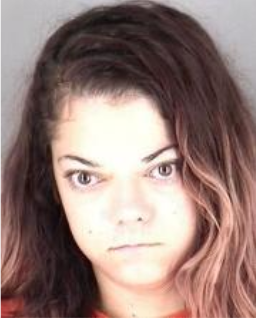
Luker photo Shawnee Co.
The Drug Enforcement Unit (DEU) for the Shawnee County Sheriff’s Department followed up on information regarding a non-school aged juvenile boy who was being exposed to unsafe living conditions that include a drug environment, according Sgt. Todd Stallbaumer.
The DEU served a search warrant on the mother’s residence located in the 1100 block of SW Lincoln in Topeka. They located narcotics and paraphernalia that would be in reach of the child. Members of DEU located the child and placed him into Police Protective Custody.
Police arrested the boy’s mother 26-year-old Montanna L. Luker of Topeka and booked her into the Shawnee County Jail on felony narcotic charges.
SEDGWICK COUNTY—Law enforcement authorities report that they have seen a decrease this summer in the number of guns stolen from cars in Wichita.
According to Lt. Scott Bruno, 47 guns were stolen from cars during June and July in 2018. Only 26 were stolen in 2019 for a total of 120 guns so far this year after 250 were reported stolen in 2018.
The majority of the guns are stolen between midnight and 5a.m. after they are left in in cars overnight, according to Brunow.
The Wichita police department has started the Operation Save-A-Casing program. It is a partnership with law enforcement agencies at the local, state and federal level and the community to combat firearm-related crime, according to the department web site.
The campaign works by submitting two firearm casings to a Wichita Police Department Officer after a gun theft has occurred. These casings are then submitted into National Integrated Ballistic Information Network known as NIBIN, a national database containing digital images of spent bullets and cartridge casings that were found at crime scenes or test-fired from confiscated firearms. This database can be searched for possible matches and if a “hit” occurs, the NIBIN lab sends that information to WPD investigators.
Participation is completely voluntary, however, we encourage the community to take part in an effort to reduce violent crime involving firearms.
Alicia BoorStress is cumulative. In other words, trees and shrubs can be affected by stresses that happened up to several years in the past.
Recent stresses in Kansas include winter damage as well as the extremely dry winter of 2017-2018 which often resulted in damaged root systems. This damaged root system may have been further weakened due to too much rain this spring. The excess water harmed root systems due to saturated soils driving out oxygen. Roots need oxygen as much as they need water.
Though the roots were able to keep up with moisture demands during the cooler spring weather, they may not have been able to keep up when the weather turned hot and dry. Such trees and shrubs may suddenly collapse and die or slough off branches they can no longer support. I have never seen lilacs collapse due to stress like they have this year.
This does not mean that all of our plants are doomed. As a matter of fact, plants that have survived thus far into the growing season will likely make it. Also, some plants are just better adapted to our tough Kansas conditions and have suffered little to no harm.
However, it is a good idea to check the overall health of your trees. So how do you tell? One of the most important clues in determining the health of your trees is the amount of new growth that tree has produced. A healthy tree should have a minimum of 4 to 6 inches of new growth each year and usually much more. Check branches with the tips in the open and not shaded by the tree itself. Anything less than 4 inches on the majority of branches suggests the tree is under a great deal of stress.
So, how do you tell where the new growth stops? Look for a color change in the stem. New growth is often greener than that from the previous year. There is also often an area of what looks like compressed growth where growth transitions from one year to the next.
Lastly, look at leaf attachment. Leaves are only produced on current seasons’ growth. Therefore, new growth stops where leaves are no longer attached directly to the twig but to side branches. However, pay attention as leaves may be appear to be attached directly to last year’s growth but are actually borne on short spurs. If you look closely, you can tell the difference.
All this clue tells you is whether a tree is under stress or not. It does not tell you what is causing or has caused poor growth. This year, the most common cause by far is environmental stress caused by the excess rain this spring.
So, what do we do for trees under stress? The most important practice is to water as needed.
Alicia Boor is an Agriculture and Natural Resources agent in the Cottonwood District (which includes Barton and Ellis counties) for K-State Research and Extension. You can contact her by e-mail at [email protected] or calling 620-793-1910
Scroll to the bottom for a map of garage sale locations. Hays Post offers FREE garage sale listings weekly. Having a garage sale next weekend? Click HERE to submit your information.
203 N. Topeka, Ness City
Saturday 8/24 – 8 a.m.-3 p.m.
Multi family garage sale—bedroom furniture, baby crib, bumbo, mattresses, play mat, nursing pillows, strollers, high chair, pack-‘n’-play, toys, women’s clothing and shoes, maternity clothing, scrubs, boy clothes NB-3T, shop equipment, and lots more!
DOUGLAS COUNTY—A woman injured in an accident just before 4p.m. August 16 in Douglas County has died.
The Kansas Highway Patrol reported a 2018 Jeep Cherokee driven by Kathy L. Robbins, 59, Independence, Mo., was westbound on U.S. 40 just south of 1802 Road driving erratically.
The vehicle left the roadway traveling through the west ditch and struck a tree.
EMS transported Robbins to KU Medical Center where she died Wednesday, according to the KHP. She was not wearing a seat belt, according to the KHP.
SEDGWICK COUNTY—Law enforcement authorities are investigating two stolen car suspects after they ran from a traffic stop and crashed.
GONZALEZ photo Sedgwick Co.
Just before 11:30p.m. Wednesday, police attempted to stop a Nissan Altima near the intersection of Harry and Bluff View in Wichita for a traffic violation, according to officer Charley Davidson.
The driver of the vehicle later identified as 23-year-old Ana Gonzalez refused to stop and sped away from officers.
A short time later, officers found the vehicle had crashed near the intersection of Harry and Lulu. They found Gonzalez and a passenger 28-year-old Donald Martin in the 1500 Block of South Patty. They were taken into custody without further incident, according to Davidson.
Investigators determined the car had been stolen early Wednesday.
Martin photo Sedgwick Co.
Gonzalez is being held on requested charges of felony evade and elude police, possession of stolen property, unlawful possession of a controlled substance, additional traffic charges and outstanding warrants. Martin is being held on requested charges that included auto theft, possession of a controlled substance, obstruct, possession of drug paraphernalia and a Kansas Department of Corrections Warrant. He has 8 previous convictions for theft, burglary, aggravated assault, criminal discharge of a firearm and aggravated escape from custody, according to the Kansas Department of Corrections.
LOS ANGELES – A 252-count federal grand jury indictment unsealed Thursday charges 80 defendants, most of whom are Nigerian nationals, with participating in a massive conspiracy to steal millions of dollars through a variety of fraud schemes and launder the funds through a Los Angeles-based money laundering network, according to the United State’s Attorney.
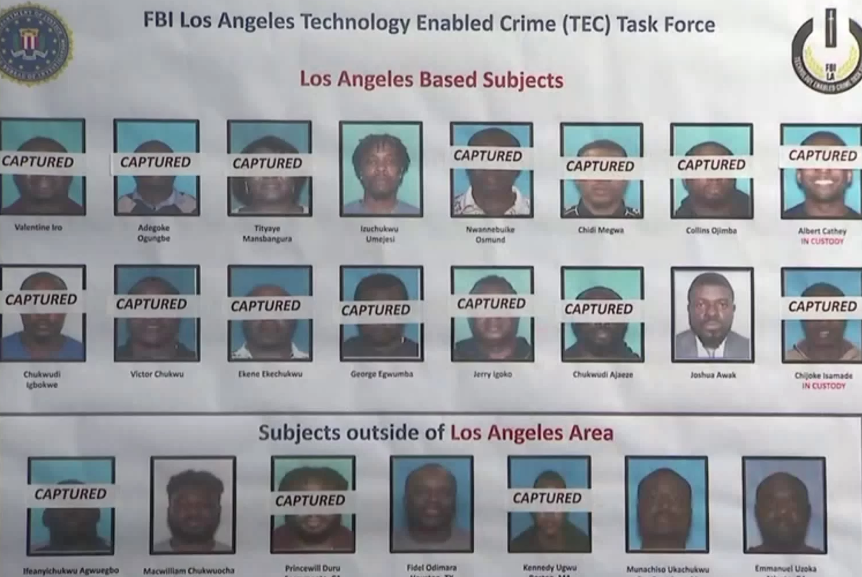
Suspects believed involved in a cyber crime and money laundering network as displayed at Thursday DOJ News Briefing
The indictment was unsealed after law enforcement authorities this morning arrested 14 defendants across the United States, with 11 of those arrests taking place in the Los Angeles region. Two defendants were already in federal custody on other charges, and one was arrested earlier this week. The remaining defendants are believed to be abroad, with most them located in Nigeria.
The indictment alleges that the 80 defendants and others used various online fraud schemes – including business email compromise (BEC) frauds, romance scams, and schemes targeting the elderly – to defraud victims out of millions of dollars. According to a criminal complaint also unsealed today, co-conspirators based in Nigeria, the United States and other countries contacted the lead defendants in the indictment – Valentine Iro, 31, of Carson, and Chukwudi Christogunus Igbokwe, 38, of Gardena, both Nigerian citizens – for bank and money-service accounts that could receive funds fraudulently obtained from victims. Once members of the conspiracy convinced victims to send money under false pretenses, Iro and Igbokwe coordinated the receipt of funds and oversaw an extensive money-laundering network, according to the 145-page indictment.
The indictment and criminal complaint allege that Iro and Igbokwe, who were among those arrested Thursday morning, were involved in schemes resulting in the fraudulent transfer of at least $6 million in fraudulently-obtained funds – and the overall conspiracy was responsible for the attempted theft of at least an additional $40 million.
The fraudsters targeted victims in the United States and across the globe, including individuals, small and large businesses, and law firms. Some of the victims of the conspiracy lost hundreds of thousands of dollars to fraud schemes, and many were elderly.
“This case is part of our ongoing efforts to protect Americans from fraudulent online schemes and to bring to justice those who prey upon American citizens and businesses,” said United States Attorney Nick Hanna. “Today, we have taken a major step to disrupt criminal networks that use BEC schemes, romance scams and other frauds to fleece victims. This indictment sends a message that we will identify perpetrators – no matter where they reside – and we will cut off the flow of ill-gotten gains.”
“Today’s announcement highlights the extensive efforts that organized criminal groups will engage in to perpetrate BEC schemes that target American citizens and their hard-earned assets,” said Assistant Director in Charge Paul Delacourt of the FBI’s Los Angeles Field Office. “Billions of dollars are lost annually, and we urge citizens to be aware of these sophisticated financial schemes to protect themselves or their businesses from becoming unsuspecting victims. The FBI is committed to working with our partner agencies worldwide to continue to identify these cyber criminals and to dismantle their networks.”
Iro and Igbokwe essentially were brokers of fraudulent bank accounts. According to the indictment, Iro and Igbokwe collected bank accounts, fielded requests for bank account information, provided that information to co-conspirators around the world, and laundered the money obtained from victims – all of this in exchange for a cut of the money stolen from victims of the various fraud schemes.
If a bank account with a specific business name was required to trick a business-victim into making a payment, Iro and Igbokwe often coordinated with “money mules” to open accounts that could receive funds obtained, according to court documents. In addition to making the fake business name mirror the name of a legitimate company, members of the conspiracy routinely filed fictitious business name statements with the Los Angeles County Registrar/Recorder’s Office that were presented to banks when the fraudulent accounts were opened.
Once a victim deposited funds into a bank account or a money services account, Iro and Igbokwe allegedly coordinated with others to further launder the funds. Members of the conspiracy sometimes wired funds to other bank accounts under their control; in other cases, they simply withdrew funds as cash or negotiable instruments such as cashier’s checks.
When stolen funds were withdrawn as cash, the defendants frequently used illicit money exchangers to move funds overseas, generally avoiding transferring the funds directly through banking institutions, the indictment alleges. To do this, Iro and Igbokwe coordinated the transfer of a victim’s funds from a fraudulent bank account they controlled to U.S. bank accounts belonging to illicit money exchangers. Those money exchangers, in turn, used a Nigerian banking application to transfer other funds in naira (₦), the currency of Nigeria, from Nigerian bank accounts they controlled to the Nigerian bank accounts specified by Iro and Igbokwe. This method was used to transfer millions of dollars to Nigerian co-conspirators without directly transferring funds overseas. The indictment alleges that Jerry Ikogho, 50, of Carson (who was taken into custody on Sunday), and Adegoke Moses Ogungbe, 34, of Fontana, were among those who served as illicit money exchangers for the conspiracy.
Each of the 80 defendants named in the indictment is charged with conspiracy to commit fraud, conspiracy to launder money, and aggravated identity theft. A number of the defendants also face substantive fraud and money laundering charges.
Additionally, Iro, Igbokwe, Ikogho, Ogungbe and three other defendants –Izuchukwu Kingsley Umejesi, 30, of Los Angeles, Tityaye Marina Mansbangura, 33, of Palmdale, and Obi Madekwe, 31, of Nigeria – are charged with operating illegal money transmitting businesses. Ogungbe and Mansbangura were also among those arrested this morning, and Umejesi is a fugitive currently being sought by authorities.
Iro, Igbokwe and Chuks Eroha, 39, face additional charges for attempting to destroy their phones when the FBI executed a search warrant in July 2017. Iro also is charged with lying to the FBI in an interview conducted during the search. The complaint alleges that, when the FBI arrived to conduct the court-authorized search at Iro’s apartment in Carson, Iro broke his phone in half, while Igbokwe and Eroha threw phones from a bedroom window of the apartment. While Iro claimed he previously had broken the phone during an argument with his wife, the complaint details how the FBI was able to determine that the phone was operational until seconds after the FBI knocked on Iro’s apartment door to execute the search warrant. Eroha is believed to have fled to Nigeria shortly after the FBI executed the warrant.
The charges contained in the criminal complaint and indictment are merely accusations, and the defendants are presumed innocent unless and until proven guilty in court.
This investigation is being led by the Federal Bureau of Investigation.
The Los Angeles County District Attorney’s Office, the Los Angeles County Sheriff’s Department, and the United States Department of State provided substantial assistance during the investigation.
Several agencies provided support during today’s takedown or during the investigation, including the United States Postal Inspection Service, U.S. Immigration and Customs Enforcement’s Homeland Security Investigations, U.S. Citizenship and Immigration Services, U.S. Customs and Border Protection, the Ventura County District Attorney’s Office and the California Franchise Tax Board.
Many of the FBI’s Legal Attachés provided assistance throughout this investigation, as did the Criminal Division’s Office of International Affairs, and foreign authorities around the world. In particular, the FBI and U.S. Attorney’s Office thank the National Crime Agency in the United Kingdom and the Public Prosecutor’s Office of Osnabrück, Germany for their contributions.












 Hays-area garage sales