TOPEKA (AP) — A road maintenance official is pushing back against suggestions that the Kansas Department of Transportation is to blame for an invasion of a plant threatening native grasses.
The Topeka Capital-Journal reports that KDOT’s potential role in spreading bluestem grass is a point of contention as the state Department of Agriculture contemplates quarantining invasive varieties now in 103 of 105 of the state’s counties.
Ranchers and others attending a Department of Agriculture comment session last month on a possible quarantine said KDOT’s mowing regimen carried seed for invasive grasses to new roads.
KDOT maintenance chief Clay Adams said the agency includes bluestem varieties in seeding mixtures applied beside highways but not the invasive varieties targeted by the Department of Agriculture. KDOT mows from April to October to improve visibility for motorists.
WELLINGTON – Matt Cavanaugh’s seventh inning RBI single broke a scoreless tie and sparked a four-run inning Thursday as the Hays Larks picked up a 5-2 win over the Wellington Heat.
Larks starter Rustin Hays and Heat starter Dylan Grove each turned in six scoreless innings before the Larks scored four in the seventh.
Hays allowed just two runs over eight innings and struck out five while walking three. It’s the second straight start that Hays has worked eight innings and picked up the win.
In the Larks four-run inning George Southerland and Jarrod Belbin opened the inning with back-to-back singles. Cavanaugh singled home Southerland and after stealing third Belbin came into score an error by the Heat cather. Drake Angeron followed that with an RBI double that scored Cavanaugh. Mikey Gangwich singled home Angeron giving Hays a 4-0 lead through six and a half innings.
Wellington scored single runs in the bottom of the seventh and eighth innings but Hays got a run back on a wild pitch in the top of the ninth as the Larks earn the 5-2 win.
The Larks wrap up the two-game series in Wellington Friday night before traveling to McPherson for the first of two games on Saturday.
David Bruce Grabbe, 63, left this earth for his heavenly home on Sunday, June 30, 2019, at Methodist Hospice in Memphis, Tennessee. Dave’s humor, compassion and warm nature made him a friend to many, both in his professional and personal life.
Dave was born March 3, 1956 to Clarence and Lillian (Coupal) Grabbe in Hays, Kansas. He attended Thomas More Prep-Marian along with several of his siblings. While working for Air Midwest, Dave met his wife, Kathryn Gentleman, while they attended Fort Hays State University. Dave and Kathy were married July 18, 1981 in Hays. Over the next 37 years of married life, Dave and Kathy moved several times around the Midwest with Dave’s career in the aviation field. After many moves, Dave and Kathy moved to Kansas City, where they began a family with the arrival of their son, Cody in 1985. In 1988, a daughter, Kailee, was born.
After Kailee was born, Dave continued his career in aviation with Federal Express, taking the family to Memphis, Tennessee and later Indianapolis, Indiana where their children would grow up. Dave loved his job with Federal Express, as it allowed him to combine his interests in both aviation and weather. During this time, Kathy worked in the healthcare profession as a nurse. In 2015, Dave was transferred back to Memphis, Tennessee.
A humble, compassionate, unassuming and hard-working man with a wonderful sense of humor, Dave was much loved by his Air Midwest and Federal Express colleagues. He kept many of his former colleagues connected throughout the years. Dave reflected with fondness and often on his time at Air Midwest as a part of the “ZV” family. He kept his own large Grabbe family connected over the years as well and was much loved by his siblings and many nieces and nephews.
Dave was also an avid golfer, car enthusiast, photographer and lover of dogs. Several of his photographs were published in numerous magazines over the years. His love of photography spilled over into their daughter, Kailee, who holds a degree in photography from Purdue University. Dave’s love of aviation spilled over into their son, Cody, who could tell you every other detail of planes they saw at a young age. The family had multiple dogs through the years, all very well loved by Dave.
Dave leaves behind his wife, Kathryn Grabbe of Southaven, MS; son Cody Grabbe and son-in-law Josh Harraman of Metuchen, NJ; daughter Kailee Koehler and son-in-law Benjamin Koehler of Brownsburg, IN; sisters Frances (Jim) Gordon, Donna (Bob) Farrell, Pat (Leroy) Newell, and Lorri (Doug) Leibbrandt; brothers Wayne (Judy) Grabbe and Richard (Cheryl) Grabbe; and sister-in-law Sharon (Rex) Keister along with a cavalcade of nieces and nephews, cousins, and friends who all loved him dearly and will miss him. Dave is preceded in death by his sister Marian (Sam) Warfel; his parents Clarence and Lillian Grabbe; and in-laws Lawrence and Betty Gentleman.
A memorial service will be held Saturday, July 6 at 2 pm at Graceland Christian Church, 2126 Stateline Rd E, Southaven, MS 38672.
With many of Dave’s family members living in Kansas, a Celebration of Life will be held there at a future date this fall.
In lieu of flowers, Memorials may be made to the Dave Grabbe Memorial Fund via Zelle to [email protected] with the memo “Dave Grabbe Memorial Fund” or check to Kathy Grabbe with the memo “Dave Grabbe Memorial Fund”. Funds will be used for medical expenditures and the remainder will be split between the First Tee Tennessee Youth Golf Program in Memphis, TN and the Misty Eyes Animal Center of Avon, IN.
Jordanne (Riley) Elisabeth Troy Hackerott, 28, of Nashville, TN died on Friday, June 28, 2019 at her home. Jordanne was born on August 9, 1990 in Manhattan, Kansas to Troy and Caroline Hackerott. Jordanne grew up in Stillwater, Oklahoma and graduated from Hays High School in 2008. Following graduation, Jordanne moved to Seattle, WA and Los Angeles, CA before settling in Nashville, TN. In Nashville, Jordanne performed and recorded as Android Girlfriend. Through music and an outgoing personality, Jordanne created a large family of friends. Despite challenges, Jordanne was known for the light they brought the gathering of those they loved.
Jordanne is survived by a brother, Jay (Lizzie) Hackerott of Yukon, OK and their children Bradley and Liliya; grandparents Roger and Glenna Hackerott, Russell, KS; aunt Shauna Hackerott, Great Bend, KS; aunt Amanda Hackerott, Great Bend, KS, uncle David (Kelly) Sherry, Norman, OK; uncle Richard (Michelle) Sherry, Olathe, KS; uncle Kurt (Victoria) Sherry, Wichita, KS; several cousins and a family of friends. Preceding Jordanne in death were maternal grandparents James and Caroline Sherry of Abilene, KS.
A celebration of Jordanne’s life is planned for July 15, 2019 at 11:00 AM St. John’s Lutheran Church in Russell, KS. In lieu of flowers, the family requests donations to Planned Parenthood, The Trevor Project (thetrevorproject.org), or the International Rescue Committee (rescue.org) be made in Jordanne’s name.
KANSAS CITY, Mo. (AP) — Authorities in Kansas City, Missouri, believe fireworks are to blame for a Fourth of July blaze at a home that sent two firefighters to the hospital with minor injuries.
Deputy Fire Chief Jimmy Walker said two firefighters received burns on their ears and necks in fighting a fire at a two-story home early Thursday. They were treated at a local hospital and released.
The Kansas City Star reports that an elderly resident safely fled the home.
It’s unclear when the fire began. Walker said the fireworks could have been smoldering long before igniting the home. He believes they came from a neighbor, not the resident of the home.
He said, “That’s why fireworks are illegal in the city.”
Walker said another home was damaged Wednesday in a fireworks-related fire.
HAYS – The Hays Senior American Legion baseball team cruised to a 10-0 run-rule win over the Northern Colorado Roughnecks in their game of the Wild West Fest Tournament in Hays.
Hays pitchers Trey Riggs and Tate Garcia combined to allow just two hits and strikeout four in four scoreless innings.
The Eagles scored the game’s first run on an error and Jamison Martin added an RBI single giving Hays a 2-0 lead after one.
In the second inning Cody Petersen singled in a pair of runs and then scored on a wild pitch putting Hays up 5-0.
The Eagles pushed across five runs in the third to take a 10-0 lead. In the inning Hays scored on a wild pitch, a pair of errors and a ground error.
Cody Petersen drove in three runs.
The Eagles are 20-5 on the summer and will take on Smith Center at 8 p.m. Friday at Larks Park.
Lucille Perez, age 94, of Oakley, passed away on June 30, 2019 at her home. She was born February 28, 1925 to Joe and Maria (Franco) Perez. She was a motel housekeeper.
She was preceded in death by her parents, brothers: Guadalupe “Lupe” Avila, Pete Perez, and Amos Avila; and sisters: Rose Hernandez and Vera Hernandez.
Survivors include her sister, Anita Oliveros of Sutherland, NE, and many nieces and nephews.
Funeral Mass will be at 10:30 a.m. Tuesday, July 9, 2019 at St. Joseph’s Catholic Church, Oakley with Fr. Richard Daise officiating. Interment will be in St. Joseph Cemetery. Visitation: Monday from 5 to 8 p.m. at Kennedy-Koster Funeral Home with a vigil servi1ce at 7:30 p.m.
Memorials to St. Joseph’s Church may be sent to the funeral home, PO Box 221, Oakley 67748. www.kennedykosterfh.com
KANSAS CITY, Kan. (AP) — A social-justice advocacy group says it is launching a hotline in Kansas City, Kansas, for people to report police misconduct.
The Kansas City Star reports that Wednesday’s announcement by the Metro Organization for Racial and Economic Equity comes about a month after it marched on local government offices.
A federal lawsuit against the department alleges that now-released Lamonte McIntyre spent 23 years in prison for two 1994 murders he didn’t commit because of police misconduct.
Another federal lawsuit was filed by a former police cadet alleging she was dismissed after reporting reported sexual harassment and assault by a supervising officer.
The police department says it has received complaints relating to only 0.1% of police calls. Local officials say police have a complaint line and there’s a Wyandotte County ethics hotline.
JOPLIN, Mo. (AP) — A recently awarded grant will help local teachers who are Hispanic or who teach in districts with large Hispanic populations.
The Joplin Globe reports that the Laura Bush 21st-Century Librarian program awarded Pittsburg State University’s College of Education a $530,281 grant to provide scholarships, mentoring and laptops to 25 teachers from Kansas, Missouri, Oklahoma and Arkansas.
University officials said school districts in those four states have experienced significant growth in their Hispanic populations in the past five years.
The project to be funded by the grant is called Building Bridges Across Cultures. It will enable 25 future school librarians to earn master’s degrees online with an emphasis in library media.
A 2013 grant to Pittsburg State focused on Native American culture in teaching and provided scholarships to 25 school librarians.
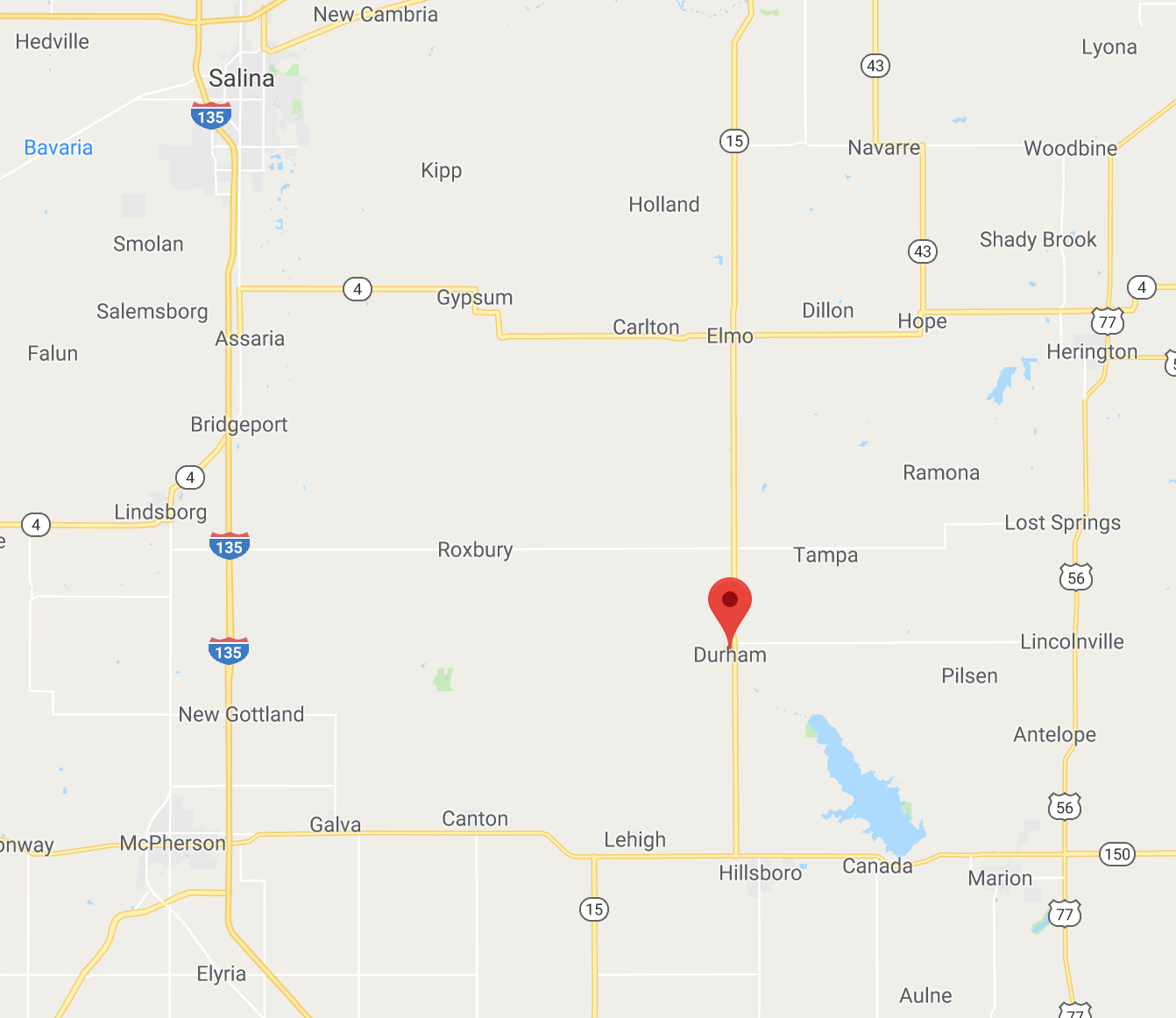
DURHAM (AP) — Flooding in central Kansas has forced evacuations in a small town along the rain-swollen North Cottonwood River.
The flooding resulted from heavy rains Thursday morning. Parts of Saline County received more than 8 inches of rain, while 6 inches fell in Marion County.
KAKE-TV reports that about 10 homes in Durham in northwest Marion County along the North Cottonwood had to be evacuated. Mayor Mike Sorensen said the downtown in the community of about 110 residents was under 3 feet of water.
Longtime resident Anna Maegoertz said she had to be rescued by boat after water surrounded her house and “It rose quickly. I couldn’t get out.”
Flooding also forced water rescues in Gypsum, southeast of Salina, along Gypsum Creek.
HAYS – Russell took advantage of three errors in the top of the 10th inning and then held off a late Eagles rally on their way to an 8-7 win over the Hays Eagles Junior American Legion team Thursday at Larks Park.
Hays took an early 2-0 lead scoring on a passed ball and a Garrett Wellbrock sacrifice fly in the bottom of the first.
Eagles starter Mason Robbins held Russell’s bats at bay for six innings before surrendering two runs in the inning. Robbins allowed just two runs in six and two-thirds innings. He struck out eight but did not factor into the decision.
Russell was able to put two runs across in the eighth inning but Hays answered right back to tie the game at four. Dawson Vonfeldt and Robbins had RBI singles in the inning.
A passed ball in the top of the ninth gave Russell a 5-4 lead but again the Eagles answered, they scored a run on an error in the bottom of the inning sending the game to the 10th inning.
In the 10th, Russell took a 7-5 lead on back-to-back errors and then added one more on an RBI single for an 8-5 lead.
The Eagles got two runs back in the 10th, scoring on a Vonfeldt single and a Remington Cox ground out but the potential runs were thrown out at third and second on back-to-back fielder’s choices as Russell earned the 8-7 win.
The Junior Eagles drop to 11-12-1 on the season. They will take on Beloit at 10 a.m. Friday at Larks Park.
LAWRENCE — New research from the University of Kansas shows machine learning is capable of identifying insects that spread the incurable disease called Chagas with high precision, based on ordinary digital photos. The idea is to give public health officials where Chagas is prevalent a new tool to stem the spread of the disease and eventually to offer identification services directly to the general public.
Chagas is particularly nasty because most people who have it don’t know they’ve been infected. But according to the Centers for Disease Control and Prevention, some 20 percent to 30 percent of the 8 million people with Chagas worldwide are struck at some later point with heart rhythm abnormalities that can bring on sudden death; dilated hearts that don’t pump blood efficiently; or a dilated esophagus or colon.
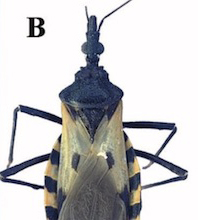
Left, an example image of an individual of Triatoma dimidiata. (A) Raw image and (B) final image with background removed digitally. Courtesy Khalighifar, et al. Right, this image shows that with more data (such as digital images of triatomine), the accuracy of deep learning used by the KU researchers increases whereas prior techniques plateau after a certain point. (Courtesy MDPI under a Creative Commons license)
The disease is caused most often when triatomine bugs — more commonly known as “kissing bugs” — bite people and transmit the parasite Trypanosoma cruzi into their bloodstreams. Chagas is most prevalent in rural areas of Mexico, Central America and South America.
A recent undertaking at KU, called the Virtual Vector Project, sought to enable public health officials to identify triatomine that carry Chagas with their smartphones, using a kind of portable photo studio for taking pictures of the bugs.
Now, a graduate student at KU has built on that project with proof-of-concept research showing artificial intelligence can recognize 12 Mexican and 39 Brazilian species of kissing bugs with high accuracy by analyzing ordinary photos — an advantage for officials looking to cut the spread of Chagas disease.
Ali Khalighifar, a KU doctoral student at the Biodiversity Institute and the Department of Ecology and Evolutionary Biology, headed a team that just published findings in the Journal of Medical Entomology. To identify the kissing bugs from regular photos, Khalighfar and his colleagues worked with open-source, deep-learning software from Google, called TensorFlow that is similar to the technology underpinning Google’s reverse image search.
“Because this model is able to understand, based on pixel tones and colors, what is involved in one image, it can take out the information and analyze it in a way the model can understand — and then you give them other images to test and it can identify them with a really good identification rate,” Khalighifar said. “That’s without preprocessing — you just start with raw images, which is awesome. That was the goal. Previously, it was impossible to do the same thing as accurately and certainly not without preprocessing the images.”
Khalighifar and his coauthors — Ed Komp, researcher at KU’s Information and Telecommunication Technology Center, Janine M. Ramsey of Mexico’s Instituto Nacional de Salud Publica, Rodrigo Gurgel-Gonçalves of Brazil’s Universidade de Brasília, and A. Townsend Peterson, KU Distinguished Professor of Ecology and Evolutionary Biology and senior curator with the KU Biodiversity Institute — trained their algorithm with 405 images of Mexican triatomine species and 1,584 images of Brazilian triatomine species.
At first, the team was able to achieve, “83.0 and 86.7 percent correct identification rates across all Mexican and Brazilian species, respectively, an improvement over comparable rates from statistical classifiers,” they write. But after adding information about kissing bugs’ geographic distributions into the algorithm, the researchers boosted the accuracy of identification to 95.8 percent for Mexican species and 98.9 percent for Brazilian species.
According to Khalighifar, the algorithm-based technology could allow public health officials and others to identify triatomine species with an unprecedented level of accuracy, to better understand disease vectors on the ground.
“In the future, we’re hoping to develop an application or a web platform of this model that is constantly trained based on the new images, so it’s always being updated, that provides high-quality identifications to any interested user in real time,” he said.
Khalighifar now is applying a similar approach using TensorFlow for instant identification of mosquitoes based on the sounds of their wings and frogs based on their calls.
“I’m working right now on mosquito recordings,” he said. “I’ve shifted from image processing to signal processing of recordings of the wing beats of mosquitoes. We get the recordings of mosquitoes using an ordinary cell phone, and then we convert them from recordings to images of signals. Then we use TensorFlow to identify the mosquito species. The other project that I’m working right now is frogs, with Dr. Rafe Brown at the Biodiversity Institute. And we are designing the same system to identify those species based on the calls given by each species.”
While often artificial intelligence is popularly portrayed as a job-killing threat or even an existential threat to humanity, Khalighifar said his research showed how AI could be a boon to scientists studying biodiversity.
“It’s amazing — AI really is capable of doing everything, for better or for worse,” he said. “There are uses appearing that are scary, like identifying Muslim faces on the street. Imagine, if we can identify frogs or mosquitoes, how easy it might be to identify human voices. So, there are certainly dark sides of AI. But this study shows a positive AI application — we’re trying to use the good side of that technology to promote biodiversity conservation and support public health work.”
Images: Left, an example image of an individual of Triatoma dimidiata. (A) Raw image and (B) final image with background removed digitally. Courtesy Khalighifar, et al. Right, this image shows that with more data (such as digital images of triatomine), the accuracy of deep learning used by the KU researchers increases whereas prior techniques plateau after a certain point. Courtesy MDPI under a Creative Commons license.
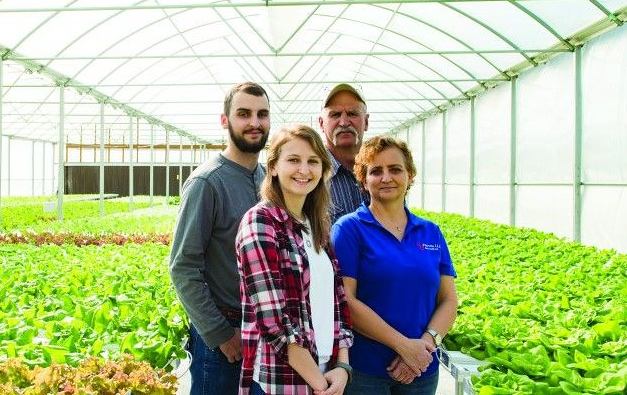
The Buck family of Grinnell, Kansas grow lettuce and herbs. From left, Wade Buck, Shayna Buck, Daniel Buck and Carol Buck.
Couple works with K-State specialists on food safety practices
K-State Research and Extension
Daniel and Carol Buck may be farming in the middle of wheat country, but they’re growing crops of a different sort in northwest Kansas. The Bucks grow lettuce and herbs for sale to grocery stores, restaurants, schools, hospitals and individuals in a hydroponic green house on their 4B Farms near Grinnell.
The couple started their produce business in January 2018 and quickly developed a market. Because they’re growing in a greenhouse, they’re able to grow year round and don’t have the problems with wildlife that other growers do. They rely mostly on Facebook and word of mouth for marketing and say they’ve taken advantage of K-State Research and Extension/ Kansas Department of Agriculture training to learn the ins and outs of Food Safety Modernization Act (FSMA) produce safety rule requirements. They’ve also participated in a Good Agricultural Practices workshop to help them prepare for GAPs audits by the U.S. Department of Agriculture.
“The food safety challenges in California and Arizona actually benefitted us,” Daniel Buck said of nationwide recalls of romaine lettuce linked to E. coli illnesses in the past couple of years. The Bucks were able to keep selling romaine because they had documented their food safety practices and could demonstrate that their romaine was not tainted. That was especially important earlier this year during a recall. The couple had just added a big customer – the Hays Medical Center, a part of the University of Kansas Health System. “We were the only supplier of romaine that could continue to sell (during the recall) to one of their hospitals.”
“With just Carol and I handling (their lettuce and herbs), it minimizes the chances of food safety problems,” Daniel Buck said.
Participating in K-State Research and Extension/Kansas Department of Agriculture workshops has helped keep basic food safety practices in the forefront of the couple’s business, they said, adding that many of those practices are common sense. One of the important things they’ve changed, however, since working with Extension Produce Safety Associate Cal Jamerson, is to stop wearing gloves as they harvest lettuce and herbs. Going without gloves is allowed in the FSMA guidelines.
“You can feel when your hands are dirty, but you can’t feel if your gloves are dirty,” Carol Buck said. In one circumstance, a customer requires gloves and when handling that customer’s produce, they comply with the buyer’s wishes. Otherwise, they harvest without them.
“We have picked Cal’s brain numerous times. He’s a lifesaver,” Carol Buck said.
Jamerson’s position with K-State Research and Extension is funded by the KDA to assist Kansas fruit and vegetable growers in improving the safety of their produce to meet the FSMA Produce Safety Rule requirements.
More information about the FSMA and GAP workshops, plus online registration is available athttps://bit.ly/2FFKDsm or contact Jamerson at 913-307-7394 or [email protected].