We have a brand new updated website! Click here to check it out!

FIRST FIVE: White House ‘chills’ on free speech

Lata Nott

Earlier this month, the Office of the Special Counsel publicly recommended that White House counselor Kellyanne Conway be fired for repeatedly violating the Hatch Act, prompting many people to Google what the Hatch Act is (it’s a law that bars federal employees from engaging in political activity in the course of their work) and President Trump to give an interview to Fox News where he stated that, “[I]t looks to me like they’re trying to take away her right of free speech, and that’s not just fair.” (This week, the president tweeted his support for a proposed constitutional amendment to outlaw burning the American flag — an act the Supreme Court has repeatedly held to be a protected form of political expression — thus ending his streak as a First Amendment advocate.)

But back to the Hatch Act for a moment. It was passed in 1939 to prevent federal employees from engaging in partisan political activities, such as endorsing or opposing particular political candidates. It’s grounded in a noble purpose: to protect federal employees from political coercion and ensure their advancement is based on merit and not political affiliation. To that end, federal employees can’t engage in political activity while they’re on duty, in the workplace, or speaking in their official capacity. The letter from the Office of the Special Counsel (OSC) pointed out that much of Conway’s recent conduct has fallen into that category, as she’s been making the rounds, “disparaging Democratic presidential candidates while speaking in her official capacity during television interviews and on social media.”

White House counsel Pat Cipollone responded with a letter stating, among other things, that applying the Hatch Act to political activity on social media “has a chilling effect on all federal employees whose fundamental First Amendment right to engage in political and public policy discussions should not be compromised based solely on OSC’s guidance.”

This isn’t the first time the OSC has faced that accusation. Ethics and transparency advocates said more or less the same thing last year, when the agency issued new guidelines that federal employees weighing in on President Trump’s prospects for impeachment or talking about “the Resistance” might constitute political activity. National Treasury Employees Union President Tony Reardon’s exact words were, “This guidance is a broad reach that employees may find confusing. It could unnecessarily have a chilling effect on employees’ First Amendment free speech.”

The “chilling effect” is a concept that comes up a lot when we talk about the First Amendment. Essentially, it means that when a law concerning expression is too vague or too broad, people won’t know exactly when their speech crosses the line and violates it. So, in order to avoid punishment, they’ll avoid speaking at all — a major loss for free expression and healthy public debate.

Practically speaking, this isn’t really a concern when it comes to Kellyanne Conway specifically. President Trump has explicitly stated he will not fire her (the OSC only has the authority to recommend that he do so). She has publicly scoffed at the Hatch Act charges, telling reporters, “Let me know when the jail sentence starts.” She continues to appear in public, making it abundantly clear that nothing will get her to chill.

But it’s worth taking a moment to reflect on the impact that laws like this have on other federal employees, most of whom aren’t as protected from consequences as Conway. Henry Kerner, who heads up the OSC, was certainly thinking about this when he recommended that Conway be fired. “In interview after interview, she uses her official capacity to disparage announced candidates, which is not allowed,” he said in an interview with The Washington Post. “What kind of example does that send to the federal workforce? If you’re high enough up in the White House, you can break the law, but if you’re a postal carrier or a regular federal worker, you lose your job?”

It’s a reminder that most government employees have severe restrictions on their First Amendment rights. Some of these restrictions are justified — government offices wouldn’t be able to function if they couldn’t discipline employees for speech that interferes with their duties. But there are plenty of examples of this censorship going too far.

Just look at the impact of the 2006 Supreme Court decision Garcetti v. Ceballos, which removed any First Amendment protection for speech that government employees make in the course of their duties. Since then, we’ve seen numerous cases where government employees have been fired for reporting the misconduct of others and whistleblowing about corruption and mismanagement, with no valid free speech claims at all.

Or think about the times when government entities have decided that their employees’ private conduct on social media impacts their official duties — like the incident where a Pennsylvania public school teacher was suspended without pay because someone posted a photo of her with a male stripper to Facebook. Or think of the postal carriers and regular federal workers who avoid political activity altogether because they’re anxious about running afoul of the Hatch Act.

Here’s hoping that the White House continues championing free speech rights for government employees — it’d be a nice change from prosecuting them for leaking information to the press and accusing them of treason.

Lata Nott is executive director of the First Amendment Center of the Freedom Forum Institute. Contact her via email at [email protected], or follow her on Twitter at @LataNott.

This weekend’s Hays-area garage sales

Hays-area garage sales

Scroll to the bottom for a map of garage sale locations. Hays Post offers FREE garage sale listings weekly. Having a garage sale next weekend? Click HERE to submit your information.

—————-

1700 Wheatland, Hays
Friday June 21st 4-dark, Saturday June 22nd 8-12

Name brand Boys (L-XL), Women’s/Juniors (S-L), Men’s (XL) clothing and shoes. DVDs and Blu-ray movies (lots), many misc excellent quality household and misc items

—————-

503 W. 39th, Hays
Friday June 21st – 11am-6pm and Saturday June 22nd 8am-12pm

Lots of clothing and shoes in all sizes – women’s, men’s, and girls (newborn-size 10/12). Home decor, kitchen items, barstools, grill, vases, books, adult Halloween costumes, lots of kids toys, booster car seat, kids bikes, kids table, scooter, doll stroller, and so much more.

——————

308 W. 37th, Hays
Friday, June 21 10 a.m.-?

-Name brand Teen and adult clothing (NIKE, Adidas, PINK, Miss Me) -Household items -Bread machine -Teaching supplies/resources -Coach purses/wallets -Misc. items

—————-

1706 Anthony Drive, Hays
3 day event, Thurs./Fri., June 27th and 28th from 10 a.m until 6 p.m. and Sat., June 29th, 8 a.m. until noon

Toy tractors, glassware, china hutch, treadmill, edger, misc. tools, pole saw, file cabinets, safes, numerous miscellaneous items

————–

81-year-old dies after Kansas truck crash

ATCHISON COUNTY–One person died in an accident just before 7:30p.m. Friday in Atchison County.

The Kansas Highway Patrol reported a Mack Truck driven by Dana A. Jenkins, 52, Omaha, was northbound on U.S. 73 at 286th Road.

The vehicle struck a westbound 2013 Ford F150. The driver of the Ford 81-year-old Gerald K. Parker died as a result of the crash.

Jenkins was not injured. Both drivers were properly restrained at the time of the accident. The KHP did not release any additional details on Parker.

Study shows strong relationship between afterschool and early reading proficiency

RR

TOPEKA – A new study discovers a strong connection between attending afterschool reading interventions and a child’s early reading proficiency.

The study commissioned by the Reading Roadmap (RR) suggests afterschool programming that includes structured reading interventions aligned with school-day data can accelerate significantly literacy proficiency among young, striving readers.

This study analyzed school individual-level data of 9,000 elementary students across 58 different schools over the 2017-18 academic year. The study compiled data from school-administered reading assessments including AIMSweb, DIBELS and FastBridge. The study compared progress toward reading benchmark among elementary-age children that attended school-based afterschool programs with those that did not.

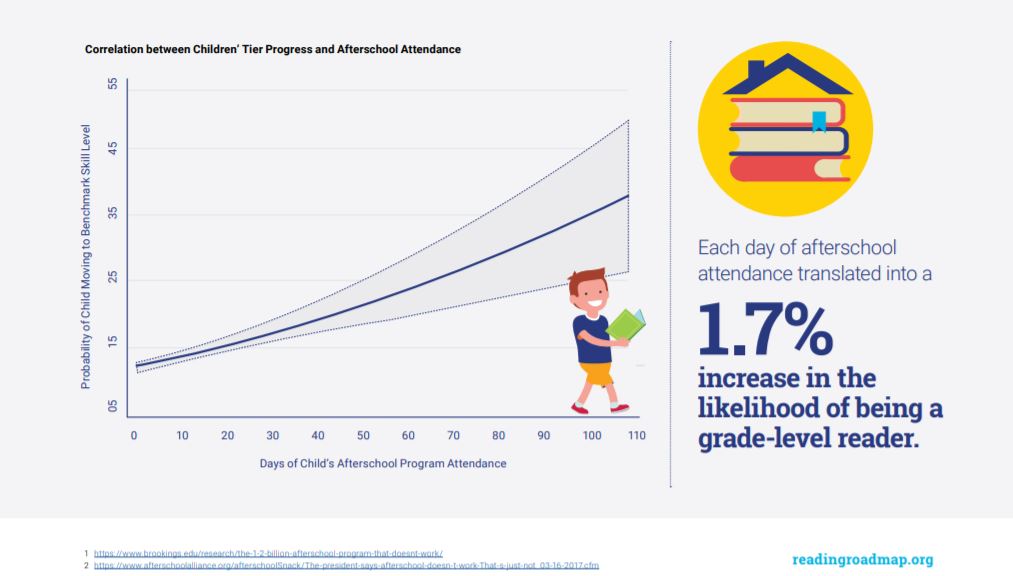
The study found children attending after school reading interventions were 26% more likely to reach benchmark than their non-attending peers. According to the study’s author, Mustafa Yilmaz, “The effect of the relationship was equivalent to a 1.7% greater chance of achieving benchmark reading for every day a child attended after school. That is quite significant.”

The study suggests that structured afterschool reading interventions, when done in concert with school instruction, can accelerate overall reading progress.

“When a child enters kindergarten, it’s a four-year race for her to learn how to read,” said Andrew Hysell, RR Director. “If she cannot achieve early reading proficiency by the third grade, she will face barriers for the rest of her life.”

Supplemental tutoring outside the school day is considered essential for a reader that is behind. For example, the Center for American Progress prioritizes “provid[ing] a tutor for every child performing below grade level” as its number one recommendation to improve education.

Unfortunately, families without resources cannot pay for professional tutoring, and families in rural communities often lack any high-quality options regardless of cost. Therefore, afterschool programs are the only option for these families and their children.

“School-based afterschool reading intervention is literally their only lifeline,” said Hysell. “The evidence continues to pile up that afterschool programs can be an effective delivery device for high-quality reading interventions for children that need them,” said Hysell. “Let’s continue to invest in after school and get more educational value out of our existing programs for the good of all children.”

A formal report of the RR’s findings is available here.

Highlights of the report include:

●      Students who attend after school interventions regularly saw their probability of moving to benchmark increase by an average of 26%;

●      The predicted probability of students reaching benchmark reading who attended RR afterschool programs was as high as 38% greater than their non-attending peers; and

●      Each day of after school attendance translated into a 1.7% increase in likelihood of being a grade-level reader.

The RR provides a structured after school reading program supporting children PK-3. The model aligns with school-tiered systems of support and provides reading interventions in the five pillars of early literacy: phenome awareness, phonics, fluency, vocabulary and comprehension.

An initiative of the Kansas Department for Children and Families (DCF), the Reading Roadmap began in the fall of 2013. DCF recognized the importance of early literacy and understood its connection to success in school and prosperity in life.

While not involved directly with education, DCF funded childcare, afterschool, and family programs targeting low-income populations and believed these types of social service programs could be used in partnership with schools to promote early literacy. To pursue that objective, DCF commissioned the Kansas Reading Roadmap to find innovative strategies for afterschool, summer, and family engagement programs to promote early literacy.

Sheriff: Teen jailed after chase, crash into Kansas home

SHAWNEE COUNTY — Law enforcement authorities are investigating a suspect on numerous charges after a chase and crash into a home.

Castenedo-Montellano photo Shawnee Co.

Just after 11:00p.m. Thursday, a deputy attempted a traffic stop on an older model Ford F-150 near SE 10th and California Avenue in Topeka for a registration violation, according to Sgt. Todd Stalbaumer. The driver failed to stop, and the Ford pickup fled the scene.

Deputies located the pickup behind a business in the 2300 SE 6th Street. A deputy attempted another car stop, but the driver aggressively reversed the Ford, nearly striking the deputy.

The Ford pickup then accelerated from the scene and struck a house in the 500 block of SE Burr. An adult male was sleeping in the residence and was injured by the Ford pickup striking the house. Injuries were not considered serious but the resident was transported to a local hospital.

The driver of the Ford then fled the vehicle and a foot pursuit ensued. With the assistance of a Topeka Police K9 Unit, the suspect was located behind a residence on SE Gray Street.

Jose L. Castenedo-Montellano, 18, Topeka, was taken into custody and booked into the Shawnee County Dept. of Corrections on requested charges that include, Aggravated Assault LEO, Reckless Driving,  Flee or Attempt to Elude, Aggravated Battery Reckless, Felony Criminal Damage and Traffic and Registration Violations.


2 Mexican nationals sentenced in Kansas City heroin ring

KANSAS CITY(AP) — Two Mexican nationals have been sentenced for their roles in a conspiracy that distributed more than 14 kilograms of heroin in the Kansas City metropolitan area.

Federal prosecutors say 46-year-old Julian Felix-Aguirre was sentenced Wednesday to 24 years and seven months in prison without parole. And 38-year-old Martin Missael Puerta-Navarro was sentenced to 14 years and eight months without parole.

The two are among 26 people charged in the case, with 16 of them now sentenced.

Prosecutors say the drug ring worked with the Sinaloa cartel in Mexico to establish stash houses, build hidden compartments in vehicles, and receive and sell black tar heroin.

Court documents say 66-year-old Dennis McLallen, of Overland Park, Kansas, was the direct contact with Mexico-based drug suppliers. He is serving 15 years without parole.

Search underway for suspects who rammed Kan. police vehicle with stolen car

SEDGWICK COUNTY —Law enforcement authorities are investigating a car theft and looking for two suspects.

Just after 8:15p.m. Thursday, police were dispatched to the 8900 Block of East Harry to check for a reported stolen vehicle from Andover, according to officer Kevin Wheeler. On-Star contacted Sedgwick County Dispatch that a Chevy Malibu was possibly in that area.

An officer was able to locate the vehicle at an apartment complex, according to Wheeler. Two men were in in the car.  As the officer approached in a patrol vehicle the driver put the car in reverse striking the patrol car.  The officer was not injured. The vehicle was able to drive from the apartment complex and police chased eastbound on Harry.

The officer quickly terminated the pursuit because of the erratic driving of the suspect. On-Star disabled the vehicle and police located it near 31st and Greenwich.  They did not locate the suspects who were described as Hispanic males wearing white t-shirts, according to Wheeler.

EPA tightens rules on lead in effort to prevent lead poisoning in young children

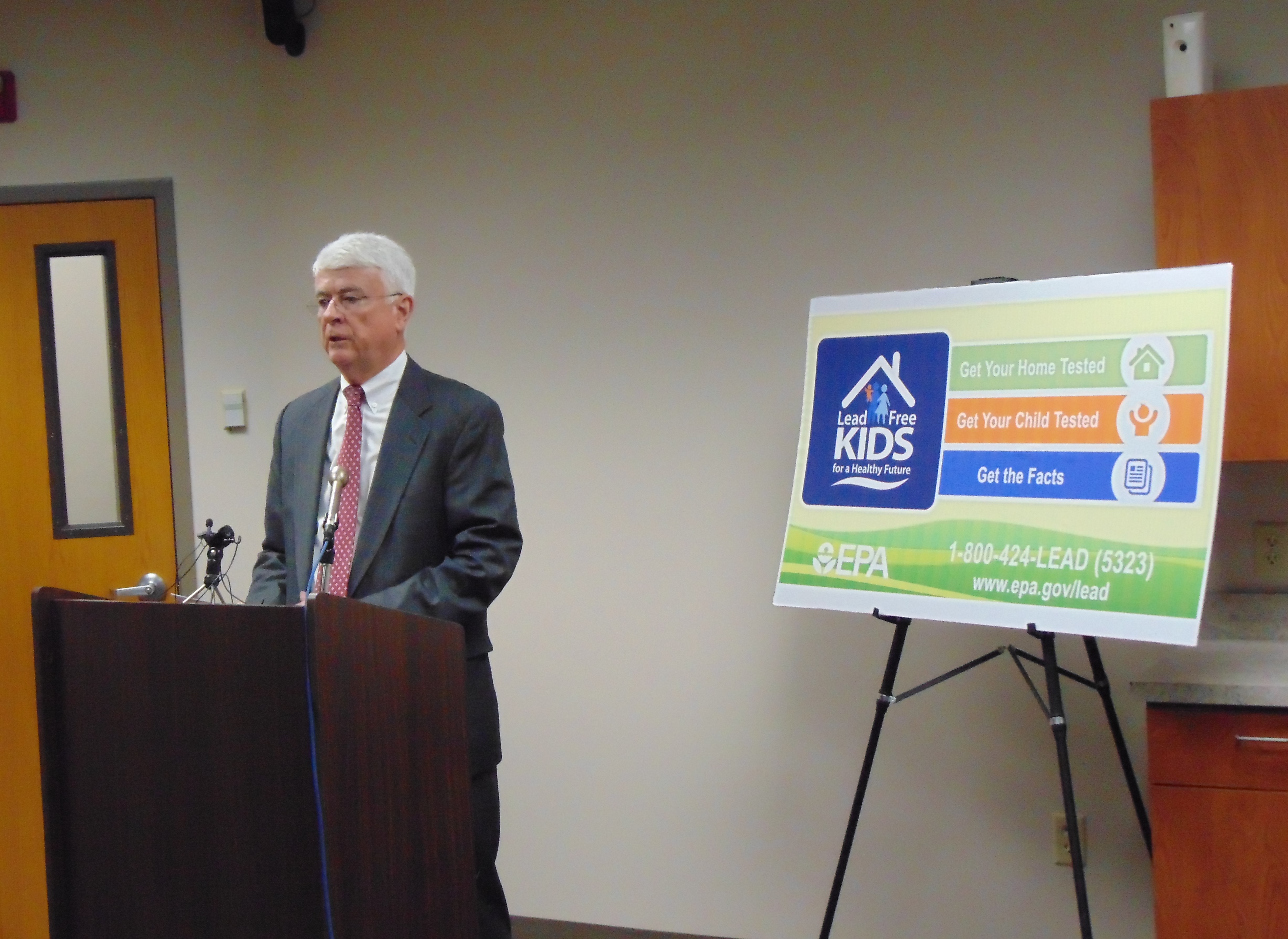
EPA Region 7 Administrator Jim Gulliford addresses a news conference in St. Joseph. Photo by Brent Martin

By BRENT MARTIN
St. Joseph Post

ST. JOSEPH, Mo. — New, tougher regulations on exposure to lead have been implemented by the Environmental Protection Agency.

EPA Region 7 Administrator, Jim Gulliford, tells reporters at a St. Joseph news conference research has proven even small amounts of lead can prove harmful to young children.

“And that’s why today EPA is announcing significantly new and more strict standards for lead dust in homes built before 1978 along with schools and child care facilities as well to protect, again, children in those early developmental years from exposure to lead,” Gulliford says.

The EPA states the United States has greatly reduced the risk of lead exposure to young children, from birth to age six, since the 1970s. New studies though indicate there is no real safe level of lead for such young children. The EPA is lowering the dust-lead hazard standards from 40 micrograms of lead per square foot to 10 on floors and from 250 micrograms to 100 on window sills in buildings built prior to 1978, when lead was banned from paint.

The EPA will work with St. Joseph city officials to educate the public on the threat of lead contamination, especially to the growth and development of children. The EPA reports lead-contaminated dust from chipped or peeling lead-based paint can lead to elevated blood lead levels in children.

Gulliford says the standards have been tightened to protect the very young.

“So, infants and young children especially vulnerable to lead paint exposure because their growing bodies absorb more lead than us as adults and their developing brains and nervous systems are more sensitive to the damaging effects of lead,” according to Gulliford.

Gulliford says the EPA is working with contractors on the issue, especially those who work in renovation of older homes. He says the agency is also attempting to help homeowners who do their own work on how best to prevent lead exposure.

Salina police seek tips about fraudulent use of bank accounts

SALINA — On June 16, law enforcement in Saline County began receiving calls from residents who reported their bank accounts were showing withdraws the residents had not made.

The commonality was they were either Sunflower Bank Customers or had used a Sunflower Bank ATM.

As of June 20, 2019, 8 a.m., Saline County law enforcement agencies had identified 147 possible victims. Many victims had multiple withdrawals. The vast majority of the usages of debit cards were outside of Saline County.

Only four of the 147 events have occurred within the county.

Law enforcement heard from residents of Manhattan, Minneapolis, and Kanopolis, Kansas, as being victims as well.

Locations of card usage have been:

  • Hutchinson, South Hutchinson, Newton, Burrton, Andover, and Wichita, Kansas
  • Spencer, Springer, Ardmore, Norman, and Oklahoma City, Oklahoma
  • Denton and Houston, Texas
  • Kansas City, Missouri

Detectives in those jurisdictions have been contacted and are investigating the crimes that have occurred in their jurisdictions. Saline County law enforcement investigators are seeking information as to the source of the data breach.

If you have any information concerning this event, call Crimestoppers at 825-TIPS, text SATIPS to CRIMES (274637), or visit www.pd.salina.org and follow the Crimestoppers link to submit a web tip. You may receive a cash reward of up to $1,000 and you are not required to give your name.

Two men dead after Kansas head-on crash

BOURBON COUNTY — Two people died in an accident just after 5:30 a.m. Friday in Bourbon County.

The Kansas Highway Patrol reported a 2004 Mercury Sable driven by Brenton T. Handly, 29, Nevada, Mo., was eastbound on U.S. 54 just east of Fort Scott.

The driver attempted to pass another vehicle and struck a 2013 Chevy Malibu driven by Adam W. Bancroft, 48, Fort Scott, head-on.

Handly and Bancroft were pronounced dead at the scene and transported to Frontier Forensics. Both drivers were properly restrained at the time of the accident, according to the KHP.

President Trump OKs disaster funds for parts of Kansas

WASHINGTON (AP) — President Donald Trump has approved a disaster declaration covering more than half of the Kansas’ 105 counties.

The federal assistance approved Thursday will provide service and funds to help recovery from severe weather that began on April 28 and included tornadoes and flooding.

The declaration provides funding for emergency work, repair and replacement of damaged facilities and mitigation of hazards.

Kansas received 10.26 inches of rain in May, more than double the 30-year average of 4.12 inches.

And an EF-4 tornado that hit May 28 caused substantial damage in parts of Douglas and Leavenworth counties.

Copyright Eagle Radio | FCC Public Files | EEO Public File