We have a brand new updated website! Click here to check it out!

Abortion opponents divided on best way to undo Kan. Supreme Court ruling


A roadside sign in rural Kansas. Chris Neal / Kansas News Service

By STEPHEN KORANDA
Kansas News Service

TOPEKA — Abortion opponents appear divided on the best strategy to overcome the Kansas Supreme Court’s ruling that the state constitution guarantees a right to the procedure.

Two legislative committees, one most recently on Wednesday, have now recommended lawmakers take up the issue after they return in January. The stakes run high. Anti-abortion forces worry the ruling will knock down dozens of abortion restrictions already in Kansas law.

The divide comes over how far a proposed amendment should go. At a hearing Wednesday, some advocates said the state should approve what’s called a “personhood amendment” aimed at banning all abortions in Kansas.

“What the personhood amendment says is that we recognize the humanity of the unborn child from their earliest biological beginning,” said Bruce Garren, the chairman of Personhood Kansas.

Supporters of that approach contend that other strategies don’t go far enough. Garren said other responses would mire state abortion restrictions in ongoing legal fights.

Pat Goodson, a former lobbyist and founding member of Right to Life of Kansas, said lawmakers shouldn’t pursue any response that would allow some abortions to continue.

“I oppose any measure which would permit the taking of an innocent human life,” she said in testimony delivered to lawmakers. “A personhood amendment is the only way to legally counteract the evil of abortion.”

Some of the state’s largest groups fighting abortion want a simpler path, reversing the Supreme Court’s ruling by changing the Kansas Constitution to clarify it does not include a right to abortion.

Former state lawmaker Chuck Weber is now executive director of the Kansas Catholic Conference. He likes the idea of a personhood amendment, but said it’s not a practical response.

“A personhood amendment just simply has no chance,” Weber said. “We live in a real world, and it’s not going to happen.”

A constitutional amendment is a high bar to overcome. It takes approval from two-thirds of both the Kansas House and Senate. Then the issue would go on a ballot for a statewide vote.

Even if a personhood amendment passed, it likely wouldn’t survive a court challenge, said Jeanne Gawdun, director of government relations with Kansans for Life.

“We’re interested in making a difference, and not just a statement,” Gawdun said.

Gawdun said lawmakers have made a difference by approving restrictions that reduced the number of abortions in Kansas. An amendment clarifying there’s no right to abortion could preserve those laws and the ability for lawmakers to approve more of them in the future.

A committee Wednesday recommended lawmakers take up the issue over the objections of Democrats on the panel.

Democratic Rep. Stephanie Clayton, who supports abortion rights, cast a constitutional amendment as radical. If voters don’t like court rulings, she said, they can ultimately vote judges off the bench during retention elections.

“You can’t always come crying to the Legislature asking them to change the constitution,” she said. “You vote out your justices. Those systems are already in place.”

Planned Parenthood Great Plains, which provides abortion and other health services, also said lawmakers shouldn’t take up the issue. Lobbyist Rachel Sweet said any amendment on abortion would discriminate against women.

“The fundamental right to personal and bodily autonomy is too critical to be stripped from our state constitution,” she said, “or put to a popular vote.”

The divide among anti-abortion forces over how to proceed with a constitutional amendment adds more difficulty to an already complex issue. The split  could bog down the discussion or ultimately cause a constitutional amendment to fail.

“One could outweigh the other, or they could just…hurt each other’s causes,” Republican Rep. John Barker said. “But, both sides may agree to a compromise.”

Stephen Koranda is Statehouse reporter for Kansas Public Radio and the Kansas News Service, a collaboration of KCUR, Kansas Public Radio, KMUW and High Plains Public Radio covering health, education and politics. Follow him on Twitter @kprkoranda or email [email protected].
Research Estimates 1,000s Of Kansas Kids Qualify For Medicaid But Don’t Have Coverage

Chris Neal / For the Kansas News Service

By CORINNE BOYER
Kansas News Service

GARDEN CITY — In 2017, an estimated 38,000 kids in Kansas didn’t have health insurance. That’s according to data recently released by the Kansas Health Institute.

The highest rates of uninsured kids live in the western and southwestern quadrants of the state, but large numbers of uninsured children also reside in the state’s more populous counties. The lack of Medicaid expansion could be contributing to the issue, but experts say it’s likely not the only reason.

“Is it a certain race and ethnicity? Is it a certain socioeconomic class? Is it by family income? Is it a certain age group — is it the zero to five group or are (the children) a little older?” Shah said.

For the first time, KHI calculated that approximately 25,000 kids are eligible for the state’s Medicaid program, KanCare, and most of them live in western Kansas. Shah said research shows rural areas can be difficult for insurance navigators and outreach specialists to cover.

Kendal Carswell is a licensed master social worker, a licensed clinical addictions counselor and a professor at the Fort Hays State University. Credit Corinne Boyer / Kansas News Service

Kendal Carswell is a social worker, addiction counselor and professor at Fort Hays State University, and has worked with uninsured people in southwest Kansas. In his experience, kids without insurance may come from families who slip between the cracks; that is, they earn too much to qualify for Medicaid but not enough to purchase health insurance.

“There are a lot of working poor … because the threshold for where you’re considered poor … is so low that you can earn almost nothing and can’t get assistance,” Carswell said.

He added that sometimes undocumented immigrants whose children are eligible for KanCare forgo enrollment out of fear that their personal information could be shared with U.S. Immigration and Customs Enforcement.

Carswell has walked a few refugees through the federal health insurance exchange website, but said facets of health insurance like paying for monthly premiums and deductibles raised even more questions from people who are new to the U.S. health insurance system.

“And to them, it was like, well, a scam,” Carswell said.

In rural Sheridan County, an estimated 17.5% of children are uninsured. Becky Mullins, an insurance biller at Sheridan County Hospital, said she also sees a lot of people who are underinsured.

“We have a lot of people that bought into the ACA (Affordable Care Act) — the high deductible plan. And because of that they’ve got to pay $5,000 out of their pocket before their insurance is going to kick in,” Mullins said.

For families who can’t afford the out-of-pocket cost, Mullins said, the hospital has a financial assistance program that both uninsured and underinsured patients can apply for.

But Mullins said more people may have coverage in 2019 because over time people have learned more about the rules and regulations of the federal health insurance program.

“The process has evolved, (and has) kind of gotten all the bumps worked out,” Mullins said. “I do see uninsured families, and generally, I don’t see them go uninsured for long periods of time.”

KHI calculated the statewide data by using numbers from the U.S. Census Bureau’s Small Area Health Insurance Estimates, Shah said.

“So thinking through partnering with local organizations, local coalitions and maybe thinking through strategies like that to facilitate enrollment may so that’s another area to explore,” Shah said.

*The Kansas Health Institute receives support from the Kansas Health Foundation, a funder of the Kansas News Service.

Corinne Boyer covers western Kansas for High Plains Public Radio and the Kansas News Service. You can follow her on Twitter @corinne_boyer or or email [email protected]. The Kansas News Service is a collaboration of KCUR, Kansas Public Radio, KMUW and High Plains Public Radio focused on the health and well-being of Kansans, their communities and civic life.
More than 100 Kansas City students’ ACT tests still missing

KANSAS CITY (AP) — More than 100 students who took the ACT this fall at a Kansas City high school will likely have to retake the college entrance exam because the results are missing.

ACT officials said that 111 exams that were taken Sept. 14 at Park Hill High School weren’t in the testing package when it arrived at their offices.

ACT spokesperson Ed Colby says searches have been conducted of the school and FedEx facilities on the route of the package. He says that ACT staff will continue to work with the test center and FedEx to search for the missing documents.

Colby says ACT officials will keep looking for the answers, and then they’ll grade them if they find them. In the meantime, they’re offering students a free makeup test on Nov. 9 or any other future date.

Commission will consider changes to public nudity ordinance in Manhattan

MANHATTAN — The Manhattan City Commission will consider an amendment to Manhattan’s public nudity ordinance at Monday’s legislative meeting, according to a media release from the city.

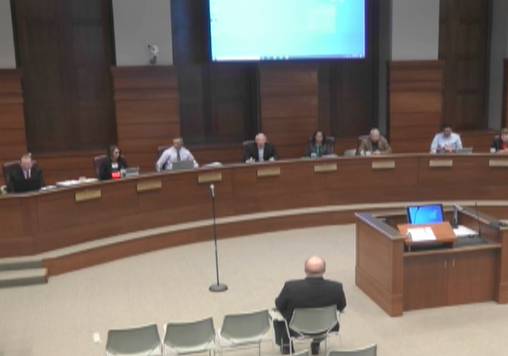
City Commission at work in Manhattan

First adopted in 2003, the existing ordinance makes it unlawful to publicly display female breasts or male or female buttocks or genitals.  The ordinance contains exceptions from prosecution, including for breastfeeding mothers. 
 
The proposed amendment removes the female breast from the definition of public nudity, in reaction to a court case that applies in Kansas.  If the amendment is adopted, Manhattan’s public nudity ordinance will continue to prohibit the display of male or female buttocks or genitals in public. Even as amended, Manhattan’s public nudity ordinance will still be stricter than many areas of Kansas. 
 
“The State of Kansas does not have a state law that prohibits general public nudity,” said City Attorney Katie Jackson.  “To prohibit general public nudity within a city’s limits, the city must adopt an ordinance similar to Manhattan’s.” 
 
Even with the amended ordinance, the City of Manhattan’s public nudity law will still be stricter than many smaller cities and unincorporated areas of Kansas, because Manhattan would still prohibit public display of female or male genitals or buttocks.  However, it is still critical to understand that these communities are also subject to the same state and federal laws as Manhattan, and public nudity in these communities could be prosecuted if the facts violate state or federal law.  
 
“Federal and state criminal laws apply throughout Kansas,” said Jackson.  The facts may violate the “lewd and lascivious” state law, or if a minor is involved, child pornography or other sex offense laws.  “If the facts surrounding a display of female toplessness violate a federal or state law, the offender can be prosecuted in federal or state court regardless of what a city ordinance says.” 
 
Riley County Attorney Barry Wilkerson agreed.  “Manhattan’s proposed change to its public nudity ordinance will not impair our ability to prosecute displays of public nudity or female toplessness that result in violations of state law.”  The County Attorney’s Office also prosecutes offenses related to public nudity that occur in the unincorporated areas of Riley County.  Unlike Manhattan, these areas have no local regulations prohibiting general public nudity.

The ordinance “decriminalizes” female toplessness, but only from the City’s ordinance.  If the definition is changed, the City will not be able to prosecute a public display of female toplessness in the Manhattan Municipal Court.  But this is not the same as “legalizing” female toplessness, which implies that a public display of female toplessness does not violate any law.  Depending upon the facts, state or federal laws may be violated.
 
“A city ordinance amendment does not change state or federal law.  Manhattan cannot legalize conduct that the federal or state laws make illegal,” said Jackson.
 
If the City Commission amends the ordinance on November 5, it retains the ability to amend it again in the future if the law changes or as issues arise.  At first reading of the ordinance, the Commission noted that the ordinance can be revisited before the City’s swimming pools open.  “This is an evolving area of the law, and we may have more guidance from federal or state courts in the next several months,” said Jackson.
 
A private business owner or organization may require a patron to wear a shirt or other clothing upon their private property.  If a topless male or female enters the location, they can be asked to adhere to the dress code or leave, and be cited for criminal trespass if they refuse.


The Latest: Two Kansas men hospitalized after chase, crash

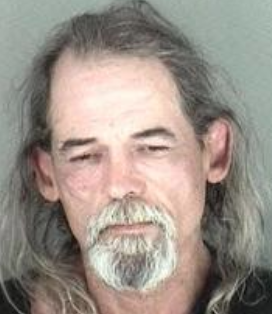
Kirk from an earlier arrest in Shawnee County

ATCHISON COUNTY — Two people were injured in an accident just after 5a.m. Sunday in Atchinson County.

A Jackson County Sheriff’s Deputy attempted to stop a 2004 Saturn Ion driven by Robert Neal Kirk, Jr. 56, Topeka, in the area of 254th Road. and US Highway 75  for traffic infractions, according to Shawnee County Sheriff Tim Morse.

The Kansas Highway Patrol reported a Jackson County Kansas deputy was eastbound on Kansas 9 Highway three miles north of Muscotah in pursuit of a 2004 Saturn Ion driven by Robert Neal Kirk, Jr., 56, Topeka.

The vehicle continued north on W Road to K-9 Highway then east through the city of Whiting and east into Atchison County. The driver failed to negotiate the curves at 159 Highway and continued east off the road and rolled and came to rest on its top. 

EMS transported Kirk to the hospital in Hiawatha. EMS transported a passenger Ronald E. Snowberger, 49, St. George to the Atchison Hospital.

Both were properly restrained at the time of the accident.  The incident remains under investigation, according to Morse.

—————–

Troopers: Teen found with meth strapped to her abdomen

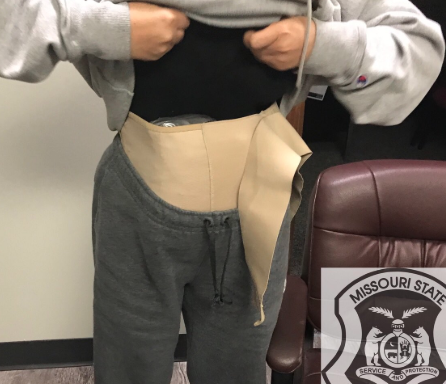
LEXINGTON, Mo. (AP) — Law enforcement authorities are investigating a drug trafficking operation — and possible human trafficking ring — after troopers conducting a traffic stop found a 15-year-old girl with several pounds of methamphetamine strapped to her abdomen.

Photo courtesy MSHP

The traffic stop occurred Tuesday on Interstate 70 in western Missouri. Troopers say a 22-year-old California woman was driving, and the girl was a passenger. When an officer called the girl’s mother, she told him she thought her daughter was at school and had no idea who the California woman was.

When questioned, the girl told officers she had 5.5 pounds of meth strapped to her.

The woman was charged Wednesday with drug trafficking, endangering the welfare of child and other counts. The teen was returned to her mother, and police say no charges against her are expected.The patrol is working with federal law enforcement on the case.

Rural Kansas grass fire burns 300-400 acres

HARVEY COUNTY — Authorities are investigating the cause of a Sunday afternoon grass fire in Harvey County.

Sunday fire burned over 300 acres -photo courtesy Harvey County

The fire in the 3800 block of North Sand Hill Road northeast of Burrton burned about 300 to 400 acres of land, according to a media release.

The spread of the fire was stopped, and there are no injuries or damage to homes reported at this time.

Responders will be on site throughout the night to monitor for potential hot spots.

Sand Hill was closed between Northwest 36th and 60th streets, according to the release.

Fire departments from Burrton, Halstead, Hesston, Newton, Sedgwick, Buhler, Hutchinson and Moundridge responded. We also had Burrton EMS, Harvey County Communications and the Harvey County Sheriff’s Office on scene. Thank you to all for the help.

Kansas man sentenced for murder of innocent bystander

WICHITA, KAN. – The second of two men charged with the murder of an innocent bystander has been sentenced to prison.

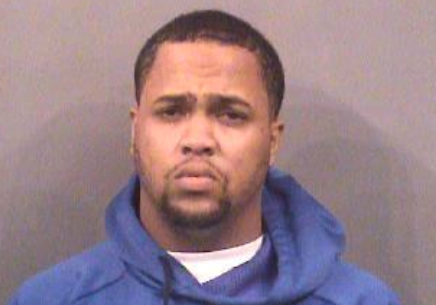
Summers

On Friday, District Chief Judge Jeffrey Goering sentenced KeAndre Summers, 24, Wichita to 179 months in prison, according to the Sedgwick County District Attorney. On August 9, Summers pled guilty to second degree murder and aggravated assault.

In June of 2017, Erick Vazquez, 25 of Wichita, was found dead in his pickup truck in the 3900 block of East 13th in Wichita.

An autopsy showed Vazquez died of three gunshot wounds. His pickup had several 9mm bullet holes in it. Just before the shooting, Jeremy Levy, 20 of Wichita, told a third party that he saw KeAndre Summers in the parking lot. Levy and Summers began shooting at each other in the parking lot of the strip mall.

At the time of the shooting, Vazquez was waiting in his pickup in the parking lot while his friend was buying cigarettes at a nearby store.

Levy is serving a sentence of life in prison after a jury found him guilty of first degree felony murder. He will be eligible for parole after 25 years.

Anti-abortion groups in Kansas divided over ‘personhood amendment’

TOPEKA, Kan. (AP) — Abortion opponents who support a constitutional amendment to ban abortions in Kansas are meeting resistance from other anti-abortion groups that are pushing a different approach.

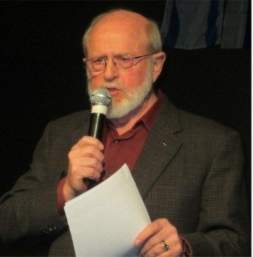
Bruce Garren courtesy photo

Two legislative committees have recommended lawmakers consider the issue during the 2020 legislative session. The recommendations come as lawmakers consider how to respond to a Kansas Supreme Court ruling last year that the state’s constitution guarantees a right to abortion, Kansas News Service reported . The ruling blocked enforcement of a first-in-the-nation ban on a common second-trimester procedure.

At a legislative hearing this week, some advocates pushed for a “personhood amendment” that would ban all abortions in Kansas.

“What the personhood amendment says is that we recognize the humanity of the unborn child from their earliest biological beginning,” said Bruce Garren, the chairman of Personhood Kansas.

Garren and other supporters say any other response to the state Supreme Court’s ruling would bring lengthy legal fights over abortion restrictions.

Some of the state’s largest anti-abortion groups instead want lawmakers to change the Kansas Constitution to clarify it does not include a right to abortion.

It’s not clear how much the differences in opinion will slow the push for a constitutional amendment next year. Anti-abortion legislators have generally deferred to Kansans for Life on policy issues for more than two decades, and the group is an important player in GOP politics. The group has long argued that an incremental approach helps build public support for greater abortion restrictions.

Even if a personhood amendment passed, it likely wouldn’t survive a court challenge, said Jeanne Gawdun, director of government relations with Kansans for Life. She said an amendment stating there is not right to abortion would preserve restrictions already in place and allow lawmakers to approve more of them.

“We’re interested in making a difference, and not just a statement,” Gawdun said.

A constitutional amendment would require approval from two-thirds of both the Kansas House and Senate and would then go to a statewide vote.

Former state lawmaker Chuck Weber is now executive director of the Kansas Catholic Conference. He likes the idea of a personhood amendment but said it’s not a practical response.

“A personhood amendment just simply has no chance,” Weber said. “We live in a real world, and it’s not going to happen.”

Democrats on the committee objected to lawmakers taking up the issue.

Democratic Rep. Stephanie Clayton, an abortion-rights supporter, said voters who don’t like court ruling can vote judges off the bench during retention elections.

And Rachel Sweet, a lobbyist for Planned Parenthood Great Plains, which provides abortion and other health services, said any abortion amendment would discriminate against women.

“The fundamental right to personal and bodily autonomy is too critical to be stripped from our state constitution,” she said, “or put to a popular vote.”

Kan. provider for children with autism agrees to pay $300K to settle false claims allegation

WICHITA, KAN. – Autism Concepts, Inc., an Overland Park-based provider of therapy services for children with autism, has agreed to pay $300,000 to resolve False Claims Act allegations that it submitted false claims to the TRICARE program, according to U.S. Attorney Stephen McAllister.

TRICARE is a federal health insurance program for active and retired military service members and their families.

The United States alleged that Autism Concepts, Inc. and its director Nancy Champlin represented in claims to TRICARE that the company provided individual applied behavioral analysis services to children with autism spectrum disorders when the company actually provided the services to groups of children at the same time. TRICARE does not cover the services in a group setting.

Autism Concepts and Champlin agreed to pay $300,000 to resolve the allegations.

“TRICARE providers must comply with program requirements that are designed for effective treatment for children with special and particular needs,” McAllister said. “This office is committed to making sure federal funds are spent as intended, while protecting federally funded programs that make it possible for military families to receive vital services.”

“I applaud the Department of Justice and the U.S. Attorney for their continued efforts to hold health care providers accountable to the American taxpayer,” said Army Lt. Gen. Ronald Place, director of the Defense Health Agency. “The efforts of the Department of Justice safeguard the health care benefit for our service members, veterans and their families. The Defense Health Agency continues to work closely with the Justice Department, and other state and federal agencies to investigate all those who participated in fraudulent practices.”

“As the investigative arm of the Department of Defense – Office of Inspector General (DoDIG), one of the primary missions of the Defense Criminal Investigative Service (DCIS) is the detection of fraud, particularly fraud that targets critical DoD health care funding,” said Special Agent in Charge Michael Mentavlos of the DCIS Southwest Field Office. “Today’s resolution demonstrates our commitment to working with DoDIG’s Deputy Inspector General for Audit as well as the FBI, Department of Labor Office of Inspector General and the Employee Benefits Security Administration to ensure federal health care programs, such as TRICARE, are protected from companies and/or individuals who attempt to take advantage of them.”

Copyright Eagle Radio | FCC Public Files | EEO Public File