TOPEKA, Kan. (AP) — The Kansas Supreme Court has unanimously overturned the conviction of a man who killed an insect exterminator in February 2008.
Howard Barrett photo KDOC
The court ruled Friday the case against 61-year-old Howard Barrett should be returned to Riley County for a new trial. Read the ruling here.
Barrett beat and fatally stabbed 48-year-old Thomas James, who was doing extermination work in Barrett’s apartment in Leonardville.
His attorney argued that Barrett, who is schizophrenic, felt irrationally threatened by James.
Barrett was convicted in November 2014 of second-degree murder but appealed, saying jurors should have been instructed they could find him guilty of imperfect self-defense voluntary manslaughter.
The Court of Appeals ruled that error was harmless because Barrett’s second-degree murder conviction nullified a possible manslaughter conviction.
The Supreme Court disagreed, saying the jury could have reasonably convicted Barrett of manslaughter.
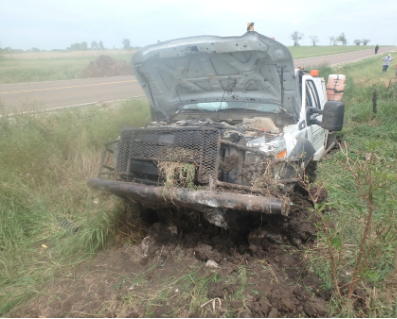
GOVE COUNTY — One person was injured in an accident just before 1:30p.m. Friday in Gove County.
The Kansas Highway Patrol reported a 2014 Dodge Ram driven by Cory S. Romanowksi, 25, Phillipsburg, was northbound on Gove County Road 30 four miles south of Grinnell.
The pickup rear-ended a 2018 Peterbilt semi driven by Daniel I. Weis, 36, Grainfield, that was slowing to turn east onto Gove County Road Z.
Romanowski was transported to Gove County Medical Center. Weis was not injured. Both drivers were properly restrained at the time of the accident, according to the KHP.
TOPEKA – Governor Laura Kelly announced today DeAngela Burns-Wallace as her choice to lead the Kansas Department of Administration.
“I’m pleased to have DeAngela Burns-Wallace on board to lead the Department of Administration,” Kelly said. “Her extensive experience and diverse qualifications will be vital to this agency. I look forward to continuing our efforts to increase transparency of contracts and improve state government.”
Burns-Wallace currently is the Vice Provost of Undergraduate Studies at the University of Kansas. Previously, Burns-Wallace was Assistant Vice Provost for Undergraduate Studies at the University of Missouri. She also served as fellow at the American Council on Education in Washington, D.C., for an emerging Leaders Fellowship in 2013. She earned her B.A. in International Relations from Stanford University, her M.P.A in Public Policy & International Affairs from Princeton University and a doctorate in Higher Education Management from the University of Pennsylvania.
“I am honored to be selected by Governor Kelly to serve the people of Kansas as Secretary of the Department of Administration,” Burns-Wallace said. “I look forward to working alongside her team to build on the progress of the last five months. Kansans are depending on us to work on their behalf.”
Current Acting Secretary Duane Goossen will step down June 7, 2019. Goossen was secretary of administration for Governors Sebelius, Parkinson and Kelly, and budget director for Governors Graves, Sebelius, and Parkinson. He also worked on the Kelly Transition Team.
“Duane was an integral part of our efforts to rebuild our state and improve morale among state employees,” Kelly said. “I can’t emphasize how important he was to this agency, as well as the state as a whole. I thank him for his friendship and service to the state of Kansas.”
John Yeary, currently with the agency, will operate as acting secretary starting June 7 until Burns-Wallace becomes acting secretary on July 1.
Burns-Wallace is to be submitted to the Senate Confirmation Oversight Committee during interim and voted on by the full Senate in 2020.
HELENA, Mont. (AP) — An appeals court has lifted a judge’s injunction that blocked construction of the Keystone XL oil pipeline from Canada to the U.S., but the developer has said it’s too late to begin work this year and environmental groups vowed to keep fighting it.
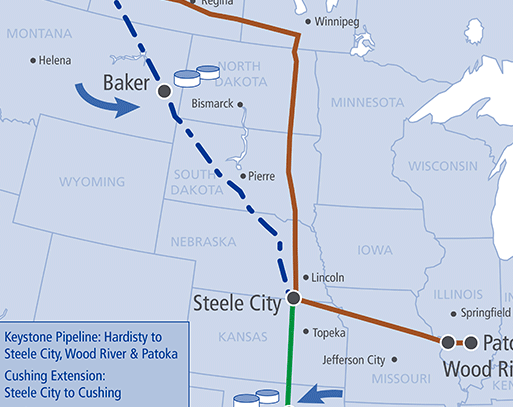
Keystone XL Pipeline — Overall route map courtesy Trans Canada
A three-judge panel of the 9th U.S. Circuit Court of Appeals on Thursday ordered dismissal of the lawsuit by environmental and Native American groups, saying President Donald Trump had revoked a 2017 permit allowing the $8 billion pipeline to be built.
Trump later issued a new permit, and the appellate judges agreed with Justice Department attorneys who say that nullifies the legal challenge involving environmental impacts.
The pipeline would ship up to 830,000 barrels (35 million gallons) of crude oil daily from the tar sands of Alberta through Montana, South Dakota and Nebraska, where it would tie in to existing pipelines to carry the crude to U.S. refineries.
The ruling Thursday was a victory for TC Energy, a Calgary, Alberta-based company that wants to build the line, though company officials have said it already missed the 2019 construction season because of court delays.
“We are pleased with the ruling,” TC Energy spokesman Matthew John said. “We look forward to advancing the project.”
John did not respond to questions on whether the ruling would change the construction schedule.
Attorneys for the plaintiffs accuse Trump of trying to get around court rulings by issuing the new permit, which they say also is flawed. They have filed another, ongoing lawsuit to block the new presidential permit.
Attorney Stephan Volker, who represents the Indigenous Environmental Network and North Coast Rivers Alliance, said he would request another judge’s order to block the project if he thought there was a chance of construction beginning immediately.
Representatives of a half-dozen other environmental groups vowed to keep fighting in court and predicted the pipeline will never be built.
“We shouldn’t forget the underlying issue here — global warning,” Volker said. “We’re trying to save the Earth. I wish the federal government would pay attention to the science and do its job.”
Last fall, U.S. District Judge Brian Morris in Montana ruled that the Trump administration did not fully consider potential oil spills and other environmental effects when it issued the 2017 permit. He blocked construction by issuing a permanent injunction against the project.
White House officials contend a presidential permit can’t be reviewed by a court. After Trump revoked that permit and issued and signed the new one, Justice Department attorneys argued that claims in that lawsuit — and Morris’ injunction — no longer applied.
The environmental groups argued that the government can’t unilaterally sweep aside years of litigation against the long-stalled pipeline.
The Justice Department has not yet responded to the second lawsuit.
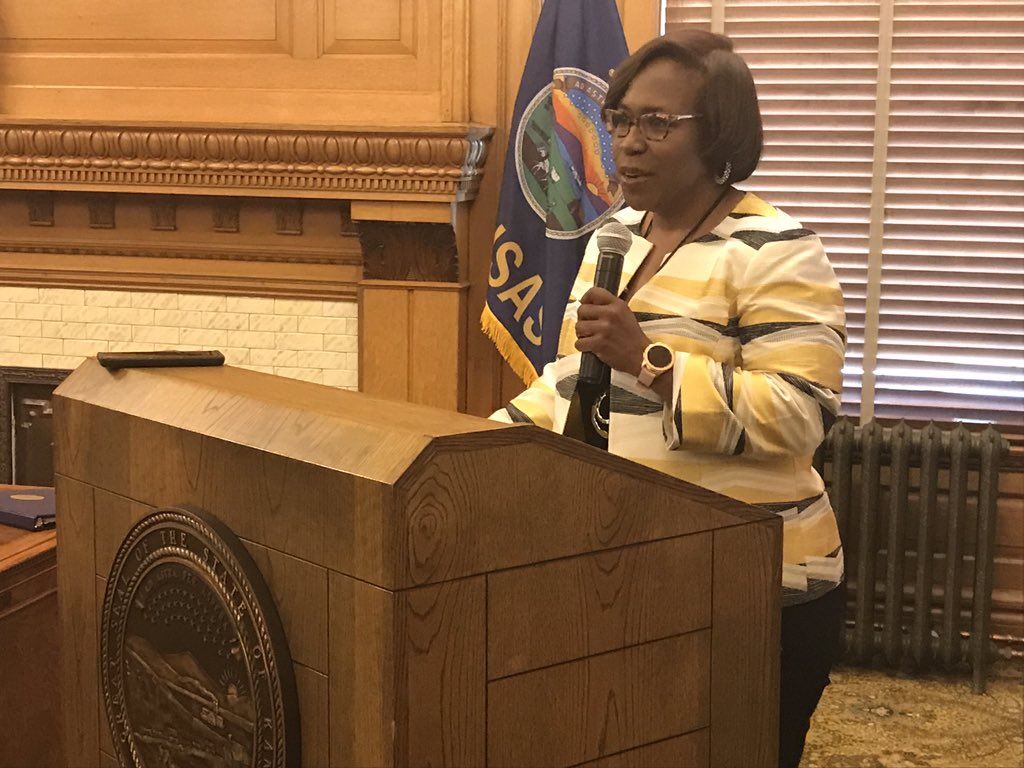
Lt. Gov. Lynn Rogers and Gov. Laura Kelly at a Wednesday press conference announcing a tour of rural communities. (Photo by Jim McLean/Kansas News Service)
KANSAS NEWS SERVICE
TOPEKA – Lt. Gov. Lynn Rogers will spend 12 days this summer in 12 far-flung towns in what is clearly an effort to show the governor’s office cares about rural challenges.
Rogers will be in Colby June 24 and Phillipsburg June 25.
He’ll hear about pains that can seem counterintuitive: Housing shortages on the wide-open prairie, for one. Or the fact that growing communities with plenty of work-age folks can struggle to train up local health workers, even while thousands toil there at lower-paying jobs.
Rural towns are used to politicians promising help or taking piecemeal stabs at fixing things. With a fresh rural revitalization effort in the Legislature and Rogers’ upcoming tour, could bigger solutions materialize? Read about the tour.
MANHATTAN – Two delegates from the 2019 session of the American Legion Boys State of Kansas Leadership Academy have been elected by their peers to represent Boys State of Kansas as senators at Boys Nation this summer.
Ian Gould, a resident of Roeland Park, Kan., and a senior-to-be at Shawnee Mission East High School in Prairie Village, Kan., and Zachary Wash, a resident of McPherson, Kan., and a senior to be at McPherson High School, will attend Boys Nation, Friday, July 19 through Saturday, July 27, at Marymount University in Arlington, Va. The announcement was made this afternoon during the ALBSKLA’s closing ceremonies at Kansas State University in Manhattan.
Benjamin Brake, Wichita, Kan., Wichita Collegiate School, and Gabe Wolff, Pawnee Rock, Kan., Macksville (Kan.) High School in Barton County, were selected as first alternate and second alternate, respectively.
At Boys Nation, Gould and Wash will join representatives from each of the 49 Boys State programs across the country (Hawaii does not have a Boys State program) to receive an education on the structure and function of federal government. At the event, each delegate acts as a senator from his Boys State. The young lawmakers caucus at the beginning of the session, then organize into committees and conduct hearings on bills submitted by program delegates. Senators learn the proper method of handling bills, according to U.S. Senate rules. Participation in the political process is emphasized throughout the week, including organization of party conventions, and nominating and electing a president and vice president.
The week of government training also includes lectures, forums and visits to federal agencies, national shrines, institutions, memorials and historical sites. On Capitol Hill, Boys Nation senators meet with elected officials from their home states.
Approximately 405 young men from across the State of Kansas, all of whom will enter their senior year of high school this fall, participated in the 2019 session of the American Legion Boys State of Kansas Leadership Academy. The event, which completed its 82nd year, started June 3 and concluded today.
The ALBSKLA provides a relevant, interactive, problem-solving experience in leadership and teamwork that develops self-identity, promotes mutual respect and instills civic responsibility. Boys State is a “learning by doing” political exercise that simulates elections, political parties and government at the state, county and local levels, providing opportunities to lead under pressure, showcasing character and working effectively within a team. It’s also an opportunity to gain pride and respect for government and the price paid by members of the military to preserve democracy.
TOPEKA —The Kansas Supreme Court has affirmed Macio Domingo Palacio, Jr.’s convictions in Saline County District Court in the death of Allie Saum in May of 2015, according to a media release from the court.
Palacio photo KDOC
He is one of five men convicted in the fatal shooting of the 17-year-old Salina girl.
In a decision written by Justice Eric Rosen and published Friday, the Supreme Court affirmed Palacio’s Saline County District Court convictions for first-degree murder, attempted first-degree murder, criminal discharge of a firearm at an occupied vehicle, and conspiracy to commit aggravated battery.
The court held that the district court did not err in denying Palacio’s motion to change venue.
It also rejected Palacio’s claim that the district court erred in denying his motion to suppress his confession. Palacio had argued that investigators obtained his confession in violation of his constitutional rights by interrogating him after he clearly asked to speak with a lawyer and by exerting coercive tactics. The court held that the officers’ questions did not constitute interrogation and that Palacio’s confession was voluntary.
OLATHE, Kan. (AP) — A prosecutor says he is no longer actively investigating a criminal case against Kansas City Chiefs wide receiver Tyreek Hill involving alleged injuries to his 3-year-old son.
Tyreek Hill -photo courtesy KC Chiefs
Johnson County Attorney Steve Howe told The Kansas City Star he would reconsider his decision if new evidence emerges against Hill, who has been suspended from the team since April 25 after a television station aired a recording of a conversation between Hill and his fiancee, Crystal Espinal, about the boy’s treatment.
In news conference a day earlier, Howe said he believed the boy had been hurt but would not file charges because he couldn’t prove who did it.
The Kansas Department for Children and Families continues to investigate the couple after police were called to the Hill’s home twice in March.
Hill has maintained his innocence. Chiefs spokesman Ted Crews declined comment Friday.
SALINE COUNTY —Two people were injured in an accident just before 2p.m. Wednesday in Saline County.
Photo Saline County Sheriff
A 2015 Ford F550 driven by Kenneth Reh, 75, Inman, was westbound in the 5800 Block of Kansas Highway 4 a half mile west of Niles Road, according to Sheriff Roger Soldan. The driver fell asleep and pickup left the road and struck a culvert.
EMS transported Reh to Salina Regional Health Center for head and possible chest injuries, according to Soldan. A passenger, Roman Loera-Ramos, 56, McPherson, had cuts to his face and was treated at the scene.
The pickup was carrying a chemical tank that had Roundup herbicide and there was a minor spill of the herbicide. Saline County Emergency Management personnel responded to the scene and determined that the spill did not pose a threat to humans or animals, according to Soldan.
Larry Fluery works for a Bentonville, Arkansas, film festival from a coffee shop in Pittsburg, Kansas.
By STEPHAN BISAHA Kansas News Service
In the 1990s, the near future looked like a place where distance would no longer matter.
In an increasingly online economy, location would matter less than connection. The internet appeared destined to make working from Pittsburgh, Pennsylvania, much the same as tackling a job from Pittsburg, Kansas.
Yet three decades later, location matters as much as ever.
Cities grew denser. Remote towns leaked talent. The growth of Silicon Valley and other high-tech hubs only added to the divide between city and country.
Now, some Kansas communities again see remote work as a way to rejuvenation. Here are six hurdles to bringing online jobs to rural Kansas and ways they might be overcome.
Internet Speed
When it comes to remote work, connectivity is everything.
Sending emails is possible — if painful — on a dial-up connection. But today’s remote work requires high speed. Video conferences. Screen sharing. Gigabyte-sized project files.
And then there’s the future. Augmented reality. Virtual reality. Holograms. Whatever the next technology trend, it will almost certainly consume bandwidth with increasing greed.
“Some of them, we just don’t know what they’re going to be,” said Brian Whitacre, an Oklahoma State University professor studying rural development. “But we’re just seeing this push for more data. More broadband.”
Some Kansas cities such as Pittsburg have access to fiber optic cable — the current gold standard for high-speed internet. A 200-plus-megabits-per-second connection can better prepare a city for the future of remote work.
But much of Kansas lacks access to the basic broadband needed for today’s workplace applications. Remote work just won’t come to places with slow internet.
Slow Acceptance of Remote Work
A little more than 5% of American workers worked remotely in 2017. That reflects a steady, but slow, rise.
And while the digital economy is expanding, many tech companies want their employees working physically closer together. Facebook and Google invested in campuses designed for workers to bump into each other. Yahoo and IBM have rolled back remote work privileges.
They reason game-changing serendipity happens over a cubicle wall more easily than by email.
Some companies continue to encourage remote work. Dell is doing so to save on real estate costs.
There’s also a shortage of high-skilled talent in the big metro areas where many tech companies are based. The Center on Rural Innovation is hoping companies will turn to remote work out of necessity. That’s why the center is providing financial and technical support to places like Pittsburg to create a virtual hub of trained remote workers living in small cities.
“There is a real opportunity to surface, and in some cases train up people, who can work in those fields to live where they want,” said Matt Dunne, the executive director for the Center on Rural Innovation.
Demands from younger workers may force employers who are still iffy on extra out-of-office time to give in. Millennials were more likely than older generations to say a flexible schedule and remote work opportunities were important in a job, according to a Marketplace-Edison Research poll.
Isolation
One problem for remote workers: loneliness.
About a fifth of remote workers said that was their top struggle, according to social media consultant Buffer’s 2018 State of Remote Work Report.
Health concerns linked to loneliness include increased risk of heart disease and suicide.
That’s prompted remote workers to reach out to each other. Larry Fleury does marketing and social media for the Bentonville, Arkansas, film festival. He’s joined an unofficial network of the city’s internet laborers.
“You kind of get new friendships with remote workers,” Fleury said.
Trend is Still Toward Bigger Cities
Even if remote workers can live outside big cities, will they want to?
Since 2000, urban counties have grown while many rural counties saw their populations decline. That’s partially driven by the tech field being concentrated in a few large metro areas. There’s also the gap in amenities — Emporia, Kansas, may have fiber optics, but it can’t compete with Kansas City when it comes to the number of breweries and comedy clubs.
Some researchers predict that the continued concentration in urban centers could reach a tipping point. Increasingly rising rents for small apartments could tempt workers to eye smaller towns.
Pittsburg is investing in new homes to attract those sticker-shocked city dwellers. The city is building bike paths. It may struggle to draw young singles, but the city could be a landing spot for new families looking to escape bigger cities. Pittsburg can offer high-speed internet with a slower lifestyle.
“It’s not just about the fiber,” said Shawn Naccarato, the chief strategy officer for Pittsburg State University. “The fiber is important to facilitate the economic growth, but this is about the quality of life.”
Competition That’s Willing to Pay
Kansas towns looking to attract remote workers have to compete with a growing number of places across the country doing the same. And some of those cities are willing to pay.
Remote workers that move to Tulsa, Oklahoma, get a $10,00 stipend and housing assistance. Vermont is making a similar offer.
Kansas does have its own program to draw in out-of-state workers to specific parts of the state by paying off some student loans and providing tax exemptions. That Rural Opportunity Zone program isn’t aimed at remote workers and excludes many of the counties with strong internet access.
Commutes Still Matter
Even in a remote work future, trips to the office won’t disappear.
Increasing numbers of Americans work remotely some of the time — as much as 43 percent of workers in 2017 according to a Gallup poll.
Trips to the office may shift from daily to weekly or even monthly. But researchers say employers still want face time with people on their payrolls — and video chats won’t cut it.
“People do need to come together,” said Tom Kochan, a professor at the Massachusetts Institute of Technology researching the future of work. “They need to look each other in the eye once in a while.”
The areas most likely to benefit from this workforce shift are those near major metro areas. An hour or more commute becomes more tolerable when it’s no longer five days a week.
But remote parts of Kansas with drives pushing past two hours to dense urban centers will have a harder time attracting and retaining an online workforce.
Stephan Bisaha reports on education for KMUW in Wichita and the Kansas News Service, a collaboration of KMUW, Kansas Public Radio, KCUR and High Plains Public Radio covering health, education and politics. Follow him on @SteveBisaha or email bisaha (at) kmuw (dot) org.
HUTCHINSON — A new festival the first weekend of the Kansas State Fair will feature the treasures and tourist attractions found in Kansas communities.
The Explore Kansas Festival — a showcase of Kansas culture, history, events and attractions — will take place the first weekend of the Fair, Sept. 7 and 8 in Gottschalk Park.
Fair General Manager Robin Jennison says the first-ever festival is a way to educate fairgoers about Kansas’ many attractions all in one place. Visitors will see an interactive display of Kansas byways, dig for a lost village, learn about one of the nation’s oldest town picnics and celebrate the upcoming 200th birthday of the Santa Fe Trail.
“The two-day showcase brings together Kansas communities and attractions, creating a place for the public to discover our unique treasures,” Jennison said.
A few of the communities represented:
Erie is famous for its annual Old Soldiers and Sailors Reunion, which is held during the second full week of July. The reunion features a Free Bean Feed. The beans are prepared using a historic recipe, simmering all day in cast-iron kettles over wood fires — just like soldiers used in the Civil War. This reunion has been conducted continuously since 1873 and is claimed to be the oldest consecutively running Old Soldiers and Sailors Reunion in the country.
Ark City’s Lost City of Etzanoa — In June 2015, archaeologist Dr. Don Blakeslee led a wide-ranging field study in central and southern Kansas. One of his primary goals was to rediscover the long-lost Native American city of Etzanoa. He was successful. It was in the present location of Arkansas City, Kansas. This site is now available for tours.
Santa Fe Trail — William Becknell, known as the Father of the Santa Fe Trail, left Missouri for Santa Fe, New Mexico, in 1821. More than half the trail runs through Kansas and many remnants of the trail still exist. The Santa Fe Trail was the first international trail between the United States and Mexico. The Santa Fe Trail Association will have a display celebrating the trail’s heritage.
“We see the Kansas State Fair as an important mouthpiece for Kansas Tourism,” Jennison added. “The Explore Kansas Festival can help visitors find unique cafes, fishing holes, hiking trails, next summer’s vacation spot, historic sites, natural landmarks, museums, arts and culture and events — or even a new place to call home.”
The fair has already filled up one tent for the festival and is working on filling a second overflow location. There are only a few vacant spots. The community application deadline is Monday, June 10. Spots after this date will be filled if spaces are still available.
To apply for the Explore Kansas Festival, please visit the fair’s website. For more information, call Kansas State Fair Director of Marketing Amy Bickel at (620) 669-3624 or email her at [email protected].
WICHITA — Spirit Aerosystems is making changes as they face financial challenges in the wake of the issues involving the safety of Boeing’s 737 Max jets.
On June 21, the aerostructures manufacturer in Wichita will shorten the work week to 32 hours for up to ten weeks for all salaried, management and executive employees working on commercial programs, according to a media release from the Society of Professional Engineering Employees in Aerospace or SPEEA.
The reduction will impact salaries by 20 percent per week, according to the release.
Those employees have the option to take Monday or Friday off. Employees on the Strategic Defense Program were not included in the changes.
In addition to the initial safety issues, Boeing is now telling some airlines flying its 737 model to replace a part on the planes’ wings, a move that could affect more than 100 aircraft. Boeing said on Sunday that it is working with federal regulators and contacted airlines about potential problems discovered in one batch of “slat tracks” produced by a supplier.
The 737 Max was grounded worldwide following two crashes involving the model.