We have a brand new updated website! Click here to check it out!

Phillipsburg, Colby part of Office of Rural Prosperity Listening Tour

OFFICE OF GOV.

TOPEKA – Governor Laura Kelly and Lieutenant Governor Lynn Rogers announced at a press conference Wednesday details on the upcoming Office of Rural Prosperity Listening Tour.

The tour is intended to foster new ways to help rural Kansas communities by hearing from the residents themselves.

“Rural Kansas has been overlooked and unheard for far too long,” Governor Kelly said. “Our small towns have been neglected. Today we’re taking an important step toward changing this serious problem.”

This upcoming series of events serves as the first phase of the new Office of Rural Prosperity, which has been approved for a $2 million allocation in the newly approved FY 2020 budget. Each location will partner with local hosts in order to set up locations and events.

The Office of Rural Prosperity is dedicated to improving life in rural Kansas. The office is guided by the blueprint created by Governor Kelly, Lt. Governor Rogers and Secretary of Commerce David Toland, which includes:

  • Developing rural housing
  • Revitalizing Main Street corridors
  • Investing in rural infrastructure
  • Supporting rural hospitals and medical professional recruitment
  • Making state government work for rural Kansas
  • Incentivizing active tourism
  • Supporting agribusiness

The tour is intended to travel to the following towns across the state:

  • Nickerson – June 17
  • Atchison – June 20
  • Colby – June 24
  • Phillipsburg – June 25
  • Ulysses – July 8
  • Dodge City – July 9
  • Garnett – July 22
  • Independence – July 23
  • Concordia – July 31
  • Sabetha – August 1
  • Lindsborg – August 7
  • Winfield – August 8

The tour will cover a wide area of the state in order to learn specific challenges and opportunities for the many different rural communities across Kansas.

“The governor and I recognize the needs of our rural communities are unique, and there is no one-size-fits-all approach,” Lt. Governor Rogers said. “We must look at a variety of multifaceted policies and programs that will empower local leaders by helping them access the resources they need. In other words, we must help Kansas communities and local leaders carve out their own route to prosperity.”

More information is available at https://ruralkanprosper.ks.gov. 

You can follow along with the tour with the Lt. Governor on Twitter @LtGovRogers and use the hashtag #LynnListens.

“I’m excited to begin this tour and have meaningful conversations about rural Kansas.,” Lt. Governor Rogers said. “It’s time for elected leaders to be sincere about listening to people in rural communities who’ve been overlooked and taken for granted far too long. We can and will do better.”

Feds: No more education, legal services for immigrant kids

PHOENIX (AP) — The federal government has stopped paying for English-language courses and legal services at facilities that hold immigrant children around the country, imposing budget cuts it says are necessary at a time when record numbers of unaccompanied children are arriving at the border.

On May 30 Border Patrol agents apprehended the largest group of illegal aliens ever: 1,036 people who illegally crossed the border in El Paso Image courtesy White House

The Health and Human Services department notified shelters around the country last week that it was not going to reimburse them for teachers’ pay or other costs such as legal services or recreational equipment. The move appears to violate a legal settlement known as the Flores agreement that requires the government to provide education and recreational activities to immigrant children in its care.

But the agency says it doesn’t have the funding to provide those services as it deals with a soaring number of children coming to the U.S., largely from Central America.

It’s now up to the various nonprofit and private organizations run facilities for the children to cover the cost of teachers, supplies, legal services and even recreational activities and equipment — if they can, or choose to.

BCFS, a nonprofit provider in several Texas cities, said in a statement that it would continue providing services because not doing so would violate state licensing standards. It said it will use emergency funding from its parent organization.

“The health and well-being of those in our care are of the utmost importance and we hope there is a rapid resolution to this funding issue,” spokeswoman Evy Ramos said.

The government says it currently has 13,200 children in its care, and more are coming. The Border Patrol said Wednesday that 11,500 children crossed the border without a parent just last month. The kids are transferred to the care of Health and Human Services after the Border Patrol processes them. Health and Human Services contracts out their care and housing to nonprofits and private companies.

“As we have said, we have a humanitarian crisis at the border brought on by a broken immigration system that is putting tremendous strain (on the agency),” spokeswoman Evelyn Stauffer said. “Additional resources are urgently required to meet the humanitarian needs created by this influx – to both sustain critical child welfare and release operations and increase capacity.”

Health and Human Services is seeking nearly $3 million in emergency funding to cover more beds and provide basic care.

An official at one of the shelter providers said the government notified them on May 30 that they wouldn’t be reimbursing costs of providing education and other activities. The providers pay for things like teacher salary upfront and are then reimbursed by the government.

The official, who spoke on the condition of anonymity because he was not authorized to speak on the matter, said his employer was scrambling to figure out how it would cover the cost of teachers. The provider hasn’t laid anyone off, but worries about children who desperately need to learn English and be intellectually stimulated.

Advocates are also worried about the ramifications of cutting recreational activities. Funding cuts may result in physical education coordinators from being let go and in a lack of adults who can supervise children playing outside.

“The kids are inside 23 hours, and the hour they spend outside is a real lifeline for them,” said J.J. Mulligan, an attorney at the Immigration Law Clinic at University of California, Davis, who has visited and spoken to many of the children at the facilities. “Most of them come from Latin American countries where soccer is king, so the ability to play with their friends really brings them joy in dark circumstances.”

In a memo to staff obtained by The Associated Press, Southwest Key interim CEO Joella Brooks said she was working with the government to figure out why the funding had ended and how it can continue to offer the services. Southwest Key is a nonprofit and the largest provider of shelters for immigrant children.

“In the meantime, remember the service, encouragement and compassion you provide to these youth every day matters a great deal. Please continue to stay focused on taking good care of them,” Brooks wrote to her staff.

U.S. Rep. Raul Grijalva, D-Arizona, was critical of the cuts.

“By eliminating English classes and legal aid that are critical to ensuring children successfully navigate the asylum process, the Trump Administration is essentially condemning children to prison and throwing away the key until their imminent deportation,” Grijalva, who represents a district on the border, said in a statement.

CROSS: We need a new American understanding of energy

Edward Cross / KIOGA

By EDWARD CROSS
Kansas Independent Oil & Gas Association

America’s energy revolution has changed the global landscape. The U.S. has surpassed all expectations and achieved a level of domestic energy production that was unthinkable just a few years ago. We are now the number one producer of oil and natural gas.

Additionally, this market-driven success has helped our nation achieve significant emission reductions. According to Energy Information Administration (EIA) data, U.S. carbon emissions are the lowest they have been in nearly seven decades.

While we can thank American oil and natural gas producers for the hard work and entrepreneurial spirit that made this possible, we must ensure that elected officials work to ensure that our nation achieves its full energy potential. What we need from our elected leaders are smart energy policies that promote our nation’s position as a leader in energy production.

In general, the most affordable forms of energy come from fossil fuels, such as oil, natural gas, and coal. Compared to these energy sources, alternative fuels such as solar and wind power are considerably more expensive and less reliable.

Burning fossil fuels to generate electricity or provide power necessarily releases carbon dioxide (CO2) into the atmosphere. Carbon dioxide is a gas we exhale every time we breathe. Erupting volcanoes, decaying trees, wildfires, and the animals on which we rely for food all emit CO2. This by-product, which is essential for plant life and an unavoidable aspect of human life, is at the center of today’s climate change controversies.

The United Nation’s Intergovernmental Panel on Climate Change (IPCC) recently released its latest climate change report. The IPCC’s models emphasize the need for people to change their lifestyle and consumption patterns to more sustainable alternatives, specifically in areas they can control, like modes of transportation, the buildings they inhabit and their dietary preferences.

While the 133 report authors are undoubtedly well accomplished in their scientific fields, they fail to understand the unintended consequences and high taxpayer and consumer costs that come with climate action. They want to drastically cut carbon emissions worldwide to limit global warming by 1.5 degrees over the next few decades. In order to meet the 1.5 degree goal, the IPCC envisions a future where people travel less using buses, trains, hybrid and electric cars. And in order to overhaul agricultural and land-use practices, the IPCC suggest eating less meat. Going all in to limit warming to a degree and a half would mean bilking the poor around the world while increasing other environmental harms.

Those who believe that increased CO2 emissions inevitably lead to global warming believe this change is directly attributable to the widespread use of fossil fuels. Because they believe further warming will have catastrophic effects, they have waged a war on carbon for many years. They advocate restricting carbon-based fuels in favor of subsidized alternative energy and encourage policymakers to make fossil fuels more expensive in hopes of discouraging their use.

If the goal is really to reduce carbon emissions, it’s worth noting that the U.S. is already doing a good job of achieving that goal. Greenhouse gas emissions continue to plummet according to the latest U.S. Environmental Protection Agency (EPA) data. The EPA found that greenhouse gas emissions, mostly carbon dioxide, fell 2.7% from 2016 to 2017.

Increased natural gas consumption has generated a truly incredible story for the environment as U.S. greenhouse gas emissions have fallen to their lowest levels since 1992. This downward trend is occurring even as U.S. oil and gas production grows dramatically.

Methane emissions from onshore U.S. oil and natural gas production fell 24%, while oil and natural gas production rose 65% and 19%, respectively, from 2011 to 2017, according to data from the EPA and the EIA.
America’s oil and natural gas producers are working hard to develop America’s own abundant resources in a safe and environmentally sound manner. The federal government’s own data confirms methane emissions have fallen in recent years and are continuing to drop, even as oil and natural gas production has risen.

Industry processes have become more efficient. Responsible energy development has and will continue to play a leading role in making the U.S. the world leader in greenhouse gas reductions.

Rational, data-driven, common-sense approach to energy policy is what our nation needs to fulfill its full energy potential, and sadly is all too often absent from today’s energy discussion. We need a new American understanding of energy and with it a national energy policy based on science, the free market, and entrepreneurial spirit. Those who act on our behalf at all levels of government should use those principles as the foundation for their energy policy decisions.

The oil and gas industry has proven that over the long-term it is possible to lead in energy production and environmental stewardship. By focusing on more efficient use of energy, it is possible to lower emissions without imposing even more environmental restrictions. The key is to avoid placing unnecessary political or legal obstacles in the way of innovation and expansion. An American energy policy that values innovation over regulation can turn energy policy challenges into great opportunities for economic growth and energy security. This approach is not just good business, it’s good stewardship and a much better strategy for improving the quality of life for all.

BOOR: Time to fertilize warm-season grasses


Alicia Boor

June is the time to fertilize warm-season lawn grasses such as 
bermudagrass, buffalograss, and zoysiagrass. These species all thrive in 
warmer summer weather, so this is the time they respond best to 
fertilization. The most important nutrient is nitrogen (N), and these 
three species need it in varying amounts.

Bermudagrass requires the most nitrogen. High-quality bermuda 
stands need about 4 lbs. nitrogen per 1,000 sq. ft. during the season 
(low maintenance areas can get by on 2 lbs.). Apply this as four 
separate applications, about 4 weeks apart, of 1 lb. N per 1,000 sq. ft. 
starting in early May. It is already too late for the May application, 
but the June application is just around the corner. The nitrogen can 
come from either a quick- or slow-release source. So any lawn fertilizer 
will work. Plan the last application for no later than August 15. This 
helps ensure the bermudagrass is not overstimulated, making it 
susceptible to winter-kill.

Zoysiagrass grows more slowly than bermudagrass and is prone to 
develop thatch.
Consequently, it does not need as much nitrogen. In fact, too much is 
worse than too little. One and one-half to 2 pounds N per 1,000 sq. ft. 
during the season is sufficient. Split the total in two and apply once 
in early June and again around mid-July. Slow-release nitrogen is 
preferable but quick-release is acceptable. Slow-release nitrogen is 
sometimes listed as “slowly available” or “water insoluble.”

Buffalograss requires the least nitrogen of all lawn species 
commonly grown in Kansas. It will survive and persist with no 
supplemental nitrogen, but giving it one lb. N per 1,000 sq. ft. will 
improve color and density. This application should be made in early 
June. For a little darker color, fertilize it as described for 
zoysiagrass in the previous paragraph, but do not apply more than a 
total of 2 lb. N per 1,000 sq. ft. in one season.  As with zoysia, 
slow-release nitrogen is preferable, but fast-release is also OK. As for 
all turfgrasses, phosphorus and potassium are best applied according to 
soil test results because many soils already have adequate amounts of 
these nutrients for turfgrass growth. If you need to apply phosphorus or 
potassium, it is best to core aerate beforehand to ensure the nutrients 
reach the roots.

Alicia Boor is an Agriculture and Natural Resources agent in the Cottonwood District (which includes Barton and Ellis counties) for K-State Research and Extension. You can contact her by e-mail at [email protected] or calling 620-793-1910.

Another small earthquake reported in Rooks County

Image Kansas Geological Survey

ROOKS COUNTY — A small earthquake shook Rooks County Wednesday evening. The quake before 10p.m. measured a magnitude 3.0 and was centered just west of Plainville, according to the Kansas Geological Survey.

On May 22, the agency reported three earthquakes that measured from 2.9-3.0 in Rooks County. There are no reports of damage or injury from Wednesday quake according to the sheriff’s department.

Cloudy, mild Thursday with a chance for showers

Thursday A 50 percent chance of showers and thunderstorms. Mostly cloudy, with a high near 78. Calm wind becoming east 5 to 8 mph in the morning.

Thursday Night A 20 percent chance of showers and thunderstorms, mainly between midnight and 1am. Mostly cloudy, with a low around 60. East wind around 5 mph becoming calm in the evening.

FridayMostly sunny, with a high near 83. Calm wind becoming southeast 5 to 7 mph in the morning.

Friday NightMostly clear, with a low around 61. Southeast wind 6 to 9 mph.

SaturdayMostly sunny, with a high near 85.

Saturday NightA 50 percent chance of showers and thunderstorms. Partly cloudy, with a low around 58.

SundayA 40 percent chance of showers and thunderstorms, mainly before 1pm. Mostly cloudy, with a high near 71.

2 dead, 1 hospitalized after SW Kansas crash, fire

FINNEY COUNTY — Two people died in an accident just before 2p.m. Wednesday in Finney County.

The Kansas Highway Patrol reported a 2017 GMC Sierra driven by Joe McNally, 50, Memphis, TN., was northbound on Jenny Barker Road.

A 2018 GMC Sierra driven by Christian Victor Westergard, 47, Scott City, was eastbound on Mead Road approaching the intersection to Jenny Barker Road.

Both vehicles entered the uncontrolled intersection at the same time. The 2018 Sierra struck the 2017 Sierra on the driver side between the two axles and it became fully engulfed in flames and overturned.

McNally and a passenger Jimmy Martin Sherlock, 57, Memphis, were pronounced dead at the scene.

Westergard was transported to the hospital in Garden City. All three were properly restrained at the time of the accident, according to the KHP.

Kansas man charged with sex crimes involving 11-year-old

HUTCHINSON — A Kansas man has been charged by the state for crimes allegedly involving inappropriate contact with an 11-year-old girl.

Donovan Hall photo Reno Co.

On Wednesday, Donavan Roy Hall was charged with aggravated indecent liberties with a child for contact that allegedly occurred March 7 and again on July 21, 2018.

He then asked for a reduction of bond, but the state objected.

Even after the investigation began, he was still attempting to contact the child, according to statements in court.. That led to the family of the 11-year-old to seek a protection from abuse order against Hall. The charge against him is a level three felony with a maximum sentence of over 20 years in prison.

Hall will be back in court on June 26.

Battle continues over prison funding, governor’s choice for KDOC chief

TOPEKA, Kan. (AP) — Top Republican legislators on Wednesday blocked nearly $10 million that Kansas corrections officials argue they need to deal with prison overcrowding and said lawmakers might reject Democratic Gov. Laura Kelly’s choice to be the prison system’s next leader.

In February Gov. Kelly spoke to employees at the El Dorado Correctional Facility -photo courtesy KDOC

The actions by Republican legislative leaders decrease the number of male inmates that the Department of Corrections can transfer for now to private prisons out of state and halt the agency’s plans to move female inmates into empty space at a juvenile detention center in Topeka.

Top Republicans in the GOP-controlled Legislature did agree to release about $18 million, including money for pay raises for corrections officers. They said they’re still addressing the troubled prison system’s most pressing problems, with future discussions of the other spending still possible.

GOP leaders said they have reservations about the department’s plans to house 600 inmates outside Kansas and worry about conditions in private prisons generally. They questioned whether the juvenile correction project was legal and complained repeatedly that Kelly’s administration waited until late April to fully outline its plans.

But recently retired Interim Corrections Secretary Roger Werholtz said, “I think it’s going to make things more dangerous.”

Legislators provided nearly $36 million in additional funds for prisons in the next state budget. However, Republicans worried enough about how it might be spent to require Kelly to convene a meeting of eight top legislative leaders, six of them Republicans, and have them sign off on releasing the bulk of it.

Their meeting Wednesday came with Republican leaders and Kelly increasingly at odds, following her vetoes of two GOP tax relief plans and top Senate Republicans thwarting Medicaid expansion.

It also came less than two weeks after Kelly announced her appointment of Jefferey Zmuda, the deputy director of Idaho’s prisons system, as the next Kansas corrections secretary. He plans to take over in July.

But Senate President Susan Wagle, a conservative Wichita Republican, told Kelly publicly Wednesday that she is not sure Zmuda can win Senate confirmation. A state-court-judge in Idaho criticized Zmuda in a March ruling, saying he had given “disingenuous” testimony in a lawsuit over access to that state’s execution records.

Wagle said she is concerned about transparency issues with Zmuda planning to take over the Department of Corrections. Lawmakers are out of session until January, but Zmuda would be forced to step down if the Senate won’t confirm his appointment.

“He would not be confirmed if we voted today,” Senate Majority Leader Jim Denning, a conservative Kansas City-area Republican, told reporters.

Kelly firmly stood by Zmuda’s appointment. The governor said she and her staff knew about the Idaho judge’s comments and discussed them with Zmuda, and he acknowledged that issues related to the lawsuit were not handled as well as they could have been. She said once lawmakers meet him they will see that he is “eminently qualified.”

“He knows what the problems are here in the state of Kansas and he is up for the challenge,” Kelly told reporters.

The Kansas prison system has been plagued with staffing shortages even as its inmate population has continued to grow. The prison system had multiple riots in 2017 and 2018. Extra funding released by legislative leaders Wednesday will 15.9% pay raises for uniformed corrections officers across the prison system.

Werholtz told legislative leaders Wednesday that since an emergency was declared in February at the state’s maximum-security prison outside El Dorado, about 30 miles (48 kilometers) east of Wichita, employees there have worked more than 2,000 16-hour shifts.

The state has about 10,000 inmates in its custody and the official capacity of its prisons is about 9,900 — after boosting the capacity figures in 2017 by declaring that inmates could be housed two-to-a-cell in much of the system, despite some officials’ past misgivings.

The next state budget included $16.4 million to allow the department to house up to 600 male inmates in county jails or out-of-state prisons. The department is pursuing a contract with a private prison in Arizona that its officials declined to name Wednesday.

But top Republicans on Wednesday blocked $6.6 million of the funds as some of them said they dislike using private prisons. Kelly said it’s not ideal but, “I just don’t think we have much of a choice.”

The department also wanted to move 120 inmates from the state’s prison for women in Topeka to the juvenile corrections center there. Lawmakers set aside $3 million.

The budget says the money was for “renovations.” Department officials said the need for renovations at the juvenile center is minimal and wanted instead to spend the funds on staff and programs. GOP legislative leaders concluded that the budget law wouldn’t allow it and blocked the funds, stopping the project altogether.

___

Regulators OK acquisition of massive Kan. wind power project

JEFFERSON CITY, Mo. (AP) — Missouri utility regulators have approved the acquisition of a large wind energy project by a Chicago firm.

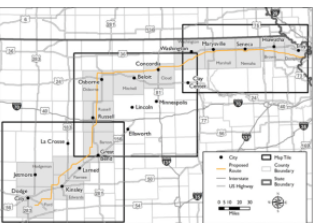
The overview map depicts the proposed route of the Grain Belt Express Clean Line in Kansas- Image Clean Line Energy Partners.- click to expand

The decision Wednesday by the state Public Service Commission was a necessary step for Invenergy to buy the rights to construct the proposed Grain Belt Express power line.

The project initiated by Houston-based Clean Line Energy Partners would carry Kansas wind energy on a 780-mile path across Missouri and Illinois before hooking into an electric grid in Indiana that serves eastern states.

Missouri regulators earlier this year reversed their previous denials and gave the green light to the project. Missouri legislators then tried but failed to prohibit eminent domain for the project.

But the project still needs regulatory approval in Illinois, where an appeals court last year overturned the state’s previous approval.

‘AK-47 bandit’ who shot at KHP trooper sentenced to prison

LINCOLN, Neb. (AP) — A Montana man dubbed the AK-47 bandit and accused of holding up banks in several states over a five-year period has been sentenced in a Nebraska federal court to 35 years in prison.

Gathercole in a Dawson County Nebraska courtroom July 2018 image courtesy KNOP TV

Richard Gathercole, of Roundup, Montana, received the maximum sentence Wednesday after pleading guilty in March to bank robbery. The 41-year-old Gathercole admitted during that plea hearing to using an AK-47 while robbing a Nebraska City bank in 2014. Gathercole also pleaded guilty to the 2017 carjacking of a farmer in Kansas that led to his arrest in Lexington, Nebraska.

As part of his plea deal, Gathercole won’t be prosecuted by other jurisdictions for other violent crimes, including shooting at a Kansas state trooper in 2017 and bank robberies in California, Idaho, Iowa and Washington state from 2012 to 2017.

Some of the crimes had passed the five-year federal statute of limitations.

Police: Man dies after SUV strikes pole in Riley County

RILEY COUNTY —One person died in an accident just after 10a.m. Wednesday in Riley County.

A 2018 Ford Escape driven by a 56-year-old man was traveling on Tuttle Creek Boulevard near mile marker 33, according to a media release from Riley County Police.

The vehicle traveled off the road and struck a pole. The was transported to Via Christi in Manhattan where he died.

The cause of the crash is under investigation. According to the Riley County Police Department, the driver may have suffered a medical episode while driving.

The RCPD did not release the man’s name.

Copyright Eagle Radio | FCC Public Files | EEO Public File