Henry L. Duryee passed away Tuesday, April 23, 2019, at Hays Medical Center in Hays, KS at the age of 85.
He was born on August 5, 1933 in Dorrance, KS to Max and Anna (Miller) Duryee. Henry attended high school in Dorrance and graduated with the class of 1952. After serving in the Army, Henry worked as the head manager for the Noxious Weed Department for Russell County. He was united in marriage to Nancy Cooper on Nov. 30, 1952 in Wilson, Kansas. They were blessed with 4 daughters: Teresa, Joleen, Ruth, and Sandy.
Henry enjoyed hunting and fishing. He could be found most days either at the lake or down by the river. Henry loved spending time with his family, and so enjoyed all of his grandchildren.
Left to cherish his memory is his wife Nancy of the home; daughters, Theresa Sparks and husband Brad of Thornton, CO, Joleen Hill of Wilson, Ruth Kepka and husband Henry of Dorrance, and Sandy Shupe of Hays; sister, Betty Goodwin of Ponca City, OK; 14 grandchildren; 29 great-grandchildren; and one great-great-grandchild.
He is preceded in death by his parents, Max and Anna Duryee; brothers, Lavern, Dale, and Willis Duryee; sisters, Maxine Temple and Cora Whitmer; and son-in-law, Roger Hill.
Funeral Services will be held at 10:30AM on Friday, April 26, 2019, at the First Baptist Church in Wilson with burial following in Dorrance City Cemetery. Visitation will be held on Thursday at the funeral home 1:00PM – 8:00PM with the family receiving friends 6:00PM -8:00PM. Visitation will also be held 9:30AM until service time on Friday at the church.
Memorials are suggested to Wilson Baptist Youth and may be sent in care of Plumer-Overlease Funeral Home, 610 24th ST., PO Box 533, Wilson, KS 67490. Condolences may be left for the family at www.plumeroverlease.com
SHAWNEE COUNTY — Law enforcement authorities continue investigating after skeletal remains were found Monday in rural Shawnee County.
Authorities on the scene near where skeletal remains were found -photo courtesy WIBW TV
Late Monday, the Shawnee County Sheriff’s Office was called to a wooded area north of the Kansas Department of Wildlife, Parks and Tourism regional office at 300 SW Wanamaker Road, according to Undersheriff Phil Blume
A citizen found skeletal remains in the dense woods. The Shawnee County Sheriff’s Office, in conjunction with the Coroner’s Office, was able to confirm that the skeletal remains are human, according to Deputy Shayna Anderson.
The excavation process in conjunction with Washburn University Forensic Anthropology Recovery Unit is complete.
A majority of the human remains were able to be recovered. The remains are now in the custody of the Shawnee County Coroner’s Office. A preliminary investigation of the scene did not indicate signs of foul play.
————–
SHAWNEE COUNTY — Law enforcement authorities are investigating after skeletal remains were found.
On Monday, the Shawnee County Sheriff’s Office was called to a wooded area north of the Kansas Department of Wildlife, Parks and Tourism regional office at 300 SW Wanamaker Road, according to Undersheriff Phil Blume
A citizen claimed to have found skeletal remains in the dense woods. The Sheriff’s Office responded and with the assistance of the Shawnee County Coroner’s Office, located and removed the skeletal remains in question. Due to darkness and heavy vegetation the search was postponed until daylight.
The property and immediate area in question is private property and access is being denied, according to Louderback
It is important for a thorough search of the area to be completed. Authorities don’t known how long that will take.
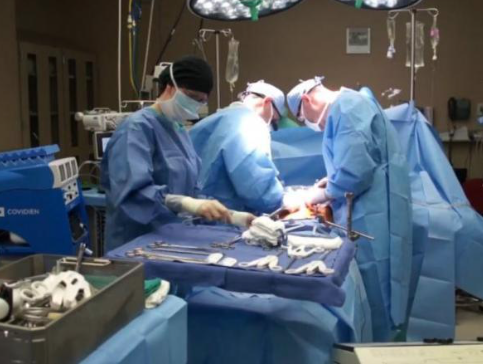
Physicians at the University of Kansas Hospital perform surgery. KU is one of 14 transplant centers challenging a new policy on liver allocation. THE UNIVERSITY OF KANSAS HEALTH SYSTEM
Two Kansas City area hospitals joined 12 other transplant centers this week in a lawsuit over a new liver allocation policy that they say will result in “hundreds of liver transplant candidates needlessly dying.”
The University of Kansas Hospital and Saint Luke’s Hospital of Kansas City are plaintiffs in a federal lawsuit filed in Atlanta against the U.S. Department of Health and Human Services and the United Network for Organ Sharing, or UNOS, the private organization that contracts with the government to manage the nation’s organ transplant system.
The new policy, set to take effect at the end of April, changes the regional system for allocating livers to one that gives priority to the sickest patients.
That has hospitals such as KU and Saint Luke’s upset because their region has a higher rate of donor registration than others.
Supporters of the policy change say that it’s meant to reduce geographic disparities in organ distribution. The notion is that where a patient lives or chooses to list for a transplant should not be a factor in organ allocation.
More than 13,000 people in the United States are awaiting liver transplants and only 7,000 livers are currently available, according to the lawsuit. Another 11,000 people are added to the liver waitlist every year.
The lawsuit filed Monday contends that the new policy “will result in at least 20% fewer liver transplants being performed in the most socioeconomically disadvantaged regions in the country, which are served in part by Transplant Center Plaintiffs’ liver transplant programs.”
“Based on the government’s own data, Transplant Center Plaintiffs will perform 256 fewer transplants per year — leaving 256 candidates at risk of imminent death absent the transplant they would have otherwise received,” the lawsuit states.
Calling the new policy “the product of an opaque, reckless process that failed to allow for full public comment and transparent discussion,” the plaintiffs say they’re not seeking preferential treatment. Rather, they say they’re asking HHS and UNOS “to develop a policy that complies with the law.”
The lawsuit alleges that HHS unlawfully abdicated its responsibility to determine the nation’s liver allocation policy by deferring decision-making to UNOS.
Ann Paschke, a spokeswoman for UNOS, said in a statement that the organization would review the complaint, but believes “that we have developed a sound policy that provides a fairer, more equitable system for all liver patients – no matter where they live – as they wait for a lifesaving transplant.”
“The reality is that, on average, three people die every day in the U.S. while waiting for a liver transplant, and because this new policy will save more lives by reducing the number of patients who die while waiting, we believe it is an improved policy and a step in the right direction,” Paschke said.
“This new policy is projected to reduce waitlist mortality by roughly 100 fewer deaths each year, will allow more children to receive life-saving transplants, and will correct an inequity that emerged over time within the old policy that led to unfair advantages and disadvantages based on where liver transplant recipients live.”
Besides KU and Saint Luke’s, the plaintiffs include Washington University and Barnes-Jewish Hospital, which jointly operate a transplant program in St. Louis that has performed more than 2,100 liver transplants since 1985. Other plaintiffs include hospitals in Atlanta, Detroit, Michigan, Indiana, Iowa, Kentucky, Oregon, Tennessee and Virginia.
Four individuals awaiting transplants are also plaintiffs.
The transplant centers collectively account for 11% of the people nationwide awaiting liver transplants.
KU Hospital, part of the University of Kansas Health System, runs the only liver transplant program in Kansas and has performed nearly 1,600 transplants since 1990, according to the lawsuit. Saint Luke’s has performed about 70 liver transplants in the last five years.
Liver transplant survival rates have improved markedly since Thomas Starzl performed the first liver transplant at the University of Colorado in the early 1960s. The first patients survived only weeks. Today, 86% are alive one year after surgery, 78% after three years, 72% after five years and 53% after 20 years, according to the National Institute of Diabetes and Digestive and Kidney Diseases.
Organ donation registration rates vary dramatically by state. They range from a high in Montana of 93% of adults registered as organ donors to a low in New York of 32%. Missouri ranks seventh in the nation, with 73 percent of adults registered as organ donors. Kansas ranks 12th, with 68 percent registered.
Other elected officials support the change. More than 80 House members sent a letter last month to Azar endorsing it, according to Modern Healthcare.
In an op-ed last week in the St. Louis Post-Dispatch, Blunt said that the new policy could result in a 32% drop in liver transplants in Missouri.
“No longer will locally donated livers be more likely to stay in Missouri or other Midwestern states that have high donation rates,” Blunt wrote. “Instead, the transplantation network rewards locations that don’t have the high number of organ donors that most Midwestern states do.”
The most common reasons for liver transplants are alcoholic liver disease, cancer, fatty liver disease and cirrhosis caused by chronic hepatitis C. The vast majority of donated livers come from people who have recently died.
A statement released by KU said the new policy will result in transporting organs and transplant teams up to 500 miles away from each donor hospital, creating more risks for patients, the organs and the teams as well as higher transportation costs.
“More people will die … that’s the bottom line,” Dr. Sean Kumer, a transplant surgeon, is quoted as saying in the release.
Dan Margolies is a senior reporter and editor in conjunction with the Kansas News Service. You can reach him on Twitter @DanMargolies.
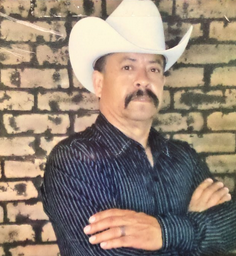
José Horacio Armendariz, age 58, of Scott City, Kansas, passed away on April 20, 2019 at the Swedish Medical Center in Denver, Colorado. He was born on June 12, 1960 in Satevo, Chihuahua, Mexico, the son of Encarnacion and Eva Prieto Armendariz. A resident of Scott City, Kansas since 1984 moving from Chihuahua, Mexico, he was a feed truck driver for Poky Feeders since 1984.
He was a member of the St. Joseph Catholic Church in Scott City, Kansas.
Survivors include four brothers – Armando Armendariz of Chihuahua, Mexico, Ramon Armendariz of Chihuahua, Mexico, Humberto Armendariz of Chihuahua, Mexico, Jesus Armendariz of Chihuahua, Mexico, six sisters – Hermila Rivera of Chihuahua, Mexico, Ideliza Rivera of Chihuahua, Mexico, Manuela Ruiz of Chihuahua, Mexico, Luz Elena Heredia of Chihuahua, Mexico, Graciela Rodriguez of Scott City, Kansas, and Leticia Alvidrez of La Paz, Mexico, nieces & nephews – Armando Armendariz of Kansas, Ever Armendariz of Kansas, Ibis Armendariz of New Mexico, Verenice Chavez of Texas, Salvador Rivera of New Mexico, Chubeto Rivera of Kansas, Gardenia Ruiz of Mexico, Pamela Heredia of Mexico, Blas Rodriguez of Kansas, Ricardo Alvidrez of Mexico and Rey Armendariz of Kansas.
He was preceded in death by his parents, and one brother – Arturo Armendariz.
Vigil Service will be held at St. Joseph Catholic Church in Scott City, Kansas at 7:00 p.m. Friday, April 26, 2019.
Funeral Mass will be at St. Joseph Catholic Church in Scott City, Kansas at 10:30 a.m. Saturday, April 27, 2019.
Interment will be in the Scott County Cemetery in Scott City, Kansas.
Visitation will be at Price & Sons Funeral Home in Scott City from 3:00 p.m. until 8:00 p.m. Thursday and from 10:00 a.m. until 5:00 p.m. Friday.
The Kansas Horse Council has announced that the 23rd year of Equifest of Kansas — the premier all breed horse fair and exposition — will be March 6, 7, and 8, 2020, in Salina’s Tony’s Pizza Events Center and the Saline County Livestock and Expo Center.
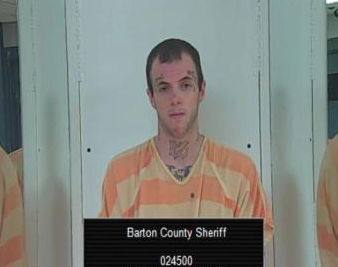
BARTON COUNTY — Law enforcement authorities are investigating a Kansas felon on new charges after an arrest.
Crawford photo Barton Co.
Just after 9:30p.m. Tuesday, police stopped a vehicle for a traffic violation in the 3600 block of 10tth Street in Great Bend, according to a media release.
The Great Bend Police Department’s K-9 Lazar was deployed and indicated there was an odor of illegal narcotics coming from the vehicle. A search of the vehicle was conducted and methamphetamine and drug paraphernalia were located.
Police arrested Cody Crawford, age 26, and booked in lieu of bond at the Barton County Detention Center for possession of methamphetamine and drug paraphernalia.
Crawford has a previous convictions f0r Lewd and lascivious behavior; Sexual relations in presence 16 or over; all person GE18, Intro Contraband: non firearm, ammo, explosive, controlled substance by non employee and for drugs, according to the Kansas Department of Corrections.
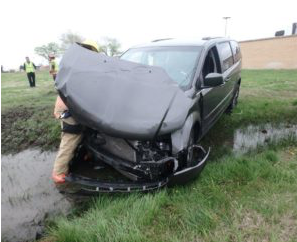
SALINE COUNTY — One person was injured in an accident on Tuesday afternoon in Saline County.
Photo courtesy Saline Co. Sheriff
A 2017 Dodge Grand Caravan driven by Kim Biery, 61, Hutchinson, was eastbound on Water Well Road, failed to yield right of way at Old U.S. 81 and struck a northbound 2015 Lincoln MKC driven by Brenda Macnair, 62, Jetmore, according to Saline County Sheriff Roger Soldan.
EMS transported Macnair to the hospital in Salina. Biery was cited for failure to yield, according to Soldan.
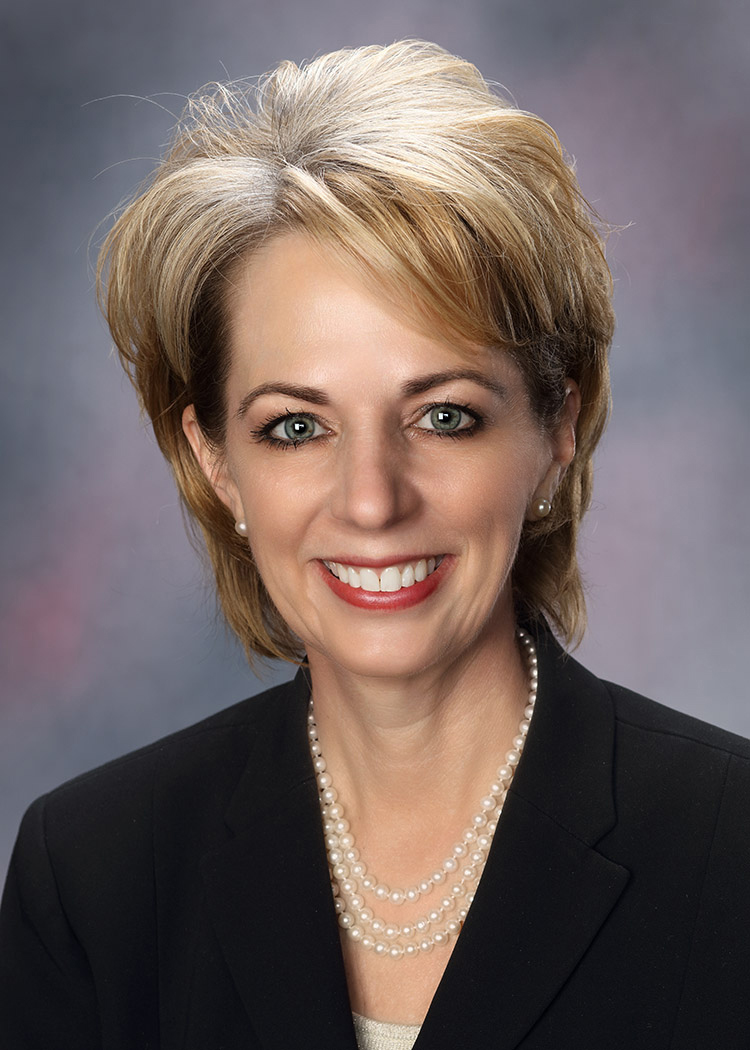
Dr. Tisa Mason, FHSU presidentMy email includes a PassItOn.com quote of the day. Some days I click through them, often with a smile, but not a lot of thought. Other times I ponder them a bit more. One that immediately caught my full attention was this one about grit, which is a key characteristic of Fort Hays State University: “Grit is not just a simple elbow-grease term for rugged persistence. It is often an invisible display of endurance that lets you stay in an uncomfortable place, work hard to improve upon a given interest and do it again and again.”
Typically when I hear that term, I immediately think of our amazing student athletes and how this quality is often on display as they fight hard to perfect their performances and bring home the trophy for their alma mater. But this particular definition got me thinking about the every-day kind of grit that we often don’t notice.
Such as: the student who goes to the tutoring center over and over and over again to master the content of a difficult class; the faculty member who endures the painstaking repetition of re-doing and re-evaluating and rewriting trial after trial on a research project; or the software technician who pores over lines of code for hours on end to find the answer to “Why isn’t X working?”
I also found grit alive and well in another place where it is often overlooked – our music and theatre program. I have been enthralled by the students this year in “Mama Mia,” “Barefoot in the Park” and “The Marriage of Figaro.” Our students’ performances have captivated me with how effortless they make it look to bring characters to life before our very eyes. I knew it took time to learn their lines, but what really surprised me is how much grit is needed for them to deliver their characters.
I discovered this when I had the opportunity to visit with the charming Danni Dickerson, a junior music education major from Colorado. Danni played a leading role in all three productions this year – a challenge in itself. In fact, she often had to leave early from “Figaro” rehearsals to join the cast rehearsing “Barefoot in the Park.” I assumed she had been acting for a very long time.
Not true. In fact, she had not participated in theatre at all until she came to Fort Hays State. That is one thing I love about Fort Hays – how our environment encourages students to discover new talents and try new things.
Danni told me that when she began her college journey, she had her heart set on two things: going to a particular name-brand institution and being an orthodontist. She had dreamed about that university since she was a child, but as the college decision approached she became concerned about the cost and decided to tour Fort Hays State. That tour sealed the deal – she immediately knew she had found her college home.
Then, at pre-enrollment, she learned about the auditions for music scholarships. Since she was trying to drive down the cost of college, she decided to audition. She described the experience as very scary as well as highly successful.
From that initial audition experience of “feeling the fear and doing it anyway” she gained a music scholarship, a wonderful group of friends, an extremely encouraging and nurturing faculty – and a new major. She said she was never so clear on her life’s passion. She will teach children to sing, but more importantly she will use music to inspire their confidence, encourage them to try new things, and to embrace fear so they can take hold of incredible opportunities – just as she has done.
As I sat listening to Danni talk about her college life, I quickly realized I was listening to someone who possessed a lot of grit. She talked about terrifying auditions, taking risks, staying focused, and learning not to be so hard on herself. She knew that performing the lead role in the “Marriage of Figaro” opera was going to be a big challenge, but she was willing to put in her time and shift other priorities to perform well. She was learning and growing.
One of the biggest lessons she has learned is that she can do a lot more than she gives herself credit for. She discovered that sometimes you just have to get out of your own way – a comment that really resonated with me!
The “invisible display of endurance that lets you stay in an uncomfortable place, work hard to improve upon a given interest and do it again and again.” You cannot simply talk about being gritty. You have to live it. Danni Dickerson’s FHSU story definitely portrays grit.
Her future students will experience a dynamic, caring music teacher, and I am confident she will encourage their hearts and unleash new opportunities for each of them.
COWLEY COUNTY — One person died in an accident just before 7a.m. Thursday in Cowley County.
A 2016 Dodge Caravan owned by Best Cabs, Inc. from Wichita and driven by James Johnson, 54, Wichita, was eastbound on U.S. 160 and crossed the center line, according to Sheriff Dave Falletti.
The van collided with a 2002 Chevy Cavalier driven by 39-year-old Joshua Mosqueda of Cowley County.
EMS transported both drivers to William Newton Hospital. Mosqueda was pronounced dead upon arrival, according to Falletti. Johnson was treated for unknown injuries.
Authorities did not report the driver’s seat belt usage.
It was a lucky feeling 20-year-old Zakarie Ramos couldn’t explain or shake. On his birthday, Ramos said he had an inkling and decided to buy scratch tickets.
“I don’t always buy tickets but my mom does. We were at the gas station and as she was buying some tickets, I decided that since it was my birthday I’d play too,” Ramos explained. “I bought two $2 tickets and we went home.”
Ramos’ lucky feeling paid off when he won $10,000 on a $2 20X the Cash instant scratch ticket!
“I kept revealing spots that said $1,000 winner, or $100 winner with a 10 times multiplier,” Ramos said. “When it was all over, we had to get out a notepad to add everything up. That’s when we realized how much I had won. It was awesome!”
Ramos said he discussed some ideas with his family on how to spend the money, adding this is a birthday he’ll never forget.
“I think we might take a little family trip this summer, so some of the money could go towards that. The rest I plan on spending slowly and smartly. I don’t plan to just burn through it,” Ramos said.
The winning ticket was sold at Casey’s General Store 1930 located at 213 Washington Street in Ellis. There are still five $10,000 top prizes, as well as thousands in other cash prizes left in the $2 20 X the Cash instant scratch games.
Kids today sometimes get the raw end of society. From time to time, I’ll read an article focusing on what’s wrong with them or overhear a conversation over coffee focusing on the problems with kids today.
Don’t be fooled — there’s still plenty of good out there!
I was recently privy to observing a group of teens band together and make a positive difference in the world by helping their neighbors because of the action of one. It is yet another testament proving there are great kids in the world. It just so happens these great kids come from my community in rural Kansas.
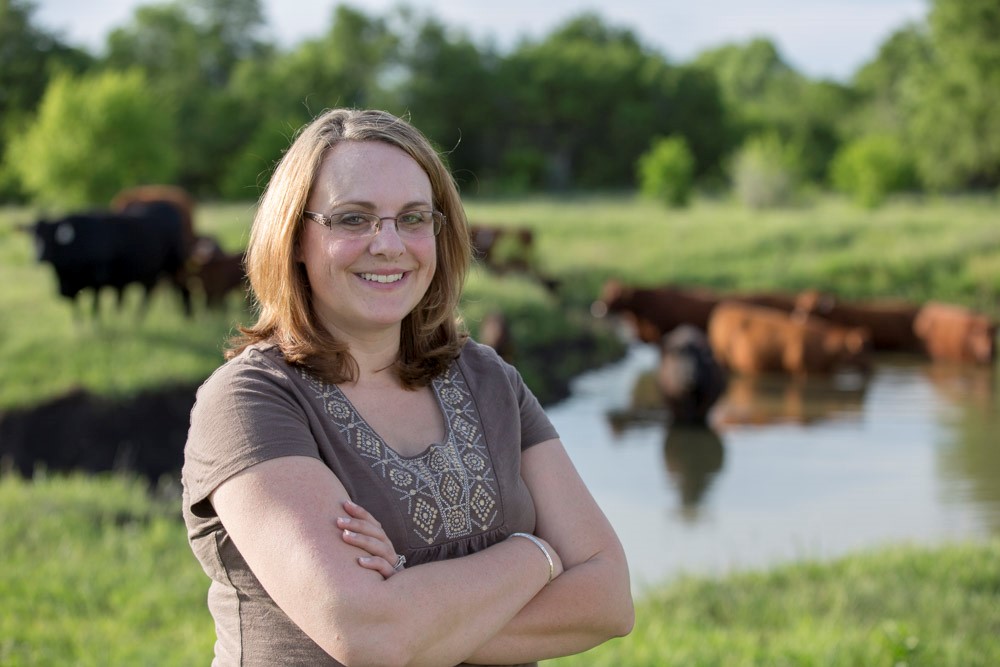
It all began when Makayla Schroeder, an 18-year-old high school senior, recognized a need and made the conscious decision to take action. She had been following reports of devastation in Nebraska so many are experiencing following the recent
floods. She wanted to pack a bag, jump in her truck and go help, but knew she had to be in school. She has less than a month until she graduates, and final exams are right around the corner.
Instead, what this young lady from central Kansas did opened the eyes of our small community and surrounding areas, left an imprint on her peers and spurred people to action.
Since she couldn’t pack her bags and go to Nebraska to help for an extended period of time, she decided to begin gathering items to assist flood victims here at home. She called her effort “Operation Feed the Critters.” She got her school advisers onboard, rallied her
friends in the local FFA chapter, made phone calls, used social media and made things happen.
It began as a post on her FFA chapter’s Facebook page letting the community know their ag shop was a collection point for Nebraska flood relief items. Her initial plan was to collect enough items to fill a pickup truck to deliver at a distribution point on a Saturday. However, a few days into “Operation Feed the Critters,” Makayla realized she would need a bigger truck.
Bags of dog food, bales of hay, milk replacer, work gloves, pallets of range cubes and other items started streaming in.
Area businesses, FFA chapters and others throughout south-central Kansas began collecting items from their staffs and communities and made trips to our small school to deliver their donations. Area stores even began offering discounts on items that were to be donated directly to the “Operation Feed the Critters” drive.
Soon, Makayla started making calls to secure a tractor-trailer.
After a week, she needed a second semi. So far, Makayla has helped send three truckloads of supplies to flood victims. All because of the initial action one Kansas teen.
Many people were involved in collecting items, loading the donations, spreading the word, and driving the semis. All of this happened because of one individual who saw an immediate need and wanted to make a difference by helping her neighbors.
Simply put, she acted.
The true beauty of it all was the ripple effect that took place when other teens jumped in to join their friend in serving others.
It’s amazing to see what the power of one person’s actions can do to make positive change. It’s even more amazing when those good things are done by kids these days.
“Insight” is a weekly column published by Kansas Farm Bureau, the state’s largest farm organization whose mission is to strengthen agriculture and the lives of Kansans through advocacy, education and service.
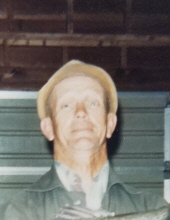
 Henry L. Duryee passed away Tuesday, April 23, 2019, at Hays Medical Center in Hays, KS at the age of 85.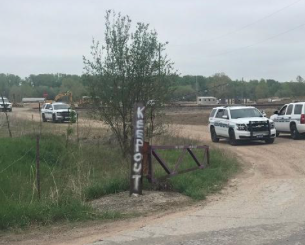



 Equifest of Kansas is moving to Salina.