The U.S. population will grow older and more diverse over the next four decades, according to new Census Bureau projections presented Thursday at a meeting of demographers.
As the U.S. median age increases, there will be a smaller ratio of workers in the labor force able to pay the payroll tax that funds Social Security payments to people of retirement age. In 15 years, the number of people over age 65 will be larger than the number of children for the first time in U.S. history, according to the presentation at a Southern Demographic Association meeting in New Orleans.
A “demographic tidal wave” is one big reason for the nation’s expected aging and the eventual drop in natural population increase from births outpacing deaths. That wave is the Baby Boomers, born between the end of World War Two and around the time of the American invasion of The Beatles.
“The youngest Baby Boomers are 55 and older now, said Allison Plyer, a demographer attending the meeting. “In 10 years, they will be 65 and older, and as those folks pass away over the decades, that’s a very larger section of our population reaching an age where they will likely experience mortality,” Plyer said.
As the U.S. grows older, it will also become more diverse, with children leading the way. By next year, no single race group alone will make up more than half of U.S. children, the projections show.
Although non-Hispanic whites currently are a majority in the U.S., their numbers will dip below 50% of the population in 40 years, declining from 199 million next year to 179 million in 2060, the projections show.
“Immigrants do continue to fill in the ranks of working-age population and workforce as the Baby Boomers age,” Plyer said. “The most likely people to replace them will be people of color, particularly Latinos who are already here and have children.”
People who identify as two or more races will be the fastest-growing group in the next 40 years, with their population expanding as births outpace deaths.
Other fast-growing groups include Asians, whose growth will be driven by migration, and Hispanics, whose growth in the U.S. will be driven by natural increases, according to the projections.
The U.S. is expected to cross the 400 million-person threshold by 2058, as it adds 79 million more people in 40 years, but annual growth will slow down. The U.S. has about 326 million people today.
Population growth, currently 2.3 million people per year, is expected to slow to 1.6 million people a year by 2060.
Growth comes from immigration and from births outpacing deaths, but that natural increase will decline as the nation ages. The nation’s median age is expected to go from 38 today to 43 by 2060.
Young adults are getting married and having children at older ages than their parents and grandparents, and they won’t be having children in the numbers to replace the Baby Boomers, said Andrew Beveridge, a demographer at the City University of New York.
As the number of people over age 65 grows, the share of working-age adults — who pay, along with their employers, for Social Security through a payroll tax — will also decline. Next year, there are expected to be 3.5 working-age adults for every person of retirement age, but that ratio declines to 2.5 by 2060, according to the projections.
That ratio will put the U.S. more in line with Europe, though it won’t be as severe as in Japan, which for years has had an aging population without the help of migration to add to the population, the demographers said.
“It’s definitely a shift, but we’re not going to be like Japan,” Beveridge said.
Degree programs offered by Fort Hays State University through the FHSU Virtual College received a No. 1 ranking for the most affordable online college in Kansas as well as eight top-10 recognitions, including four top-five ratings, in September.
OnlineColleges.com No. 1, Best Online Universities in Kansas for 2019-20 Fort Hays State claimed OnlineColleges.com’s, www.onlinecolleges.com, top spot for its study of the best online colleges in Kansas for 2019-20. The study covered affordability, financial aid resources, ratio of on-campus to online students, and number of online programs offered.
FHSU’s Virtual College prides itself in having tuition rates ranked among the lowest in the United States and the lowest rates of any four-year college in Kansas. The university awards and delivers more than $59 million in financial assistance. With nearly 200 online degree and certificate programs, Fort Hays State boasts a distance education participation of 81 percent, according to OnlineColleges.com.
Top Counseling Schools No. 2, Most Affordable Online Master’s in Clinical Psychology Top Counseling Schools, www.topcounselingschools.org, awarded FHSU’s master in clinical psychology the No. 2 program in the nation out of 29 schools. The study was based on tuition, recognition and flexibility for students.
The clinical approach of the program prepares them well for careers in counseling, social work, health and human services, said TopCounselingSchools.
College Consensus
No. 3, Best Online Bachelor’s in Accounting Degree Programs 2019 College Consensus, www.collegeconsensus.com, awarded FHSU’s W.R. and Yvonne Robbins College of Business and Entrepreneurship a top-five spot for its Bachelor of Business Administration in accounting. The degree, said College Consensus, will prepare students for a multitude of high-demand positions.
The study was conducted based on affordability, convenience, and reputation, with each weighted at 33 percent. Fort Hays State was chosen as the No. 3 program out of almost 300 programs.
Online Schools Report No. 5, Best Online Special Education Degrees Fort Hays State’s College of Education was ranked No. 5 by www.onlineschoolsreport.com for its online minor in special education. There are six categories the ranking is based on: student satisfaction, admission rate, online presence, popularity at school, department size and median debt by program.
Online Schools Report said Fort Hays State focuses on modern teaching techniques and how to utilize technology effectively in the classroom.
Affordable Schools No. 5, Affordable Online Bachelor in Information Networking and Telecommunications Affordable Schools ranked FHSU’s Bachelor of Arts or Bachelor of Science in information networking and telecommunications with a concentration in computer networking and telecommunications at No. 5 in its latest rankings. The program gives students the opportunity to earn their degrees while also earning credit towards industry specific certifications needed for the workforce. With small class sizes and laboratory equipment supported by leading companies like Cisco and Oracle, students are able to advance their skills in a great environment.
Affordable Schools, www.affordableschools.net, chose programs based on the average cost of attendance and student to faculty ratio.
No. 6, Online Bachelor of Science in Computer Science FHSU’s online Bachelor of Science in computer science received a No. 6 ranking from Affordable Schools based on the average cost of attendance and student to faculty ratio at FHSU.
The program exposes students to networking cognates in areas such as back-end and front-end Web development, database design and programming, and an introduction to web development said Affordable Schools.
Value Colleges No. 8, Online Degree in Special Education The College of Education’s online Bachelor of Science in education with a minor in special education was ranked No. 8 by www.valuecolleges.com in its September rankings. Rankings are based on three equally weighted factors: tuition price, student satisfaction and alumni salary.
Value Colleges said the program at FHSU is good for prospective teachers who want the widest range of career opportunities possible.
The Best Schools No. 10, Affordable Online Computer Science Degrees Based on the program quality, online classes offered, faculty, awards and reputation, FHSU’s Bachelor of Science in computer science was ranked No. 10 nationally by www.thebestschools.org. Degrees like this continue to become increasingly important with the U.S. Bureau of Labor Statistics projecting a 13–percent employment increase in the field by 2026.
Among its many fully online degrees, its online bachelor’s degree in computer science deserves attention for its academic rigor and affordable tuition said The Best Schools.
Top Counseling Schools No. 10, Online Psychology Degree In addition to FHSU’s master in clinical psychology, Top Counseling Schools ranked FHSU’s Bachelor of Arts and Bachelor of Science in psychology, which came in as No. 10 in its national rankings. The degree prepares students for various careers in psychology and related fields as well as for graduate study, said Top Counseling Schools.
The ranking is based on tuition affordability, program quality and courses offered, accreditations and rankings as well as flexibility of the program. The reputation of the school and faculty are also taken into account.
Online Schools Report No. 14, Best Online Computer Programming Degree Fort Hays State received a second ranking from www.onlineschoolsreport.com for its Bachelor of Science in computer science that was ranked No. 14 in the nation for its online degree program. The ranking is based on six criteria: student satisfaction, admission rate, online presence, popularity at school, department size and median debt by program.
Online Degrees No. 16, Online Psychology Degree Online Degrees, www.onlinedegrees.com, looked at tuition, percent of students engaged in distance education, financial aid options and other criteria to rank FHSU’s Bachelor of Arts or Science in psychology as No. 16 in the nation.
The program includes theoretical curriculum but also features an emphasis on experiential learning said Online Degrees.
Registered Nursing No. 23, Online RN to BSN Program FHSU’s online RN to BSN program came in at No. 23 on the Registered Nursing, www.registerednursing.org, rankings. Fort Hays State’s RN to BSN program can be completed in just three semesters.
The curriculum empowers students to utilize critical thinking skills and expanded knowledge to advance their nursing education states Registered Nursing.
About the FHSU Virtual College Education at distance from Fort Hays State began in 1911 when faculty voted to offer courses free by mail so that one-room school teachers across western Kansas could afford to gain the continuing education required to teach. The distance education department created then evolved continuously with changing technology and culture until, in 1997, the Department of Continuing Education and Instructional Technology became the FHSU Virtual College.
A fresh University of Kansas study contends state educators put too much emphasis on data and too little on the savvy and experience of teachers.
Data-driven decision have been the go to buzzwords at Kansas schools for years. The concept presses schools to rely on test scores when plotting the interventions needed — think an extra 30 minutes in a student’s schedule to home in on a math lesson — for plotting a path to student success.
The researchers argue that test scores are the only thing all schools use, ignoring the instincts of teachers and unique situations of each student. Instead of being data-driven, they’re data-dependent.
CHRIS NEAL / FOR THE KANSAS NEWS SERVICE
The study suggests calls for a smarter balance between the first-hand insight of teachers and numbers drawn from test scores and other measures.
“We are losing teachers’ ability to use far more information about what they know makes for a good education for different types of kids because we’re just reducing the kids down to a number,” said Rebecca Jacobsen, an associate professor of education policy at Michigan State University.
Switch To Data
Using test scores to evaluate students has been a near constant in education. But what that testing looked like was often different from classroom to classroom. The 2001 federal No Child Left Behind Act began dramatically emphasized tests that are comparable across schools and the country.
That — combined with new technology — led to a rapid expansion of data on students.
“There’s a lot of power in that capacity,” said Jason Grissom, who studies education policy at Vanderbilt University.
In 2007, Kansas began piloting a data-heavy approach called Multi-Tiered System of Supports, or MTSS. It’s been used to devise improvement plans for struggling students.
Since that launch 12 years ago, it’s gradually expanded across the state. MTSS is more a framework than a program — educators continually test students and adjust plans accordingly.
In 2013, Garden City Public Schools was receiving state training on implementing MTSS. KU researchers documented the shift in a newly released study that found teachers’ knowhow was “continually marginalized.”
The Problem
Test scores were considered infallible while teacher observations were dismissed.
Some teachers disagreed with the interventions suggested by the test. State MTSS consultants told the teachers to stick to the recommendation. When teachers wanted to change the interventions, consultants said the only recourse was to retake the same test the teachers considered flawed.
Ideally, test scores would be used to inform decisions. State consultants told the teachers in Garden City that their input wasn’t needed. Only the test itself mattered.
“Good teachers are rightly saying those standardized tests are part of the story, but not all of the story,” said Don Stull, one of the study’s authors and a professor emeritus at KU. “And if we don’t try to bring all that we know … then we’re not doing the best we can for those children.”
Education experts says sidelining teacher observations could lead to interventions that are ultimately harmful. A student might score poorly on a math assessment because they’re not engaged with the work. An attentive teacher might decided the student needs more challenging assignments.
But the data alone would recommend giving the student more remedial work, boring them even more.
That takes the teacher out of teaching, the study said. It also hurts teacher morale, a danger in a profession struggling with recruitment and retainment.
“There’s really been a deprofessionalization of teaching,” said Jennifer Ng, the lead author of the study.
Experts say that schools across the country have too often dismissed teachers’ judgments in favor of test scores. And it’s a problem schools have begun recognizing.
“It’s absolutely something schools have been struggling with,” said Laura Hamilton, a senior behavioral scientist at the Rand Corporation. “We’re hearing a lot of growing awareness that this narrow focus is problematic.”
Finding Balance
Kansas’ MTSS team says those early attempts were about bringing Kansas teachers on board to a more uniform system. Instead of teachers having dozens of different approaches, MTSS would bring teachers around an effective, agreed-upon system.
But shortly after the rollout in Garden City, the state began to shift its approach. In 2015, the state’s board of education released a new set of goals for Kansas schools. Social and emotional growth for students received more emphasis. High school graduation rates were set as a new marker of success alongside test scores.
The 2015 federal Every Student Succeeds Act — the replacement to No Child Left Behind — also put less emphasis on test scores.
Now Kansas educators are trying to find a balance between test scores and teacher expertise.
“The assessment is just a tool to say do we need to look at a certain area,” said Linda Wilkerson, the co-director of MTSS for the Kansas Department of Education. “It isn’t the answer. It’s the question.”
Garden City Public Schools blames much of its initial problems outlined in the study on the growing pains that come with a new policy. The district says that since the MTSS rollout in 2013, the school district has included teachers’ voices.
But school districts are still doubling down on data-driven decision making. Education experts say schools should be doing that, so long as teachers are involved and trained in how to use all that information.
Wichita Public Schools says to do that it has added more “data dives” — days dedicated to teachers and staff working through the numbers. As the district has become more data-heavy, those long days are vital to avoiding information overload and defaulting to a program’s canned intervention.
Patricia Burch, an associate professor of education at the University of Southern California, said finding that balance between test scores teacher voices is still a challenge. But schools are realizing the need to get that balance right.
“We’re coming back to a kind of middle ground,” she said, “where we agree it’s important but it’s not as heavy handed.”
Stephan Bisaha reports on education and young adult life for the Kansas News Service. You can follow him on Twitter @SteveBisaha or email him at bisaha (at) kmuw (dot) org.
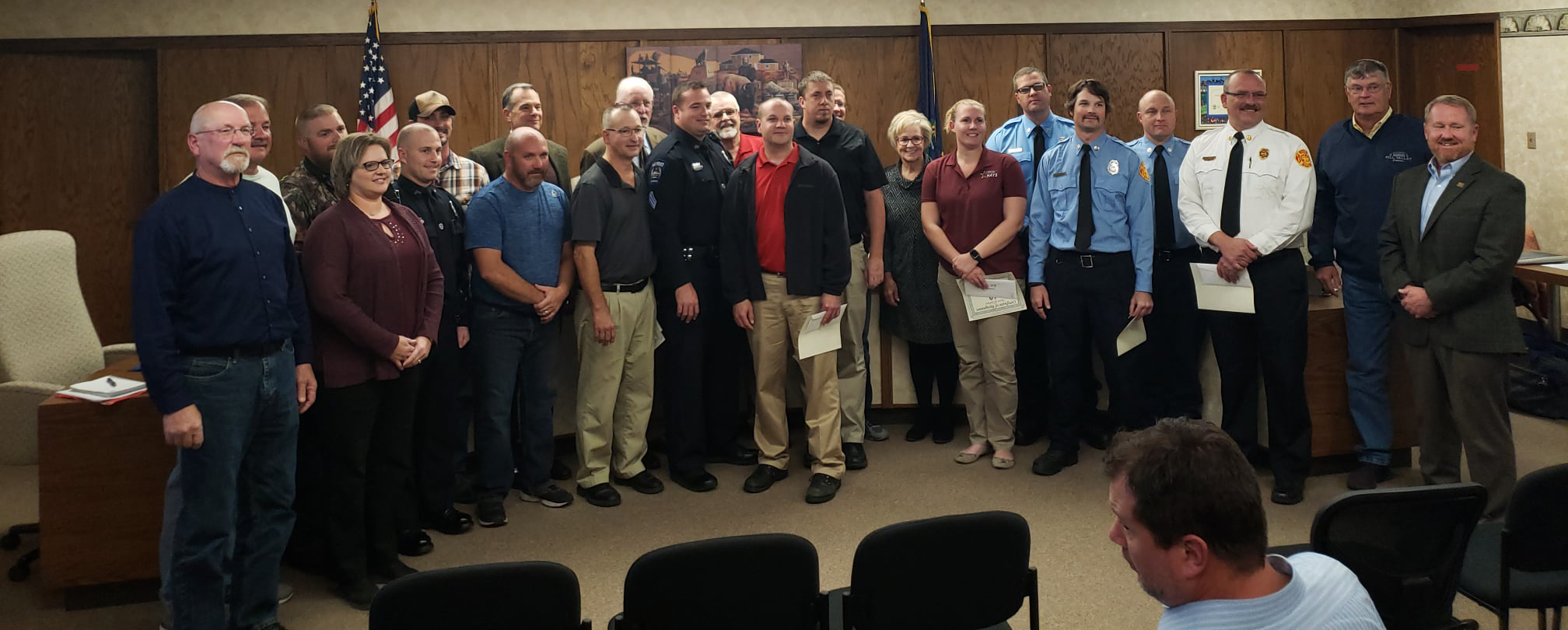
Employee service awards were presented Thursday evening by Hays Mayor Henry Schwaller to city employees who have been employed for 5, 10, 15, 20, or 25 years.
The employees were also thanked by city commissioners and City Manager Toby Dougherty.
City of Hays 2019 Employee Service Awards
5-Year Awards Dave Gillan – Dave started his career with the City as a Police Officer. Two years later, Dave was promoted to Police Corporal. Jason Riegel – Jason first joined the City as the Water Conservation Specialist. In 2017 he was promoted to his current position of Water Reclamation and Reuse Superintendent. Jayson Dinkel – Jayson rejoined the City as a Dispatcher in 2014. He was later promoted to Lead Dispatcher. Kevin Kamphaus – Kevin has served his five years with the City as the Superintendent for the Golf Course. Matt Schmidt – Matt is currently a Part-Time Maintenance Worker for Water Resources. Stefan Gildemeister – Stefan began his employment as a Hays Police Officer. In 2019 he was promoted to a Master Police Officer. Tanner Pabst – Tanner started as a Volunteer Firefighter and became a FullTime Firefighter two years later.
10-Year Awards Chris Hancock – Chris began his career as a Part-Time Police Officer with the City. One month later, he was promoted to a Full-Time Police Officer. In 2014, he was once again promoted to Police Corporal and took his newest title as Police Sergeant in 2016.
Code-enforcer Chris Rorabaugh is congratulated by Sandy Jacobs, Hays city commissioner. (Photo by Hays Post)
Chris Rorabaugh – Chris has served the City the last ten years as a Part-Time Code Enforcer. Clayton Unruh – Clayton has worked his ten years at the Chetolah Creek Water Reclamation & Reuse Facility. He started as a Plant Operator and moved up to his current role, Senior Plant Operator. Dustin Anderson – Dustin started his career as a Maintenance Worker I for the Service Division. Dustin continues to work for the Service Division and is currently a Senior Maintenance Worker. Kelli Sprague – Kelli joined the City as a Dispatcher. Two years later she became a Records Clerk with the Hays Police Department. Kolleen Dome – Kolleen began employment with the City as a Records Clerk for the Hays Police Department. In 2019 she took on a new role as the Municipal Court Clerk. Mike Windholz – Mike was hired by the City as a Maintenance Worker I for the Parks Department. He was promoted to Maintenance Worker II in 2011 and then to Park Technician in 2014. Tom Mai – Tom has served the City as an Information Technology Technician for the last 10 years.
15-Year Awards Brandon Zimmerman – Brandon began as a Volunteer Firefighter for the Hays Fire Department. A year later he moved to a Full-Time Firefighter position. In 2019 he was promoted to Senior Firefighter. Justin Choitz – Currently a Senior Firefighter, Justin started with the Hays Fire Department as a Volunteer Firefighter. In 2005 he joined the department full time as a Firefighter. Linda Bixenman – Linda has served the Planning, Inspection, and Enforcement Division for the last 15 years as their Administrative Assistant.
Hays Fire Lt. Luke Scoby with Mayor Henry Schwaller (Photo by Hays Post)
Luke Scoby – Luke was hired by the City as a Volunteer Firefighter. He became a Full-Time Firefighter in 2005. In 2011, Luke was promoted to his current role of Fire Lieutenant. Myron Dreiling – Myron began his career with the City in 2004 as a Firefighter. In 2019 he was promoted to Senior Fire Fighter. Ryan Hagans –Over the course of Ryan’s 15 years with the Hays Fire Department, he has served as a Fire Lieutenant, Fire Captain, Deputy Fire Chief, and his current position, Fire Chief.
20-Year Awards Mark Lang – Mark was hired by the City as a Plant Trainee for the Wastewater Division in 1999. During his tenure, he was promoted to Plant Operator I in 2000 and Senior Plant Operator a year later. Aaron Larson – Aaron joined the Hays Police Department as a Dispatcher. A year later he was promoted to a Police Officer and has held multiple roles as a Law Enforcement Officer for the City of Hays including, Uniformed Investigator, Detective, and his current role, Detective Sergeant. Tessa Scheck – Tessa started with the City as an Office Clerk for the Water Resources Department. She currently serves as that department’s Administrative Assistant. Steve Schmidtberger – Steve was employed by the City 20 years ago as a Plant Trainee in the Water Plant. Shortly after he was promoted to Plant Operator I and two years later was promoted to his current position Senior Plant Operator.
25-Year Awards Steve Dreiling – Steve began his career as a Refuse Collector in 1994. He has also served as a Maintenance Worker I for the Service Division, a Truck Driver for the Solid Waste Division and a Refuse Equipment Driver which was reclassified to his current position Solid Waste Senior Maintenance Worker.
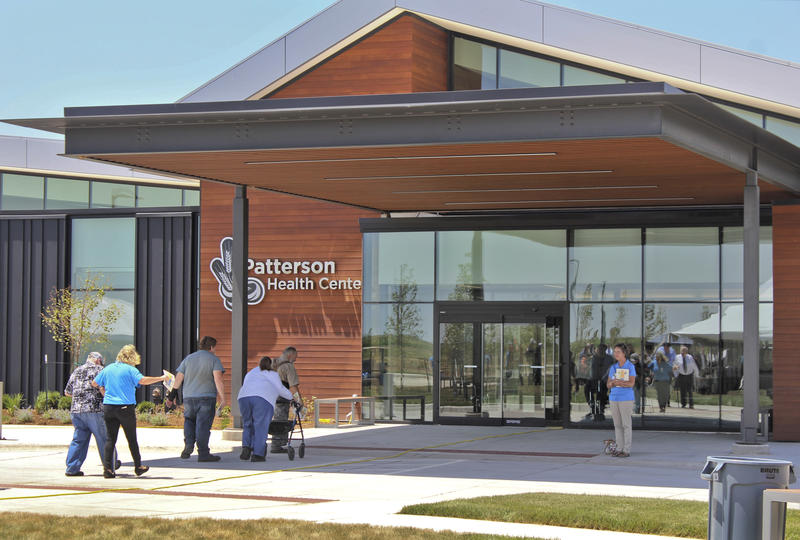
The Patterson Health Center opened only after the surrounding communities decided to shut down their competing, failing hospitals. And only with a large grant that insisted the communities team up. Chris Neal / For the Kansas News Service
ANTHONY — Few things signal a rural community’s decline more powerfully than the closure of its hospital.
Like shuttered schools and empty Main Streets, an abandoned hospital serves as a tangible reminder of the erosive power of decades of population loss and unrelenting economic trends.
“Our rural communities are challenged and, because of that, our small hospitals are challenged as well,” said Tom Bell, the head of the Kansas Hospital Association. “It’s sort of a chicken-and-egg thing.”
More than 80% of the state’s rural hospitals run at a loss, said Brock Slabach, a senior vice president of the National Rural Health Association.
“The operational difficulties (for rural hospitals) in our state are particularly problematic,” he said in a presentation to Kansas lawmakers earlier this year.
Shrinking populations mean fewer patients. Those who remain are typically older, poorer and sicker, making them more expensive to treat. Many people in rural areas also lack health insurance.
In some southwest Kansas counties, the uninsured rate approaches 19%, more than twice the statewide rate of 8.5%, according to the Kaiser Family Foundation.
Mismanagement along with state and federal policies also figure in the mix. Congress ordered cuts in Medicare payments in 2011 to trim the federal deficit and Kansas lawmakers have rejected the expansion of Medicaid the last several years.
People who run small hospitals argue expansion would provide coverage to thousands of low-income rural Kansans who now can’t afford to pay their medical bills.
Facilities known as Medicare Critical Access Hospitals are particularly vulnerable. Limited to 25 patient beds, they were designed in the 1990s to survive in remote areas. Kansas has more of them — 82 — than only Texas and Iowa.
Until recently, two of the state’s endangered small hospitals sat in the neighboring towns of Anthony and Harper in south-central Kansas.
Federal rules restrict the location of those specially designated hospitals, requiring them to be at least 35 miles apart. But the hospital districts in Anthony and Harper got waivers allowing them to establish competing facilities just 10 miles apart.
In 2014, with both hospitals in serious financial trouble, consultants proposed a merger. A long-simmering rivalry triggered by a fight over the county seat in the 1870s made that a tough sell, said Martha Hadsall. She headed the Anthony hospital board.
Martha Hadsall played a key role on getting people in Anthony and Harper to join forces for a new hospital, and abandoning hopes for keeping one solely for their own town. Credit Chris Neal / For the Kansas News Service
“I would describe one of our first joint board meetings as a junior high dance,” Hadsall said. “We sat on opposite sides of the room and stared at each other.”
Then came a windfall. With strings attached.
The late Neal Patterson was a native of Harper County. He went on to make millions after founding Kansas City-based digital medical recordkeeper Cerner Corp. He promised to pay much of the cost of a new, state-of-the-art hospital — if the two towns agreed to share a single facility.
Hadsall, a resident of Anthony and a longtime elementary school teacher in Harper, used Patterson’s offer and trust she had built in both communities to keep the boards talking. It took about a year, but the rival sides agreed that a merger was the only way to keep any hospital going.
Still, the idea remained a tough sell with residents of both communities.
In a 2015 interview with the Kansas News Service, Harper resident Bonnie June Day said the people pushing for a merger should just “leave Harper alone.”
“Our hospital is doing fine without being consolidated with them (Anthony),” she said.
To move public opinion, Hadsall said, the boards called residents of both communities to a meeting at the high school they had shared since consolidation in 1971.
They shared the hospitals’ balance sheets and provided an estimate of how much property taxes would need to go up to fill the gap between revenue and expenses.
By the end of the meeting, Hadsall said, most of those in attendance were nodding “‘yes’ to what the boards had chosen to do.”
Shortly after that, Harper voters dissolved their hospital district.
On a scorching day this past July, the communities came together to celebrate the opening of the Patterson Health Center, a $41 million facility built between Anthony and Harper next to Chaparral High School.
People from the sometimes-rival towns of Anthony and Harper got together to celebrate the opening of a hospital they now share. Credit Jim McLean / Kansas News Service
Lindsey Patterson Smith, Neal Patterson’s daughter and the head of the Patterson Family Foundation, acknowledged that most communities with struggling hospitals don’t have a millionaire to rescue them. Still, she said, “we’ve learned a lot” that could benefit other towns looking for ways to collaborate.
“We want to take some lessons from it and go out and see what is going to work in another community,” she said.
Bell, the head of the state hospital association, said he thinks the ongoing threat to rural hospitals has made rural Kansans open to new ideas. That included, he said, the possibility of rethinking, maybe even shrinking, those critical access hospitals that Kansas has so many of.
“What that hospital looks like in the future may not be exactly what it looks like today,” Bell said.
The hospital association wants federal regulators to let Kansas experiment in rural areas, perhaps with something between a clinic and a hospital. Those facilities might offer emergency and out-patient care, but not the kind of around-the-clock care needed by critically ill patients.
Small hospitals, many of which average fewer than two patients a day, can no longer afford to maintain wings of rarely used in-patient beds, Bell said.
Rural hospitals rely heavily on Medicare. Often, more than half of their patients are 65 or older. Without special waivers from Washington, Medicare money wouldn’t be available to subsidize that niche between a doctor’s clinic and an multi-bed hospital.
A room in the Patterson Health Center, where a millionaire’s grant and a compromise of two towns came together. Credit Chris Neal / For the Kansas News Service
Kansas hospital administrators are also among the biggest advocates for Medicaid expansion. It could draw in nearly $1 billion a year in additonal federal tax dollars to the state. Most of that would flow to the state’s urban and suburban hospitals. Still, some rural hospitals could benefit even more because the dollars they received would constitute a bigger share of their budgets.
“It would play a very important role in stabilizing the finances of those rural hospitals,” said April Holman, director of the Alliance for a Healthy Kansas, a pro-expansion lobbying group funded by several Kansas-based health foundations, including those that help support the Kansas News Service.
Research, Holman said, shows that hospitals in the 36 states and the District of Columbia that have expanded Medicaid eligibility are six times less likely to close than hospitals in non-expansion states.
Two legislative committees and a task force appointed by Democratic Gov. Laura Kelly are working on expansion plans ahead of the 2020 session that begins in January.
At least one of those approaches is being crafted to appeal to conservative Republicans who — fearing they no longer have the votes to stop expansion — want a less costly plan to consider.
Among other things, it would restrict Medicaid enrollment to Kansans who make too little to qualify for the federal subsidies that all-but-cover the cost of private coverage in the Affordable Care Act marketplace. But it would create state subsidies to cover those in the gap.
The effort to save struggling rural hospitals is as much about the economies of small towns as it the health of people who live in them.
Research offers a mixed picture on the impact of hospital closures on health. Some studies say when people are forced to travel longer distances, they often fail to get care that prevents nagging health problems from becoming more serious. Lack of ready access to emergency and obstetric services can also put people at risk.
But broadly speaking, studies haven’t found that the closure of a hospital leads to a measurable decline in people’s health.
However, the economic impact can be profound. Rural economists at Kansas State University recently calculated that every dollar of hospital income generates 59 cents for other businesses in a community..
So, when a hospital shuts down, towns get poorer. Per-capita income goes down and unemployment rates go up.
This is the fourth in a series of stories investigating the decline in rural Kansas and efforts to reverse it.
Support for this season of “My Fellow Kansans” was provided by the United Methodist Health Ministry Fund, working to improve the health and wholeness of Kansans since 1986 through funding innovative ideas and sparking conversations in the health community. Learn more at healthfund.org.
Jim McLean is the senior correspondent for the Kansas News Service, a collaboration of KCUR, Kansas Public Radio, KMUW and High Plains Public Radio covering health, education and politics. You can reach him on Twitter @jmcleanks or email [email protected].
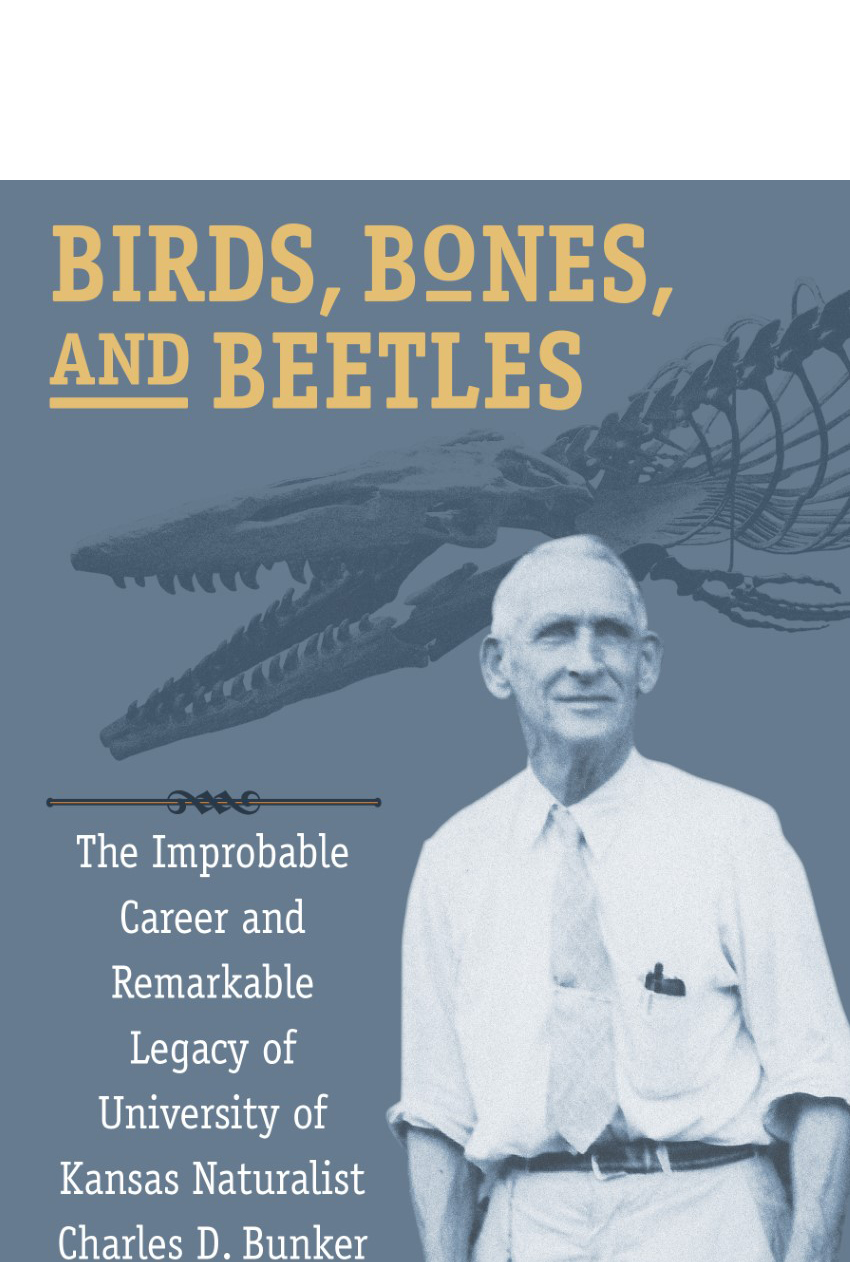
Come out to the Sternberg Museum of Natural History on Sunday, Nov. 3 at 1:30 p.m. to meet Chuck Warner. He will be discussing his new book “Birds, Bones, and Beetles: The Improbable Career and Remarkable Legacy of University of Kansas Naturalist Charles D. Bunker.”
The book spans the life and accomplishments of an early pioneer and naturalist at the University of Kansas Natural History Museum, who had important ties to the fossil fields of western Kansas.
Following Bunker’s field notes and university and community records, Chuck Warner wrote “Birds, Bones, and Beetles” about the extraordinary life of his grandfather, Charles Bunker. Bunker’s long career at the KU Natural History Museum began in 1895 as a lowly taxidermist.
Despite being naturally shy and possessing only an 8th-grade education, he went on to serve as the curator of the collections of birds and mammals for 35 years. His contributions include extensive work on the original installation of Panorama at the museum, developing a process to utilize beetles to efficiently clean skeleton for the museum collection, and training generations of students who went on to highly successful careers at prestigious institutions across the country.
This book was published by the University Press of Kansas in May of 2019 and has already received a recommendation from the Association of College and Research Libraries, a division of the American Library Association. This review will be published in the November 2019 CHOICE Connect and will recommend the book as “a valuable resource for those interested in the history of science.”
GRANT COUNTY — Two people died in an accident just before 12:30p.m. Saturday in Grant County.
The Kansas Highway Patrol reported a 2007 Kenworth truck was westbound on Grant County Road 10 three miles north of U.S. 160. The driver failed to yield right of way to a southbound 2012 Chevy Silverado driven by Kevin Jay Coyle, 57, Turpin, Oklahoma, at the uncontrolled intersection. The Kenworth entered the intersection directly into the path of the Silverado.
Coyle and a passenger Gerald Lee Coyle, 81, Turpin, Oklahoma, were pronounced dead at the scene and transported to Garnands Funeral Home. They were not wearing seat belts, according to the KHP. The KHP has not released the name of the Kenworth truck.
LAWRENCE – Those on the political left who play fast and loose with the term “hacked,” as in “Russia hacked the 2016 presidential election,” are aiding the Kremlin in its mission of undermining Americans’ faith in the democratic process, two University of Kansas researchers write in a new scholarly paper.
This dispiriting discourse threatens to discourage voting in 2020, contend the co-authors, Brett Bricker, assistant specialist and assistant director of debate in the Department of Communication Studies, and Jacob Justice, doctoral student and fellow debate coach.
Their article titled “Hacked: Defining the 2016 Presidential Election in the Liberal Media” was published in the fall edition of Rhetoric & Public Affairs. In it, Bricker and Justice cite the intelligence community consensus that while Russia hacked into Democratic National Committee computers and used that information in its 2016 influence campaign against Hillary Clinton, no electronic ballots were changed by computer hacking.
Definitional arguments have great salience going forward, they wrote.
“Our country is having a debate about how to define what Russia did in the 2016 election,” Justice said. “On the one side, we’ve got conservatives, who would probably define it as not very much at all — that the 2016 election was not about Russia as much as it was about Trump winning because of a smart campaign. Then we’ve got an intelligence community that says Russia intervened in the election in these very specific ways … And then on the left end of the spectrum, there’s a vocal and influential group of people who define what Russia did as a hack — that they hacked our election or they hacked American democracy.”
Defining social-media disinformation campaigns as hacking “introduces further haziness into a debate that is already rife with misinformation,” Bricker and Justice wrote.
“If we adopt this broad definition,” Justice said, “not just that the Democratic Party was hacked, but that the entire nation or our democracy was threatened by Russia — that could do Putin’s work for him by convincing the public that our democracy has been irreparably harmed, or that their votes not going to be counted because the Russians can change voting results with the push of a button.”
The authors lay the blame for this problem at the feet of the liberal media, which they define as media that liberals consume, including the Washington Post, CNN and MSNBC.
They wrote, “We demonstrate that the insular nature of much of the liberal media … enabled the spread of this misleading definition. Through a rhetorical analysis of texts defining Russia’s influence campaign as ‘hacking,’ we demonstrate that Twitter and the publications produced by the liberal media were highly influential in creating the widespread notion that Russia ‘hacked’ the election.”
The authors cite Malcolm Nance’s book, “The Plot to Hack America,” published just days before the 2016 election, as “influential in shaping popular understandings of the Russian influence campaign” ever since.
Bricker and Justice assert four negative consequences of defining Russian behavior broadly as hacking.
“First, this definition contributes to the already endemic problem of misinformation about the issue,” they wrote. “Second, defining Russia’s interference as a ‘hack’ has the potential to unduly limit the range of policy remedies considered to address the problem of electoral interference. Third, broad definitions of Russia’s interference as an attack on the nation risks militarizing dialogue on the issue, with dangerous consequences for United States-Russia relations. Fourth, such wanton declarations that the election was ‘hacked’ may discourage electoral participation by leading voters to conclude that the system of democracy itself is illegitimate and broken.”
The authors cite polls showing that large minorities of Democratic voters believe that Russians actually changed voting-machine tallies to help elect Donald Trump. It is widely recognized that conservatives circulate conspiracy theories in the Trump era, but what is alarming, according to the authors, is that a similar dynamic is present among liberals.
“If progressive forces aim to be champions of reasoned decision making,” the authors wrote, “they must avoid engaging in the very behavior that they criticize by propagating the misleading notion that ‘Russia hacked the election.’ The willingness of trusted figures in the liberal media and elected officials to participate in the perfunctory spread of this definition is disturbing.”
They wrote, “Without rebuke, conspiratorial thinking may become increasingly mainstream” and that “(s)uch a development has deleterious effects on democracy in the United States, raising the prospect that politics could become a permanently ‘fact-free’ affair as both sides of the political spectrum prioritize short-term political benefits over the long-term health of the nation’s public discourse.”
SEDGWICK COUNTY —Law enforcement authorities are investigating an aggravated battery and have made an arrest.
Just after 3p.m. Thursday, police were alerted to a video on social media that included a male punching a female, according to according to officer Charley Davidson. Several citizens also contacted police about the video. Investigators were able to identify the individuals involved and arrested a 16-year-old boy at his home on South Patty in Wichita.
On Friday, police also arrested a 15 and a 16-year-old girl in connection with the attack.
Police also contacted the 15-year-old victim. She sustained serious but non-life-threatening injuries, according to Davidson. He said the boy and the victim are acquainted and the battery stems from an ongoing dispute.
Police booked the youths into juvenile detention on requested charges of aggravated battery.
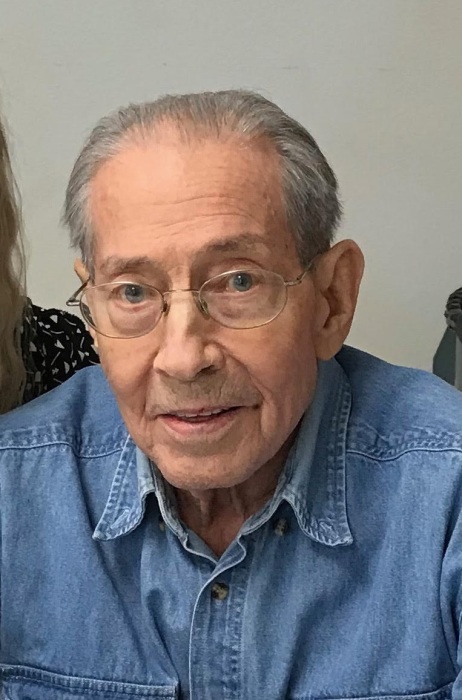
Duane V. “Arkie” Belisle, age 91, of Damar, Kansas passed away Friday, October 25, 2019 at the Rooks County Health Center in Plainville, Kansas. He was born January 22, 1928 in Damar to Arthur and Cordelia (Brin) Belisle. On April 15, 1951 he married Patricia Newell at St. Joseph Catholic Church in Damar.
Duane owned Belisle Decorating which specialized in commercial and residential painting. He was a US Army veteran serving in WWII. He was a member of St. Joseph Church and the 4th degree Knights of Columbus. He enjoyed fishing, camping, gardening, square dancing, playing pool “snooker” in league play traveling to different communities.
He is survived by his wife Patricia of Damar; a son, Paul Belisle and wife Mary of Damar; three daughters, Donna Towns and husband Michael of Palco, Christy Seib and husband Jake of Ness City and Lisa Belisle and Cammi Raab of Overland Park; ten grandchildren, Sarah, Joshua, Mark, Eric, Rachel, Aaron, Ashly, Brent, Karen and Brooke as well as twenty five great grandchildren. Duane’s family would like to say a special thank you to his caregivers, Bertha, Connie and Mary for the compassion and care they provided.
He was preceded in death by his parents; two grandchildren, Amber Seib and Blake Munsch; a brother, Delmer Belisle and two sisters, Anna Mae Normandin and Sharyl Moos.Funeral services will be 10:30 AM Tuesday, October 29, 2019 at St. Joseph Catholic Church in Damar. Burial will follow in the church cemetery.
Visitation will be Monday 5 PM – 8 PM and Tuesday 9:30 AM until service time all at St. Joseph Catholic Church, Damar.
A combined parish vigil and rosary service will be Monday at 7 PM at the church.
Memorial contributions are suggested to St. Joseph Church or Masses.
Arrangements in care of Brock’s-Keithley Funeral Chapel and Crematory 2509 Vine Hays, KS 67601.
Condolences may be sent by guest book at www.keithleyfuneralchapels.com or by email at [email protected]