LAWRENCE, Kan. (AP) — A woman who was raped 38 years ago as she jogged on the University of Kansas campus has returned to the state seven times to testify against her attacker’s release on parole, and she vows to continue her efforts as long as she can.
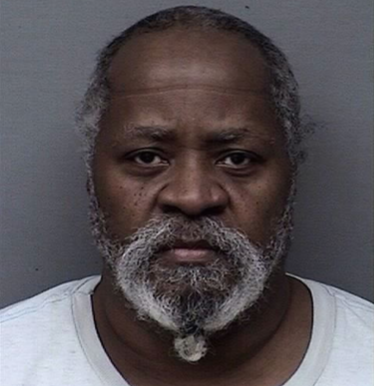
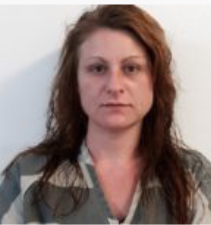
Sherman Galloway -photo KDOC
Jean Rhea was 25 when she was attacked in October 1981 by a man who held a knife to her throat and raped and repeatedly sodomized her on the Lawrence campus. She testified against her rapist, Sherman Galloway, who was sentenced to 30 years to life in prison with a possibility of parole after 15 years. Galloway was later convicted of a second rape and again sentenced to 30 years to life with a possibility of parole after 15 years. But the judge ruled that Galloway would still be eligible for parole after 15 years on the first conviction.
Galloway is considered for parole every few years, and Rhea, who has lived in California for more than 30 years, has shown up every time to testify that he should stay in prison.
“For me, personally, it’s important that I have a voice,” Rhea said this month, after speaking to the Kansas Prisoner Review Board for the seventh time. “If I didn’t participate, I feel like I’d feel more like collateral damage.”
Rhea said participating in Galloway’s parole reviews furthers her decision to participate in Galloway’s prosecution.
“But is this exactly what I signed on for in October 1981?” she said. “No.”
In Rhea’s case, Galloway was convicted of rape and aggravated sodomy. In the second rape of a Kansas graduate student he was convicted in 1984 of rape, aggravated sodomy, kidnapping and aggravated battery.
At the time sentences for those crimes were given ranges. Currently, for the same convictions, Kansas sentencing guidelines set a number of months in prison based on the severity level of the crime and the defendant’s criminal history. The Douglas County District Attorney’s Office said most modern sentences don’t include parole hearing dates, only release dates.
Rhea returned to Kansas in 1996, 1999, 2004, 2005, 2007, 2012 and this year, said Joe Phillips, administrator of the Kansas Department of Corrections’ Prisoner Review Board. Rhea said her relatives also wrote letters when Galloway asked for clemency in 2017.
Parole consideration happens automatically, Phillips said. Each time, the three-member parole board gathers oral and written public comments, holds a hearing with the inmate, then makes a decision.
Galloway’s parole hearing is scheduled for April. If he is paroled, he could be out of prison May 1.
Both of Galloway’s rape convictions are considered for his parole proceedings, though Rhea said the other victim has chosen not to participate in person.
Rhea said she has never seen any Galloway supporters at the sessions she has attended. Former and current prosecutors, and the two now-retired university police officers who worked on the case have testified against Galloway’s release.
Retired prosecutor Shelly Diehl worked on Galloway’s case in the early 2000s when he filed a motion for DNA testing, which failed to exonerate him. She has spoken several times against paroling Galloway.
“I believe in the prosecution, and I believe that this is a person who should never see the light of day — his crimes were that savage,” Diehl said.
Rhea, who suffered from post-traumatic stress disorder and alcoholism after the attack, says she made it through her dark times and is now a licensed clinical mental health professional. She said the repeated parole proceedings have become less re-traumatizing.
“No one should ever be considered for parole who is a sexual predator that does not have the ability to express regret or remorse, and has never taken accountability for his crimes,” she said.
SHAWNEE COUNTY–Law enforcement authorities are investigating a Kansas felon on new charges after a traffic stop.
Stanford-from a previous arrest in Sedgwick Co.
Just after 2 p.m. Saturday, Patrol Officers conducted a suspicious person stop in the 1500Block of SW Lincoln Street in Topeka, according to Lt. Robert Simmons.
The subject, later identified as Kanealies Lamont Stanford 41, lied to Officers about his identity. Stanford was found to be in possession of a firearm, heroin, drug paraphernalia and a homemade explosive device.
Once his true identity was determined, he was also found to have 2 city warrants for his arrest. Stanford is also a convicted felon and is prohibited from being in possession of a firearm.
Stanford was transported to the Shawnee County Department of Corrections and booked on charges of Criminal Possession of a Firearm by a Felon, Possession of Heroin, Possession of Drug Paraphernalia, Interference with a Law Enforcement Officer and Criminal Use of Explosives.
This is the 31st case in 2019 with a charge involving a felon in possession of a firearm reported by the Topeka Police Department.
Stanford has three previous drug convictions, according to the Kansas Department of Corrections.
THOMAS COUNTY —Two people were injured in an accident just after 12:30p.m. Sunday in Thomas County.
The Kansas Highway Patrol reported a 2013 Nissan NV driven by Laura Michelle Bergstraser-Lorenz, 32, Franktown, CO., was westbound on Interstate 70 just west of U.S. 83.
The van left the roadway to the left, struck a median turn around, went airborne and continued through the median until it came to rest facing westbound.
Bergstraser-Lorenz and a passenger Janet Ann Kaufmann, 61, Colorado Springs, Co., were transported to the Logan County Hospital. Both were properly restrained at the time of the accident, according to the KHP.
By DIANE GASPER-O’BRIEN FHSU University Relations and Marketing
Each speaker at Tuesday’s Rudd Foundation presentation at Fort Hays State University talked about grit, determination and a strong work ethic.
Those traits are the cornerstone on which the Rudd Scholarship Program was formed, and they are ones that the scholarship selection committee feels Rudd Scholars should possess.
The Rudd Foundation believes that Fort Hays State University also possesses those characteristics. Therefore, FHSU is one of three state universities chosen for Rudd Scholars to attend “because they represent the Midwestern values of grit, determination and work ethic,” said Peter Najera, president of the Rudd Foundation.
At a reception in the Robbins Center, the five new Rudd Scholars who will be attending Fort Hays State next fall were recognized.
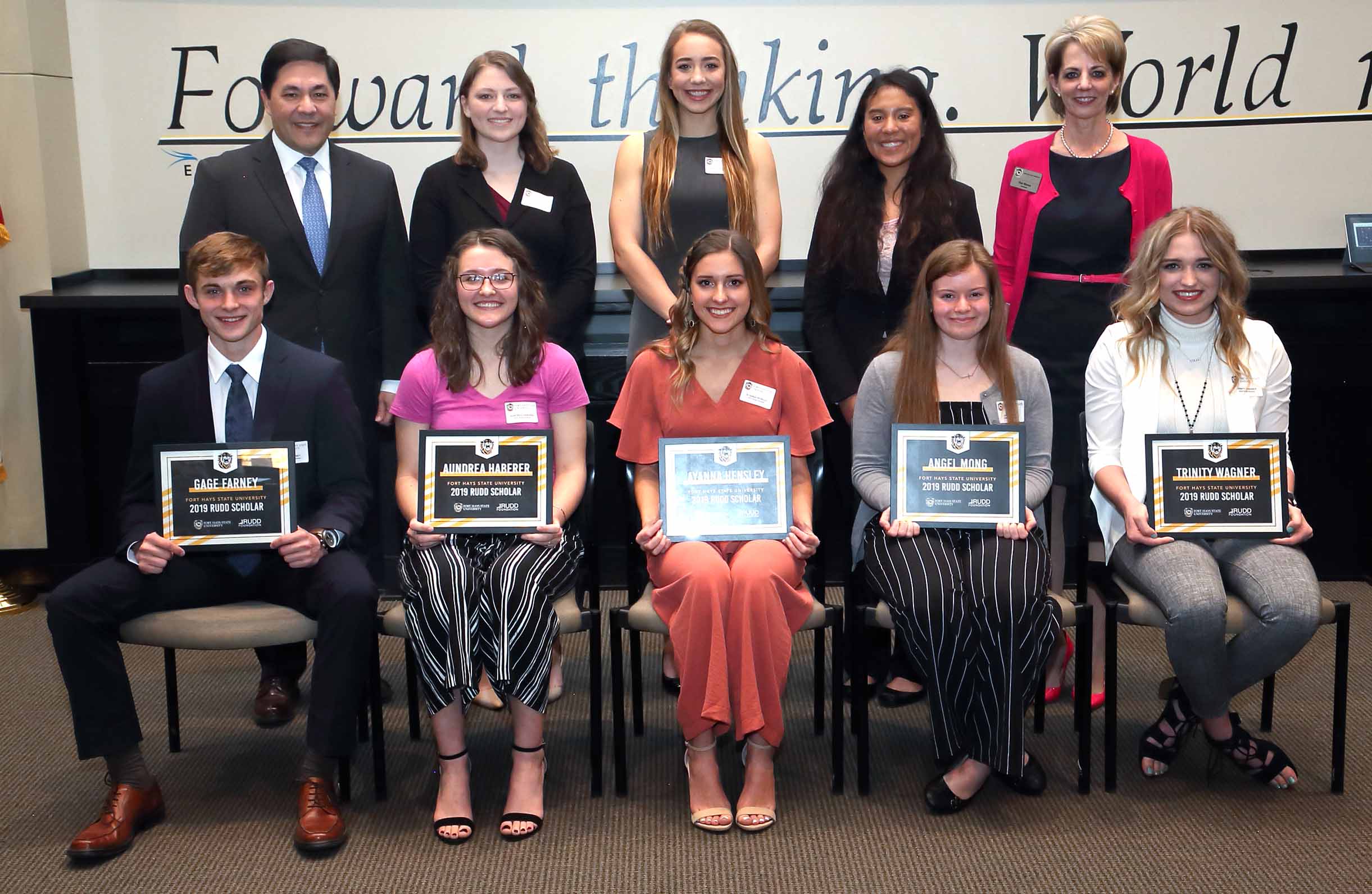
Members of the first two classes of Rudd Scholars at Fort Hays State University are: Back row, from left, Rudd Foundation President Peter Najera, entrance class of 2018 Danica Kostner, Cydney Bergmann and Meleny Jacome-Banuelos, and FHSU President Dr. Tisa Mason; front row, from left, entrance class of 2019 Gage Farney, Aundrea Haberer, Ayanna Hensley, Angel Mong and Trinity Wagner. (Photo by Mitch Weber)
Nearly 900 students from around the state were among this year’s list of applicants, from which only 25 were chosen. Five will attend Emporia State University, and the remaining 15 will enroll at Wichita State University, the alma mater of the late Leslie Rudd, a Wichita native.
Rudd was an entrepreneur and philanthropist who founded the Rudd Group, a privately owned portfolio of luxury businesses and established the Rudd Foundation in 1998. Through the foundation, the Rudd Scholarship was started “to help students for whom the the financial burden of higher education made its attainment nearly impossible,” he wrote in a letter to potential Rudd Scholars before he died in 2018.
The four-year scholarship is open to Kansas students who qualify for a Pell Grant. It covers any remaining cost of attendance after all other aid, grants and scholarships are applied to a student’s account. The expected value for the 25 members of the second class of Rudd Scholars is $1.4 million over four years. More information about the program can be found at ruddfoundation.org.
“Kansas high schools continue to produce very talented young men and women imbued with the Midwestern values, and we are excited to make an investment in them through a college education,” Najera said. “These 25 recipients, in addition to the 19 previously selected, brings us to a total of 44 Rudd Scholars in college who will continue to support each other as they are groomed to strengthen the talent pipeline here in Kansas upon graduation.”
The scholarship is earned through a competitive selection process that requires grades, test scores, essays, letters of recommendation. The 50 semifinalists then go through a personal interview as well.
One of the new Rudd Scholars is Aundrea Haberer from Sylvan-Lucas Unified High School, who plans to major in agronomy. She will be the third member of her family attending FHSU. Her older sister, Elaia Haberer Garrett, graduated in 2017, and heir mother, Rhonda Haberer, also is a Tiger alum.
Haberer visited other colleges but said she “really liked the feel of the campus” at Fort Hays State.
The three members of the first class of Rudd Scholars at Fort Hays State attended the reception.
Meleny Jacome-Banuelos from Johnson welcomed the incoming class to “our family.”
“From this moment forward, we three individuals are here to support you,” she said. “The hardest things in life are usually the best things for you, and we are here to offer any kind of help or support.”
She told the newcomers they will “get to work with the people and get to know more people who want to be successful. We can all learn from each other. I am looking forward to them coming to campus. I will get some leadership experience.”
Current Rudd Scholars talked about the numerous advantages of the Rudd Scholarship, other than the financial piece of it.
“I was extremely grateful for this, not just for the financial aspect of it but for the networking angle, too,” said Cydney Bergmann from Concordia, a pre-veterinarian major.
Bergmann was considering other colleges as well as Fort Hays State when she heard of the Rudd Scholarship.
Bergmann had received enough academic scholarships to cover expenses for the first year of college but was unsure of future years. Plus, she knew vet school would be more schooling – and additional expense.
“This scholarship has made a huge impact, because I don’t have the financial burden and can focus on my classes,” she said. “I didn’t want to be in debt twice.”
Some of the requirements for Rudd Scholars are to live on campus, take an active part in organizations and pursue leadership opportunities. They also must graduate in four years.
Jacome-Banuelos is a first-generation student majoring in organizational leadership. She said she already has been positively impacted during her first year.
“This scholarship has really helped me connect with people in my field,” Jacome-Banuelos said. “Building connections has been really helpful.”
“This scholarship strives to find the brightest Kansas minds – those who have that grit, integrity, and drive to succeed – and empower those students with the resources to achieve their goals,” said Dr. Tisa Mason, FHSU president. “At Fort Hays State, we are thrilled to provide innovative educational opportunities, vibrant learning communities, state-of-the-art technology, world-class internships and unparalleled opportunities for experiential learning inside and out of the classroom – and all at the most affordable tuition rate in the Kansas and the region.”
Najera said he is pleased with the first two classes and looks forward to adding more and more in years to come.
“In just two more years, we will have nearly 100 Rudd Scholars on campus learning from one another,” Najera said. “And in a few years after that, they will all be networking with one another throughout the state as they continue on their trajectory of being positive contributors to our Kansas communities and society as a whole.”
Each of the new scholars talked a bit, thanking the foundation for this opportunity and had their picture taken with Najera and Mason. They got to learn a little about the welcoming culture of Fort Hays State as administrators, faculty and staff joined the new scholars and their families at their tables.
Haberer already has bought into the FHSU campus spirit.
After thanking the Rudd Foundation “for this amazing offer,” she finished her talk with “Go Tigers!”
The list of the second class of Rudd Scholars at FHSU (for the 2019-20 school year), listed by hometown, name, high school and major:
BELOIT (67420): Trinity Wagner, Beloit High School, biology.
DODGE CITY (67801): Ayanna Hensley, Dodge City High School, radiology.
GRAINFIELD (67737): Angel Mong, Wheatland/Grinnell High School, elementary education.
LURAY (67649): Aundrea Haberer, Sylvan-Lucas Unified High School, agronomy.
STERLING (67579): Gage Farney, Sterling High School, construction management.
Current Rudd Scholars at FHSU, from the first class of 2018-19, listed by hometown, name and major:
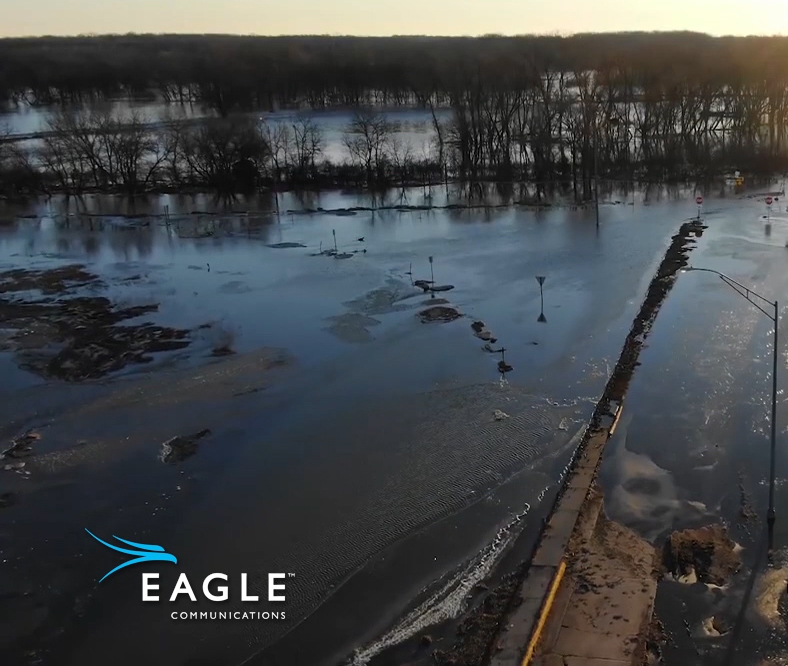
Eagle Communications is collecting monetary donations at its Kansas radio stations for victims of the recent catastrophic flooding in Nebraska.
A GoFundMe account is now available for online donations.
Hays-area residents wishing to make a contribution may bring cash or checks to the Eagle Media Center, 2300 Hall Street, Hays. Checks should be made out to the Nebraska Red Cross.
Donations will be collected through Thu., April 4.
The Hays contributions will be combined with those collected by our Eagle Radio stations in Great Bend, Salina, Hutchinson, Manhattan and Junction City. The final amount will then be matched by the Schmidt Family Foundation and will be distributed to the Nebraska Red Cross.
For more information, contact the Hays Eagle Media Center at 785-301-2211.
Disclosure: Eagle Communications is the parent company of Hays Post.
WASHINGTON (AP) — Border officials are aiming to more than quadruple the number of asylum seekers sent back over the southern border each day, a major expansion of a top government effort to address the swelling number of Central Americans arriving in the country, a Trump administration official said Saturday.
U.S. Customs and Border Patrol continues to apprehend large groups of 100 or more migrants arriving at our borders. There have been 95 large groups of 100 or more individuals totaling 16,042 apprehensions in FY19TD. Comparatively, Border Patrol encountered 13 large groups in FY18 and only 2 in FY17. This photos show USBP and BORSTAR agents processing individuals last week in El Paso, TX – image courtesy Department of Homeland Security, U.S. Border Patrol
It was the latest attempt to ease a straining immigration system that officials say is at the breaking point. Hundreds of officers who usually screen cargo and vehicles at ports of entry were reassigned to help manage migrants. Homeland Security Secretary Kirstjen Nielsen asked for volunteers from non-immigration agencies within her department, sent a letter to Congress late this past week requesting resources and broader authority to deport families faster, and she met with Central American and Mexican officials.
The efforts are being made while President Donald Trump is doubling down on threats to shutter the U.S.-Mexico border entirely, a move that would have serious economic repercussions for both the U.S. and Mexico but wouldn’t stop migrants from crossing between ports. His administration also announced it was cutting aid to the Central American countries home to most of the migrants.
Right now, about 60 asylum seekers a day are returned to Mexico at the San Ysidro, Calexico and El Paso ports to wait out their cases, the official said. They are allowed to return to the U.S. for court dates. The plan was announced Jan. 29, partially to deter false claimants from coming across the border. With a backlog of more than 700,000 immigration cases, asylum seekers can wait years for their cases to progress, and officials say some people game the system in order to live in the U.S.
Officials hope to have as many as 300 people returned per day by the end of the week, focusing particularly on those who come in between ports of entry, said the official, who had knowledge of the plans but was unauthorized to speak publicly and spoke to The Associated Press on condition of anonymity.
But the process so far has been slow-going, and such a sizeable increase may be difficult to achieve. The plan has already been marred by confusion, scheduling glitches and an inability by some attorneys to reach their clients. In San Ysidro alone, Mexico had been prepared to accept up to 120 asylum seekers per week, but for the first six weeks only 40 people per week were returned.
Plus, U.S. officials must check if asylum seekers have any felony convictions and notify Mexico at least 12 hours before they are returned. Those who cross illegally must have come as single adults, though the administration is in talks with the Mexican government to include families. Children are not returned.
Homeland Security officials have been grappling with an ever-growing number of Central American children and families coming over the border. Arrests soared in February to a 12-year-high and more than half of those stopped arrived as families, many of them asylum seekers who generally turn themselves in instead of trying to elude capture. Guatemala and Honduras have replaced Mexico as the top countries, a remarkable shift from only a few years ago. Migrants from Central America cannot be easily deported, unlike people crossing from Mexico.
Mexico has been treading lightly on the subject. After Trump lashed out, saying Mexico and the Central American nations were “doing nothing” about illegal immigration, President Andres Manuel Lopez Obrador said his country would do everything it could to help to maintain a “very respectful relationship” with the U.S. government and Trump.
Meanwhile, Nielsen sent a letter to the heads of other agencies within her sprawling, 240,000-person department, asking for volunteers to help with border duties. And she wrote to Congress asking for more temporary facilities to process people, more detention space, and the ability to detain families indefinitely and to deport unaccompanied minors from Central America. While children from Mexico can be returned over the border, laws prohibit deportation to other countries.
Democratic congressional leaders expressed deep concern, saying the administration wanted to revive “horrific” and “immoral” plans, noting its failed hardline border policies have created “senseless heartbreak and horror.”
“Democrats reject any effort to let the administration deport little children, and we reject all anti-immigrant and anti-family attacks from this President,” House Speaker Nancy Pelosi said in a statement.
JACKSON COUNTY — Law enforcement authorities are investigating two suspects for alleged burglary.
Johnson -photo Jackson Co.Cowling-photo Jackson Co.
Just after 8p.m. Friday, the Jackson County Sheriff’s Office received a report of a suspicious vehicle parked behind a residence in the 13000 block of S. Road near Hoyt, according to Sheriff Tim Morse.
Jackson County Deputies and the Hoyt Police Department responded to the area and discovered that forced entry was made to the property.
Law enforcement stopped a white Saturn passenger car east of T. Road on 126th Road. The occupants of the vehicle, Rachel Leeann Johnson, 34, of Wellsville, Kansas and Bradley Steven Cowling, 36, of Carbondale, Kansas were arrested during the traffic stop. The duo were alleged to be in possession of property that came from the residence at the time of their arrest, according to Morse.
Cowling was booked into the Jackson County Jail for burglary, theft, felony interference with law enforcement, and criminal use of weapons. Cowling also had outstanding warrants for his arrest from other Kansas jurisdictions. Johnson was booked into the Jackson County Jail for burglary and theft.
The Dane G. Hansen Museum is pleased to announce the now-open exhibit featuring Eckman Fine Arts’ collection of cast paper sculptures. Cast paper sculpture, (not to be confused with papier mâché), was invented as late as the 1950s.
The two Eckmans have developed a careful process that is now trademarked by them. Accordingly, Allen and Patty Eckman of Eckman Fine Art are internationally recognized as masters in this intricate, time-consuming medium.
Allen Eckman touching up “Sitting Bulls Vision.”
Sculpting from their home in the Black Hills of South Dakota, Marine veteran Allen Eckman’s Cherokee heritage originally spurred him to greatly broaden his knowledge of Native American history, especially beginning with the Westward Expansion in the early 1800’s.
This exhibit not only pays tribute to several aspects of Native American culture, but ties in another special focus, closely related – nature itself.
Complementing Allen’s attention to Native American history, Patty has a detailed awareness of natural beauty, especially wildlife and flowers, and has remarked that color is sometimes a distraction to the underlying intricate forms in nature. As Allen and Patty’s sculptures are typically unpainted, this purity lends itself wholly to the detail of these exquisite pieces.
Patty Eckman discussing the exhibition with Museum Director Shari Buss.
Eckman Fine Art – Cast Paper Sculptures will be on display through June 2, 2019, at the Dane G. Hansen Museum located at 110 W. Main Street, Logan, Kansas.
Museum hours are Monday through Friday 9-12 & 1-4; Saturdays 9-12 & 1-5; Sundays & holidays 1-5. We are handicapped accessible and thanks to the generosity of the Dane G. Hansen Foundation, there is never an admission fee.
For more information, please contact us at 785-689-4846.
Crabgrass preventers are another name for pre-emergence herbicides that prevent crabgrass seeds from developing into mature plants. Many people have a somewhat foggy idea of how they work and assume they kill the weed seed.
Such is not the case. They do not kill the seed or even keep the seed from germinating but rather kill the young plant after it germinates. Therefore, they do not prevent germination but prevent emergence.
Crabgrass preventers are just that – preventers. With few exceptions they have no effect on existing crabgrass plants, so they must be applied before germination. Additionally, preventers do not last forever once applied to the soil. Microorganisms and natural processes begin to gradually break them down soon after they are applied. If some products are applied too early, they may have lost much of their strength by the time they are needed. Most crabgrass preventers are fairly ineffective after about 60 days, but there is considerable variation among products. (Dimension and Barricade last longer. See below.)
For most of Kansas, crabgrass typically begins to germinate around May 1 or a little later. April 15 is normally a good target date for applying preventer because it gives active ingredients time to evenly disperse in the soil before crabgrass germination starts. Even better, base timing on the bloom of ornamental plants. The Eastern Redbud tree is a good choice for this purpose. When the trees in your area approach full bloom, apply crabgrass preventer. A follow-up application will be needed about 8 weeks later unless you are using Dimension or Barricade. Products that do require a follow-up application include pendimethalin (Scotts Halts) and Team (Hi-Yield Crabgrass Control).
Dimension and Barricade are the only two products that give season-long control of crabgrass from a single application. In fact, they can be applied much earlier than April 15 and still have sufficient residual strength to last the season. Barricade can even be applied in the fall for crabgrass control the next season.
Dimension can be applied as early as March 1. Because of the added flexibility in timing, these products are favorites of lawn care companies who have many customers to service in the spring. Though Dimension is usually not applied as early as Barricade, it is the herbicide of choice if it must be applied later than recommended. It is the exception to the rule that pre-emergence herbicides do not kill existing weeds. Dimension can kill crabgrass as long as it is young (two- to three-leaf stage). Dimension is also the best choice if treating a lawn that was planted late last fall. Normally a pre-emergence herbicide is not recommended unless the lawn has been mowed two to four times.
But Dimension is kind to young tall fescue, perennial ryegrass, and Kentucky bluegrass seedlings and some formulations can be applied as early as two weeks after the first sign of germination. However, read the label of the specific product you wish to use to ensure that this use is allowed. Lawns established in the fall can be safely treated with Dimension the following spring even if they have not been mowed.
Alicia Boor is an Agriculture and Natural Resources agent in the Cottonwood District (which includes Barton and Ellis counties) for K-State Research and Extension. You can contact her by e-mail at [email protected] or calling 620-793-1910.
The clock is ticking for Kansas lawmakers to figure out a school funding solution. Briefs making the case for a plan are due to the state Supreme Court April 15.
Photo by CHRIS NEAL FOR THE KANSAS NEWS SERVICE
With only one week of the regular legislative session to go, there’s still significant division over how to satisfy the court that funding is adequate and end the nearly decade-old Gannon lawsuit.
The Senate is backing Democratic Gov. Laura Kelly’s plan to add $360 million for schools over four years. Republican leaders in the House think the solution is in targeting more money at struggling students, but they don’t want to promise funding hikes far into the future.
The House has not in fact debated a school funding bill. Instead, the chamber approved — by only the narrowest of margins — legislation making a host of changes to school finance policy. House and Senate negotiators will discuss that policy bill next week.
The changes would require more reports on test scores and spending by individual districts. Superintendents would have to certify that sufficient resources are being directed to core curriculum and kids who are at risk of falling behind.
Republican Rep. Kristey Williams said the policy changes will ensure state dollars are spent wisely.
“Accountability is the cornerstone of all good policy,” Williams said when explaining her vote in favor of the policy bill she helped draft.
But some provisions of the bill are causing heartburn for school districts.
The legislation wouldn’t just require more reporting of school spending. It would also limit state funding for bilingual education for students learning English. The Kansas State Board of Education would be asked to determine each year how money for special education is distributed, tossing out an existing target.
The state hasn’t hit that target for special education funding in recent years, but members of the Kansas Association of School Boards don’t want to see it eliminated.
“Many districts are disappointed that we just sort of give up on that,” said KASB lobbyist Mark Tallman.
The bill includes a mix of policies the KASB opposes and supports, but Tallman said policy issues should not be the focus of lawmakers right now.
“None of the policy is as important as resolving funding,” Tallman said. “That’s a major concern.”
Plus, the policy bill isn’t likely to get a warm reception from senators eager to move on from years of litigation.
The Senate signed off on the governor’s plan more than two weeks ago — a plan that adjusts for inflation funding levels that the court said last year were nearly enough.
“The Senate’s already established its position,” Republican Sen. Molly Baumgardner said. “We established that pretty clearly.”
House Republicans do have a proposal to provide an initial infusion of cash for schools. But it doesn’t include long-term increases many believe the court will want to see.
Republican leaders called off debate on the proposal this week for lack of support, but they still believe their caucus can agree on something.
“It’s just part of the process,” House Majority Leader Dan Hawkins said. “We’ve got 84 members of our caucus and we probably have 10 or 15 different ideas out there.”
There are a few different paths legislators could take to reach a school funding solution next week.
If the House approves its own funding bill, that would spark bargaining with the Senate. Or the group of senators and House members slated to negotiate the education policy bill could decide to craft a funding agreement too.
Another option, one that House Democrats like, is to simply sign on to the governor’s proposal that passed the Senate with a bipartisan majority.
“The Senate did their job,” House Minority Leader Tom Sawyer said. “We ought to just pass what the Senate did. Get it done.”
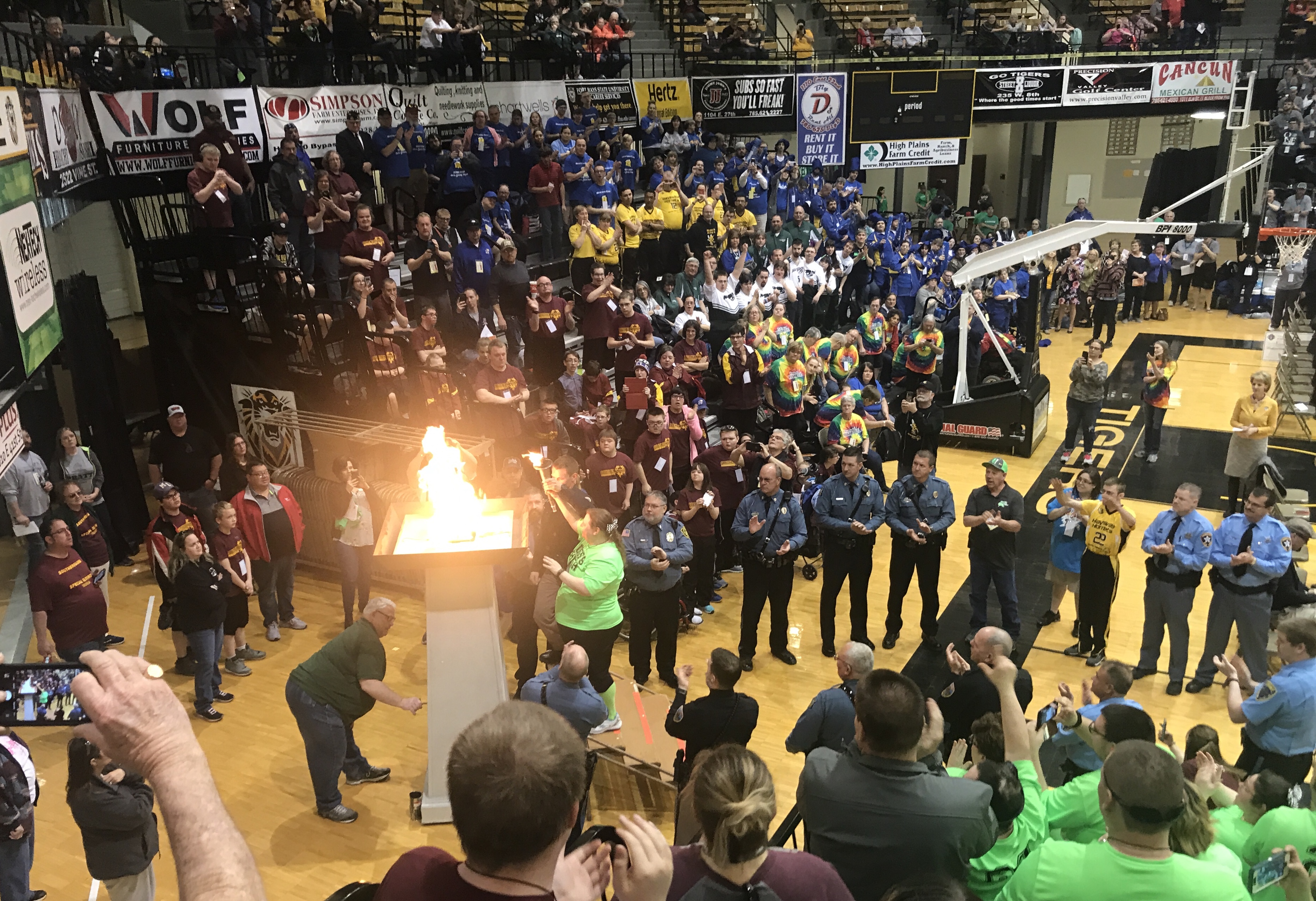
Special Olympics Opening Ceremony 2019 (Courtesy Hays Convention and Visitors Bureau)
By DIANE GASPER-O’BRIEN
FHSU University Relations and Marketing
Alysha Werth and Chloe Brown have belonged to the same church while attending college but weren’t all that acquainted with each other until recently. The two Fort Hays State University students got to know each other a little better last weekend.
They signed up to volunteer at the Special Olympics Kansas Basketball and Cheerleading Tournament in Hays, and they were assigned to work together at the scorers’ table in one of the Cunningham Hall gyms.
By the conclusion of the two-day tournament, Werth and Brown realized they had more in common than they might have thought, specifically their desire to give of their time.
Werth, a senior elementary education major from Ellis, and Brown, a senior organizational leadership major from Ottawa, both were drawn to the Special Olympics event after volunteering for two years at Night to Shine, a prom for people with special needs.
“The first year at Night to Shine, every time I saw a special needs person, they made me smile,” said Werth, who is adding a minor in special education to her resume. “So when I saw this opportunity to volunteer, I decided to sign up. I am so glad I did. This was so rewarding.”
Special Olympics Kansas is a volunteer-driven organization that features a year-round program of athletic training, health education and competition to more than 5,400 athletes.
The state basketball/cheerleading tournament is held at two different sites, in Hays and Topeka. The Hays tourney, which this year featured about 600 athletes and more than 200 coaches, relies on hundreds of volunteers to help facilitate.
“We know the volunteer base is there in Hays and that we can count on some college students for help,” said Tim Rehder, senior vice president of programs for Kansas Special Olympics, who is in charge of all the state competitions.
Hays has hosted the state basketball and cheerleading tournament for four decades, and about 250 people volunteer to help out each year, including 50 to 75 FHSU students.
“That’s a good feeling, knowing we can more or less run the tournament with students there,” Rehder said.
Werth said she empathized with the Special Olympians. It was quite an undertaking for some to score a basket, no matter how hard they tried.
After graduating from Ellis High School in 2014, Werth decided to stay close to home and attend Fort Hays State.
A first-generation college student, Werth said she was unfamiliar with the ins and outs of making college life a successful venture. She struggled to keep up with her classes, so she took a few semesters off.
“Being the first one in my family who went to college, I didn’t have anyone to help me figure it all out,” she said. “I realized I needed to reach out for help, and FHSU was there all the way. The instructors I have in my classes are amazing and want us to be excited to teach.”
Brown said watching so many Special Olympic games over the weekend “brought everything into perspective.”
“A person can take so many things for granted,” she said. “We always had the opportunity to play on basketball teams growing up. For the special needs people, it’s more difficult.”
“But,” she added, “they are so joyful just to be able to play. Whenever they made a shot, it was the best thing ever.”
Like Werth, Brown changed majors before she found the right fit.
“I had a passion for service and helping others,” Brown said, “so I went into social work at first. But I quickly realized that wasn’t for me.”
Brown found her niche in organizational leadership and plans to work for a non-profit organization that works with special needs citizens when she graduates in 2020.
However, unlike Werth, Brown had tradition on her side when it came to continuing her education after high school. Both Brown’s parents and an older brother all attended college, all in eastern Kansas.
She decided to break that tradition, however, when she decided to attend college on the other side of the state.
“My mom said, ‘You will know when you get there if that’s the right school for you,’ ” Brown said of her college visits her senior year in high school.
Brown visited two other state universities before coming to Hays.
“I remember sitting in the orientation here, and I was looking around, and I felt so comfortable,” she said. “Everywhere we went around the campus that day, I could see myself there the next few years.”
“My mom was right,” Brown continued. “I knew, I had that feeling that Fort Hays State was the right place for me.”
Brown said she is unsure of whether or not she will stay in western Kansas or go closer to home when she graduates in 2020, but wherever she ends up, she will take some valuable lessons with her.
“My professors are always talking about how we should apply what we are learning to what we do when we get out of college,” she said. “It’s basic career preparation, and it’s made a huge impact on me.”
FHSU students made a similar impact on the 2019 Special Olympics event in Hays.
“The fact that students will carve out time, the fact that they consider this important enough to help out, is flattering to us,” he said. “The support we get from Hays, especially the college, is phenomenal. They don’t charge us a dime to come in there and host this event.”
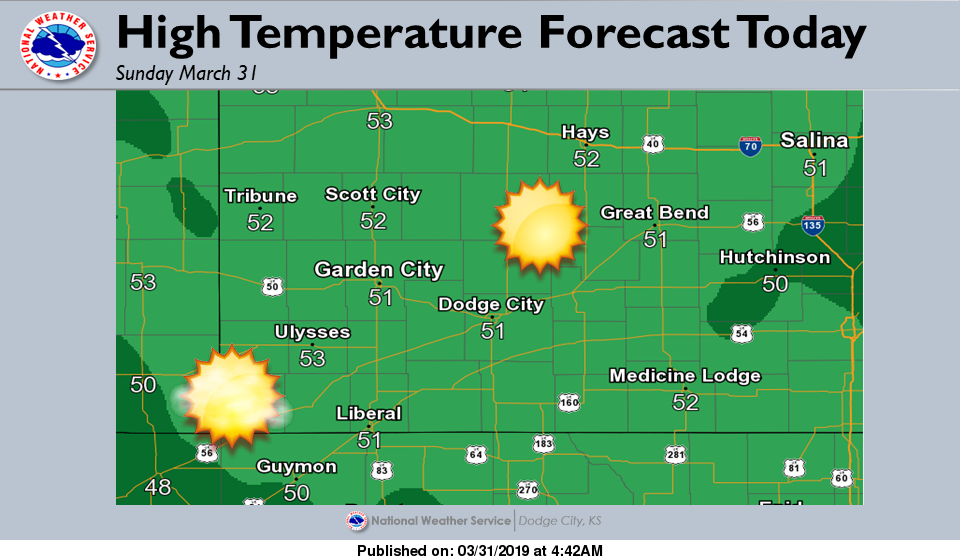
Sunny, with a high near 51. West northwest wind 5 to 9 mph becoming southwest in the afternoon.
Tonight
Mostly clear, with a low around 31. South southwest wind around 7 mph.
Monday
Sunny, with a high near 61. South southwest wind 6 to 14 mph.
Monday Night
Partly cloudy, with a low around 35. South southwest wind 8 to 10 mph becoming north northwest after midnight.
Tuesday
Mostly sunny, with a high near 61. North wind 7 to 11 mph becoming east southeast in the afternoon.
Tuesday Night
Mostly cloudy, with a low around 44.
Wednesday
Scattered showers after 1pm. Partly sunny, with a high near 64. Chance of precipitation is 30%.
Wednesday Night
Showers likely and possibly a thunderstorm before 1am, then isolated showers. Mostly cloudy, with a low around 41. Chance of precipitation is 60%. New rainfall amounts of less than a tenth of an inch, except higher amounts possible in thunderstorms.


















 Today
Today