Fort Hays State Tiger coach Chris Brown held his weekly press conference Tuesday after the Tigers outlasted Pittsburg State 42-41 Saturday in Pittsburg.
The Tigers return home this Saturday for a matchup with Nebraska-Kearney in a battle of a pair of 5-2 teams.
Senior wide receiver Layne Bieberle and senior defensive back Tanner Hoeckman also addressed the media
Kansans took out $267 million in payday loans in 2018. Some community and religious groups want to change the rules for those loans. Nomin Ujiyediin / Kansas News Service
Critics say it’s time for a change
By NOMIN UJIYEDIIN Kansas News Service
Maria Galvan used to make about $25,000 a year. She didn’t qualify for welfare, but she still had trouble meeting her basic needs.
“I would just be working just to be poor and broke,” she said. “It would be so frustrating.”
When things got bad, the single mother and Topeka resident took out a payday loan. That meant borrowing a small amount of money at a high interest rate, to be paid off as soon as she got her next check.
A few years later, Galvan found herself strapped for cash again. She was in debt, and garnishments were eating up a big chunk of her paychecks. She remembered how easy it was to get that earlier loan: walking into the store, being greeted with a friendly smile, getting money with no judgment about what she might use it for.
So she went back to payday loans. Again and again. It began to feel like a cycle she would never escape.
“All you’re doing is paying on interest,” Galvan said. “It’s a really sick feeling to have, especially when you’re already strapped for cash to begin with.”
Like thousands of other Kansans, Galvan relied on payday loans to afford basic needs, pay off debt and cover unexpected expenses. In 2018, there were 685,000 of those loans, worth $267 million, according to the Office of the State Bank Commissioner.
But while the payday loan industry says it offers much-needed credit to people who have trouble getting it elsewhere, others disagree.
A group of nonprofits in Kansas argues the loans prey on people who can least afford triple-digit interest rates. Those people come from lower-income families, have maxed out their credit cards or don’t qualify for traditional bank loans. And those groups say that not only could Kansas do more to regulate the loans — it’s fallen behind other states who’ve taken action.
Payday Loan Alternatives
Last year, Galvan finally finished paying back her loans. She got help from the Kansas Loan Pool Project, a program run by Catholic Charities of Northeast Kansas.
Once Galvan applied and was accepted to the program, a local bank agreed to pay off about $1,300 that she owed to payday lenders. In return, she took out a loan from the bank worth the same amount. The interest was only 7%.
Now that she’s out, Galvan said, she’ll never go back.
She doesn’t have to. Making payments on that bank loan helped build her credit score until, for the first time, she could borrow money for a car.
“That was a very big accomplishment,” she said, “to know I have this need, and I can meet that need on my own.”
The project has paid off $245,000 in predatory loan debt for more than 200 families so far.
Claudette Humphrey runs the original version of the project for Catholic Charities of Northern Kansas in Salina. She says her program has been able to help about 200 people by paying off more than $212,000 in debt. But it hasn’t been able to help everyone.
“The Number One reason, still, that we have to turn people away,” she said, “is just because we have a limit.”
People only qualify for the Kansas Loan Pool Project if they have less than $2,500 in payday loan debt and the means to pay back a new, low-interest loan from the bank. The program doesn’t want to put people further in the hole if they also struggle with debt from other sources, Humphrey said.
“Sometimes, even if we paid that off, they would still be upside-down in so many other areas,” she said. “I wouldn’t want to put an additional burden on someone.”
Humphrey doesn’t think her program is the only solution. In her opinion, it should be lawmakers’ responsibility to protect payday loan customers the same way they protect all consumers — through regulating payday loans like traditional bank loans.
“Why are these companies not held to that same standard?” she said. “Why, then, are payday and title loan lenders allowed to punish them at such an astronomical interest rate for not being a good risk?”
Potential Changes
Catholic Charities is just one of the nonprofits pushing for tighter rules. The members of the coalition include churches and community organizations, said Shanae’ Holman, an organizer with Topeka JUMP, the group that is leading the push.
“There are other states who’ve implemented guidelines that sell you how much income… what percentage of your check can go to a payment,” Holman said. “Those are the types of regulations that we would like to see,”
She wants Kansas to require longer loan periods so borrowers aren’t hit with penalties when they can’t meet short payment deadlines.
Currently, the maximum period for a payday loan in the state is 30 days. In comparison, borrowers of small loans in Colorado must have at least six months to pay them back, with no maximum loan period. In Ohio, borrowers have between 91 and 365 days to pay back a loan. If the period of the loan is less than 91 days, the repayment must be less than 7% of the borrower’s net income.
Both states set annual interest rates near 30%. Some states regulate payday loans the same way they do other consumer loans. But Kansas is like most other states, allowing annual interest rates of 391%. That means a two-week loan of $500 at 15% interest can cost a customer almost $2,000 over the course of a year.
The group plans to work with legislators during next year’s session in Topeka.
It’s the first time that such a large group has organized around the cause, said Jeanette Pryor, a lobbyist for the Kansas Catholic Conference. Payday loan reform is a perennial topic at the Statehouse, she said, but it’s hard to convince lawmakers to increase regulations.
“That was something that I heard in the beginning. ‘Why can’t an adult make a rational decision on their own? Why do we have to legislate this?’” she said. “The larger the coalition, the more opportunities to educate legislators.”
Nick Bourke is the director of consumer finance at Pew Charitable Trusts. It pushes for reform of payday loan laws. He said reform is long overdue in Kansas, which hasn’t updated its payday loan laws since 2005.
“It’s possible to provide small-dollar credit, even to people with damaged credit histories, for much less money than what Kansans are paying now,” he said. “But Kansas laws are outdated.”
In 2014, Pew Charitable Trusts conducted research on payday loan usage in each state. The organization found that 8% of Kansas residents had used payday loans in recent years, higher than the national average of 5.5%. The typical income for a borrower was $30,000.
The Office of the State Bank Commissioner, David Herndon, which regulates loans and penalizes lenders for breaking the rules, refused to be interviewed in person or over the phone, but did answer questions through email. Deputy Bank Commissioner Tim Kemp said the agency only enforces existing law and doesn’t weigh in on proposed changes.
Attorney General Derek Schmidt’s office, which takes consumer complaints about payday loans, declined multiple requests for interviews and information.
An Option For Credit
Payday lenders say they offer affordable credit to the large proportion of Americans who don’t have enough cash to cover an emergency expense. The Community Financial Services Association of America, an industry group for small-dollar lenders, declined an interview due to scheduling conflicts, but sent a statement through email.
“Small-dollar loans are often the least expensive option for consumers,” said CFSA chairman D. Lynn DeVault in the statement. “Particularly compared to bank fees — including overdraft protection and bounced checks — or unregulated offshore internet loans and penalties for late bill payments.”
Some Kansas customers, like Keri Strahler of Topeka, say the loans are helpful.
Strahler doesn’t work, and most of her income comes from Social Security Disability Insurance. This year, she took out three payday loans to cover medical debt, and said she hasn’t had trouble paying them back.
She knows many people perceive the loans as predatory. But for Strahler, borrowing has alleviated more stress than it’s caused. Her credit cards were already maxed out, and the loans helped her avoid being taken to court or having to sell her furniture to cover her debt.
“I chose the payday loans because I wanted them immediately addressed,” she said. “It’s been very helpful.”
Humphrey, of Catholic Charities, acknowledges the loans can be helpful for some customers. The question is whether the state can keep others from being exploited.
“I’m not saying there’s not a place for them,” Humphrey said. “(But) is there a better way to do what they do so that it’s not devastating families?”
Nomin Ujiyediin reports on criminal justice and social welfare for the Kansas News Service. Follow her on Twitter @NominUJ or email [email protected].
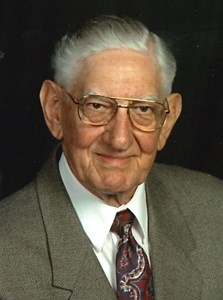
Paul was born in Salina, Kansas on January 17, 1921 one of four children to Clara and Jerry Nicholas. They moved to Hays, Kansas in 1933 where he graduated from high school in 1938 and attended Fort Hays University until 1940.
He then transferred to Montana State University in Missoula where he continued his studies in Forestry and played collegiate level basketball earning a scholarship and varsity letter.
Paul also worked part-time in the summer months with the U.S. Forest Service as a forest fire fighter and in one of the early smoke jumper response unit, parachuting on forest fires and other medical emergencies in the northwestern United States.
He then entered military service in 1942 as a parachute rigger and certified mechanic for the U.S. Army Air Corp. After completing flight training, he became certified to fly the PT-17 Steadman, BT-13A Vultee, AT-6 and the B-25 aircraft. He went on to be commissioned as a pilot in the U.S. Air Force and later became a certified helicopter pilot.
He was a veteran of World War II and Korea with Air Sea Rescue (later known as the Air Rescue Service) and was stationed on various islands in the Pacific Theater and the west coast of the United States. Paul flew bombers, amphibious planes, cargo planes and helicopters as the missions required.
In 1949 he married the love of his life, Barbara Blenderman and they began their family, having 6 children while being on active duty.
At the end of the war an Air Force directive communicated that his air crew would be assigned logistic duties and he moved to McChord AFB Washington to oversee supply, personnel equipment and Para Rescue Medical personnel.
In 1960 he was transferred to the Air Defense Command (ADC) headquartered in Colorado Springs, CO for a staff materials position. During ADC tour, while keeping his pilot duties, he returned to Fort Hayes University under Project Bootstrap and complete his Bachelor of Science degree.
Retiring as a Major after 20 years in the U.S. Air Force in 1964, he entered Civil Service at Hill AFB in Ogden, UT, where he was assigned as an Equipment Logistic Specialist supporting tactical air to ground and bombing ranges used by the Tactical Air Commands. He was awarded multiple Sustained Superior Performance Award and the ALC Commanders Award in these roles.
Continuing his logistical leadership, he worked with the F-16 program on equipment guidance and was transferred to the Simulator Program Office at ASD, Warner Robins AFB and Wright Patterson AFB OH in 1975 for support of the aircraft simulators used in the Air Force inventory. His last role was working in Source Selection with aircraft manufactures on critical equipment system requirements.
He retired from the Civil Service 1983 after 20 years and began his volunteer service. He enjoyed working at the Wright Patterson AFB Medical Center for over 35 years in the various functions within the U.S. Air Force pharmacy. During this service he received the Retired Activities Volunteer of the year recognition at WPAFB.
Paul was a member of Saint Peters Parish and the Knights of Columbus (4424). Paul was a reserved, quiet and joyful personality with friends. He actively enjoyed golfing, bowling, ballroom dancing, swimming, exercise programs and salmon fishing in Michigan. As a father, he took on a wide variety of outdoor activities and sports involving all of his children throughout the years.
Paul was a member of various fraternal and military organizations including the National Smoke Jumpers Association, Veterans of Foreign Wars (9977), American Legion (2021), Fraternal Order of Eagles (2641), Order of the Daedalians (Flight 9), Dayton Area Chapter of Military Officers Association and Paul was an active member of the Senior Citizen Centers at Huber Heights, Fairborn and Lathem centers.
He was preceded in death by his loving wife of 50 years, Barbara A. Blenderman and eldest son, Gary Lawrence Nicholas.
Paul is survived by two daughters: Constance (Gary) Cline of Lafayette, CO and Therese (Teri) Nicholas of Huber Heights, OH; and three sons: Paul B. Nicholas of Salt Lake City UT; Patrick (Jae) Nicholas of Las Vegas, NV; Michael (Claire) Nicholas of Pataskala, OH. Paul is also survived by three grandchildren: Brandon, Shae, and Zane and a very special companion: Barbara Markley of Huber Heights, OH.
A Mass of Christian Burial was held on Saturday, October 12, 2019 at 10 am at St. Peter Catholic Church (6161 Chambersburg Road, Huber Heights, OH 45424). Burial will take place at a later date in Ogden City Cemetery in Ogden, UT.
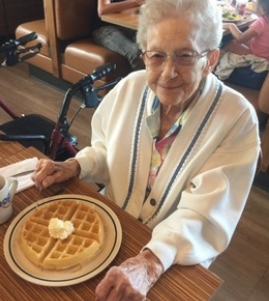
Clara Marie (Sell) Finkenbinder, 99, died Sunday, October 20, 2019 at Flatirons Health & Rehabilitation Center in Lewisville, Colorado. She was born September 27, 1920 in Rush Center, Kansas, the daughter of Emanuel & Emma (Erb) Sell.
Clare grew up and was educated in Rush County and Ness County, Kansas. On March 16, 1943, she married Dueward E. Finkenbinder in Garden City, Kansas. Clara was the Chief Telephone Operator for the United Telephone Company in Dighton, Kansas for 17 years. She was a member of the Dighton United Methodist Church, the Order of the Eastern Star, and the American Legion Auxiliary for over 50 years. Clara later moved to Thornton, Colorado in 2004 where she has lived since.
Survivors include two sons Dueward D. (Jo) Finkenbinder of Thornton, Colorado and Neal R. (Debbie) Finkenbinder of Littleton, Colorado; four grandchildren Brooke D. (Keri) Finkenbinder of Evans, Georgia, Jeremy D. (Bernadette) Finkenbinder of Littleton, Colorado, Christy A. Finkenbinder-Martin of Brighton, Colorado, & Chane D. (Shawna) Finkenbinder of Keensburg, Colorado; ten great-grandchildren HaleyFinkenbinder, Hannah Finkenbinder, Kristen (Michael) Finkenbinder, Jared (Emily) Finkenbinder, Jacob Finkenbinder, Danielle Thorpe, Devin (Nikki) Martin, Cody (Rachel) Martin, Cadence Finkenbinder, & Kali Finkenbinder; one great-great-grandchild Addilyn Rae Martin.
Clara is preceded in death by her husband Dueward of 43 years who died on January 22, 1986. She is also preceded in death by a brother Roy Sell; and two sisters Effie Brack and Freda Schwartz.
A funeral service will be held at 10:30 a.m. Saturday, October 26, 2019 at the Dighton United Methodist Church. Burial will follow at the Dighton Memorial Cemetery. Friends may call from 4:00 p.m. to 8:00 p.m. on Friday at Boomhower Funeral Home in Dighton. The family suggests memorials given to the Lane County Historical Society in care of the funeral home.
SEDGWICK, Kan. (AP) — The remains of Korean War soldier from Kansas have been identified nearly seven decades after his death.
A Defense Department agency that’s tasked with accounting for missing troops announced Tuesday in a news release that the remains are those of Sgt. James Ernest Smith Jr. of Sedgwick.
He was reported missing in November 1950 after enemy forces attacked his unit near Kujang-dong, North Korea. Several returning American POWs said Smith died several months later at a temporary prisoner of war camp. He was just 21.
Last year, North Korea turned over 55 boxes of purported human remains. And in August, scientists identified Smith’s remains, in part through a DNA analysis.
The release says Smith’s remains will be buried at Arlington Cemetery, although the date hasn’t been determined.
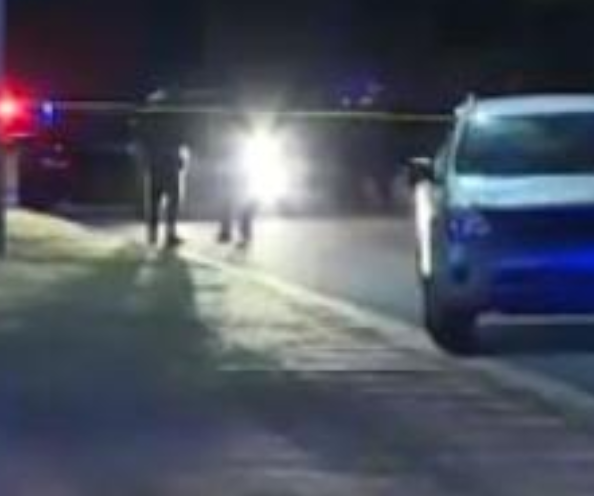
SEDGWICK COUNTY —Law enforcement authorities are investigating the death of a man found in the street in Wichita.
First responders at the scene late Monday photo courtesy KWCH
Just after 9p.m. Monday, police responded to an injury accident at Central and Maize in Wichita, according to officer Charley Davidson.
Upon arrival, officers located 36-year-old Chad Lee of Wichita in the roadway unresponsive. EMS pronounced him dead at the scene.
Investigators determined that Lee was a front seat passenger in a southbound Ford Fusion driven by his 32-year-old wife.
An argument occurred in the vehicle. It appears Lee willfully jumped from the car as it was traveling at approximately 35 miles per hour, according to Davidson. His wife call 911.
Larry Leroy Roulier passed away at Brighton Place in Topeka on October 17, 2019, at the age of 81.
Larry was born in Goodland, Kansas, on September 9th, 1938. He graduated from Brewster High School in 1956. He worked as farmer and a truck driver. On August 8, 1959, Larry married Diane Daniels in Goodland. To this union, two children Marc and Brad were born.
Larry enjoyed driving his pickup around the country side and looking at crops, visiting with friends, and telling stories of his early years.
Preceding him in death were his parents, Amedie Roulier and Wiletta (Rawson) Roulier.
He is survived by his loving wife Diane of 60 years; Son and Daughter in-law, Marc and Tina Roulier of Russell, Kansas, Son and Daughter in-law, Brad and Amanda (Aschenbrenner) Roulier of Brewster, Grandchildren Dara (Roulier)and Jerray Nichols, Brett Roulier, Kara Roulier, Bryce Roulier and one great grandson, Ryklin Nichols.
Donations may be made to Brewster USD 314 and may be left at the services or mailed to Koons-Russell Funeral Home, 211 N. Main Ave., Goodland, KS 67735.
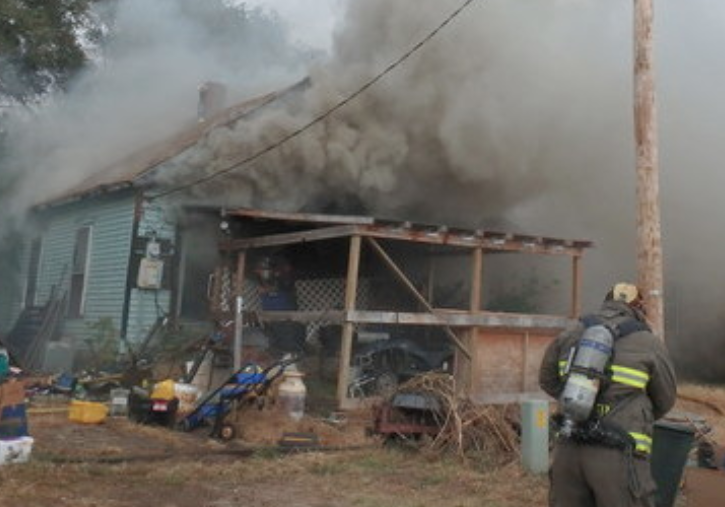
SALINE COUNTY — A dog died during a house fire Monday afternoon in the rural Saline County community of Brookville.
Firefighters responded to a house fire in Brookville Monday afternoon. Photo courtesy Saline County Sheriff’s Office
Just after 2p.m. Monday, a neighbor noticed smoke coming from a house at 210 West Anderson Street and called 911, according to Saline County Undersheriff Brent Melander.
Saline County Rural Fire District No. 3 responded.
The owners of the house, Brian and Sharon Florke, had recently moved to rural New Cambria and were in the process of moving the rest of their belongings from the house.
The couple’s dog, Gizmo, remained in the house and died of smoke inhalation, according to Melander.
Firefighters attempted to locate Gizmo, but were only able to find the dog in a back bedroom after it was too late.
The fire appeared to have started near an electrical box with old wiring. Smoke and fire damage to the house was estimated at $30,000.
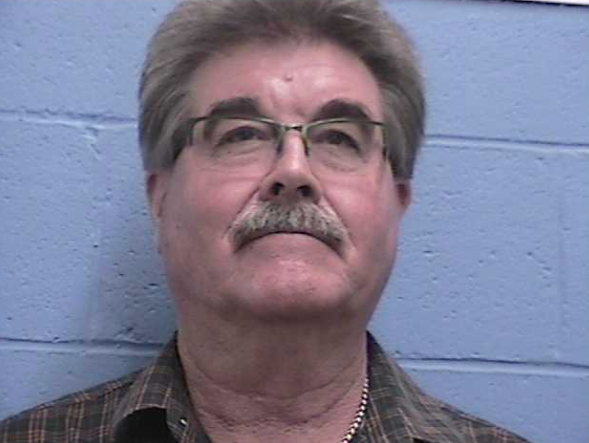
Kevin Struss, from a previous arrest in Trego County
WICHITA – A Trego County farmer pleaded guilty Monday to federal charges of crop insurance fraud and bankruptcy fraud, U.S. Attorney Stephen McAllister said in a news release Tuesday.
Kevin W. Struss, 63, Wakeeney, pleaded guilty to one count of defrauding the U.S. Department of Agriculture’s crop insurance program, which provides government insurance against unavoidable crop losses. He made false statements in which he under-reported his total 2015 corn crop by approximately 23,524 bushels, and his total sorghum/milo crop by 31,208 bushels.
He also pleaded guilty to one count of bankruptcy fraud. He falsely answered “no” to a question in his bankruptcy filing about whether he had transferred property to anyone else recently. In fact, he made two transfers of $150,000 and $320,000 to another person in 2018, McAllister said.
Sentencing is set for Jan. 21. He could face a sentence up to 30 years in federal prison and a fine up to $1 million on the crop insurance count. He could face a sentence of up to five years and a fine up to $250,000 on the bankruptcy count.
McAllister commended the U.S. Department of Agriculture and Assistant U.S. Attorney Alan Metzger for their work on the case.
COLBY — The Thomas County Sheriff’s Office is warning residents about scam phone calls originating from police telephone numbers.
“We have been getting calls today from our local residents about receiving calls from our office (785-460-4570) and the Colby Police Department (785-460-4460) informing them that they have a warrant for their arrest and they need to send money,” the sheriff’s office reported in a social media release. “These calls vary slightly, but the caller usually reports that their Social Security number has been suspended.”
The sheriff’s office warned residents those calls are not coming from law enforcement, as well as advising them not to send money to the callers.
Officials also asked that scam calls be reported to either the sheriff’s office or the Colby PD.
JUNCTION CITY — Racial concerns worked their way into the Geary USD 475 Board of Education work session Monday evening. Board members are angry at what was characterized as race-based behavior toward Junction City High School students. They have approved a motion condemning the actions, while USD 475 administrators are conducting an investigation and having conversations with administrators in USD 383.
The topic was first brought to light at the school board meeting by Board member Jim Schmidt.
“Both during and after the (Oct. 10) Junction City-Manhattan football game there were some very unfortunate events that some of our students had to endure,” he said. “I know that it would behoove us as a board and a district to condemn those activities so that our students know that we support them.”
Schmidt continued: “I know we’re not innocent of this within our own community because there have been some things in the past that have occurred. But if we can’t get our act together then I just think it’s time that Junction City and Manhattan take a break. This is absolutely ridiculous. Those things should not occur in this day and age, and apparently it also occurred on the playing field.”
Schmidt said he talked to staff and community members on this subject.
“When they feel that they have to cover up their JC Blue Jay emblem so that they can get through the parking lot … really? That’ s the day we live in, that’s where we are right now. And the things that were being chanted in the parking lot to our fans and to our cheerleaders and to our staff members, I condemn it, publicly I condemn it. And I hope Manhattan steps up and does the same thing. Shame on them if they don’t.”
Superintendent of Schools Dr. Reginald Eggleston said at the end of the game when people were leaving the field “there was a space between the fence where they were walking through and getting to the bus where our cheerleaders had some inappropriate comments made to them. Same thing happened from my understanding in the crowd as individuals were leaving, some comments were made that were inappropriate as well. ” Eggleston added those were by individuals, community and maybe even students.
Eggleston noted that administrators at Junction City High School have been in contact with their counterparts at Manhattan High School and have been working and talking with them about steps to mitigate this type of behavior as they move forward in the future.
“Additionally there were some comments that were made, alleged, that a referee may have stated to a student. That has also been reported,” he said.
Eggleston confirmed this is what USD 475 leaders have been told and has been brought to their attention by students but it was not heard by district administrators. Schmidt commented however that the cheerleading coaching staff did all ” they could to get our cheerleaders onto the bus and out of the environment.”
USD 475 Board of Education President Rina Neal said it’s alleged.
“The thing is we condemn those type of acts. We don’t tolerate that type of behavior, those conversations, those negative racist comments. So, yes, they’re doing an investigation but we still condemn it. Hopefully, Manhattan will come forth and say they condemn it as well. But it is not appropriate for us as a board to just ignore that it happened because it did happen and we were made aware of it. ”
Neal noted this was race-based. “There’s ways to curtail some of this, and come to the table, and come up with solutions. But it needs to be condemned.”
Neal continued: “Times have changed and these things are more prevalent than they have ever been before. There’s a comfort level and I don’t want to get into politics, but there’s a comfort level for people doing things like that, and it just needs to be condemned, and it shouldn’t be tolerated and our students shouldn’t be subjected to that, our fans shouldn’t be subjected to that, and our players shouldn’t be subjected to that either.”
Eggleston suggested the next time the school board meets it can go into executive session where there can be more details and the issue can be discussed.
“Of course we don’t want to throw our good name and character, throw anybody, especially when everything’s alleged at this present moment and I would prefer us to have that conversation then.”
Eggleston added he would be talking to his counterpart in Manhattan this week.
The Board of Education then voted via voice vote to condemn the alleged actions that occurred at the Junction City-Manhattan football game on Oct. 11.
JC Post will contact Manhattan USD 383 officials for their response.