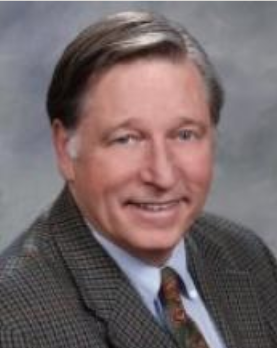
Crosby Kemper III photo courtesy Show Me Institute
KANSAS CITY,(AP) — President Donald Trump has announced plans to nominate the executive director the Kansas City Public Library to lead a little-known independent federal agency that the White House has tried to shutter.
Crosby Kemper III will become director of the Institute of Museum of Library Sciences, pending confirmation by the U.S. Senate.
Trump’s federal budget proposals for the last three years have sought to close the agency, which has an annual budget of about $242 million. The agency is tasked with supporting the nation’s museums and libraries with research, policy and grants.
On Thursday, Kemper said he was under orders from the White House not to comment. The American Library Association and Republican U.S. Sen. Roy Blunt have praised Kemper’s nomination in written statements.
REPUBLIC COUNTY — Two people died in an accident just after 9:30a.m. Saturday in Republic County.
The Kansas Highway Patrol reported a 2013 Volvo semi driven by Douglas J. Watts, 28, Omaha, was northbound on U.S. 81 at the U.S. 36 junction just west of Bellville.
The semi struck a 2004 Toyota Corolla driven by Steven A. Torres, 62, Bellville, that was westbound on U.S. 36 off ramp and had attempted to turn south onto U.S. 81.
Torres and a passenger Sherry L. Torres, 62, Bellville, were pronounced dead at the scene and transported to Bachelor-Surber Funeral Home. Watts was not transported for treatment.
All three were properly restrained at the time of the accident, according to the KHP.
If you are still using Internet Explorer, please take note.
From the staff of Hays Post
Next week, Hays Post readers will notice a change to their local source for news, sports and information.
A website upgrade will be implemented, offering a more stable and secure experience for readers, significantly boosting the speed of the site, and offering an improved experience on mobile devices.
The current website has been virtually unchanged since 2014.
Technology has changed drastically in the past five-plus years, and we are evolving with it — and confident this change will give us a stable, secure and fast platform for years to come.
Some slight design changes will accompany the upgrade, but readers should expect to find the same local news, sports, information, weather and obituaries — with no paywall.
Keeping our Community Connected is what Eagle Radio does. And Hays Post is a big part of how we do it.
As part of the upgrade, Hays Post also will disable anonymous comments.
Comments were a way to stimulate conversation in a day when people were much less comfortable attaching their opinions to their names. However, the vast majority of engagement with Hays Post content has migrated from our on-site commenting system to Facebook, which sparked the change. We hope nearly a decade of offering our readers an open forum for ideas and commentary helped create a more open environment in our community.
Expect more changes in the coming months, as Eagle’s development team is creating new native apps for mobile devices, as well as integrations for other platforms, including Alexa-enabled devices.
Our goal is to deliver our content where readers and listeners are — whether that’s commuting in your car, checking Post at work or on your phone from the porch, or wanting to get caught up while you’re cooking dinner in the evening. Keeping you connected to the local information that matters to you — that’s what matters to us.
When the update is made, it could be as long as 24 hours before every device recognizes the change — and don’t be surprised if you see an occasional 404 Page Not Found redirect, especially if visiting off older links from social media.
Stories published prior to Nov. 18, 2019, will remain online at archive.hayspost.com, which will be active by the end of the week.
An important side note, the new platform will not be supported on Internet Explorer. Microsoft no longer supports Explorer and has advised Explorer users to switch to Microsoft Edge. Hays Post will be continually optimized for best use on Google Chrome, but is supported by most web browsers, including Firefox, Safari, Edge and most mobile browsers.
COWLEY COUNTY— Law enforcement authorities are investigating a Kansas man on drug and weapons charges after a
On Friday, a 71-year-old Arkansas City man came to the police department and reported that his son, identified as 40-year-old Brian Feasel, who lives in his home, threatened him and his 71-year-old girlfriend Thursday night during an argument regarding drug usage. The victim reported that Feasel pointed a rifle at them both while also holding a handgun to his own head.
The victim reported they then left the residence and stayed at another location for the night. Officers obtained a search warrant for the residence, located in the 1400 block of North First Street.
Due to the nature of the crime and the suspect’s past violent history, the South Central Kansas SWAT team was called in to execute the search warrant and an arrest warrant for Feasel.
Just after 4 p.m. today, officers entered the North First Street residence and arrested Feasel without incident.
He is remains jailed on suspicion of two counts of aggravated assault with a deadly weapon, as well as one count each of criminal damage to property, criminal possession of a firearm by a felon, possession of drug paraphernalia and theft of a firearm.
He remains jailed in the Cowley County Jail in Winfield in lieu of $150,000 bond through
Listen as the ‘Voice of the Chiefs’ Mitch Holthus recaps last week’s loss to the Titans and previews their Monday night’s game in Mexico City with the Chargers.
The Holthus Hotline airs Saturday mornings on your home for Chiefs football, KFIX (96.9-FM), at 8 a.m. during the Chiefs season.
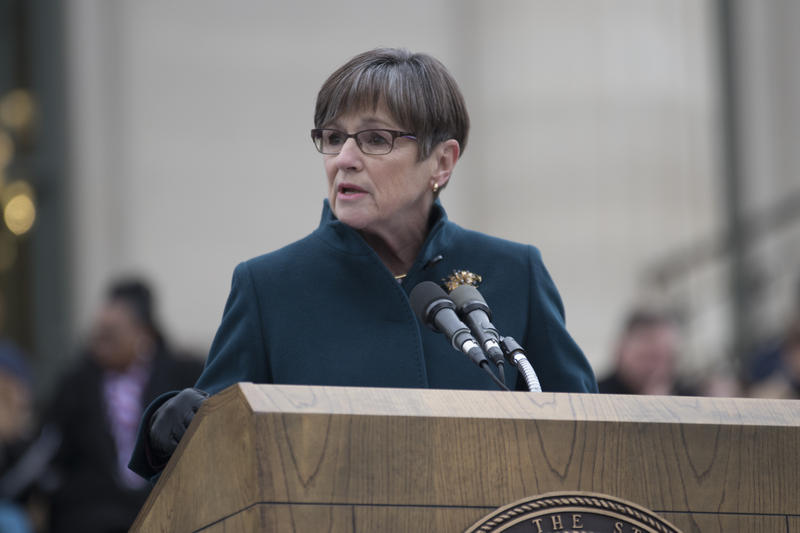
Attorneys for Kansas Gov. Laura Kelly said she’s not responsible for regulating the state’s foster care agencies and shouldn’t be named in a class-action lawsuit. Nomin Ujiyediin / Kansas News Service
Attorneys for Kansas Gov. Laura Kelly have asked a federal court to remove her from a class-action lawsuit over the state’s troubled foster care program, arguing that she doesn’t actually oversee the system.
The move comes as parents and advocates say that the system continues to traumatize the thousands of children in its care.
A year ago, child welfare advocates sued then-Gov. Jeff Colyer and the heads of the state agencies in charge of the foster care system: the Department for Children and Families, the Department of Aging and Disability Services and the Department of Health and Environment. In April 2019, Kelly and the current heads of those agencies replaced them as the defendants in the suit.
The lawsuit alleges that the state failed to provide adequate mental health treatment for Kansas foster children and traumatized them by moving them from house to house, sometimes more than 100 times. The suit was filed on behalf of 10 foster children, who were identified only by their initials.
On Oct. 25, Kelly’s attorneys filed a motion in the U.S. District Court of Kansas, arguing that the governor is protected under the 11th Amendment of the U.S. Constitution, which provides states protection from many lawsuits by private citizens.
Kelly is not responsible for regulating the state’s foster care agencies, the attorneys argued, and is therefore immune from being sued over this issue.
“While Governor Kelly generally oversees her appointees’ administration of the foster care system,” the motion reads, “she does not enforce the statutes or regulations that control the Kansas foster care system.”
Instead, Kelly’s lawyers argued, the heads of state agencies are responsible for overseeing social welfare, mental health, medical care and other duties laid out in state law.
In an email, the governor’s office said it does not comment on pending litigation.
Attorneys for the children suing the state have until Dec. 30 to respond.
Teresa Woody, an attorney for advocacy group Kansas Appleseed, said they plan to file a response opposing the removal of Kelly from the lawsuit.
“It’s not at all uncommon to name the governor in a case like this,” Woody said. “The ultimate responsibility for the executive branch of the state rests with the governor.”
The judge will make the final decision to remove Kelly as a defendant, and it’s not clear when that might happen.
Woody said both sides of the case met Tuesday for mediation.
The governor has previously said she wants to prioritize fixing foster care during her time in office. While she was a state senator, Kelly served on a task force examining the foster care system.
Nomin Ujiyediin reports on criminal justice and social welfare for the Kansas News Service. Follow her on Twitter @NominUJ or email [email protected].
HaysMed, part of The University of Kansas Health System announced this week that Kelsey Accurso, MS, APRN, AGCNS-BC and Sarah Green, RN, MSN, NEA-BC, CPAN were honored at the March of Dimes Nurse of the Year Awards Gala held recently in Kansas City.
Accurso was named Nurse of the Year out of 5 finalists in the area of Quality Management. Green was one of five finalists in the category of Surgical Services.
There were 845 nurses nominated in 22 award categories. One winner for each category was announced at the black tie awards gala at 7 p.m. on Saturday, Nov. 9, at the Marriott Downtown in Kansas City, Mo.
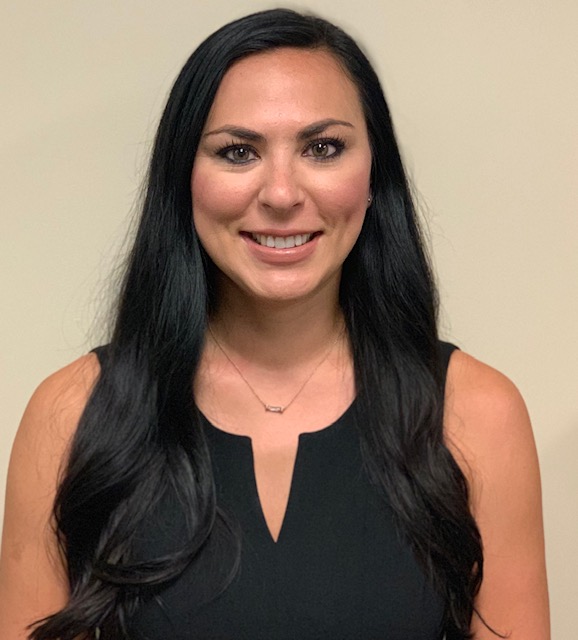
Sarah Green
Hosted by the Greater Kansas Chapter of the March of Dimes, the Nurse of the Year Awards is an annual event that recognizes the vital role of registered nurses and the many contributions they make in the community, while helping raise funds to support the nonprofit’s mission to prevent birth defects, premature birth and infant mortality.
WASHINGTON (AP) — The Trump administration has proposed making it tougher for asylum-seekers to obtain permission to work in the United States while their cases are pending, a move that immigrant advocates say would unfairly punish those who need humanitarian protection the most.
U.S. Citizenship and Immigration Services said this week a proposed rule would double the time asylum-seekers must wait for a work permit to a year and bar those who crossed a border illegally from applying for work permits at all.
The new rule aims to discourage immigrants who don’t qualify for asylum from seeking it to “restore integrity to the asylum system and lessen the incentive to file an asylum application for the primary purpose of obtaining work authorization,” Ken Cuccinelli, the agency’s acting director, said in a statement.
The proposal is the latest in a series of measures by the Trump administration aimed at deterring immigrants from seeking asylum along the U.S.-Mexico border and in limiting immigration to the United States.
There are hundreds of thousands of asylum applications pending in U.S. government offices and immigration courts. Some were filed by immigrants who were already in the country and others by people arriving in airports, at ports of entry, or stopped on the U.S-Mexico border.
Currently, asylum-seekers can obtain permission to work in the United States once their cases have been pending for six months.
Immigrant advocates decried the proposed rule and said it would fall hardest on the poorest and most vulnerable immigrants, who are often those who flee their homes at a moment’s notice in search of safety.
“Those with strongest claims are the ones least likely to be able to support themselves because they had to leave everything behind,” said Aaron Reichlin-Melnick, policy counsel at the American Immigration Council.
Eleanor Acer, senior director for refugee protection at Human Rights First, said asylum-seekers often struggle to feed and house themselves and their families during the current six-month wait period. Making that longer, she said, would worsen their lot and place an additional burden on their communities.
The public can comment on the proposed rule until Jan. 13.
Greensburg, Kansas, built a new, environmentally friendly, high-tech high school after being hit by a massive tornado in 2007. But the town has barely half the population it did before the twister struck. Chris Neal / For the Kansas News Service
It now runs on renewable energy wired into buildings and homes designed with the latest in conservation technology.
Yet the question persists: What difference did it make?
About 850 people live in Greensburg, still about 600 fewer than when the tornado struck.
“I don’t think that population is the only measurement of success,” said Stacy Barnes, who is Greensburg’s city administrator and now in charge of sustaining the community’s comeback.
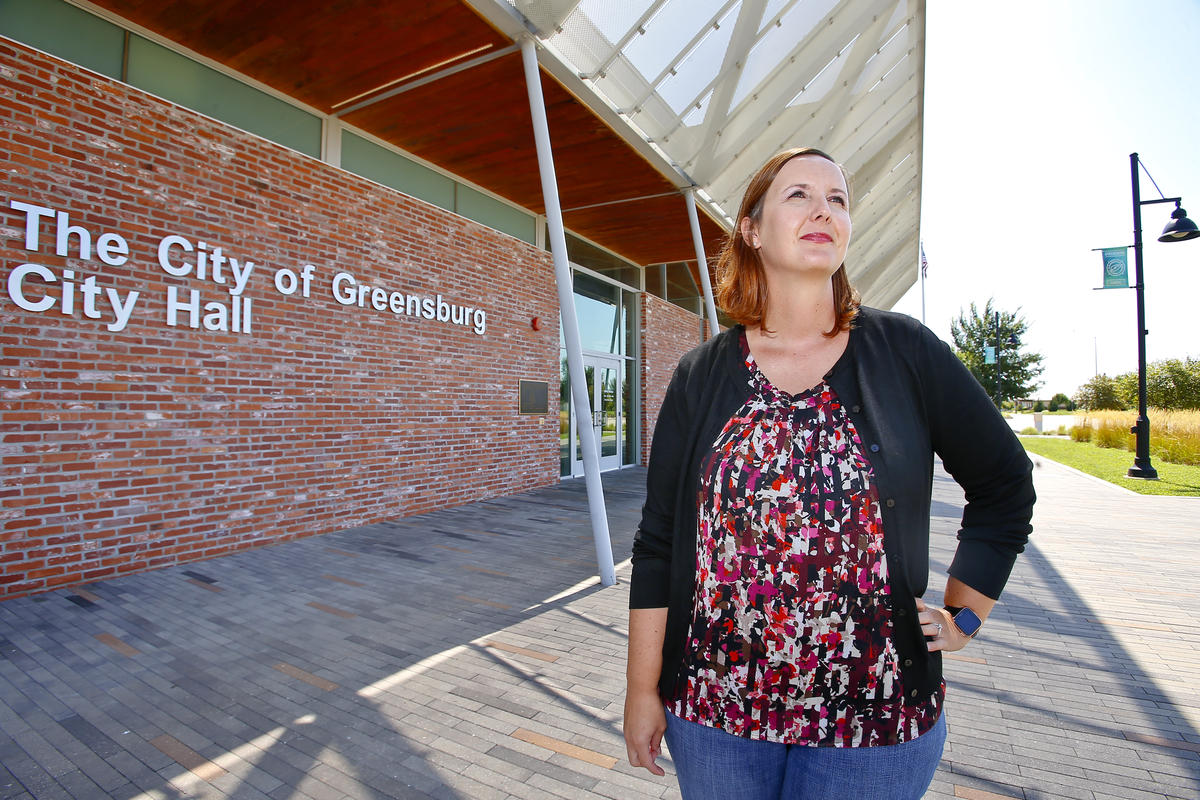
Stacy Barnes moved back to Greensburg after the 2007 tornado. She’s now the city administrator. Credit Chris Neal / For the Kansas News Service
Some defensiveness, even spin, lies in the suggestion that the number of people who live in a town doesn’t measure its success. Despite Greensburg’s shinier, more ecological veneer — like so many diminished towns across rural Kansas — it’s less than it wants to be.
Greensburg’s leaders sold the town’s green comeback as a way to set it apart from other withering rural communities. They hoped such a bold plan could help the community buck trends that had been driving people out of rural Kansas for generations.
They’re still hoping.
The tale of Greensburg’s comeback starts on the night after the tornado struck the town. When local, state and federal officials took cover from yet another storm in the basement of the damaged Kiowa County Courthouse.
“The discussion was, ‘Hey, we’re going to build back. Why don’t we do it green?’” said former Mayor Bob Dixson. “The seed was planted that night.”
A dozen years after the devastation, the scars from May 4, 2007, remain visible. Desiccated trees. Vacant lots in the middle of town. A few crumbling foundations where houses once stood.
Former Greensburg Mayor Bob Dixson. Credit Chris Neal / For the Kansas News Service
Still, the town looks fresh and revitalized compared to neighboring communities.
Its new high school brims with technology. Many of the community’s new energy-efficient buildings look like something you’d expect in a trendy tourist town, not in windswept Greensburg.
Great expectations
Barnes, the current city administrator, lived in Lawrence at the time of the tornado. She returned to help her parents — former mayor Dixson and his wife — sort through the rubble of her childhood home. After several trips, Barnes and her husband decided to move back “to be a part of this community’s future.”
First, she worked as an assistant to the city administrator. Then she got a job helping to plan a new museum to showcase the city’s main tourist attraction — a hand-dug well dubbed “the largest” in the nation.
Barnes is back at City Hall now. And she feels pressure to make the community’s comeback story the success envisioned by those who planned it in the months after the tornado.
Drawing a deep breath, she said, “I feel a tremendous responsibility.”
Greensburg’s top tourist attraction: a museum built around a hand-dug well. Credit Chris Neal / For the Kansas News Service
“Early on,” she said, “there were probably some unrealistic expectations.”
The town’s effort to transform itself captured international attention. Actor and environmental activist Leonardo DiCaprio produced a Discovery Channel television series about it. Reporters arrived from around the world to tell a story of a community’s phoenix-like rebirth.
The town built a 72-acre business park for the green companies that indicated to Dixson that they wanted to be a part of Greensburg’s celebrated transformation.
“We were under the impression that there would be opportunities,” Dixson said. “But it just never panned out.”
Today, the business park sits empty at the edge of town. To some, it’s evidence of the community’s failure to fully capitalize on its green rebirth. Yet Barnes insists the park still represents “opportunity.”
“We continue to work on projects,” she said.
Among other obstacles, even the remade version of Greensburg doesn’t have enough affordable housing.
Greensburg has trouble drawing in residents because it’s short on adequate housing. Credit Chris Neal / For the Kansas News Service
Dennis McKinney, a former state treasurer and one-time legislator from Greensburg, said housing shortages hold back communities across rural Kansas.
“I’ve talked to community leader after community leader from all over Kansas,” he said. “That’s their number one issue.”
Promises and realities
Scott Brown played a key role in Greensburg’s recovery. The building that houses his auction and real estate company on the east edge of town was just outside the path of the tornado. People gathered there to talk about whether they intended to stay and rebuild.
At one of those early meetings, Brown said, 63 people who had owned businesses in town signaled their desire to rebuild.
That may not sound like a big number, Brown said, “but I didn’t even know there (were) 63 businesses in Greensburg before the tornado.”
Early on, developers from Wichita, Kansas City and Denver offered to help rebuild the downtown business district. They walked away, Brown said, when it became clear that they couldn’t charge enough rent to make any money.
“That’s what spurred me into action, I guess,” he said.
Scott Brown helped rally people in Greensburg to rebuild its downtown as a strip mall. Credit Jim McLean / Kansas News Service
Brown figured it would cost about $1 million to build a kind of strip mall in what used to be downtown. He concluded that money needed to come from residents “not interested in getting a financial return.”
Those people invested, Brown said, just to support “a place to get a hamburger (or) get their hair fixed.”
Pitching in
Brown put up the first $50,000 and asked others to give what they could. Some matched his contribution. Others gave $10,000 or $5,000 to fund the Kiowa County United Foundation.
When it opened in 2009, the downtown mall was fully paid for and fully occupied. Over the past decade, Brown said, occupancy has averaged between 80% and 90%.
Brown would like to think that all the community has accomplished over the last 12 years has made it less vulnerable to the economic and cultural forces threatening the survival of rural communities across Kansas and the Plains.
He hopes it isn’t destined to become a “ghost town with the newest buildings.”
“I don’t doubt that we’ll survive, but that’s not what we want to do,” he said. “We want to get a little growth.”
This is the fifth in a series of stories investigating the decline in rural Kansas and efforts to reverse it.
Support for this season of “My Fellow Kansans” was provided by the United Methodist Health Ministry Fund, working to improve the health and wholeness of Kansans since 1986 through funding innovative ideas and sparking conversations in the health community. Learn more at healthfund.org.
Jim McLean is the senior correspondent for the Kansas News Service, a collaboration of KCUR, Kansas Public Radio, KMUW and High Plains Public Radio covering health, education and politics. You can reach him on Twitter @jmcleanks or email [email protected].
In November 2019, Hays Post was rated by NewsGuard, an international organization that employs trained journalists to rate and review thousands of news websites for credibility and transparency.
Hays Post received a green rating for its high journalistic standards.
NewsGuard uses nine journalistic criteria to rate each website. To learn more about NewsGuard’s rating of publications, go to www.newsguardtech.com.
The green or red badge of sites rated by NewsGuard are designed to alert readers about the credibility of a news source and appears on social media feeds and as a browser extension that rates search engine results. The extension can be downloaded HERE.
NewsGuard was launched in 2018. Based on each website’s performance on NewsGuard’s nine journalistic criteria, each site is rated with a red or green rating. News organizations producing high quality journalism and following basic standards of accuracy and accountability get green ratings.
Again this year, our Ellis County Catholic schools, TMP-Marian and Holy Family Elementary are participating in iGiveCatholic (iGC). iGC encourages charitable donations on Giving Tuesday, December 3. Donations to either of our Catholic schools through iGC benefit the St. Thomas More Society, the second-largest fund to the benefit of our annual operating budgets.
Advanced giving to iGC begins on Monday, Nov. 18 and 24/7 Travel Stores has generously donated $50,000 of matching funds restricted to Catholic schools in the Salina Diocese.
Gifts are matched at $.50 per dollar up to $1000 max per gift until matching funds are depleted. For every dollar you contribute, 24/7 Travel Stores will give $.50. These matching funds are available beginning with gifts received on Nov. 18.
Last year, TMP-M and HFE earned among the top in the nation against other organizations participating in iGC. With your help, we can do it again.
Donate offline and your gift will be entered upon receipt. Offline donations are not subject to fees. Deliver your gifts to either school with a memo of iGC and it will be counted as soon as it is received.
Remember, matching funds are available with the first gift on November 18 and likely will not last through Giving Tuesday. Make your gift early to increase it by half.
Direct questions and contributions to Troy Ruda, Advancement Director at [email protected].