We have a brand new updated website! Click here to check it out!

Police: Kansas officer hospitalized after altercation with DUI suspect

DOUGLAS COUNTY — Law enforcement authorities are investigating a suspect on multiple charges after an altercation with an officer during an arrest.

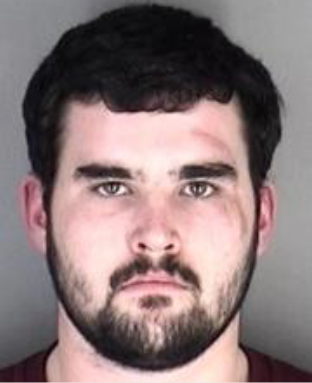
Paslay -photo from a previous arrest in Shawnee County

Just before 1a.m. Tuesday, police responded to the intersection of West 6th Street and Wakarusa Drive regarding a single motor vehicle accident involving a Chevrolet Silverado that struck a pole, according to a media release.

While Officers were responding to the scene, they were advised the suspect had moved the vehicle to a nearby parking lot and entered the business.  The suspect, identified as 22-year-old Shane A. Paslay of Topeka was located and officer began investigating the accident and Mr. Paslay for suspicion of driving while intoxicated.

While an officer was attempting to place Paslay under arrest, he resisted and fled northbound on foot.

After a short foot pursuit, the officer caught Paslay who continued to resist and fight the officer.  The officer utilized his expandable baton on Paslay who continued to fight the officer.  During the struggle, the officer fell to the ground, landing on the officer’s expandable baton, which penetrated the officer’s body.

Paslay ran from the altercation but another officer located him and placed him under arrest.

Paslay is being held on requested charges of aggravated battery on a law enforcement officer, interference with the duties of a law enforcement officer, driving under the influence and operating a vehicle in violation of ignition interlock device.

The officer was transported to a local hospital for treatment of non-life threating injuries.


WAYMASTER: From the Dome to Home Jan. 22

Rep. Troy Waymaster, R-Bunker Hill, 109th Dist.

Governor Kelly Presents State of the State Address

On Tuesday evening, January 16, Governor Laura Kelly addressed both legislative bodies in the Kansas House Chamber to administer her state of the state address which included her vision for the state of Kansas. Governor Kelly implored the legislature to proceed with caution as she contends that the state of Kansas is continuing a “fragile recovery.”

Governor Kelly’s main points focused on addressing education funding, the expansion of KanCare, and foster care. She also stipulated that she would like the process of addressing education finance to be a separate bill from the budget to have that move more quickly through the process.

Another main focus of the governor is on our rural communities and rural economic development. She mentioned that her administration, the Department of Commerce, and the House committee on Rural Revitalization will address the economic needs of our rural areas of the state.

The governor’s state of the state address was Governor Kelly’s first address to the legislature on her approach and vision.

Governor Kelly’s Budget

Early Wednesday morning, January 18, both the House Appropriations and Senate Ways and Means committees met jointly to have the Division of Budget release the details of Governor Kelly’s budget. The governor has opted to revert back to a one-year budget as opposed to a two-year budget, which has been the practice for some years. Her budget is contingent on reamortizing the KPERS payments, not allowing the transfer $238 million to the Kansas Department of Transportation, adding $134 million for K-12 Education funding, funding for vacant positions at our correctional facilities, Kansas Armory upgrades, just to mention a few. There are many more details in her budget, which the budget committees and Appropriations committee will address during the session.

Transportation Taskforce

During the 2018 legislative session, the Joint Legislative Transportation Taskforce was created due to T-Works ending in 2020. This task force was created in order to conduct meetings across the state and identify transportation needs in all of the different regions. I was a member of this task force and attended the meetings in communities all-across the state in order to identify those projects that may be included in the state of Kansas’ next comprehensive transportation plan. We identified that the main focus for the new transportation plan should be: preservation of our existing infrastructure, completing T-Works and the 23 delayed projects, and, finally, new construction. The 2019 legislature will be drafting the new transportation plan. I will definitely keep all informed on the progress of the new plan.

As always, if you have any concerns, feel free to contact me (785) 296-7672, follow on twitter at #waymaster4house, visit
www.troywaymaster.com or email me at [email protected].

Also, if you happen to visit the statehouse, please let my office know.

It is a distinct honor to serve as your representative for the 109th Kansas House District and the state of Kansas. Please do not hesitate to contact me with your thoughts, concerns, and questions. I always appreciate hearing from the residents of the 109th House District and others from the state of Kansas, as well.

Troy Waymaster, (R-Bunker Hill), is the 109th Dist. state representative and chairman of the House Appropriations committee. The 109th District includes Osborne, Russell, and Smith counties and portions of  Barton, Jewell, Lincoln and Rush counties.


Billy C. Randall

Kirwin resident Billy C. Randall passed away Nov. 25, 2018 at his home in Kirwin, KS at the age of 86.

He was born in Agra, Kansas on January 7, 1932, the son of Irwin & Frieda (White) Randall.

Survivors include his wife, Janice, of Lake Stevens, WA; son, Chuck, of Dickensen, TX and stepson, Kevin Plunkett, of San Diego, CA; daughter, Teresa Wiseman of Peculiar, MO and stepdaughter, Val Baldwin of Stevens Lake, WA; sisters, Leatrice Hanks, Lila Bryant, Bonnie Davis and Patty Martin; as well as numerous grandchildren and great-grandchildren.

The family chose cremation. A memorial service & celebration of Bill’s life will be Saturday, January 26, 2019 at 10:00 a.m. in the Olliff-Boeve Memorial Chapel, Phillipsburg, with Pastor Michael Ricci-Roberts officiating.

Friends may sign the book on Friday, Jan. 25, from 9:00 a.m. – 5:00 p.m. at the chapel.

Memorial contributions may be given to the Agra Lake. Online condolences to: www.olliffboeve.com.

Olliff-Boeve Memorial Chapel, Phillipsburg, is in charge of arrangements.

UPDATE: Interstate 70 reopened at Colby

KDOT

4:15 p.m. Tuesday: The Kansas Department of Transportation has reopened westbound I-70 from Colby to the Colorado border. Motorists are reminded to use caution when driving during winter weather conditions.

—————–

11 a.m. Tuesday: The Kanas Department of Transportation has closed westbound I-70 from Colby to the Colorado border as of 11 a.m. CST because of winter weather conditions in Colorado.

—————-

9:45 a.m. Tuesday: The Kansas Department of Transportation has closed westbound I-70 from Goodland to the Colorado border as of 9:30 a.m. CST because of winter weather conditions in Colorado.

For up-to-date information on road closures and road conditions, call 511 in Kansas or 866-511-5368 outside Kansas, or check travel information online at www.kandrive.org.

News From the Oil Patch, Jan. 22

By JOHN P. TRETBAR

Baker Hughes reported a huge drop in its weekly rotary rig count on Friday: 1,050 active rigs. That’s down 21 oil rigs and four gas rigs. Texas was down eleven rigs and Oklahoma was down ten. Independent Oil and Gas Service reported a ten percent drop weekly count of active Kansas operators. There are five active drilling rigs in eastern Kansas, down four for the week, and 28 west of Wichita, which is unchanged. Operators are about to spud two new wells in Barton County and one in Ellis County.

Out of 18 permits for drilling at new locations approved in the last week, just one was east of Wichita. There were 17 in Western Kansas, including two new permits in Barton County and one in Stafford County.

Independent Oil & Gas Service reported eleven new well completions for the week in eastern Kansas. There was one producing well reported in Ellis County out of 16 completions west of Wichita. Six of those sixteen were dry holes. Of the 98 wells completed so far this year, 20 came up dry.

U.S. crude production last year saw record growth to record heights, 10.9 million barrels per day, up 1.6 million barrels per day over the year before. The Energy Information Administration now predicts U.S. production will jump to 12.1 million barrels per day this year and up to 12.9 million next year.

U.S. crude oil production spiked again last week, reaching an all-time record. The Energy Information Administration said domestic production was more than 11.9 million barrels per day, up 202-thousand barrels from the week before and more than 2.1 million barrels more than a year ago at this time.

EIA’s monthly price forecast predicts London Brent will average $61 a barrel this year, with West Texas Intermediate about eight dollars less. But by the end of the year EIA predicts that spread between benchmarks will shrink to four dollars, with WTI at $61 and London Brent at $65 a barrel by the end of 2020.

Crude oil inventories dropped 2.7 million barrels from the previous week but remained about 8% above the five year average for this time of year. The government said crude imports averaged 7.5 million barrels per day last week, down by 319,000 barrels per day from the previous week. U.S. crude oil imports last year dropped dramatically, down 1.6 million barrels per day from the year before at 2.4 million barrels per day. The government says net imports will continue to fall to an average 1.1 million barrels per day this year, and predicts less than 100-thousand barrels per day in 2020 as the U.S. As we told you back in November, the United States was briefly a net exporter of crude and petroleum products. EIA now predicts that will happen again during the fourth quarter of 2020.

The U.S. Energy Information Administration says domestic refineries will be much busier by the end of this year. That’s when a new international agreement lowers the maximum sulfur content of marine fuel oil used in ocean-going vessels. EIA says total U.S. refinery runs will spike four percent to a record 17.9 million barrels per day in 2020. Beginning next year, the International Maritime Organization is lowering the maximum sulfur content of marine fuel from 3.5% to 0.5% for ocean-going vessels.

The Colorado Supreme Court says state law does not allow regulators to make public health and the environment their top priority when setting rules for oil and gas drilling. The ruling said state law requires regulators to “foster” oil and gas production, while protecting public health and the environment. But the court says regulators must take into account whether those protections are cost-effective and technically feasible. The ruling is a victory for the industry.

North Dakota reported another record month for oil and gas production. The Department of Mineral Resources says the state produced more than 1.39 million barrels per day in October, the latest numbers available. November will not be far behind, with a preliminary estimate of 1.37 million barrels per day. The state also posted records in October for natural-gas production, permits, and the number of producing wells. The statewide gas-capture rate is going down since regulators relaxed the rules. Operators burned off more than 21% of the gas produced at oil wells in the state in November.

The Association of American Railroads reports continued growth in oil-by-rail shipments in the U.S. and Canada. Domestic traffic for the week ending January 5 was up 25% over a year ago. Oil by rail in Canada is up nearly 52% over last year, as pipeline capacity shortages continue to slow deliveries.

List of nominees for the 91st Academy Awards

By The Associated Press

The list of the nominees for the 91st Academy Awards:

Best picture: Black Panther,” ”BlacKkKlansman,” ”Bohemian Rhapsody,” ”The Favourite,” ”Green Book,” ”Roma,” ”A Star Is Born,” ”Vice.”

Best director: Alfonso Cuaron, “Roma”; Spike Lee, “BlacKkKlansman”; Pawel Pawlikowski, “Cold War”; Yorgos Lanthimos, “The Favourite”; Adam McKay, “Vice.”

Best actor: Christian Bale, “Vice”; Bradley Cooper, “A Star Is Born”; Rami Malek, “Bohemian Rhapsody”; Viggo Mortensen, “Green Book”; Willem Dafoe “At Eternity’s Gate.”

Best actress: Yalitza Aparicio, “Roma”; Glenn Close, “The Wife”; Olivia Colman, “The Favourite”; Lady Gaga, “A Star Is Born”; Melissa McCarthy, “Can You Ever Forgive Me?”

Best supporting actor: Mahershala Ali, “Green Book”; Sam Elliott, “A Star Is Born”; Adam Driver, “BlacKkKlansman”; Richard E. Grant, “Can You Ever Forgive Me?”; Sam Rockwell, “Vice.”

Best supporting actress: Amy Adams, “Vice”; Marina de Tavira, “Roma”; Regina King, “If Beale Street Could Talk”; Emma Stone, “The Favourite”; Rachel Weisz, “The Favourite.”

Original Song: “When A Cowboy Trades His Spurs For Wings” from “The Ballad of Buster Scruggs,” music and lyrics by David Rawlings and Gillian Welch; “All The Stars” from “Black Panther,” music by Mark Spears, Kendrick Lamar Duckworth, Anthony Tiffith and lyrics by Kendrick Lamar Duckworth, Anthony Tiffith and Solana Rowe; “I’ll Fight” from “RBG,” music and lyrics by Diane Warren; “The Place Where Lost Things Go” from “Mary Poppins Returns,” music by Marc Shaiman and lyrics by Scott Wittman and Marc Shaiman; “Shallow” from “A Star Is Born,” music and lyrics by Lady Gaga, Mark Ronson, Anthony Rossomando and Andrew Wyatt.

Original Score: “Black Panther,” Ludwig Goransson; “BlacKkKlansman,” Terence Blanchard; “If Beale Street Could Talk,” Nicholas Britell; “Isle of Dogs,” Alexandre Desplat; “Mary Poppins Returns,” Marc Shaiman.

Foreign language film: Germany’s “Never Look Away”; Japan’s “Shoplifters”; Lebanon’s “Capernaum”; Mexico’s “Roma”; Poland’s “Cold War.” Documentary feature: “Free Solo,” ”Hale County This Morning, This Evening,” ”Minding the Gap,” ”Of Fathers and Sons,” ”RBG”

Documentary feature: “Free Solo,” ”Hale County This Morning, This Evening,” ”Minding the Gap,” ”Of Fathers and Sons,” ”RBG”

Documentary short subject: “Black Sheep,” ”End Game,” ”Lifeboat,” ”A Night at The Garden,” ”Period. End of Sentence.”
Adapted screenplay: “The Ballad of Buster Scruggs,” Joel Coen and Ethan Coen; “BlacKkKlansman,” Charlie Wachtel, David Rabinowitz, Kevin Willmott and Spike Lee; “Can You Ever Forgive Me?,” Nicole Holofcener and Jeff Whitty; “If Beale Street Could Talk,” Barry Jenkins; “A Star Is Born,” Eric Roth, Bradley Cooper and Will Fetters

Original screenplay: “The Favourite,” Deborah Davis and Tony McNamara; “First Reformed,” Paul Schrader; “Green Book,” Nick Vallelonga, Brian Currie and Peter Farrelly ; “Roma,” Alfonso Cuaron; “Vice,” Adam McKay

Film Editing: “BlacKkKlansman,” Barry Alexander Brown; “Bohemian Rhapsody,” John Ottman; “The Favourite,” Yorgos Mavropsaridis; “Green Book,” Patrick J. Don Vito; “Vice,” Hank Corwin

Sound Editing: “Black Panther,” ”Bohemian Rhapsody,” ”First Man,” ”A Quiet Place,” ”Roma.”

Sound Mixing: “Black Panther,” ”Bohemian Rhapsody,” ”First Man,” ”Roma,” ”A Star Is Born.”

Visual effects: “Avengers: Infinity War”; “Christopher Robin”; “First Man”; “Ready Player One”; “Solo: A Star Wars Story”

Makeup and hairstyling: “Border”; “Mary Queen of Scots”; “Vice.”

Costume design: “The Ballad of Buster Scriggs,” Mary Zophres; “Black Panther,” Ruth Carter; “The Favourite,” Sandy Powell; “Mary Poppins Returns,” Sandy Pwoell; “Mary Queen of Scots,” Alexandra Byrne

Production design: “Black Panther,” ”The Favourite,” ”First Man,” ”Mary Poppins Returns,” ”Roma.”

Cinematography: Lukasz Zal, “Cold War”; Robbie Ryan, “The Favourite”; Caleb Deschanel, “Never Look Away”; Alfonso Cuaron, “Roma”; Matthew Libatique, “A Star Is Born.”

Best animated film: “Incredibles 2,” ”Isle of Dogs,” ”Mirai,” ”Ralph Breaks the Internet,” ”Spider-Man: Into the Spider-Verse.”
Animated short film: “Animal Behavior,” ”Bad,” ”Late Afternoon,” ”One Small Step,” ”Weekends.”

Live Action short film: “Detainment,” ”Fauve,” ”Marguerite,” ”Mother,” ”Skin.”
Senate panel unveils plan to reopen government, secure the border

WASHINGTON (AP) — President Donald Trump’s proposal to reopen the government, sweetened with immigration provisions that are aimed at mollifying Democrats but that have alienated some conservatives, is headed for Senate action, its prospects uncertain.

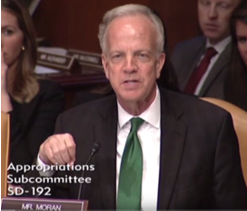
Senator Jerry Moran is a member of the Senate Appropriations Committee

Senate Majority Leader Mitch McConnell will try to muscle through the 1,300-page spending measure, which includes $5.7 billion to fund Trump’s proposed wall along the U.S.-Mexico border, the sticking point in the standoff between Trump and Democrats that has led to a partial government shutdown now in its 32nd day.

Meanwhile, another missed paycheck looms for hundreds of thousands of federal workers.

Senate Republicans late Monday unveiled the legislation, dubbed the “End The Shutdown And Secure The Border Act,” but its passage this week is by no means certain.

Republicans hold a 53-47 majority in the chamber but need Democrats to reach the usual 60-vote threshold for bills to advance. No Democrat has publicly expressed support for the proposal Trump announced over the weekend.

Senate Democratic leader Chuck Schumer’s office reiterated that Democrats are unwilling to negotiate any border security funding until Trump reopens the government.

“Nothing has changed with the latest Republican offer,” Schumer spokesman Justin Goodman said. “President Trump and Senate Republicans are still saying: ‘Support my plan or the government stays shut.’ That isn’t a compromise or a negotiation — it’s simply more hostage taking.”

The Republican plan is a trade-off: Trump’s border wall funding in exchange for temporary protection from deportation for some immigrants. To try to draw more bipartisan support, it adds $12.7 billion in supplemental funding for regions hit by hurricanes, wildfires and other natural disasters. All told, it would provide about $350 billion for nine Cabinet departments whose budgets are stalled. Other than the wall and immigration-related provisions, the core measure hews closely to a package of spending bills unveiled by House Democrats last week.

In exchange for $5.7 billion for Trump’s wall, the legislation would extend temporary protections against deportation to around 700,000 immigrants covered by the Deferred Action for Childhood Arrivals program, or DACA. Trump has tried dismantling the Obama-era program, which covers people who arrived in the U.S. illegally as children, but has been blocked by federal lawsuits.

That figure is substantially lower than the 1.8 million people Trump proposed protecting a year ago in a plan that also included other immigration changes and $25 billion to pay the full costs of building his wall. Trump’s proposal was among several the Senate rejected last February.

The new Senate bill would also provide three more years of temporary protections against deportation to around 325,000 immigrants in the U.S. who have fled countries racked by natural disasters or violent conflicts. Trump has ended that program, called Temporary Protected Status, for El Salvador, which has the most holders of the protected status, as well as for Honduras, Nicaragua and several other countries.

Democrats said that Trump’s proposal for a three-year DACA extension didn’t go far enough and that he was simply offering to restore elements of immigration provisions he’d taken away.

Some on the right, including conservative commentator Ann Coulter, accused Trump of offering “amnesty.”

“No, Amnesty is not a part of my offer,” Trump tweeted Sunday, in response. He added: “Amnesty will be used only on a much bigger deal, whether on immigration or something else.”

While the House and the Senate are scheduled to be back in session Tuesday, no votes have been scheduled on Trump’s plan. McConnell spokesman David Popp said the GOP leader “will move” to vote on consideration of the president’s proposal this week. The bill includes funding for most domestic agencies.

House Democrats, meanwhile, are pushing ahead this week with their legislation to reopen the government and add $1 billion for border security — including 75 more immigration judges and infrastructure improvements — but no funding for the wall.

On Tuesday, Trump tweeted that Democrats are playing “political games” and repeated his claims that the wall is a solution to drugs and crime — although the Drug Enforcement Administration says only a small percentage of drugs comes into the country between ports of entry.

“Without a Wall our Country can never have Border or National Security,” Trump tweeted. “With a powerful Wall or Steel Barrier, Crime Rates (and Drugs) will go substantially down all over the U.S. The Dems know this but want to play political games. Must finally be done correctly. No Cave!”

The impact of the government’s longest-ever shutdown continues to ripple across the nation. The longest previous shutdown was 21 days in 1995-96, when Bill Clinton was president.

The Transportation Security Administration said the percentage of its airport screeners missing work hit 10 percent on Sunday, up from 3.1 percent on the comparable Sunday a year ago.

The screeners, who have been working without pay, have been citing financial hardship as the reason they can’t report to work. Even so, the agency said it screened 1.78 million passengers Sunday with only 6.9 percent having to wait 15 minutes or longer to get through security.

Asked in an interview on “Fox News Sunday” whether Trump’s Saturday proposal represented a “final offer,” Vice President Mike Pence said the White House was willing to negotiate.

“Well, of course,” Pence said. “The legislative process is a negotiation.”

W. Kansas connections to WWI at Trego Co. Historical Society

By DENA WEIGEL BELLA
WaKeeney Travel Blog

WAKEENEY – A world in transition, a war like none other. The fall of monarchies and the rise of the United States on the world stage. This was the result of the First World War, one of the world’s most devastating military conflicts.

The Trego County Historical Society is taking a deeper look at World War I during a presentation given by historian Deb Goodrich of Oakley on Sunday, January 27 at 2 p.m. for their 2019 Kansas Day program at the museum in WaKeeney.

The program, “The Soldier State in the Great War” will focus on the Trego and Ness County connections to World War I, as well as recognize the 100th anniversary of the war’s end on November 11, 1918, today’s Armistice Day.

“The War to End All Wars”
World War I was an international conflict that embroiled most of the nations of Europe along with Russia, the United States, the Middle East in shocking carnage between 1914-1918. The war pitted the Central Powers of Germany, Austria-Hungary, and the Ottoman Empire against the Allies, or Entente Powers, composed of France, Great Britain, Russia, Italy, Japan, and the United States, who joined the effort from 1917 until the war’s conclusion.

The Great War, as it was also called at the time, was virtually unprecedented in the slaughter and destruction it caused. This was due to technological advances in warfare that occurred during the Industrial Age. The introduction of tanks, improved machine guns, and chemical warfare, along with airplanes, and German U-boats opened up new avenues of death to soldiers and civilians alike. The result of the fighting was so severe the conflict was believed to be the “war to end all wars” and brought about the development of the League of Nations, a precursor to NATO, as a platform where leaders of nations could negotiate grievances, rather than dissolve into another merciless war.

WWI items at Trego Co. Historical Society, WaKeeney

In recognition of the 100th anniversary of World War I, the Trego County Historical Society Museum has featured several items from local private collections throughout the past four years. Uniforms, weapons, personal items and letters have been displayed, along with the recruiting posters that depict the urgency of the effort, as well as the artistic style of marketing in the early 20th century.

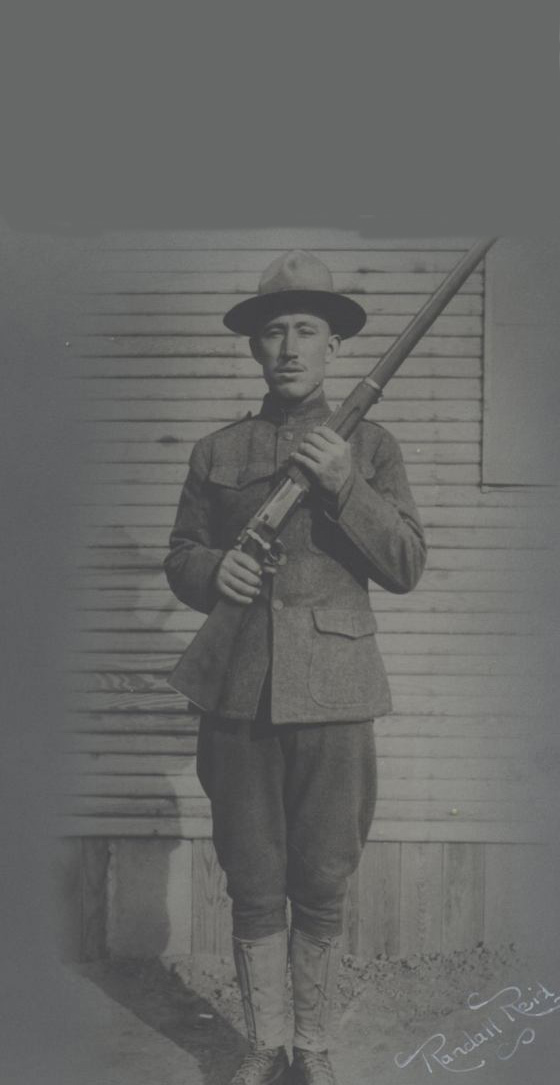
Randall Reid

Western Kansas Connections
The war’s effect stretched as far as western Kansas, with several young men from across our region joining the military and traveling to the battlefields of France. Today, our local VFW is named in honor of the first of these young men to become a casualty, Randall Reid.

Historian Deb Goodrich
Goodrich is the Garvey Foundation Historian in Residence at the Fort Wallace Museum and the co-host of “Around Kansas TV Show.” She is the author of several books and has appeared in numerous documentaries, as well as writing and co-producing the docudrama, “Thof’s Dragon.” She is a graduate of Washburn University in Topeka and a resident of Oakley, Kansas.

Fourth Grade Coloring Competition
In addition to her presentation, the awards for the historical society’s coloring contest will be presented to the winners in the first through fourth grades. This is the seventh year the historical society has sponsored the contest and the top three winners in each classroom will be announced at the Kansas Day program.

Please join us for this special presentation, “The Soldier State in the Great War,” on Saturday, January 27 at 2 p.m. at the museum in WaKeeney. For more information you can check out the Trego County Historical Society’s Facebook page or call 785-743-2963.

SCHLAGECK: Lightning rods – tools to tame the heavens

John Schlageck writes for the Kansas Farm Bureau.
For more than two centuries some perched high atop barns, silos, homes and sheds throughout much of rural America during the 19th and 20th centuries. These silent sentinels guarded buildings from lightning that attacked from the heavens.

Even going back to the ‘30s, ‘40s and early ‘50s just about every house or barn sported one or more of these gadgets on the roofs.

Lightning rods, invented by Benjamin Franklin in 1749, were iron rods sharpened to a point and designed to draw the electrical fire silently out of a cloud before it could come near enough to strike. Typically, the rods measured a half-inch in diameter, and were connected to a metal cable hidden within the structure, or sometimes attached to the outside of a building.

The size of the rods varied depending on the height of the building and the type of metal. Regardless of the size, the cables crawled their way down to Earth where they were anchored. Grounded, the lightning rod directs the lightning strike’s energy harmlessly into the ground, thus sparing the building.

During the 19th Century, the lightning rod became a decorative motif. Lightning rods were embellished with ornamental glass balls (now prized by collectors). The ornamental appeal of these glass balls were also used in weather vanes.

The main purpose of these balls, however, was to provide evidence of a lightning strike by shattering or falling off. If after a storm a ball is discovered missing or broken, the property owner should then check the building, rod and grounding wire for damage.

Today, one can drive all over the countryside and never spot a lightning rod on a house. Occasionally, I spot one still sticking up on top of an old barn somewhere in rural Kansas.

While few people rely on lightning rods today, many select surge protection for telecommunications and cable. Twenty years ago, most people used a land-line telephone, a television and an electrical line.

Now most use high-end electronics and other technology that remains highly susceptible to any kind of electrical surge. A lightning rod system protects against a direct strike. Surge protection guards against an indirect strike.

With the new technology most of the old lightning rods wound up in the dump or continue to rust in the weather on old abandoned barns – the few remaining upright. Still, because they were once so prominent across the rural United States, people have begun collecting them. Others are being used for decoration.

Some of the more sought-after designs were once made from copper with a starburst tip, other vintage lightning rods consisted of ornate, hammered aluminum with a cobalt-blue ball. But beware, some are now replicas and made of plastic.

Any more, most folks don’t see the need to spend money on these relics from the past. Today’s modern technology has also resulted in the end of the notorious lightning rod salesmen of yesteryear.

You know those flim-flam men who used to travel the countryside, looking for houses without lightning rods. Once they spotted such a house, they’d swoop down and unleash a hard-pressure sales pitch concerning the grave dangers of lightning strikes and burning down of unprotected homes and buildings.

Following the collection of a tidy sum of money, they’d install a cheap rod on top of the house, and often not even bother to attach a ground wire. The whole business, of course, was totally useless.

Lest we forget, the world remains filled with shyster salesmen of various sorts. As far as I know however, selling lightning rods is not one of their current scams.

John Schlageck is a leading commentator on agriculture and rural Kansas.

Now That’s Rural: Clara Reyes, Dos Mundos

Ron Wilson is director of the Huck Boyd National Institute for Rural Development at Kansas State University.
By RON WILSON
Huck Boyd National Institute for Rural Development

Two worlds. When a person from one country comes into a different country, it can feel to them like they have entered another world. That feeling caused one woman to create a bilingual newspaper so as to help others through such transitions. She has gone on to provide outstanding leadership for the Hispanic community in the Kansas City region.

Clara Reyes is the founder and owner of Dos Mundos, which literally translated means Two Worlds. Dos Mundos is the Spanish and English language newspaper in Kansas City.

Clara grew up in Guadalajara, Jalisco, Mexico. She wanted to pursue a career as a dentist and graduated from the University of Guadalajara. In 1964, she traveled to Kansas City to explore pursuing her education in dentistry. While there, she met Manuel Reyes and a romance ensued.

After a brief courtship, he followed her to Guadalajara where they were married. Then they moved to his home area in Overland Park.

“When I came from Mexico, I didn’t know any English,” Clara said. She quickly found that tasks which came easy to a U.S. citizen, such as opening a checking account or paying a telephone bill, were monumental challenges for someone unfamiliar with the language or the culture. She wished she had a bicultural, Spanish-language aid to help her adapt to her new country.

Clara spent several years as a student, homemaker, mother of two and then a real estate agent in Kansas City. “I saw people from Mexico who wanted to buy a house but didn’t know how to get loans or sign up for utilities,” Clara said.

She set out to find assistance for them. “I went to the gas company and they said, `Yes, we want to help and we have bilingual information, but we don’t know how to disseminate it,’” Clara said. The Chamber of Commerce indicated something similar. “They said, `We need some way to communicate with the Hispanic community.’”

In 1981, with support of her husband and children, Clara began a bilingual newspaper which could help inform the Hispanic community. “We started with a typesetter in our basement,” Clara said. The newspaper was called Dos Mundos, meaning two worlds. The company logo shows two globes connecting with each other.

Rather than producing the paper only in Spanish, she chose to use both Spanish and English. “We did it in bilingual form because we wanted others to read and know our needs also,” Clara said.

Dos Mundos was the first bilingual newspaper in Kansas City. It has now grown to become the largest and most read Hispanic paper in the area. The company’s market profile shows that the circulation region extends beyond Kansas City to rural communities such as Oskaloosa, Ottawa and Mound City, population 694 people. Now, that’s rural.

Clara Reyes’ company also operates three Spanish music and language radio stations in Kansas City. She is extremely active in community affairs.

Clara has served as president of the Coalition of Hispanic Women against Cancer, was a co-founder of the Southwest Boulevard Business Association, and has been a board member for the Hispanic Chamber of Commerce of Greater Kansas City, the National Federation of Hispanic Owned Publications, the Salvation Army, and many more. She has also received the international Ohtli Award from the Mexican consulate in Kansas City.

“Clara Reyes was our Huck Boyd Lecture speaker several years ago, and it was so interesting to learn how she started Dos Mundos with the help of her husband and children,” said Gloria Freeland, director of the Huck Boyd National Center for Community Media in K-State’s A.Q. Miller School of Journalism and Mass Communications. “For more than 35 years, her publication has filled a real need in her community and beyond. Her work demonstrates that communication can be used to unite people and strengthen communities.”

For more information, see www.dosmundos.com.

Two worlds. Just as the Dos Mundos newspaper has helped to connect the Hispanic world with the English one, Clara Reyes has been a leader in connecting people in Kansas City. In doing so, she has made a world of difference.

Political shifts, sales slump cast shadow over gun industry

By LISA MARIE PANE ,  Associated Press
When gunmakers and dealers gather this week in Las Vegas for the industry’s largest annual conference, they will be grappling with slumping sales and a shift in politics that many didn’t envision two years ago when gun-friendly Donald Trump and a GOP-controlled Congress took office.
Some of the top priorities for the industry — expanding the reach of concealed carry permits and easing restrictions on so-called “silencers” — remain in limbo, and prospects for expanding gun rights are nil for the foreseeable future.Instead, fueled by the deadliest mass shooting in modern U.S. history, the federal government banned bump stocks and newly in-charge U.S. House Democrats introduced legislation that would require background checks for virtually every firearm sale, regardless of whether it’s from a gun dealer or a private sale.

Even without Democrats’ gains in November’s midterm elections, the industry was facing a so-called “Trump slump,” a plummet in sales that happens amid gun rights-friendly administrations. Background checks were at an all-time high in 2016, President Barack Obama’s last full year in office, numbering more than 27.5 million; since then, background checks have been at about 25 million each year.

Gary Ramey, owner of Georgian gunmaker Honor Defense, says the mood at last year’s SHOT Show, which stands for Shooting, Hunting and Outdoor Trade, was subdued. He’s expecting the same this year.

“There was no one to beat up. You didn’t have President Obama to put up in PowerPoint and say ‘He’s the best gun salesman, look what he’s doing to our country,'” he said.

“Numbers are down,” he added. “You can’t deny it.”

Robert J. Spitzer, chairman of political science at the State University of New York at Cortland and a longtime watcher of gun issues, said that not only have shifting politics made it difficult for the gun industry to gain ground but high-profile mass shootings — like the Las Vegas shooting that happened just miles from where the SHOT Show will be held and the Parkland, Florida, high school shooting — also cast a pall.

“After the Parkland shooting, (gun rights’ initiatives) were kind of frozen in their tracks,” Spitzer said. “Now there’s no chance that it’s going anywhere.”

It’s easier to drive up gun sales when there’s the threat or risk of gun-rights being restricted, he said. “It’s harder to rally people when your target is one house of Congress. It just doesn’t have the same galvanizing effect.”

The National Shooting Sports Foundation’s SHOT Show has been held annually for more than four decades. This year more than 60,000 will attend the event that runs Tuesday through Friday — from gun dealers and manufacturers to companies that cater to law enforcement. There’s a wait list for exhibitors that is several hundred names long and it will have some 13 miles of aisles featuring products from more than 1,700 companies.

Last year’s show in Las Vegas was held just months after a gunman killed 58 people and injured hundreds at an outdoor music festival. The massacre was carried out by a gunman armed with bump stocks, which allow the long guns to mimic fully automatic weapons.

Organizers last year restricted media access to trade journalists. This year’s show will again allow reporters from mainstream media to attend.

Gun-control advocates are rejoicing in the gun industry’s misfortunes of late and chalking it up to not just shifting attitudes among Americans but a shift in elected political leaders.

“Without a fake menace in the White House to gin up fears, gun sales have been in a Trump slump and, as a result, the NRA is on the rocks,” said John Feinblatt, president of Everytown for Gun Safety, a group founded by former New York Mayor Michael Bloomberg.

Joe Bartozzi, the new president of the National Shooting Sports Foundation, said the industry isn’t disturbed by the drop in gun sales or the shift in federal politics. While Democrats who ran on gun-control platforms made huge gains in the House, he sees the Senate shifting to the other end of the spectrum.

“Having been in the industry for over 30 years and seeing the trends of gun sales ebb and flow over time, it’s very hard to put your finger on any one specific issue as to why this happens. It’s just the cyclical nature of the business,” he said.

Trump’s campaign was bolstered by about $30 million from the National Rifle Association and when he took office, the industry had hoped that a host of gun rights would be enacted. The Trump administration quickly nixed an Obama-imposed rule that made it more difficult for some disabled people to purchase and possess firearms.

But other industry priorities, such as reciprocity between states for carrying certain concealed firearms and a measure that would ease restrictions on purchasing suppressors that help muffle the sound when a gun is fired, failed to gain traction.

For now, Bartozzi said his organization is focused on a measure that would expand public gun ranges, funded by an existing tax on firearms and ammunition sales that supports conservation, safety programs and shooting ranges on public lands. The hope is that increasing the number of public ranges will encourage more people to become hunters.

Copyright Eagle Radio | FCC Public Files | EEO Public File