We have a brand new updated website! Click here to check it out!

News From the Oil Patch, Dec. 11

By JOHN P. TRETBAR

Independent Oil & Gas Service reports a realignment of the drilling rig fleet in Kansas. There was an increase in Kansas drilling contractors working out of state last week, as well as an increase in the number of Kansas rigs shutdown or stacked.

The active rig count was slightly lower. In eastern Kansas, there are 12 rigs moving in, rigging up, drilling or relocating. That’s up one for the week. West of Wichita the count dropped to 35 active rigs, down two. Drilling is underway this week on one lease in Russell County.

Operators filed 28 permits for drilling at new locations across Kansas last week, including five in Barton County. There are 12 new permits in eastern Kansas and 16 west of Wichita. So far this year, we have 1,718 new drilling permits across Kansas. That’s 359 more permits than last year at this time, but five thousand less than the total by this time in 2014.

The Kansas Corporation Commission reported a total of 166 new intent-to-drill notices across Kansas during November. That’s up one from the month before, up 16 from a year earlier, but down more than 300 from the total in November of 2014. So far this year, operators filed 1,801 intents, just 24 more than last year at this time, but well behind the 6,814 intents filed through November of 2014. There were two new intents filed in Barton County, five in Ellis County, two in Russell County and three in Stafford County.

Independent Oil & Gas Service reports just 56 new well completions for the week across Kansas. In the western half of the state, there were 20 newly completed wells, but 11 of them were dry holes. Barton County added one completion last week. Russell County added two, although one of those was a dry hole. So far this year, operators have completed 1,486 wells. That’s 243 completions ahead of last year at this time, but nearly four thousand less than at this point back in 2014.

There was an increase in Kansas drilling contractors working out of state last week, as well as an increase in the number of Kansas rigs shutdown or stacked. Independent Oil & Gas Service said the active rig count was slightly lower. In eastern Kansas, there are 12 rigs moving in, rigging up, drilling or relocating. That’s up one for the week. West of Wichita the count dropped to 35 active rigs, down two. Drilling is underway this week on one lease in Russell County.

Baker Hughes reported 1,075 active rigs nationwide, down ten oil rigs but up nine rigs searching for natural gas. Oklahoma was down three and Texas down down two rigs for the week. New Mexico gained two rigs. Canada was down 13 rigs at 186.

OPEC and Russia have agreed to a deal to cut production to mop up a growing global oil supply glut. The Wall Street Journal said the deal would cut output by a collective 1.2 million barrels a day.

The Association of American Railroads reports another increase in oil-by-rail traffic. For the week ending November 24, more than 12-thousand tanker cars shipped petroleum across the U.S., an increase of 39.7% over last year at this time. The cumulative total for the year is 17% ahead of last year. Canada’s oil-by-rail figures increased 36% over last year to more than 11-thousand tanker cars. Canada is 21.5% ahead of last year’s cumulative total.

The government reported total U.S. crude oil production for September was up about 129-thousand barrels per day over the month before at 11.475 million barrels per day. That’s about 21% higher than the total in September of last year. Kansas production for September was 94-thousand barrels per day, down two-thousand barrels from the month before, and a thousand barrels per day lower than last September’s total.

The U.S. Energy Information Administration reported a slight increase in U.S. crude production last week to just under 11.7 million barrels per day. That’s nearly two million barrels per day more than last year at this time.

Crude oil imports averaged 7.2 million barrels per day last week, down by 943,000 barrels per day from the previous week. The four-week average is up 0.3% from last year at this time.

U.S. commercial crude oil inventories dropped by 7.3 million barrels and (at 443.2 million barrels) are about 6% above the five year average for this time of year.

Total motor gasoline inventories increased by 1.7 million barrels last week and are about 4% above the five year average for this time of year.

Mexico’s new president likened it to selling oranges and buying orange juice. The new government detailed plans Sunday to build an $8 billion oil refinery and to renovate six others as the oil-producing country attempts to lower its dependence on fuel imported from the U.S.

The U.S. Geological Survey announced the Permian Basin of Texas and New Mexico could hold much more oil and gas than once thought. The basin’s “Delaware Basin” could hold upwards of 46 billion barrels of oil and some 280 trillion cubic feet of gas, making it the largest continuous oil and gas resource ever assessed.

The Trump administration is moving forward with plans to open more public lands to oil and gas leases. They will allow waivers for drilling to encroach into the habitat of the endangered greater sage grouse. Earlier protections for the bird habitats affected millions of acres in the American West including parts of Kansas.

Two arrested after four-county high-speed chase in Kan.

ELLSWORTH COUNTY — Law enforcement authorities are investigating two suspects on numerous charges after a  high-speed chase through four Kansas counties.

Chavez -photo Ellsworth County

Frye -photo Ellsworth Co.

Just after midnight Sunday, authorities attempted to stop a reported stolen 2018 Hyundai passenger vehicle eastbound on Interstate 70 just east of the Kansas 156 exit in Ellsworth County, according to the Kansas Highway Patrol.

The driver later identified as 37-year-old Kevin Frye of Colorado refused to stop. The chase at speeds of 100 miles per hour continued into Saline County. The driver left Interstate 70 at the Hedville-Culver exit traveling south and then continued eastbound on Crawford until he decided to travel northbound on Interstate 135 through Ottawa County and into Cloud County.

The vehicle finally pulled over in an alley in Concordia. The KHP arrested Frye and a passenger 32-year-old Candias Chavez. She was wanted for an escape from the Denver County Jail. A second passenger in the Hyundai was detained for questioning and he was released, according to the KHP.

The suspects are being held for warrants from Colorado and requested charges that include felony flee and attempted to elude law enforcement, possession of stolen property, possession of personal use marijuana and a number of additional traffic violations, according to the KHP.

Sunny, warmer Tuesday

Today Mostly sunny, with a high near 52. South southwest wind 6 to 15 mph becoming north northwest in the afternoon.

Tonight Partly cloudy, with a low around 25. Northwest wind 6 to 10 mph becoming west southwest after midnight.

Wednesday Sunny, with a high near 54. West southwest wind 6 to 13 mph becoming south in the afternoon.

Wednesday Night Increasing clouds, with a low around 30. Windy, with a west wind 6 to 11 mph becoming north 20 to 25 mph in the evening.

Thursday Partly sunny, with a high near 43. Windy, with a north wind 22 to 28 mph, with gusts as high as 39 mph.

Thursday NightMostly clear, with a low around 25. Blustery.

FridaySunny, with a high near 48.

Kansas man dies from injuries in 2-vehicle crash

SHAWNEE COUNTY — One person died in an accident just before 4p.m. Monday in Topeka.

Sheriff’s department investigators at the scene of Monday’s crash photo by Jovarie Downing WIBW TV

The Shawnee County Sheriff’s Department reported a 1999 Ford Taurus driven by Narciso Luna, 83, Topeka, was westbound on SE 45th street at SE Adams. The driver attempted to turned south onto SE Adams in front of an eastbound 2001 Nissan Sentra driven by Michael Bishop-Verschelden, 19, Topeka.

The Sentra struck the front passenger door of the Taurus. Both vehicles were immediately disabled.

Luna and a passenger in the Ford Kirk Slater, 58, Topeka, were transported to a local hospital where Slater died. Bishop-Verschelden refused medical treatment on scene.

All three occupants of the vehicles were properly restrained and there were no signs of impairment by either driver, according to the sheriff’s department.

The Shawnee County Sheriff’s Office continues to investigate this collision.

Ag Committee Leaders Release Farm Bill Conference Report

WASHINGTON, D.C. – Agriculture Committee Chairmen Sen. Pat Roberts, R-Kan., and Rep. K. Michael Conaway, R-Texas on Monday released the text of the bipartisan, bicameral 2018 Farm Bill conference report.

Click here to read the text of the report.


“The 2018 Farm Bill is our opportunity to make the American food and agriculture systems work more efficiently. I’m pleased to say we have done just that in this conference report,” said Chairman Roberts. “We started this journey nearly two years ago. Since then, the Senate Agriculture Committee has held dozens of hearings, listened to more than 90 witnesses, and received thousands of public comments. As promised, this farm bill provides much needed certainty and predictability for all producers – of all crops – across all regions across the country. I thank my counterparts in the Senate and House for coming to – and staying at – the table to reach a bipartisan, bicameral agreement for rural America.” 

“America’s farmers and ranchers are weathering the fifth year of severe recession, so passing a farm bill this week that strengthens the farm safety net is vitally important,” said Chairman Conaway. “I am grateful to the President, Secretary Perdue and my leadership for standing fast for the hard-working farm and ranch families that clothe and feed us. I also appreciate the members of the conference committee for bringing this process one step closer to completion.”

“By working across the aisle, we overcame many differences to deliver a strong, bipartisan farm bill for our farmers, families, and rural communities,” said Ranking Member Stabenow. “The 2018 Farm Bill is a good bill for our farmers and everyone who eats. Working together, we continued to expand the diversity of our agricultural economy, maintained a strong food and farm safety net, created new opportunities in our small towns and rural communities, and made significant investments in land and water conservation. Now is not the time to rest on our laurels – it’s time to get the bill across the finish line as soon as possible. I urge my colleagues to support this bill.”

“This bill is a strong start to addressing the issues our producers are facing right now, particularly our dairy farmers,” said Ranking Member Peterson. “The bill’s new provisions will offer more flexible coverage for lower cost when dairy farmers need it most, and provide producers more tools to manage their risk. It also invests $300 million in the prevention and response for animal pests and disease. More broadly, the bill invests in research, outreach to beginning & underserved producers, local and organic food production, bioenergy, and access to new markets. It also addresses broadband, farm stress and mental health issues, and the opioid epidemic in rural areas. It’s the product of strong bipartisan work in both the House and the Senate, and it’s something I’m proud to encourage folks to vote for.”

The Farm Bill Conference Committee held a public hearing on Sept. 5. Agriculture Committee leaders announced a deal on Nov. 29.

The conference report was signed by the Senate and House Farm Bill conferees and will be considered with a vote in

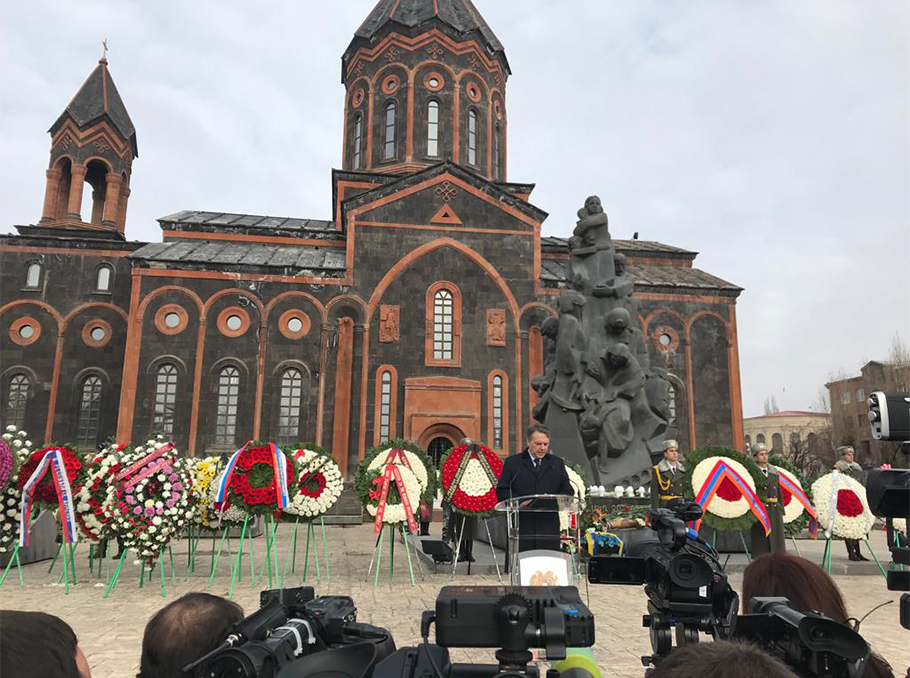
Gov. Colyer speaks at 30th anniversary of Spitak earthquake in Armenia  

Kansas governor Jeff Colyer speaks at the 30th anniversary of the Spitak earthquake in Armenia.

OFFICE OF GOV.

TOPEKA – Governor Jeff Colyer spoke Friday at an event commemorating the 30th anniversary of the Spitak earthquake in Armenia, a disaster Gov. Colyer assisted with as a medical first responder in 1988.

Gov. Colyer was sent to Armenia by then President Ronald Reagan after the earthquake hit. He was one of the first medical responders to arrive in the country after the 6.8 magnitude earthquake destroyed Spitak within 30 seconds, killing 25,000 people and injuring nearly 140,000 people.

“The disaster I saw 30 years ago was tragic, and through the tragedy the Armenian nation showed courage and resilience,” said Colyer.

“Many lives were lost, and many other lives were changed that day. It is important that as humanitarians we always answer the call for help when others need it.”

Kansas Adjutant General Maj. Gen. Lee Tafanelli also attended the commemoration with Gov. Colyer.

Kansas and Armenia first established a bilateral affairs agreement in June 2003. Fifteen years later, the partnership continues to foster strong relations between the United States and the Republic of Armenia.

Kansas and Armenia enjoy an enduring relationship built upon mutual understanding, trust and genuine friendships shared across and throughout our forces. Collaborative efforts between Kansas and Armenia have paved the way for the modernization of the Armenian Armed Forces in the areas of defense reform, enhanced interoperability, defense education reform and civil emergency planning.

“These types of partnerships are critical to international security cooperation,” said Tafanelli.

“The United States is most successful when it partners with friends and allies to achieve mutual security goals. Armenian peacekeepers have trained alongside Kansas Guardsmen as a result of the State Partnership Program, and many other enduring relationships have been developed benefiting both Armenia and the United States.”


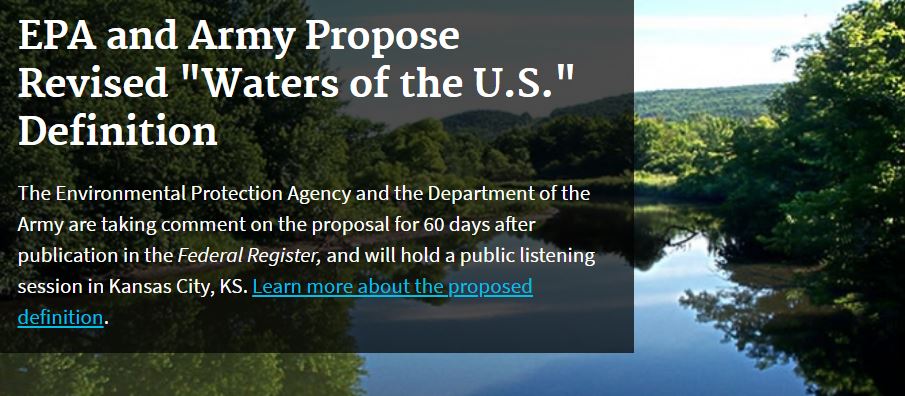
EPA and Army propose new “Waters of the United States” definition

EPA

WASHINGTON — Today, the U.S. Environmental Protection Agency (EPA) and the Department of the Army (Army) are proposing a clear, understandable, and implementable definition of “waters of the United States” that clarifies federal authority under the Clean Water Act. Unlike the Obama administration’s 2015 definition of “waters of the United States,” today’s proposal contains a straightforward definition that would result in significant cost savings, protect the nation’s navigable waters, help sustain economic growth, and reduce barriers to business development.

“Our proposal would replace the Obama EPA’s 2015 definition with one that respects the limits of the Clean Water Act and provides states and landowners the certainty they need to manage their natural resources and grow local economies,” said EPA Acting Administrator Andrew Wheeler. “For the first time, we are clearly defining the difference between federally protected waterways and state protected waterways. Our simpler and clearer definition would help landowners understand whether a project on their property will require a federal permit or not, without spending thousands of dollars on engineering and legal professionals.”

The agencies’ proposal is the second step in a two-step process to review and revise the definition of “waters of the United States” consistent with President Trump’s February 2017 Executive Order entitled “Restoring the Rule of Law, Federalism, and Economic Growth by Reviewing the ‘Waters of the United States’ Rule.” The Executive Order states that it is in the national interest to ensure that the nation’s navigable waters are kept free from pollution, while at the same time promoting economic growth, minimizing regulatory uncertainty, and showing due regard for the roles of Congress and the states under the Constitution.

“EPA and the Army together propose this new definition that provides a clear and predictable approach to regulating ‘waters of the United States.’ We focused on developing an implementable definition that balances local and national interests under the Clean Water Act,” said R.D. James, Assistant Secretary of the Army for Civil Works. “I have heard from a wide range of stakeholders on Clean Water Act implementation challenges. This proposed definition provides a common-sense approach to managing our nation’s waters.”

The agencies’ proposed rule would provide clarity, predictability and consistency so that the regulated community can easily understand where the Clean Water Act applies—and where it does not. Under the agencies’ proposal, traditional navigable waters, tributaries to those waters, certain ditches, certain lakes and ponds, impoundments of jurisdictional waters, and wetlands adjacent to jurisdictional waters would be federally regulated. It also details what are not “waters of the United States,” such as features that only contain water during or in response to rainfall (e.g., ephemeral features); groundwater; many ditches, including most roadside or farm ditches; prior converted cropland; stormwater control features; and waste treatment systems.

The agencies believe this proposed definition appropriately identifies waters that should be subject to regulation under the Clean Water Act while respecting the role of states and tribes in managing their own land and water resources. States and many tribes have existing regulations that apply to waters within their borders, whether or not they are considered “waters of the United States.” The agencies’ proposal gives states and tribes more flexibility in determining how best to manage their land and water resources while protecting the nation’s navigable waters as intended by Congress when it enacted the Clean Water Act.

Robust, publicly accessible data is also a key component of common-sense, cost-effective environmental protection. In response to requests from some states, EPA and the Army are exploring ways the agencies can work with our federal, state, and tribal partners to develop a data or mapping system that could provide a clearer understanding of the presence or absence of jurisdictional waters.

The agencies invited written pre-proposal recommendations and received more than 6,000 recommendations that the agencies have considered in developing this proposal. The agencies listened to those directly affected by the regulations, and this proposal balances the input the agencies received from a wide range of stakeholders.

The agencies will take comment on the proposal for 60 days after publication in the Federal Register. EPA and the Army will also hold an informational webcast on January 10, 2019, and will host a listening session on the proposed rule in Kansas City, KS, on January 23, 2019.

More information including a pre-publication version of the Federal Register notice, the supporting analyses and fact sheets are available at: https://www.epa.gov/wotus-rule.

Kan. woman faces 30-years in prison for embezzlement

KANSAS CITY– A former bank teller pleaded guilty Monday to embezzling from a savings and loan where she worked, U.S. Attorney Stephen McAllister said.

Theresa Williams, 49, Leavenworth, Kan., pleaded guilty to one count of theft by a bank employee. In her plea, she admitted she embezzled $13,000 from Mutual Savings Association in Leavenworth. To cover up the crime, she made false entries in bank reports.

Sentencing is set for Feb. 25. She faces a sentence of up to 30 years in federal prison and a fine up to $1 million.

5 await extradition to Kansas for killing Barton Co. fair vendors

LITTLE ROCK, Ark. (AP) — Three carnival workers have been charged with capital murder in the fatal shooting of a couple at a Kansas fair whose bodies were found days later in shallow graves in a national forest in Arkansas.

Drake -photo Crawford Co. Arkansas
Tenney- photo Crawford Co.

The Kansas Attorney General said 52-year-old Kimberly Younger, of McIntosh, Florida; 54-year-old Michael Fowler Jr., of Sarasota, Florida; and 35-year-old Rusty Frasier, of Aransas Pass, Texas, are jailed on $1 million bond in Arkansas, where they also face charges.

Capital murder carries a sentence of execution or life imprisonment.

Kimberly Younger -photo Crawford Co.

Alfred “Sonny” Carpenter and Pauline Carpenter of Wichita had been selling crafts, jewelry, purses and other handmade items at the fair in Barton County, Kansas, in July when they were killed. Investigators believe the carnival workers used the couple’s recreational vehicle to drive the bodies 320 miles (515 kilometers) to Van Buren, Arkansas. Their bodies were found buried in shallow graves next to a creek outside the small community of Natural Dam in the Ozark National Forest.

Michael Fowler – photo Crawford Co.
Rusty Frazier -photo Crawford County

Police in Arkansas have said Younger texted the other suspects posing as a carnival mafia boss named Frank Zaitchik and ordered them to kill the Carpenters and dispose of the bodies. Fowler told investigators that he believed this was an initiation into the carnival mafia, so he shot the couple and Frasier stabbed Alfred Carpenter.

Asked whether a carnival mafia even exists, Van Buren police spokesman Jonathan Wear said in an email that this was something Younger “definitely made up.”

When told that the order to kill had come from Younger, not Zaitchik, Fowler said she had “suckered” him in and that he had thrown his life away, according to police reports.

Fowler is also charged in Kansas with theft, while Younger faces charges in that state of conspiracy to commit murder, solicitation and theft.

A spokeswoman in the Kansas Attorney General’s office didn’t immediately respond to questions about whether the suspects have attorneys who can speak on their behalf.

Two others — 38-year-old Christine Tenney, of Santa Fe, Texas, and 31-year-old Thomas Drake, of Van Buren, Arkansas — are charged with obstructing apprehension. All five are awaiting extradition to Kansas.

Younger, Fowler, Frasier and Tenney have pleaded not guilty in Arkansas to charges that include abuse of a corpse.

Kan. felon with a gun arrested for aggravated assault

SHAWNEE COUNTY — Law enforcement authorities are investigating a convicted felon on new charges.

Locke -photo Shawnee Co.

Just after 9:00 pm, Saturday, officers were dispatched to a call for service, in the area of 200 NW Gordon in Topeka involving a person causing a disturbance and discharging a firearm, according to Lt. Jerry Monasmith.

On arrival officers took a subject identified as Xavian Marquise Locke, 19, into custody for warrants and found him to be in possession of a firearm.

Locke is a convicted felon and prohibited from possessing firearms. He was arrested for criminal possession of a firearm by a convicted felon, aggravated assault, criminal discharge of a firearm, and unrelated warrants.

Wichita seeks Amtrak service, county shows hesitance

WICHITA, Kan. (AP) — Wichita officials are pushing for Amtrak to restore rail service in the city that hasn’t had a passenger train service for nearly 40 years, but Sedgwick County officials aren’t ready to embrace the plan.

Bringing back the rail service is near the top of the city’s lobbying agenda when the state legislative session begins next month.

“Passenger rail is evolving as a key component for keeping and attracting young people as part of a strong workforce,” the legislative platform said. “In addition, it provides a safe travel option for an aging population.”

But Sedgwick County didn’t even put Amtrak service on its list of transportation priorities to a state committee evaluating Kansas’ long-term transportation plans.

David Dennis, the county commission’s chairman, said he can’t make a decision on the issue until he knows the service’s cost and benefits.

Wichita may have better chances of getting Amtrak restored this year, considering available federal funding and healthier state finances.

Amtrak has also decided to continue the route from Los Angeles to Chicago, which any Wichita train service would need to connect to. The railway currently offers a bus that passes through Wichita to fill a gap in rail service between stations in Oklahoma City, Oklahoma, and Newton, Kansas, according to Amtrak spokesman Marc Magliari.

More than 1,700 Wichita travelers took the bus to connect to the train in Newton over the past year, Magliari said.

Pete Meitzner, a leading advocate for Wichita’s passenger rail, recently won a seat on the Sedgwick County Commission. He hopes to change the county’s stance on the service when he joins this commission in January.

Meitzner said cost estimates for the rail service have been requested but haven’t been completed. He expects initial costs to be minimal, since the passenger rail could use the city’s existing tracks.

Amtrak conducted a test run on the tracks last year that was determined to be successful.

AAA: Kansas has fifth cheapest gas in America

Average Kansas gas price now $2.09, down 7 cents in past week and 40 cents lower in past month.

TOPEKA – Kansas motorists continue to get good news when they fill up their gas tanks. At $2.09/gallon, the Sunflower State’s average per-gallon gas price is now fifth cheapest in the nation. Kansas’ gas price has fallen 40 cents in the past 30 days, tied with Iowa and Nebraska for the largest monthly decline in
America.
“Kansans continue to see lower prices at the gas pumps,” said AAA Kansas spokesman Shawn Steward. “It certainly helps to have more money in your wallet for holiday shopping this time of year. Our gas prices across the state have been falling for about the past two months, and we are now down 8 percent from the $2.28 average from one year ago.”
Steward noted that three Kansas metro areas are among the Top 50 cheapest gas prices in America this week. Wichita, at $1.94/gallon, checked in with the third lowest gas prices among larger metro areas. Lawrence ($1.98) registered the 14th lowest price in the nation. Kansas City, Kan. ($2.04) is 41st lowest.
Of the 10 Kansas cities regularly highlighted by AAA Kansas (see chart below), all except Salina – which remained the same – experienced price declines in the past week. The largest price drops were seen in Kansas City, Kan. (-10 cents), Manhattan (-10), Topeka (-8) and Wichita (-8).
According to AAA Kansas, this week’s Kansas gas price extremes are:
HIGH: Elkhart (Morton County) – $2.67
LOW: Haysville (Sedgwick County) – $1.89
National Perspective
Today’s national gas price average of $2.42 is the lowest pump price of the year, a price point not seen since mid-December last year. The average sits at four cents cheaper than last week, 28-cents cheaper than last month and four cents less than last year. The last time the national average was cheaper on the week, month and year was during July 2017.
“Motorists are noticing a big difference as they fill-up at the gas pump this month,” said AAA Kansas’ Steward. “Month-over-month, gas price averages have dropped double digits for every state. For some in the Great Lakes and Central states (Iowa, Kansas, Nebraska and Missouri) state gas prices are as much as 40-cents less than they were in November. In some states, gas prices are nearing $2 per gallon – something that hasn’t been seen since December 2017.”
How low can gas prices go? AAA expects the national gas price average to drop as low as $2.40 by the end of the year due to cheaper crude oil prices. However, pump prices this cheap may not last into 2019. On Friday, the Organization of the Petroleum Exporting Countries (OPEC) announced that the cartel and non-OPEC members, including Russia, will reduce production by 1.2 million b/d for the first six months of the year. While the decision will help to reduce the high level of global crude supply, the move has the potential to increase oil and gas prices. Crude was up to $52.61 at the market close on Friday, while the week prior, crude was as cheap as $50/bbl.
Copyright Eagle Radio | FCC Public Files | EEO Public File