We have a brand new updated website! Click here to check it out!

BOOR: Understanding your soil pH is critical

Alicia Boor
One of the issues that we have here in the area is that our soils are of a high pH. This can cause issues with nutrient uptake in plants, especially if their root systems have been compromised by drought. I have found an article from our Horticulture department that gives you some more information about what you can do if you have high pH soils to help your plants.
   

Though there are high pH soils in most parts of the state, alkaline soils tend to be more common in the central and western regions of Kansas. These high pH soils can cause problems for plants by reducing the availability of certain micronutrients. For example, most Kansas soils have more than adequate amounts of iron. However, a high pH can make iron unavailable resulting in a condition known as iron chlorosis as evidenced by light green leaves with darker green veins. Iron chlorosis reduces the health of plants by reducing photosynthesis. Lowering the pH of such soils will eliminate iron chlorosis.
   

Now would be a good time to have a soil test done to see if your pH is too high. If so, sulfur can be added either now or in the spring to lower the pH. Different textures of soil require different amounts. A sandy soil needs 1.0 to 1.5 pounds of sulfur per 100 square feet to reduce pH one point. A loam soil needs 1.5 – 2.0  pounds and clay needs 2.0 – 2.5 pounds to do the same. For example, if you wished to lower pH from 7.5 to 6.5 on a loam soil, you would need 1.5 – 2.0 pounds of sulfur per 100 square feet.
   

So, what pH do we shoot for? For most plants, a pH between 6.0 and 7.0 is preferred. Unfortunately, adding sulfur to lower pH is not as clear-cut a solution as we would like. Here are some other factors to keep in mind. 
   

Free calcium carbonate: Some soils have free calcium carbonate, actual particles of limestone mixed in the soil. These “calcareous” soils normally have a pH of 7.3 to 8.5, with 8.2 to 8.3 being most common. In order for us to lower the pH with sulfur, all free calcium carbonate must be neutralized first. A recent soil test showed 6.7 percent free calcium carbonate. One pound of sulfur is needed to neutralize three pounds of calcium carbonate. Assuming 80 pounds for a cubic foot of soil, you would need about 1.75 pounds of sulfur per square foot just to neutralize the free lime. Additional sulfur would be needed to lower pH. Adding this much sulfur to a soil at one time is not recommended.
   

Not all high pH soils are calcareous. Perform this simple test to see if your soil contains appreciable amounts of free lime. Apply one drop of vinegar to dry soil. A vigorous fizz usually means the soil contains at least 3 percent calcium carbonate. A mild fizz suggests a calcium carbonate of between 1 and 2 percent and a fizz that can only be heard suggests the soil has a calcium carbonate content less than 1 percent.
   

How sulfur works: Elemental sulfur does not lower pH directly. It must first be oxidized to the sulfate form with the result being sulfuric acid. The sulfuric acid produces hydrogen, which acidifies the soil and lowers pH. The oxidation takes place primarily through microbial activity.
   

Oxidation takes time: Microbial oxidation of elemental sulfur takes time and depends on:
    
– number of sulfur oxidizing bacteria present
    
– temperature (75-104 degrees optimum)
    
– moisture content of soil (too wet or too dry will slow down process)
     
– size of sulfur particles (the smaller the better)
   

A single sulfur application normally takes at least 2 years for most the sulfur to react and form sulfuric acid.

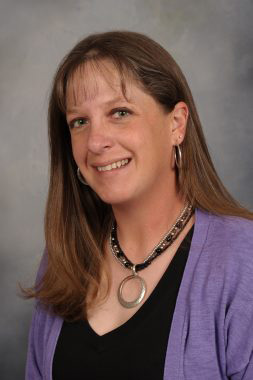
Alicia Boor is an Agriculture and Natural Resources agent in the Cottonwood District (which includes Barton and Ellis counties) for K-State Research and Extension. You can contact her by e-mail at [email protected] or calling 620-793-1910

Now That’s Rural: Western Kansas Rural Economic Development Alliance

Ron Wilson is director of the Huck Boyd National Institute for Rural Development at Kansas State University.

By RON WILSON
Huck Boyd National Institute for Rural Development

“Herd about Kansas?” I saw that phrase – with “heard” spelled “herd” as in a herd of cows – on a cap which displayed a picture of a cowherd. The cap was colored in black and white splotches like a Holstein milk cow. That cap is the type of eye-catching item which might have been used in the early 1990s to recruit dairies to western Kansas. This jointly-supported recruitment effort has not only sparked remarkable economic growth, it has been part of the spirit of regional cooperation.

In previous weeks, we’ve learned about leading dairymen in three different regions of the state. The dairy industry has grown significantly in this state, particularly in western Kansas.

In the early 1990s, community leaders in western Kansas recognized that there were opportunities to grow and attract the dairy industry. The Western Kansas Dairy Coalition was formed.

Joann Knight of Ford County Economic Development was involved at the beginning. “Dairies were getting squeezed out of California,” she said. The bountiful feed production and wide open spaces of western Kansas made this seem like a perfect location to relocate. Community leaders came together to jointly recruit to the region. By pooling their efforts, these communities could send one big, effective display to a trade show, for example, rather than having multiple communities send several small, ineffective ones.

Note that I just said that milk production was being `squeezed out’ of California and that the recruitment efforts should be `pooled.’ Isn’t that udderly funny? Okay, enough milk jokes.

Apart from the dairy industry, visionary leaders in western Kansas were concerned about the future of their communities and the region in general. Among those who saw the need to work together for mutual benefit were the late Steve Miller from Sunflower Electric Power Corporation; Carol Meyer, who was at the Chamber of Commerce in Garden City at the time; and Lyle Butler, then-president of the Dodge City Chamber of Commerce.

In May 1994, some 85 people attended a meeting to discuss the economic challenges of the region and to consider how a regional organization might help. They agreed to help plan a regional organization. This resulted in the western Kansas Rural Economic Development Alliance or wKREDA. wKREDA provided a unifying force for all of western Kansas.

Eventually, the dairy coalition came under the organizational umbrella of wKREDA, which helped organize the recruitment efforts.

For example, a wKREDA delegation went to the big dairy expo in Tulare, California and the New York farm show. This raised the visibility of western Kansas as a potential site for dairies to relocate.

Carol Meyer remembers being part of the dairy recruitment team. “Every week we went somewhere and met with dairy managers to learn about what they needed,” Carol said. Bankers and rural electric cooperatives agreed to put up funds to help the new dairies.

The effort worked. In 1994, the first dairies from California began to move to Kansas. At the New York farm show, wKREDA representatives met the McCarty family which would eventually relocate their dairy farm to Kansas also.

This was genuine rural economic development. The new dairies stimulated jobs, construction, growth in school enrollment, and other economic activity. The McCartys’ first Kansas dairy was located near the rural community of Rexford, population 232 people. Now, that’s rural.

Today wKREDA continues to work on dairy growth along with other issues benefitting western Kansas. For example, wKREDA provides economic and community development education for its members, builds relationships with various agencies and partners, and provides political representation to policymakers in Topeka and Washington. wKREDA represents 55 counties which have chosen to pool their resources for mutual benefit. Christy Hopkins, Greeley County economic development director, is the current president of wKREDA.

For more information, go to www.discoverwesternkansas.com.

Have you Herd about Kansas? We commend Carol Meyer, Christy Hopkins, and all those previously and currently involved with wKREDA for making a difference with dairy recruitment and regional cooperation. Working together, they were able to make themselves heard.

And there’s more. Growth in dairy production has led to value-added opportunities in dairy and other industries. We’ll learn about that next week.

KDHE: Carbon monoxide: The invisible hazard in your home

Carbon monoxide detector
KDHE

TOPEKA – The arrival of colder weather means more homes will be turning up the heat with fuel-burning appliances. These appliances include furnaces, ovens, space heaters, generators, indoor grills and fireplaces that can unknowingly cause dangerous levels of carbon monoxide (CO) to build up in the home.

According to the Centers for Disease Control and Prevention, from 2010 to 2015, an average of 374 people died each year from unintentional carbon monoxide poisoning in the United States. In Kansas, from 2011 to 2015, there were annually an average of 146 emergency department visits, 22 hospitalizations and 12 deaths due to unintentional carbon monoxide poisoning. On May 11, KDHE updated regulations for the reporting of notifiable disease conditions, adding CO poisoning to Kansas’ list of reportable diseases.

“KDHE will use the reported information to better understand the circumstances of CO poisonings that occur in public settings in Kansas,” said Dr. Farah Ahmed, KDHE Environmental Health Officer and State Epidemiologist. “This additional information will be used to determine if there are any potential interventions that partners can help devise to reduce the risk of another CO poisoning event in the public location.”

“CO is known as the invisible killer because it is colorless and odorless,” said Cherie Sage, Safe Kids Kansas. “The symptoms of CO poisoning are similar to those of common winter ailments, like the flu. Without a CO alarm in your home, your family can be poisoned without even realizing it’s happening.” CO poisoning can happen suddenly or cause poisoning over a longer amount of time.

CO alarms cost approximately $20 and can be purchased at most hardware and retail stores.

Tips to protect your family from CO poisoning:

  • Prevent CO buildup in the first place—make sure heating appliances are in good working order and used only in well-ventilated areas. Don’t run a car engine or any other gas-powered tool in the garage, even with the garage doors open. If you need to warm up your vehicle, move it outside first.
  • Install alarms in the hallway near the bedrooms in each separate sleeping area and on every level of the home. Keep alarms at least 15 inches from all fuel-burning appliances.
  • Follow manufacturer’s directions for installation, testing and using CO alarms. There are many options and styles to choose from, including hardwired, combination smoke and CO alarms, and battery operated. When you check your smoke alarm batteries each month, check the batteries on your CO alarms at the same time.
  • Never use an oven or gas range for heating.
  • Only use portable generators, gas camp stoves and charcoal grills outside with proper ventilation. They cannot be used indoors, inside of a garage or enclosed porch.
  • If more than one person in the home suddenly feels ill for no apparent reason, or if a CO alarm goes off, get everyone outside immediately and call 911 from a pre-arranged meeting place. Pay attention to pets, sometimes they will show signs of illness first. Don’t go back inside until the fire department or gas company says it is safe.

“Early detection can mean the difference between life and death when it comes to CO poisoning,” said State Fire Marshal Doug Jorgensen. “CO alarms, along with smoke alarms, are one of the best ways to provide protection in your home for your family.”

The Kansas Office of the State Fire Marshal, through its Get Alarmed, Kansas program, is working with fire departments across the state to deliver and install free smoke alarms, which include CO detection. For more information on Get Alarmed, Kansas, visit, www.GetAlarmedKS.org. For more information about CO poisoning, visit www.safekids.org, or call the Poison Control Hotline at 800-222-1222.

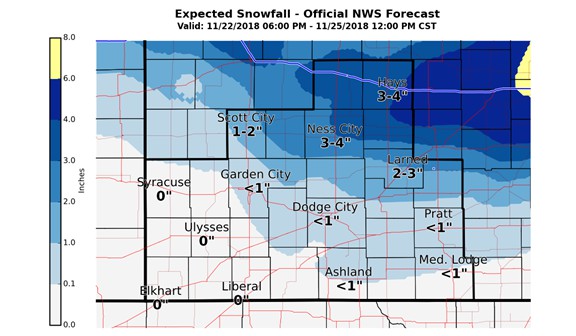
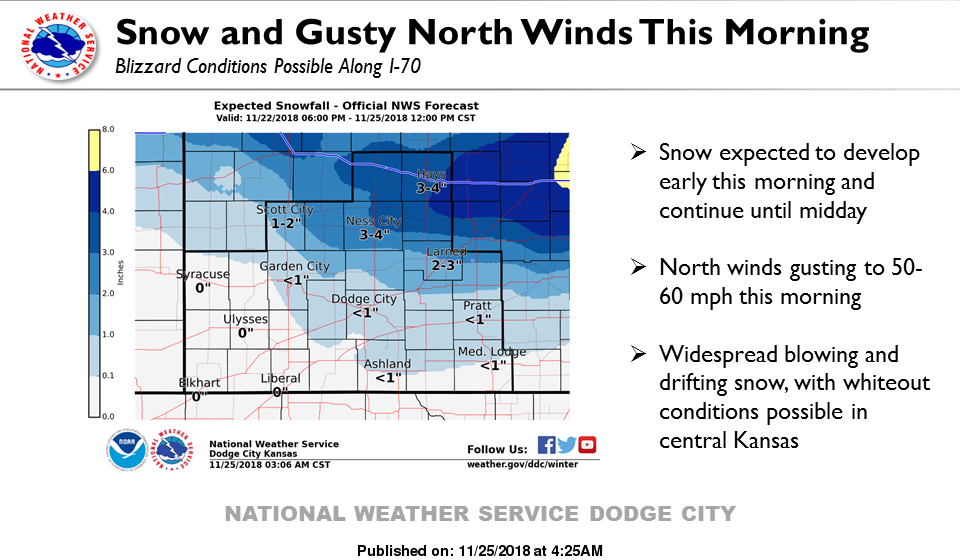
Blizzard Warning in Effect Until 12:00 PM for Ellis, Trego Counties

..Winter Weather Advisory cancelled…

.The heavy snow has remained to the east of this area.

…BLIZZARD WARNING REMAINS IN EFFECT UNTIL NOON CST TODAY…

* WHAT…Blizzard conditions expected. Total snow accumulations of
up to four inches expected. Winds gusting as high as 60 mph.

Look for these conditions to continue for a few hours early this morning before beginning to taper off. Visibility near zero at times.

* WHERE…Ellis and Trego Counties.

* WHEN…Until noon CST Sunday.

* ADDITIONAL DETAILS…Blowing snow is significantly reducing visibility.

A Blizzard Warning means severe winter weather conditions are expected or occurring. Falling and blowing snow with strong winds and poor visibilities are likely. This will lead to whiteout conditions, making travel extremely dangerous. Do not travel. If you must travel, have a winter survival kit with you. If you get stranded, stay with your vehicle. The latest road conditions for the state you are calling from can be obtained by calling 5 1 1.

Cold, snowy Sunday

A Blizzard Warning remains in effect until 12:00 PM

Today
Snow, mainly before 8am. Widespread blowing snow, mainly before 8am. Temperature falling to around 26 by 9am. Very windy, with a north northwest wind 35 to 40 mph decreasing to 21 to 26 mph in the afternoon. Winds could gust as high as 55 mph. Total morning snow accumulation of 2 to 4 inches possible.

Tonight
Mostly clear, with a low around 19. West wind 6 to 11 mph.

Monday
Sunny, with a high near 41. West wind around 7 mph.

Monday Night
Mostly clear, with a low around 21. North northwest wind around 5 mph becoming calm in the evening.

Tuesday
Sunny, with a high near 41. Light and variable wind becoming southeast around 6 mph in the afternoon.

Tuesday Night
Partly cloudy, with a low around 24.

Wednesday
Partly sunny, with a high near 45.

Saturday’s State Championship scoreboard

Eight-Man Div I – Central Plains 52, Solomon 6

Eight-Man Div II – Hanover 58, Osborne 50

Class 1A – Smith Center 59, Olpe 0

Class 2A – Phillipsburg 27, Riley County 0

Class 3A – Sabetha 43, Pratt 42, 2OT

Class 4A – Bishop Miege 69, Goddard 31

Class 5A – St. Thomas Aquinas 49, Wichita Northwest 28

Class 6A – Derby 24, BV North 16

Defense leads Panthers to 2A title

The Phillipsburg Panthers forced five turnovers, held Riley County to under 125 yards of offense and Senior quarterback Trey Sides threw for a pair of touchdowns as the Panthers claim their second state title with a 27-0 win over the Falcons.

The Panthers got the football to open the game but fumbled early in the drive setting up Riley County in great field position. Sides would come up with and interception putting an end to the drive. That interception was the first of three thrown by Falcons quarterback Garrett Harmison.

Three plays later Sides found his brother Ty Sides for a 25 yard touchdown to put Phillipsburg up 7-0.

Midway through the second quarter Sides threw his second touchdown pass of the game, a 26 yard strike to Nathan Moon to put Phillipsburg up 14-0 and they would take that lead into halftime.

In the second half the Panthers got a pair of Jonathan Hunnacutt field goals to put Phillipsburg up 20-0 midway through the fourth quarter.

The final points came from Phillipsburg’s Tanner Ragsdale on a two-yard run, following a Riley County fumble and securing the 27-0 Panthers win.

Trey Sides finished 10-for-15 for 151 yards and two touchdowns. He brother Ty Sides hauled in six passes for 104 yards and one touchdown.

In all the Panthers racked up 262 yards of offense while holding Riley County to just 123 total yards. It’s the eighth time this season Phillipsburg has held their opponent under 200 total yards.

With the win Phillipsburg finished the season 13-0 and they have won 36 out of their last 38 games.

Russell teen hospitalized after four-wheeler accident

RUSSELL COUNTY — A 15-year-old was injured in an ATV accident at approximately 5:30 p.m. Friday, the Kansas Highway Patrol reported.

The KHP said a 1998 Kawasaki four-wheeler driven by a Russell teen was eastbound in the north ditch of Homer Road, 1 mile east of U.S. 281.

The four-wheeler jumped a sewer entrance and became airborne, ejecting the rider.

The teen, who the KHP said was not wearing a helmet, was transported to Russell Regional Hospital for treatment.

Man throws rock through Topeka Police Department glass door

TOPEKA (AP) — Authorities say a man walked up to the Topeka police headquarters and threw a rock through the glass front door.

Police say an officer working the front desk heard the glass break about 10 p.m. Friday and thought the person had shot through the door.

An emergency call drew officers from several surrounding agencies.

Officers took the apparent rock-thrower into custody. He wasn’t identified because he appeared to be having a mental crisis.

He was held at the Shawnee County jail.

Kan. firefighters rescue 3 from fire but 1 doesn’t survive

COFFEYVILLE, Kan. (AP) — Firefighters in Coffeyville rescued three unconscious people from a house fire but one didn’t survive.

KSN-TV reports firefighters were called to the house fire just after 3 a.m. Saturday and found heavy flames coming from the second floor.

Firefighters used a ladder to rescue three unconscious people from a second-story window. All were taken to a Coffeyville hospital, and authorities say one person died.

The conditions of the other victims weren’t available.

Officials from several agencies are investigating the cause of the fire.

Charlotte Veatch

Charlotte Veatch, age 72, of Munjor, KS, passed away on Wednesday, November 21, 2018 at Hays Medical Center. She was born on August 2, 1946 in Hays, the daughter of Alois “Shorty” and Mary Helen (Jacobs) Schumacher.

Charlotte was a 1964 graduate from Victoria High School. She married Philip Veatch on February 14, 1976 in Hays. He preceded her in death. She was a longtime member of Christian Mothers and St. Francis of Assisi Catholic Church all of Munjor. She was devoted to her family and cherished her grandchildren. Charlotte’s loves included her cats, the KC Royals and the Denver Broncos.

Survivors include her two grandchildren, Philip Veatch III and Eileen Veatch of Munjor; two brothers, Marion Schumacher and his wife Valerie of Munjor, Ron Schumacher and his wife Pat of Arvada, CO; one sister, Mary Lou Pfannenstiel of Hays; daughter-in-law, Amy Arnhold; life-long foreign exchange student and friend, Edgar Ramirez, as well as numerous nieces and nephews.

She was preceded in death by her parents; husband, Philip Veatch; son, Philip Veatch II; two brothers, DeWayne and Geral Schumacher.

Mass of Christian Burial will be at 10 a.m., Monday, November 26, 2018, at St. Francis of Assisi Catholic Church, 883 Moscow St., Munjor. Burial will follow in the church cemetery, Munjor.

Visitation will be from 5-8 p.m., on Sunday, November 25, 2018 and 9-9:30 a.m., on Monday, all at Brock’s-Keithley Funeral Chapel & Crematory, 2509 Vine St., Hays, KS 67601.

A combined rosary and parish vigil service will be at 7:00 p.m., on Sunday at the funeral chapel.

Memorials can be made in Charlotte’s loving memory to the Hays Humane Society of the High Plains and/or to Masses in care of the funeral chapel.

Condolences may be left by guest book on her tribute wall at www.keithleyfuneralchapels.com or by email at [email protected].

Arrangements in care of Brock’s-Keithley Funeral Chapel & Crematory, 2509 Vine St., Hays, KS 67601.

Ona Merle ‘Pat’ Stecklein

Ona Merle “Pat” Stecklein, age 86, passed away on November 20, 2018 at the Trinity Manor in Dodge City, Kansas. She was born on May 8, 1932 in Ness County on the family farm 12 miles Northwest of Ness City, Kansas the daughter of Ronald and Phoebe (Lamoreaux) Snyder.

Pat was the youngest of 5 children and attended North Star Country School and then graduated from Ness City High School in 1950. She began working for Rexall Drug store while in high school. She worked in the drug store for the Rakers, Gomer Stukesbary and Greg ad Lisa Flax. She married Wilber Eugene Stecklein, who was in the United State Navy on Wednesday, April 21st, 1954, in Ness City. He preceded her in death on January 6, 2014.

She is survived by her daughter, Lisa Wasinger and her friend Darron Harms of Hanston; sons, Terrance Lee Stecklein of Ford and Darin James Stecklein of Ness City; sisters, Grace Hessman; and Lois Towns. 15 grandchildren and 10 Great Grandchildren. She was preceded in death by her parents; husband; sons, Jerald and Brent Stecklein; daughter, Rhonda Gantz; brother, Robert Snyder; and sister, Naida Moeder.

Memorial service will be on Wednesday, November 28, 2018, 2:00 p.m., at the Sacred Heart Church, Ness City, Kansas. Burial in the Sacred Heart Cemetery. Friends may call at Fitzgerald Funeral Home, Ness City on Tuesday, November 27, 2018 from 9:00 a.m. until 8:00 p.m. Rosary and Parish vigil will be at the funeral home beginning at 6:30 p.m.

Memorial contributions may be given to the Sacred Heart Cemetery Fund.

Copyright Eagle Radio | FCC Public Files | EEO Public File