We have a brand new updated website! Click here to check it out!

Schmidt among three confirmed to Board of Regents by oversight committee

TOPEKA — On Wednesday, the Senate Confirmation Oversight Committee approved Mark Hutton of Andover and Allen Schmidt of Hays to begin serving on the Kansas Board of Regents and confirmed Bill Feuerborn of Garnett for a second term on the Board. Hutton and Schmidt will fill the positions vacated by Joe Bain of Goodland and Zoe Newton of Sedan.

“Our higher education institutions play an important role in educating the next generation, which keeps our workforce and economy strong. The Regents ensure that the future of our state remains bright and prosperous by keeping our higher education system on track to meet these long-term goals,” said Gov. Jeff Colyer during his Oct. 4 announcement of the appointments. “Bill, Allen, and Mark bring a great amount of experience and talent to the Board and I am excited they’ve agreed to serve our great state.”

Bill Feuerborn was born in Garnett, Kan., and has served on the Board of Regents since 2014. He has spent the last 40 years in small business development and ranching. He also served as a state representative in the Kansas legislature from 1994 to 2012. He received his bachelor’s degree from Pittsburg State University.

Mark Hutton was the CEO of Hutton Construction Corporation in Wichita. He served as a state representative in the Kansas Legislature from 2013 to 2017. He is a graduate of Kansas State University, where he obtained his Bachelor of Science degree in Engineering.

Allen Schmidt is a retired U.S. Army Colonel from Hays, where he works as the Director of Planned Giving for Development Services of Northwest Kansas. Schmidt served as a state senator in the Kansas legislature from 2011 to 2013. He received a bachelor’s degree from the University of Kansas, master’s degree in psychology from Fort Hays State University, and a Master of Science degree from the U.S. Army War College in Carlisle, Penn.

— KBOR

GM offers buyouts to 18K salaried workers in North America

By TOM KRISHER
AP Auto Writer

DETROIT — General Motors will attempt to cut costs by offering buyouts to about 18,000 white-collar workers in North America.

The company made the offer Wednesday to salaried workers with 12 or more years of service.

The announcement comes on the same day that GM reported a $2.5 billion third-quarter profit. The company says in a prepared statement that although it is performing well, it wants to continue to reduce costs while the company and the economy are strong.

The auto industry faces looming troubles such as slowing sales in the U.S. and China and higher steel and aluminum prices due to U.S. tariffs.

GM wouldn’t disclose terms of the buyout offers. The company has about 50,000 salaried workers in the U.S., Canada and Mexico.

Company spokesman Patrick Morrissey wouldn’t say whether GM is trying to reach a target number of employees. Those who were given the offer have until Nov. 19 to make a decision, and they would leave the company by the end of the year, he said.

“Even with the progress we’ve made, we are taking proactive steps to get ahead of the curve by accelerating our efforts to address overall business performance. We are doing this while our company and economy are strong. The voluntary severance program for eligible salaried employees is one example of our efforts to improve cost efficiency,” the company said.

GM has long talked about reducing costs in preparation for an economic downturn. The company strives to continue churning out profits through vehicle sales while, at the same time, investing in new technologies such as electric or autonomous cars. The company is close to delivering on a promise to reduce structural costs by $6.5 billion annually by the end of this year.

Savings from the employee reductions would come in 2019, after the buyouts take effect.

Morrissey wouldn’t say if GM will begin to lay employees off if too few workers take voluntary buyouts.
“We will evaluate the need to implement after we see the results of the voluntary program and other cost reduction efforts,” he said.

Retired Chief Financial Officer Chuck Stevens hinted at white-collar cutbacks in April of 2017 when he told analysts that GM is looking for cuts as it simplifies its business after its exit from Europe. Simplification “will allow us to take significant structure out of the business, whether it’s corporate staff, whether it’s engineering staff,” he said on an earnings conference call.

Last year, GM sold its European Opel and Vauxhall units to France’s PSA Group.

Most of GM’s salaried workers are in the U.S., mainly in Michigan, at its Detroit headquarters, a huge technical center in suburban Warren, a testing center in nearby Milford, and an engine and transmission development center in Pontiac.

Shares of GM, which had risen about 7 percent after the company announced its third-quarter earnings Wednesday morning, were up nearly 10 percent after news of the buyouts broke. Shares that had been falling since June rose $3.20, to $36.73.

Sheriff identifies Kan. woman who died after crash into trash truck

SEDGWICK COUNTY — Law enforcement authorities are investigating the cause of a fatal accident and have identified the victim.

Fatal crash Tuesday in Sedgwick County -photo courtesy KWCH

Just after 1:30p.m. Tuesday, a vehicle driven by Rebecca Lambert, 65, Sedgwick, was traveling in the 8900 Block of North Ridge Road, according to Lt. Tim Myers. The vehicle rear-ended a stopped Waste Management trash truck.

Lambert was pronounced dead at the scene.  The trash truck operator was not injured, according to Myers.

Susan Ann Weber

Susan Ann Weber, 66, died October 30, 2018, at Wesley Medical Center, Wichita.

She was born July 26, 1952, in Hoisington, Kansas, the daughter of Joseph and Martina (Younger) Luebbers. Susan graduated in 1970 from Claflin High School and then in 1974 she received her bachelors of education degree from Kansas State University.

On August 6, 1977, she married her high school sweetheart Roy Weber in Claflin, Kansas.

A lifetime resident of Barton County, Susan was a school teacher in Ellinwood, Claflin, and Bushton, teaching 28 years at all levels but mostly 3rd Grade, retiring in 2014. She was also the co-owner of Weber Four Oil Company.

Susan was an active member of Immaculate Conception Catholic Church and Altar Society, and a former member of the KNEA and NEA.

She is survived by her husband of 41 years, Roy Weber; son, Christopher John Weber and wife Anne of Wichita; daughter, Tracey McKenna and husband Brett of Claflin; brothers, Mike Luebbers and wife Dawn of Ballwin, Missouri, and Bill Luebbers and wife Becky of Hoisington; five grandchildren, Owen and Matilda Weber, and Tate, Ellie, and Audrey McKenna.

She was preceded in death by her parents, a brother, Andy Luebbers, and an infant grandson, Thomas James McKenna.

Friends may call 2 p.m. to 8 p.m. Thursday and 9 a.m. to 4 p.m. Friday at the funeral home.

Vigil and Rosary will be 5:30 p.m. Friday and Mass of Christian Burial will be 10 a.m., Saturday, November, 3, 2018, all at Immaculate Conception Catholic Church, celebrated by Father Terrence Klein. Burial will follow in St. Catherine Catholic Cemetery, Dubuque.

Memorials may be made to Dubuque Heritage Association or the Community Scholarship Inc. – Claflin in care of Nicholson-Ricke Funeral Home, PO Box 146, Hoisington, KS 67544.

Pfizer looking for hundreds of workers for Kansas plant

MCPHERSON, Kan. (AP) — Pfizer Inc., which already employs nearly 2,000 people in a Kansas town with a population of just over 13,000, is looking for hundreds more employees.

The company, which manufactures injectable medicines, is scouring the state for 350 more workers for its McPherson plant. Pfizer has had job fairs in Wichita and Salina to fill a variety of jobs.

Carole Johnson, site leader at the McPherson plant, says the company is responding to an increase in demand.

Johnson said the search for workers is more challenging because of Kansas’ 3.3 percent statewide unemployment rate.

The plant is trying to fill a variety of positions, such as production supervisors, project managers, process engineers and microbiologists. Many of the open positions don’t require a scientific or medical education.

Taco Shop hosts United Way Dine Out Day #8

UWEC

The United Way of Ellis County will be hosting a Dine-Out Day with Taco Shop on Thursday, November 1 from 11 a.m. to 11 p.m. at 333 West Eighth, Hays.

Come join in the social media fun!

A portion of the proceeds will benefit the United Way and their 15 partner agencies.

Watch for upcoming Dine-Out Days with participating restaurants online at www.liveunited.us. Call 785-628-8281 for more information.

Portion of General Custer will be closed for repairs next week

Beginning Monday, southbound General Custer Road will be closed at Downing Avenue for pavement repairs. This work is expected to be completed by 4 p.m. Friday, Nov. 16.

Signs will be in place to direct the traveling public. The traveling public is asked to use caution and if at all possible avoid this area.

U.S. troops deployed at the border limited in what they can do

By ASTRID GALVAN
Associated Press

PHOENIX — The more than 5,200 active-duty troops being sent by President Donald Trump to the U.S.-Mexico border will be limited in what they can do under a federal law that restricts the military from engaging in law enforcement on American soil.

That means the troops will not be allowed to detain immigrants, seize drugs from smugglers or have any direct involvement in stopping a migrant caravan that is still about 1,000 miles from the nearest border crossing.

Instead, their role will largely mirror that of the existing National Guard troops — about 2,000 in all — deployed to the border over the past six months, including providing helicopter support for border missions, installing concrete barriers and repairing and maintaining vehicles. The new troops will include military police, combat engineers and helicopter companies equipped with advanced technology to help detect people at night.

The extraordinary military operation comes a week before the Nov. 6 midterm elections as Trump has sought to transform fears about the caravan and immigration into electoral gains. On Tuesday, he stepped up his dire warnings, calling the band of migrants fleeing poverty and violence in Central America an “invasion.”

“Our Military is waiting for you!” he tweeted.

R. Gil Kerlikowske, Customs and Border Protection commissioner from 2014 to 2017, said the military cannot stop asylum seekers who show up at border crossings to seek protection, and that Border Patrol agents have had no trouble apprehending people who cross illegally.

“I see it as a political stunt and a waste of military resources and waste of tax dollars,” said Kerlikowske, who was at the helm during a major surge of Central Americans migrants in 2014. “To use active-duty military and put them in that role, I think is a huge mistake. I see it as nothing more than pandering to the midterm elections by the president.”

Traveling mostly on foot, the caravan of some 4,000 migrants and a much smaller group of hundreds more are still weeks, if not months, before reaching the U.S. border. Thousands have already dropped out, applying for refugee status in Mexico or taking the Mexican government up on free bus rides back home, and the group is likely to dwindle even more during the arduous journey ahead.

Another smaller caravan earlier this year numbered only a couple hundred by the time it arrived at the Tijuana-San Diego crossing.

And despite the heightened rhetoric, the number of immigrants apprehended at the border is dramatically lower than past years. Border Patrol agents this year made only a quarter of the arrests they made in 2000 at the height of illegal immigration, when the agency had half of the staffing it does today. The demographics have also drastically changed, from mostly Mexican men traveling alone, to Central American families with children.

Migrants arriving at the border will now see a sizable U.S. military presence — more than double the 2,000 who are in Syria fighting the Islamic State group — even though their mission will be largely a support role.

That’s because the military is bound by the Posse Comitatus Act, a 19th- century federal law that restricts participation in law enforcement activities. Unless Congress specifically authorizes it, military personnel can’t have direct contact with civilians, including immigrants, said Scott R. Anderson of The Brookings Institution.

Air Force Gen. Terrence O’Shaughnessy, head of U.S. Northern Command, said Tuesday that at least 5,239 troops were being sent to the Southwest border as the Pentagon works to meet requests from the Department of Homeland Security.

“The 5,239 are going forward and there will be additional forces over and above the 5,239,” he said, adding that number “is not the top line.”

Asked about the use of weapons, O’Shaughnessy said the active-duty troops have been given clear guidance on the use of force and there will be unit and individual training to make sure they know what they can and can’t do. Generally, U.S. troops are authorized to use force in self-defense.

Still, the large troop deployment will be limited to performing similar support functions as the National Guard troops Trump has already sent to the border.

These include 1,500 flight hours logged by about 600 National Guard troops in Arizona since they were deployed this spring. Members of the guard have also repaired more than 1,000 Border Patrol vehicles and completed 1,000 hours of supply and inventory, according to Customs and Border Protection.

In one case, a group of Border Patrol agents tracking drug smugglers in the remote Arizona desert in August called on a National Guard helicopter to keep an eye on the suspects and guide agents on the ground until they had them in custody. That operation resulted in several arrests and the seizure of 465 pounds of marijuana.

O’Shaughnessy said there were about 1,000 troops already in Texas and that will grow to at least 1,800, likely by Wednesday. The deployments to Arizona and California will follow. All are going to staging bases in the states, and there are none at the border yet, he said.

It remains unclear why the administration was choosing to send active-duty troops given that they will be limited to performing the support functions the Guard already is doing.

The California National Guard has pledged up to 400 troops to the president’s border mission through March 31. Jerry Brown, the only Democratic governor in the four states bordering Mexico and a frequent Trump critic, conditioned his support on the troops having nothing to do with immigration enforcement or building border barriers.

Brown said the California troops would help fight transnational criminal gangs and drug and firearms smugglers.

In New Mexico, 118 Guard troops have been helping with vehicle maintenance and repair, cargo inspection operations, surveillance and communications.

Texas Gov. Greg Abbott pledged 400 troops to the border in April. Maj. Gen. John Nichols, the head of the Texas National Guard, told Congress in July that his troops served in a “variety of support roles,” including driving vehicles, security monitoring, and administration.

TALLMAN: Kansas K-12 funding lags personal spending growth

By MARK TALLMAN
Kansas Association of School Boards

Kansas’ investment in public education has been growing much slower than total income of Kansas residents and spending on most personal goods and services since 2010, according to new data from the Bureau of Economic Analysis. (Link)

Mark Tallman

The decline occurred as Kansas per-pupil funding has fallen behind inflation and other states. There is a strong, positive correlation between education funding, educational attainment, higher state average income, and lower poverty rates. (See previous posts on funding and the link between education and economic prosperity.)

The BEA annually reports personal consumption expenditures by state, defined as “goods and services purchased by or on behalf of households and the net expenditures of nonprofit institutions serving households (NPISHs) by state of residence for the 50 states and the District of Columbia.” (These figures do not include increased funding for school districts beginning in 2017-18 because income and spending data is not yet available.)

KASB compared Kansas personal consumption expenditures with total Kansas personal income and total expenditures on K-12 education by Kansas school districts as reported by the Kansas State Department of Education.

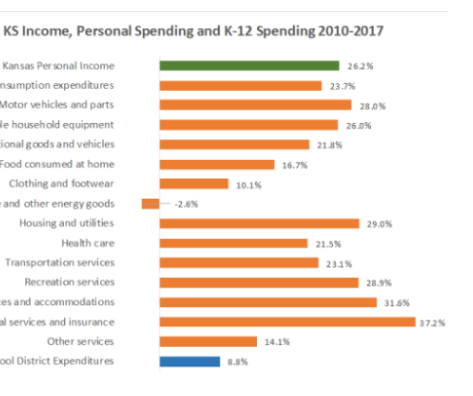
Between 2010 and 2017, Kansas personal income increased from $112.1 billion to $141.5 billion, or 26.2 percent. Personal consumption expenditures increased from $86.1 billion to $106.4 billion, a slightly lower rate of 23.7 percent.

Total school district expenditures increased from $5.5 billion to $6.1 billion, or 8.8 percent. School expenditures dropped from 5.0 percent of Kansas personal income in 2010 to 4.3 percent in 2017.

The 8.8 percent increase in K-12 expenditures between 2010 and 2017 was lower than any category of personal expenditures except for gasoline and other energy goods, which decreased 2.6 percent in 2010 and 2017.

Expenditures on Financial Service and Insurance (37.2 percent), Food Services and Accommodations – dining out and lodging (31.6 percent), Housing and Utilities (29.0 percent), Recreational Services (28.9 percent) and Motor Vehicles and Parts (28.0 percent) increased faster than Kansas personal income.

Expenditures on Furnishing and Household Equipment (26.0 percent), Transportation Services (23.1 percent), Recreation Goods and Vehicles (21.8 percent), Health Care Services (21.5 percent), Food and Beverages Consumed at Home (16.7 percent) and Clothing (10.1 percent) increased less than personal income but more than K-12 expenditures.


The amount of spending on K-12 educational also ranks low compared to major personal expenditure categories. Kansas spent $21.9 billion on Housing and Utilities in 2017, $18.7 billion on Health Care Services, $17.7 billion on Financial Services and Insurance, $10.1 billion on transportation services, vehicles and fuel, $8.7 billion on Food and Beverages at home, $7 billion on recreational goods and services and $6.3 billion on Food Services and Accommodations (dining out and lodging), compared to $6.1 billion on K-12 education. Only Clothing and Footwear, at $2.7 billion, was lower than school district spending.


This data indicates that Kansas expenditures on public education have actually been a declining share of total income by Kansas since 2010 and that other categories of expenditure have grown faster than education funding. In fact, that has been true as far back as 2000. Since 2000, K-12 expenditures increased 74.6 percent, personal consumption expenditures 78.6 percent and Kansas personal income 84.9 percent.

There would be no problem spending less on K-12 education and more on personal goods and services if Kansas were getting the education results they want and need, and/or if funding made no difference in educational results. However, Kansas education funding has fallen behind inflation and other states, as have Kansas average teacher salaries. Although Kansas ranks above average national and regionally in educational outcomes, other states have been increasing funding more and improving results faster.

To meet future employment needs and compete with other states, Kansas needs to graduate more students from high school and postsecondary education. The states with the highest educational outcomes tend to spend more per pupil than most states, already spend more than Kansas; and have higher personal income and lower poverty rates. If Kansas continues to spend less on K-12 education, it will ultimately mean less personal income to spend on everything else.

There is another impact of personal expenditure changes. Since 2000, spending on “goods” has increased by 56.1 percent and spending on “services” increased 92.5 percent. Because the Kansas sales tax is generally applied to goods and not to services, this shift in consumption from goods to services is one major reason state revenues have been growing more slowly, and why lowering state income tax rates and relying more heavily on consumption taxes that do not includes services will likely further reduce revenues for public services like K-12 education.

Definitions:

Total personal income is the income received by, or on behalf of, all persons from all sources: from participation as laborers in production, from owning a home or business, from the ownership of financial assets, and from government and business in the form of transfers; from domestic sources as well as the rest of world. It does not include realized or unrealized capital gains or losses.

Essentially, the difference between personal income and consumption expenditures is the total of taxes paid, personal interest payments and transfer payments to governmental programs such as social security, and personal savings.

Total K-12 expenditures is all spending by Kansas school districts, including state, federal and local funding. Most of this revenue is from taxes, but a portion is personal payments, such as lunch fees and charges for student materials and transportation.

Mark Tallman is Associate Executive Director for Advocacy for the Kansas Association of School Boards.

Arlan Dean Parker

Arlan Dean Parker, son of Harold H. and Leona M. (Stowell) Parker was born in Cotesfield, NE, on August 12, 1933, and went home to glory on October 29, 2018, in Ness County Hospital at the age of 85 years 2 months, and 17 days.

At a young age, his family moved to the Utica, Shields, Dighton, KS, area where he lived until 1953 at which time he enlisted in the United Sates Navy and served during the Korean War. He was discharged from the Navy in May, 1957.

On June 16, 1957, he married Juanita Kay Pember in Ness City, KS. They shared 61 years of marriage. To this union one son, Harlan Duane was born. A daughter Patricia Anne was adopted in September, 1969, and became an integral part of their family.

After their marriage, Arlan spent the rest of his life in Ness City, During this time, he was a farmer/rancher, custom harvester, store clerk, fuel delivery person, and a custom planter. The highlight was probably when he and Juanita started a herd of registered Salers cattle. Their cattle were recognized for their gentle disposition and ability to produce quality offspring.

After Juanita’s retirement in 1998, the couple enjoyed many trips and cruises together. One of their favorite vacation spots was Branson, MO. Arlan loved the country/western shows. He especially loved driving to Baltimore to see Harlan and his family with a stop in Missouri to see Patty and her family.

Arlan was noted for his ability to listen. If one had a problem, Arlan was always ready to lend a helping hand. He was a member of First Baptist Church, Ness City, and served in many different areas of church life.

He also served as a member of the first Auxiliary Police Group in Ness City.

Survivors include his wife Juanita, son Harlan (Laura) Phoenix, MD; grandchildren Elysha McAdoo, Springfield, MO; Dylan Parker, Townson, MD; Benjamin McAdoo, Lake St. Louis, MO; and Christian Parker, Phoenix, MD. Special friends are Barbie, Taylor, and Brett Scholes, Hutchinson, KS; Mike & Shell Hill, Great Bend,KS, and Caleb and Mandee Rogers and daughters, Polo, MO.

Arlan was preceded in death by his daughter Patricia; two sisters, Mildred Parker, and Pearl Walker, son-in-law Stephen McAdoo, and two brothers-in-law, Bill Walker and Eugene Birdsong.

Memorial service will be at 10:30 a.m. on Saturday, November 3, at First Baptist Church in Ness City, with internment in Ness City Cemetery.

Memorials to First Baptist Church, Ness City, are suggested.

The Latest: Trump says birthright citizenship will be ended

WASHINGTON (AP) — The Latest on President Donald Trump’s stance on immigration issues (all times local):

President Donald Trump says the right to citizenship for babies born to non-U.S. citizens on American soil “will be ended one way or the other.”

As Trump considers an executive action to curtail what he terms “so-called Birthright Citizenship,” he tweets that “It is not covered by the 14th Amendment.”

He added Wednesday: “Many legal scholars agree” with his interpretation.

In fact, House Speaker Paul Ryan and scholars widely pan the idea that Trump could unilaterally change the rules on who is a citizen. And it’s highly questionable whether an act of Congress could do it, either.

Trump has discussed the issue before and reinjected it into the political conversation just days before the 2018 midterms as he looks to energize his base.

___

12:30 a.m.

President Donald Trump is rushing out hardline immigration declarations, promises and actions as he tries to mobilize supporters to retain Republican control of Congress in the midterm elections.

Trump says he’s sending thousands of U.S. troops to stop an “invasion” of migrants at the U.S.-Mexico border even though the migrants are on foot hundreds of miles away. Trump says tent cities could be set up for asylum seekers even though that would not resolve the massive U.S. backlog of asylum seekers. And Trump says he’d like to end the Constitution’s guarantee of birthright citizenship even though most legal scholars say that would require a new constitutional amendment.

Trump says this “has nothing to do with elections,” but his timing is striking.

Trump’s presidential campaign in 2016 concentrated on border fears, and that’s his final-week focus in the midterm fight.

FHSU shotgun team places first in five-state conference

FHSU University Relations

Fort Hays State University’s Shotgun Team recently attended the 8th annual Prairie Circuit Classic 5-State Conference, where they were the first-place team in four out of five events and won the high overall team trophy.

The conference, held at the Lincoln County Wildlife Gun Club near Lake Maloney south of North Platte, comprised a total of 147 shooters from 11 different colleges including FHSU, University of Colorado, Concordia University and the University of Wyoming.

Shepard

FHSU’s team won first in skeet, skeet doubles, trap and super sporting, and also placed second in trap doubles.

Scores from the five events are totaled for each individual shooter. The top 10 men and the top five women overall are named to the all-conference team. The same is done for freshman shooters, but only the top five men and five women are named to the all-conference freshman team.

FHSU shooters who attended are listed alphabetically by hometown.

AKRON, Colo.: Jenny Schoenecker is a senior majoring in agricultural business
AURORA, Neb.: Lane Sorensen is a sophomore majoring in agriculture.
AVOCA, Neb.: Katie Dettmann is a freshman majoring in management.
BURWELL, Neb.: Austin Svoboda is a senior majoring in technology studies.
CAMBRIDGE, Neb.: Jake Whipple is a senior majoring in agricultural business.
COLBY: Keegan Morgan is a senior majoring in agricultural business.
FAIRBURY, Neb.: Brock Barton is a freshman majoring in information networking and telecommunications.
GEM: Jay Ziegelmeier is a senior majoring in agricultural business.
Cole Ziegelmeier is a junior majoring in agricultural business.
HASTINGS, Neb.: Blake Craig is a sophomore majoring in agricultural business.
JANESVILE, Wis.: Luke Heinzen is a junior majoring in agricultural business.
JEWELL: Michael Saint is a graduate student majoring in business administration.
LINCOLN, Neb.: Hank McVeigh is a freshman majoring in physics.
McCOOK, Neb.: Colton Lashley is a senior majoring in criminal justice.
MILBURN, Neb.: Gus Dunbar is a freshman majoring in technology studies.
MILLIGAN, Neb.: Bailey Steuben is a sophomore majoring in agriculture.
MINNEOLA: Jerrod Lies is a senior majoring in agricultural business.
NORTH PLATTE, Neb.: Josh Crankshaw is a senior majoring in technology studies.
ORD, Neb.: Hailey Zulkoski is a freshman majoring in health and human performance.
PINE VALLEY, Calif.: Heather Gordon is a junior majoring in nursing.
PLEASANTON: Hunter Secrest is a sophomore majoring in agricultural business.
PLEASANTON, Neb.: Cody Escritt is a senior majoring in technology studies.
SHELL KNOB, Mo.: Cordell Waggoner is a sophomore majoring in tourism and hospitality management.
ST. GEORGE: Will Dulohery is a freshman majoring in technology studies.
ST. PAUL, Neb.: Riley Ross is a sophomore majoring in agriculture.
TOPEKA: Wyatt Pursell is a sophomore majoring in agricultural business.
WORDEN, Ill.: Ryan St. Peters is a freshman majoring in agriculture.

FHSU shooters who were named to the all-conference team were: Svoboda; Whipple; Ross; Crankshaw; Pursell; Jay Ziegelmeier; Gordon; and Zulkoski.

FHSU shooters who were named to the all-conference freshman team include: Zulkoski; Dettman; McVeigh; Dulohery; and Barton.

Gordon was recognized as the high overall woman, Svoboda was tied for the high overall man and Zulkoski was recognized as the high overall freshman woman.

“Most of the shooters have been on the team their entire college career, so a major strength of the team is our depth of quality shooters,” said Dr. Duane Shepherd, coach for the team and associate professor of health and human performance.

“We have an outstanding group of shooters and are blessed with a quality group of young shooters who are continuing to get better,” he said.

Results can be viewed HERE.

Rita Kay Case

Rita Kay Case, age 51, of Johnson, Kansas, died Sunday, October 28, 2018, at her home in Johnson, Kansas. She was born September 13, 1967, in Garden City, Kansas, the daughter of Pete Marion and Joice Joan (Schriner) Marquardt.

Rita graduated from Garden City High School in 1986. While living in Garden City, she worked at McDonald’s and IBP. Rita married Johnny Sauseda, Sr. in 1984, they later divorced. To this union a son, Johnny Sauseda, Jr. was born. Rita married Paul Case on March 22, 1997, in Johnson. Rita was a wife, mother, and a caregiver to her mother for several years. She had also been a substitute mail carrier, cook for Big Bow School, para at Johnson School, receptionist at Stanton County Hospital, and waitress at Hug-A-Mug. Rita enjoyed shopping and hunting for a good bargain.

Rita is survived by her husband, Paul of the home; sons, Johnny Sauseda, Jr. of Lawrence, and Corey Schmidt of North Glenn, Colorado; daughter, Kortney Case of Hays; sisters, Peggy Fecht of Colorado Springs, Colorado, Sarah Ludwig of Towanda, Helen Blevins and husband John of Hutchinson; brother-in-law, Ron Bauer of Meade, Kansas; aunt, Norma Hill of Grand Island, Nebraska; and three grandchildren.

She is preceded in death by her parents, sisters, Joice Marion Marquardt and Lesa Bauer.

Funeral service is Friday, November 2, 2018, at 2:00 PM at Fields Memorial Wesleyan Church in Johnson, Kansas, with Reverend Kurt Rovenstine presiding. Burial will follow at the Stanton County Cemetery in Johnson, Kansas. Friends may call Thursday, November 1, 2018, from 2:00 p.m. until 8:00 p.m. at Garnand Funeral Home in Johnson, Kansas.

Memorials may be given to Rita Case Memorial Fund in care of Garnand Funeral Home, PO Box 715, Johnson, Kansas 67855.

Copyright Eagle Radio | FCC Public Files | EEO Public File