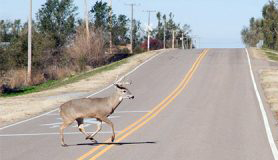
TOPEKA — The reality of driving on Kansas roads and highways from now through spring is the possible encounter with a deer, according to Ken Selzer, CPA, Kansas Commissioner of Insurance.
“The national statistics concerning deer-vehicle crashes are sobering,” Commissioner Selzer said. “Kansas is one of the top 20 states in frequency of deer-vehicle mishaps, even though the chances have decreased over the past two years.”
According to State Farm Insurance, which tracks national deer crash information:
The chance of a driver having a vehicle collision with a deer in Kansas is approximately 1 in 130.
Nationwide, from July 1, 2017 to June 30, 2018, there were 1.33 million deer-related vehicle accidents.
The national average cost per vehicle claim from a deer-vehicle collision hovers around $4,300, a number that grows each year.
Iowa, Missouri and Arkansas have higher frequencies of deer mishaps than Kansas, with Oklahoma, Nebraska and Colorado showing a lower frequency than the Sunflower State.
“To be proactive, Kansas motorists should check with their insurance agents to find out the type of vehicle accident coverage their policies have,” Commissioner Selzer said. “Deer accidents are usually covered under a person’s comprehensive coverage, not collision coverage. You will have to pay your deductible amount in order to receive your company’s coverage. However, if you have liability only for your vehicle coverage, you will probably have to cover the damage repairs out of your own pocket.”
When a vehicle-deer crash occurs, Commissioner Selzer urges Kansas drivers to consider the following:
Contact your insurance agent or company quickly to begin the claims process.
If you do hit a deer and are uncertain whether the animal is dead, keep your distance. You might be dealing with an injured, wild animal with sharp hooves.
If the deer is blocking the roadway and poses a danger to other motorists, you should immediately report the incident to the local law enforcement agency.
Stay alert, always wear your seat belt and drive at a safe, sensible speed for conditions.
Watch for the reflection of deer eyes and for deer silhouettes on the shoulder of the road.
Do not rely exclusively on devices such as deer whistles, deer fences and reflectors to deter deer.
When driving at night, use high-beam headlights when there is no opposing traffic. The high beams will illuminate the eyes of deer on or near a roadway.
Brake firmly when you notice a deer in or near your path, but stay in your lane. Many serious accidents occur when drivers swerve to avoid a deer and hit other vehicles or lose control of their cars. Potentially, you will risk less injury by hitting the deer.
If you see one deer, it is likely there are more nearby.
If the deer stays on the road, stop on the shoulder, put on your hazard lights and wait for the deer to leave the roadway; do not try to go around the deer while it is on the road.
“If you do have a deer encounter and need some assistance with your vehicle claim, our Consumer Assistance Representatives at the Kansas Insurance Department can help,” said Commissioner Selzer. “Call us at 800-432-2484, or use the online chat feature at our website, www.ksinsurance.org.”
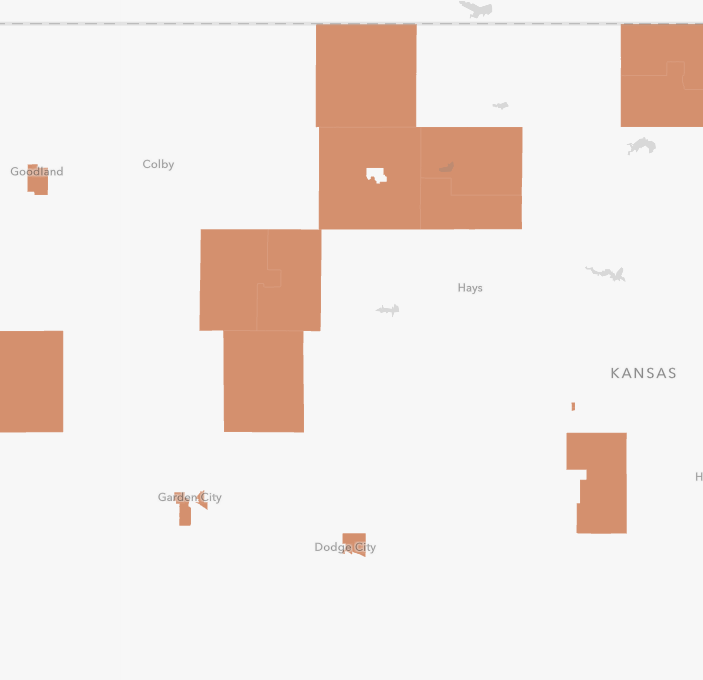
Click HERE for a map of Opportunity Zones, which includes areas of northwest Kansas.
By MARCY GORDON AP Business Writer
WASHINGTON — The Trump administration is proposing rules for investors in a new program that it says could have a big impact on economically depressed areas around the country. About 8,700 so-called “opportunity zones” have been set up in all 50 states to lure investors and developers with tax breaks.
The rules from the Treasury Department, issued Friday, lay out the period of time that individuals or companies must hold on to their investments in the zones to avoid paying taxes on resulting profits.
Administration officials say the goal of the program, established by the new tax law enacted last December, is to create businesses and jobs in low-income areas and lift residents out of poverty.
Treasury Secretary Steven Mnuchin predicts that $100 billion in private capital will be invested in the new zones.
“This incentive will foster economic revitalization and promote sustainable economic growth,” Mnuchin said in a statement.
But some critics say the new rules and the way the program is set up will benefit real estate developers and Wall Street funds, and will pull investment toward more well-off areas that need it least.
“The real estate industry is completely excited and mobilized about this, and now is getting paid through massive tax cuts,” said Timothy Weaver, a professor at the State University of New York in Albany who has studied similar development programs.
He said the program “doesn’t have much of an effect other than giving tax breaks to people who are going to invest anyway.”
Under the rules, the investments are open to individuals, corporations, partnerships and real estate investment trusts. Any kind of business or real estate development is qualified so long as it isn’t deemed by regulators to contribute to vice — a liquor store or massage parlor, for example. Participants can take their profits from unrelated investments and plow them into an opportunity zone fund, avoiding paying taxes on those gains until the end of 2026. Depending on how many years they hold the investment, they can reduce their eventual tax bill by up to 15 percent.
Investments within the zones held for 10 years or more are entirely free of capital gains taxes.
A new rule sets up a 70-30 split for determining if certain businesses are eligible for the tax break. Provided that at least 70 percent of a business’s “tangible” property sits within a zone, it is considered eligible even if the rest is outside the zone. An example would be individual locations of a restaurant chain, some inside and some outside.
With 30 percent of the properties allowed outside the zones, many of the new jobs could come in already booming areas, Weaver suggested. Conventional economic development programs generally require all of a business’s property to be within the affected area, he said.
Brett Theodos, principal research associate at the Urban Institute, estimates that only about 10 to 15 percent of the zones will attract investment, and that around 10 percent could get 90 percent of the money invested.
The 8,761 census tracts — in every state, the District of Columbia and five U.S. territories — now officially beckoning to investors as opportunity zones encompass some 35 million people. Based on Census data, the zones have an average poverty rate of about 32 percent, compared with the national average of 17 percent.
Governors in the states and territories put forward their choices for areas to become special development zones. Every choice — 100 percent of the areas proposed — was blessed by the Treasury Department after a four-month review.
The choices “indicate only minimal targeting of the program toward disadvantaged communities with lesser access to capital,” Theodos wrote in a research paper. “Low- and moderate-income residents will need to be able to afford to remain in their communities as the areas upgrade and not be displaced, if they are to benefit from the gains opportunity zones bring.”
Census tracts were eligible to become opportunity zones if their residents meet average low-income requirements. Some tracts with higher average incomes were allowed if they’re located next to the low-income tracts. Those better-off areas, with more infrastructure and amenities, could be more attractive to investors.
The mix will work out well, as Maurice Jones, the president of Local Initiatives Support Corp., a community development organization, sees it.
“From our perspective, the governors did a really fine job in picking places that are in distress,” Jones said in an interview.
The program has drawn bipartisan support. Even Democratic lawmakers, who fiercely opposed the tax legislation and unanimously withheld their votes for it, do like the opportunity zones program nestled within it.
Supporters see the estimated $9.4 billion in lost revenue from the program’s tax breaks as a small price — for U.S. taxpayers indirectly — to pay.
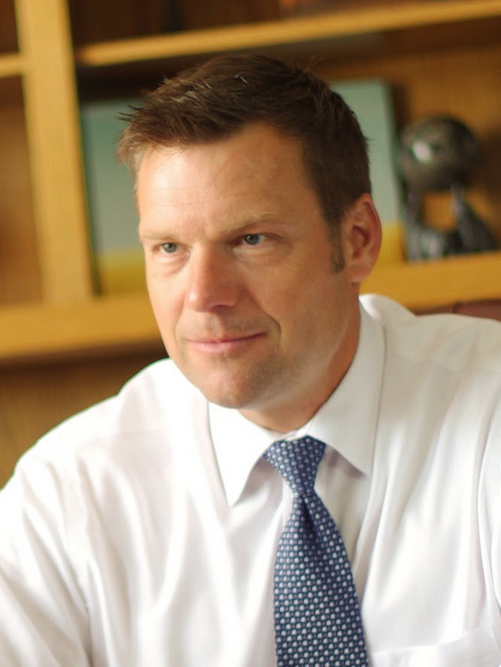
Kris Kobach made a national reputation by writing bills for Kansas and other states that opposed illegal immigration and placed restrictions on voting.
Opponents denounced him, judges ruled against some of his legal writings, (one federal judge fined him $27,000 for contempt of court). Critics have said, including in court, that many of his national and state “voter fraud” assertions are false, and that his suggestion for a Muslim national registry to help national security was a cruel and unconstitutional position.
Yet, this was what made him a friend of Donald Trump and a national name. He stands by what he’s done.
But Kansas gubernatorial candidate Kobach talks mostly taxes these days. When asked why Kansans should vote for him on Nov. 6, he pledged lower taxes, including those not directly controlled by the state. At stake, he said, are jobs, livelihoods – and retirement savings. A Republican, Kobach says his opponents, Democratic Sen. Laura Kelly and Independent candidate Greg Orman, are out of touch with voters.
What he’s heard from voters upsets him.
“Everywhere I go, people tell me how they are hurting,” he said. It’s not only state taxes but local property appraisal increases and utility bills, bills he says are 25 percent higher in Kansas than in surrounding states. “Families, elderly people who worked all their lives, and made plans, tell me they are seeing their retirement savings depleted.”
“If you look at income, property and sales taxes combined, we have the highest combined tax rate of the five-state area,” he said. “Our appraisals have been going through the roof in Kansas, our people have seen stealth tax hikes when they’ve had double-digit appraisals (on property taxes). People are being appraised out of their homes.”
The Legislature doesn’t directly set property taxes raised by municipalities and school boards but does have some say, Kobach said. If elected, he’ll ask the Legislature to impose a statutory cap of 2 percent per year on how much property tax appraisals can rise, even though critics content that may not be legally feasible. Kobach also says he will appoint members to the Kansas Corporation Commission to better-regulate utilities.
“Many of our kids are leaving after graduating from high school or college because the businesses are leaving our state,” said Kobach, a father of five. “We’ve driven many businesses out of the state because our taxes are punitively high.”
Here is what else he’d do:
State taxes. “The problem with the tax plan of 2012 was that Kansas cut taxes but did not cut spending. You can’t do it that way. There is a lot that can be cut… I was able to shrink my office, the Secretary of state’s office, from $7 million in fiscal year 2011 to $4.6 million today.”
Schools: Critics said the 2012 tax plan starved schools. Kobach says there’s not a reason to cut money for schools (or roads) if we cut elsewhere, which he says can be done. He will push for a statutory requirement that 75 cents of every school dollar go to teachers and classrooms, rather than administration. Meanwhile: “We have doubled the amount of dollars we spend on education in the last 20 years but … performance and scores have not improved – they’ve flatlined.”
More open government: If elected, he plans to personally make government more open. ”I have a policy of answering reporters’ questions personally, and not through intermediaries,” he said.
The state’s executive branch is open enough, he said. The Legislature, not so much.
“Kansas is one of the few states where the legislature does not record committee votes. And as people who follow politics know, the way you kill a bill — you kill it in committee. Right now, if you want to see how your representative is voting, you have to sit in the committee room and watch his or her lips move. It is outrageous that we don’t have that transparency. And I’ll push for that in office.”
Labor shortages: Kobach said the labor shortage in Kansas is a serious problem – and he’s willing to solve it with legal labor. He pointed out that legal immigrants from Somalia, Myanmar and Mexico have helped economies in southwest Kansas thrive. “I am only concerned with removing the illegal workforce, not the legal workforce. We should be a welcoming state to those who want to come here legally to work, whether it be in a high-tech industry or in the packing plants in southwest Kansas. We absolutely should welcome those who want to come in legally.”
One other solution: Prison labor. Some people in farming and ranching and in meat product services are looking at taking advantage of that now,” he said. “I’m willing to look at maximizing that supply of labor. That may mean moving certain inmates to facilities further west, to where the demand is highest for that.”
His opponents, Laura Kelly and Greg Orman: “Two Democrats,” he said with a grin. (Orman is on the November ballot as an Independent). They are out of step with most Kansans regarding taxes, gun rights, abortion and small government, he said.
The media: The news media is not “the enemy of the people.” “The vast majority of reporters in Kansas are doing a good job.” But – editorial pages over the last 30 years have “gone so far to the left.”
Kobach, 52, grew up in Topeka and earned degrees at Washburn, Harvard, Yale and the University of Oxford. He has served the last eight years as Kansas Secretary of State.
His running mate is Wink Hartman.
– Roy Wenzl is an award-winning journalist who formerly reported for the Wichita Eagle.
Just like Eber Phelps sending out negative attack mailers against me a few weeks ago, his latest personal negative attack mailer is just another desperate attempt by him to divert attention away from the fact that after serving as a state representative for 18 years – an entire generation – he has become a “professional politician” in Topeka. IT IS TRULY TIME FOR A CHANGE!
Let’s put the facts in their proper context. During the 8 years I served on the Hays City Commission and the 6 years I have been serving on the Ellis County Commission my attendance record is 90%. During the times when my absence was unavoidable, I did my best to coordinate in advance with my fellow Commissioners and the County Administrator to ensure business could be conducted.
I will not allow my campaign to lower itself to the level of Mr. Phelps’ campaign. I will continue a positive campaign focused on the issues, and let the voters decide whether they want a fresh new voice in Topeka or the same old voice that has been there for an entire generation – 18 years.
If missing a handful of meetings due to my recovery from open heart surgery, and if taking care of my 91-year-old mother (who lived in Chicago and now lives in Savannah, Georgia) from time to time disqualifies me from holding public office in the eyes of some voters and the local and state Democratic Party then we’ve got a real societal problem in this community.
Barbara Wasinger, R-Hays
Candidate for 111th District
Kansas State Legislature
Few issues split Kansas politics like the Obama-era expansion of Medicaid.
Unlike 33 other states, Kansas still hasn’t expanded its Medicaid program under the Affordable Care Act. The decision would pay for the health care of thousands of people who don’t currently meet the program’s stringent eligibility requirements.
The state’s program, KanCare, pays for the health care of 400,000 low-income Kansans — mostly children, pregnant women, and elderly or disabled citizens. It costs the state more than $3 billion a year.
Currently, KanCare doesn’t cover people who fall into the so-called “coverage gap.” Their incomes are too high to pass the state’s stringent Medicaid eligibility guidelines, but they make too little money to qualify for the Affordable Care Act’s subsidized insurance premiums.
Those benefits are only available to households that make over 138 percent of the federal poverty level — $25,100 for a family of four. Some do meet income requirements, but they don’t meet another eligibility guideline, like being disabled, under 19, elderly or pregnant.
In Kansas, 150,000 people fall into that gap.
They’re not eligible for Medicaid, and if they apply for health insurance through the federal marketplace, they’re on their own with no government financial assistance.
Expansion would allow them to apply for coverage through KanCare, as long as their household incomes are below 138 percent of the poverty line, and regardless of whether they meet other eligibility requirements.
Supporters say that could be a lifeline for the state’s most vulnerable residents and helps them avoid emergency room visits by giving them access to more suitable care.
“This gives them access to not just health care, but the right care,” said Cindy Samuelson, a vice president of the Kansas Hospital Association.
The issue has long been under debate.
Democrats and some moderate Republicans have argued for years that expansion would bring more health care dollars into the state economy, creating medical jobs and filling a coverage void that could keep the doors open at small, rural hospitals.
Conservatives continue to resist. They argue expansion squanders federal tax dollars and saddles Kansas taxpayers with an obligation to pay for an increasingly large share of that government health insurance.
“As much as we all want to try to provide a solid safety net for people, we have to weigh that against other priorities in state government,” said James Franko, vice president and policy director of the Kansas Policy Institute.
A bipartisan majority in the Legislature voted in 2017 for expanding Medicaid, but then-Gov. Sam Brownback vetoed it. Brownback, a Republican, said in a statementthat he opposed the bill in part because of its cost and because it didn’t require recipients to work.
Gov. Jeff Colyer, also a Republican, served as lieutenant governor in Brownback’s administration and has followed his lead in supporting Medicaid work requirements and opposing the Affordable Care Act — including expansion.
The 2018 governor’s race will decide the issue in Kansas for years to come.
Medicaid certainly won’t expand if Republican Secretary of State Kris Kobach wins the race. Democratic state Sen. Laura Kelly has promised to sign a bill approving expansion in her first year. Independent Greg Orman also says he supports expansion.
“The governor is extremely important,” said April Holman, executive director of the Alliance for a Healthy Kansas, who advocates for expansion. “If we don’t have a governor who supports expansion, we probably would have a similar result to what we have had in the past.”
Here’s what you need to know about each candidate’s stance.
Senator Laura Kelly
Laura Kelly
Kelly voted in favor of the Medicaid expansion bill that went through the state legislature in 2017. Her position hasn’t changed.
On her campaign website, Kelly promises to “advocate for and sign legislation to expand Medicaid in her first year.”
Kelly cites rural hospital closures as a major reason to expand Medicaid.
Rural facilities, such as the recently shuttered Mercy Hospital in Fort Scott, often struggle to cover operating costs while treating areas with higher-than-average proportions of elderly, poor and disabled residents.
In a statement, Mercy Hospital cited “declining reimbursement, especially from government payers which make up the largest source of revenue” as a major reason for closing.
Medicaid expansion isn’t a perfect solution for the problems faced by rural hospitals, said Diane Rowland, executive vice president of the Kaiser Family Foundation.
“Most of them are small, most of them have some economic challenges in terms of being able to even recruit adequate staff and physicians there, because of the medical shortages that plague rural areas,” she said.
Rowland says funds from Medicaid expansion could, however, greatly improve the financial stability of vulnerable hospitals, increasing treatment options for people in rural areas.
“We’ve seen far fewer rural hospitals close and expansion states than in the non-expansion states like Kansas,” Rowland said.
Kelly also argues that Medicaid expansion would create new jobs in the state’s health care industry.
Samuelson said hiring new doctors, nurses, administrative staff and other workers can have a ripple effect on the rest of the economy.
“That nurse is going to also shop at the grocery store, and get gas, and utilize the bank, and have a home, and all these other things that stimulate other jobs in the economy,” she said. “Maybe they’ll have kids in school and there’s another teacher.”
Greg Orman
Photo courtesy Orman -Doll for Kansas
Orman also supports expanding Medicaid for economic reasons.
The independent candidate told the Kansas News Service he wants to encourage recipients to work by ensuring they’ll still get Medicaid at higher income levels.
“We send a terrible message to people in Kansas who are working and not making a lot of money, which is, ‘If you get sick, quit your job,’” he said. “Ultimately, we need to be building pathways to allow people to improve their lives, not creating these very perverse incentives.”
A platform paper published on Orman’s campaign website argues that expanded Medicaid could attract workers from out of state.
“Someone making $13 per hour in a family of three in Colorado gets healthcare coverage as part of their decision to work in Colorado,” Orman’s paper reads. “That same person in Kansas gets no health care coverage unless an employer provides it. Given the shortage of workers in Kansas, this puts us at a significant disadvantage.”
Holman said more medical coverage could also attract employers to the state, and not just in the health care industry.
“Employers want to be in communities where there is a hospital and where there is care that would be available to their employees,” she said.
Orman’s platform describes a way to pay for the state’s share of the cost of expansion. The federal government has promised to pay 93 percent of expansion costs in 2019, and will pay 90 percent of costs in 2020 and beyond.
Orman proposes covering the remaining 10 percent through taxes on the health care industry, which he expects will bring in larger profits due to expansion.
Kris Kobach
Kris Kobach during a September visit to Salina Tech.
Kobach joins his Republican colleagues in opposing Medicaid expansion, calling the policy too expensive and unrealistic.
His campaign website does not have a section for health policy, but Kobach has mentioned his opposition to the Affordable Care Act in numerous speeches. He’s promised to ask President Trump for waivers to exempt Kansas from Obamacare requirements.
“The better approach is to do something smart, and look at whether we can spend that money effectively,” Kobach said at a debate at the Kansas State Fair in September.
Kobach says he wants to integrate KanCare with a payment system called direct primary care, sometimes called “concierge medicine.”
Direct primary care patients pay a monthly or yearly fee for unlimited primary care visits and reduced prices on medications and lab testing. Orman also supports the idea of allowing KanCare recipients to choose the option of direct primary care.
Kobach, however, has not addressed how KanCare would cover needs like nursing home payments and home care, which comprised 39 percent of KanCare expenditures in 2016. Direct primary care doesn’t cover emergencies, hospitalizations or specialized care, which don’t fall under the umbrella of “primary care.”
The Kobach campaign has not responded to repeated requests for further information on the plan, although Kobach told the Kansas News Service that he plans on testing the idea with a pilot program in one county or region before expanding it statewide.
“I anticipate it would create a significant amount of savings and it would be very favorably received by the KanCare patients who use it,” Kobach said. “Where direct primary care has been used in the private sector, the doctors love it and patients love it.”
SHAWNEE COUNTY — One person died in an accident just after 10:30p.m. Saturday in Shawnee County.
The Kansas Highway Patrol reported a 1993 Jeep Wrangler driven by Donald Ray Heckman, 73, Park City, Montana, was eastbound on Interstate 70 at Valencia Road.
The Jeep changed lanes in front of a 2015 Kenworth Semi and then reduced speed. The semi driven by Norman Vincent Leach, 43, Colorado Springs, Colorado, rear ended the Jeep.
Heckman was pronounced dead at the scene. Leach was not injured. Both drivers were properly restrained at the time of the accident, according to the KHP.
TOPEKA – The week of November 12-16 has been named Apprenticeship Week in the State of Kansas. This is being done to recognize the value and importance of the statewide Registered Apprenticeship Program in meeting the workforce needs of Kansas employers. The Registered Apprenticeship is an industry-driven model that combines on-the-job learning with job-related instruction leading to increasing levels of measurable skill attainment and wages.
There are presently 1928 registered apprentices in Kansas receiving both on-the-job training and paid employment from 257 employers, with the numbers growing weekly. Through this program, apprentices receive on-the-job training from an experienced mentor for at least a full year, providing a living wage while training for a career position. They also earn credentials which can be carried forward throughout their careers. At the same time, employers benefit by meeting their growing need for a trained workforce, experience lower turnover costs and higher productivity, and reduce their costs for recruiting personnel.
Apprenticeship Week will begin with a ceremony in Wichita, featuring a speech from the Mayor, on November 13. In early November, Governor Jeff Colyer, M.D., will be on-hand to present the Governor’s proclamation and speak about the benefits of Registered Apprenticeships toward meeting the workforce needs of Kansas employers.
Feast on savory samples from 16 Hays restaurants at Habitat for Humanity of Ellis County’s annual Vine & Dine fundraiser, Sunday, Oct. 28, 12 noon to 4 p.m. at Big Creek Crossing, 2918 Vine.
Win great raffle prizes donated by area restaurants and businesses and help Habitat raise funds to create more affordable housing.
Proceeds will go to Habitat for Humanity to build affordable homes for low-income working families.
Restaurants providing samples from their menus include:
Applebee’s Neighborhood Grill and Bar
Freddy’s Frozen Custard & Steakburgers
Gella’s
Golden Griddle
Hickok’s Steakhouse
Jalisco Restaurant
JD’s Chicken
Jimmy John’s
Old Chicago
Pasta Jay’s Hays
Pizza Hut
Professor’s
Starbucks
Taco Shop
Thirsty’s Brew Pub and Grill
Whiskey Creek Wood Fire Grill
Win raffles for dinners and merchandise from:
Cancun, Dillon’s, El Dos De Oros, G & L Tire and Automotive, GameStop, Gutierrez Mexican Restaurant, Osaki Japanese Restaurant, Pheasant Run, Popt!, Sake2Me, Vernie’s Hamburger House and more.
Habitat thanks our participating restaurants and merchants, Big Creek Crossing for generously providing space and our dedicated volunteers for making our work possible.
About Habitat for Humanity of Ellis County
Habitat for Humanity of Ellis County (HFHEC) began in 2003 and is an affiliate of Habitat for Humanity International. HFHEC’s mission is to put God’s love into action by bringing people together to build homes, community and hope. HFHEC has built two homes in Hays and one each in Russell, Victoria and Ellis. Go to hfhec.org to learn more about HFHEC’s work, how to volunteer or how to qualify for a Habitat home.
ANDOVER, Kan.-The end comes too soon sometimes and that was the case Saturday afternoon for the Hays High Lady Indian Volleyball squad. The Lady Indians fell to Valley Center in the semi-finals of the Class 5A Sub-State Tournament in Andover.
Hays High started slow in both sets against the Lady Hornets trailing 1-6 in the first and second sets. In the first set the Lady Indians battled back to tie the set at 15-15 and again at 19-19 but were never able to take the lead and fell 19-25. The second set was the same song, different verse except Hays was able to take a lead, albeit brief, at 7-6. That would be the only lead of the day for the Lady Indians as they lost the second set 21-25.
Kallie Leiker led Hays with 11 digs and Tasiah Nunnery with 11 kills. Hannah McGuire paced the Lady Indians with 14 assists while Nunnery and Jaysa Wichers both finished with three solo blocks. The match was the final for a big group of seniors. Leiker, McGuire, Wichers, Savannah Schneider, Jaycee Dale, and Madyson Flax all played their final match of their high school volleyball careers. The Lady Indians finished their season at 24-12.
SHAWNEE COUNTY— Law enforcement authorities are investigating a suspect in connection with a weapons charge.
McCulley -photo Shawnee Co.
Just before 11:30p.m. Friday, police were dispatched to the area of the 700 block of NE Kellam in Topeka on an unknown trouble call, according to Lt. Manuel Munoz. Dispatch advised that they could hear someone yelling, “Give me back my gun.”
Upon arrival, officers determined that the call was regarding a domestic disturbance. Further investigation determined that Jeremy McCulley, 34 years of age, was in possession of a firearm by a convicted felon.
Police transported McClulley to Shawnee County Department of Corrections under suspicion of crimes related to this incident.
Anyone with information regarding this crime is encouraged to contact the Topeka Police.
KANSAS CITY, Kan. (AP) — Authorities and rescue personnel spent part of Friday night searching for a male victim who drove a vehicle into the Kansas River.
Police said that the incident happened around 6:50 p.m. Friday at the Kaw Point Park boat ramp in Kansas City, Kansas, at the confluence of the Kansas and Missouri rivers.
Wyandotte County Sheriff’s officials say someone reported seeing a vehicle go into the river. Kansas City, Kansas, Police Chief Terry Zeigler tweeted that a witness saw a man treading water before he went under and didn’t resurface.
Rescue boats were sent out Friday night, but crews did not report finding anyone in the water.
Officials had not released any more information on the incident by midday Saturday.
 KID












 Today


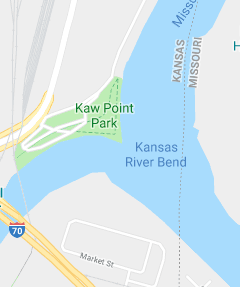
 Police said that the incident happened around 6:50 p.m. Friday at the Kaw Point Park boat ramp in Kansas City, Kansas, at the confluence of the Kansas and Missouri rivers.