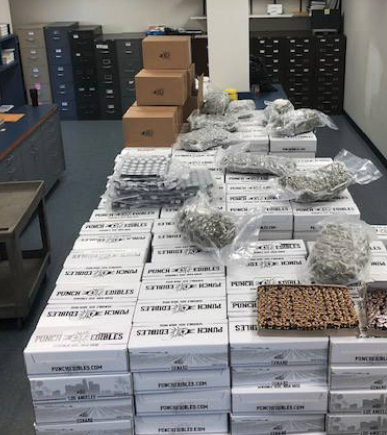
SEWARD COUNTY, NE —State troopers arrested two people and seized more than 1,600 pounds of edible marijuana products, THC wax, and marijuana during a traffic stop on Interstate 80, approximately 160 miles north of Salina, Kan., according to a media release from the Nebraska State Patrol.
Photo courtesy Nebraska State Patrol
The traffic stop occurred at approximately 2:30 p.m. October 11, when a trooper observed an eastbound 2018 Dodge Caravan speeding near mile marker 385. During the traffic stop, the trooper detected criminal activity and conducted a search of the vehicle.
Troopers found 488 boxes containing 50 THC candy bars in each box, 465 units of THC wax, and 11 pounds of marijuana. The total weight was 1,640 pounds. Estimated street value of the illegal products is more than $550,000.
The driver, Anthony Iovieno, 44, and passenger, Casey Pichette, 38, both of North Grafton, Massachusetts, were arrested for possession of controlled substances with intent to deliver. Both were lodged in Seward County Jail.
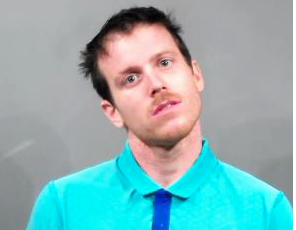
WICHITA, KAN. – A Kansas man pleaded guilty to robbing a Quik Trip in Wichita, according to U.S. Attorney Stephan McAllister.
Vliet -photo Sedgwick Co.
Samuel L. Vliet, 26, Wichita, Kan., pleaded guilty to one count of robbing a commercial business. In his plea, he admitted that on July 18, 2018, he robbed a Quik Trip at 110 S. Rock Road in Wichita. After Vliet left the store with money from the register, investigators lifted prints from a door where the clerk saw the robber touch the glass. The prints helped investigators identify Vliet and arrest him.
Sentencing is set for Jan. 3. He faces a maximum penalty of 20 years in federal prison and a fine up to $250,000.
TOPEKA—Many Kansas drivers will have the option to renew their license online starting October 23, just one customer service improvement in a list that includes new Monday hours and faster customer processing time, the Division of Vehicles announced.
The option for some drivers to renew using the iKan mobile application comes alongside the launch of KanLicense, a software program that updates the interface used by driver’s license examiners from an outdated mainframe system to a cloud based application. The modernized software program should decrease customer processing time.
“We are so pleased to jumpstart improved customer service with these new applications,” Director of Vehicles David Harper said. “The combination of these two new platforms set the stage for the long-term reinvention of the process of obtaining or renewing a license or ID across Kansas.”
Starting October 29, the new schedule for most driver’s license offices will be 8 a.m. to 5 p.m. Monday through Friday. The addition of Monday service, plus the option for mobile renewals and faster counter service should ease pressure and wait times during the week. Opening for service on Saturdays will remain an option during peak times such as spring break.
“We are significantly expanding our capacity to serve our customers,” Director Harper said. “We will be open normal business hours everyone is accustomed to, but also offer 24/7 access for renewals on the iKan mobile application.”
Director Harper noted that high demand will remain as Kansans come into the office to upgrade to a Real ID credential ahead of the October 1, 2020 federal implementation date.
“We are modernizing the credential process for the long-term, but many people will still have to come in to get their Real ID before the one-time federal implementation event,” Director Harper said. “We continue to encourage our customers to make sure they have all the documents they need before getting to the office.”
Driver’s and ID holders can use a Real ID checklist at ksrevenue.org/realid to ensure they have the necessary documents.
Driver’s license offices statewide will be closed Saturday, October 20 to prepare for the launch of the KanLicense system.
KANSAS CITY – A Kansas City man who was involved in a hit-and-run accident before leading police on a car chase that ended when he crashed into a pole and another vehicle, pleaded guilty in federal court Friday to illegally possessing a firearm.
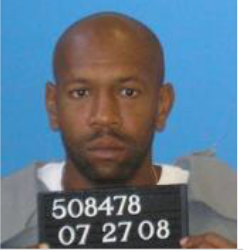
Coleman -photo Mo. Dept. of Corrections
James C. Coleman, 48, pleaded guilty before U.S. District Judge F. Sachs to being a felon in possession of a firearm.
According to court documents, Coleman was involved in a hit-and-run accident at the intersection of E. 67th Street and College Avenue in Kansas City, Mo., at approximately 1 a.m. on Oct. 4, 2017. The driver of the vehicle that was hit told police officers that a Volkswagen station wagon (later determined to be driven by Coleman) failed to stop for the stop sign and struck his vehicle. He also told police officers that Coleman, who appeared to be high, got out of his car but then left the scene of the accident without exchanging any information.
A Kansas City police officer saw Coleman’s vehicle shortly after the hit-and-run accident. The officer fell in behind Coleman’s vehicle and watched as the station wagon struck a curb. The officer activated his patrol car’s emergency lights and siren, but Coleman refused to stop and a pursuit began.
The car chase continued until Coleman struck a city utility pole and crashed into a Lincoln Continental in the 6800 block of Bales Avenue in Kansas City. Officers noted the vehicle had damage on all sides with multiple air bag deployments. Coleman, who was still inside the overturned vehicle, was lying on his back across the passenger door with his legs coming out of the vehicle’s sun/moon roof. Coleman appeared as though he had tried to crawl out of the passenger side of the vehicle.
A police officer saw a loaded Smith and Wesson 9mm pistol lying inside Coleman’s vehicle. After pulling Coleman out of the vehicle, an officer saw a clear baggie that contained what was later determined to be six individual baggies of cocaine. Coleman was transported by ambulance to a nearby hospital for evaluation and treatment of his injuries.
Under federal law, it is illegal for anyone who has been convicted of a felony to be in possession of any firearm or ammunition. Coleman has three prior felony convictions for drug trafficking and a prior felony conviction for stealing.
Under federal statutes, Coleman is subject to a sentence of up to 10 years in federal prison without parole. The maximum statutory sentence is prescribed by Congress and is provided here for informational purposes, as the sentencing of the defendant will be determined by the court based on the advisory sentencing guidelines and other statutory factors. A sentencing hearing will be scheduled after the completion of a presentence investigation by the United States Probation Office.
This case is being prosecuted by Assistant U.S. Attorney Matthew Moeder. It was investigated by the Kansas City, Mo., Police Department.
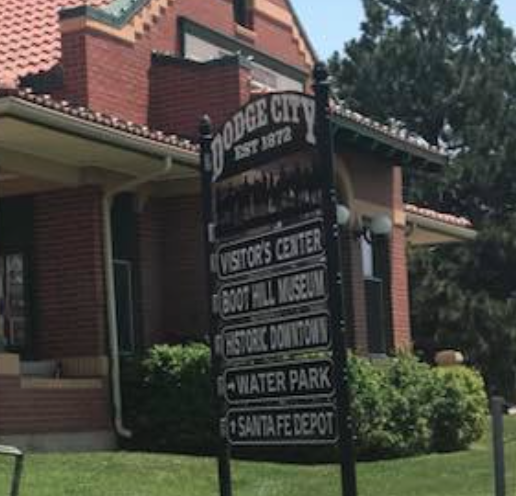
DODGE CITY, Kan. (AP) — Groundbreaking for an expansion project at the Dodge City Boot Hill Museum is scheduled for Nov. 1.
Plans are to construct a new 12,000-square-foot building to house nine new exhibits, a gift shop and a 3,000-square foot temporary exhibit hall.
Daily gunfights, shows, and dinners will continue during the summer season as they have for more than 60 years.
The museum expansion project will have an estimated cost of $5.5 million. STAR bond money will cover about 78 percent of the new building, leaving the museum to fund the rest.
The museum has raised $1 million to fund most of the interior costs of the new building. It will be the largest expansion project in the history of the museum, which opened in 1947.
The Eagle radio auction is coming up on October 18th and 19th on stations 101.9FM and 94.3FM KAYS. We will have thousands of items to bid on and buy beginning at 8 a.m. each day. To place a bid call 785-301-2211.
You can see a complete sale bill including when each item will sell by clicking HERE.
Below is one of our featured items on this year’s auction:
Bad Boy “Outlaw” zero turn mower from Farm Implement and Supply
Retail Price $9399
Features 61” cut, Yamaha 824 cc with 27 1/2 horsepower engine, solid steel deck, hydro-gear 4400 integrated drive system, dual lever steering-independent control, 19 position manual assist deck, 2”x 3” four rail frame construction, and steer Tek precision drive system. Manufactures Warranty.
That’s Bad Boy! Mow with an attitude.
Farm Implement and Supply, Plainville KS. 785-434-4824
$50 Certificate from Arthur’s Pizza in Ellis
This certificate is good for anything at Arthur’s Pizza except alcohol. Enjoy pizza, Mexican, appetizers, desserts, salad, challenge pizzas and new menu items.
Arthur’s Pizza and Mexican Foods, 109 W. 9th, Ellis, KS 67637. 785-726-4683 Use by October 31, 2019.
Governor Jeff Colyer held a press conference on June 11, 2018 announcing an increase in the exchange rate for local public agencies seeking to fund local projects with state funds through the Federal Fund Exchange Program. His office worked to return the exchange rate to $.90 in state funds made available for every $1.00 in federal funds awarded a local agency, upon the agency’s request.
LKM
TOPEKA — At the League of Kansas Municipalities Annual Conference last week, the League presented Governor Jeff Colyer, M.D. with the 2018 Intergovernmental Leadership Award.
Since 1995, the Intergovernmental Award seeks to honor those who support cooperation between the various levels of government. Recipients of this award have demonstrated, in both promise and practice, an understanding that public servants at all levels serve the same citizens and should work together to provide the best service possible.
“We are pleased to present Governor Colyer with our Intergovernmental Leadership Award,” said Erik Sartorius, Executive Director of the League. “Upon assuming the governorship, Governor Colyer brought a renewed commitment to open dialogue with cities in Kansas. Cities have been asked for opinions, ideas, and feedback during his tenure. The tone he set has carried throughout the levels of state government.”
Colyer was sworn into office as the 47th Governor of Kansas on January 31, 2018 and was twice elected as Lieutenant Governor in 2010 and 2014. Prior to his statewide leadership role, he served in the Kansas Senate from 2009 to 2011 and the Kansas House of Representatives from 2007 to 2009.
“The wonderful thing about the American government is that it is ‘of the people, by the people, and for the people’,” said Governor Jeff Colyer. “At every level, be it national, state, or local, we have a responsibility to do what is right for those we represent. Part of that responsibility is finding ways to make different levels of government work together effectively. When I took office, one of my main goals was to have open lines of communication and cooperation between my office and the various local governments in Kansas. I am proud that in my time as Governor I have been able to strengthen the lines of communication among all levels of government and I hope that the benefit is passed on to those who I have been honored to represent.”
The Governor’s Office was supportive of some of the League’s legislative efforts during the 2018 session. He signed bills authorizing the Joint Legislative Transportation Task Force and the Statewide Broadband Expansion Planning Task Force, both of which have League representation. He signed HB2597 which amends when a mayor is considered a member of the governing body under K.S.A. 12-104. The Governor also signed H Sub for SB310, the bill that clarified the previously adopted Amusement Ride Act. In June, the Governor announced that the Federal Fund Exchange Program, which assists local governments in funding local transportation projects, would return to the $.90-cents-on-the-dollar exchange rate (the level was decreased in 2017).
Governor Colyer launched the “Land in Kansas” strategic economic development initiative in July which takes a comprehensive, multi-agency approach to economic growth. The key components of the plan include a new state marketing campaign, a top-down review of economic development programs in the state, and a pilot program to enable communities across the state to better target specific areas for economic growth. Under the plan, several state agencies will each appoint an economic development liaison who will serve as the primary contact for economic development projects. The campaign will highlight the opportunities for individuals and industry to live and do business in Kansas, while also showcasing the strategic advantages of the state – including our central location, well-trained workforce, and pro-business atmosphere.
“As Kansas residents, we all want this state to succeed and grow and become the envy of other states,” said Sartorius. “To bring this about, all levels of government need to be able to cooperate and recognize the important roles they each play in providing services to residents. We at the League are grateful for Governor Colyer’s partnership and leadership this year.”
The Governor signed SB331, a bill that designated the Flint Hills Trail State Park and Little Jerusalem Badlands State Park as part of the state park system. The bill also established the Flint Hills Advisory Council to study and assess the development, staffing, maintenance, and promotion of the Flint Hills Nature Trail. Other bills were signed in the 2018 legislative session which address municipal concerns including alcoholic liquor taxation, asset forfeiture, and new rules for law enforcement personnel records.
Governor Colyer is a fifth-generation Kansan raised in Hays. Dr. Colyer earned a bachelor’s degree in Economics from Georgetown University, a master’s degree in International Relations from Cambridge University, and a medical doctorate from University of Kansas, School of Medicine. Colyer was a White House Fellow under Presidents Ronald Reagan and George H.W. Bush, working in international affairs. Dr. Colyer and his wife Ruth reside in Johnson County and have been married since 1991. They have three daughters Alexandra, Serena, and Dominique.
We appreciate Governor Colyer’s efforts and public service. We appreciate his willingness to engage in an open dialogue and work to foster a greater quality of life for the residents of Kansas.
WASHINGTON (AP) — Congress is heading toward a postelection showdown over President Donald
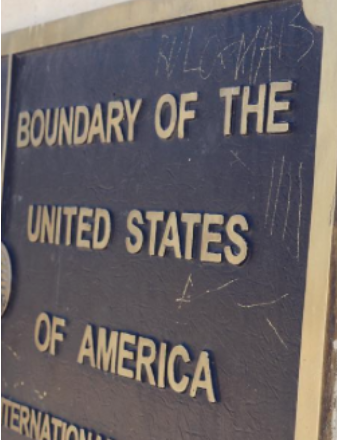
A look at the international boundary marker at the Columbus Port of Entry in New Mexico-photo U.S. Customs and Border Protection
Trump’s wall along the U.S.-Mexico border, as GOP leaders signal they’re willing to engage in hardball tactics that could spark a partial government shutdown and the president revs up midterm crowds for the wall, a centerpiece of his 2016 campaign and a top White House priority.
Trump is promising voters at rallies across the country that Republicans will bring tougher border security in campaign speeches that echo those that propelled him to office two years ago. House Speaker Paul Ryan, R-Wis., promised a “big fight” over the border wall money and Senate Majority Leader Mitch McConnell, R-Ky., has not ruled out a mini-shutdown as GOP leaders look to help Trump “get what he’s looking for” on the wall.
“Democrats want to abolish America’s borders and allow drugs and gangs to pour into our country,” Trump said without evidence Wednesday during a swing through Erie, Pa.
“Right after the election we’re doing something very strong on the wall,” Trump added Thursday in an interview on “Fox & Friends.”
Republicans steered clear of shutdown politics ahead of the Nov. 6 midterm election. They know voters have soured on government dysfunction, hold low views of Congress and are unlikely to reward Republicans — as the party in control of Congress and the White House — if post offices, national parks and other services are shuttered.
GOP leaders struck a deal with Democrats earlier this year to fund most of the government into next year. They presented their case to Trump in a White House meeting in September — complete with photos of the border wall under construction. Trump, who previously warned he would not sign another big budget bill into law without his border funds, quietly signed the legislation before the start of the new budget year Oct. 1.
Left undone, however, is the portion of the government that funds the Department of Homeland Security, which oversees the border, and a few other agencies. They’re now running on stopgap funds set to expire Dec. 7.
The deadline sets the stage for a new round of budget brawls.
“We intend on having a full-fledged discussion about how to complete this mission of securing our border and we will have a big fight about it,” Ryan said in a speech at the National Press Club.
Asked if he made a commitment to Trump for a shutdown over wall funds, Ryan said blame would fall to Democrats, who are in the minority in Congress and largely oppose increased funding for the wall. Trump promised during the campaign that Mexico would pay for the wall — a claim Mexico rejects and Republicans routinely ignore.
“We have a commitment to go fight for securing the border and getting these policy objectives achieved,” Ryan said.
House Republicans approved $5 billion for Trump’s wall, including physical barriers and technology along the U.S. southern border, in a key committee, although it comes without Democratic support. A bipartisan bill being considered in the Senate allocates $1.6 billion for the wall, far short of the $5 billion the White House is seeking as part of a $25 billion, five-year plan to complete the project.
House Majority Leader Kevin McCarthy, R-Calif., upped the stakes Friday by introducing legislation for the full $25 billion in border funds as he bids for Ryan’s job as the speaker retires. McCarthy’s toured the southern border this week to make the case for the wall as he seeks to shore up support from conservatives skeptical of his possible leadership promotion.
McConnell predicted a “lively” lame-duck session and didn’t close the door on the possibility of a mini-shutdown.
“We’ve got a lot of work left to do,” he said in an AP Newsmakers interview. “That episode, if it occurs, would be in that portion of the government that we haven’t funded.”
Asked how much money Congress would try to secure for the border wall, McConnell said, “We’re going to try to help (Trump) get what he’s looking for.”
The chairman of the Senate Appropriations Committee, Sen. Richard Shelby, R-Ala., said Senate Republicans are willing to fight for more than the $1.6 billion currently being considered, but stopped short of predicting how much money Congress would approve.
“I think it’s going to be a big fight . always because of the different views,” Shelby said.
The midterm results will play a key role in how the fight over wall funding is resolved. If Republicans lose the House majority, as some analysts predict, they will lose leverage, although the GOP would still be able to force House passage of a wall-funding package in the lame-duck session. Prospects are murkier in the Senate, where 60 votes are required to break a filibuster.
Senate Democratic leader Chuck Schumer of New York said “Democrats believe in strong border security,” but would not commit to a specific spending figure. “We’re going to keep fighting for the strongest, toughest border security,” he said.
KANSAS CITY, Kan. (AP) — A lawsuit alleges that a Kansas man who spent 23 years in prison for a double murder he didn’t commit was targeted because his mother rebuffed a homicide detective’s sexual advances.
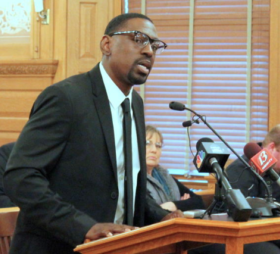
In February, Lamonte McIntyre spoke to a Kansas Senate committee. He was exonerated after 23 years in prison. Photo by Stephen Koranda/KANSAS NEWS SERVICE
Forty-two-year-old Lamonte McIntyre and his mother, 64-year-old Rose Lee McIntyre, sued Thursday in federal court. Lamonte McIntyre was freed last year . He was 17 when he was arrested in 1994 in the deaths of 21-year-old Doniel Quinn and 34-year-old Donald Ewing. They were shot in broad daylight in a drug-infested neighborhood.
No physical evidence linked him to the crime, and he didn’t know the victims. The lawsuit blames his arrest on a “dirty cop who used the power of his badge to exploit vulnerable black women.”
A police spokesman says the department is reviewing the lawsuit.
TOPEKA – For the past several years, the premium on the fire insurance portion of Kansas consumers’ property insurance has declined in many areas, thanks in part to efforts to strengthen the ISO ratings of fire jurisdiction units throughout the state.
“Since 2011, when the Kansas Insurance Department approved a newly-revised Insurance Services Office (ISO) schedule, the classification ratings for Kansas have improved dramatically,” said Ken Selzer, CPA, Kansas Commissioner of Insurance. “Kansas is now one of only 11 states with six or more Class I communities. We appreciate the hard work of fire service organizations across the state in working on this initiative with the department and ISO.”
A community’s fire-protection rating comes from ISO, a national company. Most insurance companies of home and business properties in the United States use the ISO’s Public Protection Classification (PPC) system to help determine premiums, said John Boyd, the administrator for the department’s Firefighters Relief Fund.
The ISO, based on its information, assigns a classification from 1 to 10 for each fire jurisdiction. Class 1 generally represents superior property fire protection, and Class 10 designates that the area’s fire-suppression program does not meet ISO’s minimum criteria.
“With the revised schedule approved by the department, more than 200 communities from the upper end of the ISO scale have moved toward the lower end,” Boyd said. “A lower ISO rating can equate to lower insurance premiums for consumers.”
The ISO’s system is just one of the factors insurance companies use in determining premiums. Age of the structure, construction material, and loss history of a structure all affect the base rate for the community. An individual’s rate can be affected by property value, out-of-pocket (deductible) amount, multiple policies, security system use, credit ratings and other factors.
Outside of the consumer’s property, the classification ratings for each fire jurisdiction also depend on the following:
Emergency communications systems, including facilities for the public to report fires, staffing, training, certification of the telecommunicators, and facilities for dispatching fire departments.
The jurisdiction’s fire department, including equipment, staffing, training, and geographic deployment of the fire companies.
The water supply system, including the inspection and flow testing of hydrants, and a careful evaluation of the amount of available water compared with the amount needed to suppress fires.
Community efforts to reduce the risk of fire, including fire prevention codes and enforcement, public fire safety education, and a fire investigation program.
“The ISO program provides an objective, nationwide standard that helps fire departments in planning and budgeting for facilities, equipment and training,” said Commissioner Selzer.
Kansas consumers can find out their property’s specific ISO rating by contacting the fire chief of their local fire district or their local homeowners insurance agent. They can get a snapshot of premiums under ISO ratings by using the Kansas Insurance Department’s online feature, located on the department’s website at https://www.ksinsurance.org/autohome/home/hrins.php .
For direct response questions, call the department’s Consumer Assistance Hotline, 800-432-2484, or go online to www.ksinsurance.org to use the website chat feature.
Ron Wilson is director of the Huck Boyd National Institute for Rural Development at Kansas State University.By RON WILSON Huck Boyd National Institute for Rural Development
“Go East, young man, and grow up with the country.” Actually, that is the opposite of the original saying made famous by editor Horace Greeley, who told his readers to go west in 1865. But in 1994, one entrepreneur found that his path to growth was to go east, and that led him to rural Kansas.
Dan Senestraro is the owner of Eastside Dairy in Stanton County, Kansas. Dan is the westernmost Kansan on the Board of Directors of the Dairy Farmers of America.
Dan grew up on a dairy farm in California. He went to veterinary school at the University of California at Davis. “I was determined not to be in the dairy business,” he said with a smile. He graduated in 1986. By 1989, he found himself in the dairy business again.
“I was in a partnership on 800 dairy cows in rented space in southern California,” Dan said. As California became more crowded and urbanized, he looked to relocate and grow.
Western Kansas was actively seeking to attract dairies, touting such advantages as dry climate, abundant feed, and a pro-agriculture state economy. In 1994, Dan moved to Kansas and became part of the dairy expansion.
Today, Dan and his partner Clayton Winger own and operate Eastside Dairy on the east side of Stanton County. They milk approximately 3,400 cows and have that many heifers being raised for future production, so they have roughly 7,000 total head of cows. Their heifers are custom raised up to four months of age. Each year they farm more than 800 acres of crop ground in corn, sorghum and wheat.
“We’re sustainable,” Dan said. “We have a closed loop system and we reuse all the waste water and nutrients. We catch every drop of runoff.” For example, water that is used to clean off pens is captured and fed through the water pivots to irrigate crops.
“We do nutrient recycling,” Dan said. “We do export some manure to neighbors who grow corn and silage for us. It’s a good business practice as well as environmentally sound.”
In 2000, Dan got involved in the governance of the dairy industry. Dairy Farmers of America, the nation’s largest dairy cooperative, is organized into several regions. All of Kansas was in the central region, but dairies in southwest Kansas were more similar to the ones in Texas and New Mexico so the regions were reorganized. Today in the DFA organization, Dan is chair of the southwest area, chair of the Global Trade Committee, and vice-chair of the overall organization’s Board of Directors.
Dan has seen many changes through the years, involving trade and other factors. “Fifteen or twenty years ago, we exported maybe three to four percent (of our production),” he said. “Today, 17 to 18 percent of production on a solids basis is being exported. We’re moving more and more into world markets.”
The DFA organization has also grown and changed. For years, the DFA headquarters was in a leased building in Kansas City, Missouri. In 2017, DFA built a building in the Legends area of Kansas City, Kansas. “The Kansas people bent over backwards to help us,” Dan said.
As milk production grew in southwest Kansas, opportunities grew for further processing. In September 2017, DFA opened a new milk processing plant in Garden City. “It handles four million pounds of milk a day,” Dan said. The milk is converted to whole milk powder which goes into the export market.
“We’ve made lots of progress out here,” Dan said. He serves on the city council and airport board at his rural community of Johnson City, population 1.495 people. Now, that’s rural. “Everybody needs to be involved to make things work,” he said.
“Go East, young man.” That’s the direction which Dan Senestraro took from California, and it has made it possible to grow the dairy industry. We commend Dan Senestraro, Clayton Winger, and all those involved with Eastside Dairy. Their move has enabled them to go and grow.
In coming weeks, we’ll learn more about the growth of the dairy industry in western Kansas.
Rip WinkelFall is a great time to start prepping the soil for next season’s vegetable/fruit garden. Spring is often wet making it difficult to work soil without forming clods that become a nuisance when planting, and then remain the rest of the growing season.
However, with exception to this year, the fall season is usually drier. This allows more time to work the soil when it is at the best moisture level. Even if you work the soil wet in the fall where clods are formed, the freezing and thawing that takes place during the winter will break them down, making it more malleable by the time spring arrives.
If your garden area still has the previous seasons plants laying around, insects as well as diseases often piggy-back on the old garden debris for the duration of winter. If that debris is worked well into the soil, those little critters will be less likely to make it through those cold months. Besides, that same garden debris will increase the organic matter content of the soil. Hint; turning the debris into the soil is often easier if you mow the old vegetable plants several times, forming an organic mulch. If that is not possible, at least chop the plants up by using your shovel.
As fall is an excellent time to add organic matter to the garden soil, there is more than just the old garden debris to use. There are dried leaves, rotten hay/silage, grass clippings, etc. Fresher materials (green) can also be added in the fall rather than in the spring because there is more time for them to break down before planting. As a rule of thumb, add 2 inches of organic material to the surface of the soil and till it in. Be careful not to over till the soil. You should end up with particles like grape nuts or larger. If you work your garden into the consistency of dust, you will have destroyed the soil structure.
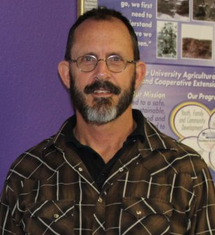
Rip Winkel is the Horticulture agent in the Cottonwood District (Barton and Ellis Counties) for K-State Research and Extension. You can contact him by e-mail at [email protected] or calling either 785-682-9430, or 620-793-1910.
DODGE CITY — Western Kansas Manufacturers Association, sponsor of the 3i SHOW, is proud to continue their support of western Kansas students furthering their education at area community colleges, technical colleges and universities through their annual scholarship program. The scholarships are for freshman students who are residents of western Kansas, have graduated from a western Kansas high school and are U.S. citizens. Preference is given to students enrolling in Agri-Business, Industrial or Mechanical Engineering, Pre-Engineering or Business Administration.
WKMA would like to congratulate the following 2018-2019 school year scholarship recipients Thomas Potter, a Hoisington High School graduate, was awarded a $500 scholarship to Barton Community College; Gerardo Ortiz-Chavez, a Wichita County High School graduate, was awarded a $500 scholarship to Colby Community College; Cora Tasset, a Spearville High School graduate, was awarded a $500 scholarship at Dodge City Community College; Jace Laswon, a Pawnee Heights graduate, was awarded a $500 scholarship to NCK Tech; John Gower, a Phillipsburg High School graduate, was awarded $500 to Northwest Kansas Technical College; Manuel Aguero, a Liberal High School graduate, was awarded a $500 scholarship at Seward County Community College; Emily Cranwell, a Ellis High School graduate, was awarded a $700 scholarship at Fort Hays State University; Britta Beesley, a Hugoton High School graduate, was awarded a $700 scholarship at Kansas State University; and Conner Lebeau, a Scott Community High School graduate, was awarded a $700 scholarship at the University of Kansas.
One scholarship remains available at Garden City Community College.
WKMA scholarships are partially funded each year by the sale of limited-edition belt buckles commemorating the 3i SHOW. A buckle order form is available online with buckles available dating back to 1984. Buckles will also be available for purchase at the 65th Annual 3i SHOW on March 21-23, 2019 in Dodge City at the Western State Bank Expo Center. Scholarship applications should be made directly through the individual school’s financial aid or scholarship department. Visit www.3ishow.com for specific school contact information or for a buckle order form.
For more information, contact the WKMA office directly toll-free at 877-405-2883 or locally at 620-227-8082. To receive continued updates and information about the 3i SHOW and upcoming events, follow the 3i SHOW on Twitter and Google+, and like the 3i SHOW Facebook Page.