We have a brand new updated website! Click here to check it out!

HAWVER: Failing KBI fingerprint system becomes funding priority

Martin Hawver

Just go ahead and put $8 million into next year’s budget for the Kansas Bureau of Investigation, and legislators will figure out Medicaid, taxes, schools, and everything else a little later.

You see, the KBI, the state’s top law enforcement agency, now has a fingerprint identification system that is a dozen years old. If it was a car, it would be out of warranty, and while parts are still available, the mechanics who will replace and upgrade them are quitting in about two years, the amount of time it takes to get a new fingerprint system up and running.

Now…anyone think that Kansas isn’t going to replace that computer system which keeps track of criminals?

That KBI computer system makes sure that criminals aren’t schoolteachers or day-care operators or workers, or maybe just applying for a job to be a law enforcement officer or a banker or your accountant.

The KBI isn’t saying whether freshman Gov. Laura Kelly’s initial one-fiscal year budget which broke the former Gov. Sam Brownback-era two-year budgets while she got her feet on the ground is the reason for the late notice of the computer system which is essentially in hospice care.

Instead, KBI folks say there was this problem getting the Office of Information Technology Services (OITS) to OK the reports that proposed updating the KBI system last year, in another administration…

No telling whether the KBI problem getting its new computer request in the short line for consideration was caused by OITS, but it probably means something that almost no legislators in a position to put that update plan in the budget this year had heard of the problem.

Now…depending on how many lawmakers demand to know who in state government knew what and when and why legislators never heard about it, the governor’s order last week to move OITS under the wing of Secretary of Administration DeAngela Burns-Wallace may find some support.

The governor can just with the stroke of a pen move the OITS management to Administration, but now it appears she has at least the KBI computers as a reason to make the move to make sure that the administration, and not a single agency silo, can delay an important-to-Kansans computer deal.

The computer geek community, of course, is split over moving a very technical piece of state government under the wing of a Democrat governor and her hand-picked secretary of administration. The governor can contend that the skill set at OITS is strong, but important information isn’t getting to the right people.

Kelly, when she announced the movement of OITS management to Administration, said that communication between the agency and its customers—the rest of state government—“has been difficult.”

“This was not the fault of the agency’s previous leadership. It is, however, a direct result of the fact that the previous administration split OITS from the Department of Administration and then failed to properly support the move, convey its mission and get buy-in from the rest of state government,” Kelly said.

So, the OITS move that Kelly ordered now has a new reason for that switch, and one that it is going to be tough for lawmakers to oppose with some line item in the budget bill that it will consider next session.

Not often that the governor gets a strong and vital law enforcement and public safety sales tool to use as she redesigns state government, as Brownback/Jeff Colyer left it, is it?

Nope, not often.

And…of course, we’ll see how it works out…

Syndicated by Hawver News Company LLC of Topeka; Martin Hawver is publisher of Hawver’s Capitol Report—to learn more about this nonpartisan statewide political news service, visit the website at www.hawvernews.com

Exploring Outdoors Kansas: Doves anyone?

Steve Gilliland
I hate hot weather like slugs hate salt, or like dogs hate sirens. I hate summer almost as much as I hate horses. Luckily both Joyce and I share this hatred of summer temperatures or things could get really ugly at the Gilliland home this time of year.

When it gets much over 80 degrees outside, I become a vegetable. I absolutely have to force myself to do anything out in the woods or at the lake. So when September looms on the horizon I can feel my cocoon begin to crumble around me with the probability that cool weather is afoot. It won’t be long until the air conditioner can be turned off at night and windows can be opened to cool the house with wonderful fall breezes.

September brings with it a plethora of good things besides cool weather. The Kansas State Fair will be just days away. I love the fair, and I look forward to spending time in the Kansas Fur Harvesters booth at the fair talking to people about the advantages of fur trapping. Early duck seasons will be in the wings as avid water-fowlers prepare for teal season in early October. But first and foremost is the opening day of dove season September 1st.

I enjoy waterfowl hunting, but upland bird hunting is not my favorite experience, partially because I possess the wing shooting skills of a four year old, so I’m not a very good or avid dove hunter. Most dove hunting is done in early morning or late evening by waiting for doves to appear at water holes to drink or by ambushing them as they come to feed along patches of wild marijuana or sunflowers.

Just outside Inman are the McPherson Valley Wetlands owned and managed by the Kansas Dept of Wildlife, Parks and Tourism (KDWPT) where there is usually water and where there are always sunflowers, both wild and domestic, making the area a dove hunters paradise hunted by dozens and possibly hundreds of dove hunters each season. So even if my “old-timers” disease makes me forget the first day of dove season, I will be reminded at first light as that area just out of town will sound like military maneuvers are in progress. The little beggars zoom in-and-out like tiny missiles, and if you can hit them you can hit anything. Believe me there is no finer table fare than dove breast, but harvesting enough doves for a good meal can be a challenge.

This year, youth dove hunts will be sponsored on opening morning by Pheasants Forever, Westar’s Green Team and by the Quail and Upland Wildlife Federation. The Osborne County Pheasants Forever chapter in partnership with the KDWPT will sponsor a youth dove hunt for youth ages 10 – 16 on September 1st and 2nd. Kids must be pre registered by calling the Glen Elder Area Office at 785-545-3345, or Chris Lecuyer at 785-545-3345 or John Cockerham at 785-346-6527.

The Westar Green Team is again hosting its annual youth dove hunt on September 1st and 2nd for youths 16 and under at Jeffrey Energy Center near St. Marys. Hunters are accepted on a first-come first-serve basis, so call Shelly Gomez at 785-575-6355.

The Jayhawk Chapter of the Quail and Upland Wildlife federation will host a dove hunt for youth 15 and under September 1st at Clinton Wildlife Area. To register, contact Dr. John Hill at 785-550-5657.

Dove season is a great time to get yourself and your equipment ready for upland bird and waterfowl seasons while the air is still warm and you can still feel your fingers. Make sure your license and permits are all up-to-date and be sure to have a plentiful supply of shotgun shells, as you’ll most likely take lots of shots to harvest just a few birds.

But like I said, if you can hit a flying dove, you can hit anything! Continue to Explore Kansas Outdoors.

Steve Gilliland, Inman, can be contacted by email at [email protected].

LETTER: Sheridan Co. Sheriff explains funding used for new K9 officer Dak

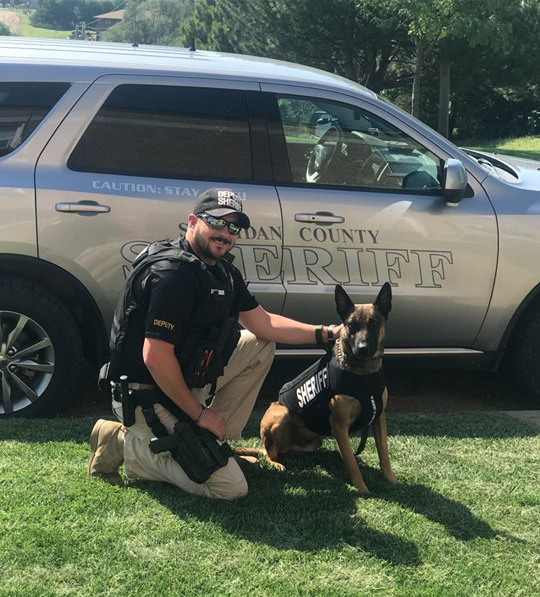
Sheridan Co. sheriff officer with K9 Dax

The following is a letter posted Friday on FB by Sheriff Brandon Carver to the residents of Sheridan County:

As Paul Harvey would say … here is the rest of the story!

The Sheridan County Sheriff’s Office wants to bring our taxpayers up to speed about the funding situation for K9 Dak. Prior to deciding on purchasing a drug dog, we took an online survey, we also discussed the idea with the commissioners. We felt that a drug dog was necessary due to the influx in drug cases, especially meth cases.

These drugs are ruining communities, families, and increasing other crime. If Law Enforcement doesn’t take proactive stance with the current drug “epidemic” happening nationwide, we will see more deaths and more victims of crimes. Our agency will stand their ground against illegal drugs.

We proceeded with getting the K9 solely based on the fact that the K9 would be funded by a GI Bill through the VA. Paperwork was submitted and accepted. We then proceeded with obtaining the dog and certifying both the handler and the K9. It was brought to our attention from the training facility that they hadn’t received payment for reimbursement for the K9. Long story short, the training facility that was listed on the initial application and was approved, was later denied and informed by the VA that the training facility was not accredited training facility through the VA. Which left us in a horrible position.

We were scrambling around trying to find the funding as our budget couldn’t withhold it. God answered our prayers, with outstanding support from the community and actually from around the state. We held a “beef raffle”, the beef was donated by local rancher (who wants to remain anonymous), which helped us tremendously. We raised over $4,000 with this fundraiser. We have had other individuals donate afghan blankets, collector cars, and misc items to be raffle off at a later date.

We didn’t know how the “beef raffle” would go over, so we looked at other avenues for funding too. We hired Corina Cox with Northwest Kansas Planning & Development Commission (NWKPDC) to help us with a grant. We applied for a $10,000 grant through the Dane G. Hansen Community Foundation and received confirmation that we received $5,000 of the $10,000 requested.

Through all the donations and grant funds received, I am proud to report to the tax payers that your local K9 Dak is fully paid for, the required equipment is paid for, and all other expense are covered. There are no words that could ever express my gratitude toward our local citizens and folks from around the state for your support! Thank You and God Bless

Sheridan County Sheriff Brandon Carver
Hoxie

INSIGHT KANSAS: Kansas incarceration rates signal a need for criminal justice reform

Patrick R. Miller is an Associate Professor of Political Science at the University of Kansas.

As policymakers manage the daily reality of Kansas’s prison crisis, let’s understand the core issue and its implications. Kansas has a growing prison population, but lags other states on criminal justice reforms that could curb that growth, ease managing prisons, and reduce budget strain from prisons.

Kansas state prisons have about 10,000 inmates. Per Kansas Sentencing Commission numbers, that population grew 16 percent in the last decade. However, per Census estimates, the Kansas population only grew 2 percent in that time, so we are growing our prison population much faster than our state is growing.

As the Prison Policy Initiative reports, Kansas is at about the national average for prisoners per 100,000 people. Like the nation, Kansas imprisons more people per 100,000 than any Western country. Kansas also has higher imprisonment rates than authoritarian regimes like Iran, Cuba, Russia and China.

The Kansas Sentencing Commission estimates our prison population will grow to over 12,000 by 2028, growing faster than the state’s population and possibly even any growth in crime rates, if recent numbers hold. Plainly, if nothing changes, the prison crisis will worsen.

Kansas is one of just 20 states where prison populations grew in the last decade. Nationally, Bureau of Justice statistics show that violent crime and property crime decreased in that time, though in surveys most Americans incorrectly perceive an increase. Of course, how those rates changed varies by location.

Let’s dissect Kansas statistics from the Kansas Bureau of Investigation. From 2009 to 2014, the number of violent and property crimes committed in Kansas was generally decreasing, including murder, rape, robbery, assault, arson and theft. However, during that five year period of decreasing crime, Kansas’s prison population grew by about 12 percent.

In 2014, the number of violent and property crimes started to increase in Kansas, which overlapped with ongoing growth in our prison population. So, regardless of whether crime increased or decreased in Kansas, prisoner numbers grew. That suggests crime rates and prisoner numbers may not be as cause and effect as many think.

The logic of the incarceration trap is temptingly simple: “tough on crime” means harsh punishments. That same mentality boomed Kansas’s prison population in the 1990s when national trends were building more prisons, enacting new felonies, and increasing sentences.

But, reality is often more complex. Absolutely, many criminals should be in prison. They are not the issue here. The issue is whether our policies grow our prison population no matter what happens with real world crime, and whether the cost benefits public safety.

One advantage to Kansas lagging other states on criminal justice reform is that we can learn from them. Conservative and liberal states alike have adopted numerous reform measures, some even while experiencing increasing crime rates. As policymakers examine this issue, they should study what other states have done on things like alternative sentencing, incentive plans, equitable policing and sentencing, re-entry, parole, and juvenile justice.

If Kansas is not smart about prisons, then we are doubling down on crisis. We are also choosing either more money to build prisons, or continued expensive relationships with sketchy private prison contractors like CoreCivic. Setting Kansas prisons on a different course will take study, experimentation, and political spine, both from policymakers and the public that shoulders the future cost of doing nothing differently.

Patrick R. Miller is an Associate Professor of Political Science at the University of Kansas.

BOOR: Stress to trees and shrubs is cumulative

Alicia Boor
Stress is cumulative. In other words, trees and shrubs can be 
affected by stresses that happened up to several years in the past.  


Recent stresses in Kansas include winter damage as well as the extremely 
dry winter of 2017-2018 which often resulted in damaged root systems.  
This damaged root system may have been further weakened due to too much 
rain this spring. The excess water harmed root systems due to saturated 
soils driving out oxygen. Roots need oxygen as much as they need 
water.

Though the roots were able to keep up with moisture demands 
during the cooler spring weather, they may not have been able to keep up 
when the weather turned hot and dry. Such trees and shrubs may suddenly 
collapse and die or slough off branches they can no longer support.  I 
have never seen lilacs collapse due to stress like they have this year.
    

This does not mean that all of our plants are doomed. As a matter 
of fact, plants that have survived thus far into the growing season will 
likely make it. Also, some plants are just better adapted to our tough 
Kansas conditions and have suffered little to no harm.  

However, it is 
a good idea to check the overall health of your trees.  So how do you tell?
     One of the most important clues in determining the health of your 
trees is the amount of new growth that tree has produced. A healthy tree 
should have a minimum of 4 to 6 inches of new growth each year and 
usually much more. Check branches with the tips in the open and not 
shaded by the tree itself. Anything less than 4 inches on the majority 
of branches suggests the tree is under a great deal of stress.
    

So, how do you tell where the new growth stops? Look for a color 
change in the stem. New growth is often greener than that from the 
previous year. There is also often an area of what looks like compressed 
growth where growth transitions from one year to the next.
    

Lastly, look at leaf attachment. Leaves are only produced on 
current seasons’ growth. Therefore, new growth stops where leaves are no 
longer attached directly to the twig but to side branches. However, pay 
attention as leaves may be appear to be attached directly to last year’s 
growth but are actually borne on short spurs. If you look closely, you 
can tell the difference.
    

All this clue tells you is whether a tree is under stress or not. 
It does not tell you what is causing or has caused poor growth. This 
year, the most common cause by far is environmental stress caused by the 
excess rain this spring.
    

So, what do we do for trees under stress?  The most important 
practice is to water as needed.

Alicia Boor is an Agriculture and Natural Resources agent in the Cottonwood District (which includes Barton and Ellis counties) for K-State Research and Extension. You can contact her by e-mail at [email protected] or calling 620-793-1910

Kansas Farm Bureau Insight: The story of food

Greg Doering
BY GREG DOERING
Kansas Farm Bureau

If you’re like my family, you don’t have much reason or opportunity to have a regular discussion with the people responsible for growing and raising our food. We order our beef from a local meat locker every year and supplement it with occasional trips to a local butcher. Outside of that, all of our food comes from the grocery store.

I recently asked my wife, “When was the last time you talked to a farmer or rancher?” She couldn’t remember the last conversation she had with a farmer. Prior to joining Kansas Farm Bureau, I’d have a similar struggle.

My background is like my wife’s. We are both removed from farm families in rural Kansas, though we grew up on opposite ends of the state. If the two of us have trouble connecting with the people growing our food, I can only imagine the struggles others face.

While our communication might be lacking, one thing that isn’t is our access to food. I can’t think of the last time I left a grocery store without an item I wanted. In fact, I usually buy more than I need – as my waistline indicates.

I’ve heard the repeated pleas for farmers and ranchers to tell their stories. It’s good advice, but any conversation requires at least two participants. While farmers weren’t telling their stories, consumers didn’t exactly burn up the gravel roads to go knocking on farmhouse doors, either.

“When I was a kid in the ’70s and ‘80s no one was talking about telling our story to the consumer,” Greenwood County rancher Matt Perrier said. “We figured they didn’t care, or they knew it already. I think we were sorely mistaken.”

The fifth-generation stockman said as fewer and fewer people grew and raised food, it left a void between farmers and shoppers. Lacking the direct knowledge, consumers glommed onto any morsel of information they could.

“I think that it’s kind of the perfect storm between one, the small percentage of people who actually raise our food and consequently the small percentage of people who know any of us, coupled with this whole foodie movement … has made people passionate about food, and the story behind the food,” Perrier said. “These people on TV, their recipes aren’t any better than the Methodist Church ladies’ cookbook, but they tell a story to go along with it.”

Fifty or 100 years ago, people could have just asked grandma where their food came from, Perrier said. Because there are fewer farmers around, people have instead turned to social media.

“Consequently, the people who do want to tell a story about animal agriculture or agriculture in general, they are probably the loudest storytellers of all,” Perrier said. “Quite often that’s not a story that’s very representative of most of our farms and ranches in America.”
It’s a compelling one. Through a combination of technology and market efficiency, all consumers see is what appears to be an endless supply of food.

“When you don’t have to face the option of, ‘Do we have something to eat or don’t we?’ we get pretty picky,” Perrier said.

Picky or not, today’s farmers and ranchers are doing a better job of reaching consumers, Perrier said.

“We can tell it very well,” he said. “We just have to do it.”

“Insight” is a weekly column published by Kansas Farm Bureau, the state’s largest farm organization whose mission is to strengthen agriculture and the lives of Kansans through advocacy, education and service.

MARSHALL: Doctor’s Note August 20

Dr. Roger Marshall, R-Great Bend, is the First District Kansas Congressman.

Friends,

I want to thank Tyson for its commitment to rebuild its beef plant in Holcomb, following last weekend’s devastating fire. This is good news not only for the plant’s 3,500-plus employees, but for Kansas farmers and ranchers. Tyson is a major employer in southwest Kansas, responsible for millions of dollars in payroll and economic impact annually.

I was in Finney County Tuesday to personally thank the fire crews in both Garden City and Holcomb, as well as all first responders who assisted with the fire. I am thankful no one was hurt, and will continue to keep first responders and Tyson employees on the forefront of my mind as rebuilding moves forward.

American Wind Week
I received a tour of NextEra wind turbine in Cimarron as part of American Wind Week, a celebration of American wind energy and the benefits it delivers to communities. Kansas is home to nearly 3,000 wind turbines that produce enough electricity to power about 1.7 million homes.

Last year, Kansas generated 36% of its electricity from wind power, ranking first in the nation for wind energy as a share of total electricity generation. Wind power creates economic opportunities for rural communities across America, paying more than $1 billion in state and local taxes and land lease payments every year, which supports our schools and local infrastructure.

$587 Million to Aid Communities Impacted by Natural Disasters
Nearly 70 counties across Kansas are now covered by the Presidential disaster declaration issued in response to the terrible flooding and damage caused by storms this spring.

In response to the ongoing need for recovery assistance, the Economic Development Agency under the Department of Commerce announced the availability of disaster grants to impacted communities.

Through their Economic Adjustment Assistance Program, supplemental funding of $587 million will be available to support disaster recovery and resiliency efforts. This assistance comes in addition to resources available through the U.S. Small Business Administration and Federal Emergency Management Agency.

While there are no application deadlines for this assistance, proposals should be based on long-term, regionally-oriented, and collaborative development strategies that foster economic growth and resilience. Disaster recovery projects must be consistent with the U.S. Department of Commerce Disaster Recovery Investment Priorities.

Hours of Service Update for Livestock Haulers
Livestock haulers across the country have the difficult task of ensuring motorist safety while also tending to the health and welfare of the animals being transported. However, “Hours of Service” regulations for these drivers lack the flexibility needed to address the unique challenges posed by transporting these commodities.

The Federal Motor Carrier Safety Administration (FMCSA) published their proposal for updating existing “Hours of Service” rules. FMCSA’s proposal will change the short-haul exception available to certain commercial drivers, modifying the maximum on-duty periods and extending the distance limit within which the driver may operate. These changes will provide greater flexibility for livestock haulers as they work to safely, efficiently, and humanely transport these goods to market.

The public comment period will be open for 45 days, and the Notice of Proposed Rulemaking as well as information on how to submit comments can be found Here.

Kansas Hospital Association Health Care Roundtable
I took part in a Kansas Hospital Association Roundtable, hosted by Pawnee Valley Community Hospital in Larned, to discuss solutions to issues affecting communities and hospitals across my district. This was a valuable opportunity to gather with Kansas health care leaders to discuss issues impacting patients and providers in Kansas, including the 340B program, surprise billing, alternative rural health models, mental health care, and the opioid epidemic.

Also taking part in the conversation were representatives for the University of Kansas Health Systems, Clara Barton Hospital, Rice County District Hospital, Ellsworth County Medical Center, Kearney County Hospital, Lindsborg Community Hospital, University of Kansas Health Systems Great Bend Campus, and University of Kansas Health Systems Pawnee Valley Campus.

Thank you Kansas Hospital Association and Pawnee Valley Community Hospital for hosting this group in pursuit of our shared goal of improving health care in Kansas.

Great Bend Company Receives Industry Award from EPA
R&S Digital Services, a full-service Geographic Information Systems (GIS) mapping company in Great Bend, was recently selected to receive an Industry Award from the Environmental Protection Agency for its work in emergency planning in the wake of several natural disasters in Kansas.

In 2007, in the hours immediately following a devastating F-5 tornado which destroyed most of Greensburg, R&S suspended work on all other projects to produce maps for search and rescue efforts and to ascertain the damage. R&S Digital Services prepared a base map for the city and all sections affected by the path of the tornado, and expeditiously completed maps which were of critical importance to responders. Bruce Schneider, President of R&S, waived all fees associated with the work, and stated “We were moved by the tragedy in Greensburg. I was never more proud of my staff.” Additionally, in 2016 and 2018, R&S provided GIS assistance in response to tornado strikes in Eureka.

Thank you to Bruce Schneider and the team at R&S Digital Services for your remarkable service to Kansas communities, and congratulations on this honor!

Visiting Miller Dairy
I had the opportunity to visit Miller Dairy outside Hutchinson, Kan. The Millers milk about 300 Holstein cows and are members of the Midwest Dairy organization, which works on behalf of dairy farmers to promote milk and dairy products.

Drinking milk is part of a nutritionally balanced diet and I have long advocated for whole milk to return to school meals. Milk delivers calcium to the body, which is essential for nutrient absorption and strong bones.

I had the opportunity to feed a day-old calf and learn how to milk a cow, using modern equipment. I will continue to support the milk checkoff program and advocate for the consumption of milk both domestically and abroad.

Eisenhower Sculpture Displayed in Italy
This month, the city of Pietrasanta, Italy, unveiled several sculptures commemorating former U.S. President and Kansas native, Dwight D. Eisenhower. Inspired by the famous photograph of General Eisenhower with the 101st Airborne paratroopers on the eve of D-Day, the statues will be displayed for three weeks before being moved to a memorial site for installation later this year.

During World War II, Pietrasanta was strategically situated on the Gothic line—a German defensive fortification—in northern Italy. It was here where U.S. troops fought during the final Allied offensive of the Italian Campaign in spring 1945.

Dr. Roger Marshall, R-Great Bend, is the First District Kansas Congressman.

HAWVER: Kan. should fix mismanaged Reading Roadmap program

Martin Hawver

Well, here’s a former Republican Gov. Sam Brownback-era program that, after an audit by his successor administration run by Democrat Gov. Laura Kelly, turned out to be a profit center for a private contractor…

It’s the Reading Roadmap program, which no-bid Washington contractor Hysell & Wagner reached into Kansas to milk as much as $2.3 million in 2014 and 2015 from the program.

The Kansas Department for Children and Families (DCF) last week canceled the contract after an audit of the program’s management, which was started and not finished five years ago, was essentially protected from public review. A later audit this year of the program which helps children learn how to read was the tipping point to cancel the Hysell & Wagner contract.

The firm says that contracting issues were fixed, that the program is running well and that it is providing the services it contracted to perform. But DCF is apparently not convinced.

Look for the issue to wind up in a court somewhere, but it’s just money at stake there, and the bigger issue for Kansans is the program itself.

Whatever the reason for the no-bid contract and whatever the reason for short-stopping that early audit that saw misuse of funds, the program of assisting generally poor Kansas schoolchildren to learn how to read is a great idea. Not sure Brownback thought it up himself, or where it came from, but any program that assists children to learn to read and to help their families learn how to encourage that reading is a good investment.

Simply, Kansas prospers the smarter its residents are. That reading assistance, which was carried out before and after school and at summer camps and by meeting with the generally poor families of those children (administered by Hysell & Wagner), is the right thing to do.

It’s a social issue, of course, government assisting parents in raising their children, but those children are the future of the state and the better their basic skills—even just reading which most of us don’t think about much—prepares those kids for better performance in school and better jobs when they leave school and better skills to help their children learn to read and prosper.

The contract hassle may divert lawmakers next session from the program itself, and that would be a mistake. Children and Families is going to make sure that the more than 30 school districts and a handful of social service agencies get the money appropriated for them last session, so the Reading Roadmap programs will continue under local management. That’s good.

But the preservation of the program gets a little complicated for lawmakers this winter.

Why is this educational undertaking financed with federal funds which are part of the Temporary Assistance for Needy Families (TANF) program that is aimed at providing needed food assistance for those families? DCF Secretary Laura Howard likes the program, sees its merit, but wonders why it is financed from the pot that ensures that mostly children, the poor and disabled are able to buy food. It’s a stretch, isn’t it?

Seems more like a program that ought to be operated by the Department of Education? Sure, but then, the TANF money is federal money, and the Department of Education doesn’t get that money and would have to find the cash from somewhere else…which likely means it would need a bigger appropriation from next year’s state budget.

Reading Roadmap? A good program with some management issues but essentially free for the state.

Wonder which way this is going to go? We’ll see when the election-year Legislature opens in January…

Syndicated by Hawver News Company LLC of Topeka; Martin Hawver is publisher of Hawver’s Capitol Report—to learn more about this nonpartisan statewide political news service, visit the website at www.hawvernews.com
News From the Oil Patch, Aug. 19

By JOHN P. TRETBAR

Kansas Common crude at CHS in McPherson starts the week at $45 per barrel after gaining 25 cents a barrel on Friday. Cash crude on the Nymex closed at $54.82 per barrel Friday.

Independent Oil & Gas Service reports a ten percent increase in the weekly Kansas rig count. There are nine active rigs in the eastern half of the state, down two for the week, and 25 west of Wichita, an increase of five rigs. Operators are about to spud new wells on two leases in Barton County, one in Ellis County and one in Russell County.

Baker Hughes reported 935 active rotary rigs for the week nationwide. An increase of six oil rigs was offset by declines in horizontal, gas and miscellaneous rigs. Texas and West Virginia were down four rigs each. Oklahoma was down one.

Independent Oil & Gas Service reported 55 newly-completed wells across the state last week, 28 in eastern Kansas and 27 west of Wichita. Operators have completed 924 wells statewide so far this year. There were two new completions in Barton County and one in Ellis County. All three were dry holes.

Regulators authorized 22 permits for drilling at new locations across Kansas last week, eight east of Wichita and 14 in Western Kansas and 608 so far this year. There’s one new permit on file in Ellis County.

The U.S. Energy Information Administration said domestic crude inventories increased by 1.6 million barrels. Stockpiles are now about three percent above the five-year season average at 440.5 million [[“440 point five million”]] barrels.

The government reported the second-best weekly production total ever. For the week ending August 9, U.S. producers pumped 12,333,000 barrels per day of crude oil. That’s an increase of 80,000 barrels per day over the week before and just 45,000 barrels per day shy of the record set during the last week in May.

Once among the largest landholders in western Canada’s oil sands region, Wichita-based Koch Industries has sold off leases and abandoned licenses there. The Kansas company joins a stream of foreign companies exiting the formation, according to reporting by the Financial Post. Koch struck an agreement to sell its land in the region to Calgary-based Cavalier Energy, in a transaction that occurred in June.

Regulators in Texas reported a significant drop in crude oil and condensate production for the month of May. According to the Railroad Commission of Texas, May production totaled over 116 million barrels, which is down 9.5 million barrels from the month before and down 13.5 million barrels from May of last year.

Operators in North Dakota, the number-two oil producing state in the country, pumped a new all-time record in June, 1.42 million barrels per day. The state’s Department of Mineral Resources reports North Dakota also set a record for the most producing wells, at 15,741.

Western Kingfisher County Oklahoma continued to shake nearly two weeks after an oil and gas operator stopped trying to complete wells at one of its locations. According to the Daily Oklahoman, an ongoing swarm of earthquakes impacted an area about 8 miles west of the county seat. Dozens of seismic events were observed in the general area since completion efforts ended July 24. The events have varied in strength, from as little as one on the Richter scale to as large as a 3.5 magnitude event observed a week ago. The swarm included a 3.6-magnitude event that is believed to be the largest temblor ever associated with hydraulic fracturing.

A County Assessor in Oklahoma is going to court to collect an additional $273 million in property taxes from seven energy producers. The court cases stem from crude stored in tank farms at Cushing. The companies are claiming a tax break under what’s called the “Freeport exemption,” which protects crude oil from state property taxes if it’s just passing through Oklahoma as interstate commerce. The county is asserting the crude in question was bought and sold in Oklahoma, according to the Stillwater News Press.

Exploring Outdoors Kansas: You never know what you might be missing

Steve Gilliland

I saw an old friend in town the other day and he asked how I had done trapping last year. I told him I hadn’t set as many traps as I’d wanted and thus hadn’t caught as many coyotes as I had planned. I’ll never forget his reply; he told me “I was never a very good trapper. I had a friend that was very good, and I would set twice as many traps as him and I would catch twice as little!” I chuckled at his wording, but it got me to thinking. If I had thrown in the towel every time I hadn’t gotten a deer, or trapped as many coyotes as planned, or caught all the fish I’d wanted I would probably have ceased even going outdoors years ago.

There have been plenty of years when I haven’t harvested a deer or trapped as many critters as I’d wanted, but my biggest challenge has always been my fishing skills, or better yet my lack-thereof. Growing up in Ohio, we enjoyed Lake Erie and one of the many islands in Lake Erie is named Kelley’s Island. Our neighbor was pastor at one of the churches on Kelley’s Island and stayed there in the parsonage during the weekend, and lived next door to us during the week. Because of our friendship, if we went to Kelley’s Island on week days, he let us stay in the church parsonage, so each year we planned a short fishing trip there during the week. One of the fish Lake Erie is known for is the Yellow Perch. They are nothing like our invasive species White Perch here in Kansas and in my book are nearly as good as Walleye as far as eating quality. In the fall the perch would be biting around the island so we planned our trips around that. We sometimes fished from the ferry dock alongside native islanders. I always bought the same bait from the same bait shop and used the same tackle as the native islanders, but sitting 3 feet away on the dock, they would catch 12 fish to my one.

Some years back when Joyce and I still had a boat, we went to Kannapolis fishing with another couple who were both avid fishermen, they in their boat and Joyce and I in ours. They had numerous brush piles in the lake marked on their GPS, so we anchored on each side of a long narrow brush pile. Joyce and I both rigged our rods exactly like theirs, and our boats were so close that at one point they tossed us the exact jig they were using. They caught crappies left and right and the only thing we caught was the rope anchoring the marker buoy.

My points here are, number one, I’m a lousy fisherman, seemingly almost cursed at times, but yet I still go when I can. Point number two is, that although harvesting fish and game is usually the goal when in the field or on the lake, the harvest should not be our sole purpose for being there. On one particular deer hunt during my youth, I was standing in a pre-determined spot in a large woodlot awaiting other hunters walking toward me. I heard rustling in the leaves, and watched as a mother red fox and her family of half-grown kits ran past me just a few feet away. As I recall, I didn’t harvest a deer that year, but would have missed that once-in-a-lifetime-sight had I not been there anyway.

I could fill pages with other stories like that of bobcats that peered at us from a few feet away, or hawks that cruised past us mere feet above the ground and only a stones-throw away, or the beaver that swam beneath my feet under the ice of a frozen creek. The bottom line is that all that would have been missed had we not been there, successful harvest or not. Continue to Explore Kansas Outdoors (successful harvest or not!).

Steve Gilliland, Inman, can be contacted by email at [email protected].

BOOR: Area Farm Bill meetings planned in August, September

Alicia Boor

Sessions will focus on decisions to consider, tools to help with decisions

MANHATTAN – With every new farm bill comes new decisions for farmers to make that can have lasting implications for their businesses. The most recent legislation is no exception. To help agricultural producers determine the best course of action, Kansas State University’s Department of Agricultural Economics will host 10 Farm Bill meetings around the state, starting in late August.

The meetings will cover commodity programs, including the economics of the Agriculture Risk Coverage/Price Loss Coverage (ARC/PLC) programs, Supplemental Coverage Option and a new decision tool available for producers.

K-State Research and Extension agricultural economists, extension agents, USDA Farm Service Agency and Natural Resources Conservation Service representatives will provide a big picture perspective, as well as a more local view for each area.

Dates and locations include:

  • Mon., Aug. 26 – Hill City – 1-4:30 p.m. – Graham County Fairgrounds.
  • Tues., Aug. 27 – Goodland – 8:30 a.m.-noon MDT – Elks Lodge
  • Tues., Aug. 27 – Leoti – 2:30-6 p.m. – Wichita County Fairgrounds
  • Wed., Aug. 28 – Plains – 10:00 a.m.-3 p.m. – Plains Community Bldg.
  • Thurs., Aug. 29 – Great Bend – 8:30 a.m.–noon – Great Bend Events Center
  • Fri., Aug. 30 – Wichita – 8:30 a.m.–noon – Sedgwick County Extension Office
  • Tues., Sept. 3 – Parsons – 1–4:30 p.m. – SE Area Research and Extension Center
  • Wed., Sept. 4 – Ottawa – 8:30 a.m.–noon – Franklin County Fairgrounds
  • Thurs., Sept. 5 – Seneca – 1–4:30 p.m. – Nemaha County Community Center
  • Tues., Sept. 10 – Concordia – 1–4:30 p.m. – Cloud County Fairgrounds

More information and registration is available online or by contacting Rich Llewelyn at 785-532-1594 or [email protected] .

Alicia Boor is an Agriculture and Natural Resources agent in the Cottonwood District (which includes Barton and Ellis counties) for K-State Research and Extension. You can contact her by e-mail at [email protected] or calling 620-793-1910

FIRST FIVE: Are social media companies going ‘too far’ to regulate content?

Lata Nott

In the past few years, social media companies have faced intense criticism for not taking a more active role in stopping the spread of hate speech and misinformation on their platforms. Meanwhile, the White House thinks those same companies are going too far in their efforts to regulate content and is currently drafting an executive order called, “Protecting Americans from Online Censorship,” which would give the Federal Communications Commission oversight over these decisions.

The order seems to be an outgrowth of the social media summit that President Trump held last month, where his 2020 campaign manager Brad Parscale said, “At a time when social media platforms are banning conservative voices and supporters of the president, it’s important for President Trump to emphasize that he appreciates their support and wants to protect their First Amendment rights.”

The executive order hasn’t been released yet. If and when it is I’m sure there will be plenty of ink spilled over whether it’s constitutional and whether Twitter and Facebook are truly biased against conservatives. But let’s put that aside for a moment. At a time when people across the political spectrum are upset with tech companies, albeit for different reasons, I’d like to posit that the real problem with social media isn’t that it allows hate to spread or that it discriminates against users based on their points of view. It’s that we only become aware that those things are happening when they involve famous or powerful people.

The First Amendment prevents the government from censoring our speech, but it doesn’t apply to private companies. Social media companies actually have their own First Amendment rights and are free to create their own policies that ban whatever kinds of content they want. Most platforms do have rules or community guidelines that ban content that threatens or harasses other users. And in the wake of recent controversies, many platforms have gone further than that. Facebook currently bans hate speech, which it defines as a direct attack on someone because of characteristics like race, ethnicity, national origin, religion, gender, sexual orientation or disease. YouTube bans content that promotes violence or incites hatred against individuals or groups because of these characteristics. Twitter threads the needle a bit, not banning hate speech but banning “hateful conduct,” meaning hateful messages that actually target specific people.

All of these content policies censor speech that would be protected by the First Amendment, but again, these platforms don’t have to comply with the First Amendment. Facebook is a private company and it has no more obligation to host you than a restaurant has to serve a customer who hurls insults at the waiters or refuses to wear shoes. What’s more troubling is how inconsistently enforced these policies are. A restaurant with a strict dress code isn’t necessarily controversial; a restaurant that bans some patrons for not adhering to the dress code, allows others to walk in naked and has an ever-shifting definition of what qualifies as a bowtie is infuriating.

To be fair, the sheer volume of content posted on social media platforms makes it difficult for them to consistently moderate content. They use a combination of algorithms and human moderators to identify posts that violate their policies — and it doesn’t always work that well.

Determining whether a post is hateful depends on context, but algorithms aren’t sophisticated enough yet to look at that — they have to use specific rules to weed out content. In 2017, an investigation by ProPublica into Facebook’s hate speech standards revealed that a post advocating for killing all radicalized Muslims didn’t count as hate speech because it targeted a subgroup of a protected category — radicalized Muslims, not all Muslims. The algorithm was programmed to designate speech attacking a category as a whole as hate speech, not speech targeting a subset.

Meanwhile, many users were banned for uploading screenshots of racist or sexist messages they had received in order to raise awareness of hate speech. This isn’t dissimilar to Twitter’s decision last week to freeze the campaign account of Senate Majority Leader Mitch McConnell for tweeting out a video showing several protesters shouting violent threats against McConnell outside his home. Twitter’s rules ban users from posting content containing threats of violence, even if it’s the target of the threats doing the posting. (Twitter quickly reversed its decision after rampant criticism from Republicans.)

Social media platforms can and do fine tune their content rules when controversies arise. For instance, Facebook’s policy does allow for hate speech that’s shared with the intention of educating others. Twitter made an exception for McConnell’s tweet because of its “intent to highlight the threats for public discussion.” But case in point, these changes usually occur when celebrities or public figures create negative publicity for the companies. Another way that business interests factor into how content rules are enforced? According to a group of former and current YouTube content moderators, high-profile content creators who draw the most advertising revenue “often get special treatment in the form of looser interpretations of YouTube’s guidelines prohibiting demeaning speech, bullying and other forms of graphic content.”

Which means that while certain people have a disproportionate amount of power to change, challenge and skirt content rules, the average person has none.

Lata Nott is executive director of the First Amendment Center of the Freedom Forum Institute. Contact her via email at [email protected], or follow her on Twitter at @LataNott.

Silver Haired Legislature holds mid-summer meeting, election

SALINA – The executive board of the Silver Haired Legislature held their annual mid-summer issues meeting on Wednesday, July 31 in Salina.

The Executive Board is composed of the SHL chairperson from each of the eleven PSA (Planning and Service Area) districts across the state of Kansas, plus the officers of the overall membership of the organization. These include the Speaker, Speaker Pro Tem, and the Floor Leader. Jay Rowh, Mitchell County SHL representative who is the out-going president of the Executive Board, chaired the meeting.

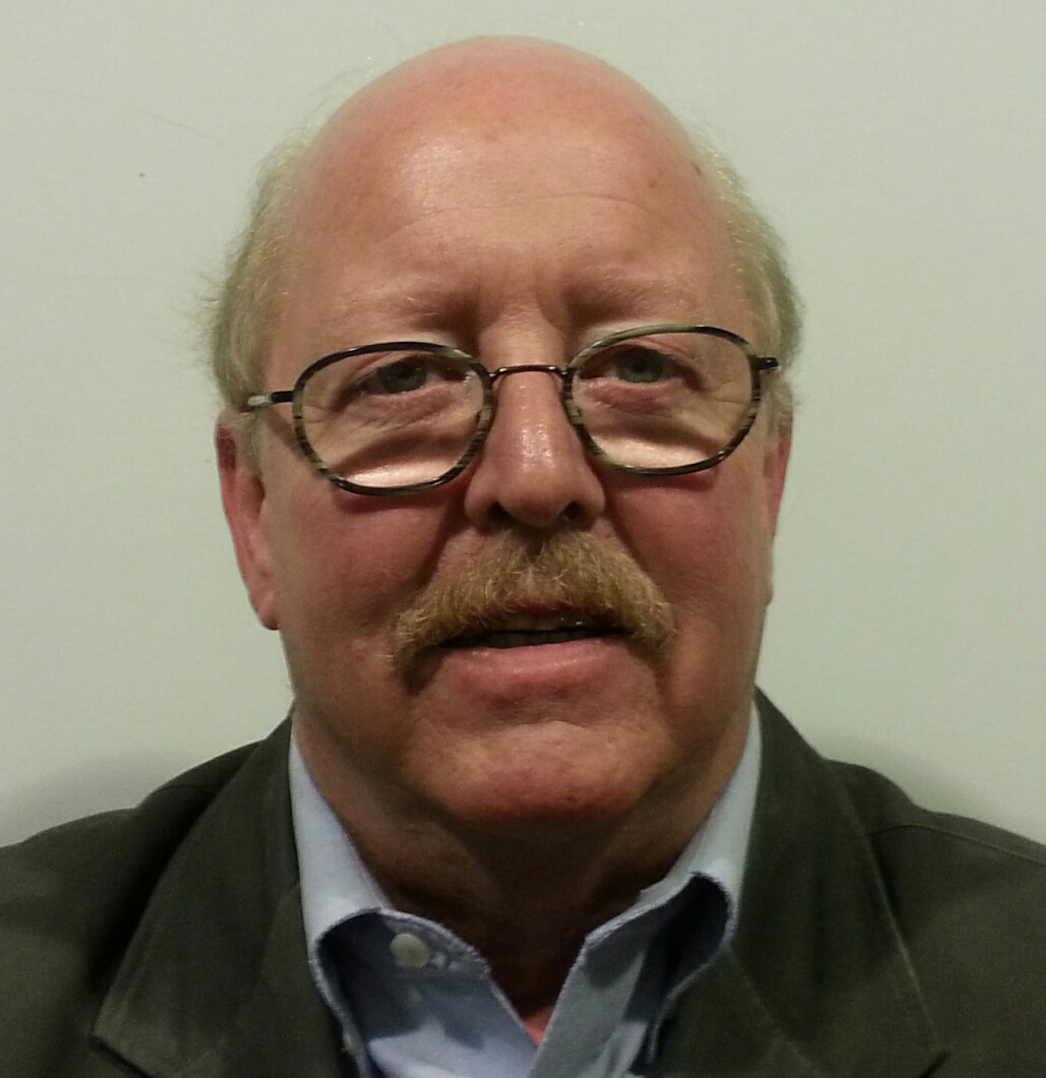
The meeting began with the bi-annual election of the officers of the Executive Board. Newly elected officers were Bill Otto, PSA 7 (Coffey County – Leroy), who will take over the reins from Rowh as the new President, and Ross Boelling, PSA 8 (Dickinson County – rural Junction City), who replaces Thomas Gordon, PSA 1 (Wyandotte County – Kansas City), as the new Vice-President of the Executive Board. These two officers will serve in their new capacity for a two-year term. Rowh will continue on the Executive Board as the Immediate Past President, and Gordon will also serve as the current chair of PSA 1 (Wyandotte County). Donna Lehane, PSA 2 (Sedgwick County – Wichita) was then appointed by new President Bill Otto to serve as the Secretary of the SHL.

In the spring and early summer, the SHL members within each of the eleven PSA districts meet to decide what issues are important to Senior Citizens in their district. These issues are then brought to the state issues meeting, where they are discussed, debated, and whittled down to a select few. The resulting finalists will subsequently be presented to the entire SHL membership for their consideration at the annual conference in Topeka on October 1-3.

A total of 26 local issues were initially brought to the Executive Board. From this list, a total of seven issues were selected to be presented to the full membership in October. These issues will be forwarded in the form of resolutions, as they are carryover bills from the 2019 Kansas Legislative Session. A SHL resolution indicates support from the organization for that legislation should it meet with approval when voted upon by the entire SHL body in the fall.

Six of these measures were SHL carryovers from last year: 1) Support for Medicaid Expansion; 2) Continued support for the KDOT Rural Public Transportation program; 3) Support for the State of Kansas to fully fund KPERS as the law stipulates, and to pass a Cost of Living Allowance (COLA) for KPERS beneficiaries; 4) Protect Grandparents Rights in Child Custody and Visitation cases, plus providing financial assistance in Guardianship matters; 5) Support for the Removal of Sales Tax on Food; and 6) Support for Legalizing the Sale of Medicinal Cannabis in Kansas.

The one new resolution deals with Support and/or Expansion of the Senior Care Act in Kansas, the act that allows qualifying Seniors to stay in their own home with just a minimum of financial support. This financial aid averages approximately $240 per month, and helps in such tasks as cleaning, washing clothes, meal purchase and/or preparation, and medication assembly for the week. If the Senior does not get this help, they often must move to a nursing home, where typical costs average around $4000 per month. The Senior Care Act is definitely a money-saver for the state of Kansas.

The next step in this process is for the entire SHL membership to discuss and debate these resolutions in committee work at the annual session of the full Silver Haired Legislature this coming October in Topeka. Those measures successfully passed out of committee will then face deliberation by the full SHL body, and if subsequently approved, will then be forwarded on to the Kansas Legislature in their 2020 Legislative Session for consideration with SHL support.

The Silver Haired Legislators represent the over 600,000 Kansas Seniors over the age of 60, most of whom vote in local, state and national elections. The SHL is just one of the ways their collective voice can be heard.

For this, and other information on the Silver Haired Legislature, you are invited to view our website Kansas-shl.org.

– SUBMITTED –

Copyright Eagle Radio | FCC Public Files | EEO Public File