H. Edward Flentje is professor emeritus at Wichita State University.Kansas’s share of federal dollars has been dropping precipitously in recent years.
According to research conducted by the nonpartisan Pew Charitable Trusts, federal grants in Kansas as a portion of state revenues fell from 33 percent in 2011 to 23 percent in 2017. That steep drop, due largely to rejecting federal dollars, represented a shocking loss, estimated at $382 million in the 2017 state budget.
In the same time frame the four states surrounding Kansas maintained their share of federal dollars at 33 percent. The average share of all 50 states has grown over the last four years to 32 percent.
Kansas now ranks third in the nation in refusing federal dollars as only two states—Hawaii and Virginia—report slightly smaller shares than Kansas.
Should Kansans be cheering or booing state lawmakers for refusing available federal aid? The answer is a no-brainer!
Nearly 80 percent of all federal money to the states comes through grants for Medicaid or income security. In the period 2011 through 2017, Republican lawmakers, led by former Governor Sam Brownback, began denying available federal aid to the state’s most vulnerable residents—poor families, children, seniors, the unemployed, and the disabled.
They blocked the extension of Medicaid coverage 130,000 low-income working Kansans and their children.
They repeatedly restricted eligibility of the poorest Kansas families for federal aid through TANF (cash assistance) and SNAP (food stamps). The number of TANF recipients, over three-fourths being children, was slashed by over 70 percent from 2011 to 2018. The number of beneficiaries of food assistance, roughly half being children, declined over 30 percent from 2013 to 2018.
They privatized Medicaid in 2013 and cut Medicaid reimbursement rates in 2016. Medicaid cuts reduced health care services for 400,000 children, seniors, and disabled individuals. A private contractor backlogged, delayed, and too often denied applications of eligible seniors for nursing home care.
This rejection of federal assistance represents a dramatic departure for Kansas. In the early decades of the 20th century Kansas lawmakers, both Republicans and Democrats, campaigned successfully for constitutional changes, as well as new taxes, that allowed state government to accept and match federal aid for roads, social welfare, unemployment compensation, and relief during the Great Depression. These actions set critical precedents for Kansas officials to accept and actively pursue available federal grants for public health, environmental protection, criminal justice, housing, workforce development, and wildlife conservation, among many other public purposes.
That changed with Brownback’s vow to remake Kansas into a national model of red-state governance by refusing federal aid to vulnerable residents. His tax experiment failed and has been abandoned, but his assault on poor Kansans and their children continues in state law. Any attempts to change the law are fought off by the Kansas State Chamber of Commerce and its dark money ally, Americans for Prosperity—organizations that despise spending on social safety nets. For the past seven years they have targeted lawmakers and legislative candidates who support such spending.
The ideological experiment with the lives of vulnerable Kansans is failing and continues to cost the Kansas economy hundreds of millions in federal dollars every year, even as we pay taxes that benefit all other states. Lawmakers should reclaim the state’s rightful share of federal grants and for starters, approve the extension of Medicaid and reestablish reasonable guidelines for providing assistance to the poorest Kansans and their children.
H. Edward Flentje is professor emeritus at Wichita State University and served with former Kansas Governors Bennett and Hayden.
Ron Wilson is director of the Huck Boyd National Institute for Rural Development at Kansas State University.
By RON WILSON Huck Boyd National Institute for Rural Development
Shopping in the produce aisle can take time, if one stops to look and study all the fruits and vegetables on display. If only those fruits and vegetables could be packaged together – maybe even with a recipe to help my family use them. Today we’ll learn about an innovative program which is simplifying healthy food access, using a local food store and community support. Thanks to JoEllyn Argabright of K-State Research and Extension for this story idea.
Last week, we learned about K-State Research and Extension’s Culture of Health initiative. Here is an example of a local initiative to support healthy eating.
Jerad Gooch is the owner of Leoti Foods in Leoti, Kansas. His family has deep roots in the grocery business. His grandfather Harold Gooch opened the store in Tribune in 1948. Harold’s son Dwight joined the business in 1972. Now the family owns three stores and Dwight’s three sons manage one each. Jerad has the store in Leoti.
In 2015, some people in Leoti started to participate in a produce basket purchasing program which utilized out-of-state goods. “I noticed these baskets coming into town and I wondered why we couldn’t do that with a local store,” Jerad said. That program ended after a few months, but Jerad met with people who were interested to see if his store could provide such produce baskets.
In early 2017, the group launched a program called Simply Produce. This program provides fruit and vegetable baskets to local customers through the Leoti Foods store.
Every three weeks, there is a sign-up period from Friday to Tuesday for people who want to get a produce basket. People order the basket and pre-pay, at the store or by phone.
On the following Friday morning, the produce is delivered to a distribution point at the fairgrounds. Volunteers then sort the produce into baskets, which customers can pick up at noon. Jerad also delivers baskets to the school and to the elderly.
Typically, the baskets would include 12 items: Six fruits and six vegetables. The baskets cost $15 each. Since the baskets might include up to 22 pounds of produce, this is a terrific value. Purchased separately, those items might amount to twice that in cost, not to mention the time spent shopping.
“We’ve had customers say, `Wow, I get all that?’” Jerad said. “Some of our elderly ladies even share baskets.” The store is now offering an additional mini-basket option.
Another popular option is the add-on baskets for an additional charge. For example, Leoti Foods recently offered an optional grill pack which includes ears of corn, sweet peppers, potatoes, squash, onions, mushrooms and more. All of these products would be great when prepared on my grill.
This makes shopping simple, which means that the name Simply Produce is especially appropriate. “This produce is delivered in the morning and is in the consumer’s hands by noon,” Jerad said. “To get fresh produce in the hands of people that quickly in western Kansas is remarkable.”
“Everything about this has been great,” Jerad said. Now their store in Tribune is using the same model. “We’re averaging about 45 participants each time,” Jerad said.
“It’s not about the business, it’s what’s good for the community and about getting produce into people’s hands,” Jared said. He also noted the importance of volunteers in assembling the baskets.
Aimee Baker, the family and consumer sciences agent for K-State Research and Extension – Wichita County, is one of his key volunteers. “She’s been with us since day one,” Jerad said. “She even makes a recipe card each time which correlates with the produce in the basket.”
This is an innovative, collaborative approach to help people get healthy produce while benefiting the local economy. It’s great to find in a rural community like Leoti, population 1,534 people. Now, that’s rural.
Shopping for produce can take time. We commend Jared Gooch of Leoti Foods, Aimee Baker, and all those involved with Simply Produce for making a difference with this project to help people utilize fruits and vegetables while utilizing their local store. I think it’s high time.
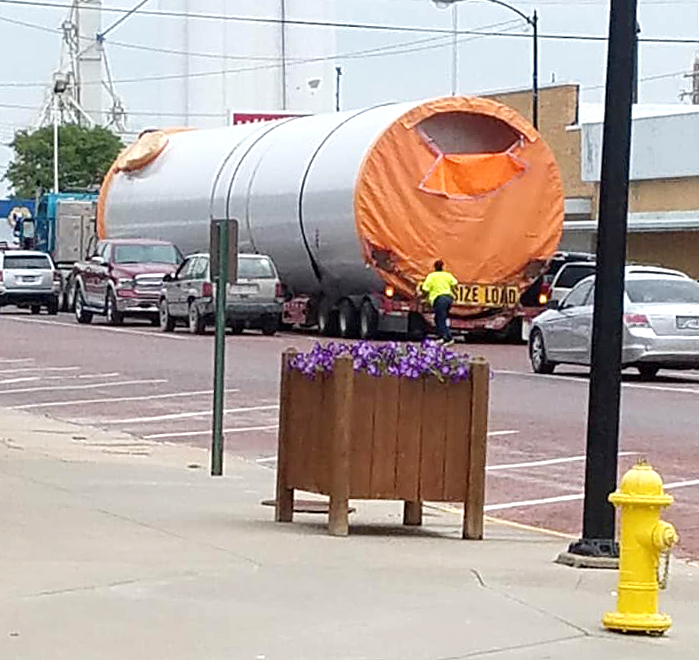
This oversize load is pictured Tuesday afternoon turning off U.S. 36 onto its proper KDOT-designated U.S. 183 route. Minutes before this photo was taken the oversize load operator had driven past that turn and attempted to turn onto 3rd Street in the downtown Phillipsburg business district, just as four other semi drivers have done in the past week. This vehicle was stopped before he could do so. With this vehicle far over-committed, the Phillips County Sheriff’s Department had to stop highway traffic in both directions, and the semi driver had to drive his almost-block long load two blocks in reverse so he could get back to his correct U.S. 183 turn.
By KIRBY ROSS Phillips County Review
PHILLIPSBURG — And we were doing so, so well!
Remember all the drama about the oversize wind turbine load fiascos that had been taking place in Phillips County? Well, to paraphrase Michael Corleone from the Godfather, “just when we think we’re out, they drag us back in again.”
First a quick recap — around a half decade ago wind turbine manufacturers ramped up production to meet market demand and a little extra, as major U.S. government subsidies were being doled out.
As those turbines were being built, they were being shipped down U.S. 183 and through Phillipsburg for stockpiling in central Kansas.
During the course of that transport, Phillipsburg turned into the Wild West as up to a dozen of the huge loads were being convoyed through town every day. And as they were coming through town, their pilot car drivers were steering directly into oncoming traffic, playing chicken to clear a path. They were also driving on sidewalks, running red lights, and taking rest stops in lanes of traffic. In addition, drivers were getting out of their vehicles and literally yanking street signs out of the ground to help them make tight turns.
Because of the resulting public uproar, a decision was made in Topeka to detour those oversize loads around Phillipsburg — and the only way to do that was to send them down K-383 through Long Island in rural northwest Phillips County and then on down through Almena in Norton County.
Out of sight, out of mind. Problem solved? Not on your life.
All the plan did was shift the problem from a highly-visible area, to one of less visibility. In effect, it was a hide-the-problem solution.
Pilot car drivers were still going amok, driving into oncoming lanes of traffic and running cars off the road. And to top it off, K-383 is extremely narrow and has no shoulders at all. Oncoming traffic was not only being sideswiped by the wide loads, but the semis carrying the loads were slipping off the highway and tipping over into steep ditches.
Finally a school bus was clipped last spring, followed in close succession by incidents where a farm truck was hit and a wind turbine trailer faded over to the side of the road and ended up dumping its massive load into a ditch.
With all three events happening in a 48-hour period, two things happened — 1) a 30-mile stretch of highway had to be closed down twice in one week, and 2) Topeka woke up and got involved again.
So the new solution was that instead of hiding the problem of oversize loads by shuttling them through lower population areas, there was no choice but to run them back through Phillipsburg.
For the first few months, they started coming back through town all went well.
CLICK TO EXPAND: Downtown Phillipsburg. Google image
Until now.
We have all heard stories about knucklehead drivers blindly following GPS and ending up driving into lakes. But those stories always seemed like an urban myth — nobody would have that much lack of common sense that they would drive into a lake just because their GPS told them to take a turn and continue driving. Would they?
Based on recent events, maybe so.
Carry that thought process one step further. We can admit it — our mothers asked every single one of us at one time or another, “would you jump off a cliff just because everybody else was doing it?”
Well, it seems we have had a bizarre version of both those things going on in regard to the oversize loads passing through Phillipsburg this past week.
Either that, or the transporters are practicing as stunt drivers for Mad Max: Phillipsburg Thunderdome.
So here’s what’s been happening — wind turbine convoys are heading into town from the west, and are driving right past their well-marked U.S. 183 turn. Instead of giving proper instructions for travel up U.S. 183, the pilot cars’ GPS has been telling them to turn onto 3rd Street in the downtown Phillipsburg business district a block to the east of 183. Phillipsburg 3rd Street — quaint, historic, flower planter-lined and red brick-paved, with diagonal parking on both sides as well as parallel parking along its center.
With that parking configuration, whatever roadway that’s left for a lane of traffic is barely wide enough for an oversize pickup. Run a massively huge oversize wind turbine tower that is too wide for K-383 down that same street and…well, you get the picture. (Actually, you don’t have to just imagine it — -there’s a real picture).
One pilot car driver who made that fateful turn into oversize load hell with a full convoy puppydogging behind him reportedly tried to loop his entourage around the entire four corners of the Phillips County Courthouse Square in an effort to make his way back to sanity.
So chaos erupts, the cops show up, and people start trying to explain what in the holy heck they are doing with a load the size of a barn on a street originally built to accommodate a horse and buggy. And that explanation?
The GPS made me do it.
Another incident on Thursday afternoon. The driver was fined $300.
Have the drivers been questioning the little voice coming out of the GPS that is doing the same as telling them to drive into a lake? No? What about that little voice in the back of their heads that has to be screaming at them?
Four times last week pilot car drivers turned up quaint Phillipsburg 3rd Street when their GPS told them to.
And four times the huge over-size-over-weight-over-wide-over-length-wind-turbine-tower-loaded-semi truck did the equivalent of following that pilot car driver over the cliff by trailing behind him onto the narrow brick street.
These guys can barely make the legal turn onto U.S. 183 because the loads are so long and the turn is so tight. How they are making that even tighter highly-skilled but absolutely illegal turn onto 3rd Street is a bit of a mystery.
The Review contacted a pilot car driver we have consulted with previously, and sent them a picture of one of the incidents from last week.
That person’s response? Drivers gotta have a little common sense.
There actually might be a way to instill that common sense into them — through their wallets. Anyway, Phillips County Sheriff’s deputies are testing that theory.
Large load semi truck drivers taking the beautiful Downtown Phillipsburg scenic tour are now being cited for deviating from the route the Kansas Department of Transportation oversize load permit requires transporters to stick to. I would think impeding traffic, careless driving, and impersonating Burt Reynolds from Smokey and the Bandit tickets might also help do the trick. With citations in hand, maybe the drivers can take their GPS to court with them to have it testify and take the rap instead.
Absent that, at this rate some people are going to have to outfit their semis Mad Max 3rd Street-style just so they get their product through the P-burg business district.
“You can’t live with them, but you can’t live without them.” This is often what I hear from homeowners when referring to their pine trees.
The needle and pine cone clean-up is monotonous, but the aesthetic they can provide for a lawn or break from the wind makes it all worth it. This summer our Pines have struggled to stay alive because we have gone from one extreme (rain) to another (hot temps). Now to add to that mix, I am starting to see a lot of pine trees fall to Pine Wilt. This is not a new disease to Western Kansas, but some may think it went “dormant” over the last several years because we haven’t seen it as often. If you are unfamiliar with Pine Wilt I have provided adequate information about the disease below including how to prevent the disease.
Pine Wilt is a very serious disease that is considered to be a problem in Scots pine trees in landscape settings, windbreaks, Christmas tree farms, and recreational plantings. Pine wilt has also been reported on Austrian and white pines.
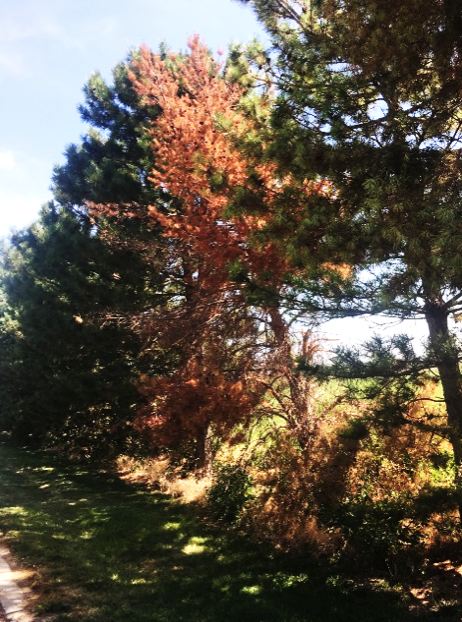
In Kansas, the symptoms for pine wilt usually appear from August through December. In general, the trees wilt and die rapidly within a short period of time. Occasionally, trees may survive for more than one year. The needles turn yellow/brown and remain attached to the tree. The early stages of the disease are subtle and may vary. The pinewood nematode is transmitted from pine to pine by a bark beetle, the pine sawyer beetle.
Needles initially show a light grayish-green discoloration, then turn yellow and brown. The disease may progress uniformly through a tree or branch by branch, depending upon the size of the tree and the environmental conditions during the growing season. The needles remain attached for up to six to twelve months after the tree has died. The rapid death of a tree contrasts with other pine problems such as fungal diseases, insects, or environmental stresses.
There is one option to potentially save unaffected Scots, Austrian, and white pine trees from Pine Wilt. According to Colorado Extension two compounds are labeled for the prevention of pine wilt. These products are directed towards killing/immobilizing the nematode and not for killing the pine sawyer beetle vector. They are not effective if the tree is symptomatic or once the PWN has colonized the tree. Several commercial injection systems are available, but pine injections are almost always done by professional arborists. Yearly injections provide the greatest protection, but the cost and potential damage associated with the injection process are issues to consider.
It is important to confirm the presence of the pinewood nematode if pine wilt is suspected to be the cause of a tree death. Early confirmation will allow the owner to act quickly to prevent the spread of the pinewood nematode to nearby pine trees. In established pine plantings such as landscape settings, windbreaks, and Christmas tree farms, the only control measure is to remove affected trees and burn, bury or chip the wood before April 1. Trees should be removed to ground level. No stumps should be left. This prevents further spread of the nematode and its vector before they emerge from the trees in the spring.
If you have further questions regarding Pine Wilt please reach out to Lauren Walz, the Cottonwood District Horticulture Extension agent by calling 785-628-9430 or by e-mail [email protected]
If you turn on the news, you will find one story after another about murder, drugs, theft and other crimes. These incidents are not only happening in big cities; rural areas and small towns are dealing with an increasing amount of crime.
Our young professional group recently toured the offices of our police, sheriff and county jail. The visit was eye opening because I have almost no interaction with law enforcement. An important takeaway was the officers’ request for our participation in public safety and community vigilance. Law enforcement officials often rely on community informants and private security footage to capture criminals.
There is a lot of truth to the saying nothing goes unnoticed in a small town. If crime or anything else is happening in your neighborhood, someone knows about it, and they will probably tell you about it. Unless they don’t know you.
Growing up in a very small community, I knew almost everyone in the whole town. In adulthood, that has not been the case. My education and career took me from coast to coast through several big cities over the course of a decade. During that time, I can count on one hand the number of neighbors I met.
Honestly, I avoided them. I was busy, tired from work, had enough people in my life, I felt safer not knowing them and any other excuse that came to mind. None of my neighbors ever knocked on my door either. We were all content in our isolated lives.
This seems to be a trend even in small communities. How many people actually take the time to welcome new neighbors or go door-to-door to meet people if they are new to the neighborhood?
The technology and culture of our connected world have negated the need to interact with others because of their proximity. The unintended consequence of this is our neighborhoods are now filled with strangers who have no loyalty or reason to care.
The problems this causes are deeper than just an occasional awkward interaction. Not knowing our neighbors is eroding communities.
A podcast on the subject, featuring a crime prevention specialist Stephanie Mann, made me realize this unwillingness to meet neighbors is part of the reason crime is seeping into our neighborhoods.
Mann says fixing community’s problems begins by the small step of meeting your neighbors. Simply knock on their door, ask what concerns they have about the neighborhood and if they are willing to help.
She highlighted multiple examples of this simple step working to bring neighbors together to stop vandalism by supporting the family of troubled teens. Another community documented license plate numbers for visitors to a known drug house while getting the mail and walking their dogs.
Crime is not inevitable. Each one of us has the ability to help protect our family, friends and neighbors. Going outside our comfort zone to get to know our neighbors can create relationships and shared commitment to the goal of a achieving a safe and healthy community.
“Insight” is a weekly column published by Kansas Farm Bureau, the state’s largest farm organization whose mission is to strengthen agriculture and the lives of Kansans through advocacy, education and service.
The House has kicked off August recess and I was happy to be home back in Kansas with my beautiful wife, Laina, to celebrate our 36th anniversary. We have four wonderful children, and two grandchildren, who are jewels in our crown. She takes a dull day, and suddenly makes it seem worthwhile and she is a saint for putting up with me! Thank you to everyone who prays for us, as we continue this wonderful American journey, 36 years later.
Scam Alert
The Social Security Administration is working with the Consumer Financial Protection Bureau and the Federal Trade Commission to create a new fraud prevention placemat to help you identify and avoid Social Security scams. You can order free copies of the placemat to use at home, or to share with friends and family.
Here are a few things to remember to help others avoid scams:
Talk about it! Social Security scams haven’t been as common until recently. Share the message with others to make them aware of this type of scam.
Government employees will not threaten to take away benefits or ask for money or personal information to protect your Social Security card or benefits.
Report Social Security scams to the SSA Office of Inspector General Fraud Hotline at (800) 269-0271 or oig.ssa.gov/report and to the Federal Trade Commission at FTC.gov/complaint.
If you think you are being targeted by a scammer, please call my office at (785) 829-9000 for assistance. We are always happy to help!
Champlin Tire Recycling
Last week, members of my staff visited Champlin Tire Recycling in Concordia, Kan.
This small, family owned business looks for new and innovative ways to recycle old tires, turning them into items such as park benches, picnic tables, and playground mulch.
Owner Gary Champlin is the chair-elect of the Institute of Scrap Recycling Industries, Inc – an international trade association representing scrap commodities. While there, they spoke about a number of issues facing the industry, including ways we can all work to do more with less.
Thank you, Gary, for showing my team around and helping them better understand the creative ways recycling can benefit our communities.
Beef Up Sustainability
Cargill recently announced they are launching a new initiative, in partnership with The Nature Conservancy, called “BeefUp Sustainability.”
The project is committed to achieving a 30% greenhouse gas (GHG) intensity reduction across its North American beef supply chain by 2030. The opt-in initiative will reduce GHG emissions throughout Cargill’s beef supply chain from a 2017 baseline, measured on a per pound of product basis.
BeefUp Sustainability is designed to engage a variety of stakeholders including producers, customers and innovators. The initiative will focus on four areas: grazing management, feed production, innovation and food waste reduction. The 30% reduction builds on the industry’s existing GHG efficiency efforts and will equate to removing 2 million cars from U.S. highways for a year.
My office hosted a roundtable in McPherson to discuss issues of importance to rural broadband providers. The providers emphasized the need for updates to the national broadband maps, which are necessary for closing the digital divide. The roundtable included discussions about the need to empower stakeholders by establishing a strong challenge process to the FCC and USDA, to ensure the accuracy of data being reported. These providers are working tirelessly to build out future-focused networks in rural America, and I appreciated them taking the time to share ways in which I can help support these efforts.
Big News for Kansas Ranchers
President Trump has announced a trade deal to sell more American beef to the European Union. Kansas is one of the top beef-producing states in the nation – each year the industry contributes more than $9 billion to the state’s economy.
Thank you to the Trump Administration for fighting to deliver new and fair trade deals on behalf of Kansas farmers, ranchers, and producers.
FCC Open Meeting
The Federal Communications Commission held its August meeting and considered a number of rural-focused agenda items. The FCC is working to make access to their programs easier, by streamlining and simplifying the way health care providers can apply for telehealth support, and by formally establishing the Rural Digital Opportunity Fund. Reducing the red tape for providers is critical to continue building broadband networks, and to ensure rural homes, small businesses, and community institutions are able to connect.
Lou Ann Kibbee, Hays, is seated in front.
National Council on Independent Living
Last week, I had a great meeting with Kansas representatives, including Lou Ann Kibbee of Hays, from the National Council on Independent Living (NCIL) the longest-running national disability and grassroots organization led by people with disabilities.
The conversation focused on health care, as well as employment and economic equity. We discussed my support for H.R. 3253, the Empowering Beneficiaries, Ensuring Access, and Strengthening Accountability Act of 2019, which reauthorizes funding for the “Money Follows the Person” program, so elderly people and those with disabilities can use federal dollars to pay for care by providers of their choice.
I am pleased to report this legislation is now on its way to the President’s desk to be signed into law.
Volunteers Needed!
My office is looking for volunteers to help out at my booth at the Kansas State Fair on Friday, September 6, through Sunday, September 15. Volunteers are needed to hand out fliers and take down contact information from constituents with questions.
Gate admission and WiFi will be provided – couples welcome! If you are interested please contact my District Director, [email protected] for more info.
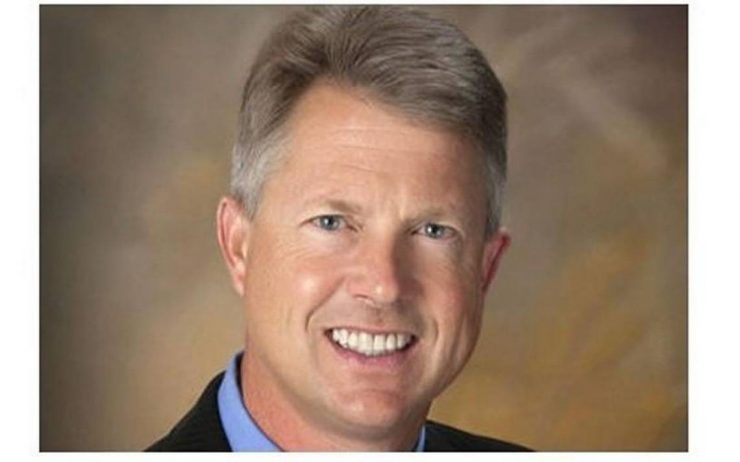
Dr. Roger Marshall (R-Great Bend) is the First District Kansas Congressman.
One of the amazing things about life in the Statehouse is that nearly everything that happens here has a political edge to it. Or two or three edges.
The latest scrap? Probably the Kansas Department of Revenue’s notice to the rest of the folks in the nation that if they sell stuff over the phone or internet or plain old mail and ship it to Kansas, they have to collect Kansas sales tax on the merchandise and send that money to Kansas, just like Kansas stores do. Those folks who don’t have a store in Kansas? They are “remote sellers” and the U.S. Supreme Court has held that they can be required to collect and remit sales tax just like the stores on any street in Kansas.
Well, Revenue has now put all those remote sellers on notice that Kansas wants that sales tax, and they should spend the morning filling out forms, registering with the state, and collecting and remitting those taxes to Kansas. Starting Oct. 1.
Sorta evens-up the prices, you don’t save 7.5 percent by just ordering stuff from out of state.
As it turns out, that notice is essentially a recitation of current state law.
Well, that notice of state law by Democrat Gov. Laura Kelly’s Department of Revenue and her agency’s intent to enforce it have become a political time bomb for conservative Republicans.
Senate President Susan Wagle, R-Wichita, has blasted the governor for enforcing that state law because she believes that Kansas is going to be sued over it at some cost to the state, or at least diverting state lawyers who could presumably be doing something else, to defend it.
Oh, and the reason Wagle’s upset? It comes down to the governor vetoing a bill that cut $35 million in income taxes to generally upper-income individuals, $72 million to corporations that do business overseas, maybe in a few years reduce the sales tax on food, and…put some limits on just which out-of-state merchants have to collect Kansas sales tax.
Nope, the out-of-state sales tax wasn’t a big deal in the bill, and the political aspects of the corporation-oriented income tax cuts don’t appear to be as heart-rending as the sales tax on food for Wagle…at least in press releases.
And, that lawsuit over that out-of-state sales tax collection might actually happen because the U.S. Supreme Court has indicated that states probably ought to have some provision for exempting some minor-league businesses from the state’s strict sales tax rules. Something like maybe $100,000 in annual sales, and maybe 200 distinct transactions.
But that’s not state law now, and we’re wondering whether the Department of Revenue just administratively allowed those exemptions, so-called “safe harbor” exemptions, without legislative authority, whether there would be an arrest warrant out for Revenue Secretary Mark Burghart…
***
Any chance lawmakers will consider some low-cost exemptions to the sales tax law next session? Or whether that “safe harbor” will become part of another major tax cut bill next session?
It could go either way.
If there’s a lawsuit, asserting that the state’s current law unconstitutionally hampers interstate commerce, it could take years to make its way through the U.S. Supreme Court.
If there’s a “safe harbor” bill that lets small and infrequent sales into Kansas without sales tax and the hassle of registering with the state? Well, that’s an amendment magnet that will undoubtedly wind up as an income tax cut bill that will include as frosting reduction in sales tax on food.
This may become a big issue in the election-year legislative session which starts Jan. 13.
Syndicated by Hawver News Company LLC of Topeka; Martin Hawver is publisher of Hawver’s Capitol Report—to learn more about this nonpartisan statewide political news service, visit the website at www.hawvernews.com
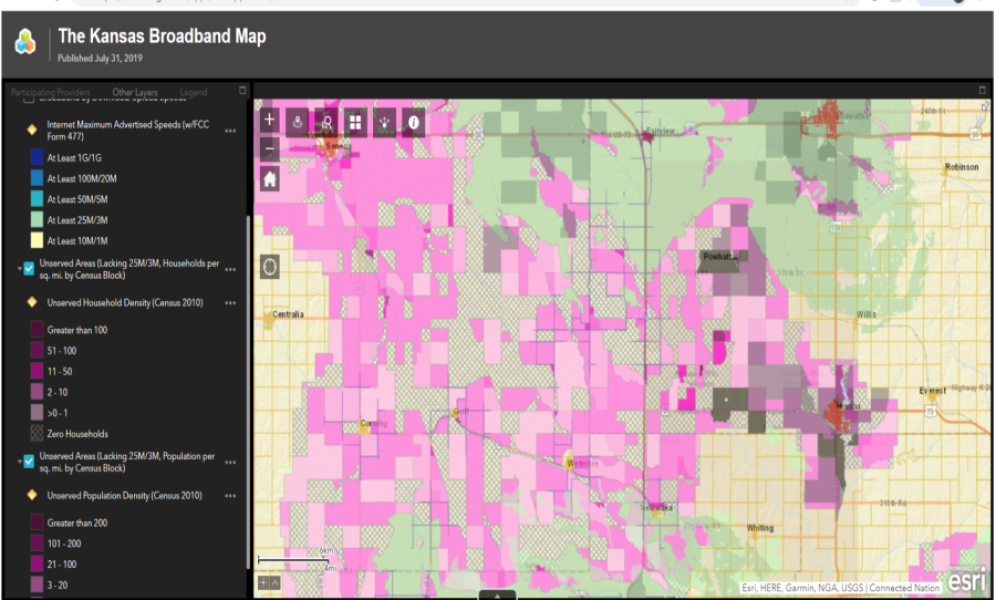
DODGE CITY – Where would we be if we couldn’t stream movies or music? Far-eastern Kansas counties and a broad swath of western Kansas.The newly released statewide broadband map shows in greater detail than ever before where 3.5% of Kansas residents don’t have adequate access to the internet. You can even search by your address … if you have internet, that is.
Telecom experts know it’s expensive to get service out to those areas, but advocates say it’s crucial to make up for the gap that’s been left in the wake of rural hospitals closing.
Kansas is bathed in shades of blue that stretch north to south, east to west. That’s not a reference to politics: It’s what the state looks like on the Federal Communications Commission’s Fixed Broadband Deployment map.
The map shows the approximate number of internet service providers within an area — the lighter blue represents fewer, the darker multiple. Considering the entire state is blue, you’d think internet service is available everywhere.
In reality, internet access has been a problem for Kansas residents, service providers, health care and lawmakers.
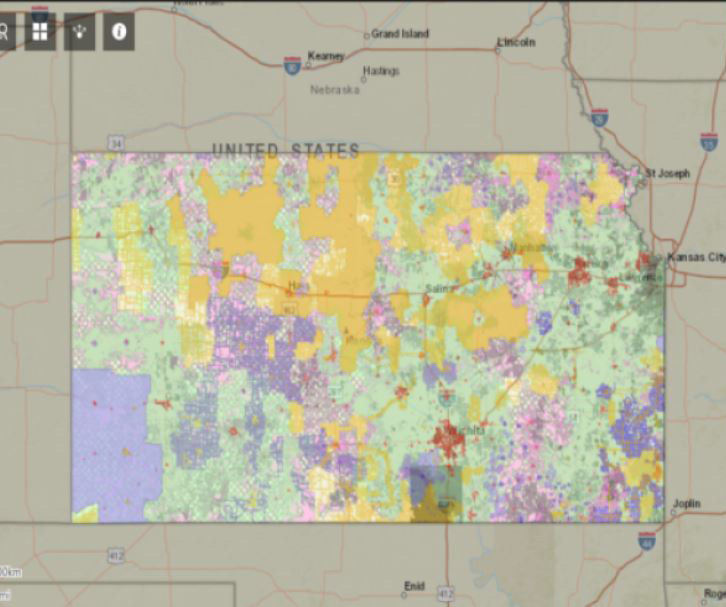
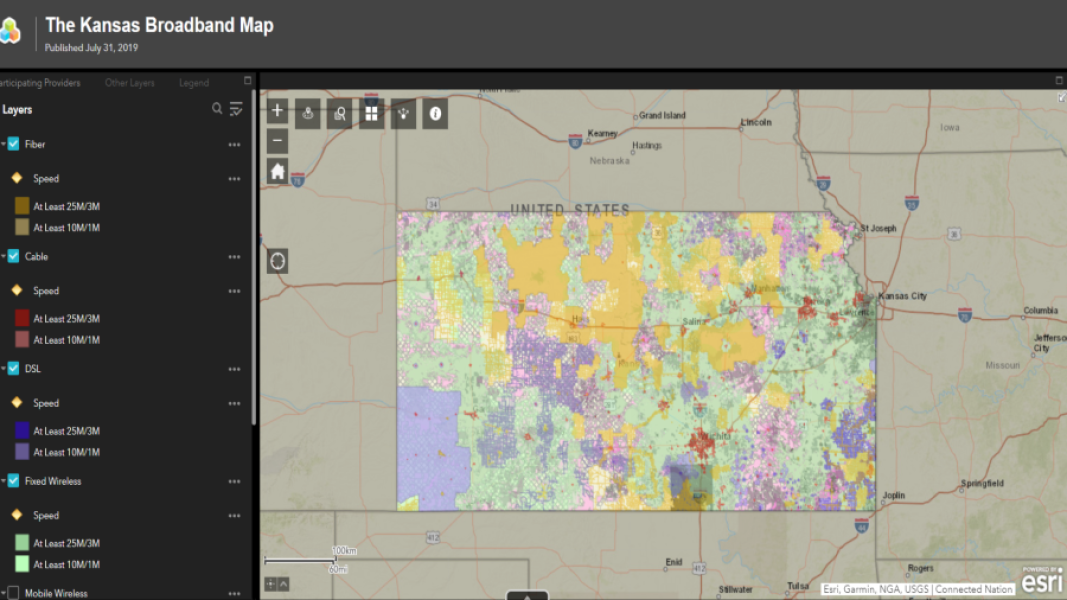
So a new map was created with information supplied by dozens of providers around the state. And the data shows that more than 95,000 people, or about 3.5% of the state’s population, do not have internet access; places like rural eastern Kansas.
The new Kansas Broadband Map shows speeds, types of service available and features an address search feature. (Credit ArcGIS.com)
“We found, through this mapping exercise, that there actually are pockets of areas where people do live — here in Dodge City and even in the suburbs of Kansas City — that don’t have service, that need it,” said Brent Legg, who’s the vice president of government affairs with Connected Nation, at the State Independent Telephone Association Conference on July 30.
Connected Nation, a nonprofit, created the new map with a $300,000 grant from the Information Network of Kansas. It worked with internet service providers and deployed engineers to verify service providers’ data, so now multiple layers of broadband availability by speed and type are publicly available.
Seventy-two of the state’s 88 internet service providers voluntarily submitted data, and FCC data was used for the companies that declined to respond or participate (Legg said none was available for six providers).
Jason Smith is CEO of Rainbow Telecommunications based in Everest, Kansas. He said the map is “desperately needed.” Laying fiber outside of of Rainbow Telecommunications’ coverage area is expensive.
“When you’re looking at anywhere from $20 to $40,000 a mile to build fiber services, you can’t make a business case on that for a small pocket of 10, 20 customers — it will never pay for itself,” Smith said. “And so you’re going to need types of grant funding.”
But federal grant funding for expanding rural internet service uses FCC census block data, which in rural and remote areas are larger and may even be measured by square miles. The census block data can lead to long and costly application processes for providers like Rainbow Telecommunications.
“So you might consider an area that you could help expand broadband to, but if you base it off those maps … they weren’t accurate,” Smith said. “So you would spend time and effort and money to find out you couldn’t participate in that program.”
What areas lack
Nationally, 19 million people in the U.S. don’t have access to broadband, according to the FCC. That’s about 5.8% of the population. Kansas’ connectivity rate is better than the national rate, but the lack of internet access can deter people from moving to and working remotely from rural areas, where populations are generally declining.
Earlier this year, some Kansans testified before the Statewide Broadband Expansion Planning Task Force about painfully slow internet speeds.
And some rural areas have seen hospitals close, Executive Manager of SITA Colleen Jamison said July 30, noting that broadband could deliver telemedicine to people who live hours away from specialized care.
“Maybe somebody who’s got a high-risk pregnancy in Ulysses, Kansas, and the nearest potential NICU for a birth maybe in Wichita,” Jamison said. “But that monthly or even weekly monitoring of maternal health could be so vitally important to that unborn child.”
And even though it may not be entirely useful for people who already don’t have internet, the new map contains an address search feature. For households without internet, searching online may involve traveling to a public place, but Legg said the new feature will be helpful to service providers that might be be unaware of unserved residents.
“So they may want to build out service into those areas,” Legg said. “It will also help service providers identify places where they could go apply for federal grant dollars to build out via the (U.S. Department of Agriculture) reconnect program, for instance.”
Pinks and purples on the new map indicate areas without internet, and some are found outside of eastern Kansas counties, including Atchison, Brown and Wabaunsee. Clicking on the unserved layers of the map shows where household are and how many don’t have access to internet.
Areas without service are located under the “other layers” tab within the new broadband map. (Credit ArcGIS.com)
Jamison said legislation authorized the creation of a more accurate map allowed it to guide the state’s broadband task force. “The statewide broadband task force said, ‘Let’s look at what we recognize the issues that there are at the federal level.’ So let’s look at what can we do to ensure that Kansas is mapped as accurately as possible,” she said. “So that it guides the state efforts at the task force level and beyond.”
Corinne Boyer covers western Kansas for High Plains Public Radio and the Kansas News Service. You can follow her on Twitter @corinne_boyer or email cboyer (at) hppr (dot) org.
The Kansas News Service is a collaboration of KCUR, Kansas Public Radio, KMUW and High Plains Public Radio focused on the health and well-being of Kansans, their communities and civic life.
I stepped out the front door one spring morning a few years back just in time to see a large falcon-shaped bird glide low overhead. It landed in a tree a block away, so I hustled to get my binoculars and our Kansas bird book. The bird sat contentedly, almost posing for me as if making certain I correctly identified it.
It was a Mississippi Kite, and although my bird book doesn’t show or give details to differentiate between males and females, we figured it to be a female in town to nest. I often begin my day with a walk around our neighborhood and I’m usually greeted by as many as 6 Mississippi Kites in the neighbor’s tall dead tree. They seem to like the high open vantage point from which to survey the neighborhood.
Mississippi Kites are light gray and slightly smaller than a red tail hawk, and are built trim and sleek, much like a falcon. They derive their name from their unique soaring style called “kiting.” Picture how a child’s kite rides the wind, gliding and sliding sideways back and forth. That’s how Mississippi Kites soar, as if on a string, sliding and almost rocking back and forth from side to side as they float effortlessly on the Kansas summer thermals. They are summer residents here, arriving in mid-April and leaving again in mid-November.
They are slowly expanding their territory northward and are quite comfortable nesting in our Kansas cities and towns. Nesting females are known to become very aggressive when their chicks are about to leave the nest, often dive-bombing humans and pets that get too close to the nest to suit them. We try each year to find a Mississippi Kite nest to watch, but have been unsuccessful thus far. Mississippi Kites are very social birds and are often seen in large groups. One day this week in downtown McPherson as I waited in the car for my wife to return from an errand, I began seeing Kites soaring above me. One or two at a time they appeared until I lost count at fifteen.
Kites occasionally feed on small reptiles and snakes but are mostly insect eaters and are skilled at snagging locusts and other flying bugs in mid-air. Last Sunday while eating ice cream in a local Dairy Queen, I watched a Mississippi Kite having dinner on a power pole just outside. It would suddenly fly toward a small group of trees nearby and return with a snack. After eating its snack, it would fly again toward the same trees, always returning with a morsel of some sort. I’ve been seeing the first locusts of the summer, and I’m betting it was finding them too.
My wife Joyce grew up on a farm south of Meade, KS, and after we got married I began hearing stories about a man named James Parker who had come to their farm for years to watch and study Mississippi Kites. A friend still living in Meade did some research and found more details to the story.
According to newspaper clippings, it was mid-June 1982 when Dr James Parker from the University of Maine first visited the Friesen farm near Meade. He was indeed there to observe Mississippi Kites, but he brought with him some visitors. Stan and Gladys were Swallow Tailed Kite chicks rescued from a nest in the Florida swamps.
Swallow Tailed Kites, although larger with a huge ornate tail, are close cousins to Mississippi Kites and until the early 1900’s were common in the eastern Kansas skies. They hadn’t been seen in the state for decades and Dr Parker was there to explore the possibility of reintroducing Swallow Tailed Kites into Kansas by transplanting chicks into existing Mississippi Kite nests. Stan and Gladys were put into active nests and Parker stayed around to observe. After two or three weeks Stan grew weak, lost weight and died, but Gladys was accepted by her foster-parents and seemed to thrive. Although the time line is unclear, Parker spent parts of 14 summers in Meade during the 1980’s and 1990’s studying the local Mississippi Kite population.
No one seems certain whether any more Swallow Tailed Kites were transplanted into Kansas. They’re not listed in my Kansas bird book so I suspect there are none in the state today. No one knows what happened to Gladys either, but I can say with certainty that Mississippi Kites are here to stay in south central Kansas and are steadily expanding their summer range to the north and east. So watch the sky and you’ll soon know if Mississippi Kites have come to your neighborhood, as you’ll see them floating and gliding effortlessly on the Kansas winds. Continue to Explore Kansas Outdoors.
Steve Gilliland, Inman, can be contacted by email at [email protected].
Kansas Common crude at CHS in McPherson starts the week Monday at $46 a barrel. The Kansas benchmark ended the month of July at $48.75 a barrel. That’s a dollar more than the average price for the month. But it’s half a dollar less than at the beginning of the month, and $10.25 below the price on the same date a year ago.
A new federal report shows Kansas crude-oil production dropped to 2.81 million barrels in May. According to the latest numbers from the Energy Information Administration, the daily statewide average in May was 91,000 barrels per day, down four thousand barrels per day from April, and down six thousand barrels per day from May of last year.
National crude-oil production totals declined as well. EIA said U.S. producers pumped more than 375 million barrels or 12.1 million barrels per day. That’s down 54,000 barrels per day from April but is more than two million barrels per day higher than the average in May of last year. The state of Texas pumped more than 41% of the national total at 4.9 million barrels per day. North Dakota reached 1.3 million barrels per day, and New Mexico notched 900,000 barrels per day.
The Kansas Corporation Commission reports 111 new intent-to-drill notices filed during the month of July, a slight drop from the month before. So far this year there are 641 intents in Kansas, down from 1,067 through July of last year. The KCC shows three new intents in Barton County, five in Ellis County and one in Stafford County.
The weekly Rotary Rig Count from Baker Hughes shows 942 active drilling rigs nationwide, down six oil rigs. The count in Oklahoma dropped by five while New Mexico was down two rigs. Independent Oil & Gas Service reported a drop in the number of active rigs in Kansas, but an increase in the total rig count for the state. East of Wichita there were 12 active rigs last week, up two. In Western Kansas the count dropped by four to 22 active drilling rigs. Drilling was underway on one lease in Ellis County and one in Stafford County.
Regulators approved 19 permits for drilling at new locations last week. Seven of those were in eastern Kansas and 12 were west of Wichita, including two new permits in Barton County. So far this year we’ve seen 569 new drilling permits, well below the 1,000 new permits issued by this time last year.
Independent Oil & Gas Service reports 20 newly-completed wells over the last week, three in eastern Kansas and 17 west of Wichita, including one in Barton County, one in Ellis County, and two in Stafford County. Operators have completed 843 wells so far this year, compared to 917 at this time last year.
The government reported a large weekly drop in U.S. crude oil stockpiles. The U.S. Energy Information Administration reported inventories of 436.5 million barrels. That’s down 8.5 million barrels from a week ago, but right at the five year average for this time of year.
EIA reported total U.S. crude oil production of 12.244 million barrels per day for the week ending July 26. That’s the fifth highest weekly production total ever, up 985,000 barrels from the week before. The cumulative daily average so far this year is up 15% over the same period a year ago.
Crude-oil imports dropped last week to 6.7 million barrels per day. The four-week average is down 13% from the same period a year ago. Total gasoline inventories decreased by 1.8 million barrels last week and are about 2% above the five year average for this time of year.
The Association of American Railroads reports the oil patch is one of just three categories of rail freight that showed growth for the week ending July 27. Oil-by-rail totals remain above year-ago levels but growth continues to slow. Operators filled 12,642 rail tanker cars with petroleum and petroleum products, up 4.1% over the weekly count a year ago. Canada’s tanker car traffic was up nearly 24%.
Mark Tallman. Photo courtesy Kansas Association of School Boards
By MARK TALLMAN Kansas Association of School Boards
Differences in academic success among Kansas student groups are receiving attention this year.
In the Gannon school finance lawsuit, the Kansas Supreme Court ruled Kansas school finance was not constitutionally adequate because too many students were not meeting state standards, and those students were disproportionately poor, non-white or disabled. The court approved a multi-year funding plan passed by the Legislature to address those students, shifting the focus to how schools are using those funds to improve results.
The State Board of Education’s “Kansas Can” goals are centered on getting more students to complete high school and go on to earn a postsecondary credential to meet the state’s economic needs and earn a higher standard of living. Many students are at-risk of failing to meet those goals.
Finally, the Kansas Legislature has commissioned its Post Audit Division to study how Kansas provides extra funding to school districts to help students at risk of poor academic performance or dropping out of school, which could result in changes in the $415 million program. This follows a study of special education funding last year, and a future audit will look at bilingual education funding.
This series looks at the major issues in the “achievement gap” between different groups of students, how current programs are working to address those differences, and issues under study.
Part 1 – Impact of student and family income on student success
Lower income students are more likely to struggle on educational measures like test scores and graduation rates than higher income students.
On Kansas state assessments, over 70 percent of all students score at the what the State Board of Education has defined as “basic” ability to understand and use the mathematics and English Language Arts skills and knowledge needed for college and career readiness. However, less than 60 percent of free/reduced lunch eligible students are at that level, compared to over 80 percent of higher income students.
Likewise, about one-third of all students scored at the “effective” level, which is considered “on track” for postsecondary success, in mathematics and 37 percent in English. But only 19 percent of free and reduced lunch eligible students scored at that level in math and 23 percent in English, compared to 45 and 50 percent for non-low-income students.
The four-year graduation rate for all students is 88 percent but only 80 percent for free/reduced meals eligible students graduate “on time”, compared to 95 percent of higher-income students.
These differences are not unique to Kansas, or to public schools. On the 2017 National Assessment of Education Progress (NAEP), which tests a sample of students at fourth and eighth grade on reading and math skills in all states, Kansas had a 22.6 percent gap between free and reduced meal eligible students and not eligible students at the Basic level, compared to 23.6 percent for all states and 24.7 percent for Kansas overall peer states (most similar to Kansas in student and population characteristics). Kansas had a 28.4 percent gap at the Proficient level, compared to 27.7 in all states and 27.9 percent for states.
The five non-public school systems that participate in Kansas State Assessments (Lutheran schools and the Catholic dioceses of Dodge City, Kansas City, Salina, and Wichita) have gaps between free and reduced meal eligible and non-eligible students of 10 to 20 percent at the Basic level and 20 to 30 or higher at the Effective level.
Reasons for the income-achievement gap
A number of reasons have been advanced for these differences (here is a chapter from a report presented by the ASCD, formerly the Association for Supervision and Curriculum Design). The conclusions are that students from low income or impoverished families experience more stress that negatively affects their development, begin school with fewer resources and therefore start behind their more advantaged peers, and have less home support and more disruption throughout their years in school.
Specifically, lower income students are more likely to lack adequate food and health care. They are more likely to live in single-parent (or grandparent) households, with one or more parents absent or incarcerated. They are more likely to be homeless. They are more likely to experience “trauma” or “Adverse Childhood Experiences” that affect their development. While there are many exceptions, they are more likely to start school with smaller vocabularies, less socialization and basic skills.
Lower income parents are more likely to have unstable employment and housing, which leads to more frequent moving from home to home, school to school. They have less reliable transportation and parents may be working multiple jobs at hours that make it more difficult to monitor student attendance and progress, and be involved in school activities.
Finally, these families are less able to afford enrichments such as home computer and internet access, travel and vacations, sports, clubs and other activities. In other words, more of these families simply lack the resources to support their students at the same level as higher income families.
Because income is now so closely linked to education level, lower income families are likely to have parents who did less well in school and have less postsecondary education themselves. Therefore, their students may receive less guidance, understanding or even support for educational attainment as a priority. In fact, school leaders say some parents may actually discourage students from further education, concerned they may “lose” their children if they pursue education that leads to employment away from home.
The result is a difficult cycle to break. Students from lower income families are less likely to complete high school and college; as a result, they are more likely to have lower income as adults and their children with face the same challenges.
Of course, this does not mean all lower income students are failing; nearly 60 percent of these students score at least at basic on state tests and 80 percent graduate on time; and nearly one in five higher income students are below basic and five percent do not graduate from high school, at least within four years. The data is clear, however, that lower income students are much more likely to be behind on academic standards, fail to complete high school and be unprepared for postsecondary education.
Mark Tallman is the associate executive director for advocacy and communications for the Kansas Association of School Boards.
The United States is exceptionally religious. Americans pray and attend religious services more than adults in other developed countries and they assign a higher value to religion in their own lives. Nearly three-quarters of Americans affiliate with some religious group.
Does this religious fervor correspond with a religiously literate public? On July 23, the Pew Research Center announced the results of a major survey of religious knowledge and found that Americans, on average, correctly answer fewer than half of questions — many of which were intended to represent some of the “basics” about various religious traditions.
Americans fare only slightly better when asked about their own religious traditions. Christians, for example, answer about 59 percent of questions about the Bible and Christianity correctly.
So are Americans both religious and religiously ignorant about religion, as some claim? The answer to that question depends entirely on what we think it means to know about religion — especially our own.
When we compare the results of Pew’s survey with a study led by political scientists Robert Putnam and David Campbell about the importance of religion in people’s lives, we notice a surprising pattern: America’s least religious groups earn the highest scores on Pew’s religious knowledge survey and some of America’s most religious groups answer the fewest questions correctly. When Pew published the first iteration of the study with similar results in 2010, major news outlets focused on a perceived inverse correlation between religiosity and religious knowledge. “Survey: Atheists, Agnostics Know More About Religion Than Religious,” blared one headline.
We should pause when we hear the claim that Americans who are religious — people who gather in religious communities frequently, who ground their sense of self in religion, who find religion important in their daily life — know less about religion than people who are not religious. Echoing the philosophy of religion scholar Thomas A. Lewis’ astute question: If religious people lack religious knowledge, does “religious” mean the same thing in both halves of the sentence? What type of knowledge are we measuring?
Take a look at what religious knowledge means on the Pew survey. Of the 32 questions asked in 2019, roughly 22 — depending on how you classify them — measure knowledge about scriptural narrative (e.g. “Which biblical figure is most closely associated with saving Jews from murder by appealing to the king?”) and doctrine (e.g. “Which is one of Buddhism’s four ‘noble truths?’”).
Here’s my interpretation of the results: Being religious often has little to do with content knowledge about scriptural narrative and doctrine — of our own or others’ religious traditions. If that is correct, then how we talk about religious knowledge should change.
We should first acknowledge that religious individuals are capable of expressing their religious identity fluently in their own religious communities. Being able to express oneself religiously — and to understand the religious self-expression of a co-religionist — is its own type of religious knowledge. I have studied religion formally for years, but I know that, as the son of a Roman Catholic and humanist Jew, if I were to step into an evangelical church I would lack the vocabulary for communicating my religious identity clearly to folks in the pews. In other words, religious knowledge includes a skill — communicating religious identity — and not just content knowledge.
As religious studies scholar Vincent Lloyd argued after the release of Pew’s 2010 survey, there is a difference between “knowledge-that” and “knowledge-how.” The Pew survey measures the former, whereas religious individuals have plenty of the latter. Religious folks know how to be religious just as someone riding a bike knows how to balance on two wheels, even if they can’t explain the physics. We learn from the results of Pew that knowing how to be religious does not necessarily require knowledge about scriptural narrative and doctrine. So what does it entail?
We might better understand what it means to know how to be religious if we recognize three buildings blocks of religiosity: belief, behavior and belonging. Drawing on decades of sociology, anthropology and psychology research — including the work of social psychologist Jonathan Haidt — I have elsewhere explained how the beliefs people hold, the behaviors they manifest and the communities to which they belong mutually constitute people’s religious identities. Knowledge about beliefs need not be the primary focus of our religious lives. Growing up I could not name the five books of the Torah, but I knew how to tell Yiddish-inflected jokes over matzo brei while visiting my Ashkenazi grandparents in New York for Passover. In the eyes of my grandparents, my biblical illiteracy did not make me any less Jewish.
Religious individuals and communities need not know the dictionary definitions of their beliefs, behaviors or communities of belonging in order to know how to be religious and express that religious identity in their private and public lives.
And that brings us to a second type of skill, one that is academic and not devotional: the ability to analyze and contextualize religious expression. If religious individuals’ knowledge-how is akin to fluency in a religious language, then the conceptual knowledge of religious studies scholars is akin to linguistics. The religious studies scholar asks how religious expressions communicate meaning and establish relationships in specific times and places. The American Academy of Religion, the world’s largest professional association for scholars who study religion, defines religious literacy — a type of conceptual knowledge about religion — as the “ability to discern and analyze the intersections of religion with social, political and cultural life.” This conceptual knowledge helps a scholar analyze lived religion and religious identities, not memorize content.
So what does Pew’s survey tell us about Americans’ religious knowledge?
The results show us that Americans lack content knowledge about religion, especially scriptural narrative and doctrine. This should concern us, because content knowledge about multiple religious traditions is important. Stephen Prothero, an adviser to Pew and the author of the 2007 bestselling book “Religious Literacy: What Every American Needs to Know — and Doesn’t,” makes a compelling case for why we have a civic responsibility to teach children facts and figures about the stories and beliefs found within religious traditions.
Pew’s survey does not tell us whether Americans are religiously literate as defined by the American Academy of Religion, though I suspect they are not. We do not know what conceptual knowledge Americans have to analyze the role of religion in public life, but recent evidence — statements that Islam is not a religion, a political cartoon showing Israel’s Prime Minister Benjamin Netanyahu as a dog, or claims that Buddhism is inherently peaceful — suggests we need to improve religious literacy education. Fortunately, the National Council for the Social Studies has taken an important step by releasing guidelines for teaching about religion academically and constitutionally in American public schools.
The Pew results emphatically do not tell us that religious people are ignorant about their own religion. Religious individuals and communities know how to be religious — and that type of insider knowledge is profound.
Benjamin P. Marcus is religious literacy specialist at the Religious Freedom Center of the Freedom Forum Institute. His email address is: [email protected].
In the U.S., there are almost five million people with mild to moderate dementia, and studies show that about 70 percent are at home, either alone or with a caregiver, often a spouse. If people with mild to moderate dementia can stay home safely, this would save Medicare and Medicaid a great deal of taxpayer money. More importantly, this would provide those people affected with dementia their preferred environment. Indeed, it is important to allow all people the chance to stay at home whenever possible.
A 2013 Johns Hopkins report studied more than 250 people with dementia living at home and found that 99 percent of the demented and 97 percent of their caregivers had at least one unmet need. The foremost unmet need was defined by safety issues such as poor lighting in walkways which increased the risk of falling. Other needs that were not being met in this study included not performing regular exercise, poor follow-up with health care providers, not having prepared legal and estate planning and not receiving help with medications and some activities of daily living. Researchers found that those with lower income, with depression and with borderline rather than severe dysfunction had significantly more unmet needs.
When there were at-home caregivers for these folks with early dementia, the caregivers were often not aware of these deficiencies. In addition, the needs of the caregivers were often ignored or unrecognized. Remarkably, at-home caregiver stress and depression were some of the strongest predictors for an earlier move of the person with dementia to the nursing home.
Methods to enhance a person’s chance of staying at home are not difficult. Preparation for legal issues and estate planning should be done early and BEFORE the loss of memory. Other methods include providing raised toilet seats, grab bars in the bath and bedroom, properly tacked down carpets, good nighttime lighting in walkways and proper day and nighttime footwear. Researchers also advise providing enhanced support for caregivers with education about community support available such as social services, occupational therapy and caregiver support groups. In addition, screening and treatment of any caregivers’ depression, should be provided. This would go a long way in helping people stay at home as they age.
Bottom line: Most of us, and our families, are not prepared for the possibility of dementia as we age. If we prepare, we greatly improve our chances for staying at home.
For free and easy access to the entire Prairie Doc® library, visit www.prairiedoc.org and follow Prairie Doc® on Facebook, featuring On Call with the Prairie Doc® a medical Q&A show streamed most Thursdays at 7 p.m. central.