We have a brand new updated website! Click here to check it out!

Exploring Kan. Outdoors: What color is your favorite lake?

BullCityBlack500x125 (1)

I know all you K-State fans love your “Royal Purple”, and KU fans adore your red and blue, and those colors are just the ticket to adorn T shirts, umbrellas and ball caps in support of your chosen team. But when the waters of your favorite lake take on those same hues, lookout!

Welcome to algae bloom season in Kansas which usually runs from May through October, the months sporting the longest days of sunlight and the warmest water temperatures.

Steve Gilliland
Steve Gilliland

This time frame also unfortunately contains the three holidays when our lakes are used the most, Memorial Day, Fourth of July and Labor Day. Blue-Green Algae are bacteria with a scientific name as long as a yardstick, that exist naturally in rivers, lakes and ponds here in Kansas. When certain conditions align, such as exceptionally high nutrient content in the water, and long hot days with lots of sunlight, those bacteria can reproduce more rapidly than usual, causing a dense growth of algae known as “a bloom.”

Some algae blooms are harmless, but when the blooming organisms contain toxins, noxious chemicals or pathogens in levels harmful to humans and animals, it is declared to be a “Harmful Algae Bloom,” and warnings or advisories are issued by the Kansas Department of Health and Environment, (KDHE.) These blue-green algae blooms can be blue, bright green, brown or even red, and may look like foam or thick, frothy slurry. Some blooms, however may not even affect the appearance of the water.

When KDHE receives notice from anyone that a harmful algae bloom is noticed or suspected, they take water samples at the most frequently used locations at the site, such as swim beaches and boat docks. The samples are analyzed, and according to the density of the algae found, either a Public Health Watch or a Public Health Warning is issued for that water impoundment.

A public health watch

Notifies the public that a hazardous condition MAY exist
Signs MAY be posted at all public access locations
Water MAY be unsafe for humans/animals
Contact with the water is DISCOURAGED
Public health watches and warnings are updated frequently, and as of 6/23, watches are in effect for McLaughlin Lake in Valley center, Marion Reservoir as well as Marion County State Fishing Lake, and zone “B” on Milford Lake, which is the central portion of the lake.

A public health warning

Notifies the public that condition ARE unsafe
Signs WILL be posted at public access locations
Contact with the water SHOULD NOT OCCUR
The only current warning in effect as of 6/23 is zone “C” of Milford Lake, which is the northern 1/3 of the reservoir. Keep abreast of current algae watches and warnings on www.ksoutdoors.com.

Health effects can occur when surface scum or water containing high levels of blue-green algal toxins are swallowed or have contacted the skin, or when airborne droplets containing toxins are inhaled while swimming, boating or skiing. Most people report the effects as “allergic” type reactions like intestinal or respiratory problems or skin irritations. Animal reactions may range from general weakness and lethargy, to vomiting, diarrhea, difficulty breathing or even convulsion.

My friend used to say “Everybody always tells me – Cheer up, things could be worse. So I cheered up, and sure enough – things got worse!” Sorry to say that health warnings at area lakes because of toxic algae blooms will probably get more numerous before they get better. So I guess your options are to sell the boat, skis and fishing poles, or just drive a little farther to a lake where no warnings exist, and continue to Explore Kansas Outdoors!

Steve Gilliland, Inman, can be contacted by email at [email protected].

BullCityBlack500x125 (1)

BEECH: Give yourself a fresh financial start this summer

Linda Beech
Linda Beech

Did you know the average vacation expense per person in the United States is $1,145? That’s over $4,500 for a family of four, according to American Express.

If you’re planning a dream vacation this summer, or working towards a different savings goal, the experts at America Saves say the official first day of summer can be your fresh start. This week, make a plan to save money, reduce debt, and build wealth. So when it’s time to pay for that vacation or other goal, you’re not taking on more debt, or squeezing another budget category.

It all starts when you set a goal and make a plan to reach that goal, because those with a plan are twice as likely to save successfully. America Saves suggests these steps:

Step 1: Set a goal

What are you saving for this summer? Here are some ideas to get you started:
•Save for a vacation
•Save for an emergency fund
•Save for fall school supplies or education
•Save for a new car, air conditioner or appliance
•Start your holiday savings fund

Step 2: Make a pledge to yourself to save
Deciding what to save for is the easy part. Now it’s time to really commit so that you are able to meet your summer savings goals.

The America Saves pledge can help. It is designed to help you save money and reduce debt by thinking through your goals, and how much you want to save. Whether you are saving for a family camping trip or a back-to-school shopping trip, the pledge can help you save.

But it doesn’t stop there. Those who make a pledge with America Saves will receive information, advice, tips, and savings reminders to help you reach your goal.

Ready to get started? Make a commitment to yourself today by taking the pledge at www.americasaves.org/for-savers/pledge.

Step 3: Create a budget
One of the first things you need to do to save more efficiently is to keep track of what you are already spending. When you know where your money is going, you can make a plan to save with a budget. There are many different ways to do this, so you’ll want to try a few out and choose the system that works best for you. The key to saving more successfully is to find a system that works for you and to stick with it through the entire summer.

You can learn how to create a budget and download a budget worksheet for first time budgeteers at the America Saves website, too.

Step 4: Save automatically
The easiest and most effective way to save is automatically. This is how millions of employees save for retirement through 401(k)s and other programs at work. It is also how millions of Americans save at their bank or credit union.

Not only does it ensure you will be saving every month, but it also puts your cash out of sight and out of mind so you feel less temped to spend it. It also helps if you keep your savings in a separate bank from your checking account, or at least an account you don’t have easy access to.

Step 5: Find more money to save
Learn how to cut back on summer spending so you can save some cash and put it in your savings account instead. There are some great money-saving ideas in the America Saves blog at www.americasaves.org/blog.

America Saves is a research-based campaign which uses the principles of behavioral economics and social marketing to change financial behaviors. America Saves is an outreach project of the Consumer Federation of America (CFA), an association of non-profit consumer organizations that was established in 1968 to advance the consumer interest through research, advocacy, and education.

K-State Research and Extension is a partner with America Saves to encourage Kansans to build wealth and reduce debt through saving. You can find the resources of Kansas Saves at www.kansassaves.org. The Ellis County Extension Office offers a group program called “Saving Dollars When You Don’t Have a Dime to Spare.” Contact me at 785-628-9430 to schedule a presentation for your group.

Improve your financial life this summer by making a commitment to yourself to save money, reduce debt and build wealth.

Linda K. Beech is Ellis County Extension Agent for Family and Consumer Sciences.

LETTER: Ellis Co. treasurer candidate introduces herself

To the citizens of Ellis County, I would like to spend a few moments introducing myself as I announce I will be running for Treasurer in November. My professional background includes several years of work experience in Higher Education, physical fitness, the banking industry, and more. During my undergraduate education, I was in the top 2% of students at FHSU in the College of Business and Leadership, and was nominated for the Torch Award when I graduated. I have a Bachelors degree in Leadership Studies, and I earned my Master’s degree from KU, where I graduated with Honors in 2011.Lisa Schlegel

After earning my degrees and learning more about the world through full-time work and travel, I became certain I wanted to make my home in Kansas. My hobbies include traveling, spending my free time with my family and pets, and doing physical fitness, hiking, and gardening. Having grown up in Ellis County, a farmer’s daughter, I feel a great affinity for the people and the environs of Kansas. I was born in this place for a reason, and I want to stay here to contribute my efforts and talents to Ellis County, the place my family has called home since my ancestors came to the U.S. in the late 1800s.

We are at a time in history, I believe, is especially poignant. Our city, county, and nation need to pick leaders with integrity, courage to make tough decisions, and common sense as we move thoughtfully onward. As a new candidate for Treasurer I aim to make our county stronger by working in the spirit of togetherness with other county employees to make the best decisions we can to strengthen and unite our county. Ellis County citizens can count on me to perform the duties of Treasurer with excellence and integrity. I invite citizens to vote for me in November to serve a 4–year term as Treasurer of Ellis County.

Lisa Schlegel

POLL: What’s your take on Obama’s plans for illegal immigration?

WorldPestSponsor

On Thursday, the U.S. Supreme Court was deadlocked on President Barack Obama’s proposed immigration plan, which would protect millions living illegally in the U.S. from being deported. The high court’s impasse upheld a block on the rules without approval from Congress.

Do YOU agree with the Obama administration’s immigration plan?

[polldaddy poll=9453681]

Sponsored by World Pest Control

WorldPestSponsor

INSIGHT KANSAS: Voters may throw the bums out

Kansas voters may be ready to throw the bums out in upcoming elections. Why? Because many Kansans see their state government as one big mess!

Nearly three of every four Kansans recently surveyed gave poor marks to the performance of Kansas government. Kansans also rated state performance low on managing taxpayer money, assuring quality education, providing a safety net for vulnerable residents, and maintaining the state’s infrastructure.

H. Edward Flentje is professor emeritus at Wichita State University.

These low ratings suggest voters are fed up with the far-right Republican lawmakers who have been running state government for the last four years and are ready to change direction in upcoming elections. All 165 legislative seats are on the ballot in the August 2 primary and November 8 general elections.

Many incumbent lawmakers, mostly Republicans, are waving goodbye on their own, leaving seats more open to competition. Since their prior election, eight state senators and 32 state representatives are not seeking reelection or vacated their offices earlier for personal reasons. Those departing are not backbenchers but include key leaders: in the senate, the vice president, majority whip, and seven committee chairs; and in the house, the speaker, speaker pro tem, and six committee chairs.

Most immediate action begins in Republican primary contests. Fifteen state senate seats are being contested in August. Ten of the 22 incumbent Republican senators seeking reelection will face primary opponents, and five of the ten seats vacated by incumbent Republicans have contested primaries.

Thirty-seven Republican house seats have contested primaries with 21 of 71 GOP incumbents facing primary challenges. Fifteen of the 16 seats vacated by incumbents have primary races.

In contrast, Democrats have 13 contested primaries statewide, six in the senate and seven in the house. No senate incumbent seeking reelection faces a primary challenger; three house incumbents do have primary contests.

Newcomers will fill no fewer than ten of 40 seats in the senate, and 32 of 125 seats in the house. If all incumbents lose in contested primaries, an unlikely possibility, half the senate and nearly half the house could turnover.

Republican primary voters should do some homework before voting. They should remember that in primary contests of 2012 and 2014 they opted for candidates aligned with Governor Sam Brownback and his tax experiment. That experiment has produced a series of unbalanced budgets and unfair tax increases, a mountain of new state debt, and lagging economic growth, as well as fiddle-faddling delays on school finance.

If Republican primary voters are now ready to change course, two short cuts are suggested: First, scrutinize every one of the 31 Republican incumbents who are seeking reelection in contested primaries. Except for a handful, these incumbents consistently supported Brownback, his reckless tax experiment, and other measures that have given him the highest disapproval ratings in the nation.

Second, ask a simple question of both incumbents and newcomers in contested primaries: Do you support Brownback and the direction he is taking state government? If you get a weaseling response, look for another candidate.

So, Kansas voters, the next step in changing course depends on you. Legislative candidates have stepped forward. Sixty-five contested primaries are on the ballot. Advance voting begins on July 13, less than three weeks away. Do your civic duty. Engage with candidates and vote.

H. Edward Flentje is professor emeritus at Wichita State University.

SCHLAGECK: This vacation, remember agriculture

John Schlageck writes for the Kansas Farm Bureau.

All across our country Americans are checking their automobiles, making sure their GPS works, studying road maps, printing off directions from MapQuest and adding another item to their “to do” lists in preparation for long-awaited summer vacations.

Anticipation will soar and expectations will rise as husband and wife teams take to the American highways and byways in search of rest, peace and tranquility. Children will ensure this dream remains only partially fulfilled with road questions like: “I’m hungry, I want a hamburger and fries.” “Mommy, Billy is teasing me.” “Are we there yet?” and “I don’t want to go on vacation, I want to go back home.”

Regardless of such comments, mom and dad will remain true to their plans and push ahead. After all, the money spent for the family vacation usually represents cash left over after paying for the family’s food, clothing and other necessities.

Oftentimes money to pay for vacations goes on plastic and is paid for later with interest. Parents will think to themselves, “We worked hard for this time off. We deserve it and we’re going to enjoy it.”

Americans remain the luckiest, most pampered people in the world. Try to imagine what it would be like if we had to be self-sufficient.

What would happen to leisure time if others did not produce the many things families need?

Although we all work throughout the year, we should not forget those people who also work hard and help us free up time so we can vacation with loved ones. One such group is the Kansas farmer.

Farmers and ranchers help meet our food, fuel and fiber needs. These needs are met without worry of availability.

The next time you walk into your local supermarket remember milk comes from carefully cared for dairy cows on someone’s farm. Remember the butcher performs a service in cutting and packaging the hamburger, chops and steak you and your family eat. Don’t forget the Kansas farmer and rancher cares for and produces pork and beef. Styrofoam cartons only hold the eggs which are laid by hens on the farm.

No other nation of people on this planet enjoys the amount of free time we do. No other country can claim that so few people feed so many.

Today less than 2 percent of our nation’s population are farmers. They are capable of supplying the other 98 percent with most of the products we eat, wear and use to fuel our vehicles.

Remember as you plot your vacation course this summer, and as you motor through the state’s highways, to notice the fields of corn, soybeans, milo, alfalfa and recently harvested wheat. Take a look at the cattle, hogs and sheep grazing in the many pastures.

Don’t forget Kansas farmers and ranchers help fulfill our food, fuel and fiber needs. These professionals also care for the livestock and crops you see as you drive by. They do so with care and compassion.

John Schlageck, a Hoxie native, is a leading commentator on agriculture and rural Kansas.

HAWVER: Election-year politics and school funding in Kansas

martin hawver line art

If that two-day meeting of the House and Senate Judiciary committees told us anything, it was subtle, and it deals with political spin.

What? Political spin in the Kansas Legislature? In an election year? Imagine that…

For all the complicated details of the Kansas Supreme Court’s May 27 threat to prevent a dime of state money going to schools after July 1 if the school finance formula remains unconstitutional, the whole issue essentially comes down to who gets blamed for school districts getting less money—no, not no money, just less.

The issue is that the distribution of state funds to assist districts that have a Local Option Budget (LOB) isn’t strictly equitable, the high court says, and that means the budget bill that sends that money to districts is unfair, unconstitutional, and the court can’t permit it to be carried out. That means no money for schools, and that’s the “close the schools” mantra that everyone is talking about.

Now, it’s just a portion of the school finance bill—that LOB formula—that the court held unconstitutional, but the whole LOB program amounts to about $1 billion of the roughly $4 billion in state aid to public schools.

But it’s just a small piece of that LOB formula that the court called unconstitutional, and the fix to make it constitutional costs about $38 million.

And, legislators are split on what do to about that $38 million. Some say the court is right and lawmakers should simply write the check.

Some say the court is wrong, and the formula is fine and they don’t want the court to essentially rewrite the state budget, which they maintain is a legislative responsibility. They’re ready for a showdown and figure that if the court does close down schools, well, it’s the court overreaching its authority, and that’s reason enough to bounce four justices at this November’s judicial retention election.

Another group figures that just paying the $38 million means that they can tell voters that while they might not agree with the court, they want their constituents’ children to have open-for-business schools to attend this fall. Yes, some of that “court meddling” with legislative action and “holding children hostage” stuff creeps in, but lawmakers can use that anti-court talk in their campaigns—and still keep schools open.

Another group of lawmakers represent districts where the $38 million and shuffling of money around under the now-repealed LOB aid formula means their districts will get less state aid for the upcoming school year than they expected. That group of largely big-city districts says that loss of money is worrisome and could lead to smaller-than-expected property tax cuts for their patrons…oh, and less than planned for educational opportunity for their pupils.

***

But, it all comes down to election-year politics, and what candidates want to campaign door-to-door and tell constituents that they voted for a plan that cuts state aid to their schools?

So that’s where the “severability clause” tactic looms large. A severability clause allows the court, or rather offers the option to the court, to just rip some portion of the school finance budget bill out, leaving the rest still alive.  The high court in May held that the constitutional equity problems with the LOB portion of the school finance bill and the amount of money involved essentially made that severability clause unusable. It would have brought down the entire school finance system, so it gave the Legislature a chance to fix it before July 1 to keep the schools open.

That brings up the numbers. The $38 million fix for the LOB is painful for a near-broke state, but probably doable. And, the $12 million to make sure that the big districts don’t lose money is probably the key to whether the special session can pass a school finance fix and keep the schools open.

That’s where a narrow severability clause comes into play. Let the court kill the “hold harmless” money, after legislators have voted to spend that $12 million, showing their support for local districts that would otherwise lose money.

So, legislators have that vote to preserve their districts’ state aid, and it was the court, not them, that killed their districts’ extra money.  Makes finger-pointing at the court pretty easy doesn’t it?

Unless…of course, voters see through the politics of that narrow severability clause ploy.

We’ll see, won’t we…

Syndicated by Hawver News Co. of Topeka, Martin Hawver is publisher of Hawver’s Capitol Report. To learn more about this nonpartisan statewide political news service, visit www.hawvernews.com.

Exploring Kan. Outdoors: Are we doin’ our part?

BullCityBlack500x125 (1)

Pheasants Forever, Ducks Unlimited, the National Wild Turkey Federation and all similar national organizations are strongly committed to habitat creation and preservation with their particular chosen species in mind. However, they all agree that getting each generation of America’s youth off the couch and involved in hunting, conservation and in the outdoors in general, is absolutely key for the sports of hunting, fishing and trapping to continue as we know them.

Steve Gilliland
Steve Gilliland

In 2006 Pheasants Forever (PF) created its National Youth Leadership Council (NYLC) with the explicit mission “To serve as spokespersons for conservationists under the age of 18 years old and represent their views and opinions on issues related to the conservation of pheasants, quail and other wildlife.” The NYLC is comprised of 20 youth from around the country who are nominated by their respective PF chapters because of their involvement in the community and in conservation. Sixteen year old Jared Austin from McPherson, KS is one of those members.

When I interview youth, I always ask how they came to enjoy and be involved in the outdoors.

Time-and-again the answer is that they were taken afield by their father when they were very young, and grew up embracing the outdoors. Jared’s answer to that question was identical. His dad Jason began taking him along on deer scouting trips before he was old enough to shoot a gun, then he just naturally became a hunter (and fisherman during the summer.) He harvested his first turkey when he was 10 years old and his first buck when he was 13. Jared told me “Now hunting and being in the outdoors is not so much a passion as it is an obsession.”

Both Jared and his dad are very involved in activities at the McPherson Valley Uplands, an outdoor conservation/education center west of McPherson, developed and supported mainly by the local McPherson Area Pheasants Forever Chapter. Jared volunteers there doing everything from pouring concrete to helping run dog trials, an annual event held at the Uplands Outdoor Life center. Brett Reber, chapter president told me “We were impressed with Jared’s willingness to volunteer for all our chapter’s projects, whatever they involved, and with his obvious love of nature and conservation. We have a number of youth members in our organization, but Jared’s initiative and work ethic was so impressive that we nominated him for a position on the PF National Youth Council.” Jared was elected and is presently chair of the magazine committee, which collects and organizes all material used in “Forever Outdoors,” the Pheasants Forever and Quail Forever quarterly youth magazine. Jared recently penned a series of articles about Conservation Heroes for the magazine.

The Youth Leadership Council also strives to train its members as leaders of their generation of hunters. He says many on the council are afraid their generation my very well be the tipping point as to whether the sports of hunting, fishing and trapping begin to recover and thrive again or whether they begin to slid into oblivion. Jared told me “One of these days this country will be run by today’s kids, and I don’t think enough of those kids really understand what they have to lose.”

Somewhere during an interview I always ask a kid to tell me a specific story or two that have helped cement their love of the outdoors, and then I want to know what keeps them goin’ back. Most kids, even the most motivated struggle to find a specific story, then give me some sort of stock textbook reason they continue to be involved in the outdoors. Jared told me story-after-story about magnificent, wonderful things he had seen in God’s Creation, then said “I go back because I want to see that stuff again and again.” That leads me to ask my generation “Are we doin’ our part?”…Continue to Explore Kansas Outdoors!

Steve Gilliland, Inman, can be contacted by email at [email protected].

BullCityBlack500x125 (1)

Commentary: The Big Shift

whopays

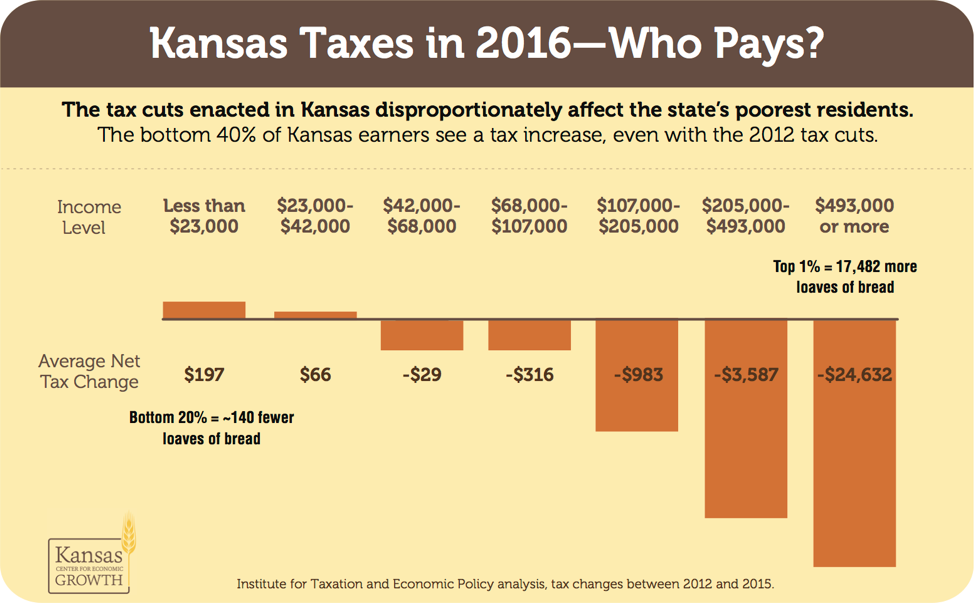
The income tax cuts of 2012 that continue to wreak havoc on the Kansas budget did not actually yield a reduction in taxes for many Kansans. Lawmakers raised other taxes and fees to partially offset the loss of income tax revenue. The net result: Wealthy Kansans still benefited, but the overall tax burden for a wide range of working Kansans went up.

The newest shift cropped up at the end of the legislative session. As a result of income tax cuts, Kansas cannot afford enough highway patrol troopers, so legislators passed a bill to raise vehicle registration fees to cover the cost of hiring more.

Duane Goossen
Duane Goossen

But that’s a small example of the shift in progress. The following list shows the more consequential changes implemented in the attempt to compensate for income tax cuts:

• Sales tax raised from 5.7% to 6.15% and then raised further to 6.5%;
• Renters no longer eligible for homestead property tax refunds;
• Food sales tax rebates limited;
• Child care income tax credit, along with many other credits, eliminated (for those who still pay income tax);
• Cigarette tax raised; and
• Many income tax deductions limited (for those who still pay income tax).

The chart above estimates the average net effect of all the tax changes (the figures come from the Institute for Taxation and Economic Policy, which has the best model for measuring these types of changes in any state).

Kansans with the lowest income have seen their tax burden go up. For middle-income Kansans, it’s been about a wash. Upper-income Kansans, especially those earning more than $500,000 annually, have come out well.

Of course, a sales tax hike takes a far bigger bite out of a small income than a large one. Lower-income Kansans spend a much higher proportion of their resources on food and other items subject to sales tax than wealthy Kansans do. Many states exempt food purchases from sales tax, or at least apply a lower rate. Not Kansas. We now have the highest sales tax rate on food in the nation.

The chart does not even count other kinds of shifts taking place. Property taxes push up as schools and local governments try to react to dwindling state resources. Tuition rises at universities when the state withdraws support. Future taxpayers get saddled with debt because the state borrows to pay for retirement system costs, and borrows through the highway fund to shore up the general fund.

However, even with all this shifting, Kansas remains broke. The hole created by the income tax cuts has been so significant that shifts to other tax sources have not come close to stabilizing the state’s finances.

Income tax cuts benefited the wealthiest Kansans, but without any obligation to create a job or even spend their tax savings in Kansas. In return, the state received financial turmoil. Many Kansans now pay more to fund state government at the same time that school class sizes go up and highway maintenance gets put aside.

If you are a Kansan and do not feel like you’ve had a tax cut, that’s because you probably did not get one.

Duane Goossen is a Senior Fellow at the Kansas Center for Economic Growth and formerly served 12 years as Kansas Budget Director.

INSIGHT KANSAS: Democrats in Deep Red Kansas

Twenty-five years ago, my colleague Al Cigler and I wrote a paper titled “Two-Party Politics in a One-Party State.” The thesis was simple.  Although Democrats at that time (1991) controlled the governorship, commanded a slender majority in the Kansas House, and held two (of five) U.S. House seats, Kansas remained essentially a Republican state, albeit one where Democrats could compete successfully for many offices.

Burdett Loomis
Burdett Loomis

Party registration numbers, the GOP’s dominance of U.S. Senate elections (since 1932), and Republican majorities in presidential contests (since 1964) led us to conclude that the state remained strongly, if not overwhelmingly, Republican.  Still, the Democratic Party of the 1970s through 1994 proved highly competitive.  Most importantly, it regularly captured the governorship; from 1966 through 1994, Democratic governors (R. Docking, Carlin, Finney) served for 20 years, while Republicans Bennett and Hayden each served one four-year term.

It could have easily been worse for the GOP.

In 1974, Democratic Rep. Bill Roy came close to defeating incumbent senator Bob Dole, and Democratic Attorney General Vern Miller lost by just 3000 votes to Bennett.  In 1977 and 1991, Democrats won control of the Kansas House, and throughout the 80’s and into the 90’s, Democrats were highly competitive in both chambers.

So what happened?

One partial answer is that guns and abortion crowded out economic issues for some voters, and the moderate wing of the GOP began to lose traction.  But more important has been the nationalization of state politics in Kansas.

Two major national  GOP “wave” elections changed the composition of the Kansas Legislature.  In 1994, after the first two years of the Clinton administration and a failed attempt to pass national health care reform, Republicans won sweeping victories across the country. In Kansas, this meant that Democrats lost 14 seats, and stabilized their numbers in the House at about 45. Still, on key votes, they could join with moderate Republicans to pass major legislation, as with school funding in 2005.

The second red “wave,” of 2010, after Obama’s successful national health care reform, swept Sam Brownback into office, along with an overwhelming GOP majority, including an absolute majority of far-right Republicans.  In 2012, Brownback and his allies linked moderate Republicans to Obama and, using national funding, eliminated most centrists from the Senate. Kansas Democrats have recently held eight (of 40) Senate seats and about 28 (of 125) House seats.

In 2014, national again politics intervened to affect the Kansas partisan balance.  After almost losing his primary election, Senator Pat Roberts was widely seen as vulnerable, and retaining his seat was crucial for Republicans to capture the Senate.  In the three months before the general election, millions upon millions of dollars in outside funding was spent to defend Roberts’ seat; he won handily, and the far-more-vulnerable Brownback narrowly won re-election, pulled across the finish line by Roberts’ anti-Obama campaign ads, mailers, and robo-calls.

To be sure, Kansas appears a far deeper red state than it was fifteen or twenty years ago. The state Republican Party has maintained its advantages, and extremely conservative activists have worked effectively to elect their candidates.

So, what of 2016? Republicans will nominate a presidential candidate in Donald Trump who did poorly in our caucuses, and, according to one Kansas survey, may actually trail Hillary Clinton.  Moreover, his bombastic campaign style and questionable statements likely weaken his appeal at the top of the ticket.

At the same time, Governor Brownback, while not on the ballot, dominates the politics of Kansas, largely in a negative way.  Most incumbents have little desire to associate themselves with him, while Democratic (and moderate Republican) candidates are readying their ads, which explicitly link their incumbent opponents to the governor.

Within a few months we’ll know whether Kansas will remain its deep-red self of the past six years or will return, perhaps, to “two-party competition in a one-party state.”

Burdett Loomis is a professor of political science at the University of Kansas.

NEY: Elder abuse includes financial fraud

Josh Ney, KS Securities Commissioner
Josh Ney, Kansas Securities Commissioner

In recognition of World Elder Abuse Awareness Day today, June 15, the Office of the Kansas Securities Commissioner spotlights the importance of safeguarding Kansas’s senior population by keeping a watchful eye for signs of elder financial exploitation and promptly reporting possible abuse to appropriate officials.

Elder financial abuse is rising with the rapid aging of the North American population, due in part to the amount of wealth seniors have accumulated throughout their careers and their increasing isolation.

Many in our older population are vulnerable due to social isolation and distance from family, caregivers, and other support networks. The days of aging in communities surrounded by generations of family members are fading into the past. We need as many eyes and ears as possible listening and watching for signs of suspect elder financial exploitation.

The Kansas Area Agencies on Aging provide resources to older Kansans in all 105 counties across the state and have partnered with the Office of the Kansas Securities Commissioner to help prevent the financial exploitation of older Kansans.

According to Julie Govert Walter, executive director of the North Central-Flint Hills Area Agency on Aging, scammers and fraudsters target older Kansans, and their ploys often rob seniors of millions of dollars of their hard-earned money. She says many seniors who have health issues also experience a diminished capacity to manage their personal finances. Worse yet, sometimes the people seniors turn to for help with their money prove to be less than worthy.

To help fight this problem, watch for the following warning signs of suspicious behavior that may indicate potential elder financial exploitation:

* Has an elder moved away from existing relationships and toward new associations with other “friends” or strangers?

* Has a new person entered the elder’s life and shown an excessive interest in the elder’s finances or accounts?

* Are you unable to speak directly with the elder despite repeated attempts at contact?

* Does the elder display unexplained excitement over a financial windfall or prize check and reluctance to discuss details?

If these sound familiar, contact the KSC at (785) 296-3307 or [email protected]<mailto:[email protected]>.

The KSC has developed presentations titled Outsmarting Investment Fraud to provide across the state to older Kansans and have been presenting to senior center groups this month. Seniors attending the presentations will leave equipped with the skills to recognize the persuasion tactics of scam artists and the red flags of fraud, as well as the knowledge of what to do to prevent scams. If you are interested in the KSC presenting to your local group, contact Shannon Stone, Director of Investor Education at the KSC, at (913) 652-9164.

Josh Ney is the Kansas Securities Commissioner.

LETTER: Trust the issue in USD 489 bond failure

opinion letter

There are three reasons the school bond issue failed. TRUST. TRUST. TRUST.

Despite comments to the contrary by some proponents, in political terms, the vote was not all that close — 56% to 44% is a significant election margin, particularly given the timing of the election and the fact that there was no organized opposition to the bond issue.

Also, the bond issue was pretty much doomed from the beginning because the school board and citizen committee members exhibited a lack of understanding of the politics of the vote, which further led to a lack of political strategy needed to convince voters to take a chance and trust the school board.

The school board had lost the trust of the taxpayer and chose nevertheless to be guided by architects from Topeka who have no understanding of local politics. (And note to school board and citizen committee members: The new superintendent’s debatable success with similar elections in the past will not make up for his lack of understanding of local politics.)

Why the lack of trust?

1. The failure of the school board for the past 20 years or more, in even the simplest of terms, to budget enough money to take care of basic repairs, maintenance and improvement issues.

2. The prevalent attitude of the school board when confronted with a budget
problem/crisis to seek first a taxpayer bailout instead of sharpening their knives, cut spending and reprioritize goals. (Think of the $400,000-plus bond issue that horribly failed in a bond election a few years ago.)

3. Reneging on their promise to taxpayers that no taxpayer dollars would be used on the FAST building when all they had to do was ask the FAST committee members to go back and do more private fundraising. Instead, they took the easy way out and robbed the cookie jar as small as it was then. The school board utterly failed to understand how devastating this decision would be on the ability of the taxpayer to ever trust them again. (Also, read 2 above again.)

What suggests their lack of political understanding and political strategy?

1. Local taxpayers are scared, particularly people on fixed incomes. The crash in oil prices has everyone very worried about the near future. They are tired of government at all levels raising taxes as a first resort. Yet, according to proponents of the bond issue, if you didn’t support the bond issue, you were told you insufficiently cared about our children’s future. Or to paraphrase the recent opinion by the Hays Daily News Editorial Page editor, if one didn’t vote for the bond issue one simply didn’t or couldn’t comprehend the issues involved in the vote like those who chose to support the bond issue. Not exactly the kind of arguments that illustrate any empathy for the taxpayers.

2. Using the local sales tax as a funding mechanism with apparent little regard or
thought as to how that would hamstring the City of Hays’ and Ellis County’s ability to deal with current and future revenue shortfalls should the local economy suffer from an even more severe downturn.

3. Asking the taxpayers to turn over $90-$100 million all at one time to a school board that has exhibited a fairly complete failure to manage their spending prudently. Taxpayers simply couldn’t trust the school board to spend this enormous sum of money efficiently and effectively. As they say in the sports world in this kind of fantastical situation: “Come on, man!”

School board and citizen committee members say they will return to the drawing board and come back for another vote. Unless they want history to repeat itself, it would be wise for them to focus on what is politically doable. Their next attempt at this demands a substantially different approach.

This of course would require a strategy based on a more thorough understanding of what wins and loses these types of elections. It would also require seeking input, not from out of town architects or superintendents, but from local individuals who understand politics, have experience in political elections and can help create a political strategy to give the next school board vote a real chance of success.

Returning to voters with more or less the same proposal in terms of both projects and money will more than likely lead to the same result. And a lack of significant change in priorities, strategy and attitude could very well spark an organized challenge the next school bond vote similar to the one that helped defeat Ellis County’s poorly designed bond project, commonly dubbed the Taj MaHadley project.

Tom Wasinger, Hays

SCHLAGECK: Outhouse lore

John Schlageck writes for the Kansas Farm Bureau.

Several images surface as we dust off the cobwebs of our minds and reflect back on rural Kansas and those days of years gone by. Red barns, silver-steel windmills, cream separators, harvest crews, Burma Shave signs and certainly the outhouse come to mind.

While many have tried to describe (or forget) the typical Kansas privy, each was as different and original as the men whose job it was to build them. This column is dedicated to those prairie dwellers across Kansas who, in the middle of pioneering this great state, still took time for moments of contemplation.

Kansas outhouses were a reflection of its people – the region of the state where they settled and where they came from back in the Old Country. Each was a classic in its own right, inherent of early settler architecture – the sturdy and inspirational “Little House on the Prairie.”

To Midwesterners and High Plains dwellers the outhouse has always seemed a fitting memorial to the ingenuity and practicality of our forefathers – those restless, imaginative spirits who first caught the scent of opportunity in the westerly breeze. And for all its many charms, the privy has gone the way of the mail-order catalog which it had such a long and intimate relationship.

Heck, some old timers in the community I grew up in went so far as to label an outhouse the very seat of government – a place where equality of all people was perceptible and indeed undeniable.

Built with a few broad boards, wide sweeping strap hinges and a bold slice cut through the doorway, it was as solidly based as the distant barn itself. Usually a two-seater, it was equipped with flies, hornets, mosquitoes, spiders, corncobs or a Sears & Roebuck.

Normally it was located at a safe, but convenient distance from the main house, at the end of a cinder path and behind a lilac bush – hence the old expression, “I’m going out to smell the lilacs.”

Yes, at one time in our state’s history, a privy was certainly an interesting topic of discussion. Talk to today’s old timers or seniors and they’ll probably break into a broad smile and share an experience or two of their time spent in the privy.

While we always enjoyed indoor plumbing, I can remember Sundays at my Uncle Lloyd’s in Phillips County. His family still used an outdoor toilet.

I was less than thrilled about doing my business in this dark, dank establishment. To begin with, there was a distinct odor I wasn’t fond of. I could never relax while imagining the black widow spiders lurking below me just waiting to send me to an early grave.

One story I’ll never forget involved a certain Volga German who built an outhouse shrine to himself less than a stone’s throw from his family dwelling. This structure was built with notched corners, manly hinges and a husky thumb latch.

Strong and solid, this structure was a match for any prairie cyclone. The old gent loved his retreat and spent many an hour in his palace on the prairie.

His wife, on the other hand, considered this privy overbuilt, unnecessary and she remarked on more than one occasion that she wished the main house she lived in were as well built as her husband’s “s_ _ _ house.”

And one more story I recall became legend in northwestern Kansas. It was told about a special outhouse named Granny’s Glory. Built by Grandpa who adored his bride of 50-some years, this wonderful little privy faced the eastern Kansas sky and included a nice southern window that cast a soft light on Granny’s reading material.

The dear old dame made and hung the curtains herself. When the couple died, the grandchildren couldn’t bring themselves to tear down the decaying monument.

Yessiree Bob, the outhouse is a part of our rich Kansas heritage we will never flush away.

John Schlageck, a Hoxie native, is a leading commentator on agriculture and rural Kansas.

Copyright Eagle Radio | FCC Public Files | EEO Public File