Stacy Campbell is Agriculture & Natural Resources Extension Agent for the Cottonwood Extension District.
By STACY CAMPBELL Cottonwood Extension District
A new weed control publication from the Department of Agronomy and K-State Research and Extension is now available. This publication, MF3448 “Integrated Pigweed Management” aims to assist producers in developing an integrated strategy to manage pigweed in summer crops and fallow periods. Used in conjunction with local expertise, this guide can help tailor a targeted strategy for each field.
Pigweed is a summer annual broadleaf that emerges from April through October in Kansas with the majority emerging in May and June. Although there are numerous pigweed species, this publication focuses on Palmer amaranth and waterhemp. Pigweed can cause drastic yield losses and harvesting difficulties in summer crops. Controlling emerged pigweed can be challenging due to its rapid growth rate, which can easily exceed 1 inch in height per day. Pigweed is a prolific seed producer with large plants capable of producing nearly one million seeds.
What is “Integrated Pigweed Management”?
An integrated approach combines many different control tactics such as crop rotation, herbicides, tillage, and row spacing to manage pigweeds in a cropping system and has three main purposes.
Decrease the risk of selecting for resistant biotypes to an herbicide or other management practice.
Reduce pigweed seed population.
Increase long-term profitability and sustainability.
With enough selection pressure, it is possible to select for pigweed resistant to cultural or mechanical practices. For example, shifting crop planting date earlier may select for a biotype that emerges later in the season after POST herbicides are applied, or by implementing sequential tillage operations in fallow, a shift toward alternative seed dormancy mechanisms could occur. With an integrated approach, it is less likely for these types of shifts to occur because the selection pressure is shared among various tactics.
When developing an integrated pigweed management plan, consideration should first be given to cultural control tactics. It is not always possible or applicable to implement all strategies in certain systems; therefore, consideration must be given to how each tactic fits in combination with the other goals of the cropping system (Figure 1).
Figure 1. When developing an integrated pigweed management strategy, cultural practices should be considered first. Too often, it is easy to place all consideration on herbicide and neglect the potential benefits of cultural and mechanical tactics. Graphic from MF 3448, Integrated Pigweed Management, K-State Research and Extension.
Cultural practices are discussed in more detail in the full publication. They include: crop rotation, crop cultivar selection and planting date, cover crops, row spacing, field border maintenance, and seed transfer.
Building an Integrated Strategy
Combining control tactics yields the best results. When developing these recommendations, have realistic expectations and make considerations from a cropping systems point of view. It can be difficult to see direct economic profit from some cultural practices such as narrow row spacing, cover crops, or crop rotation; however, long-term gain will be realized through delaying the onset of herbicide resistance and reduced weed seed production.
Developing Herbicide Recommendation for Pigweed Management
A common pitfall when trying to justify the cost of integrated strategies is through a reduction in herbicide use. This concept is not supported with research, and all integrated strategies still must be combined with a comprehensive herbicide program. Research shows herbicide programs targeting pigweed must have three key components (Figure 2).
Figure 2. Three key components that should be found in every pigweed herbicide program.
More information about each of these three components can be found in the publication.
To The USD 489 board and other interested parties:
I note that media reports are that the request to name the Oak Park facility after Emma Kolb, who dedicated her life to education here, was summarily rejected because someone ( nameless) in Topeka told someone on your staff not to name a building after a person. Please see my earlier letter about this.
Having been raised and educated in this school district, with schools named Washington, Lincoln, Jefferson, Felten, Kennedy, O’Loughlin, Wilson, and Thomas More, that reasoning seems to be logically fallacious.
It would be a break in tradition to NOT name the building after a person, and what better person than Emma Kolb.
Please try to apply some common sense to your decision as you deliberate this issue in the Toepfer Board Room at the Rockwell Center.
There’s a place where the constitutional protection of free speech bumps up against polite or at least orderly conduct that is now in the process of being sorted out in a federal court in Topeka.
The issue is that American Civil Liberties Union lawsuit against the folks who manage the Statehouse and just what is permitted and not permitted inside its halls where lawmakers consider issues ranging from expanding Medicaid to Kansans and, well, to whether you can ride your all-terrain vehicle across a federal highway.
That’s a broad range of topics, and there are different levels of emotion by supporters on the issues. But the federal district court case appears to be more narrowly focused on signs in the Statehouse and whether the four 10-foot by 24-foot banners urging expansion of Medicaid in Kansas are a little too big, and whether just an 8-1/2-inch by 11-inch piece of paper with a message on it is too small.
The First Amendment doesn’t talk about sizes. It talks about freedom to express one’s opinions. Haven’t found the American yet who opposes freedom of speech; just how that speech is delivered.
The issue gets complicated in the Statehouse, a grand and well-preserved historic governmental headquarters for Kansans that deserves protection. Can’t think of anyone except maybe maintenance contractors who want people to express their opinions by nailing signs on the walls of the Statehouse. Carrying signs? That’s a pretty good way to express one’s opinions, especially in the building where state law is created.
The banners incident which fostered the lawsuit? Three Kansas State University students unfurled banners in the Statehouse rotunda blasting legislative leaders (Senate President Susan Wagle, R-Wichita, House Speaker Ron Ryckman, R-Olathe, Senate Majority Leader Jim Denning, R-Overland Park, and House Majority Leader Dan Hawkins, R-Wichita) for stymieing passage of a bill law that would expand KanCare for poor Kansans. “Blood on their hands” was the key phrase on the banners. That’s a politically ingenious way to draw the issue, with a catchy phrase that got the protesters and their opinions on television, in the newspapers and probably all over the Internet.
But the banners were removed from the Statehouse rotunda by state workers because they didn’t meet Statehouse rules for such signage. Too big. No official approval for the size or placement of the banners, and, well, they were disruptive.
It fell a dab short of the shouting “fire” in a theater, but it was disruptive.
And while there’s a 1st Amendment and the need for an orderly and safe operation of the Statehouse, there’s something in the middle. Conservative legislative leaders would rather not see signs, and certainly not banners, in the Statehouse. The ACLU? It’s apparently willing to settle for something considerably smaller than the banners, but large enough that they can, if phrased catchily, still express a clear statement of opinion that lawmakers can read from a few feet away, or maybe even across the rotunda.
The other recent free-speech issues? Singing from the Senate balcony? Ordering reporters off the Senate floor (and threatening to revoke their Senate press credentials) after they’ve gotten their photos and quotes from protesters? A little more difficult, and probably something that will be settled not in court, but by legislative leadership which dreams up the rules for conduct in its chambers.
What’s next? We’re thinking back to those airport frames, the ones that determine whether you can carry on a bag or have to have it checked into the baggage cart. Something like “if your sign fits through this frame (unfolded), you can carry it into the Statehouse.”
Free speech? Yes, just a dab smaller…
Syndicated by Hawver News Company LLC of Topeka; Martin Hawver is publisher of Hawver’s Capitol Report—to learn more about this nonpartisan statewide political news service, visit the website at www.hawvernews.com
Oil prices at the state’s largest refinery are up four dollars since the beginning of the month. Kansas Common crude at CHS in McPherson starts the week at $47.75 per barrel, after gaining 75 cents on Friday. Cash crude on the Nymex closed at $57.35 Friday.
Independent Oil & Gas Service reported 26 active drilling rigs across Kansas last week, a gain of two rigs in eastern Kansas and one more west of Wichita. Operators in Ellis County were drilling on one lease and preparing to spud another. Drilling was also underway at one site in Stafford County. Baker Hughes reported 967 active drilling rigs across the U.S. last week, an increase of one oil rig, but a drop of four rigs drilling for natural gas. Texas was down four rigs, while New Mexico and Oklahoma were each down one.
Independent Oil & Gas Service reports operators in Kansas completed 27 wells last week, 704 so far this year, with five in eastern Kansas and 22 west of Wichita. New wells were completed in Barton, Ellis and Stafford counties.
Regulators approved 18 permits for drilling at new locations across the state of Kansas last week, four of those in eastern Kansas and 14 west of Wichita. There’s one new permit in Barton County and one in Ellis County. Year to date there are 431 new drilling permits in Kansas.
Rising tensions in the Persian Gulf are raising the cost of shipping crude oil. According to Lloyd’s Maritime Intelligence, freight rates in the region rose nearly 40% for crude oil shippers, and those new contracts added hefty insurance premiums.
According to BP’s Statistical Review of World Energy, the U.S. has extended its lead as the globe’s top oil producer, pumping a record 15.3 million barrels per day last year. The U.S. accounted for 98% of oil production growth. The Review reported a new worldwide consumption record of 99.8 million barrels per day.
Domestic crude oil inventories dropped last week. According to the U.S. Energy Information Administration, stockpiles fell by 3.1 million barrels in the week ending June 14 to 482.4 million barrels. Inventories are about seven percent above the five-year seasonal average.
The government said U.S. crude oil production also dropped slightly last week. Domestic production was tabbed at 12.17 million barrels per day. That’s down from 12.28 million barrels per day the week before.
EIA said our crude oil imports averaged 7.5 million barrels per day, down by 144-thousand barrels. The four-week average is 7.6% less than the same period a year ago.
Lawmakers in New Mexico could have a happy conundrum soon: what to do with an extra one billion dollars in oil revenue. The Permian Basin in southeastern New Mexico is expected to generate a windfall of between $1.1 billion and $1.3 billion next year, according to a state lawmaker.
The Oregon House of Representatives passed and sent to the Senate a bill that would create new fees on oil train cars to pay for spill prevention and planning in the state. The Oregonian reports the bill would also require train operators to carry more insurance to help pay for cleanup.
Weekly U.S. oil-by-rail traffic declined slightly but remains higher than last year at this time. According to the Association of American Railroads, 12,747 tanker cars carried petroleum and petroleum products during the week ended June 15, down 604 barrels from the week before, but still 13.6% [[“thirteen point six percent”]] higher than a year ago at this time. Canadian oil-by-rail increased by more than 30 percent over last year.
Canada’s government decided Tuesday to proceed with the construction of a major crude oil pipeline expansion, which will boost by about 15% the amount of Canadian oil piped to Pacific ports. Prime Minister Justin Trudeau said they hope to have shovels in the ground this year for the government-owned Trans Mountain Pipeline expansion.
You may have seen the recent activity in Congress on surprise medical billing.
When presented with a patient specimen, I don’t wait in the laboratory to check the patient’s insurance. I run the right tests and review the slides at my microscope to diagnose disease. The billing for the medical service comes later.
As a physician, my colleagues and I support holding patients financially harmless from unexpected out-of-network medical bills. Physicians want to be in-network and accept the insurance plans covering their patients. Often, it’s the health insurer who drops physicians or refuses to contract with those who wish to join.
Congress needs to adopt a federal legislative proposal that includes network adequacy standards that require health plans to contract with the right numbers of physicians practicing at in-network hospitals. Any legislative proposal should also ensure that insurers and providers can negotiate reimbursement for services in an equitable manner.
Several of the proposals in Congress hand all the negotiating power to insurers. Congress should establish a fair payment formula for out-of-network physician care and use an arbitration process that allows a doctor and insurance company to settle a bill through a third-party process.
Congress must take a serious look at the proposals several physician members of Congress, led by Reps. Raul Ruiz and Phil Roe, have recently released. Their proposal is a positive step in the right direction.
Lyle Noordhoek, MD, FCAP Hays President, Kansas Society of Pathologists
Dr. Roger Marshall, R-Great Bend, is the First District Kansas Congressman.Friends,
I recently led a letter with my Kansas House delegation colleagues to President Trump requesting that he quickly approve Governor Kelly’s request for a Major Disaster Declaration in Kansas. Over 60 counties across the state have been impacted by severe storms, straight-line winds, tornadoes and flooding, with many communities struggling to recover.
President Trump granted a Major Disaster Declaration for the state of Kansas, which triggers federal funds to help communities recover from these severe weather incidents. This declaration opens the entire state of Kansas to the Hazard Mitigation Grant Program through the Federal Emergency Management Agency (FEMA). Eligible affected counties can now receive public assistance for rebuilding public facilities and infrastructure. These counties are also eligible for Disaster Loan Assistance through the Small Business Administration (SBA), which can help communities, businesses and homeowners. More information on the SBA’s Disaster Loan Assistance program can be found HERE!
My colleagues and I here in Washington will continue to work with the Administration, FEMA, and Small Business Administration to ensure that Kansans have the tools and resources they need to get through these difficult times.
More News From the USDA
USDA’s Risk Management Agency this week announced changes to its haying and grazing program to accommodate those who planted a cover crop on Prevented Planting Acres.
For 2019 only, farmers who planted a cover crop on prevented planted acres will be permitted to hay, graze or chop those fields starting September 1 and still retain their eligibility for a full 2019 prevented planting indemnity. This is a change from the normal November 1 starting date. The move is intended to help farmers who were unable to plant because of excessive rainfall and flooding this spring but will be able to utilize the land for forage or livestock grazing this fall.
I applaud the USDA for the small but substantial change to its policy to help farmers recoup from lost planting opportunities and realize as much productivity out of their land as possible.
Talking with Sec. Chao
As a member of the Congressional Western Caucus I had the opportunity to meet with Department of Transportation Secretary Elaine Chao to discuss transportation and infrastructure priorities back in Kansas. Thanks to efforts from Kansas Livestock Association, the Livestock Marketing Association, and the National Cattleman’s Beef Association, Sec. Chao has heard from many of our beef and pork producers on the burden that Electronic Logging Devices (ELD) cause for livestock haulers. This was a great opportunity for me to remind her of the need for a delay in implementing this rule, so that we can ensure the health and safety of these animals.
We also discussed the need to continue to rollback duplicate regulations, many of which are often more burdensome on small, rural communities. Sec. Chao highlighted how the Department is working to streamline the approval process for new roads and bridges, as well as improvements to existing infrastructure. I appreciate her willingness to work with us on issues of importance to our districts. It was great to hear her thoughts on transportation infrastructure, and ways that she and the Administration are working to help rural America.
USDA Takes Control of NBAF
I had the honor of joining the Department of Homeland Security (DHS) and the United States Department of Agriculture (USDA) at the signing ceremony to transfer ownership and operational responsibility of the National Bio- and Agro-Defense Facility (NBAF) from DHS to the USDA. Under the terms of the agreement, DHS retains responsibility for completing construction and commissioning of the $1.25 billion facility, while USDA will assume responsibility for all operational planning and eventual operation of the facility.
What started out as a research project at Kansas State University, then turned into a Congressional inquiry investigating biological terror threats. Along with the tireless work of so many folks in the state, that inquiry has morphed into NBAF. The work being done in Manhattan today and in the years to come will continue to keep our country safe and will protect two of our most valuable assets – our citizens and our food supply. The location of the NBAF site in Manhattan strategically places it near the largest concentration of animal health companies in the world, providing access to important veterinary, agricultural and biosecurity research and expertise. Construction is on schedule and on budget, and I am looking forward to its completion in December 2020.
G.I. Bill 75th Anniversary
This is the 75th anniversary of the Serviceman’s Readjustment Act of 1944, more commonly known as the GI Bill. The monumental law makes sure that our troops receive immediate rewards for their service in the form of tuition assistance, small business loans, mortgages, and unemployment compensation. It has changed the lives of so many of our American heroes and hearing their stories is truly a heartwarming experience.
This anniversary I joined the rest of the Kansas delegation in sending a letter to President Trump asking him to select Mr. Harry W. Colmery to be a recipient of the Presidential Medal of Freedom. Mr. Colmery served our country in World War I as a first lieutenant in the Army Air Corps. When he returned home, he continued advocating for veterans by serving as an active member of the American Legion and would eventually become the organization’s national commander. In December of 1943, Mr. Colmery went on to handwrite the first draft of the GI Bill in the now historic Mayflower Hotel in Washington D.C. Because of his dedication to helping veterans and work on the legislation President Franklin D. Roosevelt invited him to the White House when he signed the bill into law in 1944.
Mr. Colmery may be gone, but we continue to honor his legacy. Last Congress, I helped my colleagues in passing the Harry W. Colmery Veterans Educational Assistance Act of 2017. Signed into law in August of 2017, the Colmery Act makes several improvements to the Post-9/11 GI Bill including expansion of the Survivors and Dependent’s Educational Assistance Program, improved calculations for monthly stipends, increased benefit eligibility for Reservists and Guardsmen, restoration of GI Bill benefits for students affected by school closures, funding IT improvements to ensure that GI Bill claims are processed quickly and accurately, and much more.
If you would like to hear some of the stories of what the G.I. Bill has done for our service men Click Here.
Seeking Fairness and Transparency
Who knew liver allocation policy would be such a divisive issue? A few months ago, I co-led a policy letter to the Department of Health and Human Services (HHS) asking that they halt a harmful policy instituted by the Organ Procurement and Transplantation Network (OPTN). OPTN is contracted by HHS to implement organ procurement and transplant allocation throughout the US.
The policy we are fighting would redistribute organs donated by Kansans to big cities and states with larger populations and avoids the real problem which is under performing Organ Procurement Organizations (OPO). In our state, nearly 75% of Kansans are organ donors. We support one another and our OPO is stellar at recruiting. Despite low performing OPOs like the one in New York, Kansans in need of a transplant will face longer wait times and increased costs. My amendment to the HHS appropriations bill attempted to halt this policy. Even with the support from the Ranking Member of the Energy and Commerce Committee, Ranking Members of the Appropriations Committee, and the Republican Whip, Steve Scalise, we failed at persuading Democratic Leadership from allowing my amendment to be made in order so the full House could vote for fairness, transparency and accountability.
Kansas Nurses
I was fortunate to speak with colleagues that hold a special place in my heart – America’s nurses! As a physician (and husband to a nurse), I worked hand in hand with my nursing staff to deliver the best health care to our patients, but like my profession, their workforce is also in crisis. In its current state, we will have a massive nursing workforce shortage across the US, and none will feel it more than our rural communities. With our medical professionals aging, the Bureau of Labor Statistics projects that 1.1 million additional nurses are needed to avoid further shortage. Last Congress I was proud to help pass H.R. 959, the Title VIII Nursing Workforce Reauthorization Act of 2017, which would have reauthorized nursing workforce development programs that support recruitment, retention, and advanced education of skilled nurses. The bill would also reauthorize loan repayments, scholarships, and grants fro graduates going into this profession. Unfortunately the legislation was never adopted in the Senate so there is more work to be done. Our Kansan nurses brought this program up in yesterday’s meeting, and I hope to work with my colleagues in both chambers to make sure bipartisan legislation is signed into law that will help our nurses get the resources they need to succeed.
Rural Electric Youth Tour
We had a great group of Kansans in town last week for the National Rural Electric Co-operative Youth Tour! We spent Thursday morning on the Capitol steps, where I shared a bit about my time in Congress and they asked some great questions about how to better engage with their Congressional Representatives while in Washington DC. These bright youths impressed me with their knowledge about issues affecting folks back home. It’s always encouraging to see the next generation thinking about ways to improve rural America.
Blue Cross Blue Shield
Taxes and patients. That was the big discussion with BlueCross BlueShield of Kansas and BlueCross BlueShield of Kansas City when they met with my office last week. Both groups shared with me their concerns over the health insurance tax established under Obamacare. This annual fee on health insurers would result in higher premiums for consumers, ultimately making health care less affordable to all. Last Congress, we delayed the $16 billion tax for two years, and it’s time to delay it once again. I offered them my support in working with my colleagues across the aisle to prevent this tax from going into effect.
Woman’s Congressional Softball Game
On Wednesday a group of my female colleagues from Congress took on opponents from the press corp in the Congressional Woman’s Softball Game. Started in 2009, the Congressional Woman’s Softball Game donates all proceeds to the Young Survival Coalition (YSC), and to date they have raised more than $1.3 million dollars. YSC is a group committed to improving the quality of life of young adults that have been diagnosed with breast cancer.
This was an incredible event for an even better cause and it has gotten me even more excited to play in the Congressional Baseball Game for charity this week!
4-H Meeting
I got the chance to sit down with several 4-Hers from Kansas’ First District in the middle of a busy day on the hill. We discussed the importance of passing USMCA, the recent flooding which has devastated farmers and ranchers across the Midwest, and immigration reform. Additionally, we addressed the need to create a bipartisan solution to climate change focused on innovation that would not destroy the agriculture industry as we know it. I always enjoy interacting with these young leaders and am confident that the skills they are learning now will provide them with a bright future.
Steve GillilandThere is a big wooden street light pole midway between our driveway and the neighbors. The metal pipe that extends the light out over the street fastens to the pole with a metal bracket formed in the shape of a “u.”
For the second time in a few years, a pair of western kingbirds have claimed that metal bracket for themselves and built a nest cradled in its interior. Our first impression of their chosen “digs” was “Why on earth right there, of all places, when there is a fine oak tree just a few yards away that would provide much more cover and protection.”
The answer to our bewilderment lies in the fact that kingbirds are classified as “tyrant flycatchers.” Birds classified as flycatchers hunt and feed by snatching insects in midair, known as “aerial hawking,” or while hovering, often returning to the same perch time and again with their catch. Because of their mode of hunting, they need large open areas nearby to accommodate their hunting style, thus, nesting in the open on that light pole makes perfect sense to them.
The “tyrant” part of their classification is earned because they aggressively defend their nest and territory against intruders, often succeeding in driving away much larger birds like hawks and owls. That was evident the other evening as I watched them from the front porch. Both parents were at the nest, but were very nervous. They are used to watching us putter around in the nearby flowerbed or pull weeds beneath their pole, so I wondered why they seemed so on-edge. Then I looked to the sky and noticed several of our big local Mississippi Kites soaring around on the updrafts high above. They were no threat, but had the kingbirds on alert nonetheless. Western kingbirds are a species that have benefitted from man’s acts of planting trees and erecting light and power poles.
Kingbirds make a kind of jabbering, twittering sound and we often see them hovering above the nest while making that noise. They are masters of hovering by flapping their outstretched wings but remaining in one spot above us. They are also known to be masters of great acrobatic maneuvers while hunting, although we have not yet been treated to that. Kingbirds breed and nest all across the western half of the United States and winter in Mexico and South America. They have a small topknot that usually lies flat unless agitated, but their pale yellow breast is probably what distinguishes them the most.
We enjoy watching our kingbird pair; one is always on the nest, only visible from our vantage point on the ground by either a head or a tail sticking over the side of the nest. The other is usually near, either perched on the metal pipe holding the light or flitting around, always greeting our presence with their jabbering song.
It will be fun to watch them raise their chicks high on that light pole; yet another way to Explore Kansas Outdoors!
Steve Gilliland, Inman, can be contacted by email at [email protected].
Nothing has touched my soul and spoken to aging with grace quite like the ancient Indian medicine wheel and the traditions that have evolved from it. From the National Library of Medicine, I learned that in the Americas, Indian tribes have multiple interpretations of the four directions, but the following prayer is my own, geriatrician’s interpretation of a version from the book Black Elk Speaks and Oyate (Nakota, Dakota, Lakota) tradition.
First, we get down on our knees and feel the soil, the sacred Mother Earth, bringing the world around us, the animals, plants, prairies, lakes, mountains, the environment of our planet from where all food and sustenance comes. Earth is foundation. Then we stand up on our tiptoes, and raise our arms to sacred Father Sky, the sun, stars, clouds, rain, wind, air and breath of life, light and dark; from where all energy flows and ebbs. Sky is infinity. Earth and sky, the beginning and the end.
Around the central campfire and within the circle, first we bow east, symbolized by red, rising sun, springtime, birth, blood, the very young; a sense of innocence, youth. May we have hope for a future with an open mind to all things new and true.
We bow south, symbolized by yellow, full sun, summer, sexuality, the anticipating young woman and young man; a sense of unconquerable power and invulnerability, early adulthood. May we have the courage and strength to fight for justice.
We bow west, symbolized by black, setting sun, an approaching dark thunderstorm, oncoming night, autumn, resignation, the reality filled community leader and medicine woman/midwife; a sense of the horrors of war and reality of loss, mature adulthood. May we have the gravity to protect freedom of choice and face vulnerability with honest eyes.
Finally, we bow north, symbolized by white, starry night, winter, old age, wisdom, the sagacious elder and teacher; a sense of beauty, grandchildren and the circle of life, an experienced body and mind, release from the fear of change and death. May we have insight to savor family and friendship, and the good sense to walk in another’s moccasins.
Inside the circle is the tree of life, where we become aware of our self, our consciousness, tribe, community, country, world, and our connection to all direction.
Dear Mother/Father of Earth and Sky, thank you for your blessings, the sacred hoop of life, and especially the wisdom to find release from fear of death. May our sisters and brothers of all Clans and Nations realize our sacred connection and, in harmony, savor the joy and even the sorrow of our circle of life and aging.
For free and easy access to the entire Prairie Doc® library, visit www.prairiedoc.org and follow The Prairie Doc® on Facebook, featuring On Call with the Prairie Doc® a medical Q&A show streaming live most Thursdays at 7 p.m. central.
In the time I have spent in public service, I have been privileged to be a part of some important legislative changes and met some incredible people in the process.
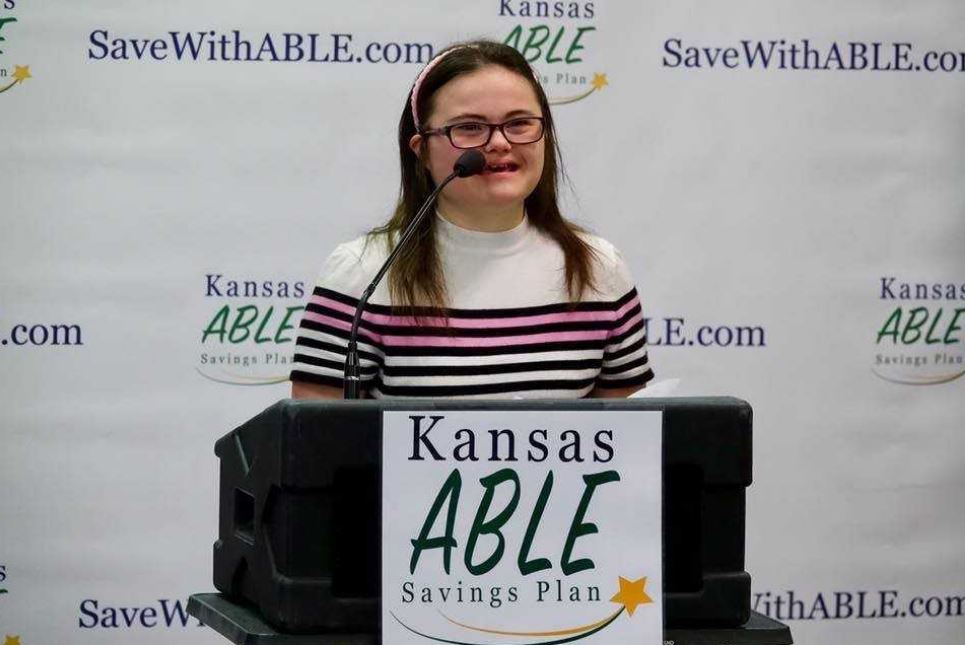
One of my favorite experiences that brings together both of these things happened in 2017 when I got to meet Rachel Mast. Rachel is a vibrant young woman who just finished her first semester of college, loves to be active in her community, and spreads her contagious enthusiasm for life to everyone she meets. She was also born with Down syndrome.
Rachel has the distinct honor of being the first individual to open a Kansas ABLE savings account, which became available just a few short years ago when my fellow legislators and I passed the ABLE Act through the Kansas Legislature.
ABLE accounts are new to Kansas and created specifically for people living with a disability. Those within the disabled community and the family members tied to the community often face the hardship of higher medical costs, along with other disability-related expenses. Prior to the ABLE Act’s passage, saving money was often a tricky issue for the disabled community. Saving more than $2,000 in one’s name could jeopardize that individual’s eligibility for necessary benefits such as SSI and Medicaid. ABLE accounts were designed to alleviate that savings restriction, and in turn give individuals living with a disability and their families the freedom to plan ahead and save for a more secure future without the worry of losing much needed public assistance.
Rachel Mast
An ABLE account for Rachel has allowed her to experience things in life that were previously financially out of reach. Rachel now attends college and is using the saved funds within the account to pay for parts of her higher education. Rachel now has a job where a portion of her earnings go into her ABLE account and her desire to work and earn an income is not limited by a $2,000 savings cap. Rachel now has an achievable dream where she can save a sizable amount of money in order to make a down payment on the pink house she’d like to own one day.
It has been very heart-warming from my vantage point now in the Kansas State Treasurer’s office, where we administer ABLE accounts, to see these accounts being opened and the disabled community feeling the relief of being able to save for the future. As awareness of ABLE accounts grows it is my hope that more and more families caring for a disabled family member will consider this path of saving.
For Rachel, ABLE has been a key to opening new doors that will assist her in living an independent and fulfilling life. We at the Treasurer’s office are excited to continue assisting more Kansans with opening ABLE accounts that we hope will allow them to live their best life as well.
For more information on how to get started with an ABLE account for yourself or a family member, please give our office a call at 785-296-7950.
Earlier this month, the Office of the Special Counsel publicly recommended that White House counselor Kellyanne Conway be fired for repeatedly violating the Hatch Act, prompting many people to Google what the Hatch Act is (it’s a law that bars federal employees from engaging in political activity in the course of their work) and President Trump to give an interview to Fox News where he stated that, “[I]t looks to me like they’re trying to take away her right of free speech, and that’s not just fair.” (This week, the president tweeted his support for a proposed constitutional amendment to outlaw burning the American flag — an act the Supreme Court has repeatedly held to be a protected form of political expression — thus ending his streak as a First Amendment advocate.)
But back to the Hatch Act for a moment. It was passed in 1939 to prevent federal employees from engaging in partisan political activities, such as endorsing or opposing particular political candidates. It’s grounded in a noble purpose: to protect federal employees from political coercion and ensure their advancement is based on merit and not political affiliation. To that end, federal employees can’t engage in political activity while they’re on duty, in the workplace, or speaking in their official capacity. The letter from the Office of the Special Counsel (OSC) pointed out that much of Conway’s recent conduct has fallen into that category, as she’s been making the rounds, “disparaging Democratic presidential candidates while speaking in her official capacity during television interviews and on social media.”
White House counsel Pat Cipollone responded with a letter stating, among other things, that applying the Hatch Act to political activity on social media “has a chilling effect on all federal employees whose fundamental First Amendment right to engage in political and public policy discussions should not be compromised based solely on OSC’s guidance.”
This isn’t the first time the OSC has faced that accusation. Ethics and transparency advocates said more or less the same thing last year, when the agency issued new guidelines that federal employees weighing in on President Trump’s prospects for impeachment or talking about “the Resistance” might constitute political activity. National Treasury Employees Union President Tony Reardon’s exact words were, “This guidance is a broad reach that employees may find confusing. It could unnecessarily have a chilling effect on employees’ First Amendment free speech.”
The “chilling effect” is a concept that comes up a lot when we talk about the First Amendment. Essentially, it means that when a law concerning expression is too vague or too broad, people won’t know exactly when their speech crosses the line and violates it. So, in order to avoid punishment, they’ll avoid speaking at all — a major loss for free expression and healthy public debate.
Practically speaking, this isn’t really a concern when it comes to Kellyanne Conway specifically. President Trump has explicitly stated he will not fire her (the OSC only has the authority to recommend that he do so). She has publicly scoffed at the Hatch Act charges, telling reporters, “Let me know when the jail sentence starts.” She continues to appear in public, making it abundantly clear that nothing will get her to chill.
But it’s worth taking a moment to reflect on the impact that laws like this have on other federal employees, most of whom aren’t as protected from consequences as Conway. Henry Kerner, who heads up the OSC, was certainly thinking about this when he recommended that Conway be fired. “In interview after interview, she uses her official capacity to disparage announced candidates, which is not allowed,” he said in an interview with The Washington Post. “What kind of example does that send to the federal workforce? If you’re high enough up in the White House, you can break the law, but if you’re a postal carrier or a regular federal worker, you lose your job?”
It’s a reminder that most government employees have severe restrictions on their First Amendment rights. Some of these restrictions are justified — government offices wouldn’t be able to function if they couldn’t discipline employees for speech that interferes with their duties. But there are plenty of examples of this censorship going too far.
Just look at the impact of the 2006 Supreme Court decision Garcetti v. Ceballos, which removed any First Amendment protection for speech that government employees make in the course of their duties. Since then, we’ve seen numerous cases where government employees have been fired for reporting the misconduct of others and whistleblowing about corruption and mismanagement, with no valid free speech claims at all.
Or think about the times when government entities have decided that their employees’ private conduct on social media impacts their official duties— like the incident where a Pennsylvania public school teacher was suspended without pay because someone posted a photo of her with a male stripper to Facebook. Or think of the postal carriers and regular federal workers who avoid political activity altogether because they’re anxious about running afoul of the Hatch Act.
Lata Nott is executive director of the First Amendment Center of the Freedom Forum Institute.Contact her via email at [email protected], or follow her on Twitter at @LataNott.
Dr. Sharon Hartin Iorio is Professor & Dean Emerita at Wichita State University College of Education.
Only a few months ago the court battle over school funding was a central issue of legislative concern and media reports. Now triumphant, school districts are deciding ways to implement the approximately $500 million of new funding that will flow to schools over five years with an additional $90 million yearly to cover inflation.
Both the Kansas State Department of Education and the Kansas National Education Association recently suggested directing a portion of the funding to increase teacher salaries and help mitigate teacher shortages.
In fall of 2018, there were 612 Kansas teaching positions that remained unfilled by a qualified teacher, up 99 vacancies from the previous year.
Conservatives, libertarians and liberals, usually at odds on education issues, appear united in advocating for more resources going into the classroom; thus, improving our schools. This is where the agreement among education interest groups stops, because some groups do not believe across-the-board pay increases can help improve learning conditions.
In today’s world, political arguments, like those surrounding teacher salaries, are often based on selected data, thus opening the door to attacks claiming that any opposing group’s data is fake, misleading or based on alternative facts. Even the veracity of data collected by long-standing, reliable organizations can be questioned.
Despite such contention, information from respected national forums and venerable government agencies can help place Kansas teacher pay issue in context.
A recent National Education Association report found the average 2017-18 starting teacher salary nationally was $38,000, but in Kansas it was $35,000 with the average salary of all Kansas teachers at $49,754.
NEA also found the national average one-year increase in 2017-18 public school teacher pay was 2.9 percent. Kansas teachers received an average increase of 0.67.
Looking at teacher’s pay another way by comparing teacher earnings to those in careers requiring similar education and experience, on-line research found U.S. nurses’ median (a middle point where half of salaries fall above and half below) pay is currently $67, 490 and police officers make about $65,400.
Unlike nurses, teachers teach students, but they also are front-line responders to support students with disabilities, health and welfare concerns. Unlike police officers who may face personal danger daily, teachers are vulnerable to growing safety threats and are charged with helping protect their students against violence.
While no data on Kansas teachers and salary-gap could be located, the U.S. Board of Labor Statistics latest report showed that during the school year, nearly one in five teachers nationally worked a second job earning an average $5,100 to supplement their income. About the same percent hold jobs during the summer.
Some education reform leaders advocate teacher pay raises based on merit alone, but merit pay is granted for an individual teacher’s performance and does not substitute for suitable teacher salaries statewide.
As Kansas recovers from the Great Recession of 2009 and years of Governor Brownback’s tax cut experiment that affected all Kansas teachers and eliminated some teaching positions across the state, pay increases are more than warranted.
Across-the-board increases for all teachers within a district cannot, in themselves, end the teacher shortage, but Kansas teachers deserve the respect that comes with earning an adequate salary. A salary increase can bring teachers the satisfaction of knowing that their work is appreciated and that, in itself, can bring positive changes to Kansas classrooms.
Sharon Hartin Iorio is Professor and Dean Emerita of Wichita State University College of Education.
One of the most commonly reported frustrations expressed by physicians today is dealing with prior authorization. Recent national research suggests that prior authorization requirements frequently lead to delayed patient care and can have a negative impact on the clinical outcomes for patients. Now, we also know that physicians in our state share those sentiments.
The Kansas Medical Society (KMS) conducted a survey of its members seeking to identify the impact prior authorization has on physicians and patient care. The results were clear:
97 percent of respondents reported that prior authorization delays access to necessary care
91 percent of respondents indicate prior authorization can have a negative impact on patient clinical outcomes
95 percent describe the burden associated with prior authorization as high or extremely high
96 percent of respondents indicated that the prior authorization has increased over the last five years
The survey results mirror those of a national survey which was conducted by the American Medical Association. KMS replicated the AMA’s survey so we might have state-specific data to help inform our advocacy on behalf of Kansas physicians.
KMS has begun meeting with payers to help them understand the extent of this administrative burden. We will also be sharing with them a set of principles adopted by the KMS Board of Trustees which can help inform positive changes to the prior authorization system.
The Kansas Medical Society is a member-service organization dedicated to improving the environment in which Kansas physicians practice medicine, and to protecting the health of Kansas’ citizens.
What happened to May? It is a question I am pondering as I think about how quickly time flies with a calendar packed with so many wonderful celebrations and six commencement ceremonies. Our Kansas Academy of Mathematics and Science completion celebration was followed by two commencement ceremonies in Hays and three in China!
As I unpack my suitcase and attempt to adjust to time zone changes, I am reminded of the importance of taking time to breathe, to reflect, and to celebrate successes. At FHSU, we had a remarkably successful spring semester. Here are some highlights:
We began by setting a new spring enrollment record and, like the fall, it was an 18-consecutive-year record! This was partially made possible by an outstanding fall-to-spring semester retention rate of 91 percent.
Thanks to our legislators, Fort Hays State University received an additional $1.3 million dollars, partially restoring previous state budget cuts. These dollars, coupled with our record enrollment, allowed us to offer a zero tuition raise to our 2019-2020 students.
The Kansas Small Business Development Center worked with 89 long-term clients in western Kansas. For the year, the center facilitated $9.1 million in capital infusions and 28 new business starts. This work positively impacted 371 jobs in western Kansas, and $390,000 of increased sales were documented by businesses the KSBDC assisted.
Over 6,000 individuals, companies and foundations, including the estate of Earl and Nona Fields, the largest single gift in university history, gave their money to support of our students, faculty, staff and facilities, setting a new overall record for dollars given to FHSU in a single year.
The Department of Nursing completed a remodeling project that included a brand new simulation laboratory, a video recording system, a conference room and a student lounge area. The project was a partnership between FHSU, Hays Med and the Dane G. Hansen Foundation.
Faculty and staff received more than $2.8 million dollars in grants.
Successful accreditation renewals were achieved in athletic training, nursing, allied health and social work.
The university was approved to offer the Master of Social Work degree, and the social work cohort programs added Colby and Norton to Liberal, Dodge City and Garden City, serving Western Kansas in partnership with community colleges and local agencies.
The Peter Werth College of Science, Technology, and Mathematics hosted more than 100 paleontologists from across the United States and Canada for the 2019 annual meeting of the Association of Materials and Methods in Paleontology, and the new Oceans of Kansas Paleontology Prep Lab at the Sternberg Museum of Natural History was a featured attraction.
The College of Education continued partnering with area schools through Tiger Teacher Day, which annually provides opportunities for professional development in a setting where hundreds of teachers can share their talents and knowledge.
The first students in Cambodia graduated with degrees from FHSU in partnership with the American University of Phnom Penh. In China, we graduated over 800 students at Zhengzhou Sias University and almost 300 students at Shenyang Normal University.
The Kansas Academy of Mathematics had the largest graduating class in its history, with 42 students completing their high school degrees and 60 hours of college credit at the same time.
The Honors College recruited 42 students into the 2019 class, selected from the largest pool of applications ever.
Digital media and journalism students in the Department of Informatics brought home eight first-place and four second-place awards from the Kansas Association of Broadcasters.
Kaytee Wisley, Wichita senior majoring in political science, was selected as a Truman Scholarship finalist.
The women’s basketball team was the MIAA regular season champion and the MIAA Tournament champion and hosted the NCAA Central Regional Tournament, and Coach Tony Hobson set the university’s women’s basketball record for most career wins, 237-94.
Brett Meyer, Scott City senior, won the national championship in the 1,500 meters at the Outdoor NCAA II National Track Meet.
The FHSU Shooting Team was recognized in the Kansas Capitol for its fall 2018 Scholastic Clay Target Program College National Championship, and then won the Association of College Unions International Clay Target Championship in the spring, going undefeated in both seasons.
These amazing accomplishments – the collective efforts of all members of our community – are just a few of examples of how we work together to provide one of the best educational values in the nation.