We have a brand new updated website! Click here to check it out!

Schumacher: Some Things Never Change

Tim Schumacher
Tim Schumacher

Part I
Let’s say your financial adviser comes to you with this proposition: Purchase a bond at 4.69%, then, turn right around and invest that bond in the stock market with a much riskier investment, and hope you can make more than 4.69% for a profit. If you’re approached with this offer, run for the hills.

Yet, this is exactly the strategy our state government is using to shore up the Kansas Public Employees Retirement System. Gov. Sam Brownback signed Senate Bill 168 on April 16, 2015 which allowed the State of Kansas to purchase $1 billion in bonds to attempt to cut down the debt of the state’s pension program.

These, in turn, were placed in much riskier investments. Sound desperate? It is, as the unfunded actuarial liability (UAL), according to the Center for Applied Economics at Kansas University is only 60%. (This is what the state of Kansas owns compared to what they owe). It’s amazing what risks the state of Kansas will take with someone else’s money.

Part II
What if your spouse was spending at such a rapid rate, that there was no way to cover your debt? But instead of addressing this by curtailing spending, your spouse just blames you for suggesting anything be cut and continues the careless spending.

And in reality, this is exactly the way the federal government is operating. This is a pretty good reason why we’re accumulating a debt of over one trillion dollars a year. And if you cannot comprehend what a trillion dollars is, take a pen, write a one, and then put 12 zeros behind it. Can you imagine for a minute being given a credit card with the instructions to spend as much as you wanted, because you would not be accountable for the debt in the end? How much would you spend?

How dare one new federal program be added with this “out of control” debt taking place?

Part III
Finally, in 1979 E.F. Hutton invented a life insurance policy called universal life. It was designed to have the flexibility to increase and decrease throughout your life, so it, theoretically would be the only life insurance policy you would need. For those that can’t remember, during the Jimmy Carter era interest rates were sky high. It was nothing to go to a bank and purchase a CD with an interest rate of 12%. These high interest rates were used in illustrating the universal life contract.

Unfortunately, many of these contracts were funded with a premium that didn’t support the contract past age 70. This occurred because as the insured aged, the cost of insurance increased, and since 1979, interest rates have decreased, dramatically.

At this point, the policies lapsed. Many people who implemented these plans in the ’80s, are now seeing their policies blow up without ridiculously high premiums to allow them to continue. Surprisingly, there are still, today, an alarming amount of contracts being implemented with this strategy.

Unfortunately, like the state and federal governments, no one in the future will be accountable for what happens today. Universal Life is really not a bad contract, but it does need to be designed correctly; but how it’s been continually presented to the public far too often, is a travesty much like the strategies of the state and federal government. It may be good for you to take the time to review your policies with your agent. And instead of using projections, find out what’s actually guaranteed.

Note: For those of you who follow Stansberry and Associates for your financial advice, the prediction on Oct. 20 about the U.S. currency did not occur.

Tim Schumacher, [email protected], Strategic Financial Partners, Hays.

This article is provided for personal financial information and is not to be construed as financial advice. Under no circumstances does the information in this content represent a recommendation to buy, sell or hold any security. The views and opinions expressed are those of the author and not necessarily those of the affiliates he represents.
Mr. Schumacher is a Registered Representative of, and Securities and Investment advisery are offered through Hornor, Townsend, & Kent, Inc. (HTK) Registered Investment adviser, Member FINRA/SIPC. OSJ Branch Office: 130 Springside Drive, Suite 100 Akron, OH 44333. 330-668-9065
Strategic Financial Partners is independent of HTK. HTK does not offer tax or legal advice.

Make family insurance talks part of your holiday gatherings

Ken Selzer, Kansas Insurance Commissioner

Having a conversation with loved ones during the holidays is part of many families’ treasured memories. While those talks are often filled with remembrances, they can also be used to discuss present-day topics such as family insurance considerations.

Ken Selzer, CPA, Kansas Commissioner of Insurance, offers the following ideas for family discussions.

Confirm your insurance is active and premiums are paid. Do all family vehicles contain a current copy of your insurance card?

If you rent a vehicle for a trip, check with your insurance agent to see if your policy includes coverage. Also, make sure you don’t duplicate benefits from your own policy if you decide to get rental insurance.

Verify that your homeowners or renters insurance covers the theft of personal items from your vehicle, especially if you are planning to transport more expensive items. Many people believe that they already have replacement coverage for items stolen from their vehicles, but that usually isn’t the case.

Know if your vehicle policy includes roadside assistance, such as towing, fuel delivery, lockout service and jump-starts.

Make sure, for those young and old, that important insurance and legal papers are in a secure place that more than one person knows about.

Those family members who take prescription drugs should have a list of those medicines written down and located in a convenient place.

Assess personal insurance needs for yourself and your family. Your needs as an older adult, for example, could be much different than your child’s or grandchild’s. Make sure you know what health insurance coverage you and your family have. What are your deductibles and co-pays? What preventive services are covered?

Plan your expenses for insurance premiums. Chart your premiums and their due dates on a calendar.

In this season of giving, be sure you know the recipients of your financial gifts. Unfortunately, scams abound during this time of year, and the spirit of the season can be the reason that people are defrauded by scam artists.

“Finding time to review these considerations with your close relatives can help to eliminate problems and questions in the future,” Commissioner Selzer said.

Ken Selzer, CPA, is the Kansas Commissioner of Insurance.

INSIGHT KANSAS: Collateral damage

“Collateral damage” is a term simultaneously freighted with emotion and devoid of it. Coined during the Vietnam War and often applied to recent conflicts, from Kosovo to Syria, “collateral damage” is a commonplace euphemism that deadens us to the war-time carnage of innocent victims, even as their numbers mount into the millions.

So, to consider the impact of various Kansas policies as “collateral damage” may seem over the top. I disagree.

Sam Brownback and the Legislature seeking to place the state’s income tax rates on a “glide-path to zero,” these tax receipts fell from $2,931 million in 2013 to just $2,218 in 2014 and $2,277 million in 2015.

Burdett Loomis
Burdett Loomis

Despite cheery reassurances from the Brownback administration, the Kansas Chamber of Commerce, and the Kansas Policy Institute, this precipitous revenue drop – in the face of increasing needs – means that many Kansans have suffered actual harm. And the collateral damage will only increase as the state becomes less capable of funding essential services.

After the state received $25 million in rebates from the federal Children’s Health Insurance Program and a Medicaid prescription drug program, budget director Sean Sullivan was asked whether these funds might reduce lengthy waiting lists. He replied, “When you have savings, you can either choose to use that for the state general fund or you can re-appropriate to something else….In our case we’re helping with the state general fund shortfall.”

The needy, untreated individuals thus represent collateral damage of the state’s disastrous budget situation. The glide path to zero, which has enriched many wealthy Kansans, continues to take a toll on faceless individuals, waiting for months to get adequate care.

In the same vein, searching high and low for cash, the Brownback administration recently “swept” $9 million in Children’s Initiatives Fund grants into the general fund, affecting both current and future programs. That’s simple theft.

Collateral damage is sometimes subtle. When Kansas universities recruit top-flight researchers or candidates for major administrative positions, one of their first questions is whether the state is truly committed to providing high-quality education, for both K-12 and higher ed. Indeed, many potential candidates simply write Kansas off as a state that has demonstrated its willingness to sacrifice education at the altar of lower taxes.

Nor is injury limited to individuals. The Kansas highway fund has been raided as never before over the past few years, all in the service of filling budget holes, as opposed to potholes. Although many governors have used the “Bank of KDOT” to an extent, the level and cynicism of the current exploitation is breath-taking. First, the state borrows hundreds of millions to pay for a ten-year transportation plan. Then, since the 2010 inception of the plan, the state sweeps $1.4 billion into the state general fund, leaving nothing for new projects and very little for crucial maintenance.

The collateral damage victims here are legion: (1) the highways and all those who ultimately drive on them over the years to come; (2) the state’s credit rating, which has steadily declined as funds are shifted away from their intended purpose; (3) tens of thousands of construction workers, who will lose their jobs as projects and maintenance dry up; and finally, (4) the rule of law in Kansas. The state constitution prohibits deficits, but by moving huge piles of borrowed funds, intended to pay for a long-term transportation plan, into the current accounts budget, Governor Brownback and his allies have violated the spirit, if not the technical meaning, of our balanced budget requirement.

In the end, the sharp reduction in income-tax revenues has failed to produce explosive growth. Rather, these cuts have inflicted collateral damage on almost all Kansans in myriad and increasing ways.

Burdett Loomis is a professor of political science at the University of Kansas.

Knoll: Religion in politics matters

Les Knoll
Les Knoll

This, my letter to the editor, is about my Christian faith. Religion, specifically Christianity, may not be important to many, but it is important to me, and I am going to exercise my First Amendment right of free speech in expressing my opinion based on some very important facts.

I will be the first to admit, there are a lot of people I know personally who think as I do and far better qualified to speak on this subject, however, as a Christian I feel an obligation to speak up about what I know.

Polls show Democrats, generally speaking, are less religious than Republicans. More Republican voters go to church than Democrats and that’s just a small part of the proof there is a huge difference between our two political parties when it comes to religion in our politics and government. Of course, going to church in and of itself doesn’t come close to telling the whole story.

Republicans have more conservatives than do Democrats. That’s a no-brainer. What does that mean? Obviously, people in one group believe in traditional values more than the other about what made this country the greatest nation on earth. Those traditional values include Christian beliefs.

Conservative Democrats high up in our government are few and far between. There are many conservative Republicans. Those facts alone prove my point about which group is more religious, but there is lots more to prove my case and may take another letter. The divide is huge and involves a multitude of issues and not just abortions.

I am appealing to people to use their minds, look at the facts, and not vote next year on emotion alone – or because Mom and Dad or grandparents voted Democrat. I changed the way I vote years ago after thoroughly studying the differences in the two parties. Actually, I didn’t have to do a thorough study. But note, anybody that has read my previous letters knows I have issues with Republicans in Congress, but it’s nothing like one’s other choice.

My letter is not about winning or losing an argument. My brother up north says, “Les, you have to win at everything.” No, that’s not it. In the spirit of Christmas (religiously speaking), maybe we should all be thinking about what is right for this country morally. There is lots that’s wrong. And, by the way, Thomas Jefferson did not profess “separation of church and state” as a bunch of liberal Supreme Court justices claimed. Not true!

The Democrat Party is run by secularists who reject, in a number of ways, Christian beliefs. It is obvious and it is a fact, our current president is a secularist. Obama said, “We are no longer a Christian nation.” He even chastised Christians whom he said “killed in the name of God” as he tried to justify Muslim behavior.

Obama’s refugee program currently is to let Muslims from Syria migrate to the U.S., but not Christians. He has done absolutely nothing about the genocide of Christians in the Middle East and even refuses to talk about it.

Let me be clear. I will vote for any party that has Christian values. The Democrat Party threw those values under the bus in the ‘60s. Hello friends, relatives and readers! The party mentioned has completely changed. It is nothing like it was a long time ago. Not even close.

Democrats now cater to those who believe in abortion as a right, but not pro lifers. Abortion is the biggest elephant in the room, but far from being the only one. For example, the Christian view calls for the traditional conservative marriage of a man and a woman. Dems are for same sex marriage and promote LGBT agendas.

When in doubt, according to the Democrat playbook, do the un-Christian thing and call Republicans racist, homophobes, bigots, war on women, etc. That Republicans are those things is a myth, better still – a lie! “Love thy neighbor” as the Bible says better describes Democrat opponents and that is a fact.

You might say my writing is especially directed at the many people I know who share the same Christian values I do. Many are more religious than I am. But I ask “why in the world are you voting in a way that is diametrically opposed to your beliefs?” Why haven’t you changed when the party you support has changed dramatically?

How about a rebuttal to what I say in this letter, particularly by a Christian Democrat that shares my same religious beliefs and values?

Most argue that their party is for the little guy and especially for the poor and that is a Christian thing. No, Republicans are not for the rich and Democrats for the poor. That’s a myth! If so, why is Obama in bed with the richest people in the world like George Soros and Bill Gates, Warren Buffet and others? He is in bed with Hollywood and no way does that entity represent my Christian values or yours.

If Democrats are for the poor why hasn’t the “war on poverty,” going back to FDR (a Democrat), been a success? Under Democrat Obama more people have ended up in poverty than when he took office in 2009 and that’s a fact. The incomes of the little guy, on the average, have gone down under this administration and that’s a fact.

Is it moral to deliberately get as many people on government welfare programs, knowing they will then vote Democrat? People on food stamps, unemployment, etc. has gone through the roof in the last seven years. Most of us believe that work has far more value than living off the government but our president wants as many people dependent on government, rather than on themselves. Is that moral? Is that Christian?

I can and will provide more to make my case. God bless all.

Les Knoll lives in Victoria and Gilbert, Ariz.

Don’t let the holidays derail your healthy habits

Linda Beech
Linda Beech

The holiday season is supposed to be a time of celebration, joy and giving. But add holiday shopping, cards, cooking, cleaning, decorating, gift wrapping and family commitments to your already busy schedule, and it can take a toll on your efforts to maintain a healthy lifestyle.

Your growing holiday to-do list and changes in your daily routine can equal a whole lot of stress – not to mention the heaping plates of holiday goodies which beckon at every turn this time of year. It’s easy to push your healthy habits aside and return to the comfort of old, unhealthy ways. It’s just for the holidays, you say, telling yourself you’ll get back on track on January 1.

Those healthy habits don’t have to take a hiatus during the holiday season if you employ a few helpful strategies. Here are five tips for staying healthy this holiday season:

1. Don’t eat your stress. You have too much to do in too little time with too little help. Sound familiar? When stress attacks, you may hit a drive-thru for a double cheeseburger or devour a plateful of cookies or half of the pie you made for the holiday buffet. Instead of harming yourself with too much calorie-laden food, stop and THINK about what you’re feeling, why you’re stressed, angry, sad, etc., and what you can do to comfort yourself aside from overeating.

Take the dog for a walk. Write in your journal. Vent to a friend. Take a warm bath. Do anything you can to deal with the stress in a healthy way. Remember, whatever was bothering you before you ate half that pie will still be bothering you once the sugar rush wears off.

2. Be a stickler. Try to stick to your normal eating habits as often as possible. A holiday dinner is not a free pass to indulge the rest of the day, weekend, or week. Whatever you do, don’t “save up” for that big holiday meal by skipping meals earlier in the day. That is a surefire way to set yourself up to overeat. It’s easy to get so wrapped up in holiday preparations that we forget to take care of ourselves. Take care of yourself with a “business as usual” attitude when it comes to nutrition.

3. Move it. Your fitness routine shouldn’t take a holiday break. In reality, you may need to adjust your routine over the holidays. If you are too busy to fit in your physical activity on a certain day, it’s okay. Just don’t allow that one day to become two, three, and then a week. Do something. After all, you can always make time to put on some music and dance while you clean or take a brief walk.

4. Forgive yourself.
You are human and you will make mistakes. Understand that up front and you will feel a lot less rotten when you slip up. Accept that things didn’t go as well as you planned that day and move on. What you shouldn’t do is beat yourself up and feel guilty. That may just lead to more overeating or skipping your exercise again the next day. Don’t give up. Hit the refresh button and start again.

5. Make it intentional. Weight gain over the holidays is NOT inevitable. Go into the season with the intention of meeting your health goals – eating nutritiously, maintaining your weight, exercising regularly, getting good rest. Set your intention each and every day. “I intend to make today a healthy day by eating right, being active, and taking care of myself.”

Let that intention guide your choices, and you’re sure to make healthier ones.

Linda K. Beech is Ellis County Extension Agent for Family and Consumer Sciences.

SCHLAGECK: Food safety this holiday season

John Schlageck writes for the Kansas Farm Bureau.

About 48 million Americans become sick from foodborne illness each year, according to the Centers for Disease Control and Prevention (CDC). Foodborne illness, also called food poisoning, is caused by eating contaminated food.

One in six Americans become ill from known and unknown bacteria, viruses and microbes each year, according to the CDC. These illnesses will result in approximately 128,000 hospitalizations and 3,000 deaths.

Many of these illnesses can be avoided. We have an obligation to keep food safe for ourselves and our families. The way we handle, store and cook food can mean the difference between a satisfying meal or a bout with E.coli or salmonella.

Purchasing, storing and preparing food, especially fresh meat and poultry products, presents many challenges to consumers. As wise and safety-conscious shoppers, it is our responsibility to keep food safe once it leaves our local grocery store or meat market.

Always buy food from a reputable dealer with a known record for safe handling. If you don’t know if the meat is fresh, ask. Talk to a neighbor or friend who’s shopped there before.

U.S. Department of Agriculture (USDA) advises to buy dated products only if the “sell by” or “use by” date has not expired. While these dates are helpful, they are reliable only if the food has been kept at the proper temperature during storage and handling. Although many products bear “sell by” and “use by” dates, product dating is not a federal requirement.

When we purchase products labeled “keep refrigerated,” do so only if they are stored in a refrigerated case and cold to the touch, USDA advises. Buy frozen products only if they are frozen solid. Never buy anything frozen that feels mushy.

Buy packaged precooked foods only if the package is sound – not damaged or torn.

One of the best recipes for food safety in the home begins with you. There is no substitute for personal hygiene. As my mother always asked before we ever touched food being prepared for our family, “Have you washed your hands?”

Always, always wash hands with hot soapy water before and after handling food. Be careful to wash between your fingers and pay special attention to your nails. Avoid handling food when ill or you have cuts or sores on your hands.

Avoid cross contamination. To prevent raw meat and poultry from contaminating foods that will be eaten without further cooking, enclose individual packages of raw meat or poultry in plastic bags. Position packages of raw meat or poultry in your shopping cart and later in your refrigerator so their juices cannot drip on other food.

Always shop for perishables last. Keep refrigerated and frozen items together so they will remain cold. Place perishables in the coolest part of your car during the trip home. Pack them in an ice chest if the time from store to home refrigerator will be more than one hour.

While preparing food – especially raw meats – for your family, be sure to wash and sanitize cutting boards and knives before, during and after. Never put food on a plate that previously held raw meat, poultry or seafood.

Remember to refrigerate or freeze perishables, prepared food and leftovers within two hours. Never defrost or marinate food on the kitchen counter. Use the refrigerator, cold water or microwave to defrost. Throw away marinating liquid. It could contain harmful bacteria.

Always cook food to the proper internal temperature. Check for doneness with a thermometer.

While most of these suggestions sound simple, a common-sense approach the next time you shop and prepare food could ensure a safer product for your family.

John Schlageck, a Hoxie native, is a leading commentator on agriculture and rural Kansas.

HAWVER: At the rail

martin hawver line artWhile Kansas is looking for a new slogan to lure tourists, businesses and economic prosperity to the state, we Statehouse habitués are waiting to see how that last catchy slogan—“tax amnesty”—worked out.

Kansas has put out a request for bids to gin up a new slogan that will help the state market itself to the nation and world, a few catchy words that will galvanize English readers and draw them here. Forgot that last state slogan? From 2004 to 2011, it was “Kansas…as big as you think.” It just evaporated rather than wore out, and most of us never heard anyone humming “as big as you think” in the liquor store, bars or across the border in Missouri…or anywhere else.

That’s why the state is looking to contract out to some private business creation and promotion of a new slogan, because the last catchy phrase thought up in-house, or at least in the Statehouse, was “tax amnesty” and we’ve got no idea yet, but some indications are that it didn’t catch on.

Tax amnesty? Remember, it was a key to meeting the state’s budget for this fiscal year, to allow delinquent taxpayers to pay up without penalties and interest, a way to get off the hook for debt to the state with no additional baggage.

The concept was that if folks who owed the state tax money could pay it off without any of those pesky penalties and interest, well, they’d contact the Department of Revenue, pay what they owed, and use that penalty and interest money for maybe a party or to hire a new roofer for their business.

Kansas lawmakers and the governor thought that there was probably about $30 million in delinquent taxes owed the state, and it would roll in from taxpayers seeking absolution for tardy payments.

Did “tax amnesty” work? Well, it doesn’t look like it, at least yet, because those tardy taxpayers’ back taxes were just rolled into the general income and sales tax receipts reported by the Revenue Department last week with no catchy asterisk noting how much was regular tax payments and how much was from that amnesty program. It all blended together.

Upside? Well, if you didn’t watch Statehouse activities closely enough, you’d just be glad that the state took in about $7.7 million more than expected for the month. That’s always good news.

Downside? If the state has been taking in that penalty-free money under the amnesty program and still just raised $7.7 million more than expected, that means the amnesty didn’t raise near the $30 million lawmakers hoped for, and state revenues continue to drop, which means that the state won’t have enough money to pay its bills through the current fiscal year, and won’t have any left to help pay for next fiscal year.

We’re thinking that maybe fresh eyes and ears can come up with something snappier than the amnesty catch-phrase to bring more people and their money to the state.

If “bigger than you think” didn’t draw people and investment and prosperity to Kansas, we’re wondering what contractors will think up for a new slogan that will boost the state’s public image and make it worthwhile to skip those other states to come here.

No telling whether “cozier than you think” or “flatter than you think” or maybe just “just to the right of Colorado” might be the key to a slogan that will make Kansas stand out.

There’s probably a slogan—and bids for thinking one up and selling it to the state end at the Department of Administration just after lunch (2 p.m.) Dec. 23—that might actually give the state a boost.

It appears “tax amnesty” didn’t work out as expected. Who knows? Maybe “Tax Amnesty!” would have ginned up more excitement…and revenue.

Syndicated by Hawver News Company LLC of Topeka; Martin Hawver is publisher of Hawver’s Capitol Report—to learn more about this nonpartisan statewide political news service, visit the website at www.hawvernews.com.

Exploring Kansas Outdoors: Sounds from a deer blind

BullCityBlack500x125 (1)

Windy days during deer season can be excruciating, but I’d rather hunt deer on a morning with a least a stiff breeze as opposed to a morning so calm that every errant movement gets the attention of every critter in the township, and every careless noise reverberates through the woods as if shouted from a bull horn.

Steve Gilliland
Steve Gilliland

That sort of eerie calmness described this morning to a tee. We had to traverse a field of frozen, crunchy milo stalks to get to our blind, every step I’m sure sounding as though we were stomping across a field of broken glass. Then came all the usual sounds heard from a deer blind; the crinkling of the foil wrapper as a pop tart is unwrapped, the clang of a rifle stock accidentally banging against the propane cylinder on the heater, the snap of the pop-top as a can of soda is opened, the cough you tried to muffle, the sniff of a runny nose, and of course the chirp, warble, tweet or whatever other obnoxious sound a smart phone can make as it receives an email or a text (heaven forbid we should turn them off or just leave them in the pickup.)

Two years ago we built a dandy tower blind overlooking a well-used deer travel-way, but as we entered the blind today, we had yet to harvest a deer from it. We also had not gotten a deer at all for the past two seasons, so we were in a drought times two. Joyce and I both hunt deer and I sit with her for the first couple days, then we often split up and hunt from different blinds.

There is an unwritten rule that says when we are together she gets the first shot, so this morning she sat overlooking the travel-way where the deer were most likely to appear, while I watched the fields around us.

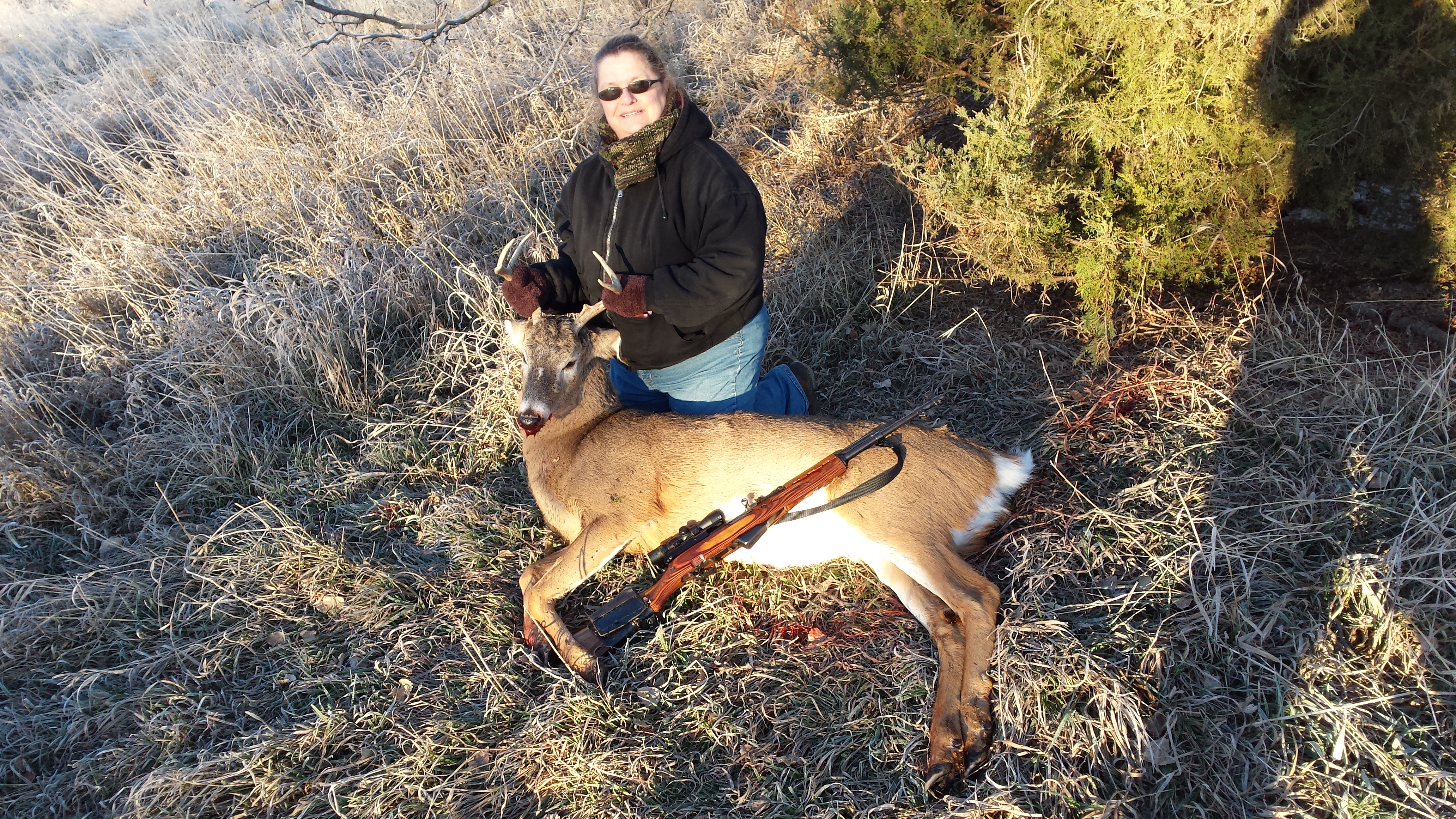
Around 8:15 having seen no deer as yet, we were getting a bit restless and probably a bit careless as we fidgeted and stirred about. I was convinced that the ghostly calmness of the morning had sent all the above mentioned sounds wafting through the woods and fields like the plague and that our morning hunt was certainly hexed. Suddenly Joyce tapped on my leg a couple times and excitedly pointed behind me; to the right in the field in front of us, camouflaged pretty well by trees along the drainage ditch that ran just in front of our blind, stood a nice buck. He appeared to be a nice big-bodied deer, but with meager, diminutive antlers that didn’t match his size.

20151203_083119

We are not horn-hunters as we’ve tried every recipe imaginable and have yet to get antlers to taste good, so the size of his rack was of little consequence to us. He gingerly moved forward, choosing each step carefully but not giving any indication that he knew we were watching. As he stepped down into the drainage in front of us, Joyce made a good shot, and minutes later the buck lay dead merely fifty yards away.

When we picked that spot to build our blind, I was convinced we had chosen well, but last season’s results had left me second-guessing myself. Now, however, both droughts appear broken as we have one deer in the freezer and I’m seeing deer from the blind with some regularity. So God willing and my wife doesn’t fall asleep like last year, the Gilliland deer-less curse may be broken!

Continue to Explore Kansas Outdoors.

Steve Gilliland, Inman, can be contacted by email at [email protected].

BullCityBlack500x125 (1)

INSIGHT KANSAS: ‘Safe space’ campuses a dangerous trend

Prior to my employment at Fort Hays State University, I was a happy resident of Columbia, Mo., and I will always be a proud Mizzou alum. Thus I’m greatly saddened by recent events there, and warn my adopted home state of Kansas to be careful not to follow the same path. Censors have disguised themselves as sincere reformers, and their success could produce disastrous consequences.

The Missouri campus has fallen prey to the same overzealousness seen at an increasing number of universities. Unlike some I do not deny that racism persists in Columbia: I have actually seen it firsthand. Sadly, the protests often fail to eradicate racism and instead merely suppress a conversation that needs to be held.

Chapman Rackaway is a Professor of Political Science at Fort Hays State University.

To understand where the protests deviated from their goals of fighting racism we must understand the demand that the protesters’ narrative be unquestioned. Students, and notably one Communication professor, physically forced away media that did not meet the twin litmus test of being narrative-friendly and national in scope under the masquerade of creating a ‘safe space’.

The virus spread to Kansas, with demands for the resignation of student body leaders at KU, a protest planned for the Board of Regents visit to Wichita State, and a race forum at Emporia State that excluded media. While those movements have not expanded to Mizzou’s proportions, there is potential for more unrest. Allow me to make one suggestion to Kansas’ students: don’t. While the desire for change may be sincere, calls for reform are being manipulated and mutated into something much more sinister and chilling: the end to dissent.

At its core, the concept of a “safe space” is antithetical to a college environment. A college must be a haven of diversity – but not only in terms of race or sexual orientation. Diverse viewpoints, even those that some may deem ‘dangerous’, are exactly what the university is supposed to encourage. Ideas contest ideas in an open and honest debate when the university delivers on its promise as a conceptual laboratory. Today, not only is viewpoint diversity poorly practiced at many universities it has become an endangered species. Rejections of ‘safe spaces’ are the only levees between today’s era of individual self-censorship on campus and a flood of intentional, systematic censorship. Donald Trump’s bromides are not fought by squelching him, as appealing as that may be to some, but by better and stronger ideas.

On any number of “safe space” campuses, advocates have looked askance at the First Amendment, as though it was merely an enabler of hurt feelings. Yale protesters demanded that a Dean resign because he did not agree with their ‘safe space’ demands and instead persisted in his belief that his job was to create an environment to bring multiple viewpoints together for respectful dialogue. When the public demands campus-style censorship, free speech and thus dissent is truly dead. Democracies cannot function without dissent. What “safe space” protesters intend is reform, but simultaneously they are actively threatening a core value of democracy. Actions trump intent, and as any protester will tell you it is impossible to separate the two.

In Ray Bradbury’s classic novel Fahrenheit 451, censorship of books was widespread. The censorship was not the work of an oppressive government, though. The public, so insecure it could not stand dissent, demanded censorship and government complied. Cautionary tales like Bradbury’s remind us that the scariest ideas, those that can disturb us the most, are there for a reason. We need to be challenged, not coddled. Even more important, our students deserve to be challenged with ideas as well. The protests at Mizzou have been a stalking horse for desires to censor. So, dear Kansans, please heed the tales from our neighbor to the east.

Ideas and concepts like racism can be defeated, but only by better ideas. Not by censorship, in whatever guise it takes.

Chapman Rackaway is a Professor of Political Science at Fort Hays State University.

POLL: What are your political views?

WorldPestSponsor

With another busy election season just around the corner, Republicans, Democrats and everyone in-between are calling the results critical for the future of the nation.

Which term below comes closest to your political point of view?

[polldaddy poll=9207734]

Sponsored by World Pest Control

HAWVER: Time to open up those re-election war chests

martin hawver line art

Well, we’re starting the holiday season for Kansas House and Senate members, where the real gifts will finally be unwrapped on Monday, Jan. 11.

What?

No, the holiday tree will be put out at curbside—or disassembled and stuffed back into the box for next year—but the real unwrapping will be Jan. 11, when candidates for the House and Senate will reveal just how much money they have in their campaign finance accounts. And, there’s a whole bunch of tactics that surround that initial filing.

Look for most incumbents to show thousands of dollars ready to be spent to woo your votes in the upcoming August primary election, and for a newcomer or two to have loaned themselves thousands of dollars in the hope that it will scare off challengers.

The deadline is Dec. 31 for contributions which will be reported on Jan. 11, after the candidates and their treasurers have had the time to fill out the forms to report the size of their campaign fund.

No matter the budget balance for the state, or the fight over expanding Medicaid, it’s the Jan. 11 announcement that will have legislators and their challengers scouring the list to see whether they have as much money as the lawmaker in the next district over, or how much more money they have than their challengers. Oh…and why the neighbor gave money to the other candidate…  Does your dog bark at night? Did you forget to sweep up your lawn trimmings from the neighbor’s sidewalk?

Remember, there are challengers—those folks who have always wanted to have some signs printed up and walk in some parades and take cute picture of their grandchildren trying to hammer yard signs into the dirt—and there are real challengers.

That’s where things get a little fuzzy, maybe fuzzier this year than in the past.

See, until you’ve formally filed for office, you aren’t in the race. If you file in December, well, who’s going to imagine that you will have raised tens of thousands of dollars in the holiday season? Or, if you wait to file until you’ve lined up contributions, who would have thought that a newcomer comes out of the starting gate that fiscally strong?

And, if you file after Dec. 31, there’s no report necessary until next July. So it becomes a stealthy campaign, doesn’t it? One candidate shows his treasury, the other doesn’t, and the incumbent has no idea how big a challenge he/she faces.

Does the incumbent order hundreds of new campaign signs, or just dust off the old ones, maybe adding a sticker that says “re-elect?” Does the challenger start ordering up a few leaflets that stress that his/her probation has ended or toss out an issue that the incumbent will play to—and spend thousands of dollars countering—and then switch the campaign theme as the election nears? The strategies are all out there.

Yes, we’ll learn the numbers, the early numbers, in January, and then see who surprises whom in July with the just-before-the-primary election second round of reports. That’s another strategy. Report tens of thousands of dollars of contributions before the primary, and the opponents scramble to put every dollar they have into signs, ads, phone calls, pamphlets, all of that and don’t have any time left for standing on doorsteps where they can actually win votes.

But the real holiday surprise will be which candidates, after the fund-raising strategies have played themselves out, support or oppose the things that voters support or oppose. …Or said last election cycle that they supported or opposed things their constituents supported and then didn’t.

That’s when it really takes a lot of campaign money to win election or re-election.

Syndicated by Hawver News Co. of Topeka, Martin Hawver is publisher of Hawver’s Capitol Report. To learn more about this nonpartisan statewide political news service, visit www.hawvernews.com.

SCHLAGECK: Land is sacred

John Schlageck writes for the Kansas Farm Bureau.

Almost every farmer has said this in one way or another, “My life begins with the land.” Look at it any way you want but this bedrock principle remains as it has for generations. Land ownership is the key to this business of farming and ranching. Farmers are proud of the crops they grow and the land they work.

From the time our first ancestors dropped seeds into the ground to today’s farmer who uses global positioning satellite, they were and are linked to the land. It’s who they are and defines the vocation they have chosen.

Many Kansas farmers and ranchers have raised their families, crops and livestock on ground that has been in their families for generations and for some more than 100 years. When producers farm land that long it becomes part of them. It is their way of life.

The land is something they cherish and love. Sowing seeds and bringing life to the land is an experience farmers anticipate each year. They look forward to cultivating the crop and protecting it from insects that would cut yields and rob food from people who depend on this precious grain.

Farmers also anticipate each year’s harvest when they gather the fruits of another year’s labor. Not only do this nation’s farmers produce great quantities of grain but they also take pride in producing a top-quality product – one of the finest and healthiest in the world.

Farmers often take better care of their land and livestock than they do themselves. The fondest wish of most farmers is to pass their land on to their children. They work for years, and often a lifetime, to leave a legacy of good land stewardship.

Most farmers learn about conservation and respect for their land from their parents. They continually seek new and better ways to work their soil to ensure they are able to pass it on to succeeding generations.

One farmer-friend once told me, “If I thought for one minute I was ruining my land, I’d give up farming.”

Producers have a deep-seated feeling of honor to be the owner and caretaker of land that has been in their families for generations. They understand that one day they will pass from this earth but the land will remain. They strive to leave the land in a little better condition.

These stewards of the soil know their ancestors came to this country and settled with the belief that it was the land of opportunity for them and future generations from their families. They hope their children will see this investment in the land in the same light and leave the farm in better condition for their children.

Land is sacred for Kansas farmers and ranchers. They’ve devoted their lives to safeguarding their farms and families while providing us with the safest, most wholesome food in the world.

John Schlageck, a Hoxie native, is a leading commentator on agriculture and rural Kansas.

Movie review: ‘The Good Dinosaur’ is a good holiday film

James Gerstner reviews movies for Hays Post.

“Life is what happens when you’re busy making other plans.” – A lot of people, including John Lennon.

I have found the above statement to be pristinely true. Whether it’s planning for your next job, planning the future of your relationship or even planning to catch a movie, “Life” is the stuff that happens between plan inception and execution.

That exact type of interference, in the form of the annual BlizzCon event (a wicked awesome gathering of fans of Blizzard Entertainment in Anaheim, California) and a debilitating cold (which is common side-effect of 25,000 nerds gathering in one place), is what rendered me incapable of providing a movie review for the past three weeks. Since the past three weeks are the only three weeks I have missed in nearly four years of writing reviews, I hope that my absence can be forgiven.

On a much less business-related note, Happy Belated Thanksgiving everyone! The Thanksgiving holiday was truly wonderful for me this year as it was the first time I had been back to Hays since moving to Washington, D.C. over the summer. I ate, sleep, was merry and spent much-needed quality time with my family.

My ease of access to food and the close proximity of loved ones is exactly opposite of the situation that the protagonist, a young Apatosaurus named Arlo, of “The Good Dinosaur” finds himself in. Set millions of years after an asteroid (that killed the dinosaurs in our world) nearly misses a prehistoric earth, Dinosaurs have evolved into early farmers and ranchers. Seeing dinosaurs farm with, literally, their faces is nothing short of mesmerizing. The concept and initial set-up of “The Good Dinosaur” is very much in the vein of Pixar’s greatest triumphs – even if the resulting movie falls a tiny bit short.

There is a lot of “The Land Before Time,” one of my all-time favorite childhood movies, in “The Good Dinosaur,” in addition to a moderate dose of “The Lion King.” While certain elements are cut from these masterpiece clothes, “The Good Dinosaur” is ultimately one of Pixar’s weaker entries. Granted, a weak entry from Pixar is something akin to a weak painting from Picasso.

There are certainly some good lessons, a compelling journey and stunning visuals in “The Good Dinosaur.” Furthermore, as “Jurassic World” continued to prove earlier this year, there is magic in bringing dinosaurs to the silver screen. Whether brought back to life in a genetics lab or an animation studio, our collective consciousness continues to love dinosaurs. “The Good Dinosaur” is a good character, a good cinematic dinosaur and a great family holiday cinematic outing.

5 of 6 stars

Copyright Eagle Radio | FCC Public Files | EEO Public File