We have a brand new updated website! Click here to check it out!

SCHLAGECK: Why it’s called ‘Turkey Day’

John Schlageck writes for the Kansas Farm Bureau.

How did the turkey reserve its place on our traditional Thanksgiving table?

That bird is what the pilgrims feasted upon according to fact and fable.

You’ve all heard how our ancestors hunted this bird. But here is the real story – the turkey scoop.

Seems our forefathers remembered to take their muskets that day, but forgot to take their ammunition. As the men marched toward the woods, they took one addition, an Indian scout.

To take the scout along was tradition. Besides, the pilgrims needed someone who knew where the turkeys were.

As the story played out, the hunters spotted an elk. It was a fine animal for a Thanksgiving feast. It sported a trophy rack no doubt.

Several hunters took aim, pulled back their triggers and clicked. They soon discovered their muskets had no shot.

This realization made them sick to their stomachs.

What could they do?

What would they have for their Thanksgiving feast?

On what would they sup that night?

One wise – or unwise – lad suggested stewing their shoes.

“I’ll gobble them up,” he said.

Well, the rest of the hunting party was in no mood for jokes. One of the hunters threw the lad’s musket into the field just as an old Tom turkey – who had heard the gobble – popped up his head.

The critter’s fate was sealed. What senses he had were knocked out that day. The turkey was plucked, stuffed and roasted.

In exchange for his silence, the scout was invited to eat while the hunters boasted and embellished the story about the day’s hunt.

They truthfully said, “We didn’t fire a shot.”

Those early-day hunters had no need for ammunition. That’s why today turkeys are raised on farms – to shoot them would break with tradition.

On a more historical note, Thanksgiving Day, is a traditional North American holiday. Although this feast is considered to be the very first Thanksgiving celebration, it was actually in keeping with a long tradition of celebrating the harvest and giving thanks for a successful bounty of crops.

The date and location of the first Thanksgiving celebration is a topic of discussion, though the earliest attested Thanksgiving celebration was on Sept. 8, 1565 in what is now Saint Augustine, Florida. Despite research to the contrary, the traditional “first Thanksgiving” is venerated as having occurred at the site of Plymouth Plantation in 1621.

What foods topped the table at the first harvest feast?

Historians aren’t completely certain about the full bounty, but it’s safe to say the pilgrims weren’t gobbling up pumpkin pie or playing with their mashed potatoes. It’s a relatively safe bet the only two items on the menu for sure were venison and wild fowl.

Today, Thanksgiving is celebrated on the fourth Thursday of November. Certain kinds of food are traditionally served at Thanksgiving meals.

First and foremost, baked or roasted turkey is usually the featured item on any Thanksgiving feast table (so much so that Thanksgiving is sometimes referred to as “Turkey Day”). Stuffing, mashed potatoes with gravy, sweet potatoes, cranberry sauce, other fall vegetables, and pumpkin pie are traditionally part of Thanksgiving dinner.

All of these dishes are native to the Americas or were introduced as a new food source to the Europeans when they arrived.

Have a Happy Thanksgiving and don’t forget to count your blessings.

John Schlageck, a Hoxie native, is a leading commentator on agriculture and rural Kansas.

HAWVER: It take more than ‘in the classroom’ spending to run a school

martin hawver line art

Statehouse habitués are gearing up for another session where the most frequently used phrase will be “spent in the classroom.”

That’s the school finance phrase that draws the most attention, that sounds on its face as a reasonable use of those state dollars. You send your kids to school, and when they come home seven hours later, well, you want to know that all those $4 billion plus in state tax dollars went to teach them things they didn’t know when they arrived.

That’s where this “spent in the classroom” phrase comes in. Everybody wants tax dollars for public education to be spent on educating his/her kids or grandkids or neighbors’ kids—in those classrooms.

But there’s a lot that school districts do that doesn’t involve direct pupil-to-teacher contact in a classroom.

The kids ride a bus to school? That’s not “in the classroom” spending, according to many legislators, but isn’t talked about much because most legislators’ constituents’ school districts bus kids to school, where the classrooms are.

And, if there’s a lunch program, well, those lunches aren’t generally eaten in the classroom, and the halls and classrooms that are cleaned, well, that’s not direct teacher-to-pupil contact.

Oh, and don’t forget that someone manages those schools, makes sure that the furnace is running, the windows aren’t broken, that equipment is bought at the best price, bills are paid and the employees who work for your local unified school district are paid, and their checks are double-checked and the deductions for taxes made.

All that non-classroom spending is important. There is probably some magic percentage that only accountants know that defines an efficiently run school district.

But, in a state with school districts ranging from 80 students to 47,000 students, we’re figuring that the “spent in the classroom” vs. “not spent in the classroom” costs are going to vary dramatically. It’s the management costs of a giant district spread over more pupils. That’s why a gallon jug of milk costs less than buying eight pint cartons of milk; it’s called economies of scale.

But about all we’re hearing from lawmakers is “in the classroom.”

That catch phrase is getting a little old, and while total costs are the least complicated for legislators to get a handle on, it’s probably not as important as how well the student do, what they learn, and are they going to know enough to go on to post-secondary schools or maybe just get a job and move out.

The upcoming legislative session is where the real work will start on assembling a new school finance formula to replace the interim block grant program, which enters its second and likely last year for the 2016-17 school year.

That block grant program essentially takes state aid the districts received in the 2014-2015 school year and just continues it for two years, regardless of changes in makeup of the school districts and numbers of pupils (if enrollment growth is less than 2 percent), and tells the districts to spend it however they think they need to provide an education to their pupils.

But don’t forget, that even with a relatively clean sheet of paper to start with, much of what we’ll hear about financing public education next session is going to be about “in the classroom” with whatever links can be established to performance of students—at the lowest cost to the state treasury.

Maybe that phrase will work out, but we’re trying to remember the last time anyone got cheaper drinks by taking their own glass, ice and an olive on a toothpick into a bar trying to pay for just the vodka and vermouth.

Syndicated by Hawver News Co. of Topeka, Martin Hawver is publisher of Hawver’s Capitol Report. To learn more about this nonpartisan statewide political news service, visit www.hawvernews.com.

Exploring Kansas Outdoors: Then there was Bob

BullCityBlack500x125 (1)

We had stopped at the Atrium Hotel in Hutchinson where the North American Falconry Association national field meet was in full swing.

We were admiring the hawks and falcons tethered to their perches in the weathering yard, a fenced-off portion of the lawn where the birds rested during daylight when not out hunting.

Steve Gilliland
Steve Gilliland

Before us sat a menagerie of beautiful and remarkable birds; the Harris’ Hawks known to be the only social birds of prey that often hunt in groups in the wild; the Cooper’s Hawks, known as very fast aerial hunters that ambush their prey in mid-air; the Peregrine Falcons that climb to 1000 feet or more and fly above their humans below, free-falling out of the sky to whack flushed game at speeds approaching 200 miles per hour, and the hardy, versatile and dependable Red Tail Hawks, which are very abundant here in the wild this time of year….

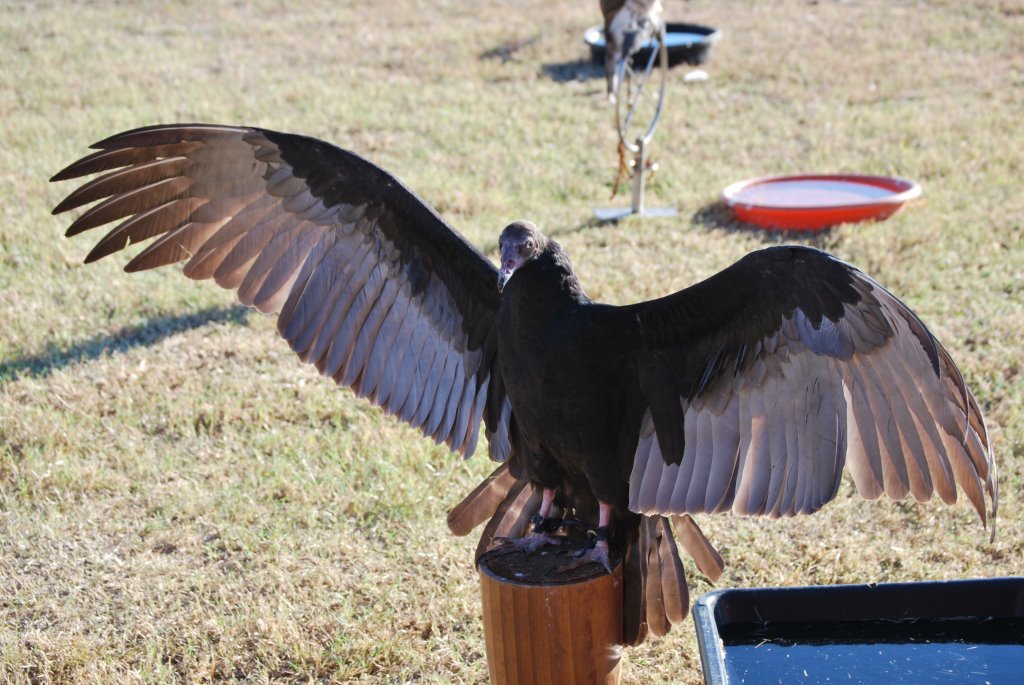
Then there was Bob, a young Turkey Vulture tethered to his perch in the front row. Don’t get me wrong, Turkey Vultures are amazing birds, and Bob was just as magnificent as the rest in his own way, but he was just a little out-classed. Now everyone and everything has a story, and Bob is no different.

Falconers Mario and Brandi Nickerson run Natures Edge Wildlife Rescue near Ft. Worth Texas, specializing in reptiles and birds of prey. About three weeks ago they began getting calls from local animal control about a Turkey Vulture in town. Each time they verified that the bird appeared to be healthy and OK, but just a little out-of-place.

turkey vulture

The third call however was different. It seems Bob was walking around in the middle of the local football field while practice was in session. The local animal control people were afraid to approach it and by the time Brandi and Mario got there, the bird was precariously perched on the roof of a nearby single story house. Now they had gone prepared for a rodeo in capturing the bird, with tarps and gear to throw over the vulture if possible, and carefully roll the bird up inside and carry it away.

Ironically, stuck in a nearby chain link fence was the carcass of a dead squirrel, so using the dead squirrel as bait, they tossed the carcass near the house and waited. In just a few minutes the vulture flew down, strolled nonchalantly over to the squirrel and picked it up. They slowly inched their way toward the feeding bird, tarps and gear at the ready, awaiting a tussle that never happened.

They were able to walk up to him, literally pick him up, place him in a crate and walk away. The next morning at home, Brandi opened the cage and held out a dead rat, and Bob waltzed casually over to her and took his breakfast from her hand.

Closer inspection of Bob’s feathers and consideration of his demeanor convinced them that Bob had been raised somewhere by humans, and was now “imprinted,” meaning that he no longer believes he is a vulture, but rather believes he is human, and must for now, rely on them for everything. Mario and Brandi are able to keep Bob because of their falconry permit, and are in the process of getting required permits to possibly use Bob for educational purposes.

As wildlife rescuers, the Nickerson’s goal is two-fold; to re-adopt rescued pets to new homes and to release wild-rescued critters back into the wild. They’re not sure if Bob can ever be re-released back into the wild, but how cool would it be to have a pet Turkey Vulture; talk about a conversation starter! Continue to Explore Kansas Outdoors.

Steve Gilliland, Inman, can be contacted by email at [email protected].

BullCityBlack500x125 (1)

Beech: Jams and jellies for holiday giving

Linda Beech
Linda Beech

Homemade foods make thoughtful holiday gifts. But, extra baking and cooking can compound the time crunch of an already busy holiday season.

Gifts of home canned foods are also thoughtful kitchen gifts, but with a big advantage– they can be made weeks or months in advance and then wait patiently on a shelf in a cool, dry place until the holiday season.

Extension food preservation workshops have been popular this fall, and our next canning class focuses on gifts from the kitchen.

A multi-county food preservation workshop on “Homemade for the Holidays: Jams and Jellies for Holiday Giving” will be held on Tuesday, November 17 from 5:30 p.m. to 9:00 p.m. at the McKenna Youth and Activity Center on Main Street in Palco, KS. The $10.00 registration fee includes a simple supper and class expenses.

The purpose of this workshop is to help participants learn or review safe techniques for preserving top-quality jams, jellies and sweet spreads.  Participants will work together to make jelly from commercial juice, savory jam for a holiday appetizer and a low-sugar freezer jam. Participants will take home at least one product at the conclusion of the workshop.

Instructors are a team of three Extension Family and Consumer Sciences agents:  Linda Beech, Ellis County; Karen Shepard, Graham County; and Anna Schremmer, Phillips-Rooks District.

Pre-register and pay fees no later than November 10 at the Ellis County Extension Office, 601 Main Street in Hays, 785-628-9430.  A minimum of ten and a maximum of 15 participants is necessary to hold this workshop. Registration is taken on a first come- first served basis; registration is complete when fees are paid.

Making homemade sweet spreads is a great way for beginners to learn basic food preservation techniques.

Freezer jams are the easiest– chop or mash clean fresh fruit, then mix with sugar and pectin, and spoon into sterilized containers.  The process is also family-friendly so that children can help make gifts to give at the holidays time.

If freezer storage doesn’t suit your gift-giving needs, cooked sweet spreads can be preserved quickly and easily in a boiling water bath canner.  The glistening jars of jams and jellies can wait on a shelf in a cool, dry place until needed for gifts.

Food science experts at K-State Research and Extension offer these additional tips for jam and jelly making:
* Follow a research-tested recipe from a reliable source or use the instruction insert that comes with canning products. Recipes that are packaged with products such as pectin or jelly jars have been tested by family and consumer science professionals who understand how ingredients interact.  Extension and USDA sources are tested and trustworthy, too.  Be cautious of online canning information from sites where recipes are shared by individuals and not tested or verified for accuracy or safety.
* Follow a tested recipe precisely and do not double the batch, or the spreads may not set.  Dry powdered pectin and liquid pectin are not interchangeable, so substituting one for the other in recipes may also cause runny jams and jellies.
* Seal all sweet spreads with proper processing in a boiling water bath canner.  Old-fashioned treatments such as inverting jars or sealing with a layer of paraffin wax do not stand up to food safety testing and are no longer recommended.
* Use standard canning jars and new, fresh lids for every batch of homemade sweet spreads.
* Increase processing time at higher altitudes. Jams and jellies preserved above sea level require longer processing in the boiling water bath canner to ensure safety.  Since most Ellis County locations are at an elevation of about 2000 ft, make sure your recipe includes extra processing time for higher altitudes.

Homemade jams and jellies extend fresh-fruit flavors into the fall and winter months. They take relatively little time to prepare, and, when used as gifts, can save time and money and reduce stress during the busy holiday season.

For more information on making homemade jams and jellies or to register for the jam and jelly canning workshop on November 17 in Palco, contact the Ellis County Extension Office at 601 Main Street in Hays, 785-628-9430.

Linda K. Beech is Ellis County Extension Agent for Family and Consumer Sciences.

Now That’s Rural: Bob Fisher, world record holder

Ron Wilson is director of the Huck Boyd National Institute for Rural Development at Kansas State University.

By RON WILSON
Huck Boyd National Institute

Not one, not two, but fourteen world records. That is an amazing accomplishment by one man. All of these records have to do with basketball free throws, and they were all set by a man from rural Kansas.

Bob Fisher is the man who set these world records. He grew up at Vermillion in northeast Kansas and moved to Centralia. After living in Dallas for six years, he moved back to Centralia where he and his wife Connie live today. Bob is a technician for USDA’s Natural Resources Conservation Service. He also serves as a shooting coach for basketball players.

“Twenty-seven years ago, I got the advice to become a true expert in something,” Bob said. He decided to become an expert in shooting a basketball.

fisher-sharp-shooters-logo

Bob had been a basketball player in high school. “I loved the game but I wasn’t athletic enough to go higher with it,” he said. “In track, I was always just ahead of the guy who finished dead last.”

Years later while looking for a hobby, he thought about basketball – specifically, shooting. He read all he could from all kinds of sources and studied from the gurus of basketball. Then in 2007, he read a book which totally changed his approach to the game.

“Dr. John Fontanella’s book ‘The Physics of Basketball’ had a profound influence on my thinking,” Bob said. This book dealt with the science of the basketball moving through the air. It applied the theories of physics to the challenge of directing a sphere to a specific spot.

“Professor Fontanella applied physics to the flight of the ball and calculated the exact launch angle of the free throw for players of different heights,” Bob said. Bob studied the science of shooting, including the biomechanics of the hand and arm. “What’s really important is where the force is being applied to the ball at the moment of release.”

His scientific study resulted in changing his release method for shooting. “After two months, I made 246 free throws in a row, missed one, and made 200 more,” Bob said. He now coaches others. As a shooting coach, he’s served customers from California to Detroit.

Since Bob had accomplished great accuracy in his shooting, his next challenge was speed.

“The Guiness Book of World Records said that some guy in Sweden had made 48 free throws in one minute, so I set out to beat it,” Bob said. In January 2010, he made 50 in one minute. He continued to set all different kinds of free throw records.

Today, Bob Fisher holds the following world records for free throws made: 33 in 30 seconds, 50 in one minute, 92 in two minutes, 448 in ten minutes, and 2,371 in one hour. Furthermore, he holds the world records for most free throws in one minute and in two minutes while alternating shooting hands, in one minute underhanded, and in one minute and two minutes while shooting blindfolded, plus in one minute while standing on one leg. On top of that, he holds several records with partners: Most free throws made in one minute by a pair of people, most made in one minute by a pair using two balls, and most made in one minute by a coed pair.

One of his records was set in Los Angeles at the NBA All-Star Jam Session. He’s appeared on the Tonight show and is writing a chapter about shooting for a book to be published by an international shooting coach.

All this is amazing for a man born in the rural community of Vermillion, population 104 people. Now, that’s rural. It’s also worth noting that he was age 52 when he set his first world record.

“Connie has been a huge part of my success,” Bob said of his wife, who documents his records and works with Guinness to get them approved.

For more information, go to www.secretsofshooting.com.

Not one, not two, but 14 world records. That’s the accomplishment of Bob Fisher, who is making a difference by understanding and teaching the science of free throw shooting. Like a well shot free throw, this project is good.

LETTER: On the warpath, against voting rights

aaron estabrook
Aaron Estabrook

Six years ago Kris Kobach and myself were on strikingly different warpaths. Kobach had just launched his campaign for Kansas Secretary of State. I was earning my combat stripes and Afghan Campaign Medal in the desert valleys of Kandahar. There, I was fighting the Taliban, an enemy that – ironically – as a young man, Kris Kobach had advocated arming. An ambitious college kid, Kobach told his student newspaper “the Afghan rebels’ cause gets the least amount of attention and support in this country”. Many of those rebels soon became the Taliban – and are still at war with America today after training and harboring the terrorists that attacked us on September 11th killing more than 3,000 and sparking the longest war in American history.

But in 2009, my first mission in Afghanistan was straightforward, if not a simple task. We were there to foster the safe and free elections of the Afghan people. To give them a shot at enjoying the democracy that we treasure. Meanwhile, the mission Kris Kobach took on back here in Kansas was neither straightforward nor simple – he was out convince Kansans that voter fraud was common, rampant, and widespread, despite the lack of any evidence suggesting it.

It was startling to return home to Kansas in 2012 and learn what our new Secretary of State was up to. He wasn’t expanding access to democracy, or empowering people to vote, as we’d been fighting the Taliban to do in Afghanistan. Instead, he’d embarked on a campaign of intimidation and suppression.

Unfortunately, this only accelerated this past summer, when Governor Brownback signed into law everything that Kobach asked for. Senate Bill 34 gave the Kansas Secretary of State authority to prosecute voters. Kobach has pursued only three alleged cases of fraud to date, hardly the massive epidemic of fraud that he claimed was marring our elections. But in addition to his use of this the prosecutorial authority, Secretary Kobach has begun purging over 37,000 Kansans from the books who have failed to obey his rules – Kansans who in fact should have every right to vote. But instead of working to expand the access of Kansans to their right to vote, Kris Kobach is on the warpath to deny it to them.

According to recent news reports, many of these folks are active military personnel and veterans. And when contacted, they had no idea they were being denied their right to vote – or what they needed to do to maintain that right. It’s not the first time Kobach has used his office in a way that undermines the vote of our service members. Just last fall Kobach mailed out a letter to military members overseas, claiming their votes may not count due to pending lawsuits about Chad Taylor withdrawing from the U.S. Senate race. There was really no reason to do that mailing, except to try and diminish their likelihood of voting by making them feel like their votes wouldn’t count.

In only 6 years Kobach has transformed an effective, transparent Kansas Elections Office into one constantly marred by controversy. Data on election results has never been harder to come by. Free and fair elections have always been what makes American democracy exceptional – so sacrificing 37,000 voter registrants to try to prosecute 3 Kansans who may have accidentally voted in multiple states out of confusion or negligence is jarringly at odds with the foundations of our democracy. And while those three votes certainly didn’t change the outcome of any elections, unfortunately, Secretary Kobach’s voter intimidation tactics just might.

It’s relevant and important this Veterans Day. Kansans who have fought for freedom abroad – and who have monitored elections in parts of the world that had never voted before – are now finding themselves being potentially denied the right to vote at home. It’s an unacceptable treatment of any Kansan, but it’s a particularly unacceptable treatment of our patriots. We need accountability from this politician, and an end to these attacks on our fellow Kansans’ democratic rights.

Aaron Estabrook is a post 9/11 combat veteran and vice-president of the USD 383 Manhattan-Ogden Board of Education.

HAWVER: The political fallout of Kansas budget mess

martin hawver line art

Wonder how this budget shortfall for the current and next fiscal year works out politically?

Wait, this is a real dollars-and-cents problem here, revenues for this and next fiscal year falling about $159 million in the remaining seven months of this fiscal year and $194 million in the year that starts July 1.

And, remember, we’re in a two-year budget, so when legislators approved the spending plan last session (it was June) they were thinking: Maybe a little touch-up for the second year and we’re out on the campaign trail.

Well, that’s all gone now. The governor is taking the lead with about $109 million of spending cuts in the current year, including another $48 million nick of the Kansas Department of Transportation budget, for a total of $350 million in this year alone, and some other cuts and shuffles that most of us won’t notice.

RELATED: Brownback says state has “good shot” to meet revenue goals.

Look for that touch-up of the budget this coming session to include more cuts in spending and maybe, just maybe in an election year, a tax increase or two.

But practically, the state constitution calls for a balanced budget, if even just $1 is in the bank every July 1, so it’s going to be done. No telling what happens if the Legislature and governor don’t put together a balanced budget. Do they lose their parking slots? Are they arrested? Does the Kansas Supreme Court or someone dock legislators’ pay? As we said, there’s no telling because it hasn’t happened since the earth cooled enough that the Statehouse could be built and restaurants started popping up so lobbyists can take lawmakers out for lunch and dinner and drinks.

So, ugly as that might be, there’s still the politics to be wrestled with.

Those politics started in 2012, when the Legislature passed a vastly expanded version of an income tax bill Gov. Sam Brownback proposed, and though it probably wasn’t a good move, he signed the giant tax cuts into law.

RELATED: Officials say Kansas economic recovery leaves rural counties behind.

It has taken three years, but those tax cuts have come home to roost, not spurring the increased revenues that was the goal, resulting in revenue shortfalls.

The politics? Well, Brownback doesn’t stand for re-election, so he’s in the clear.

Do Republicans call the cuts in spending to balance the budget a long-overdue reduction in the size of government which most people who vote Republican revere? Who isn’t for cutting wasteful or maybe just unproductive spending of our tax dollars—for those who haven’t figured a way to turn themselves into Limited Liability Companies so they don’t have to pay state income taxes?

Do Democrats, who don’t have enough votes in either chamber to pass or kill legislation, just complain and blame Republicans as they have the past three years? Or do Democrats come up with a plan, a budget or the tax increases necessary to prevent further cuts into programs and aid to local units of government?

It’s a matter of weighing which is the politically most advantageous.

Republicans, of course, with the legislative majority can assert that they tried a dramatic new taxation philosophy that didn’t work, but led to massive spending cuts that they can sell as efficiencies. And, so far, the spending cuts haven’t shown up in the everyday lives of most Kansans—unless they build highways for a living.

Democrats can point fingers at shaved expenditures for K-12 education and highways. But don’t look for a Democrat-proposed budget because it is going to require tax increases which they probably don’t have the votes to hang on Republicans, and they don’t want to cut social programs that are needed by the poor and the ill and their children.

Where do the politics of this revenue shortfall go? It’s going to depend on who thinks up the catchiest phrase for their campaigns. Wonder what it will be?

Syndicated by Hawver News Co. of Topeka, Martin Hawver is publisher of Hawver’s Capitol Report. To learn more about this nonpartisan statewide political news service, visit www.hawvernews.com.

SCHLAGECK: Make your own plan

John Schlageck writes for the Kansas Farm Bureau.

The vocation of agriculture began thousands of years ago when the first farmer dug a hole in the soil and planted the first seed. Way back then others began working with and domesticating animals that have evolved into present-day hogs, cattle, sheep, chickens and other livestock.

The farm and ranch creed has always been to nurture the land and livestock while making improvements and coaxing a bountiful harvest. Farmers and ranchers hold enduring respect for the land that sustains them. Their reward has resulted in abundance.

With this evolution in agriculture, today’s producer faces many new and sometimes unexpected challenges. Profit margins and production costs are in a constant state of flux. Weather patterns change while farmers and ranchers continue looking for ways to make profits and stay in this business.

This week Insight takes a look at the opposite end of the spectrum. Here are 11 ways to cut your profit margins. Think long and hard before implementing any of these in your operation.

1)   Blindly follow seasonal trends or patterns. If the market is going up, do not sell. It may go higher. If the market falls – do not sell. It may turn around and go up.

2) Never trust a U.S. Department of Agriculture crop or livestock report. From all the information available these reports are “strictly legit.” But never mind; discard these reports at all costs.

3) Blame the big grain companies. Everyone knows they manipulate the farmer and make all the profits.

4) Blame the big cattle packers. Everyone knows they manipulate stockmen and make all the profits.

5) Assume prices and costs are related. No place is it written that because you spend $1,000 an acre to produce irrigated corn you are guaranteed a profit on your grain.

6) Hold the short crop because less corn, wheat or beans must mean the price of these commodities will increase. In reality, by the time you hear a crop is in short supply, everyone else has heard the news too and the price has already gone up.

7) Follow the majority. If your neighbor sells his corn, it is probably the right time for you to sell yours. Ignore most conversation in the local coffee shop or coop. Figure out your own marketing strategy.

8) Ignore the futures market and basis because everyone knows that a bunch of speculators are rigging the market. Remember, speculators lose money too and provide liquidity for the market.

9) Never sell until you have a crop. Oftentimes, before you harvest a crop is the best time to lock in profits. Take a hard look at future contracting.

10) Shoot for the market high. Smart marketers have abandoned this philosophy for the goal of, “shooting for higher.”

11) Blame the banker or your wife. Again, everyone knows a banker lends you money when he/she shouldn’t. And if all else fails, who has any broader shoulders than your spouse.

You may just want to take a hard look at yourself. Operating a farm or ranch is as tough a profession as there is going these days. It takes all the wisdom, knowledge, technology, dedication and determination, luck and the blessing of Mother Nature to grow a profitable crop or market outstanding livestock.

And that’s not even taking into consideration a continually evolving marketing plan. Each farm and ranch and farmer and rancher is different. Look to yourself and those who are knowledgeable and can help you be successful.

Best of luck.

John Schlageck, a Hoxie native, is a leading commentator on agriculture and rural Kansas.

Exploring Kansas Outdoors: ‘The Cat in the Trap’

BullCityBlack500x125 (1)

One of Dr Suess’ best stories is “The Cat in the Hat.” I have my own version of that story, so set back and enjoy as I tell you about “The Cat in the Trap.”

Once upon a time in a land far far away known as Kansas, a young trapping enthusiast accompanied a well-meaning old coyote trapper as he made his morning trap check. It was a fine November morning and the two chatted about trapping as they drove through a field of milo stubble where the old trapper had his traps.

Steve Gilliland
Steve Gilliland

As they approached the end of the field, a black shape in the trap ahead caused the old trapper to shudder; “Oh no, not a skunk” he thought. But much to the old man’s relief, the black shape was only a black cat held firmly in the jaws of the coyote trap. Now even though the trap was far from any dwelling or farm, the coal black cat appeared to be a healthy specimen.

“Probably someone’s barn cat,” thought the old trapper, “And I know how much the farmers round’ here like their barn cats” he mused. So it was decided the cat should be set free to return to its life of mousing. “This should be easy and take no time at all,” he advised his young apprentice.

Now the cat it was a feisty one, spitting and growling as it fought its steel captor, but the old trapper had done this before and knew just what to do. A well placed boot on the cat’s throat would anchor it long enough to open the jaws of the trap and free it once again to its life of farmstead servitude. The boot was so-placed and the cat appeared to be held nicely against terra firma.

Dropping to one knee, the old trapper quickly sprang into action opening the jaws of the trap, when the unspeakable happened. Whether his weight shifted slightly off the foot that held the squalling feline, or whether the black demon suddenly became Satan himself we’ll never know, but the old trapper suddenly found the cat’s teeth fastened firmly across his left index finger, causing him to instantly leap upright and orate scathing words of disapproval towards the cat’s actions. A couple quick, spiteful stomps anchored the cat again and it was released to run for its life.

The mornings trapping lesson ended early for the young apprentice. The old trapper was carted off to the local dispensary where three tiny knots of thread were added to the cat’s handiwork on his finger, and he would be told by the attending doctor that “Nearly all cat bites will become infected if not properly treated.”

The moral of the story is this; good ole’ house cats can be fun as they roll around at your feet on the floor, and good ole’ barn cats are irreplaceable when it comes to keeping your barn mouse-free. But from now on and for the rest of my trapping career every cat found in a trap of mine not easily identified as “Fluffy” next door will be charged a fee, consisting of no more and no less than the unused portion of its nine lives …

Continue to Explore Kansas Outdoors.

Steve Gilliland, Inman, can be contacted by email at [email protected].

BullCityBlack500x125 (1)

Brownback tours Russell County sites on oil and gas field tour

Kansas Independent Oil & Gas Association

KIOGA provided our fifth annual oil and gas field tour with Governor Brownback on Nov. 4. The tour highlighted some of the technologies that are helping pave the way for finding and developing oil and natural gas reserves in Kansas and around the nation. Former KIOGA Chairman Tim Scheck, President of Scheck Oil Operations in Russell, organized the tour providing itinerary and sites to visit. Tim’s effort was nothing short of phenomenal.

The tour included a visit to a well site near Bunker Hill, Kansas. Representatives from several Kansas oil and gas industry companies had equipment and representatives on site providing explanations to Governor Brownback and the group about the operations and services used to drill and complete an oil and gas well in Kansas. Companies providing equipment and explanations on site were: Scheck Oil Operations, Southwind Drilling, Andy’s Mud Co., RPM Services Trilobite Testing, Inc., Log-Tech of Kansas, Express Well Service, Matt’s Cat, CHS, Quality Oilwell Cementing, Dan’s Packer Service, Lone Wolf Service Owen McQuade Pumping, Pioneer Wireline Service, and Kansas Strong.

Over forty folks joined the tour including Kansas Governor Sam Brownback, Kansas State Representative Troy Waymaster, Fort Hays State University President Mirta Martin and several representatives from FHSU, officials from Russell County, City of Russell, Russell Regional Hospital, Russell USD Schools including high school students, representatives from KRSL Russell Radio, and several oil and gas industry folks.

“The oil and gas industry is a vital segment of our state and national economy,” said Governor Brownback. “The people who work in this industry support a world-class operation and they do it in a safe and environmentally conscious way.”

“We feel it is important for state leaders to understand and see firsthand what is happening in the oil and gas industry in Kansas,” said Edward Cross, KIOGA President. “The tour was very beneficial for illustrating a number of field operations that government officials often hear about but most have never witnessed.”

Letter: Class still seeking items to help foster children

suitcase

Fort Hays State University’s 310 Leadership Team, Bags of Love, would like to thank the community of the Ellis County for all the support we have been getting.

We are helping the Salvation Army with their Project Suitcase. Project Suitcase basically provides help for the children in Foster care that only have trash bags to transfer their belongings from home to home. Our goal is to obtain 350 suitcases filled with a few toiletries and a personal item to give to each individual child. We are so close to achieving our goal!

Items that we need are:

• Any type of suitcase
• Body wash
• Bars of body soap
• Tooth brushes
• Toothpaste
• Toys
• Stuffed animals
• Books
• Etc.

We need continuous support from the Ellis County area. This Saturday, November 7th, we will have a booth set up on the south entrance at Walmart from 10 am -2pm. Feel free to stop by with any type of donation. Don’t have any of these items? Come to Walmart, purchase any of these items and drop them by our booth.

Save the date!
Date: November 7th
Time: 10am -2pm.
Location: Wal-Mart, Hays KS

We would gladly appreciate any type of these listed items as donations to be able to help out the Foster kids in Ellis County!

For any questions feel free to contact any of these numbers below
Rosa Medrano (620)474-7454
Johnae Blackmon (785) 432-4110
Diane Hernandez (785)259-9377

Presidential primary debates: Free speech as discussion or distraction?

Gene Policinski is senior vice president of the First Amendment Center

The great debate over the 2016 presidential primary debates is distracting and disappointing at the least, in free speech terms.

Distracting in that the most-talked about issue at the moment is concern over news media bias and news media credibility, an issue that while troubling is hardly new — or news — to many Americans.

Disappointing in that the purpose of a free and open debate — which is an exchange of differing political views without government intervention or limitation, and is at the core of why we have such strong protection for free speech — thus far seems more than an afterthought than outcome.

Lost in the national kerfuffle, which along with criticism of moderators includes debate hall temperatures and the process for taking bathroom breaks, is a real discussion over improving an already weakened process so that it informs rather than simply inflames.

A starting point for serious talk about using such debates as part of our commitment to free speech, petition and assembly is to acknowledge that the primary season — as opposed to the limited series of debates once presidential candidates are nominated — sets out what well may be an impossible task.

Take an increasingly common double-digit set of primary candidates onto a TV stage to face multiple questions on complex issues in just a few hours. Try to keep the focus on those issues and solicit real responses, even as campaign strategists and the financial dynamics of running for office today pressure candidates to simply stick to their generic talking points and attempt to motivate donors — or get national attention — with dramatic statements and rhetorical flourishes. Add in personal attack time, whether directed at the moderators, the news media or opponents.

Such a system doesn’t need First Amendment protection for free speech. Let’s just borrow the ropes, ring and format from professional wrestling and issue a whistle to someone who — as proposed in the latest GOP attempt to “reform” the debate structure — declares the appropriate party preference.

In 1858, the Lincoln-Douglas U.S. Senate debates in seven Illinois cities set out a format that at least put the responsibility for quality exchange of views on the candidates themselves. Future Republican president Abraham Lincoln and incumbent Sen. Stephen Douglas, a Democrat, alternated as the opening speaker for 60 minutes, with the other candidate then speaking for 90 minutes, and the first speaker closing with 30 minutes to respond.

To be sure, even then the news media role was controversial. Accounts say newspapers in Chicago sent stenographers to produce transcripts to be published in full, but that some partisan editors using the text edited their candidate’s words, while letting the opponent’s rough language stand. Scholars also note that from plying supporters in the attending crowds with liquor and food to increasingly personal attacks by both Lincoln and Douglas as debates progressed, there was much to criticize in even this iconic series.

As vocal critics of today’s debates hold forth, some do see the events as acceptable, if not admirable. The Newseum Institute and the online talk leader TYT Network recently co-sponsored a discussion at the Newseum about how millennial voters will consume news of the 2016 elections. Panelists said young voters see lighter questions, along with serious inquiries, as more in keeping with how their generation shares all kinds of news and information.

Free speech matters most when we have something worth saying, regardless of whether the views are popular or not. In a political contest, this constitutional right and duty shouldn’t be wasted on trivial talk or spiteful spats. The news media’s role in a political debate should be to encourage, enable and on occasion, to press candidates with piercing inquiry to be specific, clear and definitive about positions or policy — or journalists have no real reason to be on stage.

The First Amendment provides us with the right to freely debate public policy with the intent of making our nation a better place in which to live. Moderators asking silly questions or candidates hijacking the process simply to shriek for attention or to shill for donor support is just wrong.

Gene Policinski is chief operating officer of the Newseum Institute and senior vice president of the Institute’s First Amendment Center. [email protected]

Copyright Eagle Radio | FCC Public Files | EEO Public File