We have a brand new updated website! Click here to check it out!

INSIGHT KANSAS: ‘There you go again’ on school funding

In early September, the governor’s communications office issued a “Fellow Kansans” essay renewing the administration’s vigorous claim that everything associated with providing funding to the state’s K-12 public education system must count as money that affects children in the classrooms.

Peterson IK photo
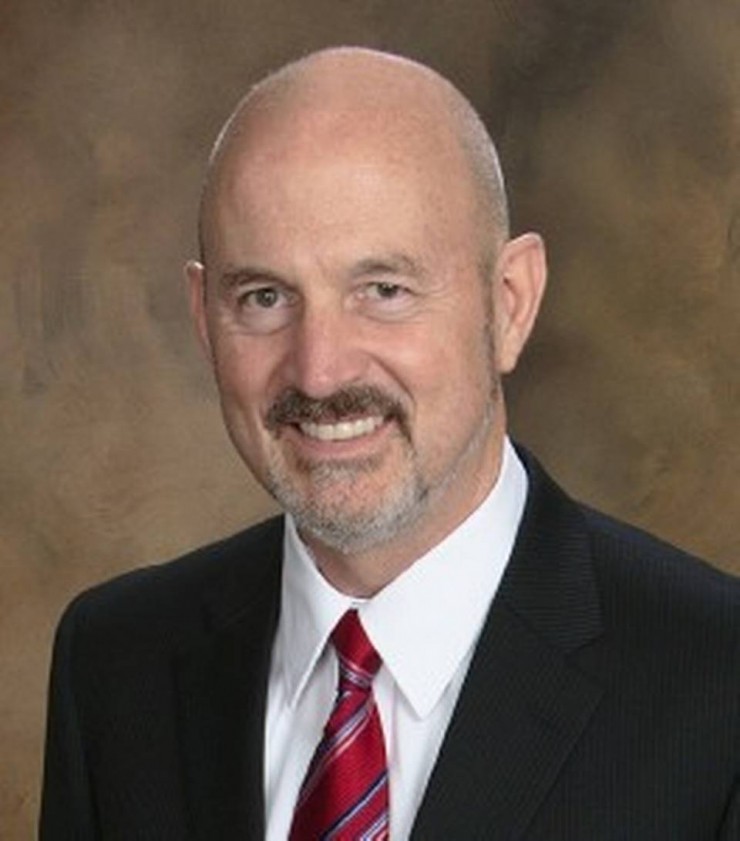
Dr. Mark Peterson teaches political science at the college level in Topeka.

Instead, the essayist complains, $456 million of the $3.2 billion the state is currently funding for K-12 must go for debt service support, capital outlays and KPERS funding. These expenditures allegedly demonstrate the badness of the school funding system the governor and the legislature replaced with block grants this spring. A state supreme court appeal is pending that will determine if the block grant system will be implemented. In the time, before that decision is reached, it’s worthwhile to examine the essay’s claims.

They don’t elicit an outright shout of “Liar, liar, pants on fire,” but perhaps the famous Reagan versus Carter quip, “There you go again” works.

Currently Kansas law requires assistance to low property valuation districts with interest and principal payments (debt service) on their school bond issues. There’s a good chance most Republican legislators believe this probably only encourages voters in those poorer districts to think their kids deserve facilities that at least resemble what wealthier districts can afford.

Nevertheless, debt service support, like the true operating support money known as Base State Aid per Pupil, helps equalize resources for districts with low property tax resources. Without the support, a lot of rural, relatively economically underdeveloped communities would unquestionably have dated, down-at-the-heel facilities. Not exactly great environments for instruction or the sort of facilities likely to attract and hold the brightest young sparks in the teaching profession.

Capital outlay covers the physical stuff that goes into classrooms, auditoriums, libraries, cafeterias, bus barns and athletic facilities. Existing statutes requiring districts to segregate and account for capital outlays differently from operating funds, although a national standard of good accounting practices, are apparently bad for Kansas school children. Setting aside funds in this way leads to funding such things as that horrendous $47,000 grand piano that Kansas City’s Sumner Academy was called out for last February. When the purchase was disclosed, it seemed that some educational administrator soon would be headed for a beheading.

Critics, including the governor’s communications office note that the price would pay a teacher’s salary and benefits for a year. It begs the response, “Yes. Then what happens the next year?” The piano has a half century of useful life. That is fifty years of enlightenment, transcendence and instruction for certainly hundreds if not thousands of school children, teachers, parents and community members at an amortized cost of less than $1,000 per year.

Statutes regarding the public pension system, KPERS, require that the state contributes to teacher pensions. The communications office views this as another unwarranted pigeon-holing of resources block grants would eliminate. Certainly, some will point out, education is a young person’s calling. It’s not the public’s or the state’s responsibility to create homesteaders in the state’s school districts. But where do these critics expect to find ambitious senior mentors, competent experienced administrators, and seasoned personnel who have seen the myriad problems and behaviors that children and parents manifest? Just how long does the current regime of short term thinkers expect to keep competent, inspired and inspiring instructional personnel if the state’s legal dedication to its statutory pension obligation is repealed?

The punchline to the Communications Office essay was that block grants change the restrictions on state school support so that now it can be used to pay teachers – “the most important asset in any classroom.” But then, what happens next year?

Dr. Mark Peterson teaches political science at the college level in Topeka.
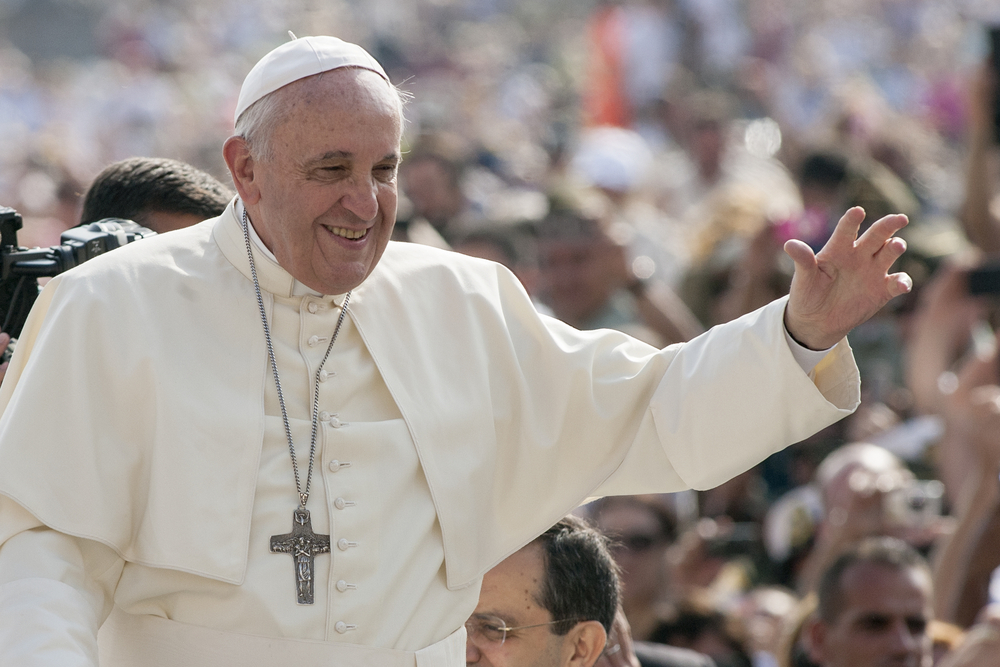
In words and gestures, Pope Francis re-awakens the American ideal

Charles C. Haynes is director of the Religious Freedom Center of the Newseum Institute.

At a cultural moment when celebrity trumps character in America, it took a humble priest from Argentina to remind us of the better angels of our nature — and of the kind of nation we must aspire to build in the 21st century.

Pope Francis arrived in our public square as a self-described migrant, and for a refreshing week his message of compassion and justice drowned out the divisive, ugly, sometimes hateful rhetoric of this political season.

Temporarily pushed out of the headlines was trash talk about immigrants, demonizing language about American Muslims, and the puffed-up buffoonery that passes for political discourse in 2016 America.

The pope didn’t downplay or disguise his convictions about everything from climate change to the sanctity of life “at all of its stages.” But he delivered his views — and here is the lesson many of our political and religious leaders would do well to re-learn — with civility and respect.

Consider the pope’s message on religious freedom, delivered at the cradle of American freedom in front of Independence Hall in Philadelphia. Few topics are more divisive in the United States, with one side proclaiming religious liberty “under assault” and the other side condemning religious liberty as cover for “bigotry.”

Without the rancor or hyperbole that characterizes our culture wars, Pope Francis offered a powerful affirmation of religious freedom as a right “given by God himself.” And he warned against confining religious expression to “a subculture without right to a voice in the public square.”

After the pope’s departure from the United States, it was revealed that he met privately with Kim Davis — the Kentucky county clerk who refused to issue marriage licenses to same-sex couples on religious grounds.

Although both sides in the Davis affair are already citing the meeting to attack the other, the pope’s balanced approach to the controversy — signaling support for the right to conscientious objection while avoiding divisive public statements about same-sex marriage — illustrates the tone and balance he brings to conflicts over religious issues in the public square.

As John Gehring, Catholic program director at the liberal advocacy group Faith and Public Life, explained in a New York Times interview, the pope’s approach makes both sides “a little bit uncomfortable.”

“I think Pope Francis affirms religious liberty,” said Gehring, “and he rejects the culture wars. That’s something we need to grapple with.”

Of course, we can, and should, contend with one another over our religious and ideological differences, but if the common good is to be served, we should do so through civil and constructive dialogue.

Standing near the spot where American freedom was born in Philadelphia, Pope Francis called on people of all faiths and beliefs to work for “tolerance and respect for the dignity and rights of others.”

Religious freedom, he argued, thrives best in a society with “a healthy pluralism, which respects differences.”

The pope reminded us that what unites Americans is not religion — we each have our religious and non-religious convictions that rank among our deepest differences — but rather a commitment to pluralism framed by religious liberty, “a fundamental right which shapes the way we interact with neighbors whose religious views differ from our own.”

Just prior to his departure from the United States, the pope modeled the “healthy pluralism” he envisions at a worship service held at Ground Zero in New York. He met with families of those who lost their lives on 9/11 and participated in a “witness for peace” ceremony with Jewish, Christian, Muslim, Hindu, Sikh, Buddhist and other religious leaders.

The gathering was deliberately and carefully described as “multi-faith” — rather than “interfaith” — to underscore that respect for the rights of others does not mean or require uniformity of belief.

At the Ground Zero ceremony, we saw on display the rich possibilities of an America of many faiths and cultures — a nation where citizens affirm distinct religious identities while living and working together for the common good.

Realizing this ideal in an America deeply divided by religion and ideology is one of our greatest challenges in the 21st century.

It will not be easy. But for one, brief shining week, Pope Francis made many of us believe it can — and must — be done.

Charles C. Haynes is vice president of the Washington-based Newseum Institute and executive director of the Religious Freedom Center. [email protected]

1 in 125 Kansas vehicles will collide with a deer this fall

Ken Selzer, Kansas Insurance Commissioner

Driving defensively during the deer mating season is a must for Kansas drivers.

The reality of driving on Kansas roads and highways this time of year is the possible encounter with a deer. That can happen whether you live in Johnson County in eastern Kansas or Johnson City in the southwestern part of the state.

A 2015 report from State Farm Insurance says that Kansas has the 18th-highest frequency in deer-vehicle mishaps in the United States. The chance of a driver having a vehicle collision with a deer in Kansas this fall is 1 in 125. The national rate is 1 in 169.

The average property damage from a deer-vehicle collision jumped 6 percent this year to $4,135, according to the current nationwide study.

Mid-fall and mid-spring are likely times of the year for deer to be seen on Kansas roadways, because of breeding habits during the fall and growth of vegetation during the spring. And, sunrise and sunset are the times that deer are most active.

I urge Kansas motorists to check with your insurance agents to find out the type of vehicle accident damage coverage your policies have. Then, if a deer accident occurs, you should contact your insurance agent or company quickly to begin the claims process.

When an accident occurs, you should consider the following:
• If you do hit a deer and are uncertain whether the animal is dead, keep your distance. You might be dealing with an injured, wild animal with sharp hooves.
• If the deer is blocking the roadway and poses a danger to other motorists, you should immediately report the incident to the local law enforcement agency.
• Deer accidents are usually covered under a person’s comprehensive coverage, not collision coverage.
• Stay alert, always wear your seat belt and drive at a safe, sensible speed for conditions.
• Watch for the reflection of deer eyes and for deer silhouettes on the shoulder of the road.
• Do not rely exclusively on devices such as deer whistles, deer fences and reflectors to deter deer.
• When driving at night, use high-beam headlights when there is no opposing traffic. The high beams will illuminate the eyes of deer on or near a roadway.
• Brake firmly when you notice a deer in or near your path, but stay in your lane. Many serious accidents occur when drivers swerve to avoid a deer and hit other vehicles or lose control of their cars. Potentially, you will risk less injury by hitting the deer.
• If you see one deer, it is likely there are more nearby.
• If the deer stays on the road, stop on the shoulder, put on your hazard lights and wait for the deer to leave the roadway; do not try to go around the deer while it is on the road.

If you do have a deer encounter and need some assistance with your vehicle claim, our Consumer Assistance Representatives at the Kansas Insurance Department can help. Call us at 800-432-2484.

Ken Selzer is the Kansas Commissioner of Insurance.

Cargill executive to speak on climate change, food production

email2 - letterI am writing to invite your readers to hear Greg Page, Cargill Inc. Executive Chairman, talk about the economic impact of climate change on the world’s food production.

As many know, the world’s population is expected to balloon to 9.6 billion people by the year 2050. The world’s farmers will have to produce as much food in the next 35 to 40 years as they have in the entire history of the world.

Page will present ‘Climate Change and the Future of Food Production’ at 7 p.m., Monday, Oct. 12 in McCain Auditorium. The event is free and open to the public.

Page is a member of the Risky Business Project, a national committee formed in 2014 to prepare American companies for climate change. In his role, Page is encouraging American business and government leaders to have serious conversations about accommodating climate change scenarios in the future.

Page’s lecture at Kansas State University is the second in the Henry C. Gardiner Global Food Systems Lecture series. Robert Fraley, the Chief Technology Officer for the Monsanto Company, presented the inaugural lecture in January.

This is an important topic that certainly will impact American agriculture in the future. If we are to continue to be the most productive food system in the history of mankind, these are the types of conversations we need to have. As the country’s oldest land-grant institution, and considering our agricultural heritage, Kansas State University is a great place for this discussion to take place.

Please come join us on Monday, Oct. 12. Click HERE for more information.

Sincerely,
John Floros, Dean
College of Agriculture
Kansas State University

HIGHTOWER: Fiorina proves we don’t want a CEO for a president

OtherWords columnist Jim Hightower is a radio commentator, writer and public speaker.

In 1992, independent candidate Ross Perot chose Admiral James Stockdale, a complete unknown, as his presidential running mate. In his first debate, the VP candidate began by asking two good questions: “Who am I? Why am I here?”

Carly Fiorina, the Republican presidential contender who’s surged in recent polls of GOP primary voters, ought to ask those questions, too. For now, she’s positioning herself as a no-nonsense, successful corporate chieftain who can run government with business-like efficiency.

In a recent debate, Fiorina rattled off a list of her accomplishments as CEO of tech conglomerate Hewlett-Packard: “We doubled the size of the company,” “quadrupled its top-line growth rate,” “quadrupled its cash flow,” and “tripled its rate of innovations,” she declared in PowerPoint style.

Brandishing statistics, however, can be a sophisticated way of lying.

In fact, the growth Fiorina bragged about was mostly the result of her buying Compaq, another computer giant, in a merger that proved to be disastrous. Hewlett-Packard’s profits declined 40 percent in her six years, its stock price plummeted, and she cut loose 30,000 workers — even saying publicly that their jobs should be shipped overseas. Finally, she was fired.

Before we accept her claim that “running government like a business” would be a positive, note that the narcissistic corporate culture richly rewarded Fiorina for failure. Yes, she was fired, but unlike the thousands of HP employees she dumped, a golden parachute let her land in luxury: Counting severance pay, stock options, and pension, she pocketed $42 million to go away.

But, here she comes again. Lacking even one iota of humility, this personification of corporate greed and economic inequality is now throwing out a blizzard of lies to hide who she is — and to bamboozle Republicans into thinking she belongs in the White House.

OtherWords.org columnist Jim Hightower is a radio commentator, writer and public speaker.

SCHROCK: U.S. graduation rates too good to be true

John Richard Schrock is a professor at Emporia State University.

“The U.S. Department of Education reports that 81 percent of the class of 2013 graduated within four years…” according to a report in Education Week earlier this year. Considering that the graduation rate was just under 70 percent 15 years ago, this over-ten-percent increase is unbelievable news. Yes, truly unbelievable.

Now, the figures are correct. They are based on the Adjusted Cohort Graduation Rate (ACGR) metric required by No Child Left Behind. This is based on the number of freshmen who graduate four years later. But even when other methods are used for calculating graduation rates, the trend is still upward.

These figures point to the supreme ability of some and perhaps many public school administrators to undermine teacher grading and inflate grades to meet government-mandated “school improvement.”

One teacher explained how her school allowed teachers to keep the 90-80-70-60 percentage cut-off scores for A-B-C-D. But the school then required that zero performance started at 50! Score 10 percent and you were over the 60 percent line and made a D. Score 20 percent and you were now a C student. Considering that many tests are multiple choice with 4 or 5 answers, random marking would score at 20 to 25 percent which, plus 50, would make a student “average.”

Another teacher described a student who never did his homework. At the end of each grading period, when it was obvious that the student had earned a zero, the school counselor pulled the student from class and put him on a programmed learning computer. Without even reading the screen, the student could progress through the question sets over and over until he had a passing or even a good score. This F-student who formerly would have flunked out of high school was now walking across the stage getting a diploma, right behind good students who completed genuine course work and earned their diploma.

Any professional educator should recognize that these programmed learning exercises for “recovering credit” are fraudulent. But instead of being fired for circumventing actual teaching and grading, they are rewarded and promoted for increasing graduation rates.

Yes, there are public schools where honest and solid teaching still occurs and these cheap end-runs are not allowed. But the number of teachers who report to me that they feel coerced into giving higher grades is increasing rapidly. School climate is changing. Whether they are beginning or veteran teachers, it is becoming more risky to assign high school students a failing grade even when the students do nothing.

The upbeat U.S. Department of Education report breaks down this increase in graduation rates for various subgroups. It reveals that the grade inflation raises all boats. 89 percent of Asian-Americans graduate on time while only 70 percent of Native American students graduate in four years.

Sixty-two percent of students with disabilities graduate on time, an increase but still 19 points lower than the national rate. Student graduation in Iowa was highest at 90 percent, lowest in the District of Columbia at 62 percent. And 61 percent of students with limited English graduated.

How can we know that this dramatic 10-percent-plus increase in student graduation does not reflect a surge in better teachers and better students?

In addition to teacher reports-from-the-field, the recently released ACT and SAT scores show that the number of high school seniors ready for college is not increasing and remains below 40 percent. And despite growing college enrollments, veteran college professors are not seeing any surge in student performance. Instead, the numbers of American-educated students who persist in college and graduate to apply for high-skill professions such as medicine or engineering are decreasing. The United States is increasing our reliance on foreign students.

More-and-more, the criterion for receiving a public high school diploma in America is maintaining a heartbeat.

MOVIE REVIEW: Ride the strange train with ‘Snowpiercer’

James Gerstner reviews movies for Hays Post.

Due to a long and complicated string of events, I was unable to make it to a movie in theatres this past weekend. I was able to squeeze in a movie from Netflix that I’d been wanting to see, so  I figured I’d review that this week.

“Snowpiercer” is a strange fish, anyway you slice it. It’s an English language film from a Korean director based on a French graphic novel about a frozen post-apocalyptic world where the few human survivors live onboard a single train that has circles the globe once per year and has been doing so non-stop for the past 17 years.

download

If that wasn’t weird enough, “Snowpiercer” was mired in film distribution politics and was released to Video-on-Demand services such as iTunes within weeks of its limited theatrical debut.

Big cinema chains hate at-home viewing outings for new movies because it’s not hard to image that, nationwide, a lot of movie-goers would just as soon stay at home with their big screen TVs and skip the theatre altogether. It’s not an unreasonable fear, but the corporate politics an business tactics clashing with the artistic creation of film always leaves some fallout.

Regardless of its release controversy, “Snowpiercer” is an engaging, exciting look into a caste-based system where the rich are pampered and the poor and left to die and what happens when people are pushed beyond their limits. “Snowpiercer’s” setting is incredible and the film does an excellent job of dolling out information about why the passengers of the train are there and how their world works.

The film’s structure and ending are a little “Gasp! Look! A twist!” for my taste, but nevertheless, the film paints an arresting picture. “Snowpiercer” will go down in cinematic history as one of the early battles in the war of the cinema chain and Video-on-Demand; controversy notwithstanding,  it’s a wild, weird and worrying ride around the snow-covered globe. I would recommend than hard-core science-fiction fans catch this on Netflix, but it may be too weird for casual movie-goers and definitely to violent and unsettling for the kiddos. Lastly, I love trains.

5 of 6 stars

SCHLAGECK: Successful farming in Kansas

John Schlageck writes for the Kansas Farm Bureau.

Travel out to the fields of Kansas during October and you’ll see them teeming with fall harvest. Combines chomp through the fields of corn, milo, soybeans and sunflowers eager to dump the bountiful crops into waiting trucks and grain carts.

Today’s green, red and silver monsters move through the fields like tanks rolling through a war game. All across Kansas, farmers pilot these 12-ton behemoths as easily as the family car.

On gravel and blacktop roads tandem trucks and semis race back from the elevators so the machines can fill them up again. Fall harvest in Kansas marks that magical time of the year when producers of food and fiber reap what they have sowed.

Seeing this bountiful production unfold, underscores the importance of farming and ranching in Kansas. Our Kansas farmers – and their contemporaries across this great land – continually risk all that is theirs; hoping success is what each harvest and year will bring.

They work with the land, chemicals, computers and livestock. They must understand markets, people, soil crops and climate. Their livelihood is largely dependent upon factors that are oftentimes completely out of their control.

Still, farmers farm to succeed. They farm to grow and harvest crops and produce livestock.

Farmers see their vocation not only as a business, but also as a way of life to preserve in good times and bad. They have their feet planted firmly in their soil. They are dedicated to the land and providing us with the safest, most wholesome food on the planet.

The U.S. Department of Agriculture estimates the average person consumes approximately 194 pounds of cereal products annually. When you couple that with approximately 66 pounds of oils, 115 pounds of red meat and 63 pounds of poultry it’s readily apparent why Kansas harvest is an important time.

Today’s consumer has the option of using nearly 4,000 different corn products. These uses range from corn flakes to corn sweeteners. Corn and milo remain the top source of livestock feed.

Countless foods are made from today’s fall soybean crop. Some of these include crackers, cooking oils, salad dressings, sandwich spreads and shortenings. Soybeans are used extensively to feed livestock, poultry and fish.

Sunflowers from the Sunflower State can be used as an ingredient in everything from cooking to cosmetics and biodiesel cars. And as you probably already know, they’re a really tasty snack – and healthy too.

So if you have an opportunity to visit our state’s fertile fields this fall, think about the professionals who are busy providing the food we find on our tables each and every day. Tip your hat, raise an index finger above the steering wheel of your car or give a friendly wave to these producers of food and fiber who are dedicated to feeding you and the rest of the world.

John Schlageck, a Hoxie native, is a leading commentator on agriculture and rural Kansas.

HAWVER: Resignations of Boehner, top Kansas Democrat ring similar tones

martin hawver line art

Maybe we should have learned something last month when Kansas Democratic Chairman Larry Meeker, Lake Quivira, resigned his job at the top of the party’s political hierarchy.

Then we could have gotten our bets down on the resignation of U.S. House Speaker John Boehner, R-Ohio.

The link between Meeker’s and Boehner’s resignations, while politically different, is philosophically identical.

Meeker wasn’t “Democrat enough” and Boehner wasn’t “Republican enough.”

Meeker, who is to be succeeded Saturday in Salina by former Kansas Democrat Vice Chair Lee Kinch, Wichita, wasn’t “Democrat enough” for the party’s old-timers and donors and members who are more interested in the party name than in actually running state government.

Meeker, recall, suggested renaming the Kansas Democratic Party “Red State Democrats,” which is a pretty accurate perception of Democrats in the Republican (red) stronghold of Kansas.

Not Democrat enough, and many Democrats don’t like the term “red” as it refers to the state’s voter registration and history.

For Boehner, well, pretty much the same story: Working, when necessary, with Democrats to keep the U.S. House of Representatives moving and getting the basic nuts-and-bolts work of running Congress done. It required some leadership compromises, some accommodation to keep things moving, and that isn’t something that some of the most right-wing Republicans will stand for. (For example, U.S. Rep. Tim Huelskamp, R-Kan., who like many farmers, won’t give up an inch on the fence line.)

Can’t tell if Meeker had suggested maybe not changing the century-old party name but maybe making Red State Democrats a nickname or casting it as a source of pride—that even in Red Kansas there are Democrats who are busy and active and politically engaged—that he would have remained chair.

But the Republican- or Democrat-enough issue is likely to play out during next year’s legislative elections where both parties need to explain to their members, and if not members maybe just voters, where the center of each party is and why the far edges of those parties aren’t going to run things.

That’s a tough one, and the central ideas of both parties in terms of taxes, education, health care for the poor and such actually aren’t that far apart. The way to those centrist party goals might be different, the catch phrases different and the reasons for those positions different, but if you squint, both parties want the state to run well and hospitably.

You’ll not have to worry about individual candidates saying where they are: They’re after votes and will be as conservative or moderate as Kansans will allow them to be on their doorsteps.

The real battle for those votes will be in the Republican Party in the House, where maybe seven or eight votes there are the difference between the “hard right” and the moderates, who often side with Democrats to move legislation. Figure that a handful of House members out of the GOP’s 97-seat majority will move things to the center.

In the Senate, with a dozen moderate Republican/Democrat votes and 28 conservative Republicans, well, it will take something dramatic to move that chamber toward the center of either party’s ideals.

So, we’re down to the campaign not just along party lines, but about Kansas values that will move into high gear.

Just waiting, though, to see whether pictures of any Republican standing next to Boehner or any Democrat standing next to Larry Meeker kills a campaign…

Syndicated by Hawver News Co. of Topeka, Martin Hawver is publisher of Hawver’s Capitol Report. To learn more about this nonpartisan statewide political news service, visit www.hawvernews.com.

Saving for retirement and a child´s education at the same time

Linda Beech
Linda Beech

Since my daughter’s May graduation and subsequent employment as a NICU nurse, both of my children are now college graduates and gainfully employed.  I had been saving money for that goal for years.
About a month later, my husband celebrated his 65 th birthday in mid-June.  Although he is still employed part-time, his milestone birthday is a reminder that retirement is getting closer year by year.  We’ve been saving for that goal for many years as well.

Saving for your own retirement and a child´s college education at the same time can be a challenge. You want to retire comfortably when the time comes, but you also want to help your child get a good education. How do you take steps now to accomplish both goals? Here are a few pointers from 360 Degrees of Financial Literacy, a website of the American Institute of Certified Public Accountants.

Estimate Your Financial Needs

The first step is to determine your financial needs for each goal. For example, how many years until retirement for you and college for your child(ren)? What do you expect to receive for retirement from your employer and/or Social Security? What standard of living do you want in retirement? What´s the expected cost of your child´s preferred college? Gather the facts and set goals now. Periodically meet with your company´s retirement representative and visit college websites to stay on track with your estimates.

Retirement Takes Priority

Although a child´s college education is certainly an important goal, you should probably focus on your own retirement first if funds are limited. With generous company pensions mostly a thing of the past and Social Security in a financial strain, the burden is primarily on you to fund your retirement. Make it automatic- enroll in your employer´s retirement savings plan and take advantage of matching funds, if offered. Or, set up your own automatic savings transfers from a checking account to a retirement savings or investment account.

If you wait until your children are educated to start saving for retirement, you´ll miss out on years of tax-deferred growth and compounding of your money. Remember that a child can get help to attend college by taking out loans (or maybe even receiving scholarships), but no one will give you a loan or a scholarship for your retirement years.

Saving Tips for Both Retirement and College
Ideally you’ll want to try to save for both retirement and college at the same time. Here are some tips to consider:

1.  Work longer.  The more years you work, the more money you´ll earn and the later you´ll need to dip into your retirement savings.

2.  Reduce your standard of living, now or later (or both.)  You might be able to adjust your spending habits now in order to save money for later. Or you may consider a more frugal lifestyle in retirement.

3.  Increase your earnings now.  Consider increasing your hours at your current job, finding a new job with better pay, taking a second job or having a stay-at-home spouse return to the workforce.  You can also earn extra money with seasonal or part-time opportunities like being a ball game referee, a tutor or a county fair judge, or selling products from home or at bazaars and farmers markets. Turn unwanted belongings into cash with garage sales or auctions.

4. Expect your children to contribute more to college expenses.  Encourage your children to work and save for future education needs.  Kids can start small with early money-makers like lawn mowing, babysitting or the sale of 4-H livestock and then move into part-time jobs as they get older. As they look toward college, help them find and apply for all scholarships for which they qualify. Expect them to work part-time while in college and explore student loans if funds are still short.

5. Send your child to a less-expensive school.  A pricey “brand-name” private school may be your child’s dream, but unless he receives generous scholarships, he may need to lower his expectations. A state university or a smaller liberal arts college might provide a similar education
for a far lower cost.

6.  Get creative to reduce education costs.  Encourage your student to take dual-credit classes at a local community college while in high school, attend a local college and live at home to save on room and board, enroll in an accelerated program to graduate in three years instead of four, take advantage of cooperative training where paid internships alternate with course work, or defer college for a year or two and work to earn college funds.

It’s not easy to save for college and retirement at the same time– but it can be done.  Set your goals and stay focused.

Linda K. Beech is Ellis County Extension Agent for Family and Consumer Sciences.

Exploring Kan. Outdoors: Gauging the effects of the length of daylight

Steve Gilliland
Steve Gilliland

Everything living thing has an internal clock of some sort that helps regulate its life.

My internal clock is very reliable as it relates to getting me up in the morning. I have an alarm clock by my bed like most everyone does, but I rarely have to use it. It seems I can just decide in my mind when I want to awaken and when that time rolls around, I awaken. We put our two little dogs to bed about ten PM every night and they also get a treat then. Their internal clock often tells them when it’s time for a snack, as they begin to stir and whine about that time every night.

Wildlife has different worries in life which are all about survival, like when to begin growing their heavy winter coats or when to begin breeding to sustain their species. All studies and research say that those things are dictated by the amount of daylight in a day, technically known as photo-period. So as the days get shorter and thus the amount of daylight becomes less, it triggers changes in wildlife.

In deer, shortening days and reduced amount of daylight triggers the breeding season known to us as “the rut.” I spoke with the Big Game Coordinator for the state of Kansas, Lloyd Fox who explained to me how increased amount of darkness each day causes increased production of certain hormones in a deer’s body and thus the bodies of both male and female deer prepare for the breeding season.

He also pointed out that moon signs and other factors may bring about increased deer activity and changes of behavior, but it is all ultimately controlled by the length of days (photo-period.) As a side note here, have you ever wondered why deer and all wildlife for that matter have their young in the spring and not fall, early winter or even year-round like some domestic livestock? God has programmed their bodies to react the way they do so all wildlife young are born in spring when everything in nature gives them the absolute best chance of survival.

Furbearers are also affected by decreased amount of daylight. Matt Peek, Furbearer Biologist for the state of Kansas explained to me how the photo period dictates when a fur bearer’s pelt becomes “prime.” Fur bearing animals grow an extra-thick, heavy coat to protect them from winter blasts, and when that coat is at its absolute fullest and best for fur harvesting it is called “prime.”

Decreasing amounts of daylight initiates that growth. It could be sixty-five degrees clear into December, but the animals’ fur still grows and becomes prime in anticipation of the cold, no matter when it comes, so that the critters are prepared. Fur from different parts of the country varies vastly in quality, as fur from Idaho for example will always be thicker and more luxurious than fur from Florida. But no matter where a fur bearing animal lives, their fur still becomes prime and the timing of that is dictated by the amount of daylight.

I hate the bi-annual time changes; I wish we would just choose one or the other (I really don’t care which one) and then just leave it alone! But this year as I’m scurrying around resetting the clocks on the microwave, etc. and knowing full well I’ll have to do it again come spring, I’ll stop for a moment and consider how the wild critters clocks just kinda’ reset themselves thanks to the wisdom of our Creator.

Steve Gilliland, Inman, can be contacted by email at [email protected].

Fighting inequality at the local level

OtherWords columnist Jim Hightower is a radio commentator, writer and public speaker.

Inequality isn’t a condition. It’s a creation. Inequality is produced by thousands of decisions deliberately made by bosses, bankers, and big shots to siphon money and power from the many to the few.

We see Wall Street and Washington doing this, but the deepening chasm of inequality in America is also the product of decisions that local elites are making every day. Take Grand Rapids, Michigan, a city largely run by a few billionaire families sharing an entrenched laissez-faire ideology. They oppose heavy-handed government policies — unless you’re poor or working class.

Thus the city’s leaders, who find it unconscionable to hike taxes on the rich, recently socked low-income bus riders with a 16 percent jump in fares. For the 27 percent of people in Grand Rapids who live below the poverty line, that’s a serious chunk of change siphoned right out of their pockets.

Then, the board of directors of the city’s transit agency slipped a siphon tube into the wallets of the agency’s own drivers and mechanics, arbitrarily terminating their pensions. Adding a crude insult to injury, the board simultaneously gave the transit boss a raise — literally stealing from workers to lift the CEO’s salary above $200,000 a year.

When the workers, members of the Amalgamated Transit Union, began leafleting bus riders to oppose the fare hike and pension theft, the arrogant boss and autocratic board threatened to arrest and fire them.

Luckily, it’s still legal to exercise your First Amendment rights even in Grand Rapids, so the union won an injunction against this repression. Better yet, the attempted siphoning of money and power has rallied community groups, students, bus riders, and others into a grassroots movement to stop widening the inequality gap and start bridging it.

OtherWords.org columnist Jim Hightower is a radio commentator, writer and public speaker.

Taking it lying down vs. plain old lying

Donald Kaul
Donald Kaul

The Republicans have finally found someone to man up to Donald Trump, who’s threatening to turn their presidential primaries into a Saturday Night Live skit. She’s a woman.

At the latest Republican debate, with a stage-full of candidates straining at the leash to distinguish themselves by puncturing the balloon that is The Donald, it was Carly Fiorina — and only Carly Fiorina — who coolly stepped forward to reveal his one-man clown show for what it was.

The moderator had asked Fiorina to respond to Trump’s insulting critique of her looks. Dripping with contempt, she noted Trump’s habit of backing away from statements like that by pleading misunderstanding, as he already had with his crack about Fiorina’s face. Then she said:

“Women all over this country heard very clearly what Mr. Trump said.”

Pow! Right in the kisser. The message behind that simple sentence was clear: “You, sir, are a cheap liar and a punk.”

It got her the warmest applause of the night.

Later, Fiorina took center stage again during a general bashing of Planned Parenthood as she told the story of a video surreptitiously taken at a Planned Parenthood clinic. It showed, she claimed, “a fully formed fetus on the table, its heart beating, its legs kicking while someone says we have to keep it alive to harvest its brain.”

Clearly a chilling and horrific story. Even I, a Planned Parenthood supporter, could see why these wonderful, moral Republicans wanted to defund the organization.

Except there’s no such video. Fiorina was lying.

It wasn’t a mistake. It wasn’t a misunderstanding. It was a deliberate lie designed to make a political point more forcefully. Shame on her.

The Republican Party finally gets someone who can stand up to Trump’s lies — and it turns out she’s a liar, too.

Fiorina wasn’t the only candidate who took on Trump at the debate. Jeb Bush, who was the front-runner out of the starting gate and has been losing ground ever since, was easily the most pathetic of the also-rans.

Trump’s been driving him crazy for weeks now, ridiculing him at every turn, and it’s begun to get to the former Florida governor. A couple of weeks ago, when asked about Trump, Bush complained:

“He attacks me every day with nonsense, with things that aren’t true. He tries to personalize everything. If you are not totally in agreement with him, you’re an idiot, or stupid, or you have no energy, or blah, blah, blah. That’s what he does.”

Which is the political equivalent of saying “That bad man is being mean to me. Make him stop.”

Is that who you want going eyeball-to-eyeball with Putin or the Ayatollah?

Give Bush this, though: He didn’t give up. He took another crack at Trump at the debate, this time in defense of his wife.

Trump had insinuated that Bush perhaps had a soft spot for Mexicans on the immigration issue because of his wife, who’s Mexican-American.

Bush came out breathing fire. “To subject (sic) my wife into the middle of a raucous political conversation was completely inappropriate,” he said. Then, addressing Trump directly, he added:

“She’s right in the audience. Why don’t you apologize right now?”

Trump said no. And Bush…said pretty much nothing.

If being called an influence on her husband is the worst thing she has to endure in this campaign, Columba Bush is one lucky political wife. As a wise man once wrote: “Politics ain’t beanbag.”

But if you demand that an opponent apologize, there should be an “or” afterward. Apologize or “I’ll punch you in the face.” Or “I’ll challenge you to a duel.” Or “I’ll pour coffee on your head.” Something.

There was nothing. Which was pretty much the case with all the candidates, save Carly Fiorina — and she lied.

OtherWords.org columnist Donald Kaul lives in Ann Arbor, Mich.

Copyright Eagle Radio | FCC Public Files | EEO Public File