We have a brand new updated website! Click here to check it out!

Insight Kansas: A Guide to the Loyal Opposition

H. Edward Flentje is professor emeritus at Wichita State University.

Every one of the 165 seats in the Kansas legislature will be on the ballot in 2016, and the loyal opposition in Kansas politics should take a careful look at 2014 election results in planning for these elections.

The loyal opposition includes Democrats, the state’s minority party and its backers, and disaffected Republicans and political independents who are dissatisfied with the current direction of Kansas state government and want to make a change. They will be challenging those who have taken charge of governing Kansas for the past five years, specifically Governor Sam Brownback, his Republican legislative backers, and their allies.

No election contest more accurately reflects voter sentiment on the direction of state government than the high-profile race for governor in 2014. Remember in that election voters reelected Brownback to a second term but also recall that Democrat Paul Davis and Libertarian Keen Umbehr together received slightly more than 50 percent of the vote. As the leading expression of the loyal opposition Davis garnered over 400,000 votes in his challenge to Brownback, a tally representing 48.1 percent of the two-candidate total.

The distribution of the Davis vote may surprise even close observers of state politics and suggests where the loyal opposition may want to concentrate its attention.

For example, Davis beat Brownback by a 54-46 margin in the aggregated vote of the state’s five large urban counties (Douglas, Johnson, Sedgwick, Shawnee, and Wyandotte) that represent over half of the state’s population. Davis also won over Brownback by a 52-48 margin in the aggregated vote of the state’s 20 largest counties, in other words, the top five plus 15 of the next largest counties, such as Leavenworth, Riley, and Saline which comprise the smaller regional centers across the state. Those 20 counties total over three-fourths of the state’s population.

On the other hand, Brownback walloped Davis by 25 percentage points, 62.5 to 37.5, in the smallest 85 counties, representing 23 percent of the state’s population. These rural voters more than offset the votes in larger urban counties and handed the governor his statewide winning margin of 32,000 votes. Indeed, the 20 smallest counties totaling less than two percent of the population contributed 25 percent of that winning vote margin.

So, if you are aligned with the loyal opposition and want to throw the insiders out, take a look at these voting patterns that may be tracked in every legislative district and precinct across the state. Voting varies sometimes widely across districts, but on average these legislative districts comprising roughly three-fourths of the state’s population form fertile ground for challengers in the upcoming legislative races. Moreover, the dissatisfaction with the direction of state government expressed by voters last November has likely been bolstered by actions of the recent legislative session to raise taxes, cut spending on core services, and dramatically increase state debt.

The loyal opposition may be discouraged by their dismal showing in the legislative contests of 2012 and 2014, but last November’s highly competitive gubernatorial vote in three-fourths of the state suggests a more optimistic view and offers a rough guide for those races in 2016.

H. Edward Flentje is professor emeritus at Wichita State University

Ellis County Commissioner questions jail article

The article in the Sunday Hays Daily with the headline “Jail Taking Shape” by Mike Corn contains significant falsehoods that I would like to address at this time.

First, it is interesting that once again, no commissioner or space needs committee members were contacted to verify statements made by Sheriff Ed Harbin. My degree in journalism tells me this is not responsible or balanced newswriting – it seemed less like an informative news article and more like Mr. Corn was acting as the Sheriff’s personal publicist.

Second, the truth is that the Sheriff’s wants were considered throughout the process leading up to and during the construction. In the beginning, competing visions for the jail were considered, but the cost of constructing a stand-alone jail for 100 prisoners was at a minimum $12-15 million dollars. That amount did not include the additional staff members needed to run that jail of the cost of transporting prisoners to and from that jail for court proceedings. Space needs committee members and commissioners determined that with the combined facility needs of the courthouse, county administration, ambulance, EMS, emergency management and rural fire, the cost of a stand-alone jail would have been prohibitive and tax payers would not approve that big of bond issue.

Third, and here is the most important point to make in response to this error-laden article:

Even after the sales tax passed and prior to bids being let, the Sheriff was given the opportunity to remove the jail renovations from the project with support. Sheriff Harbin could have then gone to voters with his stand-alone jail project and convince them that the benefits outweighed the tremendous cost. The fact is that Sheriff Harbin declined the opportunity and the option and decided to be part of the rest of the projects that we believe were fair, balanced and reasonable given all the circumstances.

In summary, Sheriff Harbin and his staff were consulted and a part of the decision making process covering the jail and law enforcement center portion of the project from the very inception.

As for the size of the jail, it is extremely important to understand the renovations doubled the prisoner capacity. Instead of continuing to publicly undermine the jail project and its alleged lack of capacity, my suggestions is that the Sheriff meet with the judges and county attorney to discuss options for managing the prisoner population. In particular, together maybe they could search for ways to balance the need to house serious offenders as opposed to nonviolent offenders.

In the future, it seems to me that it would be more useful for everyone to complain less publicly and work together to find solutions to any alleged shortcomings.

Barbra K. Wasinger

EWING: It’s Constitution Day

Constitution-Day-September-17-300x224September 17th is Constitution Day! To commemorate the September 17, 1787, signing of the Constitution of the United States of America, Congress has designated September 17th of each year as CONSTITUTION DAY.

The Founding Fathers were a group of amazing men. Possibly the greatest collection of men in the history of the world. Here are just a few quotes from some of the leaders of the group.

John Adams said, “Our Constitution was made only for a moral and religious people. It is wholly inadequate to the government of any other.” This quote says why our country and Constitution is in trouble in 2015 and has been for some time.

Thomas Jefferson said, “All tyranny needs to gain a foothold is for people of good conscience to remain silent.” When one considers that President Obama and his EPA have issued numerous executive orders detrimental to the American people while the opposing political leaders, Boehner and McConnell, have been either silent or complicit, along with a Supreme Court that makes up the laws as it sees fit, America is in deep trouble. And the media “gets a thrill up their leg” as one commentator said, spooning over Obama, that doesn’t seem to be good people of conscience speaking the truth for the American people.

James Madison said, “A well instructed people alone can be permanently a free people.” This appears to be another major problem as possibly the majority of people are NOT paying attention to American’s poor leadership which has weakened our country in a world that has become increasingly dangerous.

George Washington said, “The power under the Constitution will always be in the people.” It is time that “WE THE PEOPLE” wake up and let our voices be heard. The federal government has consumed more power over “WE THE PEOPLE” than the Constitution allows and it’s time WE THE PEOPLE” get more involved. If anyone has any doubt about this article they need to read, “Bombing America, the Deception of the American People” which was a amazon.com best seller, new release, when it first came out.

Roger H. Ewing
Hays

MOVIE REVIEW:  ‘The Visit’ couldn’t have ended soon enough 

James Gerstner reviews movies for Hays Post.

“The Visit,” is another entry in the growing list of M. Night Shyamalan – the director who made a name for himself with movies that had one big twist or one big reveal i.e. “The Sixth Sense” and “Signs” – disasters that was frankly not worth the effort of seeing. It’s dark, detached, derivative and dumb.

Granted, given my new living arrangements in Washington, D.C., seeing a movie is fair bit of work. It either involves a paid cab ride or, my preferred alternative, a mile and half walk. Last weekend I made that walk, in a very healthy dose of rain, to be very predictably bored out of my mind with “The Visit.”

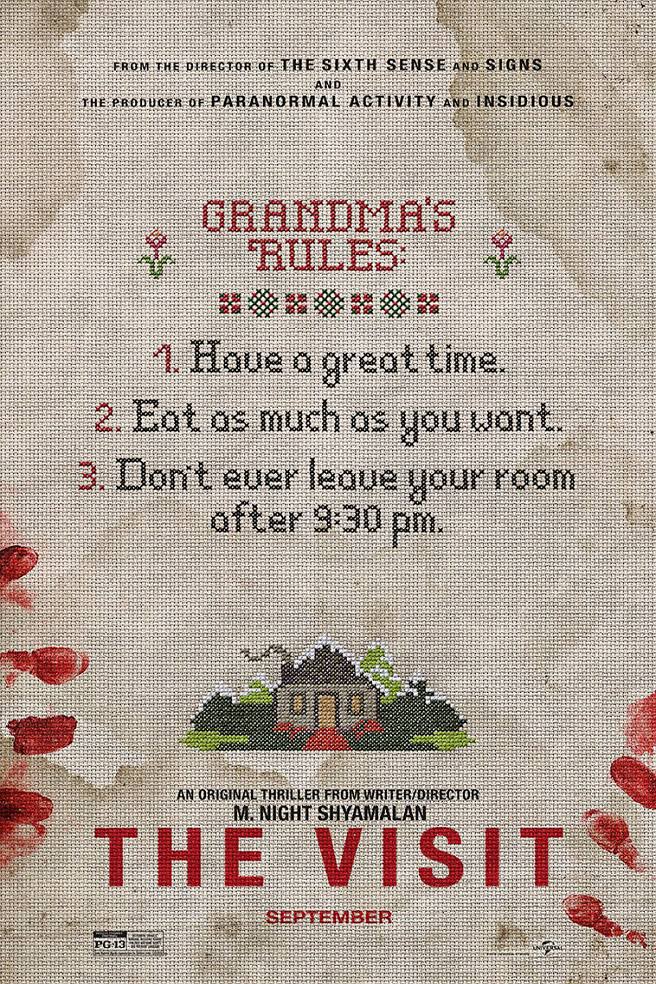
the visit movie posterThe entire concept of this film is creepy stalker/demon-possessed/serial-killer/other-horror-film-antagonists that are old. That’s it. “The Visit” is, in many cases, a worse incarnation of any other interchangeable horror film/jump-scare-fiesta that swaps out the guy with the chainsaw for an elderly couple and the scantily-clad women for grandchildren. In absolutely every scenario I can imagine, those are terrible trades.

To be fair, the trademark M. Night Shyamalan “big reveal” is pretty good. That said, everything else about the film is weak sauce. It approaches the “found footage” cinematography style in the worst way. It doesn’t claim to be real, and forces its justification far past the breaking point. No one did the math on this movie before going into production. No one crunched the numbers and told the filmmakers that applying pressure to lever B will not make the scare factor on platform 934 rise higher – because they’re not connected.

2 of 6 stars

September is Kansas Food Safety Education Month

Jackie McClaskey, Kansas Secretary of Agriculture

Kansas Department of Agriculture

Do you own a food thermometer? Do you know what the ‘temperature danger zone’ is? Do you always keep your raw and cooked food separate?

Governor Brownback along with the Kansas Department of Agriculture, Kansas State Department of Education, Kansas Department for Aging and Disability Services, Kansas Department of Health and Environment, Kansas Restaurant and Hospitality Association, K-State Research and Extension and local health departments want to make sure Kansans know the answer to those questions and more in order to help prevent foodborne illnesses. In order to highlight the importance of food safety, Governor Brownback has proclaimed September as Kansas Food Safety Education Month.

Ensuring a safe food supply is an important part of the vision of the Kansas Department of Agriculture. Secretary of Agriculture Jackie McClaskey shared that food safety from the farm to fork is imperative in all settings.

“It’s very important we ensure to the best of our ability that every step along the food chain from the farm to the fork as safe,” said Secretary McClaskey. “Each of us has a responsibility in reducing the risk of foodborne illness. By celebrating food safety month we can share information on practical steps we all can take to keep our food supply safe and healthy.”

During the month of September, all Kansans are encouraged to engage with the department on social media to help promote important food safety tips. Follow KDA on Facebook, Twitter, Pinterest and Instagram to learn more about how to prevent foodborne illness.

KDA seeks to ensure a safe food supply and promote public health and safety. The Food Safety and Lodging program is responsible for food safety inspections of food establishments, food processing plants and food storage facilities.

KDA also provides free Focus on Food Safety Training for all individuals involved in the food industry, from food service professionals and food processors, to individuals working in food retail and consumers. For more information on courses and food safety visit the Kansas Department of Agriculture website at www.agriculture.ks.gov/foodsafety.

Jackie McClaskey is the Kansas Secretary of Agriculture 

Make and take a pizza for family meal together

Linda Beech
Linda Beech

Sitting down together at the family dinner table may seem hard to manage with the busy lives people lead these days. However, a family meal helps create an environment where parents and children can have a conversation.  And that family interaction is an important factor to protect children from the dangers of smoking, drinking and drugs.

This month, the Ellis County Extension Office is teaming up with Papa Murphy’s and the Hays Kiwanis Club to offer a make-and-take pizza activity to encourage families to cook and eat together.   Families with young children will have the opportunity to assemble a pizza from provided ingredients and take home a low-cost meal to enjoy together.

Family Make and Take Pizza Night will be held on Monday, Sept. 28, from 4:15-6:15 pm at the Ellis County Extension Office meeting room, 601 Main Street in Hays.  (Enter the rear door from the north parking lot.)  The cost is only $2.50 per pizza, with a limit of two pizzas per family.  Quantities are limited, so registration is accepted on a first-come, first-served basis. Register and pay fees at the Ellis County Extension Office, 601 Main Street in Hays, 785-628-9430.

Papa Murphy’s will donate about 80 crusts for the make-and-take event and toppings are supported by funding from the Hays Kiwanis Club and Ellis County Extension.  We’ll also provide a bag of baby carrots and a few pieces of fruit to balance your healthy family meal.

Volunteers are welcome to assist with this event.  Call the Extension Office if you would like to help during one or both shifts: 4:00-5:15 pm and 5:15-6:30 pm.

The goal of Family Pizza Night is to create awareness that regular conversations between parents and children are an important prevention tool to help safeguard Kansas youth and that family meals are an important way to regularly engage in those conversations.

Parental influence is known to be one of the most crucial factors in determining the likelihood of substance abuse by teenagers.  Research done by The National Center on Addiction and Substance Abuse consistently finds that the more often children eat dinner with their families, the less likely they are to smoke, drink or use drugs. The statistics reveal that teens who almost always eat dinner with their families are 31 percent LESS likely than the average teenager to smoke, drink or use drugs, while teens who virtually never eat dinner with their families are 72 percent MORE likely than the average teenager to use illegal drugs, alcohol and cigarettes.

Kids like to eat dinner with their families, too.  When a recent survey asked teens about family meals, 84 percent said they prefer to have dinner with their families than to eat alone.

Additionally, research shows that children who eat dinner often with their families are more likely to be emotionally content, do well in school, have positive peer relationships, have lower levels of stress and be bored less often.  What amazing benefits from something as simple as a family meal!

This month, plan to make and take a pizza with your children on September 28 and think of ways you can schedule more family time to talk about what’s going on in your child’s world.  After all, what your kids really want at the dinner table is YOU!

Linda K. Beech is Ellis County Extension Agent for Family and Consumer Sciences.

Consumer Alert: Americans move 11.7 times in a lifetime

Ken Selzer, Kansas Insurance Commissioner

TOPEKA — Moving is one of the most stressful transitions we experience, and almost everyone does it. In fact, an American moves an average of 11.7 times in his or her lifetime, according to the American Community Survey. But you can make the process easier if you consider insurance implications before you move.

The Kansas Insurance Department (KID) and the National Association of Insurance Commissioners (NAIC) suggest you review these important tips prior to relocating.

Before You Move
This is a great time to take inventory of all the items you own and plan to move. It’s helpful to understand what you’re packing and moving if items end up missing or damaged. The NAIC Home Inventory app, NAIC MyHOME Scr.APP.book, is available for smartphones, or you can download the KID Home Inventory Booklet at https://www.ksinsurance.org/documents/department/publications/personal-home-inventory.pdf.

Auto and Home Insurance Concerns
It’s important to contact your auto and home insurers prior to your relocation to discuss the specifics of your move.

Contact your auto insurer to do the following:
• Give them your new address — depending on where you’re moving, this could affect your rates.
• Update information that may impact your policy, like if your car will be parked on the street or in a garage, or if you’ll no longer use your car for commuting.
• Check on your personal property limits for your possessions while they are in your vehicle. You may need to obtain more coverage for transporting your items.
• If you’re planning on renting a truck or trailer to move your items, make sure you speak to your insurance company and review the coverage from the rental company to find out if you’re adequately covered. If you use a credit card to rent the vehicle, that company may provide coverage as well.

When moving locations, it’s imperative that you speak to your home or rental insurer prior to moving. Be sure you’ll be covered until you’ve moved out and that you’re going to be covered in the new location. If you bought a home, make sure your coverage starts the day you close on the house.

In addition, consider asking the following questions:
• What coverage will I have while I’m moving?
• Will I need more or less coverage in my new dwelling?

If you already moved out of your home but still own it, don’t drop your insurance too soon. If there is damage to the appliances or the home, you’ll be left to cover the cost.

Choosing a Moving Company
If you decide to hire a moving company, make sure the company has proper coverage.
• Ask for proof of liability insurance and proof of worker’s compensation insurance.
• Find out what the company will cover. Some companies might only offer minimal coverage based on the weight of your items. Coverage cost per pound could be inadequate if valuable items are broken.

Storing Your Possessions
If you’re putting your items in storage during the relocation, talk to your insurer about what coverage you will have for your possessions while they are in the facility. You might need to purchase a policy known as an inland marine policy or floater to provide you the coverage you need while your possessions are being stored. However, the vehicle transporting property is not covered under that type of policy.

More information
If you have specific questions. Contact the KID Consumer Assistance Division at 1-800-432-2484.

Ken Selzer, CPA, is the Kansas Commissioner of Insurance


HAWVER: Gearing up for a political fistfight in the Kan. Senate

martin hawver line art

It’s early, but already there are growing indications that the State Senate will be the real battleground for political races next year, and so far, a few moderates are gearing up for that land war.

On a ballot next year where there won’t be any statewide offices, the focus may be the four-year termed Senate where in 2012 moderate Republicans were scoured from the floor, and conservatives—some more conservative than Gov. Sam Brownback—took over.

Of course, there’s both a House, up for election every two years, and a Senate, but it is the Senate with its smaller 40-member contingent that has historically become the power center of the Legislature.

So far, at least three candidates who will be the moderates in their Senate races against conservative Republican incumbents have stepped into the fray, and at least one, Dinah Sykes, Lenexa, has already started might-be constituent meetings (at a relatively tony Hy-Vee grocery/restaurant) in her district in her primary against Sen. Greg Smith, R-Overland Park, in a reapportionment-created district that is just four years old.

Out west, moderate Rep. John Doll, R-Garden City, has filed to oppose conservative Sen. Larry Powell, R-Garden City, in the primary in an attempt to retake the 39th Senate seat that Powell wrested from moderate Senate President Steve Morris, R-Hugoton, at a contentious GOP 2012 primary, 5,106 to 4,737.

Or in another tack, Republican Lynn Rogers changed his party affiliation to Democrat last month in order to challenge Sen. Michael O’Donnell, R-Wichita, who, recall, in 2012 ousted moderate Sen. Jean Schodorf, R-Wichita, in a surprise victory in the GOP primary.

Now, it’s early, but at least those three races indicate that there may be a wider moderate vs. conservative battle for Senate seats next year, and maybe, just maybe, moderates have learned that in most districts in Republican majority Kansas, the primary election is where the eventual winners are chosen.

The early start by moderates is what it is going to take to change the political leaning of the Senate, which now has 32 Republicans and 8 Democrats.

Don’t ignore the House, of course, but much of what happens in the House is the result of the Senate making policy and refusing to budge—or refusing to budge without considerable House concessions.

Those four-year terms, too, give senators a longer view of what they want Kansas to look like. While a two-year termed House member has to answer to the voters in just over a year after their votes, senators can “give it time” to work out or for constituents to forget their votes.

Except for next year…when the results of earlier votes to slash income taxes have put the state on shaky financial footing, and votes last session to boost taxes significantly (not just the 6.15% to 6.5% sales tax, but slashing the value of good old income tax deductions) were painful, and we don’t know whether they will restore the state’s fiscal stability.

So, we may be looking at one of the longest campaigns for the Senate that we’ve seen in recent years, and we’re looking at Senate members—and their opponents—with a nearly fresh tax increase to haggle over.

Would the tax increase have been necessary if incumbents had cut spending? Were the choices for those tax increases comfortable for Republican voters?

Yes, there’s a lot of ground for Republicans to cover, while Democrats, who will be in the wings in those 32 districts represented by Republicans, can be getting busy now, too, to try to convince Republican voters that the GOP may not be the way they want to go for the next four years.

Syndicated by Hawver News Company LLC of Topeka; Martin Hawver is publisher of Hawver’s Capitol Report. To learn more about this nonpartisan statewide political news service, visit the website at www.hawvernews.com

Exploring Kan. Outdoors: A wild turkey awaits you this fall

Steve Gilliland
Steve Gilliland

One of our deer hunting properties is on my sister’s farm, and a few years ago a fledgling wild turkey population began there. I’ve harvested a couple of them during spring seasons and over the years they have benefitted from our deer corn feeders.

We’ve watched the flock grow and again this year we’re seeing lots of young birds, possibly from a couple different hatches. But now I’m getting real tired of seeing all 25 or so of them on trail camera pictures and it’s time to harvest a couple this fall.

Fall turkey hunting is a vastly underutilized and thus under-enjoyed sport here in Kansas. We ourselves have only hunted fall turkeys a couple years out of the last ten. This year’s fall turkey seasons run from Oct. 1 through Dec. 1, 2015, then Dec. 14, 2015, through Jan. 31, 2016, almost four months of hunting opportunity, so the issue is most certainly not the length of the season, but rather the time of the year; let me explain.

During spring turkey season, fishing, bow fishing and mushroom hunting are about the only other games in town. However, during these nearly 4 months of the fall season, one can also hunt doves, ducks, and geese, participate in the early season youth deer hunts, hunt deer with bow and black powder, trap and call predators, not to mention high school and college football, soccer, girls volley ball and basketball…… Do you see the problem?

Fall turkey hunting has its perks; besides fresh wild turkey, the temperatures are cooler, which means fewer, if any bugs & ticks and NO mosquitoes. There are more opportunities to harvest a bird since the turkeys are grouped together in their winter flocks which can easily number in the hundreds in my part of the state.

But perhaps the best perk of all lies in the fact that fall turkey regulation allow for the harvesting of hens too. That means that any wild turkey that strolls past your stand can go onto the dinner table!

Fall turkey hunting strategies are much different also. No longer can we use the gobblers need for love against them as we can in the spring. During the fall and winter the “boys” are sort of just one of the girls and dominant hens actually rule the roost (pun intended of course.) Just as in the spring, turkeys travel routes and times are somewhat predictable from day to day, so one strategy for hunting them in the fall involves setting up a ground blind somewhere along their daily route and simply ambushing them.

Another popular approach to hunting fall turkeys relies on their social need to flock together. It has been proven that when a big group of turkeys is suddenly startled, causing them to split and fly in numerous directions, not only will they eventually group back together again, but they will often re-congregate at or very near the precise spot where they split. Let me explain. If hunters spot a large group of fall turkeys somewhere near good cover, they can either run toward the flock, causing them to fly helter-skelter, or send a dog running into the flock to cause the same outcome. They can then conceal themselves in the cover nearby, fairly confident that the flock will re-congregate where it split, giving them good shots.

I have an excellent turkey calling CD by Lovett Williams, PHD and one of the country’s leading wild turkey biologists. He devotes some of the CD to fall hunting tactics and explains how dominant hens call a flock back together after having it scattered, and plays actual recordings of the calls and sounds they use to do so. So if you are a purist and insist on calling turkeys in the fall as well, you can learn these sounds and theoretically call a scattered flock of turkeys back together and right into your lap if you are well camouflaged.

To me, fall turkey hunting is less frustrating than spring hunting because the finical nature of the gobblers is not an issue. This makes it an ideal time to introduce a youth, your wife (or husband) or your girl friend (or boyfriend) to Kansas wild turkey hunting. Remember, no ticks, no mosquitoes and many turkeys! So to put a wild turkey on the Thanksgiving table this year, or just to try something different for a change, try Kansas fall turkey hunting this year. Continue to Explore Kansas Outdoors!

Steve Gilliland, Inman, can be contacted by email at [email protected].

SCHROCK: Better education through paperwork

John Richard Schrock is a professor at Emporia State University.

On September 8, the Kansas State Board of Education approved cut-off scores for new state assessments in math and English language arts. By an 8-to-1 vote, they celebrated supposedly moving away from an era of No Child Left Behind teaching-to-the-test to embrace a new framework of accountability and standards.

Unfortunately, the changes they passed constitute an even more severe round of blaming teachers and further standardizing the curriculum our Kansas children will take.

The Board’s first action was to approve the proposed cut scores that ranged across five levels with scores providing supposedly fine grain measurements from 220 to 380.  These tests would supposedly ascend above mere multiple choice and require higher thinking skills, a claim that has been made for previous iterations of testing. The new standards would supposedly be too broad to teach-to-the-test. And maybe someday, the computer administered tests would even be adaptive.

KSDE staffers explained all the problems with the earlier decade of testing that narrowed the curriculum. The Board nodded in agreement during discussion of how well Kansas teachers could drill students and make scores go up each year by teaching-to-the-test when indeed there had not been overall general intellectual growth.

The new standards ranks students into Levels 1, 2, 3, and 4. The State Board accepted the claim that teachers could now use these fine-grain scores to advise parents on just where their child was academically deficient. Not one remembered that competent teachers used to provide diagnostic information in parent conferences before the “standards era.”

Nor did any Board member ask about the reliability of the scores and the variation that is to be expected if Suzie takes the test on a good day or a bad day. The fact that today we have digital equipment that can assign scores of 273 and 278 to two students does not in any way prove that a student who scores 278 is academically better at that skill than the student with a 273.  There are so many variables in a student’s life that a teacher recognizes—and a computer does not.

Even MisterRogers could have asked: “Children, can you say ‘mathematically insignificant’.” There is just something about numbers that make folks think that they are being scientific.

After approving the new cut scores, the State Board examined how Kansas ranked on the most recent assessment tests. Since the new standards are obviously harder than those easy old state standards, Kansas students would of course not score very high. And indeed, that is what the charts showed.

Considering that QPA required Kansas schools to establish standards well before the Bush NCLB era, and that every education reform since then has claimed to move to more rigorous standards, there appears no limit to how easy those first standards were, or how much more rigorous the standards will be when they are again revised after 2020.

The most appalling testimony came from a staffer who stressed the continued importance of holding  teachers “accountable” to meet the new goals as the scores went up.  Anytime we hear the term “accountable,” we can substitute “blame” because that is exactly what this system continues to be about: blaming teachers who don’t get students’ scores up.

So how does that avoid “teaching to the test”? Well, supposedly these wonderful new standards are too broad to be “taught to.” But teachers don’t teach to the standards; they teach to the test. And as soon as the prior test items become available, that is what will drive this next round of supercharged NCLB.

To call these “standards” is an error. What we are looking at is “standardization” where all students are expected to master the same common curriculum. But students come into the classroom unique and they should go out unique.

So the most important skill for teachers who want to remain in the classroom continues to be gaming the system by teaching to the test. That system just got more complicated.

New beginnings at home and in the Kansas Room

Lucia Bain is Kansas Room librarian at Hays Public Library.

On July 22, my husband, son and I welcomed a baby boy, Leo Tony, to our little family. He’s an easy baby to care for, and I feel quite spoiled that both my kids are turning out to be good sleepers. I’ll miss being at home with my boys, but it helps to have a job that I love in an environment that nurtures its employees like the Hays Public Library.

As of this week, I’m back to work and back to planning programs!

Fall is a busy time in the library as the community adapts to its “back to school” schedule. This September, the library is offering a fantastic concert series, featuring music from as far away as Africa and as close as western folk tunes.

UPDATE: THIS PERFORMANCE HAS BEEN CANCELED. — The series begins this Friday, Sept. 11, at 6:30 p.m. with Sean Gaskell. Mr. Gaskell plays the Kora, a 21 string harp native to western Africa. He will delight his audience with traditional west-African music. On Monday, Sept. 14th at 6 PM, the Otter Creek Duo will be returning to the Hays Public Library and offering a medley of folk, bluegrass, old time and Celtic music. Later in the month, on Wednesday, Sept. 30th at 6:30 PM Kerry Grombacher will come to the library to share contemporary folk and western tunes on his acoustic guitar.

The Kansas Room is also sponsoring a concert this month. Adam Miller, a folksinger, storyteller and autoharp virtuoso, will be at the library this Sunday, Sept. 13th at 2 PM. His family-oriented concerts are as enjoyable for children as they are for parents and grandparents. Audiences of all ages will have a great time learning about American folklore and folk traditions while singing along. All concerts in the September concert series will be in the ground floor of the library in the Schmidt gallery and are free to the public!

Fall means and end to grilling (or at least a tapering off) and the beginning of crock-pot season. I get excited thinking about the dinners I can “set and forget” when I leave for work in the morning. Stews, soups and chili all fall into the “slow-cook” category. With that in mind, it’s time to announce the third annual Hays Public Library chili cook-off! This year’s cook-off will be held on Friday, Sept. 18th from 12 PM to 4 PM in the Schmidt gallery. Contest participants are required to bring a crock-pot of their favorite chili recipe to the gallery by noon on the 18th. Library patrons will have the opportunity to taste and vote for their favorite chili throughout the afternoon. The winner will receive a prize! All participants must register with me by Sept. 16th. Please call 625-9014 to register.

The Hays Area Genealogy Group will resume meetings this month. The next scheduled meeting will be Saturday, Sept. 19th at 10 AM in the Kansas Room. Meetings are informal and open to anyone with an interest in genealogy and family history.

The Kansas Room is located in the basement of the Hays Public Library and is open from 9 AM to 4 PM Monday through Friday, and by request. Stop by anytime to say hello!

Lucia Bain is Kansas Room Librarian at the Hays Public Library.

Brownback deputy calls out editorial writers, attorney over school funding

Office of the GovernorBy MELIKA WILLOUGHBY
Deputy Communications Director
Office of Governor Sam Brownback

The rebuttal of critics to our previous message on school finance was, at best, flimsy and so easily refuted that a sequel was only appropriate. Their tired champions were the usual-suspect editorial writers and the litigation-prone attorney representing Schools for Fair funding, a taxpayer funded group demanding more than $1 billion in additional funding for schools.

In their response, they correctly point out that both bond and interest and capital outlay projects receive local funding. This is indeed the case. To finance new buildings, school districts turn to voters asking them to approve a defined bond package. Citizens assess the validity of the request and vote accordingly. But here’s the critical piece of information they left out: The State of Kansas contributes millions of dollars each year to support these efforts. The State Division of Budget reports that last school year alone the state gave $147 million to districts in bond and interest aid and $29 million in capital outlay equalization funding. It’s also worth noting that state contributions to these two funds have more than doubled since FY 2010.

Critics are often quick to dismiss KPERS funding, along with capital outlay and bond and interest aid, claiming it doesn’t count as education funding because it isn’t operating funds. The fact of the matter is this: if the state didn’t contribute $456 million in these three categories last school year, that money could have gone toward general operating funds. John Robb, attorney for the ever-litigating Schools for Fair Funding, asserted the state had “no hand” in bonds, and that local districts were able to increase teacher pay only by robbing “Peter to pay Paul.” $147 million certainly qualifies as “a hand.” While the state doesn’t designate funds specifically for teacher pay, it does contribute directly to bond packages, technology, and KPERS, freeing general operating funds to go toward teachers—the most important asset in any classroom. Furthermore, and quite ironically, Mr. Robb himself is taking money out of Kansas classrooms to fund his war on taxpayers. He is robbing Peter to pay Robb.

This conversation highlights one of the most significant flaws in the old funding formula—it prioritized and incentivized non-classroom spending. The state spends millions more on new schools, administrative facilities, and technology, while educators complain about the lack of operational funds. Many districts, however, still have enough additional operational funds to provide higher pay to their teachers. How can all of these things be true if state funding for schools is declining? Last spring, KCK purchased a $48,000 piano illustrating this exact problem. While admittedly an exorbitant expenditure, the old formula required the district to spend those funds on capital outlay items and prohibited the district from using the funding to hire a new teacher. The new formula Governor Brownback is working to craft along with legislators and educators will not include such absurd mandates. Instead, funding should be flexible, giving local districts the ability to determine what will best serve their students.

As always, thanks for remaining informed and engaged.

Copyright Eagle Radio | FCC Public Files | EEO Public File