
We have a brand new updated website! Click here to check it out!

Exploring Kansas Outdoors: Jane Schmidt’s monster striper

The other day at the nursing home/retirement center where I work, I passed a group of the senior “girls” just finished with their morning exercise class.

Among the group was Nora Jane Schmidt, who called to me “Hey Steve, have you seen the picture of my big fish?”

Steve Gilliland
Steve Gilliland

Now Nora Jane is no stranger to the business end of a fishing rod. She grew up southeast of Buhler, Kansas and remembers fishing in the Arkansas River as a little girl. She and her sisters would fish for carp with cane poles and dough balls her mom made for them. She doesn’t remember ever catching much, but the seeds were sown for her love of fishing. For years after she was grown and gone, she and her sisters still took their mom to the river to chase carp every chance they got. Mom liked to catch carp because they fought so hard. Nora Jane and her late husband Elmer fished in Canada every year they were married and made innumerable trips to Lake Texoma and to local reservoirs over the years.

To celebrate recent retirements among her kids, a Schmidt family fishing trip was organized for the first week of May at Beaver Lake, tucked into the Ozark Mountains of northwest Arkansas. The Schmidts are a competitive crew and have a Schmidt family pheasant hunt each year on opening day of pheasant season where prizes are awarded for things like the most birds killed and the longest tail feather. With that as the standard, the family got trophies for the first fish caught, the most fish caught and of course the biggest fish caught on the trip.

Two guides and two boats were reserved for each day, and the first morning everyone met the guides at the dock at six A.M., divided up four to each boat and headed out. It was a full hour boat ride to where they fished that first morning, and Nora Jane remembers thinking as they sped across the lake “I didn’t pay all this money just for a boat ride!” When they arrived at the guides chosen spot, two rods per person were baited with live shad, the rods put into rod holders that lined the sides of each boat, and the wait began.
During the next couple hours Nora Jane caught a nice seven pound striped bass and thought “My, that’s a big fish.”

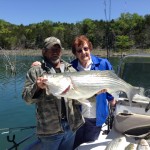
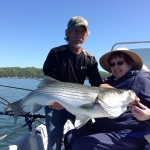
Around ten o’clock with only a couple more small fish caught by the group, a fish hammered the bait on one of Nora Jane’s rods. Their guide could tell immediately it was big and told everyone else in the boat to pull their lines to give her the entire boat to play the fish. With line zipping from the reel and the rod bent double until the tip nearly touched the water, she needed the guide’s help to even get the rod out of the holder so she could start reeling. She would gain line and pull the fish closer, then the reel would sing as the fish stripped line from it and headed for parts unknown. Back and forth they went as each tried to wear-down the other. Finally, twenty minutes later as she stood exhausted on the opposite back corner of the boat from where she first hooked the fish, the guide netted her monstrous twenty-five pound striped bass!

As the Schmidt family fishing trip came to an end, Nora Jane, the eighty-eight year old matriarch of the Schmidt family took home the trophies for both the biggest fish and for the most fish caught on the trip. We spend lots of time and energy attempting to get and keep today’s youth interested in the outdoors, and rightly so. But sometimes I fear we forget about our elders who instilled in us the love of fishing, hunting and the outdoors that we have today. Continue to Explore Kansas Outdoors!

Steve Gilliland, Inman, can be reached by email at [email protected].

Insurance scams can be plentiful after Kansas storms

Ken Selzer, Kansas Insurance Commissioner

During the past two months tornadoes, hail, high winds, driving rains and flooding have provided feelings of anxiety and frustration for Kansans whose property has been damaged.

“Unfortunately, those are the emotions that insurance con artists feed on,” said Ken Selzer, CPA, Kansas Commissioner of Insurance. “Unscrupulous individuals who prey on the misfortunes of others make their presence known in a variety of ways. I urge you to let your instincts lead you instead of your emotions when it comes to dealing with that property damage.”

Kansas Insurance Department (KID) personnel have compiled a list of some of the common scams that occur when disaster strikes. Here are some, along with tips on how to deal with them.

• Windshield/glass fraud—Some scammers have been known to stand outside of car washes, showing drivers cracks in the glass on their vehicle, then persuading them to have the glass fixed/replaced. In many cases, the replacement products used are substandard. Consumers should go through their insurance companies to have glass repair documented and to find company-approved repair businesses.
• Homeowners roof damage from hail—KID Consumer Assistance Representatives urge homeowners to call their insurance company first before having any repairs done. The company can recommend local, reliable roofers who can back up their work.
• However, in some cases, roofing companies lease the use of their company names to out-of-area roofers. Always check to see if that is happening, especially in larger-populated areas. Beware of door-to-door solicitors who have never been on your roof, claiming you have damage. Also, never sign an insurance check over to contractors prior to their completion of the work. Check the contractors’ insurance certificate, and if you need verification, call the insurance carrier or our department at 800-432-2494.
• Use of outside adjusters—Insurance adjusters working independently of a company are not licensed to estimate damage on personal property in Kansas. They can, however, adjust for commercial property. If an adjuster comes to your home, ask the person what company he/she is working for. If it’s not your homeowners insurance company, decline the solicitation and contact our Consumer Assistance Division at 800-432-2484. Never sign Power of Attorney documents with a door-to-door adjuster.
• Business “slip and fall” scams—Although this does not just occur after storm damage, the idea of someone slipping on debris and then suing for damages is heightened following bad weather. This is especially true for areas near commercial buildings, and, it can be difficult to dispute if the area is not cleaned up shortly after the damage happens.
• Buying vehicles that have flood damage—Vehicles that have been in floods in other states often make their way here. If you have any concern about a vehicle’s history, check the VIN (Vehicle Identification Number) against available vehicle databases yourself, if you are working on a private sale, or have a salesman do it if you are buying from a dealership.

“If you suspect insurance fraud, call our toll-free number and ask for a Consumer Assistance Representative or a member of our Anti-Fraud Division,” said Commissioner Selzer. “We want to assist you any way we can.”

Consumers can also visit our website, www.ksinsurance.org, or our Facebook page, www.facebook.com/kansasinsurancedepartment and print a copy of our brochure “Before and After the Storm” for tips on how to take precautions.

“Protecting yourself from the scams that happen as a result of storm damage can help keep your insurance premiums and repair bills lower,” Commissioner Selzer said, “not to mention your frustration level.”

Ken Selzer is the Kansas Insurance Commissioner

FHSU president offers statement on possible furloughs

Dr. Mirta Martin, FHSU president

Editor’s note: Distributed to faculty and staff of FHSU on Friday. Reprinted with permission.

I wish I could start by saying “I hope this note finds you well,” but I can’t because I know this note will find you concerned and anxious as a result of the possible furloughs. While I am also very concerned and anxious, I remain hopeful that our legislators will end the impasse by passing a budget that will keep the state’s economy moving forward.

You are the key to our state’s future; you are the key to moving Kansas forward. Each of you has an incredible impact on our university and on our state. Your dedication, compassion, commitment to each other, to our students, and to the Fort Hays State University family is second to none. I want each of you to know how much I acknowledge, admire and respect who you are and what you do.

RELATED: Additional information on furlough

No university president ever wishes to have to notify its family that there may be possible furloughs coming. But given the state of affairs in Kansas, I have no choice but to alert you to this possibility. I know many of you are committed to our mission and have made Fort Hays State your home. Many of you have both incomes derived from our university. Many of our students depend on the income derived from their summer work at our University to put food on the table and to meet their academic tuition obligations for the coming year. I am all too aware of this and thus, it is so disheartening to have to make the choices that have to be made.

If the Legislature does not pass a budget by 11:59 p.m. on Saturday, June 6, Fort Hays State, just like every other state agency, will have to cease normal operations and designate just a skeleton crew to continue the mandated close-of-year reports and to meet our contractual obligations. If we are furloughed, beginning 12:01 a.m. Sunday, we may not transact business on behalf of our University. Depending on the day-to-day needs, each of us will be on a day-to-day call-back notice.

Notices will go out later today providing details about the furloughs and telling you where to look for changes in the status of the situation.

News like this is not easy to deliver. I am so sorry to have to be writing this note. Regardless of the outcome of the next days’ legislative activities, I want to continue to thank you for what you do, and I want to remind you how critically important you are to the future of Fort Hays State University. I am so grateful for all your support.

The bonds of family survive in times of trouble and anguish. A family sticks together for better and for worse. Together, our family will survive the ups and downs that are thrown our way.

You all know I have great faith in you. I also believe the best is yet to be and I believe in miracles. Let’s pray together for one now.

Thank you for everything,

Mirta M. Martin, Ph.D., president, Fort Hays State University

A reminder to remember: Neweum’s Journalists Memorial

Gene Policinski is senior vice president of the First Amendment Center

On Monday, June 8, in Washington, D.C., a group will stop and remember what we all would like to forget — but should never put out of our minds.

On that day, journalists, family members and others will gather for the annual rededication of the Newseum’s Journalists Memorial — a wall of soaring metal and glass, containing more than 2,200 names of reporters, broadcasters, photographers and others who have died in the pursuit of news since 1837.

The listing is incomplete, of course — reliant as it is on available records and on how international organizations of journalists classify and track those killed in the line of duty; and most recently, because of the vexing issues surrounding the very definitions of the words “journalism” and “journalist” in an era when traditional media coexist with new technology and differing approaches to newsgathering around the world.

But what counts is the mission of the Memorial — as Newseum founder Al Neuharth said in 1997: To remind the world that journalism is a dangerous profession.

Some 18 years later, the danger is even greater, as journalists have gone from being seen by all sides as necessary tools for communicating with the world to — in a total shift — a threat to crafted stories that can be sent, via the Internet, directly to the public.

The stories of individual journalists whose names will be listed in the Memorial will forever be representative of all of those in the profession who faced that greater threat, including those who lack traditional credentials but not the modern journalism’s tools of the trade: access to the Internet, mobile phones and video, as well as text.

From the Arab Spring to the Ukraine, from the Middle East to Southeast Asia and South America, danger stalks journalists on assignment from major newspapers and networks; freelancers are caught up in the mindless violence of conflict zones; and broadcasters return to work daily despite threats and intimidation from drug lords, political critics and sometimes their own governments.

The Newseum Institute’s First Amendment Center samples adult opinions in the United States each year for its annual State of the First Amendment survey. Since 1997, the survey has asked questions about the public’s view of the news media — about bias, about the “watchdog” role over government envisioned by the nation’s founders, and even about the media’s position as a source of basic news.

The “news about the news” clearly is not positive, and this year’s survey — to be released around the July Fourth holiday weekend — won’t bring any joy to journalists hoping such negative views are receding. But those sweeping opinions ought not to obscure the straightforward facts that international journalism groups documented more than 80 journalists of every type who died in the line of duty during 2014.

We also should not forget journalists worldwide who are being held in prison by vindictive and cowardly governments, or as captives and political pawns by venal, evil groups. We saw this in 2014 — with the deaths of American journalists James Foley and Steven Sotloff at the hands of ISIS thugs — how tragically such captivity may end.

Washington Post journalist Jason Rezaian is charged with espionage, and is on trial in a secret session in a closed Tehran courtroom set to resume on the same day as the rededication, more than 10 months after he was imprisoned. Rezaian’s supporters insist he simply was working as a reporter. The trial was “continued” to a later unspecified date for undisclosed reasons — and even that news was not officially announced, but came by way of Rezaian’s lawyer to his family members.

In fact, the importance of the Journalists Memorial is not in the names it lists nor the individual stories it helps tell — but that it exists, day after day, as a reminder to millions of visitors over years past and to the many who will see it in the future. In that effort, the Memorial stands alongside international journalism groups, families and individual newsrooms whose ongoing work refuses to abandon colleagues and loved ones to either jail cells or indifference.

Associated Press senior vice president and executive editor Kathleen Carroll, in a discussion a few months ago at the Newseum, may well have defined the role of the Memorial as reminding us all that “this work that people are doing at great risk is to educate you, so give a damn. Read the paper. Read on your tablet. Engage the news and be a citizen of the world.”

Please do “give a damn” — on June 8 and every other day.

Gene Policinski is chief operating officer of the Newseum Institute and senior vice president of the Institute’s First Amendment Center. He can be reached at [email protected]. The 2015 rededication of the Newseum’s Journalists Memorial will be live streamed at 10 a.m. ET, Monday, June 8, at newseum.org.

INSIGHT KANSAS: An obvious solution — undo the tax policy

In all the hubbub of the overtime Kansas legislative session, the obvious solution to crippling state financial problems gets little traction. In fact, the governor threatens a veto if it would pass.

Duane Goossen
Duane Goossen

Why not undo the tax policy that created the problem? Steep income tax cuts directly caused a massive revenue loss–$700 million in one year. Before embarking on the infamous fiscal experiment in 2012, Kansas had a stable tax system that most people considered fair. If tax policy had been left alone, our state sales tax rate would now be 5.7 percent instead of 6.15 percent, and the state could easily pay expenses with adequate reserves left at the end of the year. Our state highway fund would be healthy, our bond rating up, and the legislative session long over.

Kansans hold contradictory notions. If given a choice, we prefer not to pay taxes. Yet we value good services—smooth roads, high-quality education, a social safety net—things that cost money. We are not unusual in that outlook. It’s normal. Human nature.

Our governor and lawmakers must find a reasonable, fiscally-responsible balance between those competing desires. That’s their key task in every legislative session. For example, going on a spending spree without regard to available resources takes the state out of balance and upsets the citizenry. Likewise, a tax-cutting binge that fails to account for the costs of basic services and bills that must be paid also unhinges the system.

In Kansas, we currently suffer from the latter irresponsible affliction. Income tax cuts that disproportionally benefit the wealthiest Kansans have destabilized state finances.

What happens when income tax rates are cut, and many businesses are entirely exempted from paying? Revenue goes down! That should not come as a surprise, but it appears to have stunned the governor and many Kansas lawmakers. For two years they have tried to tell us everything is fine while they used up the state’s savings account and raided the highway fund to cover up the now-massive budget problem that the income tax cuts have created.

But it’s no surprise any more. Reality has arrived. The state budget imbalance has become so serious that either taxes have to go up sharply or spending on education and other state programs must drop to an unacceptably damaging level.

What to do? Lawmakers don’t know. As this column is written they are mired in day 105 of what was supposed to be a 90-day legislative session. The governor and legislative leaders have dithered and weakly allowed the budget process to drift into chaos. Many proposals have been flying. More tax on cigarettes and gasoline. Higher property tax. Raise the sales tax rate to one of the highest in the nation. Eliminate the sales tax exemption on Girl Scout cookies. One proposal would even have the government tax its own purchases, though exactly how that could realistically raise money is unclear.

Instead of doing the obvious thing, lawmakers have been whacking away at programs and trying to add taxes that hit average working Kansans the hardest.

Raising regressive taxes to cover up a past mistake isn’t going to be popular. Most Kansans would rather not pay any taxes, but are willing to pay for quality services if the system is fair. Kansans know by now that forking over higher sales and property taxes or enduring service cuts to pay for a failed policy experiment doesn’t pass muster.

Duane Goossen is a Senior Fellow at the Kansas Center for Economic Growth and formerly served 12 years as Kansas Budget Director.

Your guide to the 2016 GOP candidates

Donald Kaul
Donald Kaul

The Republicans have a big problem. Their presidential primary contest is beginning to resemble the New York marathon — hordes of contestants as far as the eye can see.

How is a voter expected to choose among them, particularly since virtually all say pretty much the same thing?

To name a few examples, the entire gang of 15 or more politicians wants to cut taxes, roll back the Affordable Care Act, ban abortion, crack down on undocumented immigration, keep gun laws weak, and do nothing about global warming.

They also uniformly despise Hillary Clinton.

As part of my continuing effort to make the world a better place, here’s a brief analysis of a few top GOP candidates. I hope it helps you tell them apart.

Jeb Bush: The former governor of Florida and latest member of the Bush dynasty angling to occupy the White House is the nice-guy conservative of the bunch.

He’s no less conservative than the others, mind you — except for the suspicion that he’s soft on immigrants because his wife grew up in Mexico — but an iron fist in a velvet glove nevertheless. Jimmy Stewart would play him in the movie, if there were a movie and if Jimmy Stewart were still around.

Carly Fiorina: The former CEO of Hewlett Packard is easily spotted since she’s only woman seeking the Republican nomination.

She’s a failed corporate executive who thinks she’s the perfect answer for voters who’d like to vote for a woman but can’t stand Hillary. Maybe.

Rand Paul: The senator from Kentucky passes for this gang’s anti-war candidate. Even if Paul did sign that silly GOP letter that tried to sabotage nuclear talks with Iran, he’s still way, way out to the left of mainstream Republicans, who are nothing if not bellicose.

Paul also has other libertarian-based ideas that make him an odd goose in this company of ducks — especially his opposition to the NSA spying on us all.

Lindsey Graham: The senator from Mars — I mean, South Carolina — has yet to meet an international problem that he doesn’t think U.S. troops can fix. I get the feeling that he’d bomb Canada if he got the chance.

Marco Rubio: The senator from Florida is the closest thing to John F. Kennedy the Republicans have had in years.

He’s young, he’s good looking, and he gives a good speech. He gets a lot of mileage from how hard his parents, Cuban immigrants, had it when he was growing up. He’d be the ideal vice president for Bush if they didn’t both hail from the same state.

Ben Carson: As the only African-American contender, he’s as easy to pick out in this crowd as Fiorina. He’s a brilliant brain surgeon, and a rip-roaring speaker prone to saying some strange things.

Ted Cruz: As the leader of the Senate’s does-not-play-well-with-others caucus, it’s unclear how he would forge requisite alliances with Congress if he were elected. He sees his function as being the sand in the gears of government. People who love him, love him a lot. To the rest of us, he’s Darth Vader.

Chris Christie: The New Jersey governor is Tony Soprano on the hoof. If a blustering bully is your idea of a national leader, he’s your man.

Scott Walker: The Wisconsin governor is the one wearing a little label on his lapel that says: “If found, return to the Kochs.” His viability as a candidate depends on whether he remains the billionaire brothers’ favorite.

Mike Huckabee: The former Arkansas governor did quite well in his failed 2008 presidential bid as the pick of the religious right, which dominates the Iowa GOP caucuses.

This growing flock also includes the following sure-to-lose politicians: Louisiana governor Bobby Jindal, Ohio governor John Kasich, businessman Donald Trump, former Texas governor Rick Perry, and Rick Santorum.

Remember Santorum? The former senator from Pennsylvania and father of seven kids is the biggest zealot and easily the least likable guy in the race. If he wins, expect a mass exodus to Canada.

OtherWords.org columnist Donald Kaul lives in Ann Arbor, Michigan.

MOVIE REVIEW: ‘San Andreas’ is shaky, at best

James Gerstner reviews movies for Hays Post.

I’ve been thinking a lot lately about the television and film mediums and how they tell stories. The past couple years has seen a shift in the public consciousness about what television (and related services, i.e. Netflix) is and what it can do.

Gone are the days of nothing but sitcoms and gameshows. When we as a pop culture-consuming society want a strong story with deep character development, we turn to something like “House of Cards,” or “Game of Thrones” or “Breaking Bad.” The time factor is by far the most obvious advantage that television has over film. If one season spans somewhere around 12-15 hours of content, creators can take a slow-burn approach to unearthing characters while at the same time delivering the same dosage of excitement or tension that can be found on the big screen. On the other hand, film has become the event medium. It’s the place we get our “oohs” and “awes” at before heading back home and resuming our Netflix marathon.

I bring this up to illustrate, “San Andreas’” utter inability to create something that isn’t destruction or made out of wet cardboard. Yes, the destruction is cool, even if the physics underlying physics are occasionally laughably bad. However, we’re given the exact same characters and the exact same dramatic arc that we’ve seen a thousand times.

“San Andreas” couldn’t be so naive as to believe it’s the first disaster movie to use the “divorced parents have to reunite to rescue their child” schtick. “San Andreas” didn’t even pull off a good execution of that overused plot springboard. It’s full of holes and what pieces are solid easily buckle under the over-the-top power of the film’s true intent — cool earthquake shots.

All that said, the special effects are wooden and choppy in places. These types of films have come to be called “destruction porn,” for very good reason. The story setup and execution are afterthoughts. The entire experience is just an excuse to see widespread mayhem and destruction from the comfort of our theatre chairs — which is troubling enough by itself.

“San Andreas” has absolutely nothing new to offer. It’s a poorly made peep show that caters to the part of the human experience that loves seeing stuff destroyed. Granted, it’s hard to come up with something new when the time parameter is so limited, compared to a season or seasons of a television show, but surely, we can do better than this.

3 of 6 stars

Invitation to annual Military Appreciation Night at Larks Park

Larks-Jersey 1

Hays Larks

The Hays Larks are inviting everyone to the 7th annual Military Appreciation Night in conjunction with their game against the El Dorado Broncos on Saturday, June 6th at Larks Park at 7 p.m.

All active, reserve, and retired military personnel are specially invited to attend and will be honored on the field during pregame ceremonies. Military personnel will also be recognized after the 6th inning prior to the singing of “God Bless America”. Military personnel in attendance should check in at the east side of the grandstand by 6:45 pm Saturday evening.

Fans are encouraged to be in the park by 6:50 pm to show their appreciation and support for all military personnel during pregame ceremonies. Those ceremonies will feature recognition of all military personnel in attendance, a Color Guard provided by VFW Post #9076, and the National Anthem sung live by Jackie Maxwell. Those in attendance will also enjoy patriotic music and a red, white, and blue decorated park throughout the evening. Also at the park will be various military vehicles from the 388th Multi-Functional Medical Battalion (MMB) Army Reserve unit and information about the 388th Family Readiness Group which supports military families.

Additional booths will feature information about Camp Corral, an organization that coordinates camps for children of wounded, disabled or fallen military service members.  T-shirts will be given to the first 200 people who visit the Camp Corral booth at the game.  Local Army Reserve veteran Seth Kastle, who recently wrote a children’s book to help military families dealing with Post-Traumatic Stress Disorder (PTSD), will also be featured at a booth.  Flags lining the park will be provided courtesy of American Legion Riders Post #173 of Hays, KS. Free admission to the game will be provided courtesy of the Kiwanis Club of Hays, VFW Post #9076, and Golden Corral.

The Hays Larks is a summer collegiate baseball team comprised of players from colleges and universities across the United States.  This high quality baseball team is a member of the Jayhawk League, one of the premier amateur baseball leagues in the United States.  Dozens of major league stars including Albert Pujols, Lance Berkman, Roger Clemens, Barry Bonds, and Ozzie Smith have played in this very league.

See you at Larks Park on June 6th! Come join the team for fantastic baseball, pay tribute to veteran, reserve, and active military personnel and enjoy an evening of inexpensive fun!  For more information please contact Frank Leo, Hays Larks Manager at 785-628-6703.

Schlageck: Better prospects for 2015 wheat harvest

John Schlageck writes for the Kansas Farm Bureau.

Travel through northwestern Kansas and you’ll see plenty of variability in the winter wheat crop.

Rooks County farmer Stephen Bigge, believes wheat planted on the family farm during the third week in September looks good. Some of the crop seeded October 10 or later probably won’t yield as well and an early November freeze hammered some of the newly emerging crop.

“We won’t harvest a bumper crop; however there’s some really good wheat in this county,” Bigge says. “On the other hand, some wheat fields will not even be cut.”

As of May 20, the wheat fields sported a deep green color. Much of the crop stood knee high.

While most of the wheat looks good viewed from the roads, walking into the crop often reveals a different story.

Some of the fields didn’t develop the stand needed to get the quantity of tillers to complete the crop, Bigge says. The later planted wheat looks good, but the stand is thin.

Bigge planted the wheat crop in good moisture last fall. But then the weather turned dry and his wheat crop received little moisture until mid-April.

The last 30 days of moisture has been plentiful and timely. Fields have received from two inches to nearly eight inches.

“We’re thankful for the moisture that’s fallen, Bigge says. “We’re a lot greener out here than we have been the last several years.”

The northwestern Kansas farmer has conducted stand counts in the fields. He’s recorded yield estimates between 45 and 55 bushels.

“I believe this year’s crop is going to surprise some of our farmers once they pull into the fields for harvest,” Bigge says. “I’m crossing my fingers the (favorable) weather holds. A harvest like that would be tremendous this year.”

Bigge believes harvest will come early this year. If the temperatures warm into the 80s and low 90s, he figures to start cutting wheat June 10.

Some of the early wheat he planted was a short-season variety. As of the third week in May, the heads already contain a half to three-quarter sized berry. With warmer weather, it will not take long to finish the kernels out.

“I believe the potential for a good harvest is out there,” Bigge says pointing to his crop.

Still as any Kansas wheat farmer will tell you, “never count your crop until it’s in the bin.”

Three years ago, Bigge parked the machines next to a field and prepared to begin harvest the next morning.

“It hailed us out that night before we could begin,” he says. “You just have to wait, hope for the best and pray.”

Until then Bigge will do what farmers have done for decades, keep an eye on the sky, the weather app on their smart phones and an ear to the radio. And while harvest may be just around the corner, he cannot wait for it to begin.

John Schlageck, a Hoxie native, is a leading commentator on agriculture and rural Kansas.

DAVE SAYS: Big debt on an old car

Dear Dave,
My wife cosigned a loan on a 2007 car for her sister. Now, it’s being repossessed, and $23,000 is still owed on it at 20 percent. What can we do in this situation?
Pablo

Dave Ramsey
Dave Ramsey

Dear Pablo,
Tell the bank or dealer where the car is, and tell them to come pick it up. There’s no way to get out of the rest, my friend. You and your wife are going to be liable for whatever the car doesn’t bring in afterward. Let’s say it sells for $4,000.

That would be subtracted from what is owed, and it will still be up to you guys to pay the rest. You could always try to negotiate to settle it for pennies on the dollar. Based on what you’ve told me, that’s a best-case scenario.

The other thing I would do is demand a full audit on the account from day-one to present, because a 20 percent interest rate doesn’t explain why a car didn’t pay off – especially a $23,000 car. If this was a $5,000 car from a tote-the-note car lot, and they were ripping her off charging only interest – and that’s all anyone was paying, and she gave up and punted – that’s fine. You’re just looking for a little understanding of the situation. But $23,000 cars don’t generally have 20 percent interest. That’s a pretty freaky deal, and I’d want to know where the money went.

From a bank’s perspective, I don’t see how anyone would think something like this would work out. The car was going down in value the entire time, so it just doesn’t make sense to me. Of course, if you have the cash lying around and it wouldn’t damage your finances, you could just take care of things and call it Stupid Tax.

Cosigning on a loan, especially with family, is never a good idea.
—Dave

Dave Ramsey is America’s trusted voice on money and business. He has authored five New York Times best-selling books. The Dave Ramsey Show is heard by more than 8.5 million listeners each week on more than 550 radio stations. Dave’s latest project, EveryDollar, provides a free online budget tool. Follow Dave on Twitter at @DaveRamsey and on the web at daveramsey.com.

Annual golf tourney was a ‘successful harvest’

Tammy Wellbrock, Hays Chamber of Commerce Executive Director

The day after we completed our sixth annual Hays Area Chamber of Commerce Golf Tournament, someone asked me if the day was a success.

My immediate reaction was to answer, “Heck yeah!” But after more reflection, I wondered what success for this event looks like to our members.

To quote my farmer father, a “successful harvest” was the one that got the crops into the bin. Given Kansas’s unpredictable weather, I would apply his definition to golf. While a sunny day certainly added to the overall positive experience to our golf tournament, this event means so much more than a nice time on a beautiful course.

Certainly, all of us at the Chamber feel so blessed to be able to spend a fun day with our friends, members or not, on the lush green scene available at Smoky Hill Country Club. We are also incredibly grateful for the support of so many volunteers and sponsors, especially our Premier Sponsor, Eagle Communications.

Without the generosity of time, talents and treasures from so many, this day would not be the successful tournament in which it has grown.

Annually, we aim to achieve two specific goals with the golf tournament: earn additional funds while enhancing our relationships with the local community. I’m pleased to share we reached our financial goal while exceeding the number of golfers, volunteers and lunch attendees.

It is humbling to consider much of this support directly depicts the importance you place in your Chamber.

Most importantly, we cemented old acquaintances and even gained new friendships (and I’m not just meaning my new squirrel friend who took a liking to my sunflower seeds). Whether it occurred on the course or at the Patio Party, strangers were introduced, contacts were shared and bonds were developed.

Certainly, the Chamber plans to utilize these funds to offset valuable offerings that enhance all of our member businesses, such as Chamber Cheques, upcoming networking events and various communication tools like our weekly email or monthly newsletter.

We thank all of you for helping make your Chamber, and thus your community, a stronger, friendlier and more rewarding connection.

Tammy Wellbrock is executive director of the Hays Area Chamber of Commerce.

HAWVER: Cutting taxes on the poor while raising taxes on the poor?

martin hawver line art

Us Statehouse insiders, who don’t start to tan until the Fourth of July and are fascinated by little political gimmicks that most regular people don’t notice are…well, fascinated again.

This time, it is Gov. Sam Brownback’s new tax plan, the one that raises more than $400 million in taxes for the state budget without inconveniencing those 330,000 Kansans who make their livings by owning certain types of businesses.

That lucky 330,000 make their livings by receiving “non-wage” income from Limited Liability Corporations, subchapter S corporations or are owner-operators of their businesses, which since 2012 have been exempt from Kansas income taxes. They like it like that.

But with the budget deficit staring lawmakers in the face, and a governor who has been…a dab irrelevant in the tax-raising business this year, Brownback has come up with a plan that—good or bad—is politically fascinating.

Because this is being written before we know whether the plan is adopted or not, let’s just look at its themes.

The concept, stripped to its bones, is to raise the sales tax by half a cent on everything you can buy at retail in Kansas, plus 50 cents a pack for cigarettes—and eliminate Kansas individual income tax on about 388,000 low-income Kansans.

Political junkies can read the House and Senate reelection campaign ads already: “XXX voted to eliminate income taxes on low-income Kansans.” Does it get any better than that for a reelection campaign? Lower taxes on the poor? Almost, but doesn’t quite, bring a lump to your throat.

Or… “XXX voted to make poor people continue to pay state income taxes,” or “wouldn’t cut taxes for the poor.” Is there a candidate who wants that headline on a postcard along with a nice photo of the candidate and his/her name and party affiliation? Didn’t think so.

Now, that Brownback plan also raises the sales tax by half a cent, from 6.15% to 6.65%, but that’s not going to be noticed much by middle- and higher-income taxpayers because it’s not much of an increase, and the wealthier of Kansans spend a lower percentage of their money on food and diapers for the baby. There is no sales tax on stocks and bonds.

Now, those low-income folks who spend most of their money on food and necessities may notice that half-percent increase; the governor can say “you’re saving on that pesky income tax, so it probably equals out.”

Statisticians, or those with calculators and a little time, figure the low-income tax cut costs the state $19 million in lost revenue in the upcoming fiscal year, an average of about $48 for each of those 388,000 Kansans who won’t owe income taxes if the plan is OK’d. That $48 covers the half-cent sales tax increase (which raises about $234 million in total) for about $9,600 in purchases.

Not sure whether those who qualify for the income tax elimination which exempts from taxation the first $5,000 of income of single filers, $10,500 of single-head-of-household filers and $12,500 for joint filers, spend less than $9,600 on food and stuff which carries a sales tax. Some might, some might not.

Politically…do you vote to cut income taxes for the relatively poor, while boosting their sales taxes, along with everyone else’s? Do you use the income tax cut as a diversion so the sales tax can be raised to protect the tax exemptions for those LLC folks? Or, do you spend time explaining to the relatively poor—and no, we don’t know their party affiliations, House and Senate districts, just the counties in which they live—that they are just a diversion so those LLC folk don’t get bothered with taxes especially in the spring when they might be shopping for new boats or negotiating for lawn service?

The whole tax plan can be stretched so many ways; whether it is good public policy or not almost fades away for some politics watchers awaiting it to be used for campaigning.

And, yes, we’re thinking someone ought to get up a support group for those folks…

Syndicated by Hawver News Co. of Topeka, Martin Hawver is publisher of Hawver’s Capitol Report. To learn more about this nonpartisan statewide political news service, visit www.hawvernews.com.

Are you insured for summer fun?

Ken Selzer, Kansas Insurance Commissioner

Ken Selzer, CPA, Kansas Commissioner of Insurance

Are you insured for summer fun?

Your summer plans are likely to include more entertaining, travel and outdoor excursions. But before engaging in some recreational activities, you should reevaluate your insurance risks and needs.

The following tips from the Kansas Insurance Department and the National Association of Insurance Commissioners can help make sure you are protected while you enjoy summer fun.

Pools and Trampolines
Before inviting friends and family over to enjoy your pool or trampoline, know that either may increase your insurance risk. Consider purchasing an umbrella policy in addition to your homeowners insurance to increase your liability coverage.

However, because pools and trampolines can be dangerous, some companies may not insure your property if you own them, or there may be policy exclusions for liability for related injuries. An insurance company may also deny coverage or cancel your policy if you do not follow the policy’s safety guidelines or fail to inform the company when you build a pool or purchase a trampoline.

Check with your insurance provider for rates, discounts and safety guidelines (such as installing a fence or locked gate). If you lease a property with a pool, discuss your insurance options with your agent or insurance company.

Boats
A boat insurance policy provides liability coverage if someone is injured on your boat. It also covers bodily injury inflicted on others and property damage to your boat. These policies may not be suspended during the months your boat is not in use. Read your policy carefully and speak to your agent, because some watercraft policies have minimum or fully earned premiums associated with them.

The personal property coverage of your homeowners policy may cover a small boat for $1,500 or less in physical damage. However, coverage for your liability risk is limited.

Personal watercrafts, such as jet skis, often require a separate policy that may be offered by your homeowners’ insurer. Talk with your insurance agent and get quotes from other companies to understand your options.

All-Terrain Vehicles (ATVs)
ATVs are not covered by standard automobile insurance policies, but your homeowners policy may partially cover liability. Ask your agent if you have sufficient coverage on your homeowners policy. Also, ask about age restrictions regarding who may operate the ATV or if the policy covers friends and family.

Traveling
Whether you’re leaving home for a weekend getaway or a long road trip, be aware of what your homeowners or renter’s policy will cover while you’re gone. Typically, your homeowners insurance will follow you, protecting you even while you’re not at home.

In addition to your deductible, items will typically have a limit on things like jewelry and furs. If you’re traveling with high-priced items, it’s a good idea to get separate insurance coverage for these items. Check with your agent or company.

More Information
Contact the Kansas Insurance Department’s Consumer Assistance Division at 800-432-2484 for more information. Visit the NAIC’s www.insureuonline.org to learn more about the health, home, life and auto insurance options that best fit your needs.

Copyright Eagle Radio | FCC Public Files | EEO Public File