We have a brand new updated website! Click here to check it out!

INSIGHT KANSAS: Stand down on school finance litigation

The Kansas Supreme Court cannot be accused of ducking tough issues.

Last week the Court ruled that the Bill of Rights in the Kansas Constitution protects Kansans’ “right of personal autonomy,” including a woman’s right to terminate a pregnancy. Then, on Monday, the Court hears the latest round of litigation on school funding, the most fundamental obligation of state government.

H. Edward Flentje is professor emeritus at Wichita State University.

Debate on the Court’s engagement in the abortion issue will continue for some time. On school finance, however, the Court should sign off on school funding approved by a bipartisan legislative coalition and Governor Laura Kelly and stand down on future litigation.

The history of school finance litigation stretches back over 50 years and stems from a complete rewrite of the Education Article of the Kansas Constitution proposed by state lawmakers and adopted by voters in 1966. This revision says simply “the legislature shall make suitable provision for finance of the educational interests of the state.”

Since 1966, lawmakers, state courts, and school districts have engaged in six cycles of litigation over what exactly “suitable provision” means. In the current cycle, which began in 2010, lawmakers are making their seventh trip to the Court to settle the lawsuit. In other words, in six prior attempts—once in 2014, twice in 2016, twice in 2017, and once in 2018—lawmakers fell short in meeting the Court’s view of suitable funding.

In the most recent cycle, the first three trips to the Court, led by former Governor Brownback and his far-right legislative allies, were not credible. They chose to ignore established funding guidelines, threaten the Court, campaign to oust Court justices, and enact multi-billion dollar cuts in state income taxes. Kansas voters rejected these tactics in the elections of 2016.

Beginning in 2017 a bipartisan coalition of state lawmakers has taken the Court’s orders seriously and crafted credible steps toward settling the litigation.

Why is school finance so hard? Imagine, if you will, allocating $5 billion among 300 school districts in ways that are adequate in meeting educational goals and equitable across widely diverse rural, urban, and suburban schools.

Even so, after nearly ten years of lawsuit drama, Kansans should expect these cycles of litigation to end.

The Kansas Supreme Court has the power to establish a higher bar for itself and lower state courts in considering future complaints on the suitability provision of the Kansas Constitution. Through prior rulings, the Court has established standards for adequacy and equity in school funding; it could order that only a substantial departure from those standards by state lawmakers would qualify for judicial review. An expression of heightened restraint by the Court in applying those standards could usher in an era free of litigation over school finance.

A “substantial departure” could, of course, be in the eye of the beholder, as “suitable” has been, but the justices can certainly find the right words. Obviously, the dramatic cuts in base funding and block-grant chicanery during the Brownback era represented flagrant deviations from funding guidelines and deserved judicial attention.

Judicial restraint on challenges to school funding could send powerful messages to school districts and state lawmakers: First, that school districts should focus their attention on demonstrating how additional funding leads to improved student performance, particularly for students most in need. And second, that state legislators keep school funding in line with established standards for adequacy and equity and assure that school districts are held accountable for student performance.

As high drama on abortion politics resurfaces, the Court should clear the way for a litigious-free path on school finance.

H. Edward Flentje is professor emeritus at Wichita State University and served with former Kansas Governors Bennett and Hayden.
Prairie Doc Perspectives: The moth into the flame

Rick Holm

What is inflammation? Inflammation comes from the Latin words “into the flame” like how moths are drawn to sustaining warmth of a springtime campfire and harmful self-destruction if they get too close. Inflammation is a natural phenomenon that can encourage sustaining healing but also harmful destruction, like a moth into the flame.

During my first years of medical school, I was honored to spend my summers with multiple doctors practicing in Watertown, South Dakota. There, pediatrician Ebehardt Heinrichs, M.D., taught me about inflammation while we were examining a young child with acute juvenile arthritis. He pointed out how her hands showed four characteristics of inflammation famously described by Celsus, a Roman who lived at the time of Jesus. Dr. Heinrichs explained, “These are the cardinal signs of inflammation: rubor (redness), tumor (swelling), calor (heat) and dolor (pain).”

That summer, a red, swollen, hot, and painful joint found with juvenile arthritis was not the only medical condition I saw resulting from inflammation run amok. Other destructive examples included asthma, poison ivy, psoriasis, Lupus, and rheumatoid arthritis. Those years ago, I learned that we had anti-inflammatory medications to help patients with such unfortunate conditions, although side effects were considerable. In contrast, I also saw examples of how inflammation can be beneficial in fighting off invading infections such as skin abscesses, appendicitis, tonsillitis, meningitis and sinusitis.

Beyond this older and established knowledge, researchers have recently learned that beneficial muscle growth comes as a response to localized mild inflammation that follows exercise. Other studies show that low-intensity training, like walking, can reduce harmful chronic inflammation. All-in-all not only can our bodies be harmed when self-destructive inflammation turns against our own cells, but our bodies can be protected and even sculpted by the yin and yang of balanced and healthy inflammation.

Recently, researchers have learned of another yin and yang. We know that our bodies can recognize and remove, by inflammation, tiny cancers that pop up periodically. On the other hand, certain cancers can grow because of inflammation. This later finding has allowed for even more new therapies.

There have been great improvements in medicines relating to inflammation, compared to what we had during those early years in med school. We can now, more effectively and with fewer side-effects, turn off harmful targets of inflammation, cool crippling arthritis, sooth devastating rashes and even, when used correctly, shrink certain cancers.

Rubor, tumor, calor, dolor . . . like a moth attracted to a sustaining or harmful springtime campfire.

For free and easy access to the entire Prairie Doc® library, visit www.prairiedoc.org and follow The Prairie Doc® on Facebook, featuring On Call with the Prairie Doc® a medical Q&A show streaming live most Thursdays at 7 p.m. central.

Lt. Gov. Rogers highlights importance of Medicaid expansion to rural prosperity

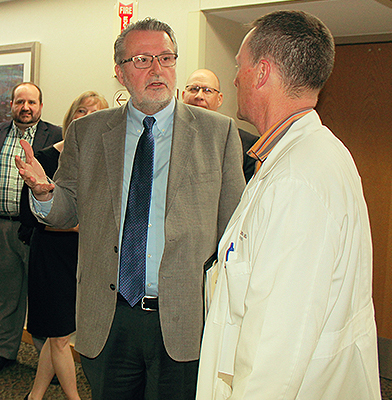
Lt. Gov. Lynn Rogers with Hays Med’s Dr. Jeff Curtis April 9 in Hays.

The following remarks are from Lt. Governor Lynn Rogers regarding the results of his Rural Healthcare Tour:

Hello, thank you all for coming today.

Since launching the Office of Rural Prosperity’s Rural Healthcare tour in February, Governor Kelly, KDHE Secretary Lee Norman and I have collectively toured more than 25 healthcare facilities. We’ve met with chambers of commerce, healthcare providers, business owners, faith leaders, families and community members across the state – from Liberal to Marysville and Pittsburg to Atwood.

(RELATED CONTENT: Rogers toured Hays Medical Center April 9.)

During this tour, there was a consistent and resounding message no matter where we traveled — Medicaid expansion would absolutely help each of their communities.

It would create new jobs, invest new money into the local economy, and would reimburse healthcare facilities for care they already provide that would otherwise be uncompensated.

Expansion would give healthcare facilities the necessary resources to upgrade diagnostic equipment to provide better local healthcare. And it would allow them to more competitively recruit and retain quality healthcare staff.

In Council Grove, hospital administrators at Morris County told me they had just lost a doctor, and that they’re afraid that if the state doesn’t expand Medicaid they could lose more.

The fear of providers leaving for higher paying jobs in nearby expansion states like Nebraska or Colorado is very real to communities on the state’s border. Goodland Regional Medical Center is just a short 30-minute drive from the hospital in Burlington, Colorado.

And healthcare facilities in southwest Kansas – like Garden City and Dodge City – told me about wanting to invest in educational facilities to address their provider shortfall but said it was a challenge while being burdened with millions in unreimbursed care.

The Governor shared a story from her tour of Horizon’s Mental Health Center in Hutchinson. The services they are providing– in their local schools, correctional facilities, and across their communities – could all be enhanced if the legislature expanded Medicaid. And you’ll get a chance to hear that first-hand from their CEO Mike Garrett here shortly.

I don’t have to remind you that four rural hospitals have closed in the past three years – each citing the state’s failure to expand Medicaid as being partially responsible for their closing. And while we cannot guarantee that Medicaid expansion will save every rural hospital, we are certain that it has the most positive and immediate benefit of anything the state can do.

The economic impact of a hospital closure is greater than a cursory glance would expect. In a rural community, healthcare accounts for 20% of a local economy, and just one physician generates 26 jobs.

Given the economic impact of healthcare, the fact that 30% of our state’s rural hospitals are considered financially vulnerable is cause for concern. Across the state over 85% of our hospitals currently have a negative operating margin.

And in the five years that Kansas has gone without expansion we have lost over $3 billion dollars in tax revenue – money Kansans have paid to the federal government, that should have been used here but has gone to other states.

We not only have an economic imperative to expand Medicaid, we have a moral imperative as well.

Nearly 150,000 Kansans fall in the coverage gap. They are hardworking – often underemployed – Kansans who don’t make enough money to afford quality health insurance but have incomes that are too high to qualify for Medicaid. And many of them live in rural Kansas.

Unfortunately, two members of Senate Leadership – both in majority urban districts I should add – are blocking a vote on expansion despite it being supported by 77% of Kansans. They are suggesting that now is the time to study the issue, and that discussion can begin next year. But after five years of discussion in Kansas and more than 300 national studies showing its effectiveness, the time for discussion is over. It is time for Kansas to join the 36 other states who have already expanded their Medicaid Programs.

This should not be a partisan fight or a means to keep a political score. It is about people’s lives.

The Senate will be back Wednesday for the annual wrap-up session.

The Governor and I are calling on the Senate to hold a vote on Medicaid expansion.

Since rolling out our plan to expand Medicaid nearly 100 days ago, we talked to Kansans — Republicans, Democrats, and Independents alike – and they’ve told us that Medicaid expansion can’t wait until next year. It simply costs Kansas too much money and too many lives.

They’ve contacted their legislators, they’ve gotten engaged in the process, and they’ve said they are done waiting. It is time for the Legislature to listen to the people.

On behalf of rural Kansans, I’m asking Senate leaders to show compassion for their constituents.

Lynn Rogers (D) is the Kansas Lieutenant Governor.

Kan. Farm Bureau Insight: Fire in the sky

Greg Doering
By GREG DOERING
Kansas Farm Bureau

While driving through the Flint Hills one evening recently I saw the most brilliant sunset. The day had been mostly overcast, with a gentle breeze from the northwest. It was a perfect day for prescribed burning in the nation’s largest patch of tall grass prairie.

I watched as flames licked at last year’s growth, stretching skyward as the sun dropped toward the horizon. The clouds broke, but the smoke-filled air dispersed purple, red and orange hues. It looked as if the burning prairie had ignited the entire sky.

It was a beautiful sight, and just a small part of the 2.5 million acres farmers and ranchers have ignited in the Flint Hills this spring. There are still a few days left in the season, which typically runs into early May.

Stretching from just south of the Nebraska border down into northern Oklahoma, the Flint Hills are home to the remains of an ecosystem that once covered much of the Great Plains. The rocky terrain saved nearly 10,000 square miles of tallgrass from being plowed under.

While I know the benefits of prescribed burning, it’s one agricultural practice that’s often misunderstood.

Fire is a vital tool to preserve this patch of grass. Without it, cedar trees and weeds take over robbing the grass of the nutrients and water it needs.

“We try to burn every year, so we have new fresh grass,” Lyon County rancher Jacquelyne Leffler said. “We do it for weed control, but we also want that fresh grass that gives us optimal gain for our cattle as well. We’re in the market to be profitable, too.”

Leffler and her family run a stocker operation that places 600-pound cattle on grass around mid-April.

“Hopefully when we pull them off in August, we’ll have around 2.2 to 3 pounds of gain per day,” Leffler said.

While fire is friendly to ranchers’ bottom line, it’s also good for the environment. Controlled burns kill weeds, nourish the soil, destroy parasites living in dead grass and help preserve the prairie ecosystem. Fire is vital to wildlife like prairie chickens and other grassland birds. Most of that can be achieved through other means, but Leffler said, those aren’t nearly as efficient as fire.

“It’s cheaper to be able to light a match and just have some water to control it,” Leffler said. “It makes it so our land is sustainable for the future generations that will be here.”

Safety is a key component of prescribed burns, Leffler said. And that starts with knowing where you’re burning.
“Our ground isn’t necessarily flat and smooth, so we try to make sure everybody knows where the bigger ditches are, Leffler said, noting that helpers also carry tools to cut fence if they need a quick escape route.

“We leave at least a 50-foot backburn anywhere we want the fire to stop.” she said. “Once we do that, we make sure everyone’s accounted for, and then we go into the process of lighting the head fire.”

Pushed by the prevailing wind, the head fire clears the land of cedars and other woody plants.

“That means more grass is going to be able to come up, so that means more feed for our cattle, which is going to contribute to those better gains,” Leffler said.

“Insight” is a weekly column published by Kansas Farm Bureau, the state’s largest farm organization whose mission is to strengthen agriculture and the lives of Kansans through advocacy, education and service.

HAWVER: State Supreme Court puts mark on legislative session

Martin Hawver

What was likely to be a three-day, maybe five-day veto session of the Kansas Legislature got more complicated last week with the Kansas Supreme Court decision that abortion is a right of Kansas women under the state constitution.

That high court decision which pronounces a woman’s decision to have an abortion a right under the state constitution sends the issue back to Shawnee County District Court for consideration of a bill that outlaws a specific procedure used in more than 90 percent of abortions in Kansas.

Nothing changes immediately. The second-trimester abortion procedure specifically outlawed by the bill remains legal until the specifics of that dilation and evacuation procedure are considered by the district court, and then likely challenged at the Court of Appeals level and then likely by the Kansas Supreme Court. That could take a year or so, but that provides time for the Legislature to try to change the state constitution to prohibit nearly all abortions in Kansas.

It’s a hot-button political scrap that may well dominate the planned short veto session of the Legislature, becoming an issue that will cast a shadow over assembling a budget, considering expansion of Medicaid eligibility, possibly a tax bill, and then getting out of town.

It’s still not clear when the Legislature will consider a resolution to allow voters to determine whether abortion will be banned in Kansas after a fetus is detected, but there are already House and Senate resolutions introduced earlier this year that might just get pulled out of a committee for debate in either chamber. That’ll make the veto session longer—count on it—if either the House or Senate gets the measure to the floor for debate.

And, for you political/procedural junkies, each chamber’s resolutions are strongly, near-emotionally written. If one or the other gains the two-thirds vote in both the House and Senate—the governor doesn’t have a role in the process—that public vote would be taken at the November 2020 general election when every House and Senate seat is on the line.

So, the wrap-up session is going to be emotional, and every decision on the abortion issue is going to be dissected by anti-abortion and abortion-rights legislators, and the lobbying groups which support them.

Delay the issue until next session for debate in an election year? Take fast action this session while the issue which smoldered for four years in courthouses has emerged?

Anti-abortion activists may not be sated by leadership assertions that the issue is too complicated to be thoughtfully dealt with in the few days left this session. Abortion-rights activists have apparently won on the Kansas constitutional issue, but the widely used abortion procedure’s battle in court may influence votes, depending on how it is described both in debate to get it on the ballot and the inevitable campaigning on the issue ahead of a statewide referendum.

Oh, and how lawmakers vote to put—or not put—the constitutional issue before voters will be a hot-button campaign issue in their election or reelection bids.

Yes, it gets complicated, this one issue that the Supreme Court has put into debate with just a few days left in the session.

***

And, don’t forget those two other issues that the Supreme Court will leave its fingerprints on this year, adequacy of funding for public schools and just who gets to nominate the next judge on the Kansas Court of Appeals to succeed retired judge Patrick McAnany…

All of a sudden, it seems, that black robe gang becomes the focus of the legislative session. It gets complicated when the court and the Legislature interact…

Syndicated by Hawver News Company LLC of Topeka; Martin Hawver is publisher of Hawver’s Capitol Report—to learn more about this nonpartisan statewide political news service, visit the website at www.hawvernews.com

Exploring Kansas Outdoors: Tree top turkey

Steve Gilliland

The hay field was awash in morning dew, making me glad I’d worn my rubber boots. I knew there would be a gobbler roosted somewhere on the far side of the field, but lack of proper scouting left me guessing where. All was unusually quiet and calm for a Kansas morning, allowing me to hear plainly the waking sounds of songbirds punctuated by the occasionally “bob-white” of a quail. When Mr. Gobbler finally made his presence known, I was much too close, a problem I often have when hunting turkeys in the morning. It took me back to a morning turkey hunt years ago.

Everyone knows wild turkeys MUST be hunted from the ground. Sitting on the ground or on a five gallon bucket until your butt and both legs are numb is just part of the turkey hunting experience, and NOT to do so would certainly be as un-American as eating pizza without potato chips, or owning a corvette with an automatic transmission. Yet here I stood, gazing longingly up the ladder of the landowners tree stand thinking what a perfect spot it would be to call-in the gobbler that roamed this wood lot. But I must persevere and not break turkey hunting protocol!

In the blackness of the morning I scaled the ladder up and into the stand, all the while remembering the gobbler and his tiny harem that had shunned me here the night before. This tree stood barely three feet into the woodlot from the edge of the crop field; if I fell out, I’d land in the bean stubble. I figured the gobbler to be roosted at the end of the crop field and along the river, some distance away. Usually you can hear a gobbler even in the dark, as he’ll often gobble at every barking dog or hooting owl, but this morning the woods was unusually quiet. Perhaps that wasn’t good; perhaps I had misdiagnosed where he roosted and would be left high and dry.

Trying not to shatter yet another turkey hunting rule of “calling very sparingly while the turkeys are still roosted,” I watched and waited as daylight slowly poured itself across the landscape around me. I yelped softly with the box call and a gobble erupted beside me along the river probably seventy yards away; the rascal was roosting where I had not even considered. For thirty minutes he gobbled away, and I tried to find a good balance between calling back to let him know I was still interested and playing hard to get to make him come find me. For those thirty minutes he seemed not to move, and suddenly he was silent. I called softly a couple times but heard nothing in return. My heart dropped to my toes; what had I done wrong or not done right?

As I tossed the situation around in my mind, a gobble broke the stillness again, this time directly in front of me not far away; he had snuck quietly through the trees and was in the bean stubble where I knew he would see my plastic decoy “jezebels.” Soon I saw him strutting his way toward me in the open field. I put the call aside and brought the shotgun around into position. He got so close I heard him spit each time he fanned out, and could hear the scratching noise as each wingtip drug across the ground. I could see him well, but too many tree limbs were in the way for a sure shot. Like a target in an arcade he marched back and forth but would not come any closer.

I had just read an article where the author warned about placing decoys too close and creating just such a situation. It became another standoff as he remained behind too many limbs for a safe killing shot. I decided it was time for a plan “B”; if he would just step a little closer to the edge of the trees during his little show, he would momentarily be in a small clear spot for a shot. Finally he appeared to stray a little closer to the trees, so as his back was toward me as he turned, I swung the shotgun around and leaned out around the tree trunk in front of me. He saw or heard me move and immediately dropped his tail feathers to run, but the twelve gauge nailed him to the ground before he could take more than a couple steps.

If I’ve left some of you turkey hunting purists shaking your heads, I apologize. I’ve never been one to worry much about protocol. Maybe more of you have shot turkeys from tree stands than I know, but if not and the situation presents itself, give it a try. If you try it, access your shooting lanes and place your decoys appropriately to draw the gobbler past you and to put him in a position for a clear shot if he hangs up a ways out. Continue to Explore Kansas Outdoors!

Steve Gilliland, Inman, can be contacted by email at [email protected].

LaTurner: We must not give up on protecting life

Jake LaTurner, Kansas State Treasurer
By JAKE LATURNER
Kansas State Treasurer

Last week, the Kansas Supreme Court issued an inhuman ruling declaring they had found a right to unrestricted abortion in the language of the original Kansas Constitution. I cannot imagine that Kansans would have ratified the 1859 Constitution if they had known it somehow contained a right to dismember a little boy or girl. It sickens me that these unelected, liberal judges could have the power to make such a sweeping change that violates the will of “We the People.”

This is one of the darkest days in our state’s history. What I can recall are the days when as a State Senator my fellow legislators and I passed bill after bill protecting both women and their unborn child’s right to life.

In 2013 we passed a bill banning the practice of sex-selective abortion. In 2016 we passed a common sense measure that required abortionists to provide women with information about the procedure that Planned Parenthood seeks to hide. And on April 7, 2015 we celebrated with Kansans across the state over the signing of the bill successfully outlawing the barbaric practice of tearing apart a child in utero, commonly referred to as dismemberment abortion.

These laws successfully saved the lives of countless babies in Kansas, and I shudder to think of what will happen to so many innocent lives who will no longer have protection under the law. The Kansas Supreme Court has abandoned these unborn children, leaving them vulnerable to the unregulated abortion industry and those who would take away their chance to live.

I truly believe a society should be judged by how it treats the most vulnerable amongst it. Women in crisis and their innocent, unborn children truly are among our most vulnerable. I will never stop fighting for them. I encourage all Kansans to join with me first in praying for the innocent victims of this cruel court ruling, and then in getting back to work taking our state back from these liberalists who do not represent the will of Kansans.

News from the Oil Patch, April 29

By JOHN P. TRETBAR

Baker Hughes reported a steep drop in its weekly active rotary rig count on Friday to 991 active rigs. That’s down 20 oil rigs and one seeking natural gas. The count in Texas was down nine rigs, North Dakota was down three. Canada was down three to just 63 active rigs.

Independent Oil & Gas Service reported an increase of five active rigs in western Kansas last week, to 27. East of Wichita there were four active rigs, down two.

In mid-morning trading Monday, the benchmark Nymex crude futures contract was down 19 cents to $63.11 per barrel. London Brent was down 20 cents to $71.95.

Regulators approved 21 new permits to drill across the last week, 11 in eastern Kansas and ten west of Wichita, including one in Barton County. So far this year, operators have received 28 permits for drilling at new locations in The Sunflower State.

Independent Oil & Gas Service reported 46 newly-completed wells in Kansas last week, 517 so far this year. There were 18 in the eastern half of the state and 28 in Western Kansas, with one new completion reported in Barton County.

The Energy Information Administration last week reported an increase in U.S. crude-oil inventories, up five and a half million barrels to 460.6 million barrels. U.S. stockpiles are at their highest level since October of last year. Inventories are still about equal to the five-year seasonal average.

EIA said imports were up more than a million barrels to 7.1 million barrels per day for the week. Imports have averaged about 6.6 million barrels per day over the last four weeks, or nearly 20% less than the same four-week period a year ago.

The government reported domestic crude-oil production of 12.17 million barrels per day for the week ending April 19. That’s up about half a million barrels per day from the week before.

EIA predicts domestic production will average 12.4 million barrels per day for the year 2019 and 13.1 million barrels per day next year. The government estimates production in March was 12.1 million barrels per day.

The government is predicting slightly lower gasoline prices this summer driving season than we had last year. According to the U.S. Energy Information Administration’s Short Term Energy Outlook, pump prices will average $2.76 a gallon from April through September, compared the $2.85 a gallon in 2018.

Oil by rail traffic continues to spike in U.S., due mainly to the inadequate pipeline capacity in the large producing basins in Texas and North Dakota. The American Association of Railroads reports a nearly 38% increase in such traffic for the week ending April 20 compared to the same week last year. About 12,900 rail cars conveyed petroleum and petroleum products. The year-to-date total was up 23.6% compared to the same period in 2018. Canada’s oil-by-rail traffic also continues to rise, up more than 26% compared to the same week last year.

Exxon Mobil is the latest company to raise concerns that a stockpile of U.S. government crude is tainted with poisonous gas. Bloomberg reports the energy giant is the fourth buyer to complain to the government about “extremely high levels” of hydrogen sulfide in a cargo purchased last year from the Strategic Petroleum Reserve. Emails obtained under the Freedom of Information Act note that in some cases, the gas levels were 250 times higher than U.S. safety standards.

The government said it is working with Exxon to resolve concerns. An Energy Department spokesman disputes come of the claims, claiming the high levels were the result of contamination during shipping. But officials acknowledge spending about one million dollars to clean up a contaminated cargo sold to PetroChina. The prospect of tainted crude in the reserve complicates future sales of U.S. oil, a key tool for funding government programs. The government plans to sell 226 million barrels from the reserve over the next eight years.

MARSHALL: Doctor’s Note April 29

Dr. Roger Marshall, R-Great Bend, is the First District Kansas Congressman.

Kansas Supreme Court Fails Those Most Vulnerable
Friday, the Kansas Supreme Court made a horrific ruling and decided that the state constitution guarantees women the right to an abortion, blocking a law that bans second-trimester abortions. This ruling protects abortions under the Kansas Constitution, and completely violates the sanctity of life.

I am shocked and deeply saddened by this verdict. This anti-life decision goes directly against what I believe in and what I know Kansans across the Big First believe in.

As someone who spent decades helping bring life into this world, I honestly cannot grasp how Kansans came to a decision that does not value life and leaves zero protections for those that are most vulnerable. The fight ahead of us just got a lot tougher, and we must work harder than ever. I am committed to doing so and beg you all to lend me your support in the effort.

This year more than ever we have had to unite as one community and fight like never before. Recently, in addition to the Kansas Supreme Court ruling, Kansas Governor Laura Kelly is rumored to veto a bill that would require doctors to tell their patients that the abortion pills are reversible. This bill will let their patient still know that they have abortion reversible options even if she takes the first round of Mifepristone, the leading pill used to terminate a pregnancy. It is outrageous that even letting patients know their options is considered controversial. As I stated above, we must protect life and fight like never before. Now more than ever, we need to stand up and protect these innocent lives.

EMS/Fire Recruitment and Retention
I had a great meeting recently with many members of the Kansas EMS Association. We focused on the outstanding work they are doing within their communities and on H.R. 1241 the Volunteer Responder Incentive Protection Act. This legislation would bolster EMS/Fire recruitment and retention by allowing volunteers to receive nominal benefits. These include property tax deductions, up to $600 per year, or other types of benefits tax free. Providing these much deserved incentives would be great for our district’s safety, and I am happy to be a co-sponsor of this legislation.

Touring Kansas Military Installments

Our team’s Military Legislative Aid (MLA), Zach Lowry (from Stockton, Kansas) led a Congressional Staff trip to Kansas this week. On the trip, he and other Congressional MLA’s had an incredible experience learning from and working with DOD leadership in the area. They traveled to Ft. Leavenworth, Ft. Riley, Smoky Hill Air Force Base, McConnell Air Force Base, Kansas National Guard Joint Forces Headquarters, and Forbes Airfield.

Throughout the week, in addition to spending time at multiple military installations, they observed numerous defense equities and discussed FY20 budget priorities. He was joined by, Greg Baker- MLA for Rep. Estes, Bri Mikeska- Legislative Assistant for Michael McCaul, Dillon Johnson- Legislative Assistant for Rep Frank Lucas and Tarik Jones- Army Legislative Liaison.

I am proud of Zach’s work on leading this trip and highlighting the great work our service men and women throughout Kansas are doing to keep our country safe.

Happy To See HHS Reconsidering Organ Donation Guidelines That Overlook Patients In Rural America
I am proud to see that the HHS announced they’ll be delaying and reviewing their new organ donation guidelines. Last week we sent a bipartisan letter from Rep. Blumenauer, Rep. Dingell, Rep. Bucshon, M.D, and myself, urging the Secretary of the Department of Health and Human Services to stop a misguided liver transplant allocation change from going into effect on April 30th.

Back in December of 2018, the Organ Procurement and Transplantation Network (OPTN), released a new national liver distribution policy that would remove the priority to keep organ transplants local and regional.

Essentially, this new rule would redistribute organs that Kansans donated to big cities and states, which in result, would leave Kansans in need of a liver transplant to deal with costly, and long waiting period putting our rural communities patients at risk.

Kansas would lose up to 45 percent of liver donations because of this policy. In the past, Kansas has been extremely successful in reducing the waiting list through proactive organ procurement and innovative transplant techniques. However, this new policy will make it difficult to keep that up. This letter outlines how we are fighting for the states and communities that are being overlooked.

You can read more about this letter here.

Iranian Oil Sanctions
On April 22nd the Trump Administration announced that they would not renew waivers on the sanctions against Iran for countries importing Iranian oil. This strong move by President Trump will effectively bring Iran’s oil exports to zero. Iran has long been a sponsor of terrorism and I am proud that the President is taking steps to cut off their main source of income.

Secretary of State Mike Pompeo is doing fantastic work on behalf of the American people and this move also stands to help producers in Kansas as the world market moves to fill the demand previously supplied by Iran. Secretary Pompeo is made it clear that they have worked closely with Saudi Arabia and the United Arab Emirates, as well as other major producers, to ensure that the transition does not lead to any potential global shortages.

The potential economic benefits from this decision, combined with the clear victory on the national security front make this another slam dunk for the American people from the Trump Administration.

Dr. Roger Marshall, R-Great Bend, is the First District Kansas Congressman.

First Five: Sri Lanka blocks social media — public safety or censorship?

Lata Nott

On Easter, a series of coordinated bombings in Sri Lanka killed more than 350 people. The attacks took place at three churches and three hotels in three separate cities. Sri Lankan officials have stated that the attacks were carried out by a local radical Islamist group, with help from international militants, and that they were intended as retribution for attacks on two mosques in Christchurch, New Zealand in March.

In the wake of this act of terrorism, the Sri Lankan government temporarily blocked citizens’ access to several major social media platforms, including Facebook, WhatsApp, YouTube and Snapchat to stop the spread of false news reports. Government officials cited fears that misinformation about the attacks could incite further ethnic and religious violence.

Is this an example of a government taking a dramatic and necessary step to ensure the safety of its people? Or is it a misguided act of censorship on the part of a government that doesn’t have the best track record on press freedom in the first place?

As a free speech advocate, my first inclination is to say that shutting down ways for people to communicate with each other is never the right way to respond to a crisis and that the citizens of Sri Lanka are better off with more information, even if some of it is false, than they are with none at all (or to be more precise, only the information provided by state-sponsored media outlets). That’s a knee-jerk reaction in me. But then, I run an organization called the First Amendment Center, so that’s not all that surprising.

But reading arguments from people who support Sri Lanka’s decision has caused me to consider my initial response more carefully. Don’t get me wrong: I still think that the Sri Lankan government shouldn’t have blocked access to social media in the aftermath of the attacks. For one thing, social media is often an invaluable tool for people to get in touch with each other in the wake of a disaster. As The Washington Post pointed out, the platform WhatsApp is “a chat app that more than 1.5 billion people around the world use monthly to text or make voice or video calls. Shutting off access to a primary means of communication during an emergency situation may leave those searching for friends and loved ones particularly vulnerable.” And of course, there’s the overarching concern that cutting off access to information in the name of national security is a step away from democracy towards authoritarianism.

But I was also struck by a comparison that tech journalist Noam Cohen made when he likened social media to gun ownership — something inherently dangerous that needs comprehensive regulation. “To fail to rein in social networks because of appeals to ‘freedom’ would be like allowing vague words written 250 years ago to get in the way of controlling guns.” This does not seem to be a knee-jerk reaction on Cohen’s part. As he puts it, “I’ve come slowly and in fits and starts to this view. Until recently, I’ve preferred to focus on the bad actors who misuse social networks — not only the hate peddlers but the Silicon Valley CEOs who profit from the networks’ misuse…But by focusing on those individuals’ shortcomings, wasn’t I buying into the argument that there was a good way for these social networks to operate, even during a time of crisis or during divisive elections? …In essence, I was replicating the tired defense of unrestrained gun ownership — social networks don’t kill people, people kill people. In point of fact, guns magnify the violence of their users, as do social networks.”

I see Cohen’s point. When you strongly believe in a principle, there’s a tendency to downplay its true cost. Those who advocate for unrestrained gun ownership often argue that stricter gun control laws wouldn’t actually deter crime. But that avoids a much more uncomfortable question: if stricter gun control laws did reduce crime, would you still believe that the right to bear arms is worth the lives put at risk by it?

Those of us who advocate for free speech often argue that censoring hateful speech doesn’t get rid of those ideas or make us any safer. But what if it did? Do the benefits of free speech and unfettered communication outweigh their very real human cost?

My answer is still yes, but there’s nothing knee jerk about it.

Lata Nott is executive director of the First Amendment Center of the Freedom Forum Institute. Contact her via email at [email protected], or follow her on Twitter at @LataNott.

Now That’s Rural: Angie Muller, Russell County Area Community Foundation

Ron Wilson is director of the Huck Boyd National Institute for Rural Development at Kansas State University.

BY RON WILSON
Huck Boyd National Institute for Rural Development

Sometimes it takes a spark to get something started. Today we’ll learn about a spark which is indeed starting something, but this spark is spelled SPARC with a C. The SPARC program was launched by an innovative community foundation to encourage and support vital economic development projects in the region.

Angie Muller is executive director of the Russell County Area Community Foundation, an affiliate of the Greater Salina Community Foundation. She told me about the SPARC grant program.

Angie is a native of Russell. She earned a degree in economics from Kansas State University and a master’s degree in defense studies from the University of Reading in England. She went on to work with federal agencies and then non-profit organizations in the Washington, D.C. area, but she had fond memories of home.

“I lived in exile (from rural Kansas) for about 18 years,” Angie said with a smile. In 2010, she and her husband decided to move back to Kansas to raise their family.

In doing so, they joined a surprising but growing trend of an increase in young people in rural Kansas. In general, demographic data have demonstrated long term population loss in the rural regions of the state. However, according to K-State sociology professor Matt Sanderson, data show that the population of those in the 20-30 age category and the 30-40 age category grew by about 4% in rural Kansas from 2010 to 2017. Angie is pleased to be part of that rural re-migration.

Angela Muller, Russell County Area Community Foundation

“Our kids are very happy, they live next door to their grandparents,” Angie said. “I love it.” When she moved back, she became executive director of the Russell County Area Community Foundation.
The foundation was formed in 2001 to create a permanent source of philanthropy to address current and future needs in the region through grant making and partnerships. “The foundation exists to preserve our rural way of life,” Angie said.

Today, the Russell County Area Community Foundation has more than $15 million in assets and 76 charitable funds created by various donors. The Kansas Health Foundation and the Dane G. Hansen Foundation of Logan have been key donors and partners in helping this foundation grow.

“Our board of directors got together and talked about how we could do even more,” Angie said. “We were giving out lots of smaller grants, but we wanted to think big and do something really meaningful.”

That led to the creation of a new grant initiative called SPARC: Strategic Partnership for the Advancement of Russell County. SPARC offered grants up to $175,000. “We had three goals: Significant economic development, community collaboration, and long term measured impact,” Angie said.

After proposals were submitted, two finalists emerged. In the end, the Russell County Area Community Foundation board decided to support both, at different levels and stages. The foundation awarded $175,000 to Russell Development Inc. to develop 20 acres of commercial real estate along Interstate 70. Russell County includes about 30 miles of I-70, from the rural town of Gorham, population 348, to Dorrance, population 185 people. Now, that’s rural.

The second project was not as far along and involved the development of a new tourism coalition for the Post Rock region of Kansas. The foundation decided to support that project with a $25,000 grant.

“Our goal is to make this a vibrant community for years to come,” Angie said. She is passionate about rural Kansas. “People are friendly, we have beautiful scenery and great schools. It’s a fantastic place to raise a family and it’s worth preserving,” she said.

For more information about the foundation, go to www.rcacf.net/

Sometimes it takes a spark to get something started. In this case, it was a program named SPARC which is stimulating economic development in the Russell region. We commend Angie Muller and all those involved with the Russell County Area Community Foundation for making a difference with creativity and philanthropy. I’m thankful for their creative spark.

And there’s more. As mentioned, one of the SPARC grants is supporting a new regional tourism initiative. We’ll learn about that next week.

KSHSAA: Getting smart but acting stupid — there is a solution

By KARISSA NIEOFF
Executive Director of the National Federation of State High School Associations
and
BILL FAFLICK
Executive Director of the Kansas State High School Activities Association

We communicate on smart phones, drive smart cars, make purchases using smart cards and even drink smart water. But, really, how smart are we?

Between college admission and internet privacy scandals, sexual misconduct investigations, stolen trade secrets and the growing concern about how we communicate and connect with each other, technology seems to be outpacing our capacity to understand the most responsible way to use it.

In other words, how are tomorrow’s leaders being groomed to make decisions that provide the perspective, balance and strength of character that today’s advanced world needs?

The answer is by participating in high school sports like the ones offered by the high schools in Kansas.

Most researchers agree that leaders are made, not born, through relationships with others. Human interaction and life experiences enable young men and women to develop leadership characteristics such as trust, mutual respect, integrity and accountability. These are the same values that are learned as a result of playing on a high school sports team.

And while club sports often have only a singular focus (the participant’s athletic abilities), research documents that high school sports programs have an unparalleled positive effect on the physical, academic and emotional growth of teens, including a more mature level of character development.

In other words, high school sports have a more profound role to play in society today than you may realize.

The high school sports and activity programs in Kansas—including music, speech, theatre and debate—typically account for only about one to three percent of a school’s overall budget, making them one of the wisest investments your community makes. You can help by attending as many games and events as possible, donating to the booster club and volunteering to work in the concession stand.

Most of all, encourage your children to participate in as many sports and activities as they can. Because when they do, they will be joining a new generation of leaders who are both technologically smart and ethically responsible.

And that’s exactly the kind of leadership our hyper-intelligent world needs.

INSIGHT KANSAS: Politics and poker

Politics and poker, politics and poker
Shuffle up the cards and find the joker
Neither game’s for children; either game is rough
Decisions, decisions, like
Who to pick, how to play, what to bet, when to call a bluff.

Fiorello, 1959

Sixty years ago, Fiorello, the musical based on the career of New York city’s feisty Mayor, Fiorello LaGuardia, premiered on Broadway. It was a smash hit, and six decades later, “Politics and Poker” remains its most memorable tune, catchy and true.

Burdett Loomis, Professor, Political Science, College of Liberal Arts and Science, University of Kansas

Kansans can watch a classic poker game over the next couple weeks, a “Texas Hold’em” showdown between Gov. Laura Kelly and Sen. President Susan Wagle. The results of this high-stakes game will determine, at least for 2019, whether Kansas will expand Medicaid or continue to reject the financial benefits that come with it.

The governor and the senate president are worthy, veteran adversaries, with contrasting policy worldviews and very different political situations. Kelly, less than eleven months after announcing her candidacy for governor, won a clear victory over Kris Kobach, even though an independent siphoned off six percent of the vote.

Wagle observed that Kelly had not received more than half the vote, and thus had no mandate. Kelly smiled a knowing smile from Cedar Crest.

Wagle’s political imperative derives from her desire to become a U.S. senator, replacing the retiring Pat Roberts. With her Wichita base and conservative record, she may be viable, but no shoo-in. And here’s the rub. Medicaid expansion — in various polls, in a host of editorials from around the state, and given the results of a solid favorable vote in the Kansas House – is downright popular. Moreover, it’s likely that there are at least 21 votes, a constitutional majority, to pass expansion in the Kansas Senate. And its chances increased this past week when the governor allowed a Farm Bureau “non-insurance bill” to become law, thus potentially winning additional backing.

This is where another player comes into the game. Senate Minority Leader Anthony Hensley has essentially said, “let’s see what you’ve got,” by filing a motion to move the Medicaid bill out of committee. That takes 24 votes. No one knows if the votes are there, but governor Kelly, Lt. Gov. Lynn Rogers, and outside groups have pushed hard over the legislative recess to build support.

While Wagle seems a clear “no,” other Republican senators understand that, per Kelly’s win and Sharice Davids’ victory in the KS-3 House race, the context of the 2020 election is changing, especially in Johnson County. And other highly conservative states, such as Indiana and Arkansas, have expanded Medicaid. So perhaps some senators might hedge their bets, explaining how small-town hospitals and rural areas will benefit.

Moreover, Kelly is the state’s chief executive, with the ability to offer legislators inducements unrelated to Medicaid expansion. Overall, she holds better cards than does Sen. Wagle, whose only action is to obstruct.

As the last cards flop on the table, both leaders have a lot at stake, but not everything. Gov. Kelly can live to fight another day, given that she is just in the first few months of her tenure. More importantly, Sen. Wagle does not actually need to win on this issue. What’s central is the position she takes in the fight. She needs the support of far-right Republicans to win the nomination for the Senate. Win or lose, if she holds tight to her opposing position, she likely maintains this base.

Thus, there could be two winners: the governor on policy and the Senate president on politics. So, let’s see the cards.

Burdett Loomis is an emeritus professor of political science at the University of Kansas.

Copyright Eagle Radio | FCC Public Files | EEO Public File