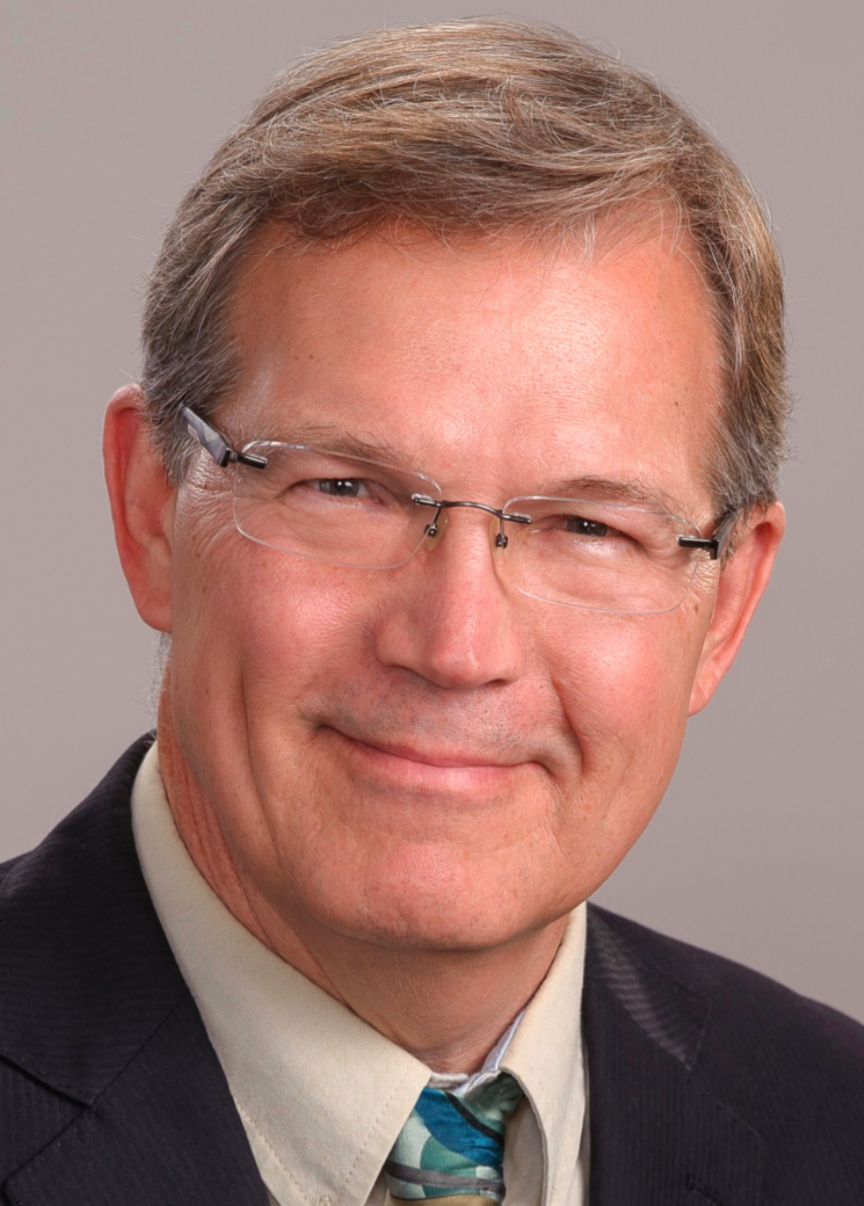
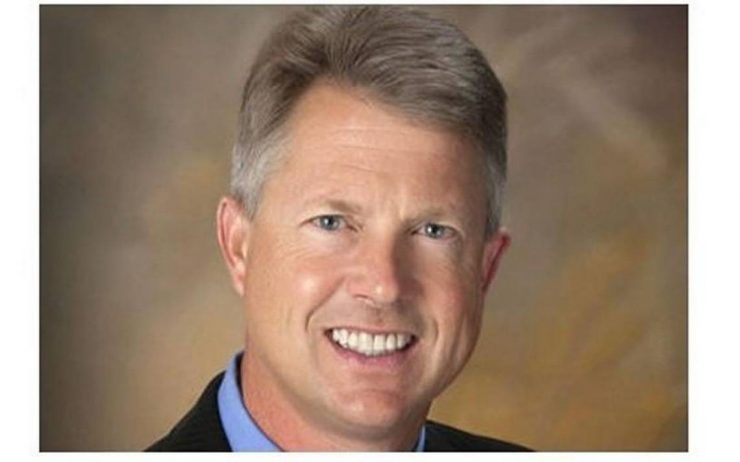
Michael A. Smith is a Professor of Political Science at Emporia State University.
The connection between faith and politics is unavoidable. From the freethinking deists that made up a good portion of our nation’s Constitutional Founders, to America’s periodic evangelical revivals, to the roles of Judaism, Catholicism, and other faiths among the waves of immigrants that have transformed America, our history, politics, and faith cannot be easily separated.
Kansas has often been right at the center, from the abolitionist movement and Bleeding Kansas, to the 1991 anti-abortion Summer of Mercy, through the Brownback governorship to the present.
In recent times, the connection between religion and politics shows up in election returns. White, Evangelical Christian voters backed President Trump by over 80%, while the religiously unaffiliated went overwhelmingly for Hillary. Recent Republican missives to Jewish voters regarding Israel do not appear to be working— Jewish Americans still go strongly for Democrats. Catholics are split, in large part by ethnicity, with those of European heritage going Republican, while Latin Americans favor Democrats. American Muslims—many of whom might seem predisposed to support Republicans due to shared, conservative cultural values—now see the Republican Party as unwelcoming and trend heavily Democratic, as do other small-but-significant groups like Buddhists and Unitarian Universalists. Mainline Protestants are declining dramatically, but some churches have found new life by embracing social justice and diversity. However, there is only one large group showing major growth: the “nones.”
A recent Pew Charitable Trust poll shows “nones” on the rise—now roughly equal to Catholics and Evangelicals (considered separately) as a percentage of the population, and decidedly younger. What will be their influence on our politics?
An unfortunate homonym for nuns, nones are people that answer “none” when asked about their faith traditions, for example, by opinion pollsters.
Right now, nones are defined primarily by what they are not. Nones are not evangelicals, nor conservative Catholics. When asked to further-elaborate their views by the Pew pollsters, the most-popular self-description was “question certain religious teachings.” This begs the question, which ones? In politics, this means that they generally reject those groups’ support for the Trump presidency. They do not seek to criminalize abortion, nor cite “religious freedom” as an excuse to discriminate against their friends who are LGBT, Muslims, or immigrants. Yet, this tells us mostly what the nones oppose, not what they support. Perhaps they have not arrived at a final answer to this question.
Young nones will one day have to work out their approaches to religion and secularism in ways that go beyond pro- vs. anti-Trump. Will they be open to alternative faith traditions like Social Justice Christianity and Western Buddhism? Or, will they stick with secularism? No matter their choices, our chosen faith (or non-faith) traditions have a profound impact on our state and nation’s cultural climates, past, and present, and the young nones just might hold the keys to our political future.
Michael A. Smith is a Professor of Political Science at Emporia State University.
Submitted by
Judith Deedy, Game On for Kansas Schools
Patty Logan, Stand Up Blue Valley
Megan Peters, Education First Shawnee Mission
Nikki McDonald, Olathe Public Education Network
Susan DeVaughn, Educate Andover
House Speaker Ron Ryckman’s recent op-ed was extremely disappointing to Kansas public education parent advocates.
We disagree with Rep. Ryckman’s assertion that the Legislature should have passed his “better” school funding plan. We oppose the way his plan attempts to resolve the inflation issue and believe it would fail constitutional muster. We can’t go into much detail, though, because Rep. Ryckman submitted only an outline of his “better” plan to his fellow legislators over 250 days after the Court issued its opinion and with only two days remaining in the regular session. Rep. Ryckman’s “better” plan had no public hearings, no budget runs, no legal basis, and yet he complains because his last-minute deal wasn’t adopted.
Instead of proposing a last-minute problematic plan, Rep. Ryckman should have provided constructive leadership through the regular session. The Senate understood how narrow the Gannon VI school finance ruling was and how close lawmakers are to reaching constitutional adequacy for the first time in over a decade. They passed a bill to fund inflation in mid-March. House leadership failed to resolve the inflation issue, choosing instead to usurp the role of our state and local boards of education through controversial policy changes and entered the final days of the regular session without having passed a funding bill.
More offensive than the procrastination and lack of focus exhibited by House leadership is the way Rep. Ryckman rewrites history. If the Legislature had returned to the promises made in the Montoy case as the national recession lifted in 2010, there would be no Gannon lawsuit. Instead leadership prioritized continued budget cuts and later the 2012 tax plan that many of us correctly predicted would put Kansas in a huge fiscal hole, leaving it unable to meet its financial obligations. The Block Grant plan Rep. Ryckman championed in 2015 is more typical of past obstinance that ensured school finance litigation would continue as our children progressed from elementary to middle to high school. The bill passed by the Legislature this session is not “the same failed approach,” but is rather a refreshing good-faith effort to end the litigation.
Rep. Ryckman’s concept of how to deal with fiscal uncertainty in the future defies common sense and abdicates his responsibility. His overall theme is that we must “help” our children by avoiding promising them adequately funded schools, because that promise might be challenging to keep in the future. Instead, he urges Kansans to ignore actual estimates on the cost of educating our children, and instead for schools to make do with less, regardless of needs, regardless of state standards. Rep. Ryckman’s stance is particularly ironic given his support for SB 22, a tax cut proposal that would blow a much bigger hole in the budget than the inflation adjustment that just passed.
Funding inflation into the future is not a “poison pill.” Unless the Legislature plans to prohibit school vendors from increasing their prices, the inflation adjustment merely maintains district purchasing power from year to year. Failure to adjust for inflation was the lesson we learned from the Montoy case and results in functional cuts to our schools.
Rep. Ryckman knows we were watching the votes on the inflation funding bill. He voted against it. He says the vote was not about who loves schools and who doesn’t, but about whether “we want to make promises we can keep.” We understand the competing demands on the state budget, but the Legislature has never been able to demonstrate our schools don’t need the funding they agreed to provide last year. The expert hired by the Senate last year only bolstered the claims of education advocates. The real question isn’t how do we avoid making promises we can’t keep, it’s how do we keep the promises we need to make for the sake of Kansas children?
After 40 years as a doctor interacting with patients, in the last two and a half years the tables turned, and I’ve become the patient. Although most are good, I’ve found some doctors are detached, some are too quick, some would rather be somewhere else, some are even angry; but, when a physician who cares walks into the room, and I’m not exaggerating, the day becomes better, the pain becomes less, and hope fills my heart. Scientific knowledge is important, but the ability to convey honest concern, human thoughtfulness and compassion is equal in importance in this healing profession. So, how do we select pre-med students for that, or teach compassion in medical school?
There are studies that show those interested in humanities or taught disciplines that explore how people tick, do better in the compassion department. These disciplines include history, literature, religion, ethics, anthropology, psychology, cultural studies and the arts of theater, film, painting and poetry. Some explain that the humanities give us the very reason to learn science and mathematics.
Several studies support the value of humanities in medicine. Seven hundred medical students were surveyed about their lifetime exposure to the humanities and the results indicated that those who had more humanities knowledge had more empathy, tolerance to ambiguity, resourcefulness, emotional intelligence and less burnout. Another study found that a med student’s ability to recognize diagnostic clues increased by more than 35 percent after taking a visual arts class. Another study found practicing improv theater helped med students learn to prepare for unexpected questions and conversations. A fourth study showed how writing exercises helped med students have foresight into what a patient may be experiencing. Clearly, an exposure to the humanities makes a better doctor.
I believe that care providers who have had a well-rounded humanities education have a better chance of understanding about how it feels to face pain, nausea, loss of bodily functions or even a cancer diagnosis. Those steeped in good literature or art have a better opportunity to tap creative juices to problem solve and tolerate a life that can be ambiguous and unpredictable. Those who are knowledgeable of history, ethics, cultural ways will find it easier to know when it is time to stop aggressive care and move toward comfort.
This is a call for all students to become readers, to find time to enjoy the humanities, to exercise your caring and compassion muscles; so, when you come into the room of a person suffering, it makes their pain less and day better.
For free and easy access to the entire Prairie Doc® library, visit www.prairiedoc.org and follow The Prairie Doc® on Facebook, featuring On Call with the Prairie Doc® a medical Q&A show streaming live most Thursdays at 7 p.m. central.
Donna KrugThis is a busy weekend with the celebration of Easter and also Earth Day on April 22nd. I’m offering a free educational program “It’s Easy to be Green” Wednesday, April 24th in Great Bend that is based on a fact sheet I wrote several years ago by the same title. If there is interest in the Hays community for this educational program, I’ll be happy to share. Just give me a call. There are countless ways you can reduce your ecological footprint by consuming less energy and water, and reducing solid waste. Consider these recycling tips from A to Z in your daily living.
Avoid fast food. Most fast food is over-packaged in containers that will take forever to break down.
Buy recycled products whenever possible. Good things come in less packaging.
Change a light bulb. Consider replacing standard bulbs with compact fluorescent ones and you will get more light for less money.
Don’t buy aerosols. They cannot be recycled so they fill up the landfill.
Eating food from your garden is better for your health and the environment.
Find out how to dispose of hazardous waste. The Barton County landfill offers this service on the third Saturday of each month. Items like paint cans, unused pesticides and used motor oil are some common waste materials.
Get your water from the tap. While it may be necessary to filter contaminants from your water supply, drinking filtered water will keep plastic bottles out of the landfill. (And FYI: plastic beverage bottles take 450 years to decompose.)
Have a green picnic. Avoid using paper or plastic plates or utensils. Use separate trash bags to collect paper, glass and aluminum.
Identify energy wasters. (Examples: turning off lights, fix dripping faucets, etc)
Join an environmental group. Get involved in your community and encourage others to do their part.
Keep the car at home. Whenever possible walk or ride a bike to complete errands. An added benefit to this tip is that you will be exercising regularly.
Look at labels. Is it hazardous? Also check to see if the packaging is recyclable.
Make scratch pads from paper you have written on one side.
Say No to paper and plastic bags at the supermarket. Bring your own bags along.
Observe the 3 R’s – Reduce, Reuse, and Recycle.
Plant a tree. Trees add beauty to the landscape & shade provided can save energy.
Quit throwing away batteries. Use rechargeable batteries whenever possible.
Recycle everything. Set up storage bins at home to collect newspapers, glass, aluminum, plastics and cardboard. Recycle food waste by starting a compost site.
Stop a leak. Organize a stop a leak day where family members tighten, insulate, replace, caulk or do whatever else they can to make their house tight.
Turn off the lights. Add stickers to lights reminding family members.
Use recycled paper and other recycled products whenever possible.
Visit the recycling center in your community. Ask for a list of items they accept.
Write a letter. If a company is doing something you do not like let them know. It is also good to let a company that is working hard to be earth friendly that you appreciate their efforts.
Examine the world around you. Try to make everything you do “Earth friendly.”
Yell at a litterer. Well, maybe don’t yell, but you should say something. Remind the person how unsightly scattered trash is and how bad it is for the environment.
Zero in on specifics. There are so many issues related to environmental problems and solutions. Choose one or two to really get serious about. Do not try to do everything at once.
I hope your awareness has been raised so that every day is Earth Day in your household.
Donna Krug is the District Director for the Cottonwood Extension District. You may reach her at: [email protected] or (620)793-1910.
In the months and years leading up to the most recent presidential election, you may have heard me say, “There is no question we will have a female president someday, I just hope it’s not her.”
Hilary Clinton didn’t get votes like mine; not because of her gender, because of who I observed her to be.
There is a subtle feeling of hypocrisy that creeps into the ongoing conversation about gender on the national level. Singling a woman out as the first to do something or talking about how great it is to see a woman in a specific position feels like a fail for feminism in my mind.
Yes, women can do anything they set their minds to, but so can men. Equality is the basic tenant of feminism. Yet gender remains front and center in the national debate.
Professionally, I don’t feel disadvantaged because of my gender. In a boardroom, people respect me because I work hard to be engaged, understand the issues and share my opinions. The few people who have shown signs of sexist behavior in my presence quickly learned I don’t tolerate it, and they no longer have the privilege of working with me. That may sound arrogant, but I understand my value and know how others should treat me.
Conversely, it is naïve to think gender never matters. It absolutely does. There are women pioneers who have fought for my current comfort. Women still often have a completely different set of expectations and challenges to face — from the pressures of conforming to stereotypes, to the considerations required to maintain personal safety.
Amid this complex and often uncomfortable conversation surrounding gender, I wonder about my generation’s role. We won’t be like the pioneers of previous generations sacrificing and fighting for the far-off dreams of equality. Our firsts and successes are in some ways only a matter of time.
Recently, I attended an event aimed at helping women in agriculture grow. Surprisingly, there were more adults in attendance than students. These women worked as university professors, highly skilled industry professionals, and farmers and ranchers. Each are excellent role models and wanted to share because they are proud of what they have achieved.
Students at the event were genuinely interested in developing their skills. They were excited to have access to great role models, but I wonder if our efforts where actually counterproductive. We were, in some cases, the ones saying they need to fight to have a chair in the boardroom or they will be treated differently. They already expect a seat at the table.
It’s time to stop acting surprised when a woman does something outstanding. Anyone can find a reason to be an outsider in the group: the only woman, the youngest person, the most rural or any number of other qualifiers. None of that matters if the person brings value to the conversation.
We should be teaching young women and men the same things. If you are a person who brings value by your words and actions, you will earn respect. Focus all your energy on being your best. It will make you stand out, but in the most desirable way.
“Insight” is a weekly column published by Kansas Farm Bureau, the state’s largest farm organization whose mission is to strengthen agriculture and the lives of Kansans through advocacy, education and service.
Thursday will be, well, not quite the same as a puff of white smoke emerging from the Vatican to signal selection of a new Pope, but close for us habitués of the Kansas Statehouse.
It’s the day that the Consensus Revenue Estimating (CRE) Group posits just what the state will book in revenues for the remainder of this fiscal year (to June 30) and for the upcoming fiscal year.
That estimate becomes the basis for every dime in spending that the Kansas Legislature will approve for the rest of this, and all of the next, fiscal year.
It’s the bank account. Don’t over-spend, and at the same time, don’t not spend enough to provide Kansans the services that they want their state—and its governor and Legislature—to spend on them.
The group, professors and economists and such, looks at virtually every tax number available. Then they estimate just how much of that will wind up in the State General Fund, and then the governor and legislators spend it.
This year’s CRE will provide the first good look at the “trickle down” of the December 2017 federal income tax cuts, which presumably freed up more money for the state to levy taxes against.
Businesses—those with overseas interests—that have been pushing for $130 million in income tax cuts to keep their tax bills level may or may not be able to recalculate just how much in the way of tax breaks they need to keep their profits stable or growing. Then they just have to squeeze it out of the Legislature.
And individual income taxpayers? Not sure, but the CRE will likely tell us how those federal income tax changes—lower rates—will work to make more of their income taxable by the state. Remember, Kansas income tax calculations start with what’s left over after you’ve paid your federal income taxes.
While the rate reductions are a key to that CRE computation, it may well tell legislators just how those new and higher federal standard deductions ($12,000 for single filers, $24,000 for marrieds filing jointly) will work with the state’s standard deductions. Remember, because the Legislature hasn’t “de-coupled” those standard deductions, if you can’t top the federal standard deduction then you are stuck with the Kansas standard deduction–$3,000 for singles, $7,500 for marrieds filing jointly.
What might we learn Thursday? Well, it starts with CRE predicting enough revenue to finance government, and probably pick up some of those services that have been squeezed the last few years because revenues were lower than hoped.
And if the estimate is for more money than needed for those basics? Well, after saving a dab for fiscal safety, there’s likely to be some room for tax cuts—possibly even this legislative session.
Of course, then the fight over the tax cut bill that Gov. Laura Kelly vetoed starts again, but at least there would be an identifiable amount of money that can be spent on tax cuts—after the social welfare, education, transportation and administrative pieces of the state budget are taken care of.
How much will be floating around? We’ll know Thursday.
And who gets that loose change in the state’s pocket? Corporations? Probably not. Individual income taxpayers? That’ll be fun to watch. Give it to the poor and middle-class or give it to the wealthier Kansans. As we recall, each of those folks gets one vote, and there are more Kansans in the lower brackets than at the top.
That CRE puff of white smoke? It might blow in a lot of directions…
Syndicated by Hawver News Company LLC of Topeka; Martin Hawver is publisher of Hawver’s Capitol Report—to learn more about this nonpartisan statewide political news service, visit the website at www.hawvernews.com
Our thoughts continue to be with the folks in the Norton community, we lift you up and wish you strength and healing in the days and weeks ahead.
The Kansas Legislature is on a “Spring Break” until May 1st, so it is a time to catch up on other work, visit with constituents and attend meetings to hear directly from those we serve.
I have the privilege of serving as Chairman of the Higher Education Budget Committee and am a strong supporter of all of the university, colleges and technical schools in the state, and last weekend attended functions celebrating the successes and opportunities at Manhattan Christian College and Colby Community College.
There was a lot of activity right before first adjournment and I wanted to share a few highlights with you this week.
Following several rounds of negotiations, the budget conference committee was unable to come to a final agreement on SB 25, which is the bill in which all budget positions are being discussed. House and Senate negotiators left all decided positions frozen and will take up conferencing when the Legislature returns for Veto Session May 1.
House Appropriations and Senate Ways and Means Committee will meet just before the start of Veto Session to put together Omnibus budget bills. The meeting is set for April 30.
The Committees will meet jointly to receive the Consensus Revenue Estimates (CRE), caseloads adjustments, and potentially Governor’s Budget Amendments (GBA), prior to holding separate meetings.
The CRE is determined by the Consensus Revenue Estimating Group, which has representatives of the Division of the Budget, Kansas Legislative Research Department, Kansas Department of Revenue, and economists from the University of Kansas, Kansas State University, and Wichita State University. The group meets twice each year, generally in November and April.
The CRE is the official revenue projection for the State General Fund. Estimates are made for the budget year and adjustments are made for the current and out year. The Governor uses the November estimate to finalize her budget recommendations. The spring CRE will be released on April 18 and may be used by the Legislature to adjust expenditures. The CRE and Budget Conference positions can be found here.
The House approved of the conference committee report of SB 67, which would require a physician to verbally inform a woman who is seeking a medication abortion that she may be able to reverse the intended effects of the abortion before the medication regimen is complete.
The bill specifically applies to medication abortions induced via mifepristone (also known as RU-486), which is followed by a second pill named misoprostol. The first pill is taken in the presence of a physician and the second is taken at home. Under this bill, the physician must inform the woman 24 hours before the abortion takes place of the possibility of reversing the intended effects of the abortion, before the second pill is taken. In addition, the facility where the first pill is administered must post a sign with the same details.
The conference committee amended the bill to require a report to be sent to KDHE regarding APR. The report would include the prescription/administration of progesterone, the failure of the progesterone treatment to reverse the effects of the medication abortion, and the maternal and newborn health conditions, at the time of birth, if a pregnant woman successfully reversed the pill-based abortion.
Seven states have enacted APR legislation, including Arizona, Arkansas, Idaho, Kentucky, North Dakota, South Dakota, and Utah. Four states including Kansas are considering this type of legislation. This language was previously in HB 2274 (sponsored by 60 representatives) and SB 167 (sponsored by 21 senators). SB 67 was approved with a veto-proof majority vote of 85-35. The bill has been sent to the Governor for consideration.
The House passed HB 2144, which would require community colleges to post on their respective websites their tuition rates, fees, cost per credit hour, percentage of students attending each campus, enrollment, percentage of students residing inside and outside of the community college district, property tax revenues and mills levied over five fiscal years. Specific student fees imposed by the colleges would be required to be spent on those particular purposes. Billing statements must also include student fees broken down by purpose. The aggregate amount disbursed for the two previous fiscal years for scholarships, foundation scholarships, and Pell Grants for students residing in the community college district and those who reside outside the state.
Property taxes are levied within a community college district to fund the local community college. Requiring that these colleges post property tax information along with scholarship information, general credit hour costs and other information digitally ensures that taxpayer dollars are spent appropriately and adequately. Disclosing the specific purposes of each student fee also guarantees this.
HB 2144 would also allow community college students and prospective students to verify which offered courses will afford them the opportunity to transfer to a Regents institution, should they decide to attend any of those institutions. The House concurred with amendments in conference with a vote of 116-6. The bill has been sent to the Governor for consideration.
And, the House passed HB 2209, which would primarily exempt a nonprofit agricultural membership organization in Kansas, the Kansas Farm Bureau (KFB), from the jurisdiction of the Commissioner of Insurance should healthcare benefit coverage be provided to its members.
This healthcare benefit coverage would allow KFB to offer affordable plans that are available to members without the threat of cancellation. It would be individually rated, allowing KFB to accurately assess risk to keep premiums affordable as well.
KFB’s coverage is not considered health insurance and is not offered by an insurance company. It is not an association health plan, not compliant with the Affordable Care Act, and not a mandate.
HB 2209 and KFB’s coverage offers an affordable alternative to high healthcare coverage costs in Kansas, reduces the number of Kansans without coverage, provides an additional revenue source for the state, provides an incentive for Kansans to remain on the farm and helps starting businesses by reducing healthcare costs. The bill would also expand association health plans and amend the Insurance Code to exempt an entity providing non-insurance healthcare benefits coverage. Like the KFB portion of this bill, these provisions would also be exempted from the jurisdiction of the Insurance Commissioner.
Secondly, the bill would prevent life insurance companies from refusing to insure individuals who are living organ donors. Organ donors would be subject to the same standards as individuals who are not organ donors. This is a commonsense measure to protect those who have chosen to donate their organ(s).
Thirdly, the bill would require a life insurance benefit to be payable to owner or the beneficiaries, and in the event they could not be found, then the benefits would revert to the state as unclaimed property. The insurance company would be required to notify the State Treasurer should the beneficiary not submit a timely claim or the company has been unable to contact the beneficiary. The unclaimed policy would then be required to submitted to the State Treasurer.
Lastly, HB 2209 would allow the Kansas Board of Regents (KBOR) to purchase cybersecurity to protect student records and other sensitive information without typical purchasing compliance procedures of the Department of Administration, and also independent of the Committee on Surety Bonds. This would allow KBOR to more easily acquire protection for taxpayer kept data. The House adopted the Conference Committee Report with a vote of 116-6. The bill has been sent to the Governor for consideration.
If I can be of assistance or if you have questions or concerns, please reach out: email is: [email protected] and you can always try my cell number is (785) 302-8416.
It is my honor to serve you in the Kansas House of Representatives.
Rep. Ken Rahjes (R-Agra), is the 110th state representative and chairman of the Higher Education Budget Committee. House District 110 includes Norton and Phillips counties as well as portions of Ellis, Graham, and Rooks counties.
Native Kansan Karen Madorin is a local writer and retired teacher who loves sharing stories about places, people, critters, plants, food, and history of the High Plains.Those who follow my essays know I love history and finding surprise connections. While spending hours buried in old card catalogues and tackling primary sources still triggers a racing pulse, a google with unexpected results has the same result. Recently, I sent copies of family photos to the Ford County Historical Society. One pictured my Great Grandfather Reuben Bisbee II who was born in Phillips County while his father served as a Methodist minister at Long Island, Logan, and Marvin. Choosing a different career path, this Reuben served on the Dodge City Police Force and raised his family in Ford County.
The curator was glad to receive two pictures of early Ford and one of a uniformed policeman wearing spats and standing by his K-9, a Rin Tin Tin double. She soon posted them online. I embarrassed to see my paragraph detailing the relationships resulting in my having the documents included. I hadn’t meant to share that with the history-loving world, but I see why it’s important to maintain a chain of evidence, so to speak.
In short time, viewers responded to the photos. One even recognized that the old family boarding house is still in Ford, now functioning as a home on main street. Unfortunately, the accompanying livery stable once located behind this business is now gone. The highlight was a response from a fellow history buff who had tickets and warrants my Great Grandfather had signed. I was especially excited when she said she’d share her treasures.
Considering that I never look forward to receiving speeding or parking tickets, I laughed at my quick response, “I’d love to see them!” Then my mind took several bunny trails. Did this person have a relative inclined to break the law and run into my ancestor? Did she, like a friend in Ellis, inherit boxes filled with ancient documents from the early days of settlement? I haven’t inquired yet, but there’s still time.
Keep in mind, this grandpa was dead and buried in the Dodge Cemetery long before I was a sparkle in my mother’s eye. Despite that, stories his son, my grandpa, told wide-eyed grandchildren riding in his Mercury’s back seat on Sunday drives to Jetmore brought this early law enforcement officer and his era to life. I still hear Grandpa pointing out a washout where his dad once arrested bank robbers. I get lost while examining sepia-toned photos that relay snippets of the life he shared with his first wife, my great grandma.
While it was a thrill to think about receiving those old tickets and warrants my long dead police officer relative signed, I admit it’s a better idea for them to be included in the Ford County Historical Society Archives. The administrators responded as quickly as I did to the individual offering to share them. Now that I know where they are, I can either ask for copies or stop by to visit.
On that note, I encourage you to copy and share family documents with local historical organizations. Who knows when a researcher will discover the connecting piece that fills a hole in their ancestral jigsaw?
Native Kansan Karen Madorin is a local writer and retired teacher who loves sharing stories about places, people, critters, plants, food, and history of the High Plains.
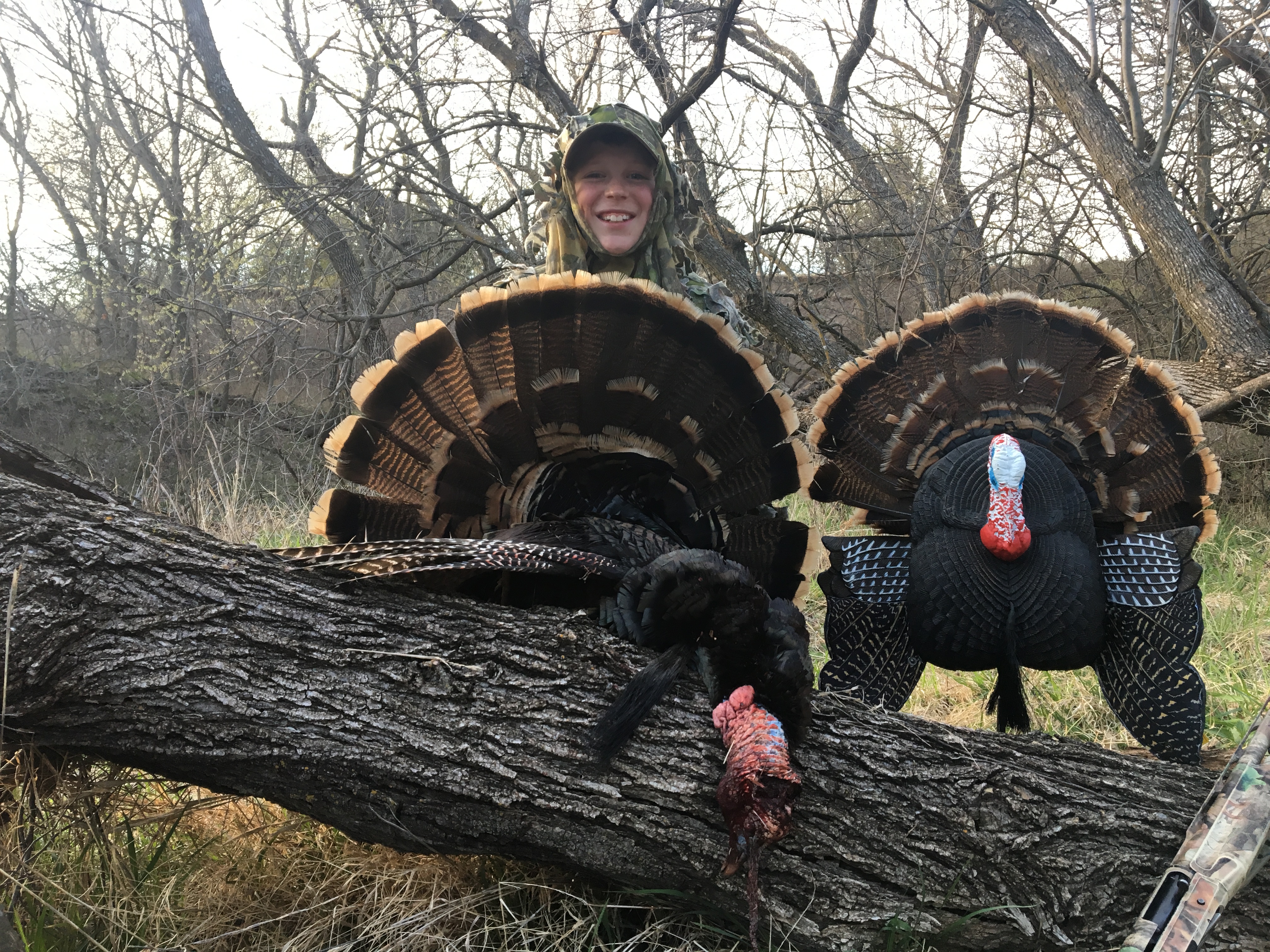
Thirteen-year-old Cael Austin and his dad Jason were hunting northwest of McPherson on the opening evening of Kansas youth turkey season, and had set up along one of several wheat fields, calling every few minutes hoping to attract the attention of roaming gobblers.
After a time, they moved, sat awhile and called some more, repeating that strategy twice more before finally hearing and spotting a small group of turkeys in a field of wheat and corn stalks. Slinking slowly through the trees surrounding the field, they eased into position, but the turkeys disappeared ahead of them and a dozen-and-a-half deer flooded onto the field instead (now where were they during deer season?) They called again, trying to convince the gobblers that some lonely little hen required their attention, and sure enough, as the deer spooked and ran for the trees, out came the small group of turkeys they had spotted before, consisting of a few hens and 2 strutting toms.
The hunters had a Scoot-N-Shoot turkey decoy, a very lifelike looking decoy that holds a real turkey fan for a tail and has wings that fold open, allowing a hunter to hold the decoy in front of them and actually move toward a group of turkeys. On hands and knees with the decoy in front of him, Cael inched across the stalks toward the 2 strutting toms, figuring they would be nervous about the new “intruder.”
Things changed in an instant though as both gobblers headed for Cael and the decoy on a dead run like a pair of linebackers rushing the quarterback. As he attempted to pull himself into a shooting position, the sling on his shotgun caught on his boot. So there he was, crouched behind the decoy with 2 angry gobblers bearing down on the decoy, probably intent on giving it a good thrashing, and unable to get his shotgun into shooting position. A final tug loosed the sling from his boot and he swung the shotgun into position to stop the biggest tom at about 5 yards as his buddy raced for cover.
Cael had 2 tags, so a week later, they were out again, this time northeast of McPherson. They parked on a mud road and after carefully navigating through a ravine filled with junk washers, dryers and rusting old car hulks, they again situated themselves along a cornstalk field. After a couple hours of calling and moving, the 2 hunters ended up behind a stack of irrigation pipe. While his dad sat there and called, Cael set out by himself and after another long walk, happened upon a lone gobbler munching on a pile of deer corn below him in a ravine along the river.
He tried placing the decoy on the ridge to get the gobblers attention so he could slip around beside him, a trick his brother Jared had shown him, but the wise old bird busted him and headed for a nearby stand of cottonwood trees. He watched the turkey disappear among the trees, and noticed a couple smaller saplings that had bent and grown across each other, forming a “cross” shape a couple feet above the ground. As he pondered the odd tree formation, the bright red head of the tom turkey that had just run from him suddenly appeared in the upper notch formed by the trees, much like a shooting game on the state fair midway.
Figuring it was now-or-never, he shot the turkey through the notch in the trees and again won his prize. As a side note to this adventure, when they got home they noticed the gobblers beard, a turkey hunters trophy as revered as a buck deer’s antlers was missing completely. The next day Cael’s dad and a friend searched over their lunch hour and found the missing 10 inch long beard at a place they had stopped for a rest on their way back to the truck. Evidently Cael had stood on it when hoisting the bird over his shoulder and unknowingly pulled the beard clean off the turkey. A successful father – son hunting trip, great adventures and fresh roasted wild turkey breast; what better ways to Explore Kansas Outdoors!
Steve Gilliland, Inman, can be contacted by email at [email protected].
We grab our phones and tablets and brace ourselves for the hoaxes sure to be lurking behind every tap or click.
We wish every day could be like April Fools’ Day. Why?
Think about it. We awake on April 1, grab our phones and tablets and brace ourselves for the hoaxes sure to be lurking behind every tap or click. Determined not to be duped, we look at every post, email and text with a healthy dose of skepticism. Where is the evidence? What’s the source of this alleged scoop? Is this premise believable? “They won’t fool me into sharing false news,” we think and brag about all the clickbait we outwit.
Then 24 hours later, it’s back to business as usual. We let down our guard. We stop thinking critically about the content we encounter online and in our social media feeds. We indulge in bad habits and don’t ask questions. The media literacy superhero puts away the cape until next year.
It’s no secret that news consumers have developed some bad habits. We gravitate to platforms that only share news we want to hear, share stories after only reading their headlines and get sucked into content that outrages or entertains us.
The blame isn’t entirely consumers’, though. News producers may feed into the appetite for biased content and aggregators use mysterious algorithms that boost questionable content. But given all these imperfections in the media landscape, how do we encourage good daily habits? How do we restore trust in journalism, the unofficial fourth estate working daily on our behalf?
If we can’t make every day April Fools’, then from our vantage point, the answer is media literacy education.
Media literacy education is not new, but the recent intensified interest in building up these essential skills has cast light on some holes in traditional approaches. While media literacy teaches students how to analyze, evaluate and even make their own content, it often fails to instill an understanding of why these skills are so important and why they’re necessary in the first place — every day, not just on April Fools’. Without laying this foundation — the reasons to beware and the reasons to care — it can be too easy for media literacy training to breed hardened cynicism. This type of disillusionment can widen societal divisions and amplify the very echo chamber effect that media literacy should combat.
Because of our First Amendment mission, we’ve always approached media literacy differently. We marry the analytical aspects — such as separating fact from fiction and identifying bias — with active free expression and productive social engagement. For example, consider the need to confront and counter confirmation bias, the tendency to selectively search for and consider information that confirms one’s own beliefs.
Where traditional media literacy might focus on how to find diverse information sources and assess competing claims, we broaden the approach to also look at how confirmation bias can affect the ways we express ideas and engage with pressing issues as individuals and as a society. This marriage of free expression and analytical skill is what we call First Amendment media literacy.
How do we get these vital tools and habits? How do we hone the skills all citizens need to navigate the information universe? In our work, we partner with other educators who have the skills, existing relationships and community trust, helping us deliver content that engages and resonates with everyone from students to seniors.
But educators can’t do it alone. We need the help of news producers, aggregators, technologists and everyone involved in the production and distribution of news and information. In particular, journalists can lead the charge for accurate, fair, clear reporting on issues that are important to consumers. We all can celebrate the successes of the unofficial Fourth Estate, working daily on behalf of consumers and consistently providing reliable places for trustworthy news in all communities.
Technologists can take a more proactive approach to curtailing the spread of disinformation by developing algorithms and mechanisms that prevent this type of content from seeing the light of day.
We can all support each other as we develop the stamina to maintain a healthy skepticism throughout the entire year, not just on April 1 — and that’s no joke.
Contributing to this column were Pierce McManus, NewseumED’s digital communications and outreach director, and Kirsti Kenneth, NewseumED’s curriculum developer. Anna Kassinger, NewseumED’s director of curriculum and Barbara McCormack, NewseumED’s vice president of education, can be reached for media inquiries at [email protected].
WASHINGTON – U.S. Senator Jerry Moran (R-Kan.) has joined a bipartisan group of colleagues in calling on Amtrak to continue service to rural communities in Kansas and across the United States by investing in long-distance and state-supported routes, including the Southwest Chief.
“We are writing in strong support of Amtrak’s national network, including the long-distance and state-supported routes,” the senators wrote. “These routes serve small, midsize, and rural communities in our states and provide essential connections to jobs, tourism, and family that are critical to the people and places we represent. As you develop Amtrak’s plan for the long-term viability of the company, we urge you to recognize the critical importance of the entire national network, which includes the long-distance and state-supported routes. Once again, we seek your firm commitment that Amtrak will abide by its statutory purpose – maintaining a truly national network for our rail system.”
“Congress purposely created a national network of long-distance and state-supported train service throughout the nation, in recognition of the importance of a transportation system that reaches every community – regardless of how rural it may be,” the senators continued. “Amtrak is more than a collection of individual train routes; it is a web of essential connections that bind our country together and link rural communities with major markets and economic opportunities.”
The letter requests responses to questions about Amtrak’s budgeting process and their future plans regarding long-distance train routes and their interest in introducing new short distance routes. The letter also addresses the changes Amtrak made to long-distance routes last year, such as the removal of ticket agents at stations across the country, and asks when Amtrak plans to restore the services it previously provided passengers.
Sen. Moran has led a bipartisan push to make certain Amtrak maintains train services along the established, long-distance passenger rail route of the Southwest Chief, which runs daily between Chicago and Los Angeles, connecting towns and cities across the western United States and providing train and long-distance passenger service, particularly through rural areas.
The Southwest Chief stops in several Kansas communities, including Lawrence, Topeka, Newton, Hutchinson, Dodge City and Garden City.
The letter was also signed by Senators Tom Udall (D-N.M.), Martin Heinrich (D-N.M.), Michael Bennet (D-Colo.), Pat Roberts (R-Kan.), Cory Gardner (R-Colo.), Catherine Cortez Masto (D-Nev.), Joe Manchin (D-W.Va.), Dick Durbin (D-Ill.), Jon Tester (D-Mont.) and Kyrsten Sinema (D-Ariz.).
We are writing in strong support of Amtrak’s national network, including the long-distance and state-supported routes. These routes serve small, midsize, and rural communities in our states and provide essential connections to jobs, tourism, and family that are critical to the people and places we represent. As you develop Amtrak’s plan for the long-term viability of the company, we urge you to recognize the critical importance of the entire national network, which includes the long-distance and state-supported routes. Once again, we seek your firm commitment that Amtrak will abide by its statutory purpose – maintaining a truly national network for our rail system.
Amtrak’ recent appropriation clearly demonstrates Congress’ strong, bipartisan support for the network. In making this investment, Congress chose to ensure the continued viability of Amtrak’s entire system, including the National Network’s long-distance and state-supported routes. These funds should be used to operate the entire existing system and, where possible, expand the system to grow both revenue and ridership.
Congress purposely created a national network of long-distance and state-supported train service throughout the nation, in recognition of the importance of a transportation system that reaches every community – regardless of how rural it may be. Amtrak is more than a collection of individual train routes; it is a web of essential connections that bind our country together and link rural communities with major markets and economic opportunities. It provides residents of these communities with transportation options on which families, seniors, and businesses rely to access jobs, create economic opportunities, see our beautiful country, and visit family. The federal investment in Amtrak ensures the small, midsize, and rural communities served by Amtrak’s long-distance and state-supported routes continue to receive this essential service. The long-distance and state-supported routes of the national system are no less important than the Northeast Corridor (NEC), another critical aspect of Amtrak service.
The long distance and state supported trains generate more ridership than the NEC and similar levels of revenue. Many long-distance sleeper cars are regularly sold out. The entire national network helps cover Amtrak’s fixed corporate costs such as police, facilities and capital expenditures, particularly when the route shares trackage with the NEC. Continuing and expanding the entire national system of long-distance and state-supported routes is both good for Amtrak’s business, and our national economy.
We look forward to working with you and receiving assurances of your commitment to the national network. For these reasons, we request your response to the following questions by April 29, 2019.
Amtrak customers have already experienced a deterioration in service as Amtrak pursues efficiencies. A recent report in Trains Magazine[1]indicated that Amtrak utilizes accounting mechanisms to inflate costs associated with the national network, by charging long-distance and state-supported routes for costs which may be more appropriately charged to the Northeast Corridor. We are concerned that Amtrak’s accounting is intentionally obscure and is causing a false inflation of costs of lines outside of the Northeast Corridor. Please provide the accounting methods used to determine the costs referenced.
Does Amtrak plan to truncate or otherwise alter any of the long-distance train routes? If yes, then:
Which routes are under consideration for alteration?
Would any of these routes be altered in such a way that they would fall under the definition of State Supported routes, requiring states to find local operating funds for existing service? What discussions has Amtrak had with states, if any, that lead it to believe states would be willing to assume this financial obligation?
Amtrak says it wants to introduce new short distance routes with daytime service and multiple frequencies. What specific routes is Amtrak considering? What discussions—if any—has Amtrak had with host railroads, stakeholders, or government officials regarding these additional frequencies?
Amtrak claims that public demand for its long-distance interstate service is declining. Yet the number of passengers using the total long-distance network in FY 2017—the last year without major service interruptions—was 10.6% higher than it was eight years earlier in FY 2010. It was also higher than in all but three of the last eight years. This growth occurred in spite of worsening on time performance, capacity reductions and other changes to service levels. On what basis does Amtrak claim that demand is declining for long-distance trains?
Amtrak has made a number of changes impacting long-distance routes in 2018 that may reduce revenues and services, such as the removal of ticket agents at a number of stations across the country. Why did Amtrak calculate ridership totals based on weekly boardings on routes that do not run daily? When will Amtrak restore or otherwise alter assistance it provides passengers at stations based on Congressional directives in the Fiscal Year 2019 Appropriations Act?
Amtrak has expressed concern at how the dispatching practices of some host railroads has led to deteriorating on-time performance (OTP). Does Amtrak have a strategy to improve OTP and better interface with the host railroads? Are there policies that would assist Amtrak in this endeavor?
Sleeper cars provide approximately 40-50% of the revenue on many long-distance trains. Please provide us with an update on the 25 sleeper cars that were scheduled to be delivered in 2015 and 2016. Please provide a timeline for completing this order and putting the new cars into service?
Our constituents – in both large and small communities rely on Amtrak service. We look forward to continue to work with you to preserve and expand the long-distance and state-supported routes, and to reviewing your response to our questions.
One of the greatest resources we have in this nation is access to a quality, public education. By teaching our children well, they can go out and improve the world, innovate, and do things differently than they’ve been done before.
That’s why it was disappointing to see the Legislature resist a new and innovative solution, instead gravitating toward the same style of school finance plan that has mired our state in litigation for over a decade.
The Gannon case began in 2010 after the Legislature was unable to keep its promises, failing to fund its school finance plan in the wake of the 2008 recession. Now, here we are again – on the verge of what financial experts predict is another impending recession – attempting to resolve the litigation with another unsustainable plan.
Kids First Plan
Recognizing that the plan proposed by the Governor and the Senate (Senate Bill 16) would repeat the mistakes of those who came before us, the House began conversations with school leaders and the Governor about how to build a sustainable plan – one that would fully fund our schools, not just for a year or two, but for the long haul.
That solution – known as the Kids First Plan – would have:
Followed the court’s directive to pay $126 million in inflation,
Recession-proofed the plan by escrowing $243 million so the state could meet its obligations to our schools in the event of an economic downturn.
Added an estimated $17 million for early childhood programs, recognizing that investments in early childhood education are one of the most effective ways we can close the achievement gap identified by the court.
Added $27 million to expand a children’s mental health pilot program that is seeing results in our schools by identifying young people in need and preventing teen suicide.
Unfortunately, a few days before the Legislature was set to adjourn, the Governor backed away from negotiations on the Kids First Plan and opted instead to push for SB 16, the plan that was ultimately passed by the Legislature. It was a plan that the majority of House Republicans could not support.
Senate Bill 16
Senate Bill 16 contains an often-overlooked provision that commits taxpayers to an automatic annual inflation increase – not just during the life of this plan, but for the rest of our lives and our children’s lives. That means an estimated $100 million more will come due every year – funds that will have to come from our highways, mental health, foster care, our colleges, our nursing homes and other essential services. These areas of the budget will be made to suffer even more because of SB 16.
Make no mistake: This plan is a promise the Governor and the Legislature cannot keep. According to the budget analysts, sustaining SB 16 relies on six assumptions:
The Supreme Court rules in favor of funding not based in their opinion.
Taxes are raised.
The food sales tax is not lowered.
Money continues to be swept from the highway fund.
The state does not make its KPERS payments, and
There is not a recession.
I’m not willing to take that gamble.
Legislators on both sides of the aisle care about public education, and are committed to ensuring that every kid has every opportunity to succeed. Our shared priority for funding our schools is evident in the fact that many of us – myself included – have voted for $3.13 Billion in new funding over the past two years. The vote on SB 16 was not about who loves schools and who doesn’t. It was about whether we want to make promises we can keep.
As parents, we serve as role models for our kids. Repeating the mistakes of those who came before us is not the right example to set. As legislators, we have a responsibility to think beyond what is politically expedient in the short-term, and to be disciplined enough to form long-term, sustainable solutions that will carry our schools and our state forward. Senate Bill 16 is not the long-term, sustainable solution that our children and our teachers deserve. As Kansans, we can do better.
Dr. Roger Marshall, R-Great Bend, is the First District Kansas Congressman.
Friends,
I have long said, in order to fix our broken health care system, we must focus on solutions that prioritize transparency, innovation, and consumerism.
This week I introduced H.R. 2183, The State Flexibility and Patient Choice Act of 2019, this legislation aims to give more power to states so that they have the freedom to develop programs and policies that will focus on cost and patient choice.
As a physician who helped run a hospital for many years, I saw first-hand the hassle that people went through to get the care they needed and the added stress that hospitals and doctors were under doing hours of paperwork for a single patient.
I believe that each state has unique needs and demands and shouldn’t be forced to fit a one-size-fits-all model. This bill lets Kansans make health care decisions for Kansans by eliminating arbitrary guard rails but still mandates that each state possess a plan that will not increase the federal deficit and provide coverage to the same number of citizens in order to get a waiver. This bill also Continues to protect those with pre-existing conditions.
My goal is to help get more people covered and drive down the cost for patients in the process.
ENOUGH!
So far this year I’ve done nearly 20 town halls. At every stop Kansans have told me, ENOUGH of this. Kansans have had it with the Mueller Investigation. I hear you message loud and clear- people are sick of the Russia-mania, Trump tax return pursuit, and all of the Mueller back and forth. I stand with you, I have had enough of it too.
We could accomplish way more if members would focus on actual solutions and solving real problems rather the fantasies. I am embarrassed at how little this Congress has achieved. This week I addressed the House floor to say -ENOUGH- to my colleagues, some I believe need a reminder that we are here to fix problems not create them.
Minister Xu
Talking Trade with China
On Wednesday, I had a productive meeting with Minister Xu of the Chinese embassy. We discussed the US-China relationship and recent progress made by the Trump Administration towards securing a trade deal.
Over the past two years I’ve supported the Trump administration’s efforts to solidify a free and reciprocal trade agreement with China. My conversation with Minister Xu was centered around the high quality beef, grain, and other agriculture exports that hard working Kansans produce every day. Minister Xu expressed her belief that our trade agreement can be a win-win deal for both countries, and to this I absolutely agree.
Looking ahead, I’m hopeful and optimistic that any long-term deal reached with China will include an increase in agriculture purchases. Free trade and access to foreign export markets are vital to our Kansas producers and manufacturers.
It has been made very clear to China that the days of the United States ignoring issues within our trade agreements are over. Congress and this Administration are working around the clock to address the shortcomings in our trade agreements and create better and more efficient deals so that our farmers and ranchers no longer get the short end of the stick.
Susan Schlichting and Jacob Schmeidler, Hays, (at left) pose with Congressman Marshall outside his capitol office. (Photo courtesy Susan Schlichting)
4-H Helping Our Young Leaders Since 1903
I had the great pleasure to sit down with Jacob Schmeidler from Hays, Erin Rose May from Oberlin, Rachel Yenni from Lindsborg, Adelaide Easter from Salina, and Camden Bull from Wichita. We were also joined by Susan Schlichting from Hays, Kansas, who volunteered to chaperone their trip to D.C. for the National 4-H Conference this week.
In our meeting, we talked about the 4-H program and the great work that 4-H does for our young men and women. 4-H was started in 1903 and now has nearly 75,000 members across the state of Kansas. Following our discussion, the 4-Hers joined our team for a night tour of the Capitol.
I was impressed; each of them shared with me their current studies, their goals, and how 4-H has helped them develop life skills and become influential leaders. From examining mental health to promoting entrepreneurship, and ways to end bullying each student presented forward-thinking solutions to improve their communities. This program does an incredible job of developing students leadership and professional skills.
I am excited to see you all succeed and follow your success, and thank you, Susan, for supporting our future leaders!
NASA Selects WSU Professor
In case you missed it, the first ever image of a black hole’s event horizon was released earlier this week. In the wake of this monumental achievement I want to take a moment to congratulate those who accomplished this achievement, and also talk about some of the great space-related work being done in Kansas.
As many of you know I am a member of the House Science, Space and Technology Committee, which has oversight of the National Aeronautics and Space Administration (NASA). Recently, NASA selected Nickolas Solomey of Wichita State University to receive funding for his project to develop a solar neutrino spacecraft detector. The project seeks to build a device that will be able to detect neutrinos in our Sun’s orbit, and eventually this technology will be included on a spaceflight probe. It’s a great opportunity for Wichita State, and this sort of innovation keeps America at the forefront of air and space technology. You can read more about his project here.
Kansas Beer Wholesalers Association
Ice Cold Delicious Beer
The Kansas Beer Wholesalers Association came through the office on Tuesday to give us an update on the work they’re doing not only in my district but across the state. With Congress moving closer toward an infrastructure package, we talked about the importance of road and bridge maintenance not only in their line of work, but also as we work to get other Kansas commodities to market. Our Kansas beer distributors help ensure that products make it from the manufacturer to the retailer, and ultimately (ice cold) into the hands of Royals or Chiefs fans across Kansas for enjoyment during a big game!
Updates from Kansas Housing Authority
Last fall I visited the Salina Housing Authority, there I met with Executive Director Tina Bartlett. Tina and I discussed challenges facing the housing authority and gave me a tour of a couple of their housing properties. It was great to get out and see how the housing authority operates and see firsthand some of the challenges they’re working to address.
Following up on our last visit they dropped by the office this week to give us an update. We had a great conversation about public housing, housing choice vouchers, and community development. Housing is an important part of community and economic development, especially in Kansas. Whether it’s thinking through how to attract new businesses or ways that small towns across my district can maintain safe, reliable and affordable housing is a key part of those conversations. I appreciate the hard work these various housing authorities and others like them are doing across the Big First.
Pharmacists Support Trump’s Plan to Eliminate Unfair Kickbacks
Kansans Pharmacists flew in this past week to discuss the Prescription Drug Price Transparency Act and the Trump Administration’s proposal to get rid of unfair kickbacks to PBMs that harm Medicare beneficiaries, the Medicare Trust, and pharmacists!
Across Kansas, there are 506 chain drug stores and 253 independent community pharmacists and 99 of those local pharmacies are across the Big First. The increase of DIR fees over the last several years has raised out-of-pocket costs for our seniors and put our pharmacies at financial risk, often operating in negative margins. Far too regularly pharmacy benefit managers or PBMs collect DIR fees from pharmacies months and months after the claim. It’s completely unpredictable and unfair… while the benefit all goes to the pocket of the PBM.
The National Community Pharmacist Association and Kansas Pharmacists Association are completely supportive of the Trump’s Administration proposal to stop this from happening. The Trump Administration plan guarantees predictability by standardizing the process and end the disparity between pharmacists, patients and PBMs. It is estimated the beneficiaries could save anywhere from $7 to $9 billion over the span of ten years. Additionally, the government could save $17 billion.
ALSO A HUGE SHOUT OUT TO fellow Kansan Brian Caswell, R.Ph., of Baxter Springs was elected to be the next President of the National Community Pharmacists Association!
Honoring a Fierce Nutrition Advocate and Friend
This week, The Global Child Nutrition Foundation awarded U.S. Congressman Jim McGovern the 2019 Gene White Lifetime Achievement Award for Child Nutrition. This award recognized Rep. McGovern extraordinary contributions in helping to end hunger and improve nutrition around the globe.
Congressman Jim McGovern
In particular, the foundation highlighted his work with Senator Bob Dole on the McGovern-Dole International Food for Education and Child Nutrition Program. The McGovern-Dole, introduced in 2002, supports education, child development and nutritious meals in low-income, food-deficit countries around the world.
Almost 20 years ago, McGovern and Dole called upon our farmers to help improve conditions in more than 20 low-income countries. Today farmers continue to answer their call to help children far and wide receive nutritious meals.
The program provides U.S. agricultural commodities and financial assistance to support, feed, and educate millions of children across the world. As a Physician and now a leader of the Food is Medicine Caucus in Congress, I have always been impressed by the great bipartisan forward-thinking solutions that McGovern has proposed to address hunger.
I was glad to attend the award ceremony this week, honoring my friend, Jim McGovern.
Dr. Roger Marshall, R-Great Bend, is the Kansas First District Congressman.