Crime can have a lasting impact on any person. Our office supports communities and victim service providers as they work to help victims to face their grief, loss and fear while seeking to find hope and renewal.
National Crime Victims’ Rights Week, April 7-13, and Take Back the Night events this month focus on victims of crime as well as those who advocate on their behalf.
“Take Back the Night” highlights efforts by victim advocates and law enforcement to build a community that is free of the threat of sexual assault and promote an atmosphere of healing for those impacted by it.
The U.S. Department of Justice will host the Office for Victims of Crime’s annual National Crime Victims’ Service Awards Ceremony in Washington, D.C. on April 12, 2019, to honor outstanding individuals and programs that serve victims of crime.
“Victims of crime deserve justice. This Department works every day to help them recover and to find, prosecute, and convict those who have done them harm,” Attorney General William P. Barr said in a statement. “During this National Crime Victims’ Rights Week, we pause to remember the millions of Americans who have been victims of crime and we thank public servants who have served them in especially heroic ways. This week the men and women of the Department recommit ourselves once again to ensuring that crime victims continue to have a voice in our legal system, to securing justice for them, and to preventing other Americans from suffering what they have endured.”
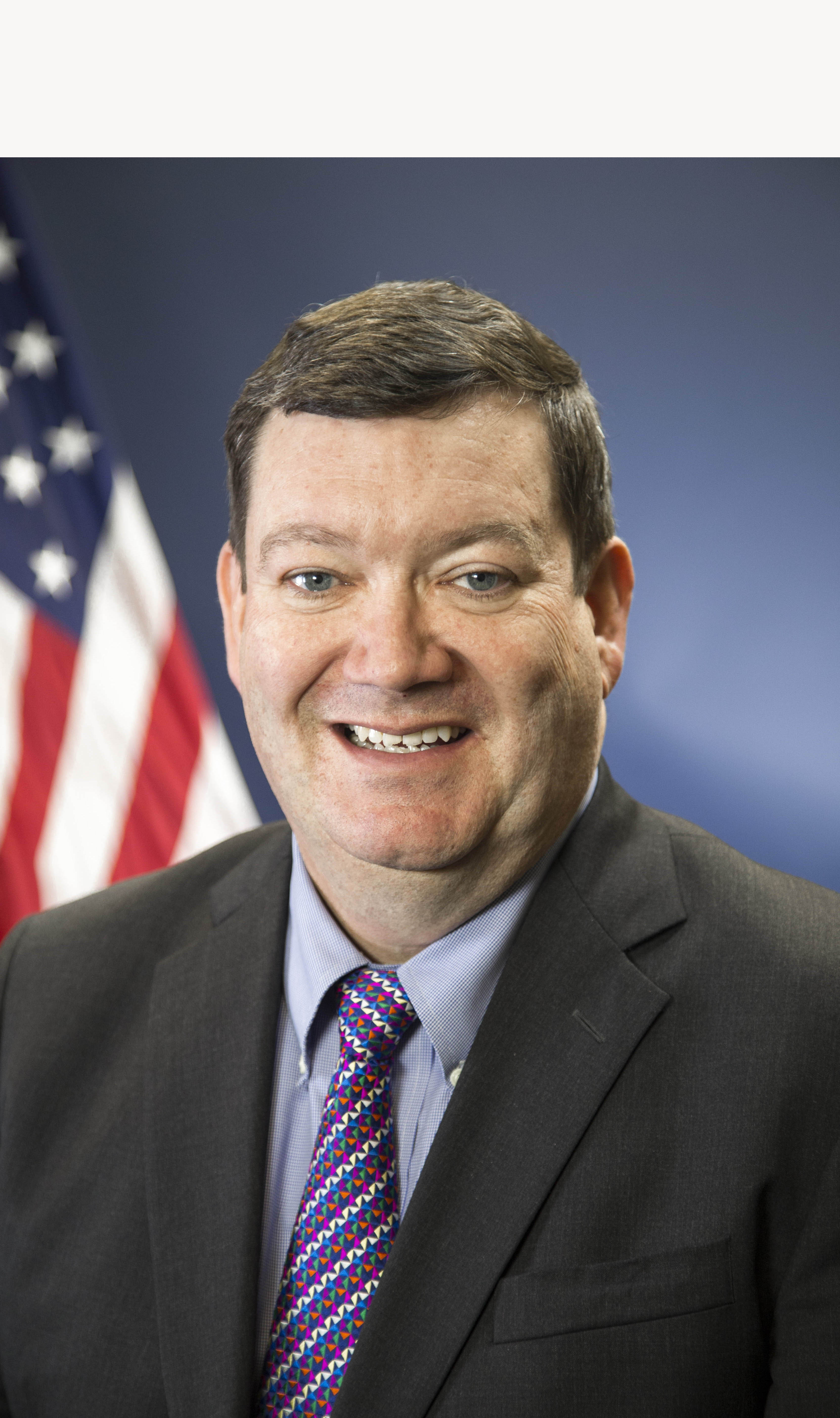
Based in Wichita, Stephen McAllister is the U.S. Attorney for Kansas.
Budget Bill In Conference
Last week the Senate Ways and Means and the House Appropriations members met in what is referred to as conference committee to discuss the differing details of the budgets that were passed from the Senate and the House. We met numerous times each day, which actually started on Wednesday, March 27, to remedy those differences.
Some of the items that we continued to deliberate about were $100,000 from the state water plan and placing that within the conservation districts. We also discussed adding money for water contamination remediation and for the drinking water protection program.
We also discussed the amount of funding that we would restore to the Board of Regents, which would funnel those funds to all of the Regent schools, adding additional dollars for the K-State Polytechnic Campus in Salina for additional flight instructors, plus negotiating $650,000 for a new fund with K-State that would be named the Fire Suppression/State Forest Service Fund.
We also had discussion regarding the Kansas Bureau of Investigation to implement a new Cyber and Financial Crimes Investigative division. We also addressed the need for the KBI to hire four new positions for the Criminal Justice Application Security and Quality Assurance Program.
We had hoped to come to an agreement between the two chambers before we adjourned for our April break. Unfortunately, we will continue deliberations when we return on May 1, 2019.
Senate Bill 16 – K-12 Education Finance Remedy
Late Wednesday evening, the education finance conference committee between the House and Senate had intense negotiation. This conference committee had met numerous times this past week and could not come to a resolution that could appease both chambers. The Senate held firm to their position of adding additional funding of approximately $90 million each year for four years to satisfy the Supreme Court order that the Legislature must account for inflation increases. This is also the same plan that was provided and supported by Governor Kelly. The House did not technically have a financial position, which made the discussions more difficult, however, we did pass Senate Bill 16, which contained mainly pieces of policy. The conference committee report was finally debated and voted on in the House on Thursday afternoon and passed the chamber with a vote of 76-47. I voted “yes.”
Legislative Schedule
On Friday, April 5, the schedule for the Legislature is to adjourn for the better part of the month of April. During this time, I will be back home in the 109th District conducting numerous town-halls and forums, as well as other public events. I will also be working on our family farm while back home. Here is a list of the events that are planned:
April 16, Forum in Russell, KS at the Dream Theatre, 10 AM;
April 16, Forum in Lucas, KS at the Backstreet Bakery, 1:30 PM;
April 18, Forum in Rush Center at Golden Belt Telephone, 10 AM;
April 13, Forum in Lincoln, KS at Main Street Coffee and Things, 10 AM;
This is a list of the forums that will be conducted until we reconvene on May 1, 2019. I will also be traveling and meeting with the county commissioners of Barton and Ellis counties, attending the Kansas Counties Officials meeting in Colby, and we have meetings to review the applications for the Industrial Hemp Advisory Committee.
I will continue in sending out weekly newsletters when the Legislature reconvenes on May 1, 2019.
Contact Information
As always, if you have any concerns, feel free to contact me (785) 296-7672, follow on twitter at @waymaster4house, visit www.troywaymaster.com or email me at [email protected]. Also, if you happen to visit the statehouse, please let my office know.
It is a distinct honor to serve as your representative for the 109th Kansas House District and the state of Kansas.
Please do not hesitate to contact me with your thoughts, concerns, and questions. I always appreciate hearing from the residents of the 109th House District and others from the state of Kansas, as well.
Troy Waymaster (R-Bunker Hill) is the 109th Dist. state representative and chairman of the House Appropriations committee. The 109th District includes Osborne, Russell, and Smith counties and portions of Barton, Jewell, Lincoln and Rush counties.
Alicia BoorLately, I have been getting a lot of calls into the office about weed control, mainly sand burrs. If you had sandburs last year, now would be a good time to control them. I found an article from K-State Research and Extension’s horticulture department that gives you some tips on how to get rid of this troublesome weed.
Grassy sandbur is the “sticker” plant that looks like a grass. It will often invade thin lawns, especially in dry years. Therefore, the best control for this weed is a thick, healthy lawn. However, if your lawn is thin this spring and grassy sandbur was a problem last year, use a preemergence herbicide before the sandbur comes up. However, not all preemergence herbicides are effective. The three products that can help minimize grassy sandbur are oryzalin, pendimethalin and prodiamine.
Oryzalin is sold under the trade names of Surflan and Weed Impede. It can be used on all warm-season grasses as well as tall fescue. It should not be used on cool-season grasses other than tall fescue such as Kentucky bluegrass. Oryzalin is also sold as a combination product with benefin as Green Light Amaze. As with oryzalin alone, it can be used on all warm-season grasses as well as tall fescue. It should not be used on cool-season grasses other than tall fescue such as Kentucky bluegrass. Apply Amaze or an oryzalin product about April 15 when redbud trees approach full bloom.
Pendimethalin is sold commercially as Pendulum as well as several other names. On the homeowner side, it is sold as Scotts Halts. Pendimethalin is best applied as a split application with the first half applied about April 15 and the second about June 1. Alternatively, make the first application when redbud trees approach full bloom and the second six weeks later.
Prodiamine is sold under the commercial name of Barricade. It is also the active ingredient in a number of homeowner products. It can be used on all of our common lawn grasses. Apply as is done for oryzalin, about April 15 or when redbud trees approach full bloom. Only one application is needed per year. None of the “weed preventers” will give complete control but each should help. Quinclorac (Drive) can provide some postemergence control especially if the sandbur is in the seedling stage. Quinclorac is also found in a number of combination products that control both broadleaf weeds and crabgrass such as one of the following.
Ortho Weed-B-Gon Max + Crabgrass Control
Bayer All-in-One Lawn Weed and Crabgrass Killer
Monterey Crab-E-Rad Plus
Fertilome Weed Out with Crabgrass Killer
Trimec Crabgrass Plus Lawn Weed Killer
Bonide Weed Beater Plus Crabgrass & Broadleaf Weed Killer
Spectracide Weed Stop for Lawns Plus Crabgrass Killer
Again, the best control for grassy sandbur is a healthy, thick lawn.
Alicia Boor is an Agriculture and Natural Resources agent in the Cottonwood District (which includes Barton and Ellis counties) for K-State Research and Extension. You can contact her by e-mail at [email protected] or calling 620-793-1910.
By MARK TALLMAN Kansas Association of School Boards
The Kansas State Board of Education, Gov. Laura Kelly, and the Kansas Senate have all agreed on a plan adding $90 million a year for four years to the school finance package passed last session as an “inflation adjustment” to resolve the Gannon school finance case.
So far, the Kansas House of Representatives has resisted, with some Republican leaders saying that in the past, the Legislature has added more funding to K-12 education without seeing any better results. They say they’re skeptical that more money will make a difference and that the Legislature should place more strings on funding, implying local school leaders can’t spend the money wisely.
Let’s look at some facts.
From 1990 to 2009, Kansas education funding did rise more than inflation. Over that time, Kansas showed improved education outcomes. However, total funding declines from 2009 to 2017 compared to inflation.
As funding surpassed inflation from 1990 to 2009, then dropped below inflation, how did educational outcomes change over that time?
Since 1990 adult educational attainment has improved. High school completion for Kansas 25 and older increased from just over 80 percent to over 90 percent and improved for each major ethnic minority group.
Four-year degree completion rose from about one in five Kansans to one in three. All major racial/ethnic groups in the state have been improving although significant differences remain.
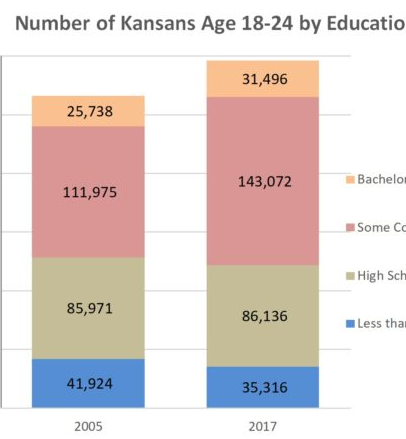
The youngest age group reported by the U.S. Census, 18 to 24-year-olds, has also improved, with data back to 2005. The number of these Kansans most recently leaving the school system increased by over 30,000 from 2005 to 2017, but the number who haven’t finished high school dropped; the number of a high school diploma only remained about the same, and the number with any postsecondary experience, including a one or two year credential, and those with a four-year degree increased by almost 35,000.
Improving Kansas education levels have a direct economic impact because employees with higher credentials earn more. A higher percentage of Kansas with college degrees in 2017 means higher incomes than would have been if education levels were unchanged from 1990.
Short term education measures like test scores have also improved since the previous decade, but many have slowed or declined as funding fell behind inflation from 2009 to 2017.
On the National Assessment of Educational Progress (NEAP), a higher percentage of Kansas students scored at the basic level and proficient level in 2017 than in 2003; but both are below their peak in 2009 and 2011. If improving had continued at the same rate as 2003 to 2009, 88 percent of students would be at a basic level and over 41 percent at proficient – among the top states in the nation.
Looking at the adjusted cohort graduation rate – the percentage of students who graduate from high school “on time” in four years – Kansas improved from 81 percent in 2011 to nearly 88 percent in 2018, but improvement slowed in the mid-2010s, while the rest of the nation was improving faster. (Other states were also increasing funding more than Kansas.) In the past two years, Kansas rates have begun rising again, to all-time highs. Kansas graduation rates for low-income students also improved but slowed from 2002 to 2016 and the national average rose faster to match Kansas.
Twenty-nine percent of Kansas students who took the ACT test and scored at college-ready on all four subjects. That’s higher than when ACT began measuring college-readiness in each subject in 2006, but down from 32 percent in 2015 when the percentage began to drop. It stayed level this year. Kansas continues to lead the national average. Once again, performance did not drop immediately after funding cuts began in 2009, but eventually began to fall.
As a share of Kansas taxpayer income, K-12 is lower than in the past.
Although Kansas education funding rose faster than inflation from 1990 to 2009 and has begun increasing the past two years, total funding for K-12 education are a smaller share of Kansas income than most of the years in the 1990 and 2000s. In other words, Kansans aren’t paying a higher share of income for higher results; they are actually contributing a lower share.
To sum up:
Kansas K-12 funding has grown more than inflation over time, but has fallen since 2009. Although the Legislature provided “real” (more than inflation) increases for 2017-18 and 2018-19, total funding is still below 2009 levels, and district budgets without capital expenditures, debt service, and Kansas Public Employees Retirement System contributions are even farther below.
Kansas educational levels have also increased, reaching all-time highs and increasing incomes.
National tests of basic and proficient skills, graduation rates and college readiness are all higher than their baseline.
However, each of those measures slowed or declined in recent years as funding fell behind inflation, although the impact took several years. Educators say this is because educational improvement is cumulative. What students gain isn’t lost immediately, but if educational supports are reduced, it eventually has an impact on learning.
It’s reasonable to assume that higher education funding will promote higher results.
There are reasons we know funding levels make a difference in K-12 outcomes in addition to these historical results.
First, more funding provides more ways to help students who are not reaching educational standards, such as early childhood, special education, extra time and assistance for at-risk students. Much of the new funding over past decades has gone to these programs.
Second, more funding allows districts to hire more staff to provide these services, keep average class size relatively low, and provide individual student attention. Simply put, there are more adults to both teach and support students.
Third, more funding allows competitive salaries to attract and keep high-quality employees and invest in professional development programs to improve performance. Kansas teacher salaries fell behind inflation every year between 2009 and 2018, before rising in 2018 and 2019. An example of professional development is a House committee proposal to fund a program to help teachers better identify and address students with dyslexia.
Fourth, more funding supports services to keep students safe and healthy. This includes more student transportation, improving school security, and school-based mental health services.
Fifth, three previous education cost studies commissioned and funded by the Kansas Legislature have found a positive relationship between funding and outcomes.
Finally, there are many examples of successful programs that show positive results but cost more money. This year, the Legislature has been focusing on the Jobs for America’s Graduates program in Kansas (JAG-K), a program with a strong track record in encouraging students to graduate, but at a cost of over $1,000 per student. It’s a clear example of additional funding making a difference.
Mark Tallman is Associate Executive Director for Advocacy for the Kansas Association of School Boards.
Dr. Roger Marshall, R-Great Bend, is the First District Kansas Congressman.
Friends,
This week in D.C. I continued to fight for the rights of babies across the nation. I am thankful for the pro-life community and the men and women of Congress who are willing to fight alongside those who do not have a voice. Fighting for the unborn, and now with the Democrat legislation on the state level that allows infanticide, those babies born alive from botched abortions, is a fight I will never stop fighting. This is very a personal fight for me as I’ve spent my entire life dedicated to bringing life into the world; I will never back down. I am blessed to represent so many men and woman who have made it consistently clear to me that they support me and support those most innocent and vulnerable, the unborn.
In other news this week, we met with many Kansans in here D.C. we touched on a variety of issues and had solution-based discussions ranging from Kansas water to USMCA updates, Home care and Hospice, to Crop Insurance. Our office also sponsored a two-day health symposium!
Now I am back in Sunflower State, enjoying my weekend with town halls and traveling across this Big First to sit down and check in with you! I hope you are available to join me. Stay tuned to our Facebook page where we are consistently posting our upcoming town halls and events.
Sat. 6th 8:30 A.M. – Hays Chamber Legislative Coffee – Fort Hays State University Memorial Union
Sat. 6th 10:30 A.M. – Ellsworth County Town Hall – Ellsworth Antique Mall
The Fight Continues…
Never in my wildest dreams did I think that when I came to Washington, I’d have to fight harder to save babies lives in Congress than I did in my 25 years as a practicing OB-GYN in the delivery room. It is mind-boggling how far the pro-abortion Democrats have gone when they refuse to advance legislation that would protect infants outside of the womb!
House Republicans have asked Nancy Pelosi 29 times now to bring the Born-Alive Abortion Survivors Protection Act to a vote, every time she has refused. The Born Alive Act would provide protections to babies that survive botched abortions and ensure that they receive the immediate medical care they desperately need.
This week I stood with the Pro-life community, and GOP Members in signing a discharge petition, with enough signatures, this petition would force every representative to go on record as to whether or not they support allowing babies, who survive botched abortions, to live. As a society, we have a moral obligation to stand up for our children. This legislation does just that, and for the life of me, I do not understand how this could be a topic with any room for debate.
Today, sadly only six states report when babies survive abortions, and even in those states it’s severely under-reported by the abortion provider, being that it behooves no abortionist to report this failure on their part (seeing as though their goal was for the baby not to survive the procedure.) Those six states are-Arizona, Florida, Michigan, Minnesota, Oklahoma, and Texas. In 2017 alone, at least 25 babies were born alive during abortions in these states. And again, we don’t know the data for 44 states, including California and New York, where the largest number of abortions happen. To me passing this law is common sense- these babies need this immediate care.
I want to thank the many constituents who have called in support of this legislation.
Outside of the Capitol, we discussed why this legislation is so important to the public and reporters with members, abortion survivors, physicians, and pro-life leaders. I addressed the media by telling very unforgettable experience I had while in residency trying to save a woman and her baby after she was rushed to our hospital following an abortion procedure gone wrong at a nearby abortion clinic.
Watch my remarks below: WARNING IT IS GRAPHIC.
Health Symposium Focuses on Care in Low-Income Communities
Earlier this week I sponsored a multi-day Health Care Symposium at the Library of Congress featuring presentations on graduate medical education, prior authorization, direct primary care, and much more!
It included experts from across the country, and even a keynote address by U.S. Department of Housing and Urban Development Secretary, a fellow physician, Ben Carson. Secretary Carson discussed the intersection of housing and health care, and the importance of providing safe and affordable housing. He also shared with us his experience from shifting from serving as a physician to HUD Secretary.
Pastor Stephen Broden
The following day I had the privilege of hosting Pastor Stephen Broden. The Pastor spoke to the group about the importance of having medical professionals place a larger emphasis on talking about policies plaguing low-income communities. He expressed his belief that Americans need full transparency when it comes to their health care and called on physicians to advocate for their patients and access to quality care both in and out of the doctor’s office. I am proud to have Pastor Broden working with our office to find solutions for low-income communities.
A huge thank you to all those who spoke and attended this two-day long event, and I assure you all that I am fighting hard to make some critical fixes to our health care system so that health care is affordable, provides families with patient choice, and offers complete cost transparency.
Kansans Stepping up to Help Flood Victims
Our neighbors in Nebraska are recovering from a fatal record-setting flood that took multiple lives, destroyed farmers land, and caused more than 20 counties to evacuate due to the widespread destruction. In true Kansas fashion, I have seen many Kansans posting and praying for Nebraska’s recovery! Kansans have even banded together with groups like the Kansas Farm Bureau and Kansas Livestock association making donations to help Nebraska rebuild after this tragedy that has caused more than 4,400 people to evacuate their homes.
The road to rebuilding their state’s infrastructure will be long and difficult, and in response, groups like Inman High School FFA, Bethany Home in Lindsborg, United Way, Boot Hill Distillery in Dodge, and so many more Kansas organizations are collecting household supplies and donations for Nebraska flood victims.
This week, Addy Tritt from Hays, Kansas made national headlines when she went to her local Payless shoe store and purchased more than 200 pairs of shoes to donate to the Nebraskans impacted by the massive flooding.
I am so proud to be a part of the Sunflower State where people band together to help others through difficult times. I love the compassion and love Kansans have, we help our neighbors in need and our communities, and that mentality extends far and wide as you can see in response to this devastating flood! So proud to be a Kansans and represent such wonderful and thoughtful people!
Kansas Leads in National Bio and Agro-Defense
I had the pleasure of meeting with a diverse group of representatives from different companies in the bioscience industry in Kansas. The Big First is well positioned to benefit from the investments being made as a result of the growth of this unique industry.
We spoke at length about the importance of the work being done at K-State to bring the National Bio and Agro-defense Facility (NBAF) online and how it will spur economic development across the entire State of Kansas.
I was also proud to learn of Kansan Erin Smith, a Thiel Fellow at the age of 18, for being recognized in this year’s Forbes 30 under 30 list. As a teenager, she developed a machine learning tool that can detect the early symptoms of Parkinson’s using only a computer and a remote webcam.
With your help, I look forward to further developing the “Silicon Prairie” as a premiere destination for new business, innovation, and growth that will benefit all Kansans.
Addressing the Cost of Funerals for our Nation’s Veterans
This week I was able to meet with the Kansas Funeral Directors Association. We discussed the importance of a bill I co-sponsored earlier this year, HR 497 – the BRAVE Act of 2019.
In 1917 Congress passed a law that authorized a burial allowance fund to cover funeral expenses for certain veterans. In 1973, they updated this law to better define the allowances for veterans based on whether their cause of death was related to their service or not. This law allowed for $2,000 to be issued to the families for the veteran’s funeral if their death was service- related, $780 if the veteran’s cause of death is not service-connected and they passed in a VA facility and $300 if their cause of death was not service-related.
However, back in 1973, the average cost of a funeral was between $1,200- $2,000 today the average funeral cost is between $7,000 and $9,000. That is why Congress introduced this legislation which examines these allowances and updates them so that they reflect the current cost and account for inflation.
Additionally, they brought to my attention HR 1835 – the Consensual Donation and Research Integrity Act of 2019. As of today, there is a lack of oversight on the donation of human remains. This legislation will be a safeguard and make sure that each remain goes to its respectful place. It will do this by creating a registration and tracking system. I am thankful for this educational meeting with them and their staff!
Addressing America’s Most Expensive Disease
This week I met with the Alzheimer Association and in this meeting I was joined by Glenda Owens from Garden City, Kansas. She shared her story about her father’s struggle with Alzheimer’s. In our meeting, the Association asked me to support funding for the BOLD Infrastructure for Alzheimer’s Act. Passed last Congress, this law authorizes $37 million over seven years to fund research and centers of excellence specifically for Alzheimer’s. I reassured them that I absolutely was behind them. I had voted yes for this bill and was happy to join my colleagues in sending it to the President’s desk.
Alzheimer’s, America’s most expensive disease, cost our healthcare system $277 billion last year, with Medicare and Medicaid paying for the majority of it. Alzheimer’s is a degenerative neurological disease affecting 5.5 million Americans. And sadly, this figure is expected to triple by 2050. Until a cure is found, we need to ensure patients have access to hospice and palliative care professionals to improve their quality of life.
For this reason, I am a cosponsor of HR 647, the Palliative Care and Hospice Education and Training Act, legislation that will provide funding support for Palliative Care and Hospice Education Centers and promote graduate medical education programs. In addition, it will enhance research in this field to build best practices and develop a more effective workforce.
I have also submitted a request to the Appropriations Committee to fully fund the 21st Century Cures Act BRAIN Initiative at the National Institutes of Health. Funded at the full level, Congress will continue to support health innovation and advancement to one day find a cure for this destructive and cruel disease!
USDA Improves Website for Farmers!
The week, the USDA launched two new features on farmers.gov. These two new features will help farmers with their H2A Applications and managing loans. Farmers across the country have said time and time again that they would like for the USDA to come up with innovative ways to support our farmers. I am glad to see that they have listened to farmers call to action and are making their website easier and more efficient to use!
President Trump recently signed an executive order to withhold federal funding from public and private colleges and universities that do not protect free speech on their campuses. Despite the dramatic lead-up, the order itself doesn’t say all that much. It requires public colleges to comply with the First Amendment and private colleges to comply with their own speech policies — things they’re already required to do — and unsurprisingly, it’s been described as redundant (it’s also been referred to as a “nothingburger”).
Of course, there’s still potential for the order to be enforced in a way that threatens civil liberties and comprises federal overreach, but that’s for our future selves to worry about. Today, I’m thinking about the impetus behind the order and Trump’s words when he signed it. “Under the guise of speech codes and safe spaces and trigger warnings, these universities have tried to restrict free thought, impose total conformity and shut down the voices of great young Americans,” he said last Thursday. Is that true? Are colleges actually eroding free speech and undermining First Amendment values?
Sure. But no more so than anyone else.
The Knight Foundation’s 2018 survey on campus free expression showed that a majority of college students think that free speech rights are extremely important to democracy — but at the same time think that campuses should be able to restrict things like hate speech and stereotypical costumes. Yes, this means students believe in free speech in the abstract more than they support it in reality — but they’re certainly not alone. The First Amendment Center’s annual State of the First Amendment survey consistently demonstrates that while a majority of Americans of all ages are generally supportive of the First Amendment, they’re less enthusiastic about it when it comes to real life scenarios.
In 2017, its results showed that conservatives were more likely than liberals to believe that government officials who leak information should be prosecuted and that the government should be able to hold Muslims to a higher level of scrutiny. Liberals — even the non-student variety — were more likely than conservatives to think that colleges should be able to ban speakers with controversial views and that people should not be able to express racist views on social media. And I probably don’t need to point out that the president’s call for free speech from young Americans is at odds with many statements he’s made in the past, about, say, taking a knee during the national anthem.
While everybody loves the First Amendment in theory, nobody’s all that fond of it in practice. We love speakers who articulate thoughts we were already thinking and barely tolerate the ones who contradict our world view. Most of us, even those of us long since graduated from college, struggle with the desire to relentlessly censor one another. Free speech makes hypocrites of us all.
That said, it’s hard to ignore the high-profile controversies that specifically involve campus speakers being shouted down by angry audiences or disinvited due to pressure from students. Considering that we live in a nation with more than 4,700 colleges and only about 50 have been embroiled in such controversies, I wouldn’t call it an epidemic, but it’s indisputable that these sorts of incidents happen on college campuses. But then again — where else would they happen?
The college campus is a unique and paradoxical place in our society. It’s where young people are supposed to learn to be adults. It’s also where they can engage in the kind of debates, activism and inquiry that most of them will, frankly, never have time for as adults. It’s a venue that’s frequently open to the public and it’s also the place that many students call home. It’s a bastion of elitism and it also provides more exposure to racial, economic and intellectual diversity than some students will ever get again. Colleges are, all at the same time, molders of the next generation, institutes for high-level research, conveners for the exchange of thoughts and ideas and businesses catering to the needs of their customers.
Fostering an environment for free speech is a tricky business, one that involves balancing numerous interests. Students and faculty should be allowed to express themselves and speech codes that prohibit offensive speech are almost always too broad or too vague to be constitutional. But that doesn’t negate the legitimate concern that speech from some students can have a chilling effect on the speech of other students. Student groups have the right to invite campus speakers, even if they’re controversial. But to punish students from protesting these speakers deprives them of their own First Amendment right to peacefully assemble. Of course, there’s another concern that allowing students to shout down a speaker deprives the audience of — their First Amendment right to listen and receive information. My point is that ensuring free speech for all is complicated.
In contrast, the narrative of free speech on college campuses under attack is refreshingly simple and, ironically, has led to some unnerving anti-speech laws — not just last week’s executive order; there’s nothing nothingburger-ish about proposed laws in Illinois, Minnesota, Missouri and South Carolina that would require public college administrators to suspend or expel students found guilty of “infringing the expressive rights of others” by protesting a campus speaker, or the one in Arkansas that would create criminal sanctions for that. Yet another example of First Amendment hypocrisy — defending one First Amendment right by limiting another.
Lata Nott is executive director of the First Amendment Center of the Freedom Forum Institute.Contact her via email at [email protected], or follow her on Twitter at @LataNott.
The key to passing Medicaid expansion may not necessarily be our polarized legislature, but voters themselves, especially in small town and rural Kansas. But how much do average Kansans honestly care about expansion, and how much do they prioritize what their communities might gain from it? Maybe less than you think, which might help explain why Topeka is gridlocked on this issue.
Patrick R. Miller is an Assistant Professor of Political Science at the University of Kansas.
Most polling over time shows that Kansans support expansion. For example, the fall 2017 Kansas Speaks survey showed that Kansans supported “expanding Medicaid under the Affordable Care Act” 69 percent to 30 percent—typical numbers in Kansas polls. The exception is one recent poll from a conservative organization that produced 54 percent opposition after crafting their survey questions to make expansion look unattractive.
Unfortunately, no public poll of Kansans has asked how much they actually care about expansion or prioritize it versus other issues. The gut sentiment of most Kansans may be to support expansion, but we do not know the strength of those opinions, or how persuadable they are to opposing expansion. Big unknowns.
One key argument of expansion advocates is that Medicaid expansion would particularly benefit rural communities since the uninsured are often more rural and expansion dollars would benefit struggling rural hospitals. But one pattern in surveys is that rural residents typically support expansion less than suburban and urban residents, and are often pretty divided on the issue.
Elections reflect this.
In 2018, Nebraska, Utah and Idaho voters expanded Medicaid. These states in polls are typically more Republican and conservative than Kansas. If voters there passed expansion, Kansans probably would, too. In all three, though, rural communities mostly opposed expansion. It passed because of suburban and urban voters.
In Kansas, Independence and Fort Scott have experienced hospital closures. However, voters in both often prefer anti-expansion politicians. They backed anti-expansion Kris Kobach strongly in 2018 over pro-expansion Laura Kelly, supporting him as strongly as they supported anti-expansion Sam Brownback in 2014.
When the Kansas state House voted recently to expand Medicaid, anti-expansion votes skewed more toward rural legislators whose communities could benefit more from expansion. Why? Some legislators may feel safe opposing expansion if they believe that constituents will not punish them. That could also explain why conservative leadership blocks expansion votes if they feel that they have nothing to fear.
Barring some grand bargain in Topeka, how does Kansas eventually pass expansion? Advocates bear part of the burden. They should assess how effective their efforts have been. If many Kansans, especially in rural communities, are not voting based on this issue, then how effectively have advocates communicated the benefits and importance of expansion?
Politicians, especially pro-expansion moderate Republicans, also have some burden. Because of changing demographics between the parties, Democrats are increasingly a suburban to urban party, whereas Republicans are increasingly a rural to suburban party. All things equal, Democrats are more likely to defeat Republicans, moderate or conservative, in suburban than in rural districts.
For expansion advocates to replace rural anti-expansion politicians, that probably has to occur in Republican primaries where issues often matter more since party is not a factor. However, moderate Republicans leave many rural conservatives unchallenged in primaries, perhaps thinking that rural voters are too conservative to elect moderates when in fact many pro-expansion moderates represent rural districts.
If voters, especially in rural communities, are not invested in expansion or offered attractive candidates for their palates, then elections will not produce the right mix in Topeka to break its gridlock. Ultimately, most Kansans may support expansion, but they must truly invest in the issue for that preference to become policy.
Patrick R. Miller is an Assistant Professor of Political Science at the University of Kansas.
Edward Cross is president of the Kansas Independent Oil & Gas Association.
By EDWARD CROSS Kansas Independent Oil & Gas Association
The next generation of Americans will be challenged to expand and maintain our nation’s energy abundance and global energy leadership. Currently, America’s oil and natural gas industry is meeting record consumer demand and leading the world in production, all while driving emissions to their lowest level in nearly seven decades.
Today, oil and natural gas supply nearly 65% of all U.S. energy. Oil supplies 97% of U.S. transport needs and natural gas supplies 34% of U.S. electricity. Oil and natural gas support over 10.3 million jobs in the U.S. including over 118,000 Kansas jobs. In addition, the latest EPA data shows total U.S. CO2 emissions decreased nearly 14%, while methane emissions were reduced by 4% since 2005. Meanwhile, U.S. oil and natural gas production increased more than 80% and 51% respectively. The oil and natural gas industry has proven that over the long-term, it is possible to lead in energy production and environmental stewardship.
We applaud President Trump’s commitment to America’s energy leadership, which has the power to unify Republicans and Democrats in a divided Congress to put up some major wins for the American people.
Debate continues across the country on our nation’s energy future. Few doubt that energy has improved lives and enabled human progress. Yet one of the biggest challenges facing the world is the polarized debate over the future of energy. Facts and economics are too often replaced with assertions and emotions. Discussion about fossil fuels and alternative energy sources often degenerate into a battle to delegitimize the other side. This is a recipe for inaction. And it keeps billions of people trapped in energy poverty. The world expects and deserves better.
A new energy poll released earlier this year indicates what Americans think about U.S. oil and natural gas. Key poll results include:
• 83% see oil and natural gas as important to the future
• 78% of voters support increased production of oil and natural gas resources
• 84% support increased development of the country’s energy infrastructure
• 77% support energy policies that the oil and natural gas industry advocates: a secure supply of abundant, affordable, available energy.
• 75% support the role that natural gas are playing in reducing greenhouse gas emissions
• 90% see personal value in oil and natural gas
Clearly, Americans support developing domestic energy resources and believe that can be done in a way protective of our environment. Policymakers at all levels should pursue energy policies that drives economic growth, lower costs for consumers, protects the environment, increases American competitiveness, and uses our considerable energy resources as a way to lift people up.
The U.S. currently has a better, more sensible approach to energy development than any other country in the world, both short-term and long-term. Where government policy has been absent, free markets have filled the void with great success.
The energy policy choices our nation makes today are among the most important and far-reaching policy decisions we will make in the 21st century. If we are to continue our nation’s positive energy trends, we must implement energy policies based on current reality and our potential as an energy leader. Too often, energy policy discussions are dominated by the ill-informed whose contributions to the discussions do little to educate and much to misinform.
As the oil and gas industry has shown, there is a better way. Just a few years ago, no one would have imagined the U.S. could increase production of oil and natural gas while cutting greenhouse emissions, which are now near 25-year lows. By focusing on more efficient use of energy, it is possible to lower emissions without imposing even more environmental restrictions.
An American energy policy that values innovation over regulation can turn energy policy challenges into great opportunities for economic growth and energy security. This approach is not just good business, it’s good stewardship and a much better strategy for improving the quality of life for all.
The key going forward is to avoid placing unnecessary political or legal obstacles in the way of innovation and expansion. That’s a prescription for economic prosperity and a cleaner environment.
We should set aside the acrimony and division that has marked too much of past national energy policy discussions and work together as one nation on a positive forward-looking energy future. American energy policy should focus on what’s important: American jobs, American energy security, and American global energy leadership. We need a national energy policy based on science, the free market, and entrepreneurial spirit. Those who act on our behalf at all levels of government should use those principles as the foundation for their energy policy decisions.
Ron Wilson is director of the Huck Boyd National Institute for Rural Development at Kansas State University.BY RON WILSON Huck Boyd National Institute for Rural Development
Let’s take a flight on Air Force One. Look at the fine cabinetry and furniture. The craftsman who worked on those furnishings is now putting his skills to work with his partner in creating beautiful customized wood products in rural Kansas. These are master craftsmen working in wood.
Jerry Rumbaugh and Dan O’Neal are partners in this business called Studio 57, which produces customized wood products near Junction City.
Jerry Rumbaugh grew up in Junction City and attended Southern Nazarene University where he met his wife. Jerry was always skilled in working with wood. He did roofing, framing, and finish carpenter work in his parents’ construction company. For almost 20 years before retiring, he worked in the wood shop at New Horizons RV, building cabinets for recreational vehicles.
Dan O’Neal got a degree in music education at K-State but there were no teaching jobs open when he graduated. He went to work in L. W. Wilson’s cabinet shop near Manhattan and found he really enjoyed it. His career in carpentry and woodworking took him to Wichita where he worked on the furnishings on Air Force One.
Eventually he moved back to the Junction City area and worked at New Horizons RV where he met Jerry. He worked in the wood shop at New Horizons for 11 years before retiring. Dan and his wife live at Wakefield, so he crosses the Milford Lake bridge when he goes to work. “It’s a gorgeous drive,” Dan said.
The two friends worked on wood projects together at New Horizons. “Jerry was wood shop supervisor,” Dan said. “The exceptional quality of his work was instrumental in making the company No. 1 in the nation.”
When they retired, they decided to go into business together. They set up shop at Jerry’s place, which is in a rural setting along Highway 57 between Junction City and the rural community of Dwight, population 252 people. Now, that’s rural.
Because Highway 57 is where the shop is located, they called their business Studio 57. Their specialty is high quality, customized wood products. They have CNC equipment which enables them to do remarkable digitally-controlled designs.
The company makes signs, headboards, lithophanes, engraved photos, ash boxes, custom lettering, CNC carvings, and more. A lithophane, by the way, is a type of back-lit etching. When their former boss at New Horizons passed away, his family asked them to make an ash box as the final resting place for the cremains, which they did.
These two craftsmen created a sign for their business which is especially eye-catching. It’s an engraved acrylic sign with built-in lighting on a gorgeous cherry wood base. They can also cut out designs in Corian countertop material that can be inset in a wooden sheet.
Studio 57 produces carved photos which are like works of art. In fact, their picture of a boat was displayed at what is now the Strecker Nelson West Gallery in Manhattan.
Using a software program, the photos are superimposed onto a piece of wood which is grooved in a way that displays the design. Up close, one can feel the grooves. Step back, and it looks like a black and white photo. The grooves or lines can be cut at any width and any angle.
When asked what kind of wood they use, the answer is “Yes.” In other words, they can use any and all types of wood. Maple, cherry and oak would be the most common.
Jerry and Dan use the phrase “Woodwork Re-Imagined” to describe their work. The quality and diversity of products which they can produce is remarkable. The company’s market is growing through word of mouth.
It’s time to leave Air Force One, where we’ve admired the handiwork of the craftsman who made these fine wood products. Now that craftsmanship can be found in rural Kansas. We commend Jerry Rumbaugh and Dan O’Neal for making a difference with their skills and creative abilities. If there is a wood product that can be designed, you can be sure that these guys would.
Over four years ago, after being approached by the USD 432 School Board, the Victoria Alumni Association began raising funds for the much-needed Victoria Junior/Senior High School Gymnasium Floor Replacement Project. It is the original floor that the first basketball game was played on it in January of 1950.
Last December, I had a vision at a basketball game that if we would put on a large-scale German Meal Fundraiser, we could help raise funds more quickly and the replacement project could get underway sooner.
Following your kids and grandkids through their sporting activities, you create close bonds with their fellow athletes’ parents and grandparents. You become “One Big Family,” so to speak. When I brought this idea up to them, they were all on board because we all realize how badly in need of repair the floor is, and we would all like to see our kids/grandkids have the opportunity to play on the new court.
First a VISION – then ACTION!!! Just by word of mouth and School Way, we planned an organizational meeting at my house on Wednesday, February 20. What an outstanding response of interested parents and grandparents! I had already checked possible dates, so by the end of the meeting the German Meal Fundraiser for the VHS Gym Floor Replacement was in MOTION.
By Friday, February 22, at a 3:05 assembly at the High School, we handed every Jr./Sr. High student an envelope with five advance meal tickets to sell. Students who sold at least 10 tickets by Friday, March 8, were included in a drawing for cash prizes of $100, $75, $50, and $25. For each additional 10 tickets they sold, their names would be entered in the drawing again.
The students only had two weeks to sell their tickets, because we had such a short amount of time to order supplies and make dumplings in the Grade School kitchen during Spring Break. We also asked parents and community members if they would make and donate desserts. Not knowing if we would have enough desserts, we also made mini kuchen that we could use if needed. However, with our pastor Fr. John’s encouraging words at weekend Masses, it got our community in the “Giving Spirit” and we were able to sell the mini kuchen, which added to our bottom line. An anonymous donor paid for all the groceries and supplies which also helped our cause.
Ethel Younger graciously donated her labor to make 125 pounds of homemade noodles (even though she had back surgery during that span of time), and Warren Wittman (Warren’s Meat Market) made our German Brats at an exceptional price. If you happened to join us for the German Meal Fundraiser, you will agree, both the noodles and brats were delicious!
Besides all the cash donors and raffle prize donors, I want to send out a huge “Thank You” to Shannon and Mark Karst for accepting my invitation to serve on the Committee as one of the leaders and to Melissa Schmidt who headed all financial aspects of our fundraiser. Also to my daughter, Natasha Hammerschmidt, and my sister, Rose Ann Dreiling, thank you for doing so many things behind the scenes and participating in every aspect of the fundraiser when you got off work. Rose Ann had a prior commitment before we set our date, or she would have been in the kitchen the whole weekend also. (Don’t worry Sis, if we ever do another big fundraiser, we’ll make sure you’re free before we set the date!) Two other “Grandma’s” that I want to thank are, Kathy Kuhn and Mary Brungardt. They were at every cooking/baking workday we had. We didn’t even have to ask, they just told us they would be there or just showed up when they knew we were working. Connie Windholz, thank you for all the hours you put into the project for us also.
In addition, I would like to thank everyone who worked so hard behind the scenes during both meals. There were so many people that stepped up to the plate and helped out for this fundraiser. The men outside grilling and cooking dumplings, cooks in the kitchen, meal servers, runners, dishwashers, ticket takers, raffle table workers, dessert table attendants, people who cleaned the tables, and last but not least all of the students who gave up their time to set up, tear down, and do whatever was asked of them throughout the weekend. But for me to mention every single person by name, would be impossible and I would fear I may miss someone. Know that you all hold a special place in my heart for coming out and helping us make this such a successful fundraiser.
By the next school board meeting, April 8, we should find out what the current bids are for completing the gym floor replacement. To date our net profit from the Fundraiser is $35,698.58; however a portion of that has been ear-tagged by the donor for new balls and equipment to be used on the new floor. So with the collected amount from the Alumni Association of $26,000, we should have almost $57,000 to put towards the project. We are so close to making the new gym floor a reality!
Last but not least, the Committee members would like to thank their husbands and families for being so understanding during this entire fundraising project.
I have received so many compliments on how smoothly and well organized it was. That is all because we had such great help in every aspect from students, coaches, school staff, parents, grandparents, community members, and faithful alumni!
A.P. Kalem said, “War is never a lasting solution for any problem.” However, is that statement completely true? War, through the ages, has brought great advances and solutions in medicine.
Perhaps the first innovation in medicine that evolved during warring times came with drilling holes through the boney skulls of warriors whose heads were smashed in by clubs. Once a hole was made, one could insert a finger and pull out the caved-in skull bone with the added benefit of providing an escape hole for bleeding, releasing pressure off the brain. There are museums that have 7,000-year-old skulls with healed over burr holes, and this treatment called trephination, is still done today.
During the 1700 and 1800s, the world-wide imperialism of the British came from their conquering navy. This was partially because the Brits knew lime and lemon juice with vitamin C prevented scurvy which is a life-threatening progressive condition of profound weakness, gum disease, skin ulcers and bleeding. Opposing navies riddled with scurvy had no chance against the Brits.
During the Crimean War of the 1850s, Florence Nightingale and her team of newly trained nurses showed how nursing made a difference. They cleaned up injured soldiers, provided a warm dry bed, gave healing nutrition and, in general, cared for the soldier, which remarkably reduced the death rate by two-thirds. Nursing grew from that beginning.
The Civil War brought the advancement of anesthesia with easily used ether and the education of myriads of surgeons who spread their surgical skills throughout the country after the war. Also, the Civil War generated the development of the ambulance wagon, an effective method of transferring the injured from the battlefield to a place for treatment and comfort. For example, in the battle of Antietam, every wounded-living Union soldier was off the battlefield by the end of the day.
During the Boer War and World War I, X-Ray machines became available at portable hospitals, facilitating the repair of boney injuries. The field of orthopedics evolved as surgeons had growing trauma experience along with the aid of anesthesia and antisepsis. Also, blood transfusions and intravenous fluids came to be used during WWI and brought into reality how very sick people no longer had to die from dehydration.
Civil War General William T. Sherman said, “War is cruelty . . . and at best barbarism. Its glory is all moonshine . . . war is hell.” That said, in response to the terrible injuries and illnesses of war, we have learned and improved medicine in ways to relieve suffering and enhance healing during times of both war and peace.
For free and easy access to the entire Prairie Doc® library, visit www.prairiedoc.org and follow The Prairie Doc® on Facebook, featuring On Call with the Prairie Doc® a medical Q&A show streaming live most Thursdays at 7 p.m. central.
As far as first jobs go, opening gates on my grandparents’ ranch was the best I could ever imagine. I don’t remember how old I was when I started helping. I do know it led to my first experience with the majestic plural.
“We’ll get this gate,” my grandfather would say with a chuckle as we approached the pasture. “We” of course meant me. The worse the weather, the harder he’d laugh. Being the gate-getter led to many other “we” jobs. Post-hole digger, wire stretcher and thistle cutter were some. The list of less than glamorous tasks stretches to the horizon.
My favorite job was mowing hay because I could sit in the comfort of an air-conditioned cab, provided I didn’t break a section on the sickle bar. The same was true for running the baler, but fixing a twisted belt took more time and was far itchier than swapping out a broken section.
One assignment that really made my heart thump was hauling hay out of a bottomland meadow. The trip to involved getting the truck, trailer and its 12,000-pound load up a steep hill with a blind curve.
The first trip was the most daunting, but my grandfather did offer some advice: “You want to go fast enough you make it to the top, but not so fast you lose control of the load. Do that and we’ll be fine.”
He stayed in the field and watched as I gripped the wheel with white knuckles and motored down the road. I made it to the top with momentum to spare and the load intact.
That was the summer after my freshman year at Kansas State University, my last on the ranch. After that I was a city dweller. I got a degree in journalism, fell in love with the Flint Hills and bounced around various newspapers in the area for a little over a decade.
When my title changed from reporter to editor, I began using the royal “we” with reporters. I couldn’t utter it without thinking of my grandfather and the ranch.
I’m sure I’ve romanticized much of the work. Some was tedious, most was hard. Harder than sitting in an office looking at a computer screen. But I’d often thought about getting closer to my rural heritage. Then the opportunity at Kansas Farm Bureau came up, and now they’re stuck with me. Don’t worry, we’ll be OK.
And my grandfather wasn’t above using the majestic plural to help me avoid embarrassment. The best example is when he helped avert a catastrophe of my own making.
I was probably 5 or 6 when it happened. I had followed him out to the shed to see a baby calf. While he was busy with the calf, I rolled the gate that separated the tack room from the pen off its track. I could tell something was wrong, but I didn’t know how to right the gate. Just as I started to panic that I’d done serious damage, my grandfather came to my rescue.
“We’ll fix this,” he said as he hoisted the gate into place.
“Insight” is a weekly column published by Kansas Farm Bureau, the state’s largest farm organization whose mission is to strengthen agriculture and the lives of Kansans through advocacy, education and service.
Martin HawverGov. Laura Kelly vetoed that massive tax cut bill that she didn’t like and says the state can’t afford; it doesn’t appear that action, first veto of her term, will be overridden.
Oh, there’s talk about it, but practically, the votes don’t appear to be there for the override. And leaders in the House and Senate who supported the bill and would like the override aren’t interested in seeing a failed veto attempt diminish their power, or perceived power, so don’t look for that override try.
Let’s see how a veto vote works. Senate President Susan Wagle, R-Wichita, leader of the Senate GOP with enough Republicans but not votes to override, won’t get it done. House Speaker Ron Ryckman, R-Olathe, is similarly situated. Plenty of Republicans, just not enough votes. Why try when it’s likely to fail, and both Wagle and Ryckman will hear from constituents “…and you still couldn’t get Kelly overridden?” That talk gets old the first couple dozen times you hear it.
But…there are some smaller tax cuts, none related to the biggest portion of that three-year $230 million cut for corporations doing overseas business, that are in the air and low-buck enough that they wouldn’t wreck Kelly’s first budget.
Watch for property tax “relief.”
Nice thing about it for the Legislature is that whatever happens to property tax cuts doesn’t happen here…in the Statehouse and the State General Fund, but rather with local units of government. It’s called “free” tax cuts, paid for by local units of government which live on property taxes, but with legislators’ names on the bill.
Does it get any better than that? Tax cuts, no cost, and all the glory that legislative candidates can make fit on their re-election palm cards.
The Senate, which tends to lead this year in major legislation, has passed its major property tax cut bill this year and sent it to the House.
It puts a freeze on property taxes at the current level—if you’re 65 or older, or a veteran with a 50 percent disability.
Oh, and if your household income (all who live there) is less than $50,000 a year, and the house is valued at less than $350,000, whether it’s paid off or not.
That means if you qualify for the program, you get to go to the picnics and get to hear your neighbors gripe about property tax increases, while you just reach for another beer or handful of chips.
Oh, there are some other tax cuts floating around, but with the biggie now off the table, nobody’s come up with a sales tax exemption for, say, assault rifles or holsters for those concealed-carry fans.
Key, of course, is to find a group whose taxes can be cut slightly but memorably, at relatively low cost. And while Kelly is firm about not cutting taxes (or, rather, receipts) enough to damage the budget, there are probably some little measures out there…
Already, there’s been a bill that has gone nowhere to exempt from state income tax Social Security payments, which is expected to cost somewhere north of $70 million in lost revenues, but revenues from folks who vote and from folks who remember who saved them money.
Possible? Probably not, it’s a narrowly focused political tax cut, but every retiree will remember it, and probably their children will get to hear about it at every gathering.
The tax cut issue isn’t over, though it doesn’t look good for those multinational corporations. And it’s going to have to be relatively low cost.
Let’s see where this goes next…
Syndicated by Hawver News Company LLC of Topeka; Martin Hawver is publisher of Hawver’s Capitol Report—to learn more about this nonpartisan statewide political news service, visit the website at www.hawvernews.com