Ron Wilson is director of the Huck Boyd National Institute for Rural Development at Kansas State University.
BY RON WILSON Huck Boyd National Institute for Rural Development
Let’s go to a party. No, not a birthday party or bowl game party. This is a special event in a very rural community. This party is helping to promote peace in the world, one personal encounter at a time.
Last week we learned about Dusty Turner, organizer and promoter of annual motorcycle rallies including one in Cedar Vale, Kansas. These yearly motorcycle rallies have brought dozens of people to Cedar Vale and raised money for local community needs. These rallies are promoted through an online forum of Moto Guzzi motorcycle enthusiasts.
The fun of the motorcycle ride and the interaction with the community has been a win-win relationship. “The mayor of Cedar Vale said she has seen an uptick in civic pride because outsiders are showing an interest in their little town,” Dusty said.
This motorcycle rally worked so well that it sparked another idea. In addition to the Moto Guzzi online site, Dusty was on another website which had a political subforum. As sometimes happens with discussions on the Internet, it became a site of bitter conflict. “People hate each other over politics,” Dusty said. The atmosphere of the discussion was toxic. He wondered if something could be done about it.
“I’m half Lakota,” Dusty said. “In our history, there were tribes who were at war with each other, but once each year they would call a truce and get together for a few days,” he said. “I wondered if this would work for us.”
Dusty decided to try this far-fetched idea with those on the website. In 2018, he invited the people on the website to come to Cedar Vale for a face-to-face gathering. “We need to get out of our echo chamber and meet face-to-face,” he said.
He scheduled this gathering for September. Remarkably, people came.
“I called it the Peace Party,” Dusty said. “We had 25 people come from across the country.” Believe it or not, they came from places such as Chicago, Dallas, LA, Portland, and as far away as Canada and New Zealand. These were people who were already interacting anonymously online but had never met in person. In many cases, they were on polar opposite sides of the political spectrum, and had engaged in bitter online exchanges.
For this gathering, Dusty used the same model as his motorcycle rallies. The participants were called Adventure Riders. They interacted with local citizens, camped and ate together, and had time to spend with each other. Just as with the motorcycle rallies, a portion of the proceeds went to local needs and jars were set out to collect donations.
“We raised about $1,000 for the community,” Dusty said. However, it was not the financial results which Dusty found most impactful.
His most meaningful aspect was seeing people connect on a personal basis. “I watched people who had called each other names for years shake hands and give each other a hug,” Dusty said.
This initiative also exposed these participants, many of whom come from urban settings, to rural life. “I am introducing these sophisticates to small town America so they can see why people in rural America feel left behind,” Dusty said. “I’m trying to raise a little money for Cedar Vale and expose these city people to real small town America.”
“We are reconnecting and learning how to communicate with each other again,” Dusty said. It went so well that there is interest in holding this gathering annually. Dusty is seeking support to make this happen.
“We are doing something fun and interesting, and it is working,” he said. “It’s not just me, other people are involved.” This remarkable gathering is happening in the rural community of Cedar Vale, population 526 people. Now, that’s rural.
Let’s go to a party. No, not for a birthday or bowl game. This is a party which intends to overcome division and help people find common ground. We salute the Adventure Riders and the community of Cedar Vale for making a difference by hosting this remarkable gathering. To them I say: Party on.
As many well know, farming is one of the most hazardous professions in the nation, consistently ranking in the top ten most dangerous jobs. There are many reasons for this including the long hours, working around large and heavy machinery, as well as the extreme age ranges, and complacency that can happen when you live and work in the same place. If you are injured, the time away from your work, and the costs that are associated with it can be substantial. Because of this, a reminder about safety practices is always a good idea.
On March 6th, K-State Research and Extension, along with Kansas Farm Bureau of Ellis County will be hosting A.S.A.P, or Ag Safety Awareness Program. This program has been created with today’s youth in mind, but open and important to all age ranges. Topics that will range from working around ATV’s, skid steers, and heavy equipment. The program will also cover how to work around animals, as well as personal protection practices.
The program begins at 9 AM on March 6th and will run until 2:30. There is no cost to attend but RSVP’s are needed for meals and snacks. Contact 785-628-9430 or email [email protected] to register or for more information. Safety is an integral part of being a farmer and a good review is an important step to ensuring its practices on your farm.
Alicia Boor is an Agriculture and Natural Resources agent in the Cottonwood District (which includes Barton and Ellis counties) for K-State Research and Extension. You can contact her by e-mail at [email protected] or calling 620-793-1910
Night to Shine Hays (Photo by Cristina Janney, Hays Post)
On February 8th we hosted our second annual Night to Shine Hays sponsored by the Tim Tebow Foundation at Celebration Community Church. We had another very successful event this year. For those of you who don’t know, Night to Shine is an unforgettable prom night experience, centered on God’s love, for individuals with special needs ages 14 and older.
This year our 140 guests (Individuals with Intellectual and Developmental Disabilities) were served by more than 400 volunteers…. THAT’S RIGHT, I SAID 400 VOLUNTEERS and over 30 businesses/sponsors who contributed goods, services or financial assistance. All together with guests, parents/caretakers/staff, and volunteers we had around 700-750 people in attendance at Night to Shine Hays 2019 from all over Northwest Kansas. In our inaugural year (2018) we had approximately 550 people in attendance with 25 businesses/sponsors. That’s a growth of almost one-third in our second year and it was truly made possible by our community support and involvement.
I speak for our whole Night to Shine Hays Coordination Team when I say, we have been blown away by the response from our community. This unforgettable night is about serving individuals with intellectual and developmental disabilities and showing them God’s love. It’s also about pampering them, loving them and giving them the opportunity to shine with the whole community.
On behalf of our Night to Shine Hays Coordination Team, THANK YOU! We are very appreciative of your generosity and willingness to come together to serve a wonderful community of people. Whether you gave financially, provided a service from your business, gave your time to volunteer or were a part of any other area to make this night possible, THANK YOU! We look forward to working with each and every one of you in future years! Brent Kaiser
Programs and Activities Director
The Arc of Central Plains
Night to Shine Hays Coordination Team Members:
Drew Gannon
Grace Buessing
John Egan
Haley Nixon
Peri Lang
Katelyn Unruh
Brent Kaiser
As I walked my legislative district last year, one of the subjects people would ask me about is school security. My response was that we need to approach school security in several different ways, including implementing an anonymous student supporting system; installing classroom panic buttons; supporting mental health services; and creating a single point of entry/exit for school buildings.
Last Session, House Republicans put forward an initiative to keep the children of Kansas safe and secure at school that was signed into law in May 2018 . The Safe and Secure Schools Act requires the State Board of Education to work with other agencies to develop statewide standards for safety and craft security plans for each school district in the state. Since its enactment, the Kansas State Department of Education (KSDE) and the State Board of Education have worked on creating, refining, and adopting standards.
They also have looked through the funding requests from 156 USDs, as a total of $5 million was allocated in FY 2019 to help schools make their buildings more secure. The districts requested a total of $13 million in improvements, but unfortunately, the Governor recommended defunding this program entirely in her proposed budget for FY 20. I believe this is a step in the wrong direction.
For more info1mation on this subject go to the website KSDE created for schools to get more information on the Safe and Secure Schools initiative: https://www.ksde.org/Kansas-SafeSchools. The website provides a listing of the 9 adopted standards, free online courses, planning documents, and other resources to consult.
In a recent letter to the editor, I pointed out that abortion is not a political issue. However, in just these past few weeks we have seen extreme legislation promoting abortion. New York passed legislation approving 3rd trimester abortion – up to the point of birth and then celebrating the fact with loud shouts of exaltation. This legislation included abortions being performed by non-physicians i.e. coat hanger abortions (this is caring for women and their health?). As a side note — today more black babies are aborted in NYC than are born — anyone thinking Margaret Sanger?).
Virginia proposed legislation that would not only allow 3rd trimester abortion but if the baby survived the abortion, the bill would allow the baby to be killed after being “made comfortable”, in the words of Virginia Gov. Ralph Northam (you can see that video @ https://www.youtube.com/watch?v=E6WD_3H0wKU.) And yes, Northam received $2M from Planned Parenthood(PP) during his campaign.
Archbishop Naumann of KCK speaking on the NY legislation said, “This legislation is evil, pure and simple. It shocks the conscience… greeted to raucous cheers and standing ovations. Most grieving to our Lord of Life is that those who advocate for abortion put their eternal souls in jeopardy.
Evil? What’s it like for a 3rd trimester infant? In 1977 Gianna Jesson burned alive for 18 hours in her mother’s womb from a saline abortion at PP (Planned Death is more like it!). She miraculously survived. “Women’s Rights? — As a human being, what were Gianna’s? What other hideous ways are they using to kill infants these days?
First babies in the womb, then babies born alive who survived abortions, then the elderly, then the disabled — sound familiar? That’s Nazi Germany – that’s dictatorship – that’s the loss of our basic freedoms – that’s a menace from within!
I beg all men and women of good will to vote for those legislators who support life from conception to natural death for they are the true social justice warriors! It’s that important — it’s not just one issue – it’s foundational. Without this “right to life” no other rights matter. That is why it is the first unalienable right listed in the Declaration of Independence.
Abortion underpins violence in society – for killing an innocent human infant is a very violent, brutal, horrific, gruesome act. Increased violence is coming — wake up America and act (vote) before it is too late! Love, peace and justice will then have a chance in America.
This is the two-minute warning for the first half of the 2019 Kansas Legislative Session. Most of next week will be spent on the house floor all day debating and voting on the bills produced through the committee process.
With that being said, it is time for a round of legislative updates on Friday, March 1st. There will be a more detailed schedule next week also check on kenforkansas.com or my social media channels.
Now, let’s get to some of the big items this past week: On Thursday, February 14th, the House considered HB 2197, which would reamortize KPERS for thirty years. This bill was introduced by Gail Finney (D-Wichita) on behalf of the Governor. The bill is the cornerstone of the Governor’s budget proposal. It proposes to extend the time that KPERS is not fully funded and this refinancing frees up some short-term dollars to support the Governor’s proposed spending increases.
The bill received a public hearing in the Financial Institutions and Pensions Committee and opportunity was provided to debate and amend the bill. It was imperative to see if this bill had any support before considering the entirety of the Governor’s Budget. With one third of the session in the books, house budget committee members needed to know if this “crucial” part of the Governor’s proposal had support.
On a motion to advance HB 2197 to final action, the motion failed with a super majority opposing the measure, effectively killing the bill. The vote was 36 in favor and 87 against. I along with all the remaining Republicans voted against advancing the bill and they we were joined by four Democrat colleagues. Supporting reamortization would extend the time KPERS is not fully funded by 15 years and leave a debt legacy of $7.4 billion more just to fund the Governor’s spending increases today. Protecting our retirees, responsibly paying down debt, and ensuring that future Kansans don’t have to incur massive debt for current spending are all priorities for our members. We stood together in defense of those priorities and against bad policy that violated them.
Also, this past week, as a member of the House Appropriations Committee we heard the Governor’s Supplemental Budget bill, HB 2121. Appropriation adjustments to the current approved budget for FY 19 include: $9.3 million SGF for a one-time payment to the federal government for debt setoff settlement agreement; $2.2 million SGF for the KanCare Clearinghouse; $6 million for revenue shortfalls at the four State Hospitals (Osawatomie, Larned, Kansas Neurological Institute, and Parsons); and $1.4 million SGF for medical contract funding in the Department of Corrections. Additionally, the Supplemental bill reflects caseload adjustments.
Additionally, the Governor added language replacing current law on the Budget Stabilization Fund, modifying how deposits and withdrawals would be made to the Fund. She also set up an deposit/withdrawal arrangement for a Debt Repayment Fund. The Governor’s Supplemental bill also pays the Pooled Money Investment Board loan in full, eliminating planned transfers to pay the interest-free loan off in FY 20-FY 24. The Governor also eliminates the transfer from the SGF to the KPERS Trust Fund of up to $56 million if SGF receipts are above the April consensus estimates.
The other budget bill, the Mega bill, is HB 2122.
The House Appropriations Committee has begun the process of considering Budget Committee recommendations this week. Those recommendations and any changes made by the Appropriations Committee will eventually become a budget bill for consideration by the House. The last of the Budget Committee reports will be made to Appropriations on March 13. The budget bill will be finalized in Appropriations after that date.
And on Wednesday, a Joint meeting of the House and Senate Education Committees were held to hear the Dyslexia Task Force Report. The Task Force was created in 2018 Sub. for HB 2602, a bill crafted and worked by the 2018 House Education Committee. The Task Force met five times during the 2018 Interim. The four Subcommittees met for additional days.
The Legislation provided a charge of four areas to study: 1) Research and recommend evidenced-based reading practices to address dyslexia or characteristics of dyslexia for use by schools. 2) Research and recommend high-quality pre-service and in-service professional development activities to address reading difficulties like dyslexia, including identification of dyslexia and effective reading interventions to be used in schools and within degree programs, such as education, reading, special education, speech-language pathology, and psychology. 3) Study and examine current state and federal laws and rules and regulations, and the implementation of such laws and rules and regulations that affect students with dyslexia. 4) Identify valid and reliable screening and evaluation assessment and protocols that can be used and the appropriate personnel to administer such assessments in order to identify children with reading difficulties, such as dyslexia or the characteristics of dyslexia as part of an ongoing reading progress monitoring system, multi-tiered system of supports, and Child Find special education eligibility for students.
The leadership of the Dyslexia Task Force was Chairperson Jim Porter (State Board of Education) and Vice-Chairperson Rep. Brenda Dietrich (R-Topeka). The Task Force organized its recommendations around the structure of the four subcommittees that were created: Pre-Service and Inservice Professional Development; Screening and Evaluation Process; Evidence-based Reading Practices; and Current State and Federal Law. The recommendations did not include any proposed legislation but did recommend that the Legislature reappoint the Dyslexia Task Force to meet once per year for three years to monitor progress of implementation of the recommendations. Also included was that the Legislature provide funding for: school districts to train staff on dyslexia and to train college of education professors who teach reading. A bill to reauthorize the Task Force has not been introduced this session.
Nearly all the recommendations provided guidance to the State Board of Education. Specific recommendations included: requirements for standards; examinations of certain teacher candidates on the science of reading; and encouragement of colleges of education to develop a course of study with a specialization in dyslexia and dyslexia-like characteristics.
We had a great group from Norton at the capital this week, they met with several new cabinet secretaries and had lunch with a number of members of the house and senate including Lt. Governor Lynn Rogers.
If you come to Topeka during the session, my office is in Room: 149-S. My phone number is (785) 296- 7463 and email is: [email protected] and you can always try my cell number is (785) 302-8416.
I hope to see you at one of the legislative updates on March 1st. It is my honor to by your representative.
Rep. Ken Rahjes (R-Agra), is the 110th state representative and chairman of the Higher Education Budget Committee. House District 110 includes Norton and Phillips counties as well as portions of Ellis, Graham, and Rooks counties.
Martin HawverWe’ve seen the first out-and-out defeat of a key piece of a Democrat Gov. Laura Kelly budget initiative by the Legislature. There was considerable pride among Republicans that they did it.
It was the House that rejected the governor’s plan to essentially refinance the debt — or more precisely, actuarial shortfall — of the Kanas Public Employees Retirement System, or KPERS.
Her bill would have taken that shortfall and reamortized it over 30 years, cutting the state’s payment toward making the fund for more than 300,000 Kansans actuarially sound…which means it has the money in hand to make the pension payments that those state and school district employees expect.
The Republican victory? It was refusing to refinance that debt to free up maybe $200 million a year for other purposes. Which means, essentially, that there will be less of that money from lower annual payments which can be spent on nearly everything else the state spends your taxpayer money on.
It comes down practically to “pay now or pay more later” and Republicans figure that the refinancing would cost the state billions of dollars in additional interest payments over the next three decades.
It’s a principle thing. The Republicans say they believe–but haven’t always voted for–the state paying its bills on time and saving that interest penalty which will undoubtedly present the next generation of House and Senate members money they would probably like to spend on something sexier for most voters than actuarially determined pension obligations.
But for the House Republicans, nixing the governor’s plan is a major victory, which also has the effect of reducing the state’s bank balance. But it is something they can campaign on. Don’t look back several years when GOP lawmakers and their GOP governor repeatedly didn’t make the pension appropriations they should have under state law, just look with them at saving money for Kansas income taxpayers who haven’t been born yet.
Now, there’s always the view that Kelly took the reins of a state in which that Gov. Sam Brownback-era income tax cut experiment is still being shaken off with recent increases in income and sales taxes. But there’s also the view that spreading out the state’s debt to its pensioners and pension program participants frees up money for other uses. And…the pensioners still get paid.
There’s also the chance that the refinancing of pension debt makes possible expanded funding for education, roads and care for the state’s children. Oh, and though she’s not a fan right now, it also means there’s a chance for some income and maybe sales tax on food cuts.
The refinancing would hand Kelly and the Legislature more money to spend on politically attractive items, or at least more money to fight over how to spend or give back to taxpayers.
So, is the fight over? Has this first major defeat for the governor handed control of the state back to the Republican-dominated Legislature? Or does it ring the bell for the start of the fight between conservative Republicans who control the Legislature and its moderate Republican/Democratic faction?
That’s the key to that one House vote. What does it end and what does it start?
That start? It might just be the fight for who gets to sit in the governor’s chair…four years from now. Which means the battle this year could determine whether Kelly gets to see enough of her platform enacted to make reelection look likely, or whether she gets so little of her platform enacted that it will appear she’s doing nothing for the state.
It’s a long fight ahead. The first-round bell has just rung.
Syndicated by Hawver News Company LLC of Topeka; Martin Hawver is publisher of Hawver’s Capitol Report—to learn more about this nonpartisan statewide political news service, visit the website at www.hawvernews.com
I have a confession. I am proud to be a millennial.
Admittedly, there are many criticisms of my generation. Some are based in the truth–young people spend more time on their phones and don’t seem to get involved in their communities.
I see these criticisms in a different light. For some it may seem like young people spend too much time on their phones, but in reality, that time is keeping millennials present in the new way of the world. Technology is ingrained as part of our careers, connects and builds our social circles, and keeps us moving at the ever-increasing pace of the world. Smartphones are a constant companion, resource and vehicle for communication. In this same way, it can be easy to look around your community and say young people don’t want to be involved. I challenge that idea. Maybe young people are open to being involved but something is holding them back.
As an adult I regularly volunteer my time and serve on a variety of different boards. My time in these roles has helped me understand my generation desperately needs to get involved.
Over the past two decades, hours of training and many resources have been spent making me into a leader, and I am a confident and outgoing person naturally. It might surprise some to learn that I have rarely sought out leadership roles.
Whether it’s not wanting to seem too ambitious, or not feeling like we have the knowledge or experience to be a good representative, raising a hand for leadership positions is not something young people often feel comfortable doing. It typically takes someone asking and providing the important guidance that we don’t have to be an expert when we come into the position.
Serving on boards is the best way to learn about an organization and its impact. I have learned so much about how the world works and what my community is accomplishing. Each board position has increased my knowledge, made me more comfortable sharing ideas and increased my belief that I can make an impact.
Another hurdle may be time. Millennials value their time differently and want to use it wisely on their passions. Try easing them into a position by setting term-limits or making it clear that one election doesn’t equal a life sentence on a board. If a person doesn’t want to keep the same job for 20 to 30 years, they may not be excited about serving on the same board for decades.
Frequent changes in board structure will mean more fresh perspectives. When you invite a young person to the table, be prepared and excited about the ideas and questions they have. Change is inevitable, but it’s not a bad thing.
Communities of all shapes and sizes need people to get involved. We need young people to raise their hands and learn everything they can. We need established community members to seek out new people and work to make leading something that is fulfilling and meaningful. No matter how much the world changes, there will always be value in bringing a new perspective to boards and everyone can play their part in making our communities stronger.
“Insight” is a weekly column published by Kansas Farm Bureau, the state’s largest farm organization whose mission is to strengthen agriculture and the lives of Kansans through advocacy, education and service.
Kansas producers in November pumped more than 2.7 million barrels out of the ground, according to the latest figures from the Kansas Geological Survey. So far this year, we’ve produced just 31.95 million barrels. Unless we picked up the pace in December, 2018 will become the worst year for crude production in more than a decade. Barton County production in November was nearly 129-thousand barrels. Ellis County kicked in 208-thousand barrels. In Russell County the total for November was 117-thousand, and Stafford County produced 81-thousand barrels.
Independent Oil & Gas Service reports a slight increase in Kansas drilling activity over the last week. There were three rigs actively drilling in eastern Kansas, which was unchanged. West of Wichita there are 30 active rigs, up one. Operators were about to spud wells on one lease in Barton County and one in Russell County.
Baker Hughes report 1,051 active drilling rigs across the U.S. on Friday, up three oil rigs and down one gas rig from last week. New Mexico and Texas were each down two rigs. Oklahoma was down one. In Canada there are 224 active rigs, down 16.
Independent Oil & Gas Service reports four new completed wells in Barton County over the last week, including one dry hole. There was one new completion in Ellis County and two in Stafford County. Statewide there were 38 newly-completed wells last week, with 18 of those in eastern Kansas and 20 west of Wichita.
Regulators approved 11 permits for drilling at new locations last week, two east of Wichita and nine in Western Kansas.
The U.S. Energy Information Administration reports January crude production in the U.S. reached 12 million barrels per day, an increase of 90-thousand barrels over December and the highest monthly total ever reported. EIA predicts production will average 12.4 million barrels per day this year and 13.2 million barrels per day next year. Weekly production figures were unchanged from last week: 11.898 million barrels per day.
The government now predicts U.S. crude prices will average just under $55 per barrel this year and $58 next year.
EIA reported another increase in American crude oil stockpiles. Inventories last week jumped 3.6 million barrels from the week before to 450.8 million barrels. Inventories are about six percent above the five year seasonal average.
U.S. crude oil imports averaged 6.2 million barrels per day last week, down by 936,000 barrels per day from the previous week. The four-week average is 11.2% less than the same four-week period last year.
A pair of Republican lawmakers in Texas is proposing the state’s “rainy day fund” be tapped to finance a border wall. As President Trump campaigned for border wall funding in El Paso, Representatives Briscoe Cain and Kyle Biedermann proposed spending $2.5 billion dollars to add new technology and coordinate the design and construction of a physical barrier on the Texas border to prevent illegal crossings.
Employment growth is finally catching up to the boom in oil production in Texas. The Texas Independent Producers and Royalty Owners says crude production in Texas totaled a record 1.54 billion barrels in 2018, surpassing a previous record of 1.28 billion bbl set in 1973. Final government numbers have not yet been released. The trade group says the Texas patch added nearly 27-thousand jobs last year to employ more than 352-thousand people. That’s an increase of five-percent year-on-year. Total oil patch payroll in the U.S. reached $99 billion last year.
The oil boom in New Mexico is translating to big tax collections in Santa Fe. Figures released by the New Mexico Oil and Gas Association show revenues, taxes and other fees from the patch reached a high of $2.2 billion for the 2018 fiscal year. That represents an increase of $465 million over the previous fiscal year. Overall, the industry provided more than $1 billion for public schools and the state’s universities during the period. The state has now surpassed California and Oklahoma to become the third-largest producer in the country, while still trailing Texas and North Dakota.
The government’s efforts to promote energy development on public lands is bearing fruit. The Bureau of Land Management logged record lease sales last year. In a statement, acting Interior Secretary David Bernhardt said the federal agency generated $1.1 billion from the lease sales, making 2018 its highest-grossing year ever.
Operators in North Dakota continue to set records for crude oil and natural gas production. Despite a price drop brought on by limited pipeline takeaway capacity, the state pumped 1.4 million barrels per day in December, the latest numbers available from the Department of Mineral Resources.
Weekly oil-by-rail numbers grew 23% over the same week a year ago. According to the Association of American Railroads, we hauled petroleum and petroleum products in more than 12-thousand tanker cars last week. The tally in Canada continues to decline from recent weeks. The total is down seven percent from a year ago.
SENATE HIGHLIGHTS
Last week marked the fifth week of session with the first half of the legislative session almost behind us. As we approach “turn-around” which is February 28th, one hundred and ninety-nine bills have been introduced into committees with Friday as the last day for non-exempt committees to accept bills. Six Senate bills have been sent over to the House for consideration. This week will be the last week for committees to hear and work bills before the half-way point of 2019 session.
SNAPSHOT OF THE KANSAS LEGISLATURE 2019
The Kansas Senate consists of forty Senators – twenty-eight Republicans, eleven Democrats and one Independent with fourteen women and twenty-six men. Fifteen Senators live in cities of 100,000+ population, nine with 20,000 to 100,000, six with 5,000-20,000 and six with 2,000-5000 and four with 0-2000. The Kansas House of Representatives consists of one-hundred twenty-five members with eighty-four Republicans and 41 Democrats with thirty-one women and ninety-four men.
FLOOR ACTION
ACCESS OF CRIMINAL DEFENDANT’S PRESENTENCE INVESTIGATION REPORT SB 19– changes the statute governing the presentence investigation report prepared in criminal cases. JUDICIAL BRANCH SURCHARGE SB20 – makes the judicial branch surcharge permanent. The Legislature reauthorized the surcharge (HB2041) in 2017 which funds non-judicial personnel. ATTORNEY GENERAL ENTERING INTO DIVERSION AGREEMENTS SB 18 – allows the attorney general to enter into diversion agreements pursuant to statutes; add a provision specifying that any diversion costs or fees collected under a diversion agreement entered into by the attorney general would be deposited in the Fraud and Abuse Criminal Prosecution Fund. VEHICLE DEALERS AND MANUFACTURERS LICENSING ACT SB19 – identifies that the dealer may establish its average percentage markup for parts or its labor rate, by submitting to the manufacturer or distributor copies of sequential retail service orders paid by the dealer’s customers, or all of the dealer’s retail service orders paid by the dealer’s customers in a 90-day period. CONDEMNING THE ENACTMENT OF NEW YORK’S REPRODUCTIVE HEALTH ACT SCR 1606 – Senate Concurrent Resolution 1606 condemns the enactment of New York’s Reproductive Health Act (RHA).
ELECTION COMMITTEE
Constitutional Amendment on Population Adjustments – SCR 1605
On Wednesday, Secretary of State Scott Schwab testified in front of the Senate Ethics, Elections and Local Government Committee in support of a constitutional amendment that would end the revision of population figures to reflect where military members and college students reside for the purpose of redistricting. Secretary of State Schwab told the committee that Kansas would have to spend an estimated $834,000 to adjust the 2020 U.S. Census figures to prepare for redrawing political boundaries for House and Senate districts. “The adjustment requirement is burdensome, antiquated and expensive,” Schwab told the committee. “Kansas is the only state in the nation that continues to adjust census numbers. I think this provision of the constitution is a waste.” Secretary of State Schwab explained that the population report relied on for redistricting would be delayed three to six months while a private consultant contacted college students and military personnel in Kansas to determine where they want to be counted as residents. The district maps are based on population. The adjustment of census figures was originally done to allow rural areas -for redistricting- to retain people who had moved elsewhere to serve in the military or attend college. While the original purpose was to help rural areas, the revisions favored urban centers after the 2010 census. For SCR 1605 to be placed on a statewide ballot, it would require the approval by two-thirds majorities of the House and Senate.
Update from the League of Kansas Municipalities and the Association of Counties
The League of Kansas Municipalities and the Kansas Association of Counties presented in the Elections and Local Government Committee on February 5 and gave an overview of Kansas cities and counties. Did you know cities existed before Kansas was a state? It’s true – Leavenworth became a city in 1854 (Kansas became a state in 1861). Thirty-six counties were also created during Kansas’ territorial days. There are 105 counties and 625 cities in Kansas. Counties act as an administrative arm of the state government for elections, taxation, judicial administration, and land records. Counties also provide local services to their respective counties. Cities provide localized services to their residents in the form of public safety, utilities, parks and recreation, infrastructure, economic development and other locally determined services. Cities were granted “Home Rule” by Kansas voters in 1961 which means that local governments, and their officials, are allowed to make policy decisions locally on many issues that affect their cities. There are many challenges city and county leaders see as concerns for local governments. They cited continued struggles to provide quality services at the best price while dealing with a local “tax lid” which was enacted in 2015. Cities continuously cite concerns over providing quality, affordable housing; a trained workforce; and ensuring technology is available across Kansas to connect residents to the Internet for work and educational purposes.
POST AUDIT JOINT COMMITTEE
Auditing has always been a part of State government in Kansas. The original 1859 Kansas Constitution provided for an elected state auditor. A constitutional amendment in 1971 did away with the auditor as an elected position, and the 1971 Legislature passed a bill that created the Legislative Post Audit Committee and the Legislative Division of Post Audit. (The “post” in “Post Audit” refers to auditing transactions after they occur.) Today, the Legislative Post Audit Committee is a 10-member, bipartisan, joint legislative committee made up of five senators and five representatives. To help guarantee the committee’s independence, the members, once appointed, serve for the duration of their term, and the committee chair is elected by the members themselves. The committee directs and oversees the work of the Legislative Division of Post Audit, a 25-person legislative staff agency that audits government programs for efficiency, effectiveness, and compliance with the law. It issues 20+ audit reports a year, on topics ranging from computer security to foster care to the state’s economic development activities. The division also contracts with accounting firms to do various financial audits, including those relied on by bond rating agencies and investors. All audits are either required by state law, or selected by the Legislative Post Audit Committee. The division’s mission is to provide accurate, timely, and unbiased information to legislators to help them make informed decisions about the myriad issues affecting Kansans.
The staff recently introduced the latest Audit of an Online Sales Tax review to the committee noting Kansas could see an additional $35M-$60M in additional revenue a year if this tax was collected from on-line companies. This audit and others can be viewed at www.kslpa.org.
From the State Library
The public can find reliable and age appropriate information online with Britannica – Public Library https://kslib.info/eor from the State Library of Kansas. Three levels of learning (Children, Young Adult, and Reference Center) offer continually updated entries, multimedia, primary –source material, maps, and links to expert websites. Double–click any word in the article for the definition to pop up with audio pronunciation. Also available at https://kslib.info/eor, Britannica – Academic includes more scholarly content. Another link https://kslib.info/kids takes you to Britannica – School for learning about any subject for all grades and reading abilities. If you have questions for the librarians – visit the website at [email protected] or call 785-296-3296.
Good News for Senate District #36
The Department of Commerce Small Cities Community Development Block Grant Program has awarded 23 projects across the state. Seven cities in Senate District #36 will receive these grants: City of Greenleaf – $300,000 for housing, City of Washington – $600,000 for water, City of Tipton – $102,000 for storm drainage, City of Beloit – $300,000 for housing, City of Downs – $600,000 for water, City of Russell – $600,000 for water and City of Phillipsburg – $462,000 for water. For additional information on the grants from the Department of Commerce call 785 296-3610.
T-WORKS Modernization and Expansion Projects and Schedule
One of six projects proposed in the Governor’s Budget is US-281 in Russell County (15th street in Russell to 3 miles north) which is a three-mile stretch, two-lane reconstruction project with the planned schedule start date in the spring of 2020. Seventeen projects pending funding include US 281 in Russell County of 12 miles of two-lane reconstruction with a possible schedule date of 2023 and K-383 in Phillips County reconstruction and added shoulders also to start in 2023.
VISITORS FROM SENATE DISTRICT #36
The fifth week of session was one of the busiest of the legislative year so far. The Kansas State Fire Fighters Association held their annual reception for legislators at the Historic Fire Station #2 in downtown Topeka. Kansas Board of Emergency Medical Services members attended their annual meeting and visited with their legislators – Kathy Coleman representing the city of Miltonvale and Region IV stopped in between her meetings. Members from home with the North Central-Flint Hills Area on Aging had lunch with us for Older Kansans Day and stayed to watch the Senate session. Kansas Livestock Association members attended their annual event and dinner on Wednesday and Leadership Mitchell County invited Rep. Susan Concannon and myself to join them for lunch and a legislative update from us. Kansas Farm Bureau members met with legislators for lunch. County Treasurers and the members of the Kansas Chiropractic Association met us on February 14th for their annual visit with legislators.
I always encourage you to stay informed of the issues under consideration by the Kansas Legislature. Committee schedules, bills, and other helpful information can be easily accessed through the legislature’s website at www.kslegislature.org. You are also able to ‘listen in live’ at this website. The House meets at 11:00 a.m. and the Senate at 2:30 p.m.. Please do not hesitate to contact me with your thoughts, concerns, and suggestions. An email is the best at this point in the session.
Elaine Bowers, R-Concordia, is the 36th Dist. state senator and serves as the Senate Majority Whip. The 36th Senate District includes Cloud, Jewell, Lincoln, Mitchell, Osborne, Ottawa, Republic, Rooks, Russell, Smith and Washington counties and portions of Marshall and Phillips counties.
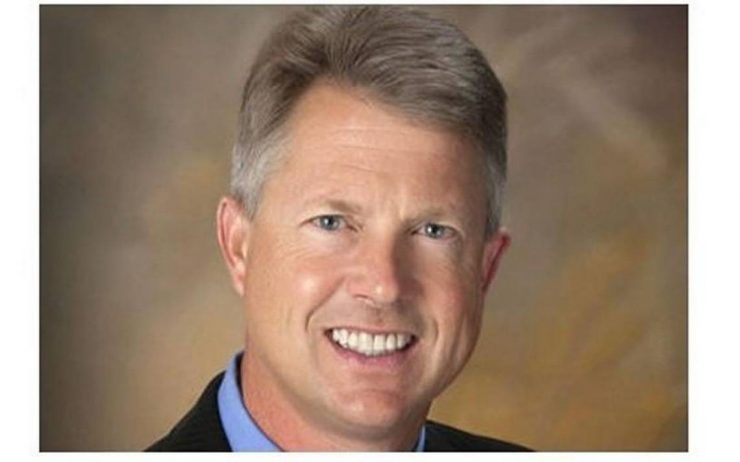
Dr. Roger Marshall, R-Great Bend, is the First District Kansas Congressman.Friends,
Thursday I voted against the bipartisan proposal, and I want to be clear as to why. This ‘compromise’ failed. We started these negotiations asking for 230 miles of border wall – the end result only left us with 55 miles. Any Kansan can tell you that’s not a deal worth taking.
There is no one, Democrat or Republican, that could say the President didn’t try to negotiate this deal in good faith. The bottom line is, Democrats never shared the same goals as the American people or President Trump- that goal being, secure our southern border. They solely wanted to deny this crisis and ignore all of the evidence that DHS has consistently provided.
It is shameful that these negotiations failed, so I understand and respect the president’s declaration.
Last week, I wrote an op-ed for Fox News that outlined the incredible risks of the barbaric New York abortion law. The late-term abortion process that New York recently passed is inhumane, for both the child and the mother. The further along in a pregnancy, the more risk from complications come with an abortion procedure.
On Wednesday morning, I joined Fox & Friends to discuss my experience as a physician at length and to continue to spread the truth about these dangerous procedures. On Wednesday night, I spoke out about the incredible risks of abortion on the floor of the House of Representatives and called upon my colleagues on both sides of the aisle to realize the danger it poses to mothers.
NY Abortion Law is Inhumane and Dangerous
I am outraged by the new legislation in New York that legalizes abortion up to the due date. I never thought I would see this day come, but I will do everything I can to prevent and combat anti-life legislation such as this.
New York’s latest embrace of late-term abortion is disgusting. It is, not only legalizing the murder of these precious babies just moments before their birth, but it also puts these mothers in extreme danger. The further along in a pregnancy a woman is, the more at risk she is of being harmed or even killed as a result of complications. Often, a woman in the late stages of pregnancy are at higher risk of life-threatening hemorrhaging and other extreme health risks.
As an OB-GYN, I’ve delivered thousands of babies and helped mothers through their pregnancies for 25 years, New York’s law demonstrates a complete disregard for life and medical standards that should be strongly condemned by all physician organizations and all Americans. As long as I have the privilege to serve in Congress, I will keep fighting for life and against abortions.
I discussed this topic further on Wednesday morning when I joined Ainsley Earhardt on Fox & Friends and exposed the harsh reality of the risks to mothers that late-term abortions pose.
Securing Our Southern Border
I voted against the border security proposal that made a mockery of the crisis on our southern border. I’m not sure how this negotiating process went from bad to worse. The President was very clear about needing 5.7 billion to build 230 miles of the wall across the southern border. I cannot support a deal that only funds 55 miles of the wall.
Throughout this entire process we have seen those on the far-left use these negotiations as a messaging platform to attack the president, rather than focus on the crisis at our southern border. I’m fed up with it, and the more than 70 percent of Kansans in my district who want the wall built are sick and tired of the political games and dysfunction in Washington.
Kansas Medical Society
Kansas Medical Society
The Kansas Medical Society visited my office on Tuesday where we discussed health care issues affecting citizens statewide. One of the main topics of the meeting was the opioid crisis and how it is affecting our communities.
The misuse of opioids has garnered increased attention in Kansas and across the nation in recent years. Last Congress, I voted for the Consolidated Appropriations Act of 2018 and the Bipartisan Budget Act of 2018, both of which appropriated around $10 billion to address the opioid epidemic – the largest investment to date. These bills also provide for public prevention programs and law enforcement activities related to substance abuse.
I am committed to finding a solution that maintains the ability of physicians to make clinical decisions in the best interests of patients while adequately addressing the crisis of opioid abuse.
Border health care
Discussing Health Care at the Border with the Department of Homeland Security
I joined my colleagues in the House Doctors Caucus on Tuesday for a briefing by Department of Homeland Security officials about their efforts to deliver quality healthcare at the Southern border. We discussed the current challenges and how further developments like a border wall would help them perform their jobs better and more efficiently. I am proud to be a member of such a dedicated group of medical professionals, and I look forward to working with them to provide the men and women at the DHS with the resources they need to do their jobs.
Hearing on Climate Research
On Monday, I joined my colleagues on the Science, Space, & Technology Committee to hear from leading climate scientists about the state of the climate and current climate research.
Climate research hearing
One thing is clear; industrial activity is contributing to the changing climate. To combat this, we must incentivize American businesses and entrepreneurs to develop a strong energy sector that includes all production methods and sources. If we are to remain a global leader, we must have a broad portfolio of affordable energy technologies to create cleaner energy.
I believe that the best and only way for us to achieve this goal is to put forward realistic and market-based solutions to develop cleaner energy while maintaining our market dominance when it comes to energy. What we need is to set the ingenuity of the American economy loose to find solutions, not dictate economy-crushing mandates from Washington.
Hutchinson Community College
Last week leaders from the Hutchinson Community College visited Washington, DC. We discussed my support for Pell Grants, which help students in need attend college, the Federal Work Study program, and the importance of job training.
With over 70 academic programs, Hutchinson Community College is a leader in equipping Kansans with the knowledge and skills they need for a successful career. They also offer some of the most affordable education in the state, allowing for a healthy work/school balance. It is critical that Congress continue to support community colleges like Hutchinson and I am proud to represent such a fine institution.
We Must Stand with Israel
On the House floor, I spoke out against antisemitism. There is no place for such hatred in America, especially not in the halls of Congress. We must hold our elected officials accountable and speak out forcefully when they advocate against the values of this nation.
It is clear to all of us; there are a couple of new colleagues across the aisle need be reminded, in fact, they need to admit, that the brutal regime of Iran is the chief obstacle to peace and security in the Middle East. We must continue to stand with Israel.
Endometriosis Awareness Month
Last week, I joined a group of bipartisan members to introduce H.R. 118. This legislation would designate March 2019 as Endometriosis Awareness Month.
Endometriosis is a disease of the uterus that can lead to complete infertility and, sadly, 1 in every ten women of reproductive age in the United States is impacted by it. Throughout my career as a physician, I’ve treated hundreds of endometriosis patients, and while we have advanced our treatment procedures through surgery, medication, and nutrition, we are still working hard to understand this disease in its entirety.
Establishing Endometriosis Awareness Month is an important step towards highlighting the experiences of women fighting this chronic disorder every day, that remains incurable to this day. I hope that one day, through awareness efforts like this legislation, we find a cure.
Laina and Roger Marshall
Valentine’s Day
To me, Valentine’s Day will always be the day that I celebrate my wife and I’s engagement. I took Laina to our church, got down on one knee and asked her to spend the rest of her life with me. I can’t believe that was 36 years ago, I remember it like it was yesterday.
There was no one else in the church, it was just us, and I wouldn’t have done it any other way.
Thanks for being my rock, my wife, a wonderful mother, and a super grandmother! Happy Valentine’s Day, Laina.
This was the last week for non-exempt committees to have bill introductions and there were many bills introduced.
One of the bills introduced was SB 50 and I have had many emails regarding this bill. SB50 amends the fee limitations for certain wildlife parks and tourism licenses. This bill will allow the Secretary of Wildlife and Parks to raise the amount of fees for hunting, fishing and other permits. Some of the proposed fees will double what they are today. At this time I do not believe this bill will get any traction and I am not in favor of raising fees at this time.
This week the House voted on Governor Kelly’s budget reamortization of KPERS. The Governor’s budget was built around the reamortization of KPERS. Her proposal would add an additional $7.4 billion to the unfunded liability of KPERS. The House voted down her proposal 36-87.
Last month, the State of New York passed Reproductive Health Act which expands legal abortion from 24 weeks to full-term; removes abortion in its entirety from the state penal code; allows non-physicians to commit abortions such as nurses, physician assistants, or midwives; jeopardizes a health professional’s right to not participate in abortion. Senate Concurrent Resolution 1606 condemns the enactment of New York’s RHA because it violates the health and well being of a woman and her unborn child.
Secretary of State Scott Schwab testified in front of the Senate Ethics, Elections and Local Government Committee in support of a constitutional amendment that would end the revision of population figures to reflect where military members and college students reside for the purpose of redistricting.
Schwab told the committee that it would cost Kansas approximately $834,000 to adjust the 2020 U.S. Census figures to prepare for redrawing political boundaries for House and Senate districts. The district maps are based on population. The adjustment of census figures was originally done to allow rural areas, for redistricting, to retain people who had moved elsewhere to serve in the military or attend college. While the original purpose was to help rural areas, the revisions favored urban centers after the 2010 census. Schwab commented: “Kansas is the only state in the nation that continues to adjust census numbers. I think this provision of the constitution is a waste.”
I would like to invite everyone to mark their calendars for the upcoming Town Hall Meetings. At this time the locations have not been determined, so please watch your local newspaper for more information. I will also include times and locations in my next newsletter.
Friday-March 1, 2019
8:00-9:00 a.m. Ellis County
9:45-10:45 a.m. Rooks County
11:15-12:15 Phillips County
1:30 – 2:30 p.m. Norton County
3:15 – 4:15 p.m. Graham County
Saturday-March 2, 2019
8:00-9:00 a.m. (MT) Wallace County
9:30 -10:30 a.m. (MT) Sherman County
12:30-1:30 p.m. Cheyenne County
2:00-3:00 p.m. Rawlins County
3:30-4:30 p.m. Decatur County
Tuesday-March 5, 2019
8:00-9:00 a.m. Thomas County
9:30-10:30 a.m. Logan County
11:00-12:00 Sheridan County
1:00-2:00 p.m. Gove County
2:30-3:30 p.m. Trego County
I would like to thank all of the visitors who stopped by my office this week or held receptions in Topeka.
I am honored and grateful to represent the 40th Senate District in Kansas. Please do not hesitate to contact or call me with your questions and concerns, my office number is 785 296-7399 or my cell is 785 899-4700. If you are in Topeka stop by my office at 236-E.
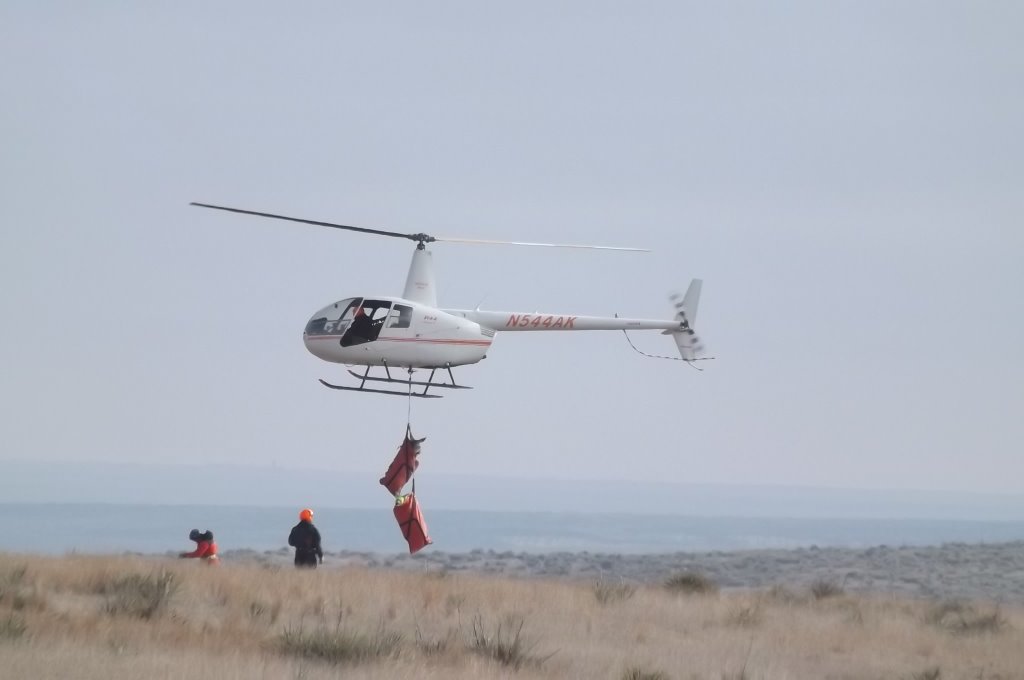
The staccato chopping sounds of helicopter blades echoed across the gorges, drawing everyone’s eyes skyward as the little chopper appeared as a dot on the horizon.
Anticipation ran high among the K State “deer crew” as the early morning light revealed the day’s first two Scott Co. Kansas deer suspended safely below the craft. Even though it was blasted cold and we were all bundled up like snowmen, the moment the deer were laid gently on the ground, the crew rushed forward with all the enthusiasm of the doctors and nurses on MASH as they ran up the hill to retrieve their patients from the choppers.
The three year western KS deer research project I wrote about last winter has just entered its second year and the task at hand last weekend was capturing and tagging additional deer for the study. As their headquarters for the day, Kansas State Professor of Wildlife and Outdoor Enterprise Management Drew Rickets and his student crew had chosen this high open knoll in a rolling desolate pasture northeast of Scott City surrounded by deep, winding, brushy draws.
A sizeable tent was erected to hold examination tables and equipment. This year the goal was to capture, tag and collar an additional 30 does near Scott City and an additional 30 farther north near Lenora, KS. Only enough bucks will be collared at each site to replace bucks lost last year through harvesting, motor vehicle accidents or natural causes. The deer selected for capture will be divided evenly between whitetails and mule deer.
Three guys make up the helicopter crew, the pilot, a “gunner” and a “mugger.” The pilot cruises the draws and hillsides and when a deer is sighted, he puts the chopper over the deer so the gunner can shoot a large net that encompasses the animal and puts it safely on the ground. The helicopter lands and drops off the mugger to prepare the deer for transport while the pilot and gunner take to the air again in search of another. The deer is given a mild sedative and all four legs are tied together with a leather belt, then it gets a blindfold and is rolled out of the net into a heavy canvass transport bag. After the gunner nets a second deer, he is dropped off to prepare that one while the chopper picks up the mugger and the first deer. Finally, the gunner and second deer are picked up and both deer are flown back to the tent. Captured bucks are given a GPS tracking collar by the helicopter crew and released where they are captured.
Does taken to the tent site are rolled onto wooden stretchers, weighed and laid on a table in the tent. Again, with all the eagerness of Trapper, BJ and Hotlips on MASH, the crew sets to work. While a couple students gently hold the deer on its side, a veterinarian gives her a sonogram to determine if she’s pregnant, she’s given an ear tag and a GPS collar, various measurements of her body are recorded, and if she’s pregnant a vaginal transmitter is implanted that will begin transmitting when she enters labor so the fawn can be found, collared and tracked also. Finally, a paint mark is put on her back so she’s not recaptured by the chopper crew, and she’s released outside.
The study began as a means to help KS Dept of Wildlife, Parks and Tourism biologists understand why mule deer are steadily regressing westward and being replaced by whitetails. Joyce and I spent a couple days at Scott City last May helping the group track and find fawns, and I was honored to be allowed to participate in this part of the project as well, as the exuberance and attention to detail by these college students running the study is infectious to say the least. The only thing lacking from my experience was a chance to ride in the chopper as the pilot threaded his way through the brushy canyons like Luke Skywalker in Star Wars!…Continue to Explore Kansas Outdoors.
Steve Gilliland, Inman, can be contacted by email at [email protected].